Cost Accounting: A Managerial Emphasis, 6e
Chapter 15 – Cost Allocation: Joint Products and Byproducts
15.4 Identify the strategic implications of a decision to implement one joint cost
allocation method.
1) Different joint cost allocation methods will result in different product margin percentages for the
individual products.
2) If managers make processing or selling decisions using incremental revenue / incremental cost
approach, which of the following statements is true?
A) The resulting budgeted product-line income statement under the sales value at split off method, will
show each product to have a positive operating income.
B) The resulting budgeted product-line income statement under the physical measure method, will show
each product to have a positive operating income.
C) The resulting budgeted product-line income statement under the constant gross margin NRV method,
will show each product to have a positive (or zero) operating income.
D) Estimated net-realizable method the resulting budgeted product-line income statement under the
estimated NRV method, will show each product to have a zero operating income.
E) The resulting budgeted product-line income statement under the sales value at split off method, will
show each product to have a negative operating income.
3) The selection of a joint cost allocation method assists managers in which of the following decisions?
A) pricing
B) total cost minimization
C) joint costs minimization
D) adding or dropping a product line
E) sell or process further
1) Byproducts are recognized in the general ledger either at the time of production or at the time of sale.
Cost Accounting: A Managerial Emphasis, 6e
Chapter 15 – Cost Allocation: Joint Products and Byproducts
2) Processes that yield joint products always yield byproducts as well.
3) Byproduct revenues appear in the income statement as a cost increase to the main product and as a
separate item of expense.
4) Recognition of byproducts in the financial statements at the time of sale usually occurs when the dollar
amounts of the byproducts are immaterial.
5) A sound reason for reporting revenue from byproducts as an income statement item at the time of sale
is to lessen the chance of managers managing reported earnings.
6) A byproduct is one or more products of a joint production process that have low total sales value
compared to the total sales value of the main product or joint products.
7) The production method of accounting for byproducts recognizes byproducts in the financial statements
at the time when production is completed.
Cost Accounting: A Managerial Emphasis, 6e
Chapter 15 – Cost Allocation: Joint Products and Byproducts
Use the information below to answer the following question(s).
Troy Company processes 15,000 litres of direct materials to produce two products, Product X and Product
Y. Product X, a byproduct, sells for $4 per litre, and Product Y, the main product, sells for $50 per litre.
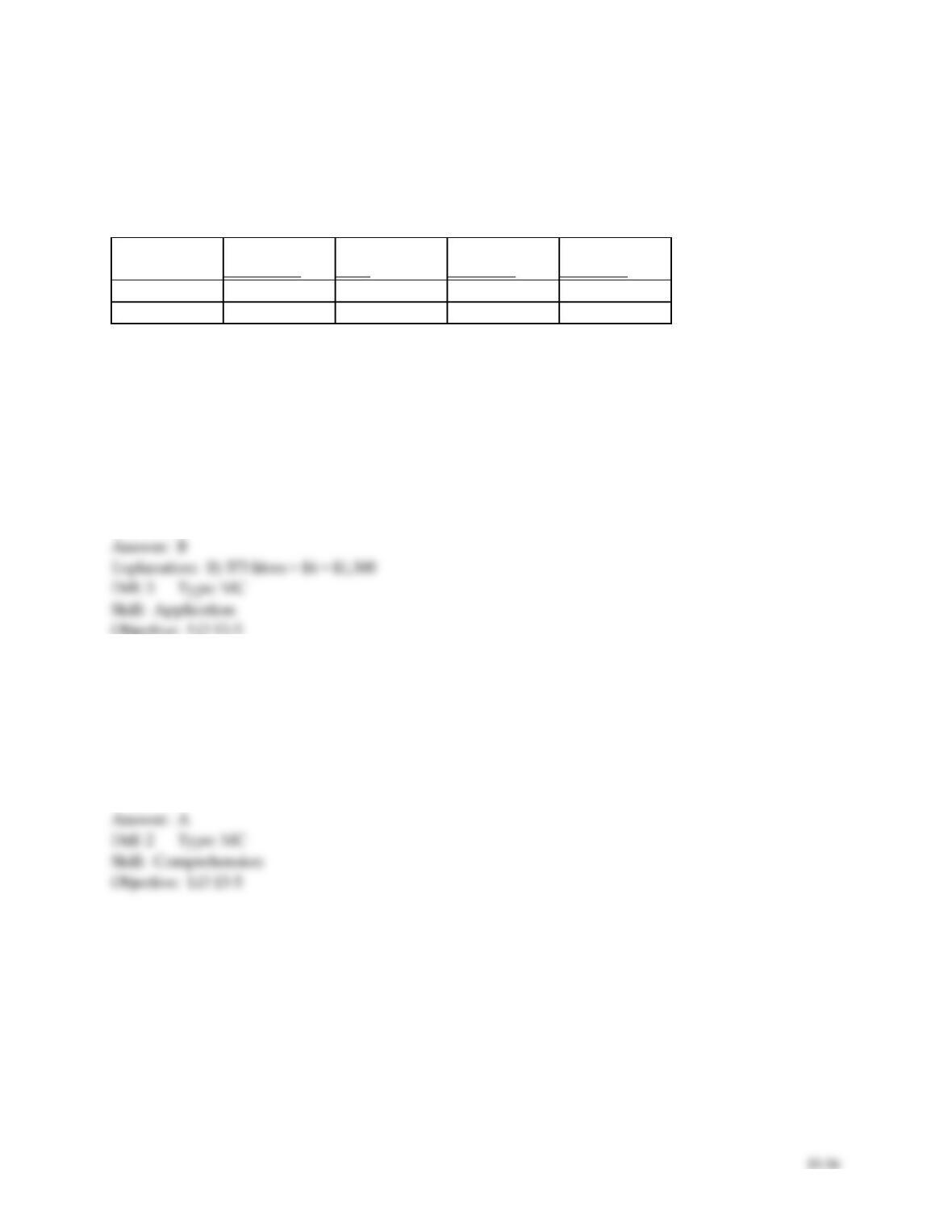
The following information is for August:
Production
Sales
Beginning
Inventory
Ending
Inventory
Product X:
4,375
4,000
0
375
Product Y:
10,000
9,625
125
500
The manufacturing costs totalled $15,000.
8) How much is the ending inventory reduction for the byproduct if byproducts are recognized in the
general ledger at NRV during production?
A) $0
B) $1,500
C) $14,375
D) $16,000
E) $17,500
9) How much is the ending inventory reduction for the byproduct if byproducts are recognized in the
general ledger at the point of sale?
A) $0
B) $563
C) $1,500
D) $16,000
E) $17,500
Cost Accounting: A Managerial Emphasis, 6e
Chapter 15 – Cost Allocation: Joint Products and Byproducts
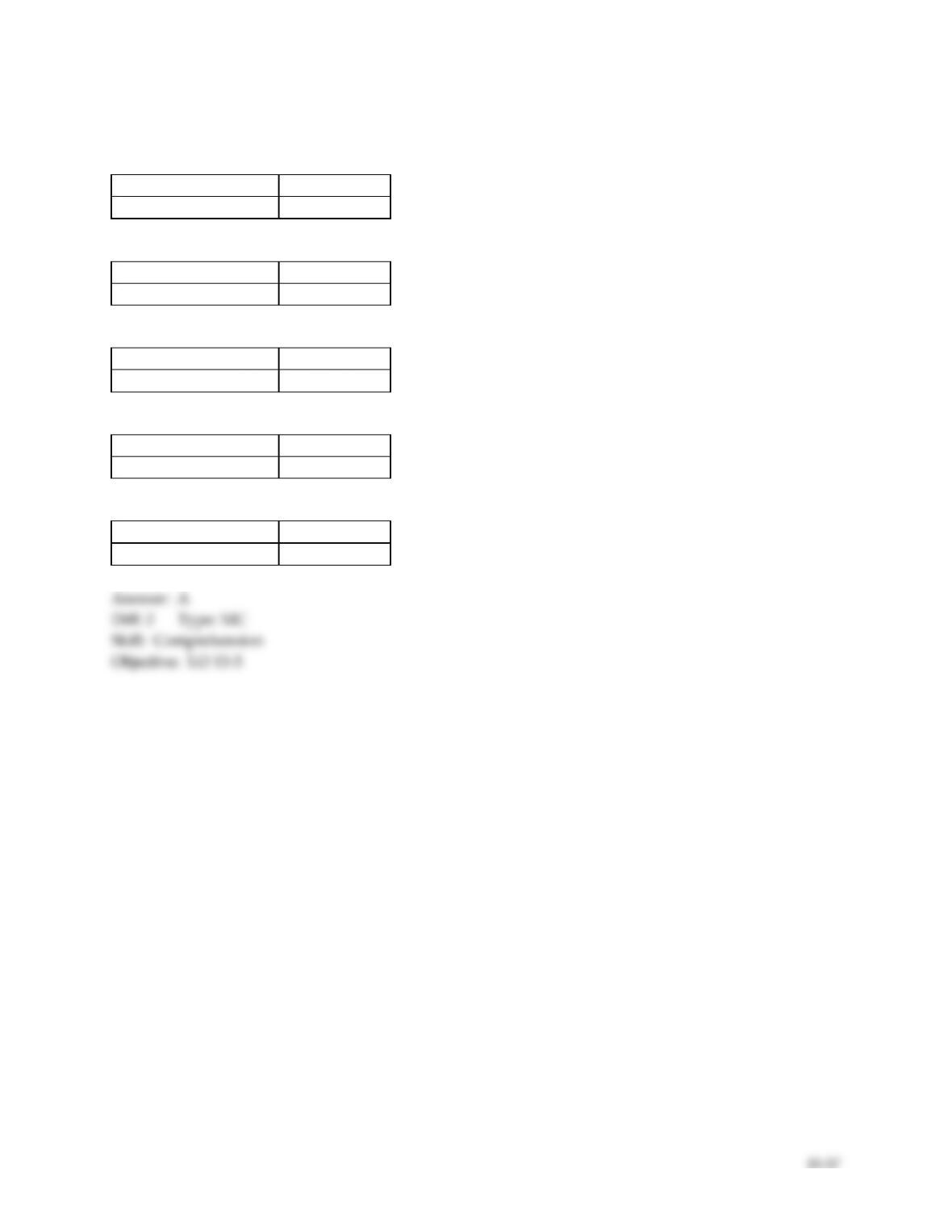
10) Which of the following entries is the initial entry to recognize a byproduct in the General ledger,
based on the accounting method of recognizing byproducts at the time of production?
A)
byproduct inventory
500
work in process
500
B)
work in process
500
byproduct inventory
500
C)
byproduct inventory
500
cost of goods sold
500
D)
cost of goods sold
500
byproduct inventory
500
E)
byproduct inventory
500
revenue
500
Cost Accounting: A Managerial Emphasis, 6e
Chapter 15 – Cost Allocation: Joint Products and Byproducts
Use the information below to answer the following question(s).
Troy Company processes 15,000 litres of direct materials to produce two products, Product X and Product
Y. Product X, a byproduct, sells for $4 per litre, and Product Y, the main product, sells for $50 per litre.
The following information is for August:
Production
Sales
Beginning
Inventory
Ending
Inventory
Product X:
4,375
4,000
0
375
Product Y:
10,000
9,625
125
500
The manufacturing costs totalled $15,000.
11) What is the net effect to the income statement for the sale of byproduct, if byproducts are recognized
at the point of sale?
A) $0
B) $1,500
C) $16,000
D) $17,500
E) $20,000
12) Which statement is NOT true regarding the sales method of accounting for byproducts.
A) The method makes no journal entries until the byproduct is sold.
B) This method is the preferred method because of the matching principle.
C) Revenues of the byproduct can be recorded in the income statement as revenue.
D) Revenues of the byproduct can be recorded as a reduction of cost of goods sold in the income
statement.
E) No value is attached to the byproduct inventory.
Cost Accounting: A Managerial Emphasis, 6e
Chapter 15 – Cost Allocation: Joint Products and Byproducts
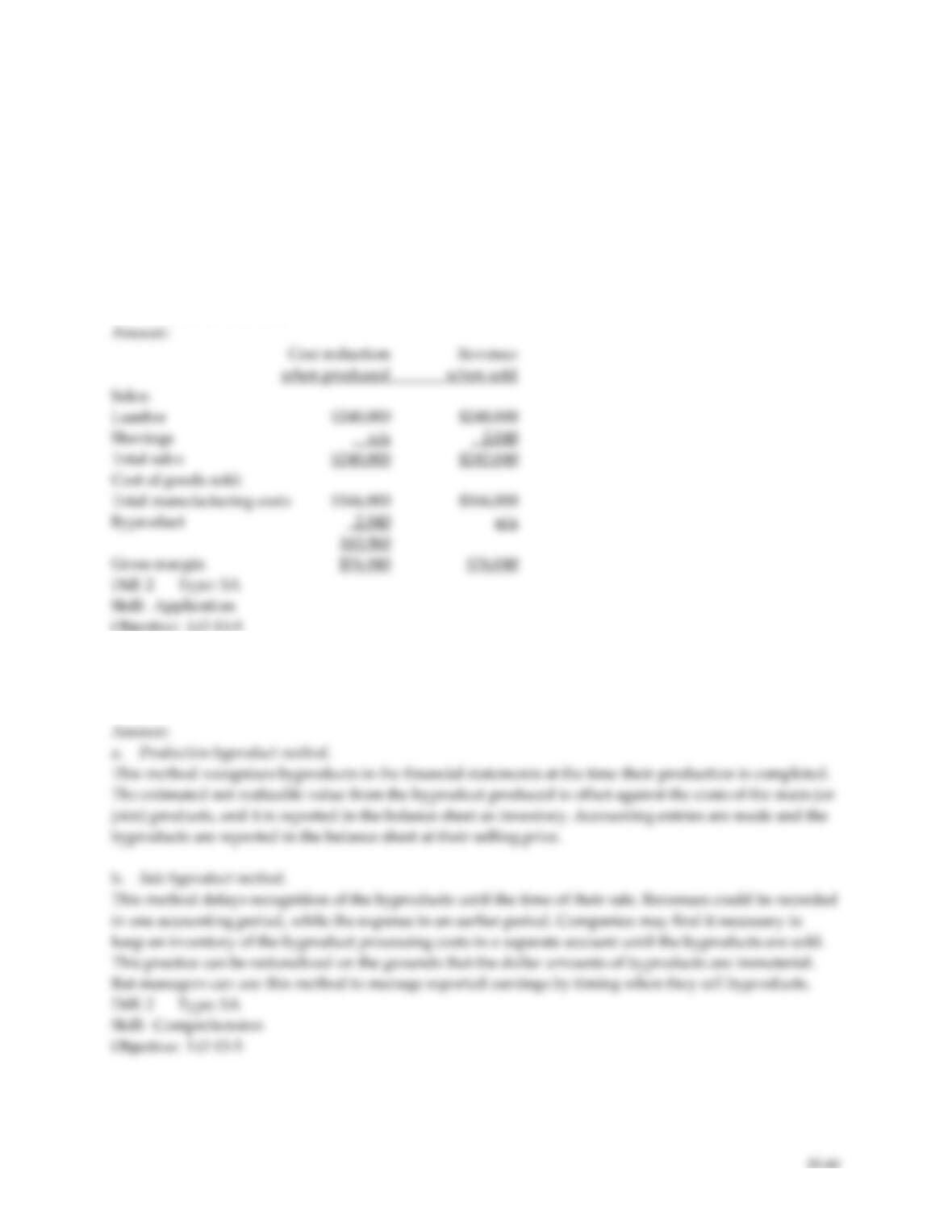
13) BC Lumber Company prepares lumber for companies who manufacture furniture. The main product
is finished lumber with a byproduct of wood shavings. The byproduct is sold to plywood manufacturers.
For July, the manufacturing process incurred $332,000 in total costs. Eighty thousand board feet of
lumber were produced and sold along with 6,800 pounds of shavings. The finished lumber sold for $6.00
per board foot and the shavings sold for $0.60 a pound. There were no beginning or ending inventories.
Required:
Prepare an income statement showing the byproduct (1) as a cost reduction during production, and (2) as
a revenue item when sold.
Cost Accounting: A Managerial Emphasis, 6e
Chapter 15 – Cost Allocation: Joint Products and Byproducts
14) Lumber Company prepares lumber for companies who manufacture furniture. The main product is
finished lumber with a byproduct of wood shavings. The byproduct is sold to plywood manufacturers.
For July the manufacturing process incurred $166,000 in total costs. Eighty thousand board metres of
lumber were produced and sold along with 6,800 kilograms of shavings. The finished lumber sold for
$3.00 per boardmetre and the shavings sold for $0.30 a kilogram. There were no beginning or ending
inventories.
Required:
Prepare an income statement showing the byproduct (1) as a cost reduction during production and (2) as
a revenue item when sold.
15) Distinguish between the two principal methods of accounting for byproducts, the production
byproduct method and the sale byproduct method. Briefly discuss the relative merits (or lack thereof) of
each.
Cost Accounting: A Managerial Emphasis, 6e
Chapter 15 – Cost Allocation: Joint Products and Byproducts
16) Trundle Ltd. produces 2 main products, J and K, and a by-product, L. There were no beginning
inventories. During April, it incurred $275,000 of joint costs, which are allocated to main products using
the physical output method. Additional information follows:
Units Units Unit Sales
Product Produced Sold Price
J 12,000 9,600 $22
K 18,000 15,300 38
L 6,000 5,200 3
Required:
Assuming Trundle recognizes byproduct revenue at the time of sale, what is the total value of ending
inventory?
Cost Accounting: A Managerial Emphasis, 6e
Chapter 15 – Cost Allocation: Joint Products and Byproducts
17) Trundle Ltd. produces 2 main products, J and K, and a by–product, L. There were no beginning
inventories. During April, it incurred $275,000 of joint costs, which are allocated to main products using
the physical output method. Additional information follows:
Units Units Unit Sales
Product Produced Sold Price
J 12,000 9,600 $22
K 18,000 15,300 38
L 6,000 5,200 3
Required:
Assuming Trundle recognizes byproduct revenue at the time of production, what is the total value of
ending inventory?
Cost Accounting: A Managerial Emphasis, 6e
Chapter 15 – Cost Allocation: Joint Products and Byproducts
18) Framingham Ltd. produces three products out of a common process. The company currently uses the
physical measures method to allocate joint costs to the three product lines: Leonid (L), Madagascar, (M)
and Napoleon (N). The manager of the Napoleon product line is particularly disgruntled. He believes
that his product line is allocated a disproportionate share of joint costs. In a recent managers’ meeting, he
argued that the company should consider using sales value as split off as the joint cost allocation method.
He stated that his product is sold in a highly competitive market and increasing price is not an option.
The manager of the Leonid product line disagreed strongly. He stated that all products are sold in a
competitive market place and that allocating joint costs on physical measures was simple and easily
verifiable. The manager of the Madagascar product line sat quietly through the meeting and she did not
seem to favour one method over the other.
As the assistant controller, you were asked by the controller to look into the concerns of the product line
managers. The following additional information is available:
Product Line Physical Volume Unit Selling Price
Leonid 10,000 units $79.20
Madagascar 12,000 units $36.00
Napoleon 18,000 units $20.00
Joint costs for the company are $950,000.
Required:
As the assistant controller, prepare a report to the controller.
Cost Accounting: A Managerial Emphasis, 6e
Chapter 15 – Cost Allocation: Joint Products and Byproducts
19) Land and Sea Corporation processes frozen chicken. The company has not been pleased with its profit
margin per product because it appears that the high value items have too few costs assigned to them
while the low value items have too many costs assigned to them. The processing results in several
products, the primary one of which is frozen small hens. Other products include frozen parts such as
wings and legs, byproducts such as skin and bones, and unused scrap items.
Required:
What may be the cost assignment problem if a key consideration is the value of the products being sold?
Cost Accounting: A Managerial Emphasis, 6e
Chapter 15 – Cost Allocation: Joint Products and Byproducts
20) Explain the difference between a joint product and a byproduct. Can a byproduct ever become a joint
product?