ch15.doc Page 1
Chapter 15
Managing for Results
TRUE/FALSE (CHAPTER 15)
1. Zero-base budgeting requires the periodic review of all programs, not just new ones.
2. It is difficult for accountants to have a role beyond auditing the financial statements of
governments and not-for-profits.
3. “Outputs” is a term used to indicate the quantity or units of service provided by an activity.
4. One of the principal disadvantages of zero-base budgeting is that it requires budgetary units
to provide information that may never be used in the decision process.
5. Many of the benefits of program budgeting may be ascribed to the organizational self–
examination that it requires at the outset.
6. Most accounting organizations support the notion that performance measures should be
included in general-purpose annual financial reports.
7. The Government Performance and Results Act of 1993 requires federal agencies to focus on
explicit near-term objectives and performance measures.
8. The GASB’s SEA reporting proposals focus on measures of efforts, measures of
accomplishments, and measures that relate efforts to accomplishments.
9. Rather than cash inflows, the potential benefits of many capital assets can be expressed as
cash savings to governments and not-for-profits.
10. It is widely accepted that capital assets should be financed with resources on hand to achieve
interperiod equity.
11. Program outcomes frequently are more difficult to measure than inputs and outputs.
12. An important part of capital budgeting is to compare alternative means of achieving the same
objective.
13. Benefit-cost analysis has fallen from favor among management experts because it usurps the
role of informed judgment.
14. A disadvantage of evaluating capital expenditures separately from operating expenditures is
that it is easy to overlook operating costs associated with newly acquired assets.
15. An organization’s mission and goals derive from its operational objectives.
ch15.doc Page 2
MULTIPLE CHOICE (CHAPTER 15)
1. In which of the following steps of the management cycle of governments and not-for-profit
entities are accountants least involved?
a) Performing cost benefit analysis on proposed programs.
b) Selecting among alternative programs.
c) Preparing financial reports.
d) Evaluating efficiency and effectiveness of programs.
2. Accountants are actively involved in collecting and analyzing data to be used by public
policy makers. Which of the following other groups might also be involved in the data
collection and analysis process?
a) Statisticians.
b) Economists.
c) Program managers.
d) All of the above.
3. Which of the following groups is least likely to be involved in evaluating the efficiency and
effectiveness of government programs?
a) Accountants.
b) Legislators.
c) Economists.
d) Statisticians.
4. Which of the following is a true statement regarding the implementation phase of a
government program?
a) Internal accountants are not involved; only program managers are involved.
b) Internal accountants are actively involved, preparing budgets, controlling costs, and
preparing operating reports.
c) Internal accountants have only a minor role, preparing reports for external parties.
d) Internal accountants have final say in program choices.
5. Which of the following is NOT the role of policy makers in solving social problems?
a) Selecting among options
b) Developing alternatives.
c) Appropriating resources required to implement programs
d) Establishing expected goals.
6. All governments and not-for-profit entities should establish goals and objectives. Which of
the following is a desirable characteristic of an operational objective?
a) An operational objective should be open to interpretation.
b) An operational objective should be measurable.
c) An operational objective should be a statement of aspirations.
d) An operational objective should be accomplishable by an unspecified future date.
ch15.doc Page 3
7. An accounting program has determined that preparing students for careers in public
accounting is the program’s goal. Which of the following measurements is the best outcomes
measurement for this accounting program?
a) Number of accounting majors that graduate.
b) Number of students that pass the CPA examination.
c) Number of students in management positions in public accounting firms ten years after
graduation.
d) Number of students employed in public accounting within one year of graduation.
8. Which of the following groups are involved in auditing a program?
a) Accountants.
b) Statisticians.
c) Economists.
d) All of the above.
Use the following information to answer Questions 9 and 10.
A piece of federal legislation has as one of its objectives “improving the health of older
Americans.” Title 20 of that legislation provides for granting federal funds to governments and
not-for-profit entities to provide nutritious hot meals to older Americans in congregate settings.
Senior Citizens Center, a not-for-profit entity, receives funding under this legislation. The center
determines the following for a one-month period:
Number of meals served 500
Total number of individuals participating in the program 25
Total meals costs incurred $860
Average cost per meal $1.72
9. The numerical value that best represents outputs of this program is
a) 500
b) $1.72
c) $860
d) None of the above.
10. The numerical value that best represents outcomes is
a) 500
b) $1.72
c) $860
d) None of the above.
11. College professors are evaluated on teaching, research, and service. Which of the following
would be a surrogate for the desired operational objective of “Engage in research that
expands the horizons of knowledge“?
a) Value of research grants received.
b) Number of publications in peer-reviewed journals.
c) Both of the above.
d) Neither of the above.
ch15.doc Page 4
12. At many colleges and universities, students are asked to evaluate the quality of instruction
received and course content for all undergraduate courses. The evaluations are used for
which of the following?
a) As an outcome measure.
b) As an output measure.
c) As a surrogate for an outcome measure.
d) As a surrogate for an output measure.
13. Because of the difficulty of measuring quality teaching, many colleges and universities rely
heavily on student evaluations of the quality of instruction and accomplishment of course
objectives. Which of the following is (are) a true statement(s)?
a) This is a good practice, which may improve the quality of instruction.
b) This is a good idea but may have unintended negative consequences by causing faculty to
decrease the rigor of a course.
c) Both are true.
d) Neither is true.
14. Aid for Friends, a not-for-profit entity, provides temporary shelter for the homeless, provides
temporary housing and other assistance for victims of spousal abuse, serves meals to the
needy in a congregate setting, operates a second-hand clothing store, and operates a food
bank to provide food for those temporarily in need. Which of the following is the best
statement of operating objectives for Aid for Friends?
a) Our objective is to provide food and shelter for the needy.
b) Our objective is to provide assistance to those in need.
c) Our objective is to provide temporary assistance to those in need.
d) Our objective is to help the needy achieve financial independence.
15. Which of the following is NOT an example of a performance budget?
a) Program budget.
b) Object classification budget.
c) Zero-base budget.
d) Priority-based budget.
16. Which of the following is true about zero-based budgeting?
a) It is a variant of program budgeting.
b) It requires activities of the entity to be evaluated over a five-year period.
c) It currently is used by most state and local governments.
d) It is incremental in approach.
ch15.doc Page 5
17. Help, Inc., a not-for-profit entity dedicated to providing assistance to the needy, has
submitted to its governing body a budget that includes the following budgeted expenditures.
Nutrition $250,000
Family housing assistance $300,000
Shelter House $200,000
Legal aid $100,000
Medical assistance $150,000
Which of the following best describes the budgeting practices of this entity?
a) The entity uses program budgeting techniques.
b) The entity uses object classification budgeting techniques.
c) The entity uses zero-base budgeting techniques.
d) The entity uses priority-based budgeting techniques.
18. Which of the following is true about budgets prepared by entities that use program budgeting
techniques?
a) The budget package will include information about the object classification expenditures
necessary to accomplish a specific goal or objective.
b) The budget package will generally include information about the costs of providing a
variety of levels of service of the same program.
c) The budget package will generally include information about the importance of the
activity in accomplishing the entity’s objectives, alternatives methods of accomplishing
the objective, and the consequences of not performing the activity.
d) All of the above can be true.
19. Which of the following is an advantage of program budgeting over traditional budgeting
techniques?
a) It promotes continuation of existing programs.
b) It relates expenditures to objectives.
c) It encourages consideration of alternative means of accomplishing the objective.
d) Both b) and c).
20. Program budgeting, although highly popular and successful, has many disadvantages or
drawbacks. Which of the following is an advantage or benefit of program budgeting?
a) It may provide too much information.
b) It may be applied perfunctorily after its initial implementation.
c) It may not live up to its expectations.
d) It may discourage funding at levels other than those that will result in actual increases in
results.
21. Which of the following is a reason for governments and not-for-profit entities to incorporate
service efforts and accomplishments (SEA) measures into their management process?
a) Measuring and reporting upon SEA helps management determine short-term cash flow
requirements.
b) SEA measures allow management to make objective assessments about whether the goals
of the government are worth achieving.
c) SEA reporting fosters sound budgeting and administration.
d) SEA fosters budgetary compliance and custodianship of resources.
ch15.doc Page 6
22. Which of the following is NOT one of the three categories of SEA measures identified by the
GASB?
a) Measures of efforts.
b) Measures of financial stewardship.
c) Measures of accomplishment.
d) Measures that relate efforts to accomplishments.
23. Which of the following is an example of a cost-outcome measure?
a) Cost per passenger-mile on public transit.
b) Cost per hot meal served.
c) Cost per legal case handled.
d) Cost per client placed in gainful employment.
24. Which of the following is an example of an efficiency measure?
a) Cost per client placed in an appropriate job.
b) Cost per ton of garbage collected.
c) Cost per gallon of water suitable for drinking.
d) Cost per child reading at grade level.
25. With regard to audits of SEA, which of the following might be appropriate for an auditor to
do?
a) Assess the appropriateness of the organization’s basic objectives.
b) Verify that the government selected the correct indicators to gauge whether its objectives
were achieved.
c) Evaluate whether SEA data is fairly presented.
d) Evaluate the usefulness of SEA data.
Use the following information to answer Questions 26 through 29.
The City Swimming Pool is considering several options for maintaining the grounds around the
pool area over the next ten years. One option is to buy a tractor with equipment for cleaning the
underbrush and cutting the grass. A second option is to contract out with a local garden and
nursery center that provides this kind of service. A third option is to hire many local youths to do
most of the work by hand. The city already has several small lawnmowers and grass-cutting
equipment.
Option #1
Cost of tractor and equipment (useful life 10 years) $220,000
Salvage value of tractor in 10 years 20,000
Yearly cost of operator 6,000
Yearly maintenance and upkeep, supplies, etc. 3,000
Option #2
Yearly fees $ 36,000
Option #3
Yearly cost of part-time labor $ 32,000
Yearly cost of supplies, equipment repair, etc. 1,000
Present value factors @ 6%
$1 due in ten years .55839
Annuity of $1 for 10 years 7.36009
ch15.doc Page 7
26. What is the present value of Option #1?
a) $220,000.
b) $275,072.
c) $297,408.
d) $433,442.
27. What is the present value of Option #2?
a) $ 20,102.
b) $ 36,000.
c) $264,964.
d) $285,066.
28. What is the present value of Option #3?
a) $ 18,426.
b) $235,522.
c) $236,080.
d) $242,882.
29. Which option should the city select based solely on cost?
a) Option #1
b) Option #2
c) Option #3
d) Unable to determine.
30. Due to limited resources, Johnson City must select from among the following capital projects.
Which project should the city select?
a) Court-ordered improvements to the City Jail.
b) Repairing the roof on City Hall.
c) Replacing an inefficient data processing system with a more efficient system.
d) Adding two new police cars to the fleet.
31. Which of the following best describes the role of benefit-cost analysis in the capital
budgeting process by governments and not-for-profit entities?
a) It may be used to enhance the objectivity of decision-making.
b) Because all costs and all benefits can be quantified, it removes subjectivity from the
decision process.
c) It eliminates the role of value judgments in the decision-making process.
d) It ensures that decisions about capital asset acquisition will be consistent with
organizational goals and objectives.
32. The GASB indicates that the information in an SEA report should have relevance. If it does,
then users can be sure that
a) The information is free from bias.
b) The information is consistent with information reported in financial statements.
c) The information helps users assess the organization’s objectives.
d) Even the quantitative information is understandable.
33. Zero-base budgeting is a form of
a) Incremental budgeting introduced in the 1960s.
b) Program budgeting introduced in the 1970s.
c) Performance budgeting introduced in the 1980s.
ch15.doc Page 8
d) Traditional budgeting revamped for the new millennium.
34. A benefit-cost ratio for a not-for-profit organization’s program is
a) A comparison between cash received and cash paid in a given program year.
b) Total projected annual benefits/total projected costs over the life of a program.
c) Program outcomes/program inputs for each five-year period.
d) Present value of net annual benefits from a program/initial investment in the program.
35. A significant difference between not-for-profit organizations and businesses with regard
to investments in capital (fixed) assets is that a) Not-for-profits generally do not invest in
capital assets.
b) Unlike businesses, not-for-profits do not discount projected future cash flows when
evaluating the benefit-cost of an asset acquisition.
c) Unlike businesses, not-for-profits do not include the estimated salvage value of a capital
asset in considering whether or not to acquire it.
d) When considering the merit of asset acquisitions, maximizing future cash flows is not the
principal objective of a not-for-profit.
36. The concepts of outputs and outcomes are not the same because
a) Outputs measure how many units of service an activity produced, whereas outcomes
measure the results that the activity produced compared with the activity’s objectives.
b) Outputs are quantifiable whereas outcomes are not.
c) Outcomes are subject to audit whereas outputs are not.
d) Outputs can be evaluated in relation to inputs, but outcomes cannot be related to either
inputs or outputs.
PROBLEMS (CHAPTER 15)
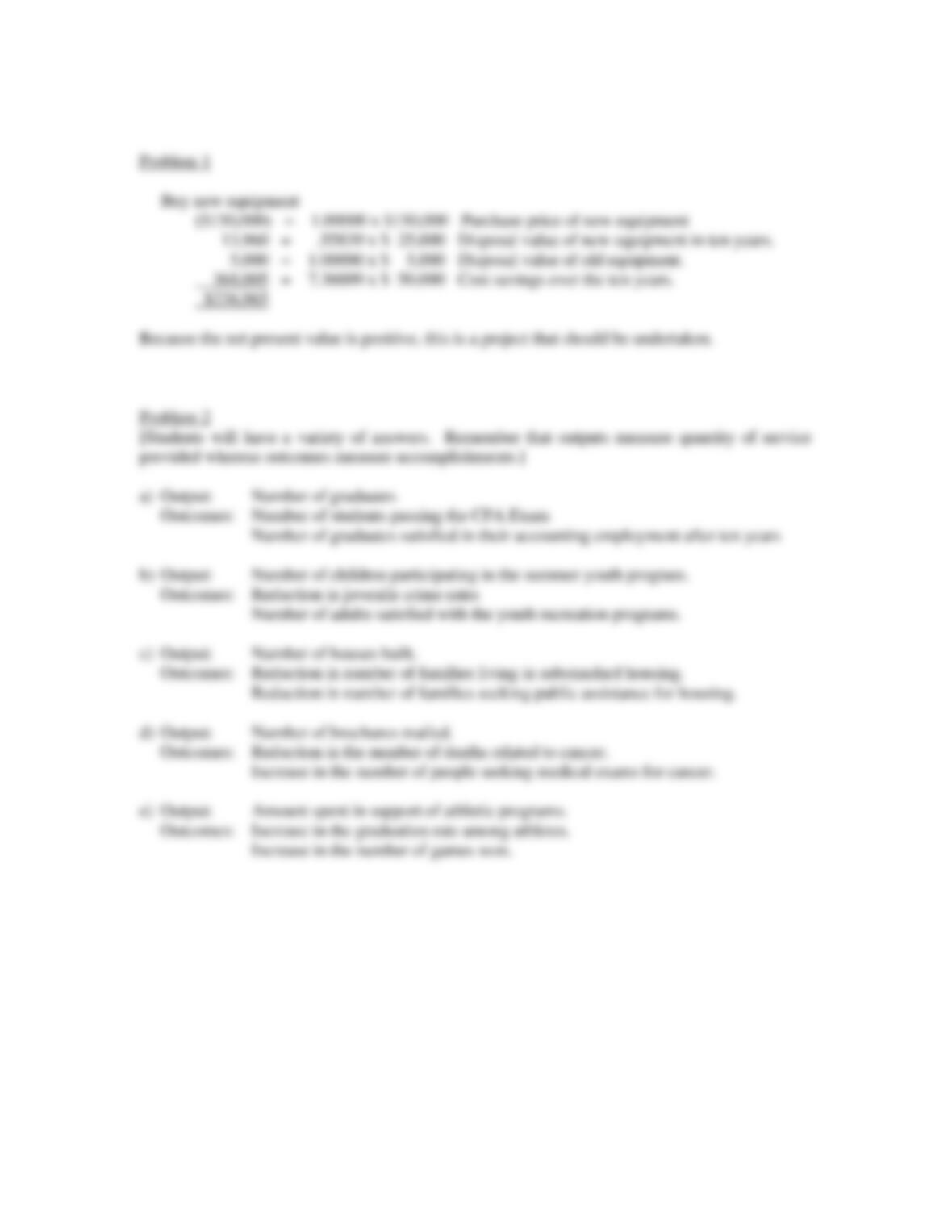
1. City of Oliver is considering automating a process in its accounting department that
has been labor-intensive. The equipment currently used in the department can be
sold. The new equipment will have a projected useful life of 10 years. The old
equipment has a remaining useful life of 10 years. The following data are available
to be used in making the decision. Should the city invest in the new equipment?
Support your answer with appropriate calculations.
Current equipment
Current equipment book value $ 30,000
Annual depreciation charges 3,000
Current estimated disposal value 5,000
New equipment
Cost $150,000
Annual depreciation charge 12,500
Expected disposal value 25,000
Labor savings each year $ 50,000
Present value factors @ 6%
$1 due in 10 years .55839
Annuity of $1 for 10 years 7.36009
ch15.doc Page 9
2. For each of the following entities or departments, propose at least one measure of
outputs and two of outcomes.
a) State University Department of Accounting
b) City Parks and Recreation Department
c) Habitat for Humanity
d) American Cancer Society
e) University Foundation for support of athletics
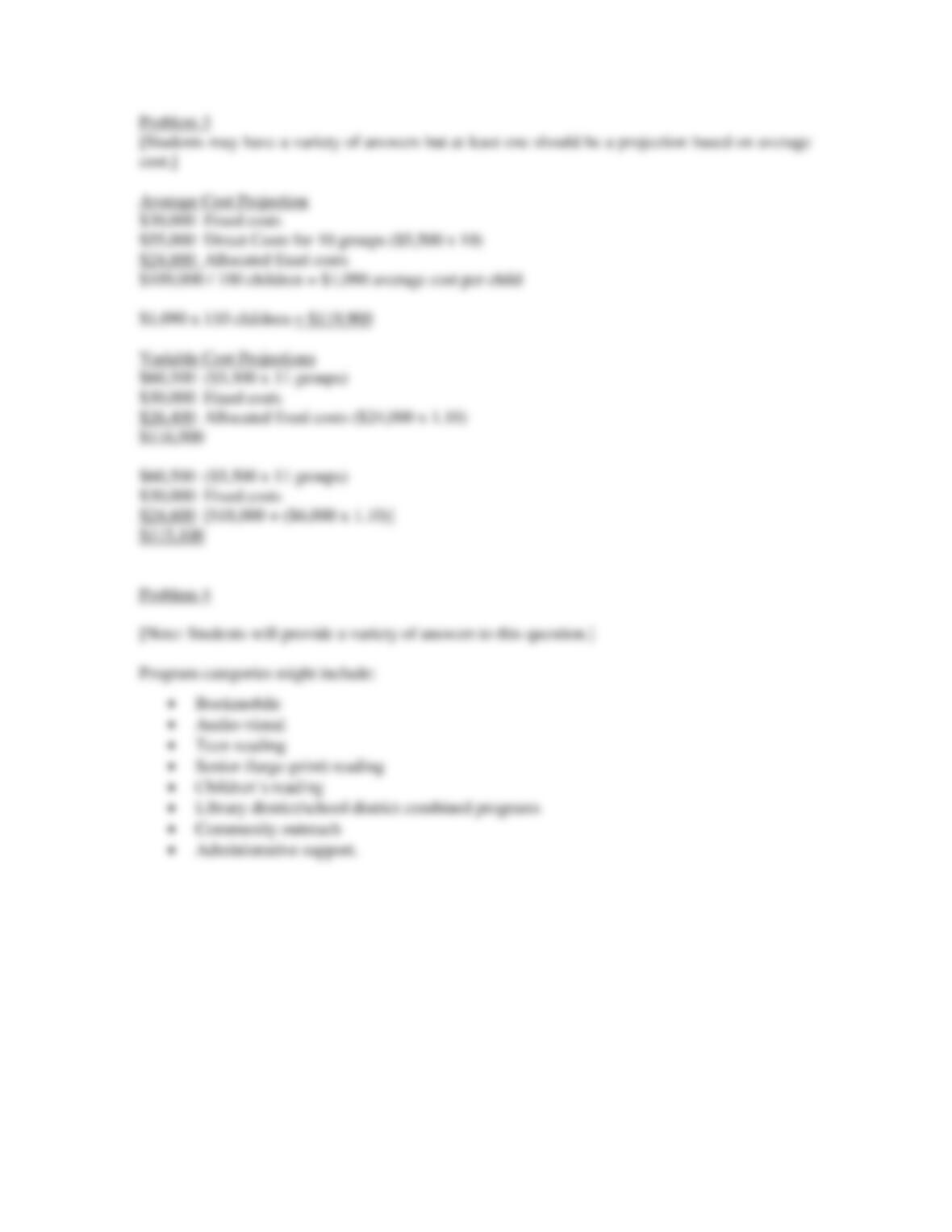
3. The City Parks and Recreation Department has determined the following costs
related to its very popular 12-week summer youth program. The number of
participants in the program has grown significantly over the past few years to 100
participants last year and the director is preparing for another 10 percent increase in
participants next summer. How much should the director request for next year?
Calculate at least three different budget requests.
Direct variable costs for a group of 10 children (group worker and supplies)
$ 5,500
Number of participants last summer
100
Fixed costs for the summer program
$30,000
Allocated fixed overhead: 25% is directly associated with the program,
75% would not be eliminated if the program were eliminated.
Allocated based on number of groups
$24,000

ch15.doc Page 10
4. The Carol Public Library District currently prepares its budget on an object
classification basis. Last year’s budgeted expenditures included these line items:
• Salaries
• Employee benefits
• Collection purchases
• Equipment purchases
• Library maintenance
• Dues and subscriptions
• Supplies
• Utilities
• Equipment maintenance
• Bookmobile maintenance
The district has decided to use program-based budgeting in the future. Based on
your knowledge of libraries, what are three programs that might be included in the
district’s budget?
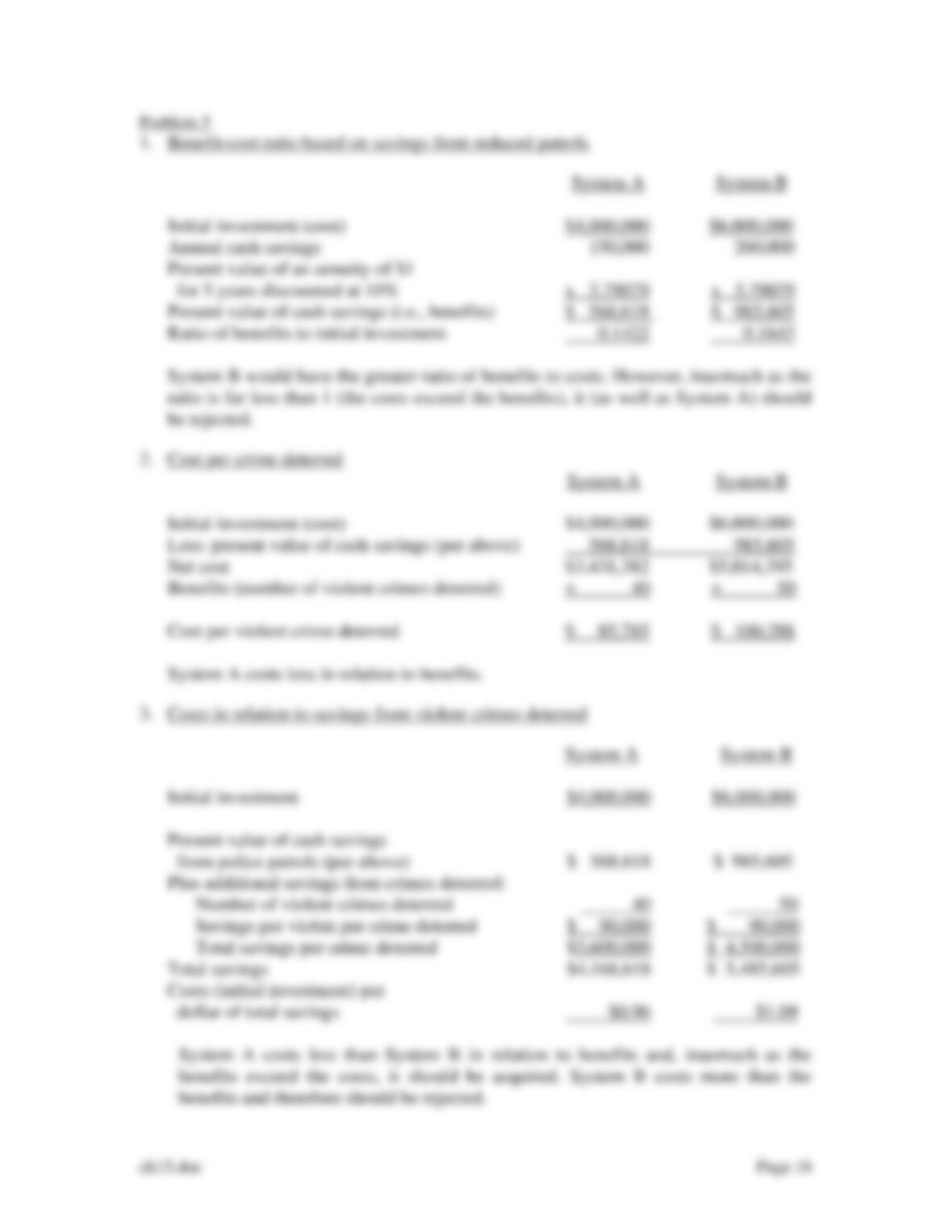
5. To enhance security in Avalon Centenary Park, the City of Avalon is considering whether
it should install a high-tech security system. The system would reduce the cost of police
patrols and deter crime. Two independent contractors have proposed competing systems
to the city. System A would cost $4 million; System B would cost $6 million. The city
estimates that by reducing the cost of police patrols, System A would save $150,000 per
year and System B $260,000 per year. The city uses a discount rate of 10 percent to
evaluate all capital outlays. It determines that each of the systems would have an
economic life of five years.
1. Considering the cost as the initial investment and the benefits as the present value of the
cash savings from reduced police patrols, which of the two systems would cost less in
relation to benefits? Based only on this criterion, should that system be acquired?
2. Suppose that the city estimates that System A is likely to deter 40 violent crimes
per year and that System B is likely to deter 50 violent crimes per year. Which of the two
systems would cost less in relation to benefits? Consider cost to be the initial investment
less the present value of savings from reduced police patrols.
3. Suppose further that consultants engaged by the city have placed a dollar cost upon
violent crime. Taking into account victims’ medical bills and lost wages, they estimate
that the present value of net outflows owing to violent crime is $90,000 per victim.
Considering the costs as the initial investment and the benefits as the present value of the
cash savings (including those from both reduced police patrols and crimes deterred),
which of the two systems would cost less in relation to benefits? Based only on this
criterion, should that system be acquired?
ch15.doc Page 11
ESSAYS (CHAPTER 15)
1. One goal of State University is to prepare students to become valuable, contributing members
of society. One goal of the Department of Accounting of State University is to prepare
students for meaningful careers as professional accountants. What are goals and objectives?
How do they differ and how are they similar? What are outputs and outcomes? What are the
outputs and the outcomes directly associated with the goals adopted by the university and the
department? How would the university and the department measure achievement of these
goals?
2. The GASB has encouraged governments to publish service efforts and accomplishments
(SEA) data. What is the role of auditors in attesting to SEA data?
3. Many governments use performance budgets in place of, or as a supplement to, the traditional
object classification budget. What is a performance budget? What are the advantages and
disadvantages of performance budgets over traditional budgets?
4. The Patton Landfill Authority decides to use zero-base budgeting for the first time. Assume
that you are asked to prepare the budget decision package for a proposal to establish a 24-
hour drop-off location for large refuse (such as old appliances, furniture and so forth). Patton
County, in which the authority is located, has recently experienced a surge in the level of
illegal dumping. What are four elements that should be included in your budget decision
package for the proposed program?

ch15.doc Page 12
ANSWERS TO TRUE/FALSE (CHAPTER 15)

ch15.doc Page 13
ANSWERS TO MULTIPLE CHOICE (CHAPTER 15)
ch15.doc Page 14
ANSWERS TO PROBLEMS (CHAPTER 15)
ch15.doc Page 15
ch15.doc Page 17
ANSWERS TO ESSAYS (CHAPTER 15)
ch15.doc Page 18