Chapter 14: Increasing Learning Through Assessment
CHAPTER FIFTEEN
SANDARDIZED TESTING AND LEARNING
Standardized Testing and Accountability
* 1. Statements describing what students should know or be able to do at the end of a prescribed period of study
are called:
a. specifications.
b. benchmarks.
c. criteria.
d. standards.
* 2. The process of focusing curricula and instruction on predetermined goals is referred to as:
a. high-stakes testing.
b. standards-based education.
c. criterion-based education.
d. norm-referenced testing.
* 3. The process of requiring students to demonstrate that they have met specified standards and holding
teachers responsible for students’ performance is best described as:
a. standardization.
b. criterion referencing.
c. accountability.
d. high-stakes testing.
* 4. The mechanism used to ensure that students have met standards is:
a. effective instruction.
b. instructional supervision.
c. effective leadership.
d. standardized testing.
* 5. Of the following, which is the best description of high-stakes tests?
a. Standardized tests, such as the National Assessment of Educational Progress (sometimes called the
nation’s report card) that measures student achievement
b. Standardized tests that are used to make important decisions affecting schools, teachers, and
students, such as promoting students from one grade level to another
c. Teacher-made tests that teachers use to measure the extent to which their students are reaching the
standards prescribed by their state
d. Tests in reading, math, and science that our country uses to compare the achievement of our students
to the achievement of students in other countries around the world.
* 6. Which of the following are advantages of high-stakes tests according to advocates of high-stakes testing?
1. They help clarify the goals of a school system.
2. They prepare students for a competitive world outside of school.
3. They send clear messages to students about what they should be learning.
4. They provide the public with evidence about schools’ effectiveness.
a. 1, 2, 3 4 b. 1, 2, 4 c. 1, 2, 3 d. 1, 3, 4
Chapter 14: Increasing Learning Through Assessment
* 7. According to critics, which of the following are weaknesses of high-stakes testing?
1. The tests don’t reflect the curriculum being taught.
2. Teachers spend too much class time having students practice for the tests.
3. The tests have a disproportionately adverse effect on minority students.
4. The tests measure only knowledge of factual information.
a. 1, 2, 3, 4 b. 1, 2, 3 c. 1, 2, 4 d. 3, 4
* 8. Of the following, which is likely to be the most direct impact of high-stakes testing on you as a teacher?
a. Your school may be graded A, B, C, D, or F, and a stigma is attached to teaching in a school given a
low grade.
b. Students don’t like high-stakes tests, so you will be confronted with negative student attitudes when
preparing them for the tests.
c. School principals are under a great deal of pressure to improve student performance, so your
principal is likely to supervise you more closely than he or she otherwise would.
d. Some states are considering legislation that will tie your salary to your students’ performance on the
tests.
Essay Items
* 9. Explain the terms standards, standards-based education, accountability, and high-stakes tests.
* 10. Explain how standardized tests are related to standards-based education and the process of accountability.
* 11. Describe the positive features of high-stakes testing that advocates commonly cite.
* 12. Describe criticisms of high-stakes testing that are often cited by people who oppose this process.
* 13. Describe three implications that issues in standardized testing are likely to have for you as a teacher.
Standardized Tests
* 14. Assessment instruments given to large samples of students under uniform conditions and scored and
reported according to uniform procedures are best described as:
a. standardized tests.
b. criterion-referenced tests.
c. high-stakes tests.
d. performance tests.
* 15. Which of the following are current, accepted functions of standardized tests?
1. To compare students with other children at the same grade level.
2. To promote or retain children to appropriate grade levels.
3. To place students in special programs that have limited space available.
4. To determine which students are effected by cultural bias in the classroom.
a. 1, 4 b. 1, 2 c. 1, 3 d. 2, 4
* 16. Scores of individuals taking a standardized test are compared to the scores of a group of individuals similar
in age, grade level, and background who have taken the same test. This group of individuals used for
comparison is called:
a. a grade-equivalent group.
b. a norming group.
c. a peer group.
d. an ability group.
Chapter 14: Increasing Learning Through Assessment
* 17. The purpose of a norming group is to:
a. describe specifically what content students know and don’t know.
b. provide information for decisions about advancement to the next grade.
c. describe student performance in terms of specific criteria.
d. allow educators to compare the progress of their students with others.
* 18. To find out how well a student can perform a particular learning task or how well he or she can solve
problems, what kind of comparison should be made?
a. Norm-referenced using an immediate peer group
b. Norm-referenced using a different peer group
c. Criterion-referenced with teacher-set standards
d. Criterion-referenced with percentile standards
** 19. In order to determine how his students compare to other students from a neighboring district, a teacher will
most likely will use which of the following types of assessments?
a. A criterion-based assessment
b. An alternative assessment
c. A performance assessment
d. A standardized assessment
** 20. A junior high school wants to compare its students’ performance in a new algebra program with the
program it had used in the past and to other junior high algebra students. What kind of test would be most
effective?
a. A standardized aptitude test
b. A standardized achievement test
c. A standardized diagnostic test
d. A standardized intelligence test
* 21. Tests designed to measure and communicate how much students have learned in different content areas are
called:
a. performance tests.
b. achievement tests.
c. diagnostic tests.
d. aptitude tests.
* 22. The Iowa Test of Basic Skills is one example of a(n):
a. aptitude test.
b. achievement test.
c. intelligence test.
d. diagnostic test.
* 23. The most widely used standardized tests in schools today are:
a. aptitude tests.
b. achievement tests.
c. intelligence tests.
d. diagnostic tests.
* 24. Of the following, what is the most commonly cited weakness of standardized achievement tests?
a. Student scores on specific sections of the tests sometimes indicate that they know more than they
actually do.
b. Subject matter covered in the tests sometimes corresponds to one particular textbook series.
c. Testing takes place over several days.
d. Content measured on the tests might not cover the curriculum of a specific school or textbook
program.
Chapter 14: Increasing Learning Through Assessment
* 25. Tests that provide a detailed description of students’ strengths and weaknesses in specific skill areas are
described as:
a. diagnostic tests.
b. performance tests.
c. achievement tests.
d. aptitude tests.
* 26. Of the following, what is the most important difference between diagnostic tests and achievement tests?
a. Diagnostic tests are usually administered in groups of 50-100 students, whereas achievement tests
are administered to regular class-sized groups.
b. Achievement tests are designed to tell how well students will do in a future area of study, and
diagnostic tests are not.
c. Achievement tests are more subject-area specific than diagnostic tests.
d. Diagnostic tests include a larger number of items and report in more detail than achievement tests.
* 27. The Stanford-Binet is an example of a(n):
a. aptitude test.
b. achievement test.
c. intelligence test.
d. diagnostic test.
* 28. Of the following, the most popular intelligence test in use today is the:
a. Stanford-Binet.
b. Wechsler Intelligence Scale for Children (3rd edition) (WISC–III).
c. System of Multicultural Assessment (SOMPA).
d. Kaufman Assessment Battery for Children (KABC).
* 29. Consider the relative advantages of group compared to individually administered intelligence tests.
According to research, which of the following is the most accurate statement?
a. Group and individually administered tests provide results similar in accuracy, and group tests are
less costly to administer.
b. While time-consuming and expensive, individual tests yield results that are more accurate than those
obtained from group tests.
c. Group tests yield more accurate results than do individual tests because the conditions under which
they are given are standardized.
* 30. Tests designed to predict the potential for future learning and measure general abilities developed over long
periods of time are called:
a. performance tests.
b. achievement tests.
c. diagnostic tests.
d. aptitude tests.
* 31. The type of standardized test designed to measure one’s capacity to acquire knowledge and to solve novel
problems is a(n):
a. aptitude test.
b. achievement test.
c. intelligence test.
d. diagnostic test.
* 32. The type of standardized test designed to predict potential for future learning is a(n):
a. aptitude test.
b. achievement test.
c. intelligence test.
d. diagnostic test.
Chapter 14: Increasing Learning Through Assessment
* 33. The SAT (which you may have taken as part of your college application process) is an example of a(n):
a. aptitude test.
b. achievement test.
c. intelligence test.
d. diagnostic test.
* 34. Of the following, what is the most accurate description of standardized aptitude tests for predicting a
learner’s future learning potential?
a. A standardized aptitude test eliminates possible inconsistencies in grading between different schools
and teachers.
b. A standardized aptitude test eliminates differences in learners’ past exposure to specific ideas.
c. A standardized aptitude test reduces the importance of learners’ previous background knowledge in
different content areas.
d. A standardized aptitude test can be used effectively to diagnose specific problems in language and
mathematics.
* 35. What type of assessment would best determine the extent to which students are prepared for subsequent
learning experiences?
a. mastery test
b. intelligence test
c. readiness test
d. diagnostic test
* 36. The precision, stability, and consistency of a test’s scores could be used to describe the test’s:
a. validity.
b. variance.
c. referencing.
d. reliability.
** 37. The items on the Comprehensive Test of Basic Skills reflect the objectives taught in a particular school
district. This congruence best illustrates the concept of:
a. validity.
b. usability.
c. reliability.
d. practicality.
* 38. Of the following, what is most important and efficient in trying to ensure that content validity is maintained
in using a standardized achievement test?
a. Compare the test’s table of specifications with school curriculum objectives.
b. Give the test to a sampling of students, and compare their scores with national percentiles.
c. Have teachers in the appropriate subject matter areas take the test themselves.
d. Use performance assessments for teacher-made tests, so students have practice with a variety of
testing formats.
* 39. When a test accurately assesses what it is designed to measure, it is said to have:
a. construct validity.
b. predictive validity.
c. concurrent validity.
d. assessment validity.
** 40. Mr. Walker is concerned that the math placement test given to the fifth graders is not a good indicator of
sixth-grade math performance. Mr. Walker is most concerned with the test’s:
a. content validity.
b. construct validity.
c. placement validity.
d. predictive validity.
Chapter 14: Increasing Learning Through Assessment
** 41. Nancy group-administered a standardized math test. By mistake she gave her students too little time when
they took the test. What can we conclude about the validity of the scores the students will receive?
a. The scores will be valid since she gave the students too little time, not too much.
b. The scores will be valid because the validity of the scores is not dependent on amount of time
allotted.
c. The scores will be invalid because her students will be compared to those who had full time.
d. The scores will be invalid because standardized tests are not meant to be group administered.
** 42. A school committee tries to determine if a standardized test measures the same dimensions of learning as
their curriculum. The committee is assessing:
a. test reliability.
b. assessment validity.
c. predictive validity.
d. content validity.
** 43. A standardized test for elementary mathematics students that accurately correlates with high school algebra
grades and test scores demonstrates:
a. construct validity.
b. predictive validity.
c. content validity.
d. assessment validity.
** 44. A school committee compares the questions in a standardized test with the school’s curriculum objectives.
The committee is assessing the test’s:
a. construct validity.
b. predictive validity.
c. content validity.
d. assessment validity.
** 45. Ms. Brewster, a junior high teacher, is emphasizing higher-order thinking in her physical science class. To
see if her eighth graders were “getting” what they were supposed to be getting with respect to higher-order
thinking in science, she examined a standardized test designed to measure higher-order thinking in science,
compared its table of specifications to the content of her course, found the two to be consistent, and
administered the test. She found, however, that while the test measured topics in physical science, most
items didn’t measure students’ abilities to apply their understanding to unique problems. Which of the
following is the most valid conclusion?
a. The test lacked content validity, since she attempted to teach higher-order thinking and higher-order
thinking wasn‘t measured on the test.
b. The test lacked construct validity, since it didn‘t measure what it was designed to measure.
c. The test lacked reliability, since it didn’t actually measure what Ms. Brewster was trying to measure.
d. Ms. Brewster’s teaching lacked validity, since her students’ only experience was with what she
taught, and they were tested on different outcomes.
Essay Items:
* 46. Describe and give an example of each of the functions of standardized tests.
* 47. Describe each of the types of standardized tests, and give an example of a question each would be used to
answer.
* 48. Explain content validity, predictive validity, and construct validity.
Chapter 14: Increasing Learning Through Assessment
Understanding and Interpreting Standardized Test Scores
* 49. Which of the following is a measure of central tendency?
a. Mean
b. Standard deviation
c. Variance
d. Range
* 50. The arithmetic average for a set of scores is the:
a. mean.
b. median.
c. mode.
d. range.
* 51. The middle score in a distribution of scores is called the:
a. mean.
b. median.
c. mode.
d. standard deviation.
* 52. The most frequent score in a distribution is called the:
a. mean.
b. median.
c. mode.
d. range.
* 53. Of the following, the measure of central tendency is:
a. standard deviation.
b. range.
c. average deviation.
d. median.
* 54. Regardless of the distribution of scores in a sample, the score at the 50th percentile rank is also the:
a. mean.
b. average.
c. mode.
d. median.
** 55. Given the following distribution: 1, 2, 4, 4, 5, 5, 5, 6, 6, 8, 9, the median is:
a. 2
b. 4
c. 5
d. 6
** 56. Given the following distribution: 1, 2, 4, 4, 5, 5, 5, 6, 6, 8, 9, the mode is:
a. 2
b. 4
c. 5
d. 6
** 57. Given the following distribution: 1, 2, 4, 4, 5, 5, 5, 6, 6, 8, 9, the range is:
a. 4
b. 6
c. 8
d. 10
Chapter 14: Increasing Learning Through Assessment
** 58. Given the following scores: 80, 90, 75, 75, what is the mean score?
a. 75
b. 80
c. 85
d. 90
Use the following information for items 59–61.
Debbie Ponte gives her 10 students a 10-item quiz. The scores on the quiz were 10, 4, 7, 7, 10, 4, 3, 9, 7, 9.
** 59 The mean on Debbie’s quiz was:
a. 6
b. 7
c. 8
d. 9
** 60. The median on Debbie’s quiz was:
a. 5
b. 6
c. 7
d. 9
e. 10
** 61. The mode on Debbie’s quiz was:
a. 5
b. 6
c. 7
d. 9
** 62. What is the range of the following scores: 7, 11, 12, 16, 19?
a. 11
b. 12
c. 13
d. 19
* 63. Which of the following are reasons that the standard deviation valuable in interpreting test scores?
1. It is easy to calculate.
2. It indicates the difference between the highest and lowest scores in a distribution.
3. It indicates how spread out the scores are around the mean.
4. It is not overly affected by extreme scores.
a. 1, 2 b. 1, 3 c. 1, 4 d. 2, 3 e. 3, 4
** 64. If Lisa scored a 25 on a standardized test with a mean of 20 and a standard deviation of 5, approximately
what percent of the students who took the test had scores lower than hers?
a. 95%
b. 85%
c. 75%
d. 65%
** 65. If Nick got a score of 26 on a standardized test with a mean of 28 and a standard deviation of 6,
approximately what percent of the students taking the test scored lower than he did?
a. 10%
b. 30%
c. 45%
d. 55%
Chapter 14: Increasing Learning Through Assessment
** 66. A test given to a group of 30 students has a mean of 24 and a standard deviation of 3. A second test given
to the same group of students also had a mean of 24 but had a standard deviation of 4. Based on this
information, which of the following is the most valid conclusion.
a. The students performed better on the second test, since the standard deviation is higher.
b. The average on the second test is higher than on the first test.
c. The median on the second test is higher than on the first test.
d. The students’ scores on the second test spread out more than they did on the first test.
** 67. You have two sets of scores, which are as follows:
Set A: Mean—40 Median—40 Standard deviation—4
Set B: Mean—40 Median—41 Standard deviation—6
Of the following, which is the most accurate statement?
a. The students’ performance for both sets was equal since the means are the same.
b. The scores in Set B tend to be spread out more than the scores in Set A.
c. The students in Set B actually performed better since the standard deviation is higher than in Set A.
d. The students in Set B actually performed better since both the median and standard deviation are
higher than they are in Set A.
* 68. On the normal curve, which of the following is represented on the vertical axis?
a. the raw score
b. the number of people obtaining a particular raw score
c. the percentile
d. the stanine
e. the z-score
** 69. On a subtest of a standardized test, Nikki gets 45 items correct of a possible 50. Of the following, the most
valid conclusion is:
a. Nikki is in stanine 9.
b. Nikki has raw score of 45.
c. Nikki is in the 90th percentile (45/50 = 90%).
d. Nikki has a raw score of 90.
** 70. Jill correctly answered 15 items on a 50-item, 150–point biology test. The 15 items represents Jill’s:
a. raw score.
b. percentile scores.
c. stanine score.
d. grade-equivalent score.
** 71. Mike, a beginning fourth grader, takes a standardized test and gets a grade-equivalent score of 5.5. Of the
following, the best interpretation of this score is:
a. Mike is capable of doing work that is equivalent to the work done by students halfway through the
fifth grade.
b. Mike’s score equals the average score obtained by a fifth grader in the fifth month of school.
c. Mike is a year and a half ahead of his grade level.
d. Mike has the IQ of an average fifth grader.
* 72. Which of the following is most closely related to z-score?
a. raw score
b. mean
c. percentile
d. standard deviation
Chapter 14: Increasing Learning Through Assessment
* 73. The range of possible percentiles for a standardized test score is called:
a. the stanine.
b. the standard deviation.
c. a percentile.
d. a percentile band.
* 74. A percentile band takes into account:
a. the possibility of measurement error of the test.
b. the possibility of cheating on the test.
c. the range of possible answers to test items.
d. the lack of validity of the test.
Use the following information for items 75-78.
A subtest of a standardized test has a mean of 40 with a standard deviation of 4. (Assume a very large sample so the
test results nearly fit a normal distribution.) Cindy scores a 46 on the subtest. Cory scores a 44 on the same subtest.
** 75. Based on this information, the best approximation of the following of Cindy’s percentile rank is:
a. 40
b. 44
c. 84
d. 94
** 76. Of the following, the best description of Cory’s stanine is:
a. 3
b. 5
c. 7
d. 9
** 77. Cory’s z–score on the subtest would be:
a. -1.0
b. 0
c. 1.0
d. 1.5
e. 2.0
** 78. Cory’s T-score on the subtest would be:
a. 40
b. 44
c. 50
d. 60
** 79. On a recent standardized test, your student Becky had a T-score of 70. What is the closest assessment of
her performance compared to the norm group?
a. Her z-score is negative.
b. Her percentile rank is below 85.
c. Her percentile rank is above 85.
d. Her stanine score is 4.
* 80. Of the following, which is an example of a standard score?
a. A grade-equivalent score.
b. A percentile rank.
c. A T-score
d. A raw score
Chapter 14: Increasing Learning Through Assessment
** 81. A z-score of 1 is at which percentile?
a. 84th
b. 50th
c. 34th
d. 16th
** 82. Rocco received a raw score of 56. Given a mean of 50, a median of 50, and a standard deviation of 4, what
is Rocco’s z-score?
a. –1.5
b. 0.0.
c. 1.25
d. 2.5
** 83. Angie is in the eighth grade. On a standardized test, she scored at the tenth-grade level on a vocabulary
subtest. What is the best interpretation of her score?
a. Angie is at the 80th percentile rank of eighth graders for vocabulary.
b. Angie’s vocabulary is similar to that of the average tenth grader taking that test.
c. Angie’s score is about 2 standard deviations above the average vocabulary score for eighth graders.
d. Angie scores better on vocabulary than in other content areas.
** 84. Jordan‘s score on a standardized test of mathematical aptitude was at the 85th percentile. Which of the
following best interprets this score?
a. Jordan got 85% of the test items right.
b. Jordan’s rank in the class is about 15th.
c. 15% of all students taking this test scored higher than Jordan.
d. For any given test item, Jordan’s chances of answering it correctly are 8.5 out of 10.
** 85. Given a person who has a T-score of 30 on a norm-referenced assessment, what can we conclude regarding
his performance compared to the norm group? The student:
a. performed significantly above average on the assessment.
b. performed at about an average level on the assessment.
c. performed within 1 standard deviation of the mean.
d. performed significantly below average on the assessment.
** 86. In a distribution with a mean of 50 and a standard deviation of 5, a T–score of 30 equals a score of
a. 35.
b. 40.
c. 45.
d. 55.
** 87. In a normal distribution, a T-score of 50 is at the ____th percentile.
a. 84
b. 50
c. 34
d. 16
** 88. A z-score of 1 is at the ______th percentile.
a. 84
b. 50
c. 34
d. 16
Chapter 14: Increasing Learning Through Assessment
* 89. If a test could hypothetically be administered several times to the same group of students, and an
individual’s scores were averaged for all the times the test was taken, this average would be an estimate of
the individual’s:
a. norm-referenced score.
b. median score.
c. true score.
d. z-score.
* 90. The range of scores within which an individual’s true score is likely to fall is called:
a. the standard deviation.
b. the true score range.
c. the stanine score.
d. the standard error of measurement.
* 91. Another name for standard error of measurement is:
a. percentile band.
b. standard deviation.
c. range.
d. confidence interval.
** 92. Don and Kathy both take a standardized test (the same test) that has a standard error of 4. Don scores a 36
on the test, and Kathy scores a 42. Based on the information in the example, which of the following is the
most accurate statement?
a. Kathy’s true score is higher than Don‘s, since her score is more than 4 points higher than his.
b. Don’s true score could be higher than Kathy’s.
c. Kathy’s true score is likely to be between 42 and 46.
d. Don’s true score is likely to be between 34 and 38.
** 93. John has a score of 34 on an achievement test. Raul has a score of 39. The standard error of measurement
is 2. The teacher should conclude that:
a. John’s true score is probably equal to Raul’s.
b. John’s true score might be higher than Raul’s.
c. Raul probably has a higher true score on this test than John.
d. No conclusion about the students’ true scores can be drawn from the given information.
Essay Items
** 94. Following are standardized test scores for Beth and Anne, two fifth-grade students:
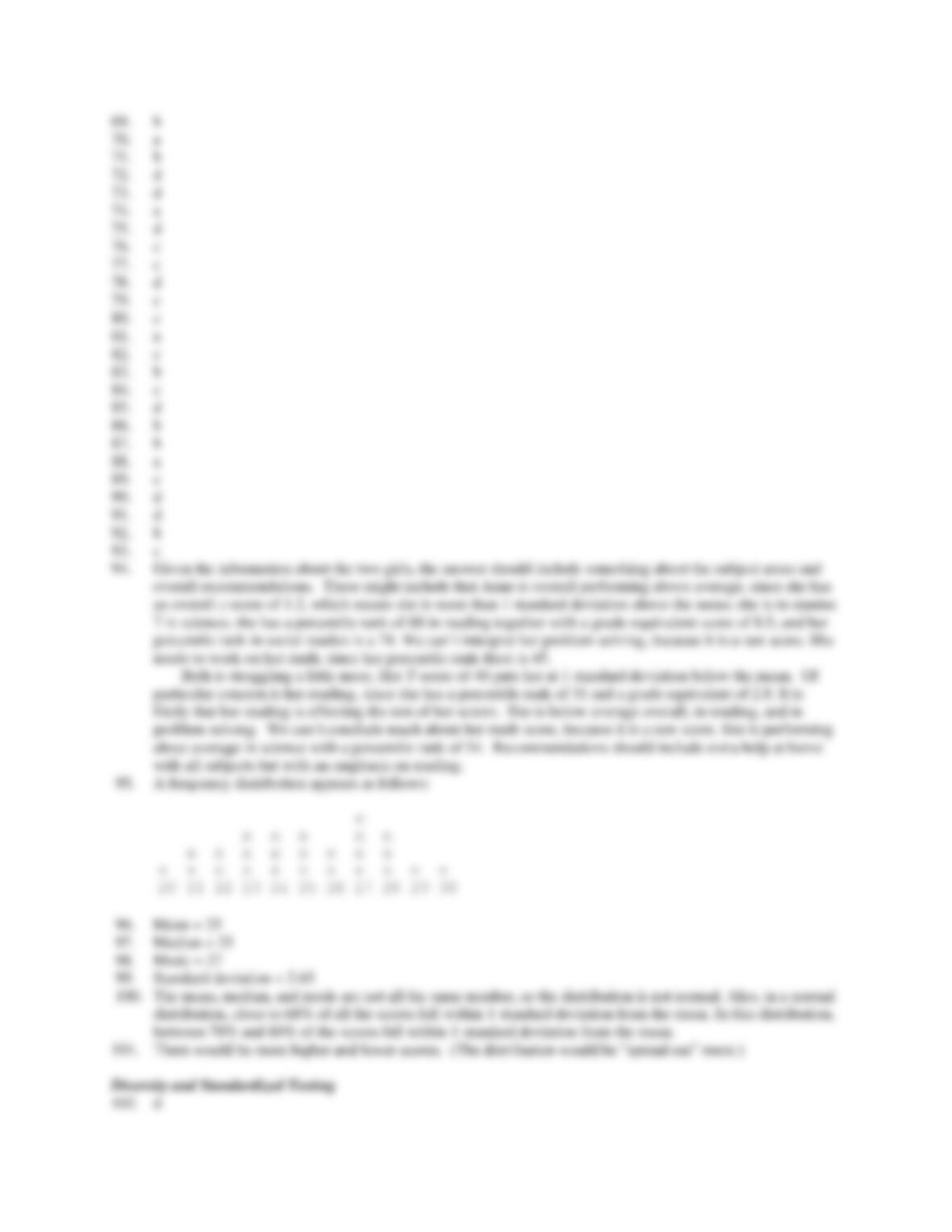
In math, Anne has a percentile rank of 45, a stanine of 7 in science, a grade-equivalent score of 8.5 in
reading and a percentile rank of 68. On problem solving, she had a raw score of 72. In social studies, she
received a percentile score of 78. Her overall z-score is 1.2.
Beth has a T-score of 40 overall. She has a raw score of 81 in math, a percentile rank of 54 in science.
In reading, she has a grade equivalent for 2.8 and a percentile rank of 31. On problem solving, she had a
percentile rank of 38. In social studies her stanine score was 3.
You are preparing for teacher conferences with Anne and Beth’s parents. For each child, first, explain each
individual subject area score. Second, provide an overall assessment of the student. Finally, make
recommendations to the parent regarding how they can assist their child.
Use the following set of scores on a 30-item quiz to answer items 82-88.
30, 25, 24, 28, 27, 29, 24, 26, 27, 25, 23, 23, 27, 23, 28, 20
22, 21, 21, 28, 22, 24, 25, 27, 26
** 95. Create a frequency distribution for the scores.
Chapter 14: Increasing Learning Through Assessment
** 96. What is the mean for the sample?
** 97. What is the median for the sample?
** 98. What is the mode for the sample?
** 99. What is the standard deviation for the scores?
** 100. Is the distribution “normal”? Why or why not?
** 101. Suppose you had another set of scores with the same mean as this one but with a standard deviation of
3.11. What would you know about the second distribution?
Diversity and Standardized Testing
* 102. A form of discrimination that occurs when a test or other assessment instrument unfairly penalizes a group
of students because of their gender, ethnicity, race, or socioeconomic status best describes:
a. high-stakes testing.
b. construct validity.
c. accountability.
d. assessment bias.
Use the following information for items 103–105.
A group of kindergarten students whose parents are migrant farm workers from Mexico and whose English–
language skills are just developing are given a nationally normed standardized readiness test. The test uses a
multiple-choice format, and the teachers have the students practice with multiple-choice items. The results of the test
will be used to determine if the students will be retained in kindergarten or will be promoted to the first grade.
Several of the items on the test are designed to measure the students’ basic skills. For example, one item asks
the students to identify the item that begins with the long vowel i, and students were shown pictures of a clothes
iron, a shovel, a power drill, and a lawn mower as choices. The correct answer was the iron, since it begins with i.
Many of the children choose the shovel as an answer, since it is the only item on the list with which they are
familiar.
** 103. Based on the information in the vignette, of the following, which is the best description of the test?
a. It is a criterion-referenced test.
b. It is a high-stakes test.
c. It is an aptitude test.
d. It is an intelligence test.
** 104. With respect to the test itself, which of the following is the most valid conclusion?
a. Bias in content exists in the test, since it requires background knowledge the students lacked.
b. Bias in testing procedures exists, since the students are in kindergarten and kindergarten students
aren’t given standardized tests.
c. Bias in format exists, since multiple-choice tests should not be used with kindergarten students.
d. The test is not biased, since it has been nationally normed.
** 105. Which of the following is the best analysis of the fact that the test will determine whether or not the
students will be allowed to enter the first grade?
a. The test is not biased, since it is an objective measure of the children’s performance.
b. Bias in reliability exists, because the teachers had the students practice with the test format.
c. Bias in test use exists, since the children’s promotion depends on this single instrument.
d. Bias in test format exists because multiple-choice tests should not be used with kindergarten
students.
Chapter 14: Increasing Learning Through Assessment
* 106. Which of the following is not a type of test bias as identified by measurement experts?
a. Bias in test use
b. Bias in test format
c. Bias in content
d. Bias in testing procedures
* 107. Of the following, which is an example of accommodations suggested for use when testing special needs
learners?
a. Only administering a portion of the exam instead of the entire test.
b. Allow learners to work in pairs when completing portions of the test.
c. Allow the learners to take the test home to have it administered by a parent.
d. Alter time to provide extended testing time or more frequent breaks.
* 108. Which of the following are commonly cited problems with testing English learners (ELs)?
1. These students tend to come from low SES families.
2. These students tend to attend schools with underqualified teachers.
3. These students are given tests that have not been validated with national norms.
4. These students are placed in classes for which the requirements exceed their academic ability.
a. 1, 2, 3, 4 b. 1, 2, 3 c. 1, 2, 4 d. 1, 2
* 109. Of the following, which is considered to be the most effective option when administering standardized tests
with ELs?
a. Give them the test in their native language.
b. Provide interpreters who interpret the meanings of the items as students are attempting to respond to
them.
c. Allow them to use bilingual dictionaries to help them interpret unfamiliar vocabulary.
d. Focus instruction on test content, and have them practice with previously used copies of the test.
Essay Items
* 110. Describe three forms of bias that can exist when standardized testing is used with members of cultural
minorities. Provide an example of each.
* 111. Describe three problems that commonly exist when administering standardized tests with English learners
(ELs).
* 112. Describe the two most effective accommodations that you can provide your EL students when
administering standardized tests with them.
Educational Psychology and Teaching: Your Role in Standardized Testing
* 113. Which of the following best describes teachers’ roles in standardized testing?
a. Teachers play an essential role in standardized testing at all grade levels and in all content areas.
b. Teachers play an important role in standardized testing at the middle and secondary levels, but they
don’t play an important role at the elementary level.
c. Teachers play an important role for standardized achievement tests, such as the Stanford
Achievement Test, but they don’t play a significant role in high-stakes testing.
d. Because standardized tests are created at the national or state level, teachers don’t play a significant
role in standardized testing.
* 114. Which of the following is not one of teachers’ roles in standardized testing?
a. Preparing students for standardized tests
b. Communicating test results to students and their caregivers
c. Sending standardized test results to district offices
d. Making accommodations, if possible, for members of cultural minorities
Chapter 14: Increasing Learning Through Assessment
* 115. Of the following, which is likely to be your most important role in standardized testing?
a. Communicating the results of standardized tests to your school administrators, so they can be as sure
as possible that your students are performing at acceptable levels.
b. Communicating standardized test results to parents, so they understand how well their children are
performing on the tests
c. Sending test results to district, and, when required, to state offices, to be sure accurate records of
student performance are being maintained
d. Helping your students understand the content that will be assessed on the standardized test to ensure
that they perform as well as possible
* 116. Which of the following will likely be the most important factor determining the extent to which students at
all grade levels and in all content areas are prepared to perform as well as possible on standardized tests?
a. The emphasis your school places on standardized testing
b. The effectiveness of your instruction
c. The extent to which you “teach to the test”
d. The extent to which you encourage your students to study and prepare for standardized tests
* 117. For which of the following groups is teaching test-taking strategies most important?
a. Gifted students
b. Students from high SES backgrounds
c. Members of cultural minorities
d. Middle school students
Essay Items
** 118. You’re a math teacher, and you typically have students solve a number of word problems on your quizzes.
However, you know that the standardized test your students will soon be taking will be in a multiple-choice
format. In addition to ensuring to the extent possible that your students understand the content that will be
assessed on the standardized test, describe what you should do to best prepare your students to succeed
using this format?
* 119. Describe four guidelines that will help you, as a teacher, best perform your role in standardized testing, and
provide an example of each.
Chapter 14: Increasing Learning Through Assessment
CHAPTER FIFTEEN ANSWERS
Accountability and Standardized Testing
Standardized Tests
Chapter 14: Increasing Learning Through Assessment
Understanding and Interpreting Standardized Test Scores
Chapter 14: Increasing Learning Through Assessment
Chapter 14: Increasing Learning Through Assessment
Educational Psychology and Teaching: Your Role in Standardized Testing