Chapter 15: Performance Evaluation and Compensation
Learning Questions
True /
False
Multiple Choice
Matching
Exercises
Short
Answer
Problems
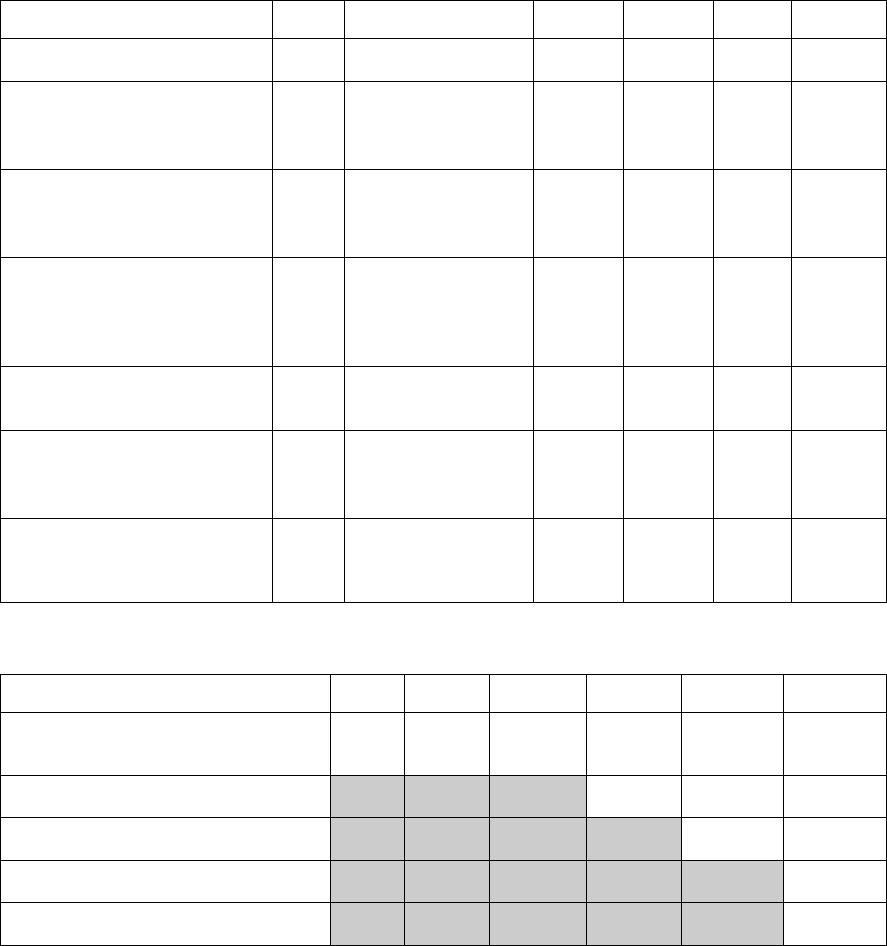
1. What is agency theory?
1-3
20-27, 57
W: 94, 95
1
1
2. How are decision-making
responsibility and authority
related to performance
evaluation?
4-6
28–33
S: 78
W: 99,100
2
2, 9
3. How are responsibility
centers used to measure,
monitor and motivate
performance?
7-10
34,39
S: 64
W: 101-103, 105
3
4. What are the uses and
limitations of return on
investment, residual income
and economic value added
for monitoring performance?
11–15
1, 2, 13-19, 54-56, 58-
62
S: 65-73, 82-88
W: 90, 92, 104
3
1, 3, 4, 5
4, 10
2
5. How is compensation used to
motivate performance?
16–18
35-38, 40-44
S:
W:
5
1
5
6. What prices are used for
transferring goods and
services within an
organization?
19–22
3, 4, 7, 8-10, 45, 51
S: 74, 76, 77, 79-81
W: 89, 93, 96
4
2
7
1
7. What are the uses and
limitations of transfer
pricing?
23–25
5, 6, 11, 12, 46-50, 52,
53, 63
S: 75
W: 91, 97, 98, 106-108
2
6, 8
1, 2
S: Questions from the study guide
W: Questions from web quizzes on the student web site
Level of Complexity*
True /
False
Multiple
Choice
Matching
Exercises
Short
Answer
Problems
Foundation: Repeat or paraphrase
information; Reason to single correct
solution; Perform computations; etc.
All
All
All
All
1, 2
Step 1: Identify the problem, relevant
information, and uncertainties
1, 2
1, 2, 3, 6
1
Step 2: Explore interpretations and
connections
4, 5, 7, 8,
9, 10
1, 2
Step 3: Prioritize alternatives and
implement conclusions
Step 4: Envision and direct strategic
innovation
*Based on level in Steps for Better Thinking (Exhibit 1.10, textbook p. 16):
Note: Step 1, 2, 3, and 4 questions in this test bank are intentionally open-ended and subjective, giving students the
opportunity to demonstrate skills such as judgment, reasoning, identification of uncertainties, identification or analysis of
pros and cons, and so on. Therefore, student answers may not exactly match those shown in the solutions.

15-2 Cost Management
True / False
1. Agency theory is an analytical framework that tells managers how to solve potential conflicts with
shareholders.
2. Agency theory is related to accounting because organizations incur costs, including the costs to
produce accounting information, to solve conflicts that might arise between managers and owners.
3. An organization’s chief executive officer can be both a principal and an agent.
4. Decentralization typically eliminates agency costs from for-profit organizations.
5. Choices about decision-making authority and about organizational structure are often related.
6. Technical details about complex manufacturing processes are examples of specific knowledge.
7. Responsibility accounting is the process of using financial information to justify pay increases and
promotions for managers.
8. If manufacturing departments are only responsible for production decisions, they are considered cost
centers.
9. Investment center managers are held responsible only for their costs.
10. In a profit center, managers’ primary goal is to maximize revenues.
11. Return on investment is typically calculated as net income divided by total sales.
12. Return on investment cannot be used effectively to evaluate profit centers because it motivates
managers to make suboptimal decisions from the viewpoint of the organizations’ owners.
13. Return on investment can be decomposed into two ratios: investment turnover and return on sales.
14. Residual income measures a company’s profits given a required rate of return.
15. Economic value added can be measured so that it reduces most of the problems that arise under
residual income.
16. Managers can reduce agency costs through the use of compensation contracts.
17. Compensation contracts can be based on accounting and / or non-accounting measurements.
18. Executive compensation is typically set by the shareholders at the annual meeting.
20. A transfer price is required only when goods or services are transferred between cost centers in the
same organization.
21. An ideal transfer price would be the opportunity cost of internal transfers.
22. If a supplying division has excess capacity, the best transfer price is the product’s variable cost.
23. If a product has an external market and divisions are treated as profit centers, cost-based transfer
prices can often lead to suboptimal decisions.
24. In a dual-rate transfer pricing system, the selling department is credited for the market price and the
buying department is charged the product’s variable cost.
25. Transfer pricing policies can affect a company’s tax liability, particularly if it does business
internationally.

Performance Evaluation and Compensation 15-3
Multiple Choice
1. A segment with an ROI of 30% has an income of $84,000. The company’s required rate of return on
segment investments is 18%. The segment’s residual income is
a. $50,400
b. $25,200
c. $26,712
d. $33,600
2. Division A of a firm produces a single product, which is sold only to Division B. Division A has a
total investment of $1,000,000, while Division B has a total investment of $2,000,000. Division A
annually sells 100,000 units of its product to Division B for $5 per unit and earns $150,000 in
operating income. Division B currently earns $250,000. If Division A raises its selling price to $6 per
unit and nothing else changes,
a. Division A’s ROI will increase to 20%
b. The firm’s overall ROI will rise
c. The firm’s overall ROI will fall
d. The firm’s overall ROI will remain unchanged
Use the following information for the next 2 questions.
The Mukilteo Division of Snohomish Corp. produces and sells a product to outside and internal customers.
Per-unit data collected from its operations include:
Outside sales price $640
Direct materials 105
Direct labor 250
Fixed overhead 180
3. If Mukilteo is operating at full capacity and selling solely to outside customers, what price should
another division pay for Mukilteo’s product?
a. $285
b. $625
c. $640
d. $480
4. If Mukilteo has excess capacity available to meet an internal order, what transfer price should be set?
a. $625
b. $355
c. $430
d. $285
5. Hitek, Inc has 2 divisions, Diodes and Boards. The diode can be sold internally or externally. If sold
externally, the sales price is $15 per diode. The Boards division needs 3 diodes for each electronic
board it produces. The external sales prices and costs are:
Diodes Boards
Sales price per unit $15.00 $16.50
Variable costs (direct) per unit 6.00 9.00
Fixed costs per unit 3.00 6.00
If Diodes can sell all of its production externally, what is the minimum price at which it would be
willing to sell internally, and what is the maximum price the Board Division would be willing to pay?
Diodes Boards
Willing to Sell Willing to Pay
a. $15 $2.50
b. $15 $7.50
c. $15 $15.00
d. $27 $27.00

15-4 Cost Management
6. The Jupiter Division of Space, Inc. produces dilithium crystals. One-third of its output is sold to the
Antari Division, and the remainder is sold externally. Jupiter’s estimated sales and cost data for the
coming year are:
Antari Division External Sales
Units 12,500 25,000
Sales $18,750 $50,000
Variable costs 12,500 25,000
Fixed costs 3,750 7,500
Assume that Jupiter cannot sell any additional crystals externally. If the Antari Division has an
opportunity to buy from an outside supplier at $1.40 per crystal and Jupiter refuses to meet this price,
the company as a whole will be
a. $1,250 better off
b. $3,750 worse off
c. $6,250 better off
d. $5,000 worse off
Use the following information for the next 2 questions.
The National Division of Roboto Company is buying 10,000 widgets from an outside supplier at $30 per unit.
Roboto’s Overseas Division, which is producing and selling at full capacity (12,000 units), has the following
sales and cost structure:
Sales price per unit $45.00
Variable cost per unit 22.50
Fixed cost (at capacity) per unit 15.00
7. If the National Division buys its 10,000 widgets from the Overseas Division, the transfer price should
be
a. $45.00
b. $30.00
c. $22.50
d. $37.50
8. If the Overseas Division meets the outside supplier’s price and sells the 10,000 widgets to National,
the effect on overall company profits will be
a. $ 75,000 higher
b. $150,000 lower
c. $300,000 higher
d. $225.000 lower
Use the following information for the next 2 questions.
Division A of Sibley, Inc. has operating data as follows:
Capacity 20,000 units
Selling price $80 per unit
Variable costs $45 per unit
Fixed costs $20 per unit
Division B wants to purchase units from Division A. If Division A agrees to sell units to Division B, A’s
variable costs will be $5 less per unit.
9. If Division A is operating at capacity, what is the minimum price it should charge?
a. $40
b. $75
c. $20
d. $60
Performance Evaluation and Compensation 15-5
10. If Division A has capacity available to meet B’s requirements, what is the minimum price it should
charge?
a. $40
b. $75
c. $20
d. $60
Use the following information for the next 2 questions.
Division A produces a component for Hielkema Company’s main product — automobiles. The division
operates as a profit center. It also sells to outsiders. The present selling price is $75 per component. The
company buys 600,000 units of a similar component per year from outside sources. The external purchase
price is $73 as a result of a quantity discount. Division A has adequate capacity to supply the needs of the
Assembly division. The following data are for Division A:
Direct material $30 per unit
Direct labor $25 per unit
Variable overhead $10 per unit
Fixed overhead (based on a capacity of 5,000 units) $6 per unit
11. The minimum price at which A would sell components internally is
a. $71
b. $73
c. $75
d. $65
12. The price range within which A would sell components to the Assembly Division is
a. $71 to $73
b. $65 to $73
c. $71 to $75
d. $65 to $75
13. Which of the following responsibility centers can be evaluated using residual income?
a. Cost centers
b. Profit centers
c. Revenue centers
d. Investment centers
14. THN Corporation reported operating income of $30,000, revenue of $50,000, and average operating
assets of $40,000 for a recent year. Which of the following is true?
a. THN has an adequate return on investment
b. THN’s return on sales was 1.67
c. THN’s return on investment was 75%
d. THN’s return on sales was 80%
15. KNY Corporation reported operating income of $80,000 and average operating assets of $120,000 in
a recent accounting period. Which of the following transactions would definitely increase KNY’s
return on investment?
a. Increasing product prices
b. Switching suppliers for raw materials
c. Collecting accounts receivable
d. Decreasing research and development expense
16. Residual income is calculated as
a. Operating income – (required rate of return × average operating assets)
b. Net income – (required rate of return × average operating assets)
c. Operating income – (required rate of return × average equity)
d. Net income – (required rate of return × average equity)

15-6 Cost Management
17. The Southern Division of WDY Corporation reported net income of $2,500, operating income of
$4,000, average equity of $24,000, and average operating assets of $30,000 in a recent accounting
period. If Southern’s required rate of return is 12%, its residual income was
a. $380
b. $(380)
c. $400
d. $1,100
18. Economic value added uses “adjusted after–tax operating income” as one of its inputs. One purpose of
using after-tax income, rather than operating income, is to
a. Encourage managers to file tax reports
b. Encourage managers to minimize taxes
c. Improve information reported to the SEC
d. Remove bias from the EVA calculation
19. How are research and development costs treated for financial reporting and for economic value added
(EVA) calculations?
Financial Reporting EVA
a. Capitalized Capitalized
b. Expensed Expensed
c. Capitalized Expensed
d. Expensed Capitalized
20. What type of theory provides an analytical framework for the conflicts that arise between owners and
managers?
a. Decision making theory
b. Conflict resolution theory
c. Agency theory
d. Evaluation theory
21. Agency theory recognizes two kinds of information consumers. Which of the following describes the
relationship between them?
a. Principals hire agents to make decisions for them.
b. Agents hire principals to hold them accountable for decisions.
c. Principals and agents work together in the best interest of the organization.
d. Principals are government employees, while agents work in the private sector.
22. To reduce agency costs, organizations implement various systems and controls to monitor behavior,
including
I. Publishing audited financial statements
II. Filing income tax returns
III. Tying financial rewards to reported results
a. I and III only
b. I and II only
c. II and III only
d. I, II, and III
23. Under what circumstances could organizations eliminate agency costs, according to agency theory?
a. If they are not publicly traded
b. If bonuses are based on financial performance
c. If they publish audited financial statements
d. Organizations cannot eliminate agency costs
Performance Evaluation and Compensation 15-7
24. Which of the following is an agency cost from a business owner’s perspective?
a. Losses from poor economic conditions
b. Costs to provide appropriate incentive contracts for top management
c. General supplier price increases
d. Insufficient executive pay
25. Because agents may not set the same goals and objectives as principals, organizations may experience
which of the following general agency costs?
I. Goal alignment costs
II. Losses from a downturn in economic conditions
III. Monitoring costs
a. I and III only
b. II and III only
c. III only
d. I, II, and III
26. Costs for producing and analyzing internal performance reports are examples of
a. Goal alignment costs
b. Losses from poor decisions
c. Monitoring costs
d. Contracting costs
27. Managers can reduce agency costs by
a. Giving agents less decision-making authority.
b. Holding agents responsible for the results of their decisions and rewarding them for good
performance.
c. Constantly monitoring agents’ actions to ensure goal congruence.
d. Reporting residual income in their SEC reports.
28. When decision making is decentralized
a. Upper management does not make decisions
b. Decision-making authority is delegated throughout the organization
c. The important information in an organization is very general
d. Organizations are less likely to experience agency costs concerning goal congruence
29. Which of the following best describes “general knowledge” in a decision-making context?
a. Detailed information about manufacturing processes
b. Customer lists and preferences kept by individual departments in retail sales
c. Knowledge that is easily transferred between employees
d. Knowledge that can be obtained only outside the organization
30. Decision-making based on general knowledge is more likely to occur in this type of organization
a. Centralized
b. Decentralized
c. Effective
d. Ineffective
31. Which type of knowledge is most costly to transfer within an organization?
a. Centralized
b. Decentralized
c. Financial
d. Specific
15-8 Cost Management
32. Specific knowledge is
I. More detailed than general knowledge
II. More costly to transfer than general knowledge
III. An example of an agency cost
a. I and II only
b. I and III only
c. II and III only
d. I, II, and III
33. An advantages of centralized decision making is
a. More motivated employees
b. More rapid decision making in all contexts
c. Greater effectiveness in volatile environments
d. Less monitoring of decisions
34. Responsibility accounting includes
I. Monitoring primarily for mistakes
II. Assigning authority to subunit managers
III. Measuring the performance of subunit managers
a. I and II only
b. I and III only
c. II and III only
d. I, II, and III
35. Budgets can be used to evaluate managerial performance in
I. Cost centers
II. Profit centers
III. Investment centers
a. II only
b. I and II only
c. II and III only
d. I, II, and III
36. Among the responsibility centers listed, which type of responsibility center is most likely to use
growth in sales as a performance measure?
a. Cost
b. Profit
c. Revenue
d. Investment
37. Managers are held responsible for revenues in
I. Revenue centers
II. Profit centers
III. Investment centers
a. I and III only
b. II and III only
c. I only
d. I, II, and III
38. Efficiency measures, such as number of new products developed, may be more useful than financial
measures in
a. Profit centers.
b. Discretionary cost centers.
c. Revenue centers.
d. Investment centers.
Performance Evaluation and Compensation 15-9
39. A corporate accounting department would most often be considered a
a. Cost center, because it is typically a high cost operation
b. Cost center, because its costs can be controlled by upper management
c. Revenue center, if accountants have input in pricing decisions
d. Cost center, because it is a support service
40. Compensation contracts that provide incentives for agents to increase organizational value might
include I. Cash-based bonuses
II. Stock options
III. Cash bonuses based on stock price increases or targets
a. I and II only
b. II and III only
c. I and III only
d. I, II, and III
41. “Reduce costs by 5%” is an example of a(n)
a. Measurement
b. Agency cost
c. Benchmark
d. Reward
42. To protect shareholders from excessive compensation practices, executive compensation packages are
best set by
a. The board of directors
b. A committee of primarily outside members of the board of directors
c. A committee of top management employees
d. The external auditors
43. Stock-based compensation has been used to encourage
a. Focus on long-range results
b. Focus on short-term results
c. Higher compensation for executives
d. Lower compensation for executives
44. Basing executive compensation on accounting earnings
I. Is a popular practice in the United States
II. Is sharply criticized because of potential negative long-term effects
III. Leads to unbiased accounting practices
a. I and II only
b. I and III only
c. II and III only
d. I, II, and III
45. The price used to record exchanges of goods and services inside an organization is called a
a. Transfer price
b. Exchange price
c. Full price
d. Suboptimal price
46. Setting transfer prices can be especially problematic when
a. Managers are evaluated based on non-financial factors
b. Compensation is tied to the financial performance of responsibility centers
c. Centralized decision making is the organizational norm
d. Compensation is tied to the financial performance of the organization as a whole

15-10 Cost Management
47. A transfer pricing policy based on market price
a. Maximizes total organizational profit.
b. Is best because the market price is always objective and easily obtainable.
c. May result in suboptimal decision making for the company as a whole.
d. Is the only alternative accepted by the Internal Revenue Service.
48. Which of the following is an advantage of cost-based transfer prices?
I. Managers do not have much incentive to reduce fixed costs
II. Managers may be motivated to purchase goods and services from outside the company
III. Contribution margins may be split between buying and selling divisions
a. I only
b. II only
c. III only
d. None of the above (I, II, and III are all disadvantages)
49. When a company uses activity-based transfer prices
a. The internal buyer is motivated to overstate the number of units to buy internally
b. The internal buyer is motivated to understate the number of units to buy internally
c. Capacity is usually reserved for products or services that are transferred internally
d. Batch-level costs are excluded from the computation
50. Problems with market-based transfer prices include
a. Lack of knowledge about underlying costs
b. Lack of objectivity
c. Their impact on corporate profitability
d. Their lack of reliance on supply-and-demand relationships
51. Which prices are recorded by departments under a dual-rate transfer pricing system?
Selling Purchasing
Department Department
a. Variable cost Variable cost
b. Variable cost Market price
c. Market price Full cost
d. Market price Variable cost
52. Dual-rate transfer pricing systems are appropriate when the
a. Market price is unknown
b. Selling department has excess capacity
c. Market price is higher than the variable cost
d. Market price is higher than the full cost
53. Which of the following transfer pricing systems potentially takes the most time to establish?
a. Market-based
b. Dual-rate
c. Negotiated
d. Full-cost

Performance Evaluation and Compensation 15-11
Use the following information for the next 3 questions.
Chicago Division has a required rate of return of 15%. The weighted average cost of capital is 10%.
Information for Chicago Divisions operations over the past 2 years follows.
20×5 20×4
Current assets $120,000 $100,000
Property, plant and equipment (cost) 300,000 280,000
Accumulated depreciation 80,000 60,000
Current liabilities 90,000 70,000
Long-term debt 85,000 80,000
Pretax operating income 52,800 48,900
Income tax rate 30% 30%
54. What was the Chicago Division ROI for 20×5 (rounded to nearest 0.1%)?
a. 11.2%
b. 13.2%
c. 15.5%
d. 16.0%
55. What was the Chicago Division residual income for 20x5?
a. $(12,540)
b. $3,300
c. $15,300
d. $19,800
56. What was the Chicago Division EVA for 20×5?
a. $3,960
b. $11,960
c. $20,460
d. $27,800
57. Which of the following is most likely to be an example of an agency cost caused by incongruent
goals?
a. Employee time working in a target costing team
b. Loss on a special order because of unanticipated production problems
c. Managers’ time to negotiate a transfer price
d. Decline in sales from a change in consumer preferences
More Difficult Multiple Choice
58. The Shannon Division of the Wasson Widget Co. requires a 12% rate of return. During a recent year
Shannon had a net income of $400,000 and a residual income of $250,000. What was its ROI?
a. 32%
b. 15%
c. 12%
d. 26%
Use the following information for the next 4 questions.
Teresa’s Taco Co. had the following results during the most recent year: Sales $500,000; Residual income
$5,000; investment turnover 2.5; and a required rate of return of 15%.
59. The capital investment was
a. $1,250,000
b. $75,000
c. $170,000
d. $200,000

15-12 Cost Management
60. The operating (pretax) income was
a. $30,500
b. $192,500
c. $35,000
d. $16,250
61. The return on investment was
a. 15.4%
b. 21.67%
c. 15.25%
d. 17.5%
62. The return on sales was
a. 7%
b. 6.1%
c. 38.5%
d. 3.25%
63. Division S sold a part to both Division P and outside customers last year. The revenues from these
sales were $30,000 (1,000 units) and $35,000 (1,000 units), respectively. Next year, S plans to
increase the unit sales price to $42 and wants a proportionate increase in the sales price to Division P.
The unit costs are $9 variable and $15 fixed. If Division P does not agree to the price increase, 50%
of Division S’s fixed costs will be eliminated.
What is the highest price Division P would be willing to pay for external purchases?
a. $30.00
b. $36.00
c. $16.50
d. $28.50
Multiple Choice from Study Guide
s64. A business segment that has responsibility for both revenues and expenses is called a(n)
a. Administrative center
b. Investment center
c. Profit center
d. Revenue center
s65. For 2005, Aberdeen’s return on sales was 10% and its investment turnover was 2.0. Return on
investment for 2005 was
a. 5%
b. 10%
c. 12%
d. 20%
s66. For 2006, Aberdeen’s return on investment was 26% and its investment turnover was 2.0. Return on
sales for 2006 was
a. 10%
b. 13%
c. 24%
d. 26%

Performance Evaluation and Compensation 15-13
s67. Thurston, Inc. experienced a 14% rate of return on average investment of $1,000,000. If the required
rate of return is 12%, then residual income is
a. $20,000
b. $40,000
c. $120,000
d. $140,000
s68. Suppose an office building is owned for which long-term leases have been signed, the tenants pay
utilities and operating costs, and straight-line depreciation is taken. The rate of return on the book
value of this investment can be expected to
a. Increase over time
b. Remain constant over time
c. Decrease over time
d. Vary randomly over time
Use the following information for the next 5 questions.
Bellingham Division has a required rate of return by corporate headquarters of 20%. The weighted average
cost of capital is 12%. You are given the following information for Bellingham’s operations for a two-year
period: 2005 2004
Current assets $ 50,000 $ 60,000
Long-term assets 200,000 204,000
Accumulated depreciation 60,000 44,000
Current liabilities 40,000 20,000
Long-term debt 100,000 140,000
Operating income for the year 19,000 21,000
Tax rate 40% 40%
s69. The ROI for 2005 was
a. 9.3%
b. 10.0%
c. 3.7%
d. 20.0%
s70. The residual income for 2005 was
a. ($21,000)
b. ($22,000)
c. ($14,000)
d. $1,000
s71. The average investment to be used in the EVA computation for 2005 was
a. $257,000
b. $227,000
c. $279,000
d. $175,000
s72. The after-tax income for 2005 was
a. $47,500
b. $11,400
c. $7,600
d. $31,667
15-14 Cost Management
s73. The EVA for 2005 was
a. ($18,600)
b. ($12,840)
c. ($9,600)
d. ($6,600)
Use the following information for the next 2 questions.
The Machining Division has a capacity of 2,000 units. Its sales and cost data are:
Selling price per unit $100
Variable manufacturing costs per unit $25
Variable administrative costs per unit $5
Total fixed manufacturing overhead $20,000
Total fixed administrative costs $5,000
s74. The Machining Division is currently selling 1,900 units to outside customers, and the Assembly
Division wants to purchase 300 units from Machining. If the transaction takes place, the variable
administrative costs per unit on the units transferred to Assembly will be $2/unit, not $5/unit. What
should be the transfer price?
a. $73.67
b. $76.67
c. $97.00
d. $100.00
s75. If the Assembly Division is currently buying from an outside supplier at $98 per unit, what will be the
effect on overall company profits if internal sales take place at the optimum transfer price?
a. $7,000 increase
b. $7,300 increase
c. $300 increase
d. There is no effect
Use the following information for the next 2 questions.
The Kelso Division produces and sells a product to external and internal customers. Per-unit information
about its operations include:
Selling price per unit to external customers $250
Variable manufacturing costs per unit 115
Fixed manufacturing overhead costs per unit 70
s76. If Kelso is operating at capacity and has unlimited external customer demand, what should be the
transfer price for Kelso’s product?
a. $245
b. $250
c. $115
d. $185
s77. If Kelso has sufficient excess capacity to meet internal demand, what should be the transfer price for
Kelso’s product?
a. $245
b. $250
c. $115
d. $185
Performance Evaluation and Compensation 15-15
s78. An advantage of centralization is
a. Increased time for upper-level management to focus on the organization’s strategic goals
b. The potential for decreased agency costs
c. Managers of business segments feel more empowered to make decisions
d. Managers of autonomous business segments are more likely to make decisions that are in the best
interests of the organization as a whole
Use the following information for the next 3 questions.
Division X sells organic high-gluten flour to Division Y. Division X incurs costs of $0.375 per pound of
flour. Division Y makes loaves of bread that sell for $2.50 each. Division Y incurs costs of $1.25 per loaf,
excluding the cost of the flour. Each loaf of bread uses one-half pound of flour.
s79. What is the operating income per pound of flour for Division X if the transfer price is set at
$0.625/lb?
a. $0.25
b. $0.4375
c. $0.625
d. $0.8125
s80. What is the operating income per loaf for Division Y if the transfer price is set at $0.625 per pound
for flour?
a. $0.6250
b. $0.9375
c. $1.2500
d. $0.8750
s81. What is the operating income for the entire organization if 100,000 loaves of bread are sold?
a. $93,750
b. $125,000
c. $106,250
d. $87,500
s82. Which of the following performance measures can be used to compare the performance of business
segments of varying sizes?
a. Return on investment
b. Residual income
c. Economic value added
d. All of the above
s83. Aiden’s operating income was $100,000 and its ROI was 20%. What are Aiden’s average operating
assets?
a. $20,000
b. $200,000
c. $500,000
d. None of the above
s84. An organization’s required rate of return is 13%. The ROI of Divisions A and B, respectively, is 10%
and 15%. Each Division is considering a project that will have a 12% rate of return. If ROI is used to
evaluate divisions, which of the following statements is true?
a. Both divisions will accept the project
b. Both divisions will reject the project
c. Division A will accept, and Division B will reject, the project
d. Division A will reject, and Division B will accept, the project

15-16 Cost Management
s85. An organization’s required rate of return is 13%. The ROI of Divisions A and B, respectively, is 10%
and 15%. Each Division is considering a project that will have a 12% rate of return. If residual
income is used to evaluate divisions, which of the following statements is true?
a. Both divisions will accept the project
b. Both divisions will reject the project
c. Division A will accept, and Division B will reject, the project
d. Division A will reject, and Division B will accept, the project
s86. ROI will decrease if
a. Sales increase
b. Investment turnover increases
c. Return on sales increases
d. Average operating assets increases
s87. Operating income is
a. Net income less taxes less interest expense
b. Net income plus taxes plus interest expense
c. Net income plus taxes
d. Net income less interest expense
s88. What is the difference between the definition of investment for residual income and EVA?
a. Residual income does not include long-term assets
b. EVA subtracts current liabilities from operating assets
c. EVA does not include current assets
d. EVA subtracts long-term debt from operating assets
Multiple Choice from Web Quizzes (Available on Student Web Site)
w89. Transfer prices are used to value all of the following except
a. Internal transfers of products
b. Internal transfers of services
c. Transfers to unrelated businesses
d. Transfers to other divisions in the same company
w90. Return on Investment is
a. The same as residual income
b. Net operating income divided by average operating assets
c. A nonfinancial measure of performance
d. Net operating income minus average operating assets X cost of capital
w91. Governments often require the following type of transfer price for income taxes
a. Variable cost
b. Dual rate
c. Market price
d. Activity based cost
w92. Residual income is
a. The same as return on investment
b. A nonfinancial measure of performance
c. Net operating income minus a required rate of return X average operating assets
d. Sales divided by net operating income
Performance Evaluation and Compensation 15-17
w93. Which of the following is most likely to be the lowest transfer price?
a. Variable cost
b. Dual rate
c. Market price
d. Activity based cost
w94. Agency costs include
a. Losses from bad economic conditions
b. Losses because managers’ interests sometimes conflict with owners
c. Losses from natural disasters
d. Losses from changes in customer preferences
w95. An example of an agency cost because of inefficient behavior is
a. Employees surfing the internet for personal reasons during working hours
b. Employees spending an appropriate amount of time on long-term projects
c. Team members working together with concentrated effort
d. Exceeding a time budget because of uncontrollable price increases
w96. Which of the following is most likely to be the highest transfer price?
a. Variable cost
b. Dual rate
c. Market price
d. Activity based cost
w97. An advantage of using negotiated transfer prices is
a. Both the selling and buying units have complete information about costs
b. It may take more of managers’ time than is beneficial for the company
c. The market price will always be chosen
d. Once the price is set, it never needs to be adjusted
w98. A transfer price that reduces suboptimal decisions without consuming a lot of time is
a. Variable cost
b. Dual rate price
c. Market price
d. Activity based cost
w99. Specific knowledge is
a. Not necessary in today’s business operations
b. Not very costly to transfer
c. The same as general knowledge
d. Detailed technical knowledge about specific processes
w100. The location of decision authority in an organization depends on
a. The size of the organization
b. Whether specific or general knowledge is most important in successful decision making
c. Whether the organization is for-profit or not-for-profit
d. Whether the organization uses a lot of technology
w101. The manager in a profit center is responsible for
a. Investments
b. Only revenues
c. Only the costs of production or services
d. Both costs and revenues
15-18 Cost Management
w102. In responsibility accounting, information is used to
I. Measure performance
II. Produce financial statements for external users
III. Motivate managers to perform well
a. I only
b. I and II only
c. II and III only
d. I and III only
w103. The manager in a cost center is responsible for
a. Investments
b. Only revenues
c. Only the costs of production or services
d. Both costs and revenues
w104. (CMA) The segment operating margin less imputed (estimated) interest on the assets used by the
investment center is known as
a. Return on investment
b. Residual income
c. Operating income
d. Return on assets
w105. (CMA) Responsibility accounting defines an operating center that is responsible for revenue and costs
as a(n)
a. Profit center
b. Revenue center
c. Division
d. Investment center
Use the following information for the next 3 questions.
Adler Industries is a vertically integrated firm with several divisions that operate as decentralized profit
centers. Adler’s System Division manufactures scientific instruments and uses the products of two of Adler’s
other divisions. The Board Division manufactures printed circuit boards (PCBs). One PCB model is made
exclusively for the Systems Division using proprietary designs, while less complex models are sold in outside
markets. The products of the Transistor Division are sold in a well-developed competitive market; however,
one transistor model is also used by the Systems Division. The costs per unit of the products used by the
systems Division are presented below.
PCB Transistor
Direct materials $2.50 $0.80
Direct labor 4.50 1.00
Variable overhead 2.00 0.50
Fixed overhead 0.80 0.75
Total cost $9.80 $3.05
The Board Division sells its commercial products at full cost plus a 25% markup and believes the proprietary
board made for the Systems Division would sell for $12.25 per unit on the open market. The market price of
the transistor used by the Systems Division is $3.70 per unit.
w106 (CMA) A per unit transfer price from the Transistor Division to the Systems Division at full cost,
$3.05, would
a. Allow evaluation of both divisions on a competitive basis
b. Satisfy the Transistor Division’s profit desire by allowing recovery of opportunity costs
c. Demotivate the Systems Division and cause mediocre performance
d. Provide no profit incentive for the Transistor Division to control or reduce costs

Performance Evaluation and Compensation 15-19
w107 (CMA) Assume the Systems Division is able to purchase a large quantity of transistors from an
outside source at $2.90 per unit. The Transistor Division, having excess capacity, agrees to lower its
transfer price to $2.90 per unit. This action would
a. Optimize the profit goals of the Systems Division while subverting the profit goals of Adler
industries
b. Optimize the overall profit goals of Adler Industries
c. Subvert the profit goals of the Transistor Division while optimizing the profit goals of the
Systems Division
d. Cause mediocre behavior in the Transistor Division as lost opportunity costs increase
w108 (CMA) The Board and Systems Divisions have negotiated a transfer price of $11.00 per printed
circuit board. This price will
a. Cause the Board Division to reduce the number of commercial printed circuit boards it
manufactures
b. Motivate both divisions as estimated profits are shared
c. Encourage the Systems Division to seek an outside source for printed circuit boards
d. Demotivate the Board Division causing mediocre performance
Matching
1. Several examples of agency costs are listed below on the left, and general categories of agency costs
are listed on the right. Match the lettered items on the right with the appropriate item on the left.
Each numbered item has only one correct answer. Each lettered item may be used once, more than
once, or not at all.
____ 1. Excessive executive pay because of CEO’s
influence
____ 2. Purchasing poor-quality raw materials
____ 3. Cost of auditing financial statements
____ 4. Sales commissions
____ 5. Legal fees for contract negotiations
____ 6. Bonuses
____ 7. Stock options
____ 8. Expensive offices
____ 9. Excess travel costs
____ 10. Prioritizing projects using suboptimal criteria
A. Losses from poor
decisions
B. Losses from
incongruent goals
C. Monitoring costs
D. Goal alignment costs
E. Contracting costs
2. Indicate whether each of the following is more descriptive of centralized (C) or decentralized (D)
decision making.
____ 1. Decision makers may not fully understand organizational goals and strategies
____ 2. Decisions are more easily made for the benefit of the overall organization
____ 3. Decisions are made by individuals with the greatest knowledge
____ 4. Good for organizations with stable and less complex operations
____ 5. Lack of coordination among subunits may lead to duplication in efforts

15-20 Cost Management
____ 6. Although less monitoring of decisions is usually needed, more monitoring of employee
effort is necessary.
____ 7. Managers are motivated more often through incentive contracting rather than by
monitoring
____ 8. Poor quality decisions due to lack of information
____ 9. More timely decision making
____ 10. Upper management can focus on organizational strategies
3. Indicate whether each item listed below is most closely associated with: (A) return on investment,
(B) residual income, or (C) economic value added. Each numbered item has only one correct answer.
____ 1. Adjustments incorporated in calculations are a matter of management judgment
____ 2. Components motivate managers to increase sales
____ 3. Discourages managers from investing in projects that may harm divisional results but
may enhance overall organizational results
____ 4. Does not incorporate measurements of risk
____ 5. Does not penalize project investments with lower returns than current returns
____ 6. Easily compared with external benchmarks
____ 7. Incorporates weighted average cost of capital
____ 8. Larger subunits are more likely to report better results
____ 9. Measures the dollar amount of profits given a required rate of return
____ 10. Research and development costs are often capitalized in its calculation
4. Indicate whether each transfer price below is (A) cost-based, (B) activity based, (C) market-based,
(D) dual rate, or (E) negotiated.
____ 1. Require end-of-period adjustments for accurate organizational profit reporting
____ 2. Is required by the IRS and other international government taxing authorities
____ 3. Ensures that both managers have full information about costs and market prices
____ 4. Enhances organizational planning through accurate forecasts of internal demand
____ 5. Commonly used when no external market exists
5. Several descriptions of responsibility centers are listed below (1-5). Match each description with a
type of responsibility center (A-D) AND with a potential performance measure (I-V). Each
numbered item has only one correct answer from each list. Each lettered item may be used once,
more than once, or not at all. Each Roman numeral item may be used only once.
Responsibility Center Types
A. Cost center
B. Revenue center
C. Profit center
D. Investment center
Potential Performance Measures
I. Budgets and variances
II. Inventory turnover
III. Number of new products or processes
introduced
IV. Return on investment
V. Revenue per passenger
(continued)

Performance Evaluation and Compensation 15-21
____ ____ 1. Franklin Toy Company’s Irish Division manufactures toys and is responsible for
developing new lines of toys and games, including toys that use new technologies.
____ ____ 2. The Facilities Management Department of CPP Corporation handles office cleaning
and grounds maintenance.
____ ____ 3. The Cruise Booking Department of All-Ways Travel manages group reservations of
twenty passengers or more. Its costs are largely fixed and determined by the travel
agency manager.
____ ____ 4. MND Corporation’s Research and Development Department investigates new
products and processes to increase organizational profits.
____ ____ 5. The Electronics Department of ESale.com, an Internet retail company, sells small
electronics and sets its own product prices.
Exercises
1. Delta Division had the following results for the year just ended:
Sales $375,000
Variable costs 225,000
Fixed costs 120,000
Total operational assets 150,000
Delta is considering a new product line that would involve the following:
Sales $75,000
Variable costs 45,000
Fixed costs 23,250
Total operational assets 37,500
Delta’s parent company, Omega, Inc., has a company-wide ROI of 14% and pays bonuses based on
divisional ROI.
a. Determine the effect on Delta’s ROI if it introduces the new product line. Would Delta’s
managers be encouraged to introduce the new product line?
b. Determine the effect on Omega’s ROI if Delta introduces the new product line. Would the top
managers of Omega want to introduce the new product line?
c. Assume a required rate of return of 10% on operational assets invested in each division.
Determine the effect on Delta’s residual income if it introduces the new product. Would Delta’s
managers be encouraged to introduce the new product line?
2. Aberzombie, Inc. has 2 divisions, Alpha and Beta. Beta produces a unit that sells for $50, with the
following costs based on its capacity of 250,000 units:
Direct materials $15.00
Direct labor 12.50
Variable overhead 2.50
Fixed overhead 7.50
At present Beta does not sell any units to Alpha. Beta is selling 150,000 units externally, and Alpha is
purchasing 75,000 units from an outside supplier for $45 per unit.
a. Determine the benefit, if any, to Beta in meeting the outside supplier’s price.
b. Determine the lowest price Beta would be willing to accept.
c. Assume that a transfer price of $50 is used between Alpha and Beta. Determine the effect on the
profits of Alpha, Beta, and Aberzombie, Inc.

15-22 Cost Management
3. Clark and Lana are product managers at SML Corporation. They are considering two potential
investments, data for which are estimated below:
Project A Project B
Operating income $ 600 $ 750
Adjusted after-tax operating income 500 700
Adjusted total assets 1,000 3,500
Average operating assets 1,200 4,000
Current liabilities 800 500
Revenue 1,000 1,200
SML’s weighted average cost of capital, which also serves as its required rate of return, is 12%.
If Clark and Lana can invest in only one project, which should they choose? Why?
4. Use appropriate information from the list below to calculate the amounts indicated.
Operating income $ 50,000
Adjusted after-tax operating income 35,000
Adjusted total assets 80,000
Average operating assets 90,000
Current liabilities 15,000
Revenue 120,000
Weighted average cost of capital 10%
a. Calculate return on investment
b. Calculate residual income
c. Calculate economic value added
5. Two divisions of Interspatial Company report summary results as follows:
Pluto Mars
Sales $800,000 $900,000
Operating income $100,000 $150,000
Average investment $200,000 $400,000
a. Calculate the return on investment for each division and then break it down into the return on
sales and investment turnover.
b. What is the residual income for each division if the required rate of return is 20%?
Short Answer
1. Describe agency theory and explain how it relates to accounting.
2. Managers often make choices about the location of decision-making responsibility. What is the
relationship between the type of knowledge that is important in the organization and the location of
decision-making authority?
3. Lazy A Stables has operations in Norco and Corona, California. Each geographic location has the
following responsibility centers: horse boarding, riding lessons, horse sales, and administrative
support. The director at each location is responsible for decisions regarding investments in facilities,
horses, and any other type of investments. In addition, the directors make operating decisions such as
advertising, hiring, and evaluating personnel. Department heads for the responsibility centers are
responsible for daily operating decisions.
Identify the type of responsibility center for each of the following: the two geographic locations and
each of the responsibility centers—horse boarding, riding lessons, horse sales, and administrative
support. Explain your classifications.

Performance Evaluation and Compensation 15-23
4. Compare and contrast return on investment, residual income, and economic value added. Which
method is best for evaluating investment center managers? Explain your reasoning.
5. Why should executive compensation in public companies be set by an independent compensation
committee of the board of directors?
6. Define transfer prices in your own words. Describe one conflict that arises in setting transfer prices
between two divisions.
7. Other than cost-based prices, list and discuss three options managers have for setting transfer prices
and suggest a setting that might be appropriate for each.
8. An ice cream outlet that is part of a regional chain has begun purchasing its ingredients from an
outside supplier instead of purchasing from the chain. The products from the outside supplier are
cheaper, although the quality is not as high. The transfer price for the products is based on the market
price, even though the actual costs that the chain incurs are much lower than the market price.
Explain why the outsourcing decision is considered suboptimal. What type of transfer price policy
would help to avoid this problem?
9. Centralized organizations may decide to decentralize their decision-making authority once they begin
operations in foreign countries. Explain why this occurs.
10. Why might some organizations use both ROI and EVA in their performance measures for bonus-
based compensation?
Problems
1. Norex Corporation is a manufacturer of electronic equipment. The large, diversified organization is
decentralized and has a number of different divisions. The components division makes electronic
components that can be sold either internally to the equipment division or sold to outside customers.
Currently, the components division is producing a tiny motor that is often used to run fans to cool
equipment. The variable cost of making the motors is $15 per unit, the fixed cost is $5, and the
market price is $28. Production is 100,000 units.
The equipment division uses the motor when assembling small fans that are sold to computer
manufacturers. Currently, the equipment division sells 50,000 fans. The additional variable cost for
processing the motors into fans is $8 per unit. Top management is re-evaluating Norex’ transfer
pricing policies. The managers are considering the following price options: variable cost, fully
allocated cost, and market price.
a. Assume the components division has enough capacity to meet both internal and external demand.
If the transfer price is set using the opportunity cost for the components division, what transfer
price would be most appropriate? Explain your reasoning.
b. Assume the components division is operating at full capacity and could sell more units to the
outside market. If the transfer price is set using the opportunity cost for the components division,
what transfer price would be most appropriate? Explain your reasoning.
c. Now assume the selling price for fans is $40 per unit, the transfer price is set at variable cost, and
the components division could sell all of the units it produces externally.
1. What is the contribution margin for Norex if the motors are sold externally? What is the
contribution margin for the components division if the motors are sold externally?
2. What is the contribution margin for Norex if the motors are sold internally? What is the
contribution margin for the components division if the motors are sold internally?
3. Would the managers of the components division be willing to sell any units to the
equipment division? Explain.
4. Calculate the opportunity cost of selling all of the motors externally.
5. Recommend a transfer price policy to Norex that could potentially solve any problems of
suboptimal decision making.

15-24 Cost Management
2. Following is information for the Krishnan Company’s three business divisions.
Division A Division B Division C
Pretax operating income $800,000 $400,000 $600,000
Current assets 80,000 60,000 80,000
Long-term assets 3,200,000 2,600,000 1,600,000
Current liabilities 400,000 200,000 300,000
Krishnan’s tax rate for the divisions is 30%, and its after-tax weighted-average cost of capital
(WACC) for each segment is 12%. The WACC is also used as a required rate of return.
a. Determine the division with the highest ROI. Show your calculations.
b. Determine the division with the highest residual income. Show your calculations.
c. Determine the segment with the highest EVA. Show your calculations.
d. Compare and contrast these three performance measures and their influence on managers.
e. Why is it better to use multiple measures for evaluating manager performance rather than a single
measure such as ROI or EVA?
Performance Evaluation and Compensation 15-25
Answers
True / False
Multiple Choice
15-26 Cost Management
Matching
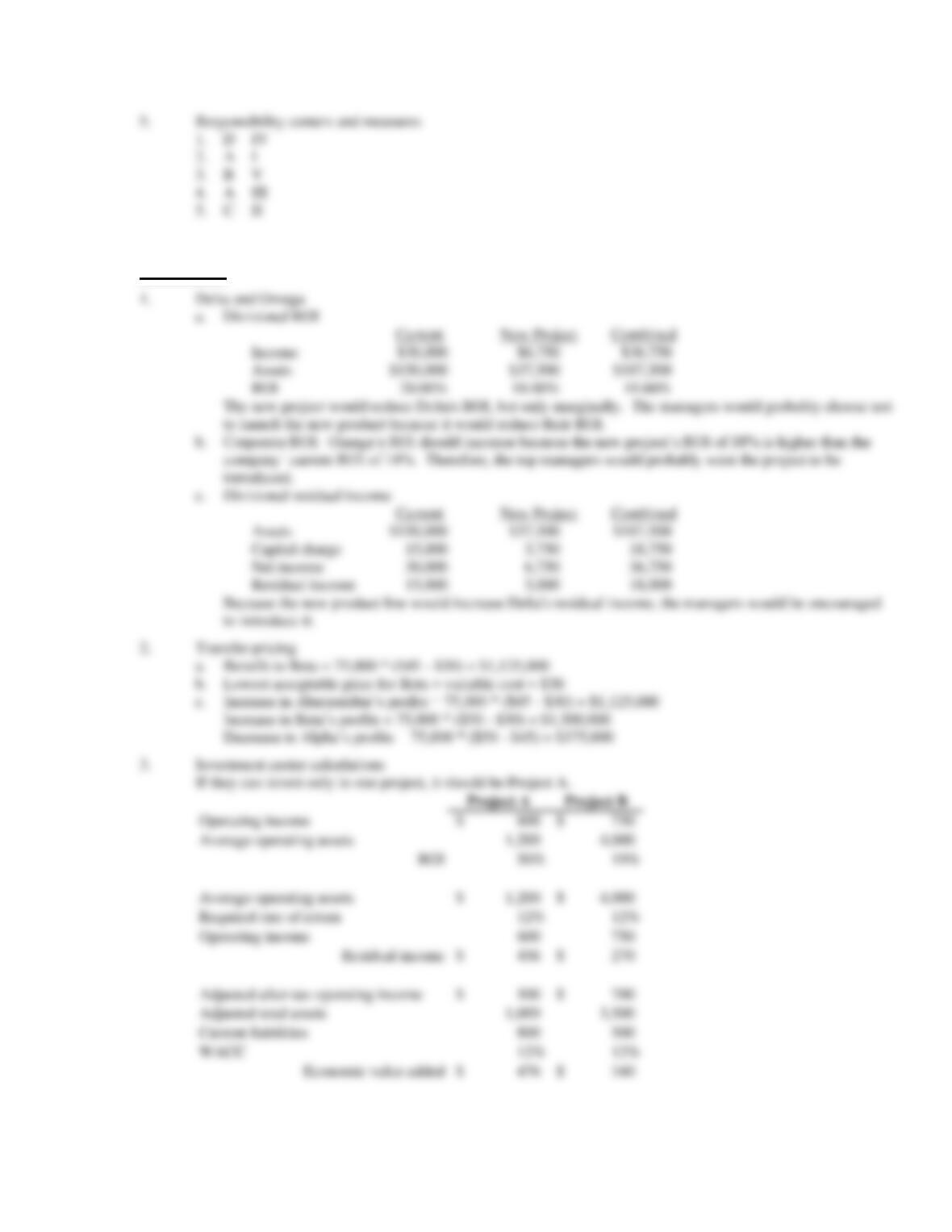
Performance Evaluation and Compensation 15-27
Exercises
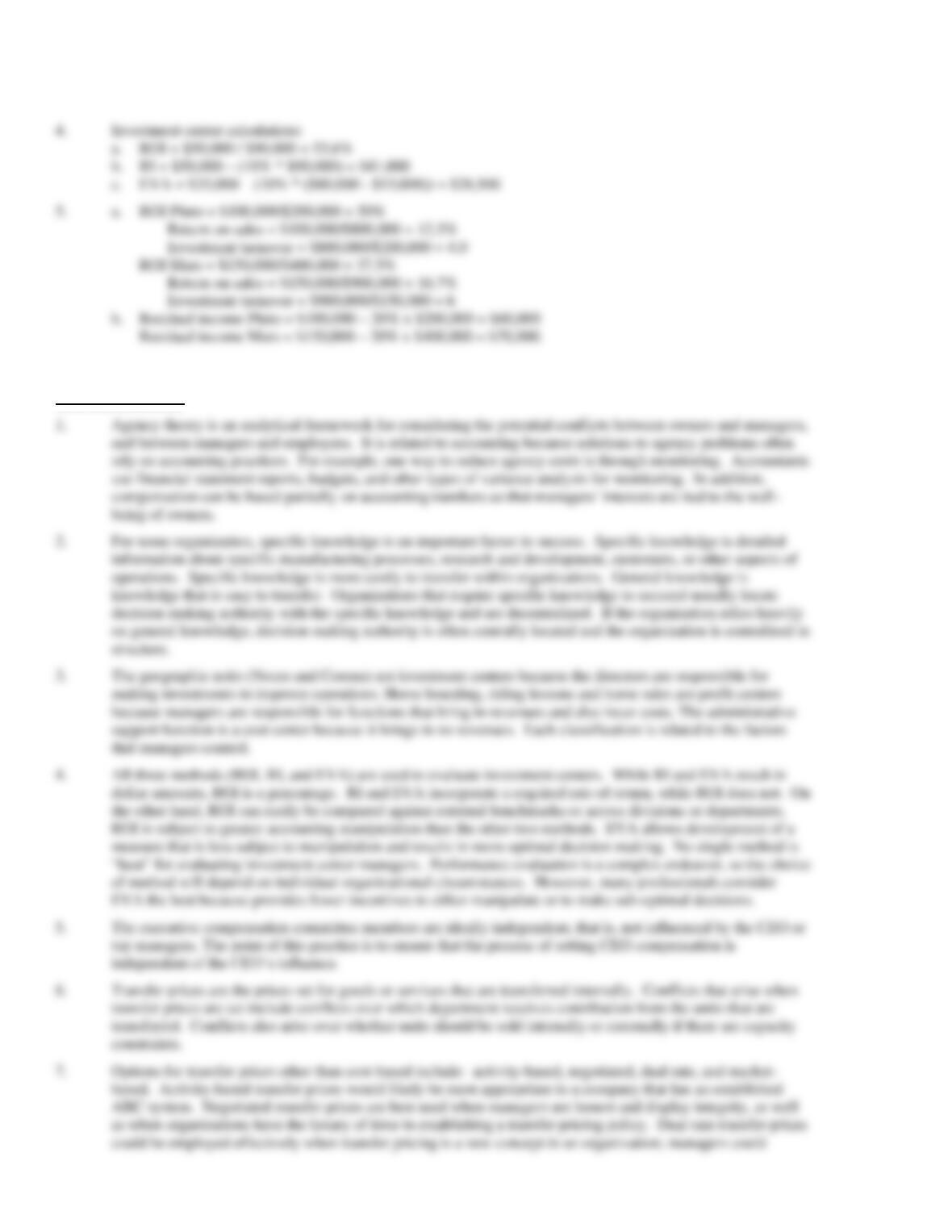
15-28 Cost Management
Short Answer
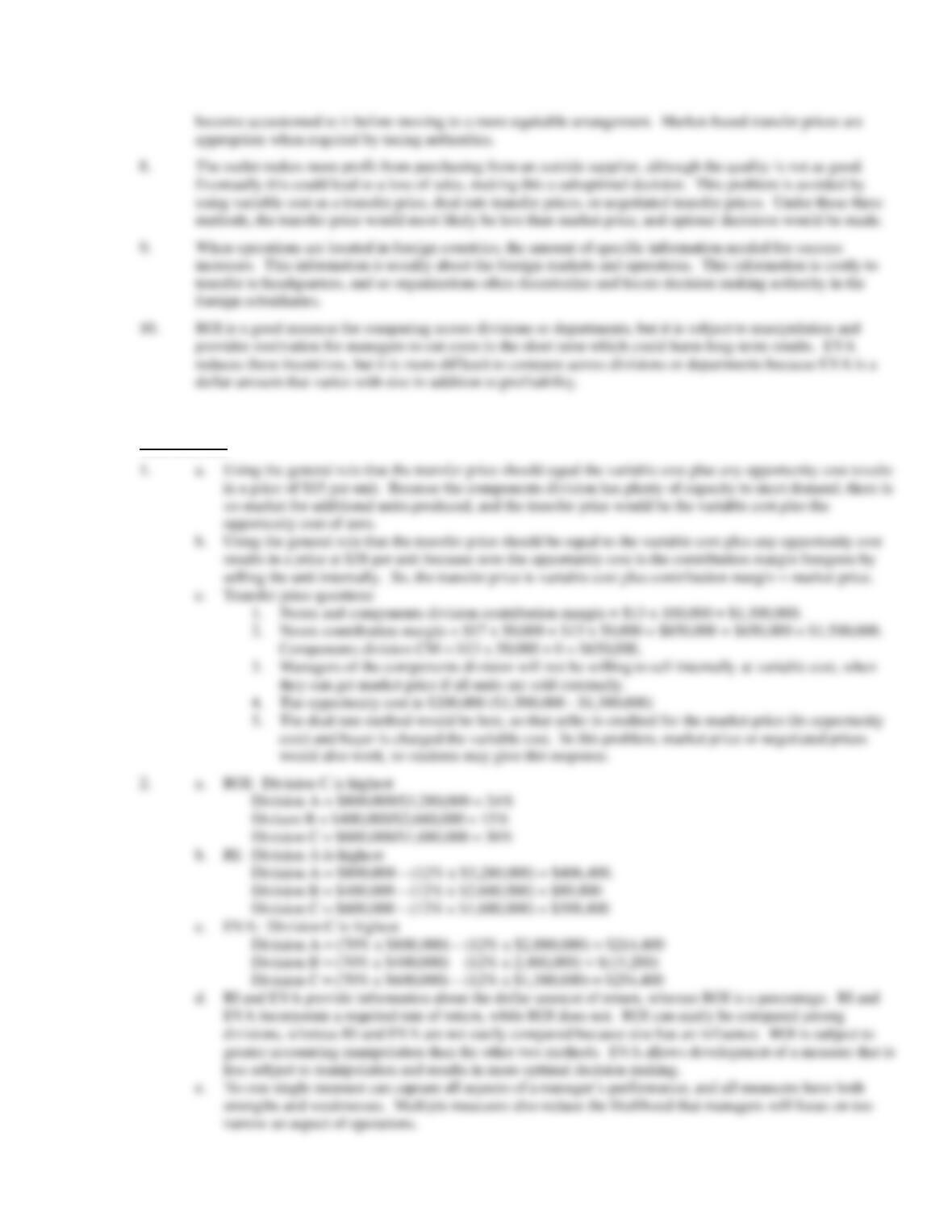
Performance Evaluation and Compensation 15-29
Problems