
Exam
Name___________________________________
MULTIPLE CHOICE. Choose the one alternative that best completes the statement or answers the question.
1)
Compared with stars in the disk, orbits of stars in the halo
1)
A)
are elliptical, with random orientations.
B)
are confined to a relatively thin plane.
C)
are elliptical, orbiting in the same direction.
D)
do not have to be around the galactic center.
E)
do not have to pass through the plane of the galaxy.
2)
What is an ionization nebula?
2)
A)
a region of very hot, low–density gas surrounding a recent supernova
B)
a colorful cloud of gas that glows because it is heated by light from nearby hot stars
C)
a clump of gas that will soon give birth to a new star
D)
a name sometimes used to describe spiral galaxies besides the Milky Way
3)
Which of the following properties is more likely to be a characteristic of a halo star in the Milky
Way, not a disk star?
3)
A)
It could be quite young.
B)
It orbits the center of the Milky Way galaxy.
C)
It has a low ratio of iron to hydrogen.
D)
It is moving very slowly relative to the Sun’s motion.
4)
Which of the following molecules is the most abundant in molecular clouds?
4)
A)
H2
B)
CO
C)
NH3
D)
H2O

5)
What makes up the interstellar medium?
5)
A)
O and B stars
B)
gas and dust
C)
K and M stars
D)
open clusters
E)
all of the above
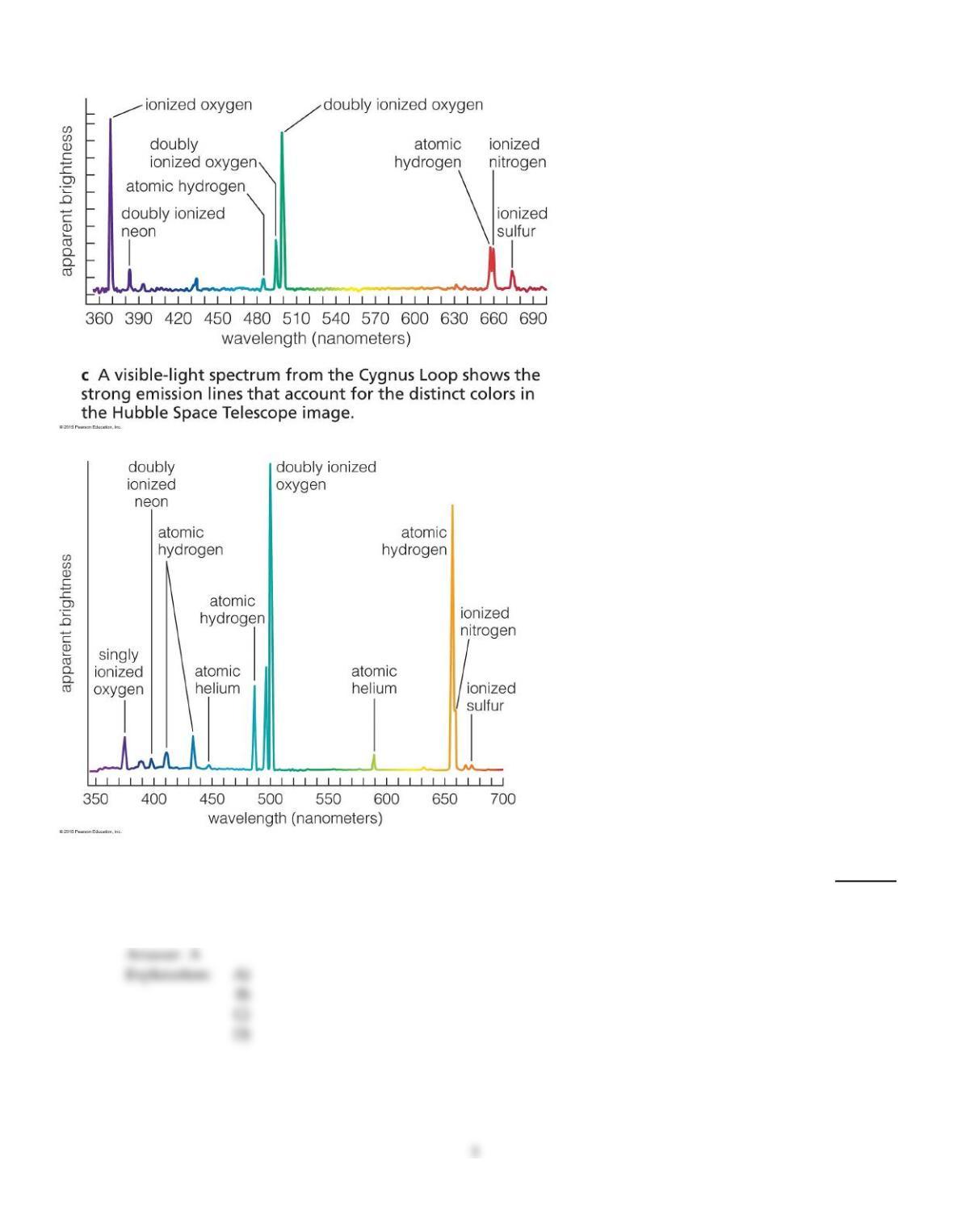
6)
Spectra for the Cygnus loop and the Orion nebula are shown above. Which of these is seen in the
Orion nebula, but is not clearly visible in the Cygnus loop spectrum?
6)
A)
atomic helium
B)
ionized oxygen
C)
atomic hydrogen
D)
ionized sulfur

7)
Harlow Shapley concluded that the Sun was not located at the center of the Milky Way Galaxy by
7)
A)
looking at other nearby spiral galaxies.
B)
looking at the shape of the “milky band” across the sky.
C)
mapping the distribution of gas clouds in the spiral arms.
D)
mapping the distribution of stars in the galaxy.
E)
mapping the distribution of globular clusters in the galaxy.
8)
Most stars in the Milky Way’s halo are ________.
8)
A)
found inside molecular clouds
B)
blue or white in color
C)
very young
D)
very old
D
9)
What is the most abundant molecule in interstellar clouds besides molecular hydrogen?
9)
A)
molecular helium
B)
ammonia
C)
water
D)
methane
E)
carbon monoxide
E
10)
What is the diameter of the disk of the Milky Way?
10)
A)
10,000 light years
B)
1,000 light years
C)
100,000 light years
D)
100 light years
E)
1,000,000 light years
C
E

11)
Sound waves in the interstellar medium
11)
A)
can travel through the halo interstellar medium but not the disk of the galaxy.
B)
can travel through the gas, but the very low density of the interstellar medium makes them
inaudible.
C)
travel extremely quickly and are therefore very loud.
D)
cannot travel through the gas.
E)
travel so slowly that they are undetectable.
12)
Which of the following patterns in the Milky Way structure is consistent with the idea that the
Milky Way has not suffered a major collision with another massive galaxy?
12)
A)
The halo is full of old stars orbiting in many different directions.
B)
Globular clusters are compact groups of thousands of stars.
C)
The disk is composed of stars orbiting in the same plane, same direction.
D)
The disk is composed of stars of many different ages.
13)
Approximately how long does it take the sun to go through a full cycle of passing above and below
the plane of the galaxy?
13)
A)
a few tens of millions of years
B)
a few million years
C)
a few thousand years
D)
a few hundred years
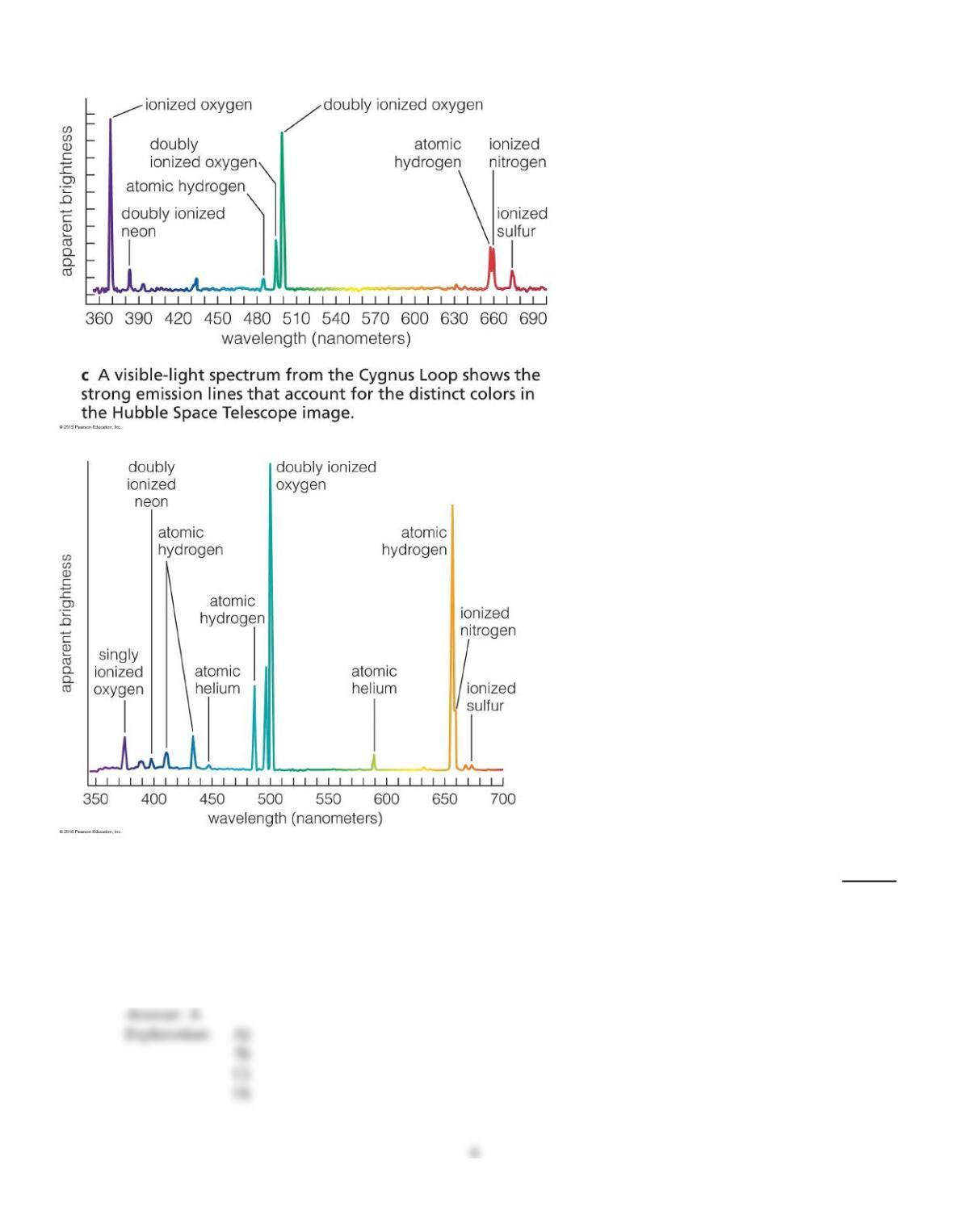
14)
Spectra for the Cygnus loop and the Orion nebula are shown above. Judging from their spectra,
how would these two objects look to the naked eye (assuming they were bright enough for colors to
be distinguished)?
14)
A)
The Cygnus loop would appear blue, and the Orion nebula would appear red.
B)
The Cygnus loop would appear blue, and the Orion nebula would appear blue.
C)
The Cygnus loop would appear red, and the Orion nebula would appear blue.
D)
The Cygnus loop would appear red, and the Orion nebula would appear red.

15)
Why has star formation ceased in the galactic halo?
15)
A)
The halo has no gas at all.
B)
All of the galaxy‘s cool gas settled to the galactic plane long ago.
C)
All the halo gas consists of elements with more protons than helium.
D)
There are no white dwarf binaries to trigger star formation via their supernovae.
16)
If we could see our own galaxy from 2 million light–years away, it would appear ________.
16)
A)
like a single, dim star
B)
to fill the sky with widely spaced stars
C)
as a faintly glowing band of light stretching all the way around the sky
D)
as a flattened disk with a central bulge and spiral arms
D
17)
What is the best evidence for a supermassive black hole in the center of the Milky Way Galaxy?
17)
A)
the gigantic bursts of X–ray energy from a mysterious dark object
B)
the motions of stars around a mysterious dark object
C)
amazing filaments of radio emission swirling around the center of the galaxy
D)
The existence of the Milky Way itself: The mass of the black hole is essential to gravitationally
bind the galaxy together, so it doesn’t fly apart.
B
18)
Suppose you read somewhere that 10 percent of the matter in the Milky Way is in the form of dust
grains. Should you be surprised? If so, why?
18)
A)
Given how easily dust grains can form, 10 percent is a surprisingly low fraction.
B)
The fraction of 10 percent is surprisingly high because dust grains can form only at low
temperatures.
C)
There is nothing surprising about the 10 percent figure because dust grains are the material
from which stars are born.
D)
The fraction of 10 percent cannot be correct. Dust grains are solid and only 2 percent of the
matter in the galaxy is made of anything besides hydrogen and helium.
D
B

19)
What are cosmic rays?
19)
A)
lasers used as weapons by extraterrestrials
B)
another name for gamma rays and X–rays
C)
fast–moving dust particles in the interstellar medium
D)
subatomic particles that travel close the speed of light
E)
the highest–energy form of light
20)
Where does most star formation occur in the Milky Way today?
20)
A)
in the bulge
B)
in the Galactic center
C)
uniformly throughout the Galaxy
D)
in the halo
E)
in the spiral arms
Explanation:
21)
How does the interstellar medium obscure our view of most of the galaxy?
21)
A)
The small mixture of dust grains in the interstellar medium absorbs visible light.
B)
Molecules in the interstellar medium absorb all wavelengths of light.
C)
Dust reflects most light from distant regions of the galaxy back towards the source.
D)
Hydrogen gas produces so much visible light that the interstellar medium is opaque, blocking
our view of anything beyond it.
E)
all of the above
Explanation:
22)
How are interstellar bubbles made?
22)
A)
by the collapse of a gas cloud to form stars
B)
by the winds of massive stars and supernovae explosions
C)
by the ejection of planetary nebulae from low–mass stars
D)
by the rapidly rotating magnetic fields of pulsars
E)
by collisions between the Milky Way and satellite dwarf galaxies
Explanation:
Explanation:

23)
Which of the following stars would be most likely to have the same abundance of elements heavier
than helium as a red main sequence star in globular cluster M13?
23)
A)
a red main–sequence star in the disk of the Milky Way
B)
red giant in globular cluster M13
C)
None of these choices
24)
Which of the following models best explains why our galaxy has spiral arms?
24)
A)
The spiral arms are a wave of star formation caused by wave of density propagating outward
through the disk of the galaxy.
B)
The spiral arms were imprinted on the galaxy at its birth. Ever since, like a coiling rope, the
spiral arms have been wound tighter with each galactic rotation.
C)
The spiral arms are composed of groups of stars that are bound together by gravity and
therefore always stay together as the galaxy rotates.
D)
No model can explain the existence of the arms, which rotate with the galaxy like the fins of a
giant pinwheel toy.
25)
Why are we unlikely to find Earth–like planets around halo stars in the Galaxy?
25)
A)
Halo stars are all very low mass stars that cannot hold onto planets.
B)
Halo stars formed from gas containing few heavy elements, the elements needed to create
terrestrial planets like the Earth.
C)
Planets around stars are extremely rare in our Galaxy.
D)
Halo stars formed from gas containing lots of heavy elements and few of the light elements
needed to create terrestrial planets like the Earth.
E)
Halo stars formed directly from gas in the halo without forming a planetary disk.
26)
Where does most star formation occur in the Milky Way Galaxy?
26)
A)
within the halo
B)
in the spiral arms
C)
in the central bulge
D)
everywhere throughout the galactic disk

27)
What is Sgr A
?
27)
A)
a source of bright X–ray emission coming from the entire constellation of Sagittarius
B)
a source of bright radio emission in the center of our galaxy
C)
the bulge at the center of our galaxy
D)
the brightest star in the constellation Sagittarius
E)
a source of bright ultraviolet light near the center of our galaxy
28)
All the following types of objects are found almost exclusively in the disk (rather than the halo) of
the Milky Way except ________.
28)
A)
globular clusters
B)
X–ray binaries
C)
young stars
D)
high–mass, red supergiant stars
29)
How would you expect a star that formed recently in the disk of the galaxy to differ from one that
formed early in the history of the disk?
29)
A)
It should be higher in mass.
B)
It should be much brighter.
C)
It should have a higher fraction of elements heavier than hydrogen and helium.
D)
It should orbit the galactic center at a much higher rate of speed.
E)
All of the above would be expected.
30)
What kinds of objects lie in the disk of our galaxy?
30)
A)
O and B stars
B)
open clusters
C)
old K and M stars
D)
gas and dust
E)
all of the above

31)
What produces the 21–cm radio line that we can be used to map the Milky Way Galaxy?
31)
A)
ionized hydrogen
B)
molecular hydrogen
C)
atomic hydrogen
D)
carbon monoxide
E)
helium
32)
What evidence suggests that most of the mass of the Milky Way is in the form of dark matter?
32)
A)
Our view of distant galaxies is often obscured by dark blotches, which are presumably made
of dark matter.
B)
Theoretical models of galaxy formation suggest that a galaxy cannot form unless it has at least
10 times as much matter as we see in the Milky Way disk.
C)
The orbital speeds of stars far from the galactic center are surprisingly high.
D)
Although dark matter emits no visible light, we have detected its radio emissions.
Explanation:
33)
Red and orange stars are found evenly spread throughout the galactic disk, but blue stars are
typically found ________.
33)
A)
only in the central bulge
B)
only in or near star–forming clouds
C)
also evenly spread throughout the galactic disk
D)
in the halo
Explanation:
34)
The image of our galaxy in radio emission from carbon monoxide maps the distribution of
molecular clouds. Which of the following would give a similar picture of our galaxy?
34)
A)
infrared emission from interstellar dust grains
B)
X–rays from hot gas bubbles in the disk
C)
visible light, which is closest to how the night sky appears from Earth
D)
21–cm–line radio emission from atomic hydrogen
E)
visible light, showing the edges of supernova bubbles
Explanation:
Explanation:

35)
The Sun’s location in the Milky Way Galaxy is ________.
35)
A)
very near the galactic center
B)
at the very outer edge of the galactic disk
C)
in the halo of the galaxy, about 28,000 light–years above the galactic disk
D)
in the galactic disk, roughly halfway between the center and the outer edge of the disk
36)
How can we see through the interstellar medium?
36)
A)
by observing at wavelengths (high–energy X–rays and long wavelength radio waves) that are
not absorbed by interstellar dust
B)
by observing with telescopes above the Earth’s atmosphere, such as the Hubble Space
Telescope
C)
by observing only the brightest stars in the galaxy
D)
by observing with only the biggest telescopes
E)
We cannot see through the interstellar medium.
37)
What happens after many generations of the star–gas–star cycle?
37)
A)
The heavy element abundance decreases; the amount of gas increases.
B)
The heavy element abundance increases; the amount of gas decreases.
C)
The heavy element abundance increases; the amount of gas increases.
D)
The heavy element abundance increases; the amount of gas stays the same.
E)
The amount of gas and heavy elements stay the same: it’s a cycle.
F)
The heavy element abundance stays the same; the amount of gas decreases.

38)
What is the best evidence for an extremely massive black hole in the center of the Milky Way?
38)
A)
Huge amounts of X–rays are pouring out of the center of the galaxy.
B)
The orbits of stars in the center of the galaxy indicate that the presence of 3 to 4 million solar
mass object in a region no larger than our Solar System.
C)
The center of our galaxy hosts a pulsar that is spinning so fast that it could only be a black
hole.
D)
We observe stars vanishing in the center of the Galaxy as they are sucked into the black hole.
39)
How do high mass stars transport newly formed elements into the interstellar medium?
39)
A)
stellar winds
B)
supernova explosions
C)
formation of planetary nebula
D)
A and B
E)
A and C
D
40)
Where do most dust grains form?
40)
A)
in supernovae
B)
in molecular clouds
C)
in planetary nebulae
D)
in the winds of red giant stars
E)
all of the above
D
41)
What do we mean by the interstellar medium?
41)
A)
the middle section of the Milky Way galaxy
B)
the gas and dust that lie in between the stars in the Milky Way galaxy
C)
the dust that fills the halo of the Milky Way galaxy
D)
the name of an oracle who can channel messages from beings that live near the star called
Vega
B
B

42)
What do we mean by a protogalactic cloud?
42)
A)
a term once used historically to refer to any galaxy
B)
the cloud–like halo that surrounds the disks of spiral galaxies
C)
a cloud of gas that was once a galaxy
D)
a cloud of hydrogen and helium that contracts to become a galaxy
43)
How do low mass stars transport newly formed elements into the interstellar medium?
43)
A)
formation of planetary nebula
B)
F supernova explosions
C)
stellar winds
D)
A and B
E)
A and C
E
44)
How do high–mass stars make it more difficult for a molecular cloud to form more stars?
44)
A)
Ultraviolet photons heat the gas.
B)
Ultraviolet photons ionize the gas.
C)
Radiation pressure pushes ionized gas away.
D)
Strong winds push gas away.
E)
All of the above
E
45)
Where are most heavy elements made?
45)
A)
in stars and supernovae
B)
in the interstellar medium
C)
All were made in the Big Bang, when the universe first began.
D)
none of the above
E)
all of the above
A
D
46)
What do we mean by the star–gas–star cycle?
46)
A)
It is the idea that stars in close binary systems can exchange gas with one another.
B)
It is the set of nuclear reactions by which heavy elements are produced in the cores of massive
stars.
C)
It is the continuous recycling of gas in the galactic disk between stars and the interstellar
medium.
D)
It describes the orbits of the stars and interstellar medium around the center of the galaxy.
47)
What kinds of objects lie in the halo of our galaxy?
47)
A)
gas and dust
B)
O and B stars
C)
open clusters
D)
globular clusters
E)
all of the above
48)
What is a shock wave?
48)
A)
a pressure wave that moves slower than the speed of sound
B)
an electromagnetic wave created when electrons recombine with protons
C)
a pressure wave that moves faster than the speed of light
D)
a pressure wave that moves faster than the speed of sound
E)
an electromagnetic wave that can create electrical shocks
49)
The most common form of gas in the disk of the Milky Way galaxy is ________.
49)
A)
atomic hydrogen gas
B)
gas in stellar winds
C)
molecular hydrogen
D)
gas in hot bubbles

50)
How do we learn about the conditions at the center of our own galaxy, the Milky Way?
50)
A)
High–resolution photographs obtained by the Hubble Space Telescope have revealed the
galactic center using visible light.
B)
While we cannot see the galactic center with visible or ultraviolet light, radio and X–rays from
the center can be detected and used to determine the conditions there.
C)
We must look at the centers of other (external) galaxies and assume that they are similar to the
Milky Way.
D)
The gas and dust in the Milky Way prevent any type of direct observation of the galactic
center, but theoretical models allow us to predict what is happening there.
51)
Approximately how far is the Sun from the center of the galaxy?
51)
A)
270 light–years
B)
27,000 light–years
C)
27 million light–years
D)
2,700 light–years
E)
27 light–years
B
52)
What kind of object do we think lies in the center of the Milky Way Galaxy?
52)
A)
a gigantic X–ray binary system
B)
a 3 to 4 million solar mass black hole
C)
a dense cluster of young, hot stars
D)
an enormous collection of dark matter, explaining why we detect no light at all from the
galactic center
B
53)
What is the most common form of gas in the interstellar medium?
53)
A)
atomic helium
B)
molecular hydrogen
C)
ionized hydrogen
D)
molecular helium
E)
atomic hydrogen
E
B

54)
Which of the following statements comparing halo stars to our Sun is not true?
54)
A)
Most stars in the halo have cooler surface temperatures than the Sun.
B)
Most stars in the halo have either died or are in their final stages of life, while the Sun is only
in about the middle of its lifetime.
C)
Most stars in the halo are less luminous than the Sun.
D)
Most stars in the halo contain a much lower percentage of heavy elements than the Sun.
55)
Over time, what is the net effect of the star–gas–star cycle in the Milky Way?
55)
A)
The total mass in the galaxy‘s interstellar medium is gradually increased, and the new gas is
continually enriched in heavy elements.
B)
The temperature of the interstellar medium varies between the cool 10–50 degrees (Kelvin)
required to form stars and the 2000–30,000 degree (Kelvin) temperatures of the outer layers of
the stars that form. But over time, more and more of the interstellar medium remains cool.
C)
The total mass in the galaxy’s interstellar medium is gradually reduced, and the remaining
gas is continually enriched in heavy elements.
D)
The gas of the interstellar medium is continually depleted in elements heavier than helium.
E)
There is no net effect to the cycle. Mass in the interstellar medium lost to star formation is
exactly replaced by stellar winds and supernova explosions.
56)
If we could watch spiral arms from a telescope situated above the Milky Way over 500 million
years, what would we see happen?
56)
A)
Stars will move through the spiral arms, bunching up closer as they pass through. Young hot
stars will form and die within the arms before having a chance to move out.
B)
The spiral arms will eventually dissipate and fade away, since they are a temporary
phenomenon that should only last for a million years or so.
C)
The spiral arms will seem to “wind up,” to wrap more and more tightly around the center of
the Galaxy.
D)
The spiral arms will eventually unwind, as centripetal forces send the stars flying outwards
into intergalactic space.

57)
How should we expect the Milky Way’s interstellar medium to be different in 50 billion years than
it is today?
57)
A)
Thanks to the recycling of the star–gas–star cycle, the interstellar medium should look about
the same in 50 billion years as it does today.
B)
The total amount of gas will be much less than it is today.
C)
The total amount of gas will be about the same, but the percentage of elements heavier than
hydrogen and helium will have risen from the current 2% to more than 50%.
D)
The total amount of gas will be much greater, since many stars will undergo supernovae
between now and then.
58)
Interstellar dust consists mostly of ________.
58)
A)
hydrogen and helium atoms
B)
microscopic particles of carbon and silicon
C)
tiny grains of water ice
D)
the same tiny particles found in household dust
E)
ozone “smog”
59)
What affects the average orbital speed of a star in our galaxy?
59)
A)
the mass and age of the star
B)
the mass of the galaxy inside its orbit and the size of its orbit
C)
the mass and age of the galaxy
D)
the star’s mass and the mass of the galaxy
60)
About what percentage of the mass of a molecular cloud is in the form of dust?
60)
A)
98%
B)
10%
C)
50%
D)
1%

61)
Which of the following are signposts of the presence of high mass stars, and thus recent star
formation?
61)
A)
closely spaced low mass stars
B)
predominantly blue reflection nebulae
C)
predominantly red ionization nebulae
D)
A and C
E)
B and C
62)
What do we call the bright, sphere–shaped region of stars that occupies the central few thousand
light–years of the Milky Way Galaxy?
62)
A)
the galaxy’s halo
B)
the galaxy’s disk
C)
a globular cluster
D)
the galaxy’s bulge
63)
Fill in the blank: Elements heavier than hydrogen and helium constitute about ________ of the mass
of the interstellar medium.
63)
A)
70%
B)
0.002%
C)
98%
D)
2%
64)
How do disk stars orbit the center of the galaxy?
64)
A)
They all orbit in roughly the same plane and in the same direction.
B)
They follow orbits that move up and down through the disk, typically taking them about
50,000 light–years above and below the disk on each orbit.
C)
They follow spiral paths along the spiral arms.
D)
They have orbits randomly inclined and in different directions relative to the galactic center.

65)
What evidence suggests that the protogalactic cloud that formed the Milky Way resulted from
several collisions among smaller clouds?
65)
A)
Halo stars differ in age and heavy–element content, but these variations do not seem to
depend on the stars‘ distance from the galactic center.
B)
The Milky Way is the central galaxy of a dense cluster of galaxies.
C)
The stars in the halo of the Milky Way are organized into several dense clusters arranged
throughout the halo.
D)
The bulge of the Milky Way is surrounded by many globular clusters, just as elliptical
galaxies are.
E)
The Milky Way resembles an elliptical galaxy more than other spirals do.
66)
How did star formation likely proceed in the protogalactic cloud that formed the Milky Way?
66)
A)
The stars that formed first eventually settled into a galactic disk, circling the center of the
galaxy.
B)
The stars that formed first could orbit the center of the galaxy in any direction at any
inclination.
C)
The protogalactic cloud gradually formed stars, starting from the outer edges of the spiral
arms and working inward.
D)
The protogalactic cloud gradually formed stars, starting from the center of the galaxy
working outwards.
67)
The galactic center lies in the direction of which constellation?
67)
A)
Sagittarius
B)
Taurus
C)
Leo
D)
the Big Dipper
E)
Orion

68)
What do halo stars do differently from disk stars?
68)
A)
They remain stationary, quite unlike disk stars that orbit the galactic center.
B)
They orbit the center of the galaxy at much lower speeds than disk star.
C)
Halo stars explode as supernovae much more frequently than disk stars.
D)
They orbit the galactic center with many different inclinations, while disk stars all orbit in
nearly the same plane.
69)
What are the Magellanic Clouds?
69)
A)
two small galaxies that orbit the Milky Way Galaxy
B)
two nebulae located in the disk of the Milky Way galaxy and visible only from the Southern
Hemisphere
C)
the clouds of dust and gas found interspersed in many places throughout the Milky Way
Galaxy
D)
star–forming clouds found in the constellation Orion
A
70)
What causes the sun to “bob” up–and–down in its orbit around the galactic center?
70)
A)
gravitational attraction towards other nearby galaxies
B)
lack of friction with the low–density interstellar medium
C)
the localized pull of stars within the disk itself
D)
A and B
E)
B and C
E
71)
How does the diameter of the disk of Milky Way Galaxy compare to its thickness?
71)
A)
The diameter is about 100 times as great as the thickness.
B)
The diameter and thickness are roughly equal.
C)
The diameter is about 100,000 times as great as the thickness.
D)
The diameter is about 10 times as great as the thickness.
A
D

72)
On a dark summer night in the northern hemisphere, we can see the Milky Way, but we can‘t see
the center of the Milky Way. Why not?
72)
A)
There are no stars in the center of the Milky Way, just a supermassive black hole.
B)
Interstellar dust and gas absorb and scatter visible light.
C)
The center of the Milky Way does not emit enough visible light.
D)
We are in the center of the Milky Way.
73)
What is the thickness of the disk of the Milky Way?
73)
A)
100,000 light years
B)
10,000 light years
C)
1,000 light years
D)
100 light years
E)
1,000,000 light years
C
74)
What elements do astronomers consider heavy elements?
74)
A)
all elements besides hydrogen and helium
B)
elements that are heavier than uranium
C)
elements that are heavier than iron
D)
elements that are heavier than carbon
E)
elements that are heavier than hydrogen
A
75)
How does the interstellar medium affect our view of most of the galaxy?
75)
A)
It prevents us from seeing most of the galactic disk with visible and ultraviolet light.
B)
It produces so much visible light that it blocks our view of anything beyond it.
C)
It has no effect on visible–light observations, but prevents us from studying the galactic center
with radio waves or X–rays.
D)
It absorbs all wavelengths of light.
A
B

76)
Based on observations, which of the following statements about stars in the Milky Way is generally
true?
76)
A)
The older the star, the bluer its color.
B)
The younger the star, the higher its mass.
C)
The older the star, the faster its orbital speed.
D)
The older the star, the lower its abundance of heavy elements.
E)
The less massive the star, the older it is.
77)
The very first stars in the universe were made of
77)
A)
hydrogen and helium, 0.1% heavy elements.
B)
hydrogen and helium, 10% heavy elements.
C)
hydrogen and helium.
D)
hydrogen and helium, 2% heavy elements.
78)
Which of the following statements is not true of the object known as Sgr A* in the center of our
Galaxy?
78)
A)
It is a source of X–ray emission that we have observed with telescopes in space.
B)
It is thought to harbor a black hole of more than 3 million solar masses.
C)
It is a source of bright radio emission.
D)
It is by far the brightest source of visible light lying in the direction of the galactic center.
79)
Why do we believe that most of the mass of the Milky Way is in the form of dark matter?
79)
A)
Our view of distant galaxies is sometimes obscured by dark blotches in the sky, and we
believe these blotches are dark matter located in the halo.
B)
The orbital speeds of stars far from the galactic center are surprisingly high, suggesting that
these stars are feeling gravitational effects from unseen matter in the halo.
C)
Although dark matter emits no visible light, it can be seen with radio wavelengths, and such
observations confirm that the halo is full of this material.
D)
Theoretical models of galaxy formation suggest that a galaxy cannot form unless it has at least
10 times as much matter as we see in the Milky Way disk, suggesting that the halo is full of
dark matter.

80)
If you were to take a voyage through the entire disk of the Milky Way, what kind of material would
you spend most of your time in?
80)
A)
cool, dense clouds of molecular hydrogen
B)
star clusters
C)
hot bubbles of ionized hydrogen
D)
empty space–a pure vacuum
E)
rarefied clouds of atomic hydrogen
81)
What evidence supports the existence of a black hole at the center of our galaxy?
81)
A)
We observe a large, dark object that absorbs all light at the center of our galaxy.
B)
We observe an extremely bright X–ray source at the center of our galaxy.
C)
We can see gas falling into an accretion disk and past the event horizon of a black hole.
D)
The motions of the gas and stars at the center indicate that it contains 4 million solar masses
within a region only 3 light–years across.
E)
All of the above
D
82)
Which of the following does not accurately describe what we observe toward the Galactic center?
82)
A)
At X–rays, we see faint emission from an accretion disk around a black hole.
B)
At infrared wavelengths, we see a massive star cluster.
C)
At optical wavelengths, we see a cluster of old, red stars.
D)
At radio wavelengths, we see giant gas clouds threaded by powerful magnetic fields.
C
83)
Most nearby stars move relative to the Sun at speeds below about 30 km/s. Suppose you observe a
nearby star that is moving much faster than this (say, 300 km/s). Which of the following is a likely
explanation for its high speed?
83)
A)
It has been pushed to high speed by the shock wave from a nearby supernova.
B)
It is a very high mass star.
C)
It is probably a halo star that is currently passing through the disk.
D)
It is a very young star, recently formed.
C
E

84)
Which star is older?
84)
A)
an A star in the globular cluster M13
B)
an M star in the globular cluster M13
C)
Both stars (the A and M star) are the same age.
85)
If you could watch a time–lapse movie of the interstellar medium over hundreds of millions of
years, what would you see?
85)
A)
The entire disk of the Milky Way would pulsate in and out as it contracts to form stars and
then blows out in supernovae and then contracts to form stars again and so on.
B)
The movie would alternate back and forth between being very bright when there is a lot of
gas and very dark when there is very little gas.
C)
Gas that changes only in very slow and steady ways, so that the movie would in fact be quite
boring
D)
Gas that is often moving at high speed, particularly after one or more supernovae, and
constantly changing form between molecular clouds, atomic hydrogen, and hot, ionized
bubbles and superbubbles
D
86)
Spiral arms appear bright because ________.
86)
A)
they contain far more stars than other parts of the galactic disk
B)
they contain more molecular clouds than other parts of the disk
C)
they are the only places where we find stars within the disk of the galaxy
D)
they contain more hot young stars than other parts of the disk
D
87)
Suppose you want to observe and study the radiation from gas inside an interstellar bubble created
by a supernova. Which of the following observatories will be most useful?
87)
A)
the Keck I telescope on the summit of Mauna Kea
B)
the SOFIA airborne infrared observatory
C)
the Hubble Space Telescope
D)
the Chandra X–ray Observatory
D
B

88)
Why do stars in the disk of a spiral galaxy orbit in roughly the same direction, in the same plane in
space?
88)
A)
Collisions between the stars caused their motions to organize into a general, spinning disk
direction.
B)
The gas that formed the stars was shaped as a giant, rotating disk.
C)
After the stars formed, gravity pulled the stars down into a plane in space, all orbiting a
supermassive black hole.
D)
It is pure coincidence; the stars just happen to be going in the same direction.
89)
Over time, the star–gas–star cycle leads the gas in the Milky Way to ________.
89)
A)
have a greater abundance of heavy elements
B)
become denser and have a greater abundance of heavy elements
C)
become denser and hotter
D)
have a lower abundance of heavy elements
90)
Suppose a scientist holds a press conference at which he claims that 10% of the matter in the Milky
Way is in the form of dust grains. Does his claim seem reasonable? Why or why not?
90)
A)
It seems reasonable as long as we assume that red giant starswhich produce dust grains in
their stellar windsare more common than we thought.
B)
It is reasonable because we already know that interstellar dust obscures our view through the
disk of the galaxy.
C)
The 10% figure is too low because most of the mass of the galaxy is in the form of interstellar
dust.
D)
The 10% figure is too high because there are not enough heavy elements to make that much
dust.

91)
Approximately how long does it take the Sun to orbit the center of the Milky Way Galaxy?
91)
A)
2 billion years
B)
2 million years
C)
20,000 years
D)
200,000 years
E)
200 million years
92)
Compared to our Sun, most stars in the halo are
92)
A)
young, red, and dim and have fewer heavy elements.
B)
young, blue, and bright and have many more heavy elements.
C)
old, red, and dim and have fewer heavy elements.
D)
old, red, and bright and have fewer heavy elements.
E)
old, red, and dim and have many more heavy elements.
93)
Which of the following observations confirms that Sgr A at the center of our galaxy is indeed a
supermassive black hole?
93)
A)
measurements of trans–dimensional space warps in the vicinity of Sgr A
B)
measurements of radio emission from gas around Sgr A
C)
measurements of occasional X–ray emission from Sgr A
D)
measurements of the orbits of stars around Sgr A
94)
How do we know the total mass of the Milky Way Galaxy that is contained within the Sun’s orbital
path?
94)
A)
by applying Newton’s version of Kepler’s third law (or the equivalent orbital velocity law) to
the Sun’s orbit around the center of the Galaxy
B)
by estimating the amount of gas and dust in between the stars
C)
by using the law of conservation of angular momentum to calculate the orbital speeds of
nearby stars
D)
by counting the number of stars visible in this region of the galaxy
95)
The primary way that we observe the atomic hydrogen that makes up most of the interstellar gas in
the Milky Way is with ________.
95)
A)
X–ray telescopes
B)
radio telescopes observing at a wavelength of 21 centimeters
C)
ground–based visible–light telescopes
D)
space–based ultraviolet telescopes
96)
The Sun lives in which component of the Milky Way?
96)
A)
the bulge
B)
a globular cluster
C)
the disk
D)
the halo
97)
Which kind of star is highly unlikely to be found in the halo of the Milky Way?
97)
A)
G star
B)
O star
C)
K star
D)
M star
SHORT ANSWER. Write the word or phrase that best completes each statement or answers the question.
98)
How would our view of our galaxy be different if we were located in the central bulge?
What about if we were located in a halo globular cluster?
98)
99)
What produces the striking red, blue, and black colors of ionization nebulae?
99)
100)
The average speed of stars relative to the Sun in the solar neighborhood is about 20 km/s.
Suppose you discover a star in the solar neighborhood that is moving relative to the Sun at
a much higher speed, say 220 km/s. What kind of orbit does this star probably have around
the Milky Way? In what part of the galaxy does it spend most of its time? Explain.
100)
101)
Suppose you discovered a star made purely of hydrogen and helium. How old do you
think it would be? Explain.
101)
102)
Explain why in space, “no one can hear you scream.”
102)
103)
Why do spiral arms have a blue color?
103)
104)
Astronomers observe huge bubbles of hot gas, some over a thousand light years across, in
the Milky Way. What is their cause?
104)
105)
Briefly describe the star–gas–star cycle.
105)
106)
Reflection nebula are bluer than the stars that illuminate them. The Earth’s sky is bluer
than the Sun. Is this a coincidence? Explain why or why not.
106)
107)
Briefly describe how we can use the orbital characteristics of stars at many distances from
the galactic center to determine the distribution of mass in the Milky Way.
107)
108)
Briefly explain why stars that formed early in the history of the galaxy contain a smaller
proportion of heavy elements than stars that formed more recently.
108)
TRUE/FALSE. Write ‘T’ if the statement is true and ‘F’ if the statement is false.
109)
The star–gas–star cycle will continue forever because stars are continually recycling gas.
109)
110)
Open clusters and young stars are generally found only in the disk of the Milky Way and not in the
halo.
110)
111)
The Milky Way looks the same in X–rays as it does at infrared wavelengths.
111)
112)
All heavy elements are made during supernova explosions.
112)
113)
Most of the mass of the galaxy is located at the galactic center in the form of a massive black hole.
113)
114)
Observing our galaxy at radio wavelengths allows us to see through the dust in the disk that
obscures our view.
114)
115)
Shapley used the distribution of globular clusters in our galaxy to determine that the Sun was not
at the center of the Milky Way.
115)
116)
Almost all elements heavier than hydrogen and helium were made inside stars.
116)
117)
Most of the mass of the Milky Way is located in the halo of the galaxy in the form of dark matter.
117)
118)
All elements heavier than iron are made during supernova explosions.
118)
119)
We can see most of the Milky Way with visible light.
119)
120)
Most of the current star formation in the Milky Way occurs in its spiral arms.
120)
121)
The Sun is located near the edge of our galaxy, approximately 100,000 light–years from the galactic
center.
121)
ESSAY. Write your answer in the space provided or on a separate sheet of paper.
122)
Observational Bias: The history of human understanding of the structure of the Milky Way starts with the bias
that humans use visible light to see. Imagine you were a creature on another planet in the disk of the Milky Way
who used radio waves to “see” the universe. What would have been your starting point for the structure of the
Milky Way? What components would you have found easier to detect? What components would have been
harder?
123)
Modified Newtonian Dynamics? The case for dark matter in the Milky Way can be viewed as a failure of stars and
gas far from the galactic center to obey Newton’s law of gravitational attraction— that is, the stars and gas seem
to orbit too quickly for the visible matter their orbits enclose. Why do you think that astronomers choose to
“save” Newton’s form of gravitational attraction by postulating unseen dark matter, as opposed to regarding the
observed orbital motion as a falsification of Newtonian gravitation on the scale of the Milky Way? [Note: At the
distance scales involved, the gravitational forces in the galaxy are all fairly weak, much weaker than those
encountered in a neutron star or black hole, and hence Einstein’s theory of gravity (General Relativity) gives the
same predictions as Newton’s gravitational law].
124)
Inferring cloud properties using carbon–monoxide: At the low temperatures of molecular clouds, carbon monoxide
emits radio light more strongly than does molecular hydrogen. What assumptions must be made to then use
observations of carbon monoxide to infer the properties of the cloud as a whole?
125)
A History of Water: One of the triumphs of 20th century astronomy is a convincing explanation for the origin of
the chemical elements. Consider a single water molecule in your body, consisting of two hydrogen atoms and a
single oxygen atom. Trace, from the earliest point in time that you can, the history of these atoms. List all of the
possible environments in which these particular atoms could have spent time.
Answer Key
Testname: C15
Answer Key
Testname: C15
34
Answer Key
Testname: C15
Answer Key
Testname: C15