
CHAPTER 15: LEAN ACCOUNTING AND PRODUCTIVITY
MEASUREMENT
1. Lean manufacturing is concerned with eliminating waste in manufacturing processes.
a. True
b. False
2. Lean manufacturing adds value by reducing labor costs.
a. True
b. False
3. Customer value is the difference between what a customer receives and what they give up.
a. True
b. False
4. The value stream focuses on just value-added activities.
a. True
b. False
5. Employee empowerment is a major difference between traditional and lean environments.
a. True
b. False
6. Changes in product-costing and operational control approaches are crucial to a value-stream based lean
manufacturing system.
a. True
b. False
7. Productivity is concerned with the efficiency of input usage in producing output.
a. True
b. False

Chapter 15: Lean Accounting and Productivity Measurement
8. The two lean accounting approaches are average-costing and value-stream cost reporting.
a. True
b. False
9. Implementing the value-stream structure requires an increase in employees.
a. True
b. False
10. Value-stream costing reports the actual revenues and actual costs on a weekly basis for each value stream.
a. True
b. False
11. A Box Scorecard is used by the lean control system to compare operational, capacity, and financial figures
a. True
b. False
12. Technical efficiency is concerned with a given input using no more than needed output.
a. True
b. False
13. Allocating efficiency chooses the least costly, technically efficient combination of inputs.
a. True
b. False
14. Productivity measurement is a quantitative assessment of increases or decreases in productivity.
a. True
b. False
15. Operational partial measures are difficult to interpret by those within an organization.
a. True
b. False
Chapter 15: Lean Accounting and Productivity Measurement
16. The productivity measure of all inputs simultaneously is called total productivity measurement.
a. True
b. False
17. Profile measurement provides a series of profiles for all operational measures.
a. True
b. False
18. Profit–linked productivity measurement involves the measuring of the amount of profit related to productivity
change.
a. True
b. False
19. Partial measures allow managers to focus on the use of the total production and are easily interpreted.
a. True
b. False
20. The disadvantage of using partial measures in isolation is that it can be misleading.
a. True
b. False
21. The worth of one or more features of a product for which customers are willing to pay is
called __________ .
22. Identifying value streams may be accomplished by using a two-dimensional matrix
where are listed on one dimension, and on a second dimension.
23. The departments or cells that contain all the related operations needed to produce a family of products are called
__________ .
24. Maximizing customer value, on–demand production, and zero setup times are realized in the
pursuit of .
Chapter 15: Lean Accounting and Productivity Measurement
25. The is used by the lean control system to compare operational, capacity, and financial metrics.
26. In a lean environment, many overhead costs are assigned to products as directly costs.
27. allocation is the only allocation used regularly in a value stream cost assignment.
28. The accounting approach designed to support and encourage lean manufacturing is
called accounting.
29. The point at which technical and allocative efficiency are achieved is called efficiency.
30. The achievement of efficiency and efficiency is the point of total productive efficiency.
31. The process of producing output efficiently using the least amount of inputs
is called __________ .
32. The quantitative assessment of productivity changes is called measurement.
33. The component which provides a server or vector of separate and distinct partial operational measures is called
__________ measurement.
34. An assessment of productive efficiency for all inputs combined is called measurement.
35. The difference between the total profit change and the profit–linked productivity change
is called the component.

Chapter 15: Lean Accounting and Productivity Measurement
36. Lean manufacturing benefits of better quality, reduced lead times, inventory reductions, and reduced setup
times result in
a. lower manufacturing costs.
b. increased production rates.
c. reductions in innovative capabilities.
d. both a and b.
37. Lean manufacturing is best defined as
a. an operating approach that reports on the effectiveness of the management of the organization.
b. an operating approach designed to eliminate waste and maximize customer value.
c. an operating approach that is designed to analyze the activities of the organization.
d. an operating approach that is designed to compute variances between expectations and actual performance.
38. Which of the following is NOT a characteristic of a lean manufacturing system?
a. delivery of the right product in the right quantity
b. zero defect
c. delivery of product the exact time a customer needs it
d. all of the above
39. A difference between Toyota’s lean manufacturing system and Ford’s lean enterprise system is
a. Toyota incorporated employee empowerment, team structure, cellular manufacturing, small batches,
and reduced setup times as integral pieces of their system.
b. Toyota was not structured to deal with product variety.
c. Toyota valued process over employees.
d. Low volume products were not compatible with either system.
40. Which is NOT a benefit of lean manufacturing?
a. increased productivity
b. reduced lead times
c. reduced direct labor costs
d. reductions in inventory

Chapter 15: Lean Accounting and Productivity Measurement
41. Lean manufacturing shares many of the same methodologies as
a. activity-based management.
b. JIT manufacturing.
c. process costing.
d. none of the above.
42. Identification of a “value stream,” pursuit of perfection, and making value flow without interruption are examples of
a. total quality management.
b. activity–based costing.
c. principles of lean thinking.
d. Kanban processing.
43. The worth of one or more features of a product for which the customer is willing to pay is defined as:
a. Value
b. Quality
c. Efficiency
d. Innovation
44. To identify value streams using a two–dimensional matrix, the following two items must be utilized:
a. value indicators; costs
b. activities/processes; costs
c. quality indicators; products
d. activities/processes; products
45. The value stream
a. is made up of all activities, both value–added and non–value–added, required to bring a product group or
service from its starting point to a finished product in the hands of the customer.
b. is made up value–added activities required to bring a product group or service from its starting point to a
finished product in the hands of the customer.
c. is where the production stream is triggered by forecast.
d. is a series of steps designed to set target costs.
Chapter 15: Lean Accounting and Productivity Measurement
46. The order fulfillment value stream focuses on
a. developing new products for new customers.
b. providing current products to current customers.
c. providing current products to new customers and new products to new customers.
d. the production, sale, and delivery of products.
47. The new product value stream focuses on
a. developing new products for new customers.
b. providing current products to current customers.
c. providing current products to new customers and new products to new customers.
d. the production, sale, and delivery of products.
48. There are two basic types of non-value added activities. They are
a. activities avoidable in the long run and activities unavoidable in the short run due to current technology or
production methods.
b. activities avoidable in the short run and activities unavoidable in the long run due to current technology or
production methods.
c. activities unavoidable in the short run due to current technology and activities avoidable due to production
methods.
d. activities avoidable in the short run and activities unavoidable in the short run due to current technology or
production methods.
49. The processing department can produce one unit every 5 minutes and is the last department before the finishing
department. Under traditional manufacturing where a batch equals 10 units, how long will it be before the first unit
in the batch can move from the processing department to the finishing department?
a. 5 minutes
b. 50 minutes
c. 10 minutes
d. not enough information is given

Chapter 15: Lean Accounting and Productivity Measurement
50. In a traditional manufacturing setup
a. there is significant move and wait time.
b. organization is by function into departments.
c. products are produced in large batches.
d. all of the above.
51. Reducing the time it takes to configure equipment to produce a different product is an example of
a. cellular manufacturing.
b. batch processing.
c. reduced setup/changeover times.
d. value flow stream.
52. The departments or cells which contain all the operations in close proximity that are needed to produce a family of
products.
a. Manufacturing cells
b. Value stream cells
c. Batch departments
d. Plant departments
Figure 15-1
The following information relates to Lancashire Manufacturing:
To produce a unit of product:
Mixing department 3 minutes per unit
Molding department 5 minutes per unit
Casting department 7 minutes per unit
Finishing department 4 minutes per unit
There is a wait time of 8 minutes before the mixing department begins a batch, 5 minutes between the mixing and
molding departments, a move and pre–wait between molding and casting of 10 minutes, and a move and pre-wait
between the casting and finishing departments of 12 minutes.
Chapter 15: Lean Accounting and Productivity Measurement
53. Refer to Figure 15–1. How long does it take to produce a batch of 20 units under a traditional manufacturing
approach?
a. 380 minutes
b. 415 minutes
c. 35 minutes
d. none of the above
54. Refer to Figure 15–1. Which area represents the bottleneck operation?
a. finishing
b. casting
c. molding
d. mixing
Chapter 15: Lean Accounting and Productivity Measurement
55. Refer to Figure 15–1. What is the production rate?
a. 8.6 units per hour
b. 7 units per hour
c. 21 units per hour
d. 19 units per hour
56. Refer to Figure 15–1. How long would it take to process the first unit of a 20-unit batch under a cellular
manufacturing setup?
a. 21 minutes
b. 12 minutes
c. 19 minutes
d. 60 minutes
57. The production rate
a. tells how many units of a product can be produced by the manufacturing cell.
b. calculates how many minutes it takes an operation to process one unit of product.
c. calculates the processing time of the slowest department.
d. calculates the wait and move time of a production.
58. In a demand–pull system
a. production is triggered by a forecast.
b. production is triggered by a customer order.
c. production is triggered by a vendor shipment.
d. production is triggered by an economic reorder point.
Chapter 15: Lean Accounting and Productivity Measurement
Figure 15-2
The following information relates to Cranmore Manufacturing:
To produce a unit of product:
Cutting department 5 minutes per unit
Welding department 8 minutes per unit
Polishing department 3 minutes per unit
Finishing department 4 minutes per unit
There is a wait time of 5 minutes before the cutting department begins a batch, 15 minutes between the cutting and
welding departments, a move and pre-wait between welding and polishing of 12 minutes, and a move and pre-wait
between the polishing and finishing departments of 8 minutes.
59. Refer to Figure 15–2. What is the cycle time of operation?
a. 60 minutes
b. 20 minutes
c. 35 minutes
d. 16 minutes
Chapter 15: Lean Accounting and Productivity Measurement
60. Refer to Figure 15–2. If Cranmore produces in batches of 10 units, how much time would have elapsed by the time
the 10th unit is produced under a manufacturing cell environment (assuming the cell is processing continuously)?
a. 60 minutes
b. 65 minutes
c. 150 minutes
d. some other amount
61. Refer to Figure 16–2. What is the production rate?
a. 12 units per hour
b. 20 units per hour
c. 15 units per hour
d. 7.5 units per hour
62. The JIT solution
a. requires carrying materials inventory in order to lower the cost of inventory without production delays.
b. requires selection of vendors based on lowest cost alone.
c. exploits supplier linkages by negotiating long–term contracts with a few chosen suppliers located closest to the
production facility and establishing more supplier involvement.
d. requires a solid forecast to push production.
63. Which of the following is NOT considered a major source of waste?
a. costs spent on defect detection
b. unnecessary movement of goods
c. unnecessary transport of goods
d. design of goods and services that don’t meet the needs of the customer

Chapter 15: Lean Accounting and Productivity Measurement
64. The pursuit of perfection is realized in
a. zero setup times.
b. producing on demand.
c. maximizing customer value.
d. all of the above.
65. Which of the following is NOT considered a major source of waste?
a. waiting
b. joint products
c. overproduction of goods not needed
d. defective products
66. Which of the following is true in regards to a lean accounting system?
a. The cost of people with specialized skills, such as industrial engineers, are allocated to all manufacturing cells
based on an activity driver.
b. Workers are multi-skilled and responsible for setting up equipment, maintaining equipment, and operating
equipment.
c. Implementing a value stream system will require more workers.
d. Workers are highly skilled in one specialized area or activity and are not expected to spend time on other
value–added activities.
67. Which of the following is a reason traditional costing approaches may NOT work in a lean manufacturing
environment?
a. Standard costing variances encourage overproduction.
b. Distorted product costs may conceal the outcome of success of a lean system.
c. Traditional operational controls work against demand–pull systems.
d. all of the above.
68. Emphasis on departmental efficiency
a. causes bottleneck departments to over-produce and build work–in-process inventories.
b. causes stock outs related to demand-pull systems.
c. is a critical component of a lean accounting system.
d. none of the above.

Chapter 15: Lean Accounting and Productivity Measurement
69. In a lean environment, many overhead costs are assigned to
a. products using driver tracing.
b. products as directly traceable costs.
c. products using allocation methods.
d. costs using plantwide overhead rates.
70. Why might labor costs be reduced in a value stream system?
a. The elimination of the need for any specialized skilled employees such as industrial engineers or production
schedulers.
b. The labor costs of industrial engineers and production schedulers can be pooled and allocated to the value
streams.
c. Some of the workers can be cross-trained to perform value-added activities within the value stream.
d. none of the above.
71. The only allocation used regularly in a value stream cost assignment is
a. facilities.
b. depreciation.
c. maintenance.
d. setup costs.
72. With multiple products in a value stream, unit cost will increase if
a. more units are shipped than produced.
b. more units are produced than shipped.
c. average conversion cost is used instead of total average cost.
d. none of the above.
73. If a facility has costs of $100,000 per year and 20,000 square feet, and if 19,000 square feet are absorbed by the
value streams, what happens to the unabsorbed cost of the remaining 1,000 feet?
a. allocated to all the value streams based on proportionate square foot usage
b. assigned to all value streams equally
c. absorbed by the largest value stream
d. deducted from revenue as a separate item

Chapter 15: Lean Accounting and Productivity Measurement
74. Which of the following is NOT a limitation of a value stream cost assignment?
a. Initially, it may not be possible to allocate all the people needed in a value stream to that stream exclusively.
b. There will always be some individuals whose related costs will remain outside of any particular value stream.
c. A value stream is usually organized around a family of products.
d. Having a value stream for each product is not practical.
75. What is the usual formula for calculating product costs for value streams with multiple products?
a. total value stream cost of period / units shipped for period
b. budgeted value stream cost of period / units shipped for period
c. total value stream cost of period / units sold for period
d. budgeted value stream cost of period / forecasted units shipped for period
76. In the calculation of product costs for value streams with multiple products, units shipped instead of units produced is
used as the denominator because
a. it reduces conversion costs assigned to the value stream.
b. it motivates managers to reduce inventories.
c. units shipped are always greater than units produced.
d. units shipped is not used.
77. In calculating product costs for a value stream with multiple products, average product costs are a good estimate of
individual product costs if
a. the products are similar and consume resources in approximately the same proportion.
b. the product mix is relatively stable.
c. the products are homogenous.
d. all of the above.
Chapter 15: Lean Accounting and Productivity Measurement
Figure 15 – 3
Based on the following information:
Order
Processing
Purchasing
Materials
$28,000
Wages
Machining
Other
Total cost
28,000
43,000
43,000
Cutting
$160,000
36,000
$33,000
$8,000
237,000
Forming
57,500
49,000
22,000
12,000
140,500
Finishing
42,500
28,000
5,000
75,500
Testing
30,000
30,000
Packaging and
Shipping
Invoicing
Totals
Part A
Part Q
Total
10,000
10,000
6,000
6,000
$260,000
$230,000
$60,000
$20,000
$570,000
2,005 units
4,100 units
6,105 units
78. Refer to Figure 15–3. What is the product cost based on total average cost? (Round to nearest cent.)
a. $54.05
b. $42.59
c. $48.32
d. $93.37
79. Refer to Figure 15–3. What is the product cost based on total average conversion cost? (Round to nearest cent.)
a. $100.56
b. $48.32
c. $36.04
d. $50.78

Chapter 15: Lean Accounting and Productivity Measurement
80. The document used by the lean control system that compares operational, capacity, and financial metrics with
prior week performances and with a future desired state is called:
a. balanced scorecard
b. profit analysis worksheet
c. box scorecard
d. performance improvement plan
81. In value-stream reporting, the income statement reflects the profit/loss by
a. individual product line.
b. activity.
c. value stream.
d. customer.
82. Using average product cost for a value stream means that individual product costs are not known. This is
adequate mainly because
a. waste can be eliminated at the activity and process level without knowing product costs.
b. a fully accurate product cost is not needed for many decisions.
c. standard costing variances may actually impede improvement decisions.
d. all of the above.
83. Which of the following statements is true about the box scorecard?
a. Operational, non-financial measures are used at the cell level.
b. There is a comparison between prior week metrics, current week metrics, and desired future state metrics.
c. The expectation to achieve desired future state provides motivation towards constant
performance improvement.
d. all of the above.
84. On a box scorecard, capacity can be labeled as
a. productive, non-productive, and excess.
b. available, excess, and budgeted.
c. productive, non–productive, and available.
d. valued, excess, and wasted.

Chapter 15: Lean Accounting and Productivity Measurement
85. Which of the following statements is NOT true about the box scorecard?
a. Operational, non-financial measures are only used at the department level.
b. There is a comparison of operational, capacity, and financial metrics.
c. The lean control approach uses a mixture of financial and non-financial measures for the value stream.
d. A weekly product cost is reported in the box scorecard.
86. Which of the following is an example of an operational performance measure on a box scorecard?
a. dock–to–dock days
b. on–time delivery
c. first time through
d. all of the above
87. The features and characteristics approach
a. focuses only on total quality, zero-defects.
b. recognizes the cost of a product is determined by the rate of flow of the product through the value stream.
c. recognizes the cost of a product is determined by the amount of labor time required to make the product.
d. recognizes the cost of a product is determined by the amount of machine hours required to make the product.
88. What approach is normally used to calculate product costs when products in a value stream are heterogeneous?
a. variable costing
b. features and characteristics costing
c. absorption costing
d. functional costing
89. Under features and characteristics costing, conversion costs are normally assigned
a. using a predetermined overhead rate.
b. using a labor rate.
c. based on proportion of production.
d. using a conversion ratio that considers different features.
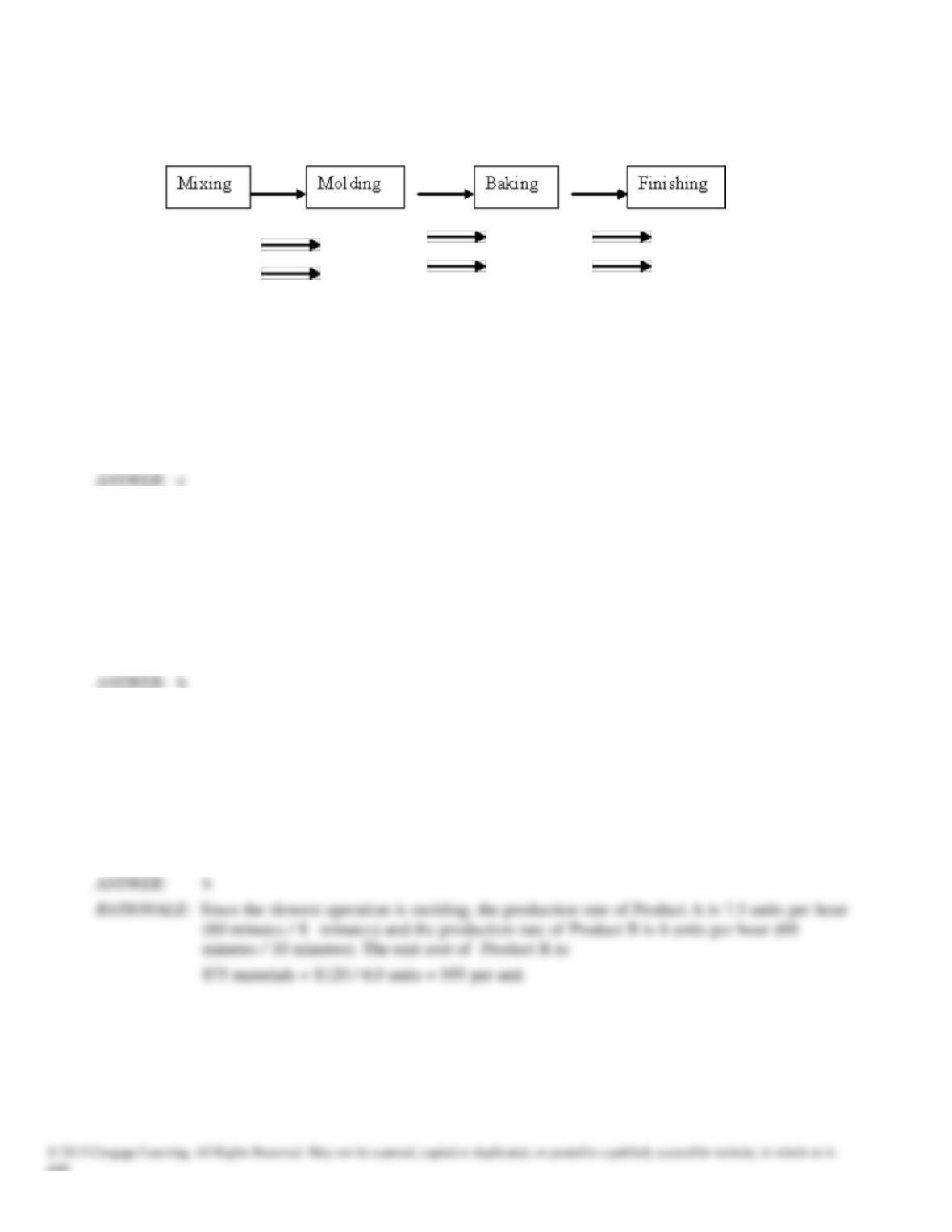
Chapter 15: Lean Accounting and Productivity Measurement
Product A 5 minutes
8 minutes
3 minutes
4 minutes
Product B 2 minutes
10 minutes
3 minutes
2 minutes
Figure 15-4
90. Refer to Figure 15–4. Under traditional costing methods, which product would have more overhead costs
allocated?
a. Product A because the first two cycles are bottlenecks
b. Product B because it has the highest individual cycle time in molding
c. Product A because it has the highest total cycle time
d. Unable to determine from information given
91. Refer to Figure 15–4. Under the features and characteristics costing method, which product would have
more overhead costs allocated?
a. Product A because it has the highest total cycle time
b. Product B because it has the highest individual cycle time in molding, the bottleneck department
c. Product A because the first two cycles are bottlenecks
d. Unable to determine from information given
92. Refer to Figure 15–4. If the materials costs for both products are $75 per unit produced, and conversion costs are
$120 per hour, what is the unit cost of Product B under the features and approach costing method?
a. $190 per unit
b. $95 per unit
c. $91 per unit
d. $92 per unit
Chapter 15: Lean Accounting and Productivity Measurement
93. Refer to Figure 15–4. If the materials costs for both products are $75 per unit produced, and conversion costs are
$120 per hour, what is the unit cost of Product A under the features and approach costing method?
a. $87 per unit
b. $182 per unit
c. $91 per unit
d. $81.75 per unit
94. The point at which technical and allocative efficiency are achieved is called:
a. Input trade-off efficiency
b. Productivity
c. Financial productivity efficiency
d. Total productive efficiency
95. Productivity is concerned with producing
a. output rapidly.
b. output efficiently.
c. the maximum quantity of output possible.
d. output effectively.
96. The point at which for any mix of inputs that will produce a given output, no more of any one input is used than
is absolutely necessary is called:
a. Input trade-off efficiency
b. Technical efficiency
c. Total productive efficiency
d. Productivity
97. The two efficiencies included at the point of achieving total efficiency are:
a. cost efficiency; profit efficiency
b. maintenance efficiency; profit efficiency
c. sales efficiency; profit efficiency
d. technical efficiency; allocative efficiency