Chapter 15 – Fluid and Acid Base Balance
50. Vasopressin secretion and thirst are both stimulated by a free H2O deficit and suppressed by a free H2O excess.
a.
True
b.
False
True
51. Another stimulus for increasing both thirst and vasopressin is angiotensin II.
a.
True
b.
False
True
52. Vasopressin-controlled H2O reabsorption is of primary importance in regulating ECF osmolarity.
a.
True
b.
False
True
53. The term acid–base balance refers to the precise regulation of bound hydrogen ion concentration in the blood.
a.
True
b.
False
False
54. A strong acid has a greater tendency to dissociate in solution than a weak acid does.
a.
True
b.
False
True
Chapter 15 – Fluid and Acid Base Balance
55. Every unit change in pH actually represents a 10-fold change in [H+] because of the logarithmic relationship.
a.
True
b.
False
True
56. The pH of pure H2O is 8.0, which is considered slightly alkaline.
a.
True
b.
False
False
57. The major clinical effect of increased [H+] (acidosis) is tingling of the peripheral nervous system.
a.
True
b.
False
False
58. The major source of H+ is from metabolically produced CO2.
a.
True
b.
False
True
59. The breakdown of fruits and vegetables produces acids that, to some extent, neutralize bases derived from meat, grain,
and dairy protein metabolism.
a.
True
b.
False
False
True
60. A chemical buffer system is a mixture in a solution of two chemical compounds that minimize pH changes when
either an acid or a base is added to or removed from the solution.
a.
True
b.
False
61. The relationship between [H+] and the members of a buffer pair can be expressed according to the Henderson–
Hasselbalch equation.
a.
True
b.
False
True
62. An increase in venous [H+] as the result of a non-respiratory (or metabolic) cause brings about reflex stimulation of
the respiratory center in the hypothalamus.
a.
True
b.
False
False
63. Type B intercalated cells are more active than Type A intercalated cells under normal circumstances, and their activity
increases even more during acidosis.
a.
True
b.
False
False
of body fluids
64. The kidneys control the pH of body fluids by adjusting three interrelated factors: H+ excretion, HCO3– excretion, and
ammonia secretion.
a.
True
b.
False
65. Possible causes of respiratory acidosis include fever, anxiety, and aspirin poisoning.
a.
True
b.
False
False
66. If the quantity of a substance is to remain stable within the body, its __________ through ingestion or metabolic
production must be balanced by an equal __________ through excretion or metabolic consumption.
67. When losses for a substance exceed its gains, a(n) __________ balance exists and the total amount of the substance in
the body decreases.
negative
68. __________ fluid lies in the spaces between cells and makes exchanges with the cells, and represents four-fifths of the
ECF compartment.
Interstitial
69. Synovial fluid is an example of __________ fluid.
transcellular
70. The barrier between the ECF and the ICF is the __________.
of body fluids
71. The two factors regulated to maintain fluid balance in the body are __________ volume and ECF __________.
72. Control of ECF volume is important in the long-term regulation of __________.
73. The amount of sodium reabsorbed is controlled through the __________ system.
74. The __________ of a fluid is a measure of the concentration of the individual solute particles dissolved in it.
75. Dehydration with accompanying hypertonicity can be brought about by __________, a disease characterized by a
deficiency of vasopressin.
76. The condition of over-hydration, hypotonicity, and cellular swelling resulting from excess free H2O retention is
known as __________.
77. Respiration is an example of a(n) __________ loss of H2O.
78. The pH of __________ blood is normally 7.45 and the pH of __________ blood is 7.35, for an average blood pH of
7.4.
79. Changes in excitability of __________ and __________ cells are among the major clinical manifestations of pH
abnormalities.
80. Dietary proteins found abundantly in meat contain a large quantity of __________ and phosphorus.
81. The body has four buffer systems: the H2CO3:HCO3- buffer system, the __________ buffer system, the hemoglobin
buffer system, and the __________ buffer system.
82. __________ buffers the H+ generated from metabolically produced CO2 in transit between the tissues and the lungs.
83. The phosphate system serves as an excellent __________ buffer.
84. The respiratory system alone can return the pH only __________% of the way toward normal.
Chapter 15 – Fluid and Acid Base Balance
85. Ventilation is __________ by the peripheral chemoreceptors in response to a rise in arterial [H+].
86. The task of eliminating H+ derived from sulfuric, phosphoric, lactic, and other acids rests with the __________.
87. Type __________ intercalated cells are H+ secreting, HCO3– reabsorbing, K+-reabsorbing cells that actively secrete
H+ into the tubular lumen via two types of primary __________ transport mechanisms.
88. When acidosis exists, the tubular cells secrete __________ into the tubular fluid once the normal urinary phosphate
buffers are saturated.
89. Respiratory __________ is the result of abnormal CO2 retention arising from hypoventilation.
90. __________ alkalosis is a reduction in plasma [H+] caused by a relative deficiency of non-carbonic acids.
Chapter 15 – Fluid and Acid Base Balance
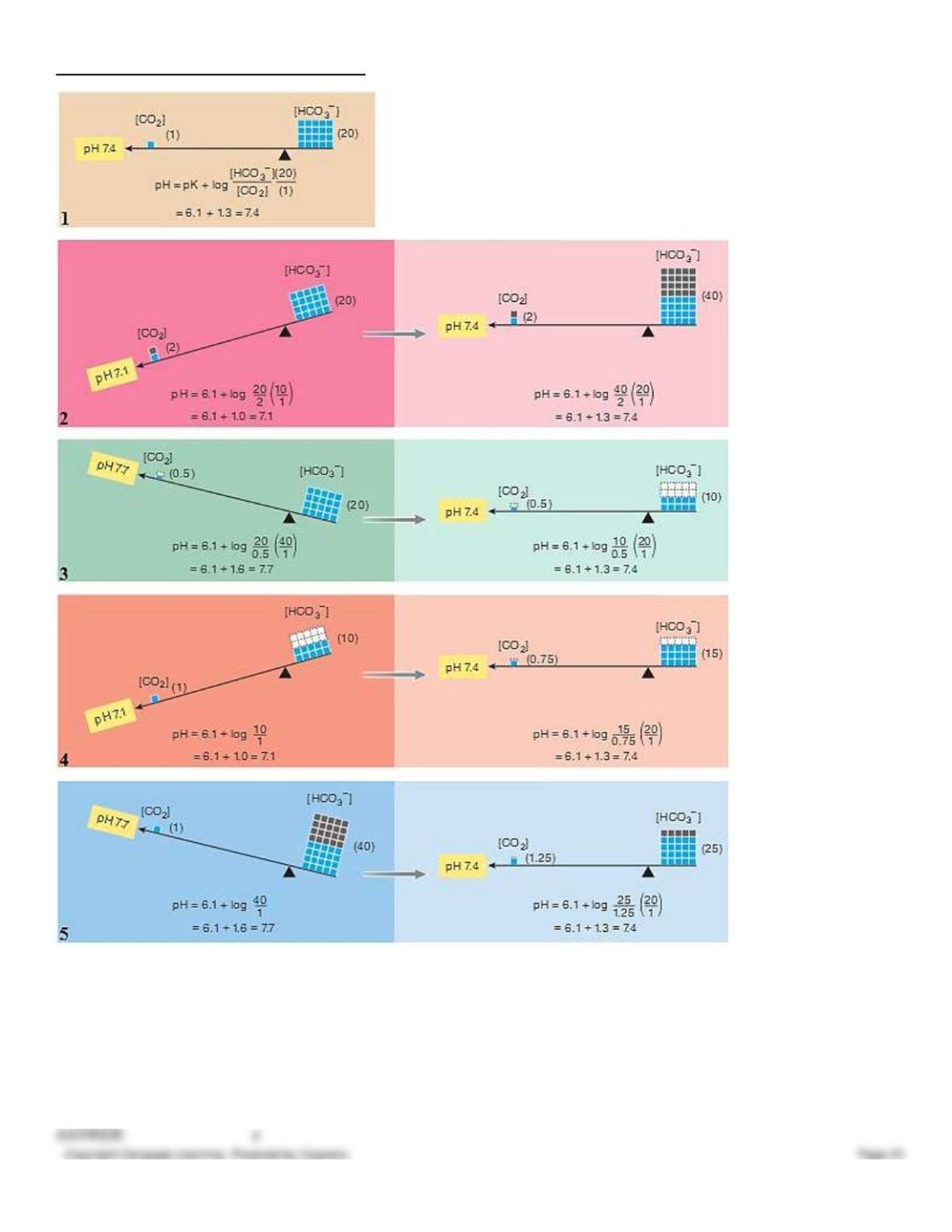
Use the figure above (Figure 15–13) to answer the corresponding questions.
91. Which figure represents metabolic alkalosis?
a.
1
b.
2
c.
3
d.
4
e.
5
92. Which figure represents respiratory alkalosis?
a.
1
b.
2
c.
3
d.
4
e.
5
93. Which number in the figure represents respiratory acidosis?
a.
1
b.
2
c.
3
d.
4
e.
5
b
94. Which number in the figure represents metabolic acidosis?
a.
1
b.
2
c.
3
d.
4
e.
5
d
95. Which figure represents normal acid–base balance?
a.
1
b.
2
c.
3
d.
4
e.
5
96. Outline the three causes of hypertonicity (dehydration).
97. Define acclimatization and give an example.
98. Describe the features of acids.
99. Discuss pH levels of the blood.
100. Explain respiratory acidosis and list the common causes.
Chapter 15 – Fluid and Acid Base Balance