Appendix 15A
Quick Stats Review
a. one either rejects or accepts the null hypothesis on the basis of the evidence at hand
b. a null hypothesis may be rejected but can never be accepted
c. one must always reject the null hypothesis unless the evidence is convincingly
(determined by the a level) to the contrary
d. one must always accept the null hypothesis unless the evidence is convincingly
(determined by the a level) to the contrary
e. there is no guiding scientific principle and the analyst should frame them as he or
she sees fit
hypothesis may be but can never be .
a. accepted; rejected
b. incorrectly stated; rejected
c. rejected; accepted
d. unacceptable; rejected
e. rejected; unacceptable
least 20,000 units. The correct hypotheses for this decision rule are: .
a. Ho : μ < 20,000
Ha : μ > 20,000
b. Ho : μ > 20,000
Ha : μ < 20,000
c. Ho : μ > 20,000
Ha : μ < 20,000
d. Ha : μ = 20,000
Ho : μ = 20,000
e. Ho : μ < 20,000
Ha : μ < 20,000
declining sales. The manager felt that in blind product testing there would be no
difference or possibly even a preference by consumers for the inexpensive shampoo over
the expensive brand name alternative. The product manager decides to test this
hypothesis. If the inexpensive shampoo is given by πI and the expensive shampoo by πE,
the correct hypotheses for this situation are
a. H0:πI=πE, Ha:πI > πE.
b. H0:πI=.50, Ha:πI ≠ .50.
c. H0:πI<.50, Ha:πI >.50.
d. H0:πI=πE, Ha:πI =≠ πE.
e. none of the above.
(Use the following information for the next four questions.)
A large clothing manufacturer plans to introduce a new line of sports clothes for women if
preliminary market research shows that at least 50% of the population are favorably impressed
by the new line. Five hundred women were surveyed; 265 of the women were favorably
impressed. The research manager wants to test the hypothesis at the .05 significance level.
The z-value associated with this significance level is 1.645.
a. Ho: > < .50 HA: > > .50
b. Ho: > < .50 HA: > > .50
c. Ho: > < 250 HA: > > 250
d. Ho: > < 250 HA: > > 250
e. none of the above
a. 0.0005
b. 0.0224
c. 0.0307
d. 0.0326
e. more information is needed
a. 1.339
b. -1.339
c. 0.977
d. -0.977
e. more information is needed
in order to reject the null hypothesis at the specified significance level?
a. 250
b. 251
c. 249
d. 269
e. 268
simply because of random variation in a large number of samples may be referred to as
the .
a. b risk
b. 1-a risk
c. confidence level
d. 1-b risk
e. a risk
a. is committing a Type I error
b. is committing a Type II error
c. is committing neither a Type I nor Type II error
d. is typically sure that he has made an incorrect decision
e. none of the above
possible but he recognizes that an extremely low value of a error leads to .
a. low b error
b. the need for large samples
c. large opportunity losses
d. indeterminate b errors
e. large b errors
a. incorrectly rejecting a true null hypothesis; a
b. correctly accepting a correct null hypothesis; b
c. correctly accepting a correct null hypothesis; 1-b
d. correctly rejecting an incorrect null hypothesis; b
e. correctly rejecting an incorrect null hypothesis; 1-b
a. the odds are only 1 in 100 of getting the results simply by chance.
b. there is only a 1% chance that the results are incorrect.
c. there is a probability of 1 in 100 that this result would occur if the null hypotheses
were true.
d. all of the above are true.
e. none of the above are true.
a. the probability of correctly rejecting a false null hypothesis.
b. the probability of retaining a correct null hypothesis.
c. equal to one minus the confidence level.
d. equal to the power of the test.
e. none of the above.
significance or using tests of significance.
a. decreasing; decreasing; one-tailed
b. increasing; decreasing; one-tailed
c. increasing; reducing; two-tailed
d. decreasing; reducing; two-tailed
e. increasing; increasing; one-tailed
enough may be used and the may be appropriate.
a. normally; the binomial approximation; runs test
b. binomially; the normal approximation; chi-square
c. normally; the binomial approximation; t-test
d. cumulatively; the normal approximation; z-test
e. binomially; the normal approximation; z-test
a. a error and b error are completely complementary in that a + b always equals one.
b. A Type I or α error occurs when a false null hypothesis is not rejected.
c. A Type II or ß error occurs when a true null hypothesis is rejected.
d. When it is said that the difference between two numbers (e.g., two means) is
significant at the 5 percent level, it means there is only a 5% chance that the
difference is the wrong amount.
e. All of the above statements are false.
apparel than male college students. Which of the following is INCORRECT?
a. The null and alternate hypotheses are:
Ho : mF < mM
HA : mF > mM
b. If you concluded that female students spend more than male students when in fact
there is no difference between the two groups, you would be committing a Type II
error.
c. The probability of concluding that females spend more than male students when in
fact this is the case, is called the power of the test.
d. If in testing the above hypothesis, we insist on reducing the probability of making
the Type I error, ceteris paribus the probability of Type II error will increase.
e. If we conclude that females spend less than males when in fact that is the case, we
have made a correct decision.
were stated:
H0: Proportion Preferring Brand A = 0.50
Ha: Proportion Preferring Brand A ≠0.50
Of 200 people tested, 49% preferred Brand A. At α=0.05, which of the following is
correct?
a. The null hypothesis is accepted.
b. The null hypothesis is rejected.
c. Based on the evidence available, no support for the alternative hypothesis is found.
d. Based on the evidence available, the alternative hypothesis is supported.
e. More information is required to test these hypotheses.
49% preferring Brand A to be significantly different from the hypothesized proportion?
a. 200 people
b. 4,800 people
c. 9,600 people
d. 50,500 people.
e. cannot be determined with the information provided in the example.
concern to a researcher with regard to a test of a Hypothesis?
a. the power of the test
b. the rejection of a true null hypothesis
c. the failure to reject a false null hypothesis
d. committing a Type II error
e. none of the above
a. specifying the null and alternative hypotheses
b. choosing an appropriate statistical test
c. specifying the significance level for the test
d. determining the probability of the test statistic under the null hypothesis
e. all of the above are steps in the typical hypothesis testing procedure
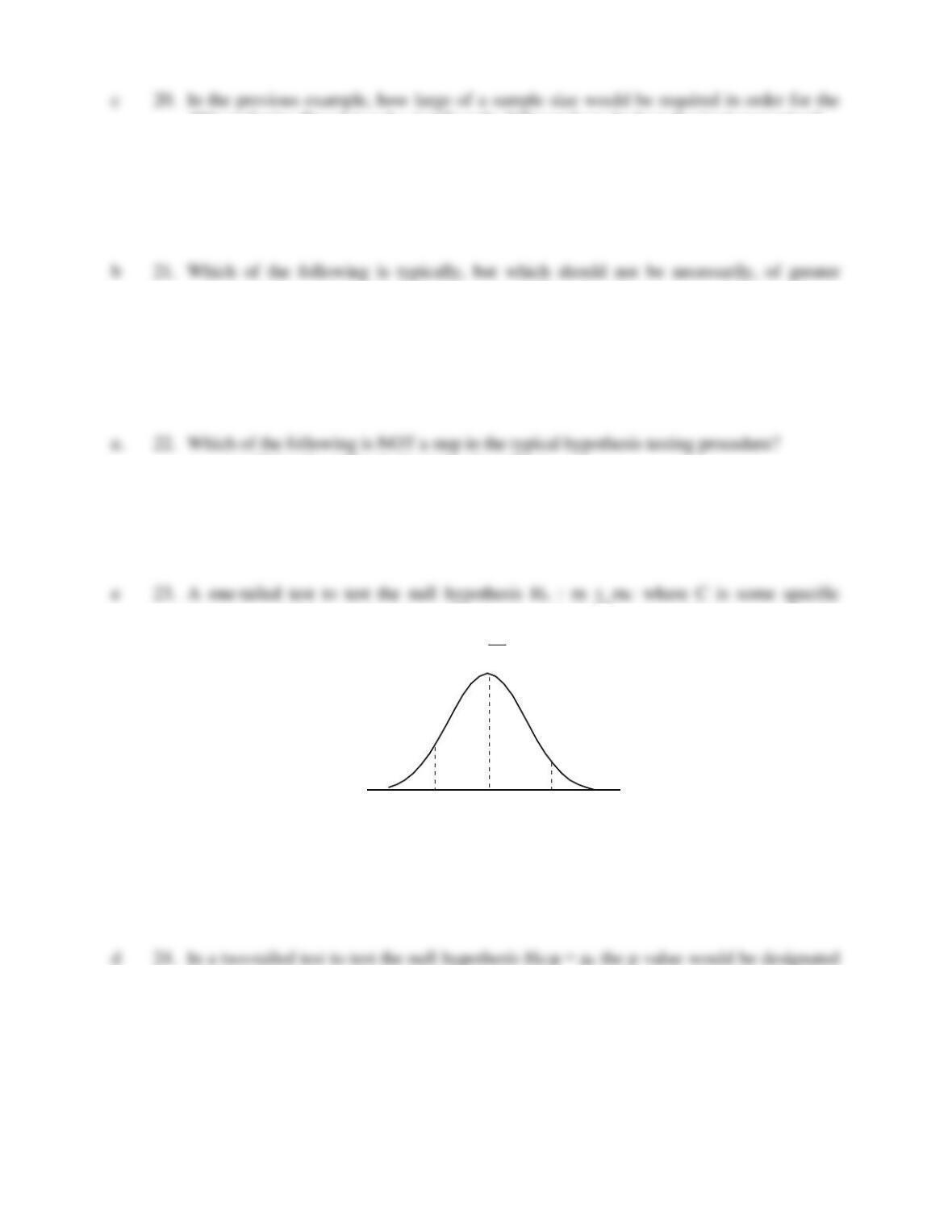
constant, could be carried out by comparing the calculated z value with the area under the
curve (in the graph below) designated by .
a. C
b. B
c. A
d. AB
e. None of the above
by
a. one minus the area between B and C
b. the area between A and C
c. the area to the left of C
d. twice the area to the left of C
e. none of the above
A
B
C A
B
C
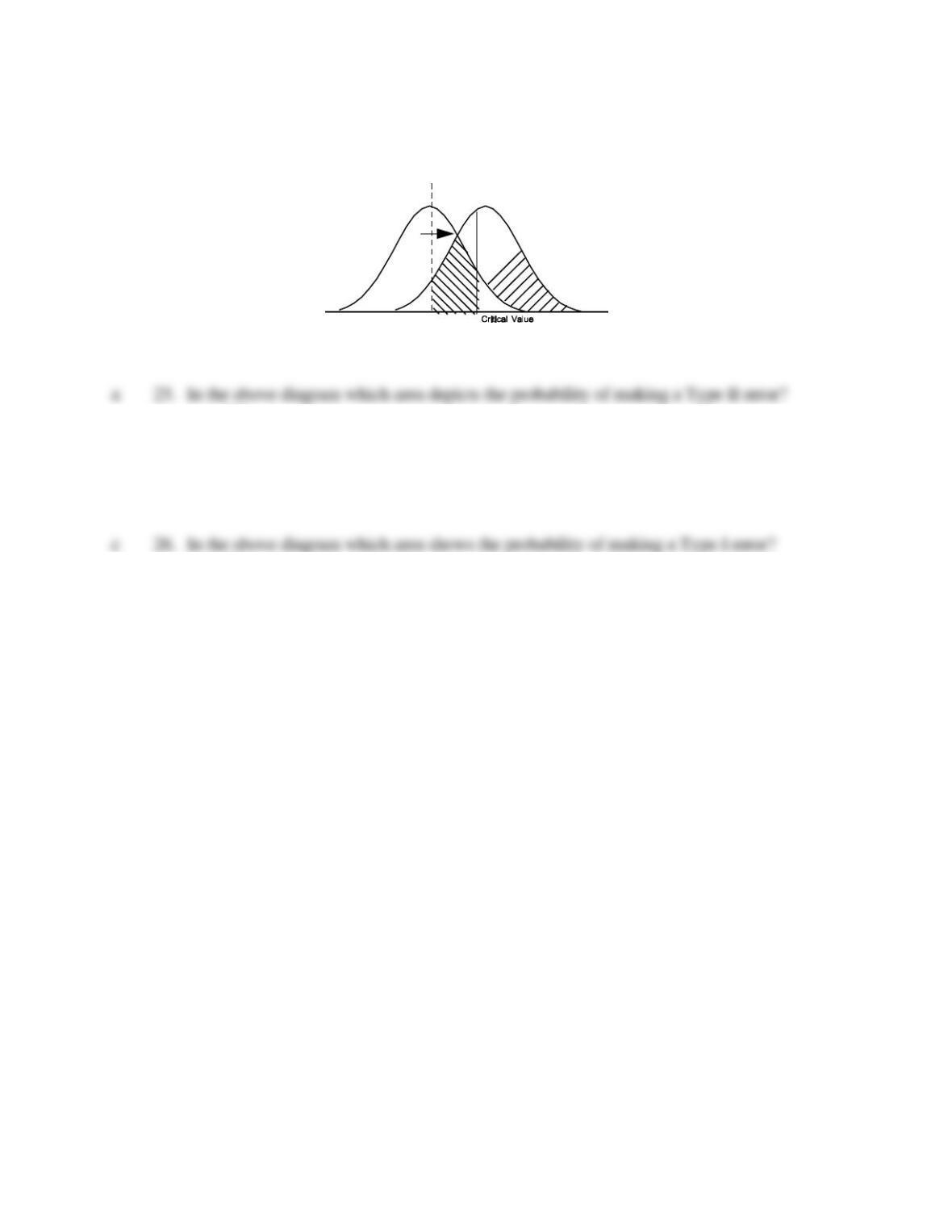
Distribution if Ho is true Distribution if Ha is true
a. BC
b. BA
c. A
d. B
e. BD
a. BC
b. BA
c. A
d. B
e. BD