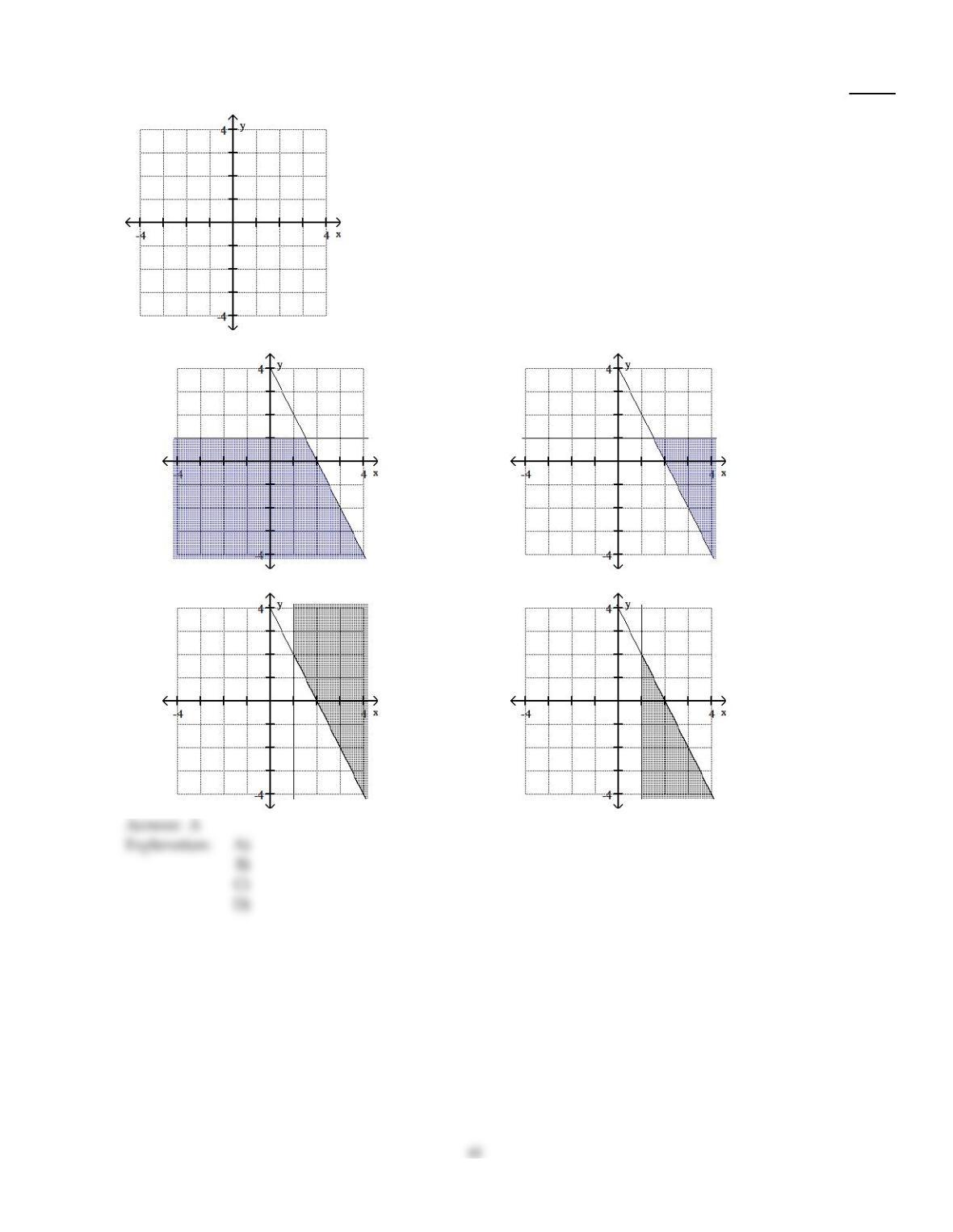
116)
2x + y
4
y – 1 0
116)
A)
B)
C)
D)
Solve by the substitution method.
117)
–7x – 1 =8y
5x + 4y =1
117)
A)
{(x, y)|–7x – 1 =8y}
B)
C)
{(1, –1)}
D)
{(0, 0)}
Provide an appropriate response.
118)
Suppose that you start a business manufacturing and selling computers and you decide to sell each
computer for $1960. What expression in x represents the revenue you will take in if you sell x
computers? Write an equation using y2 to express your revenue when you sell x computers (y2 in
dollars).
118)
A)
y2=1960 – x
B)
y2=1960 + x
C)
y2=1960x
D)
y2= x –1960
Solve by the substitution method.
119)
9x – 7y = – 44
–3x + 3y =18
119)
A)
B)
{(–2, 6)}
C)
{(–1, 6)}
D)
{(–1, 5)}
Decide whether or not the ordered pair is a solution of the system.
120)
(2, 5)
2x + y = – 1
4x + 2y = – 2
120)
A)
Yes
B)
No
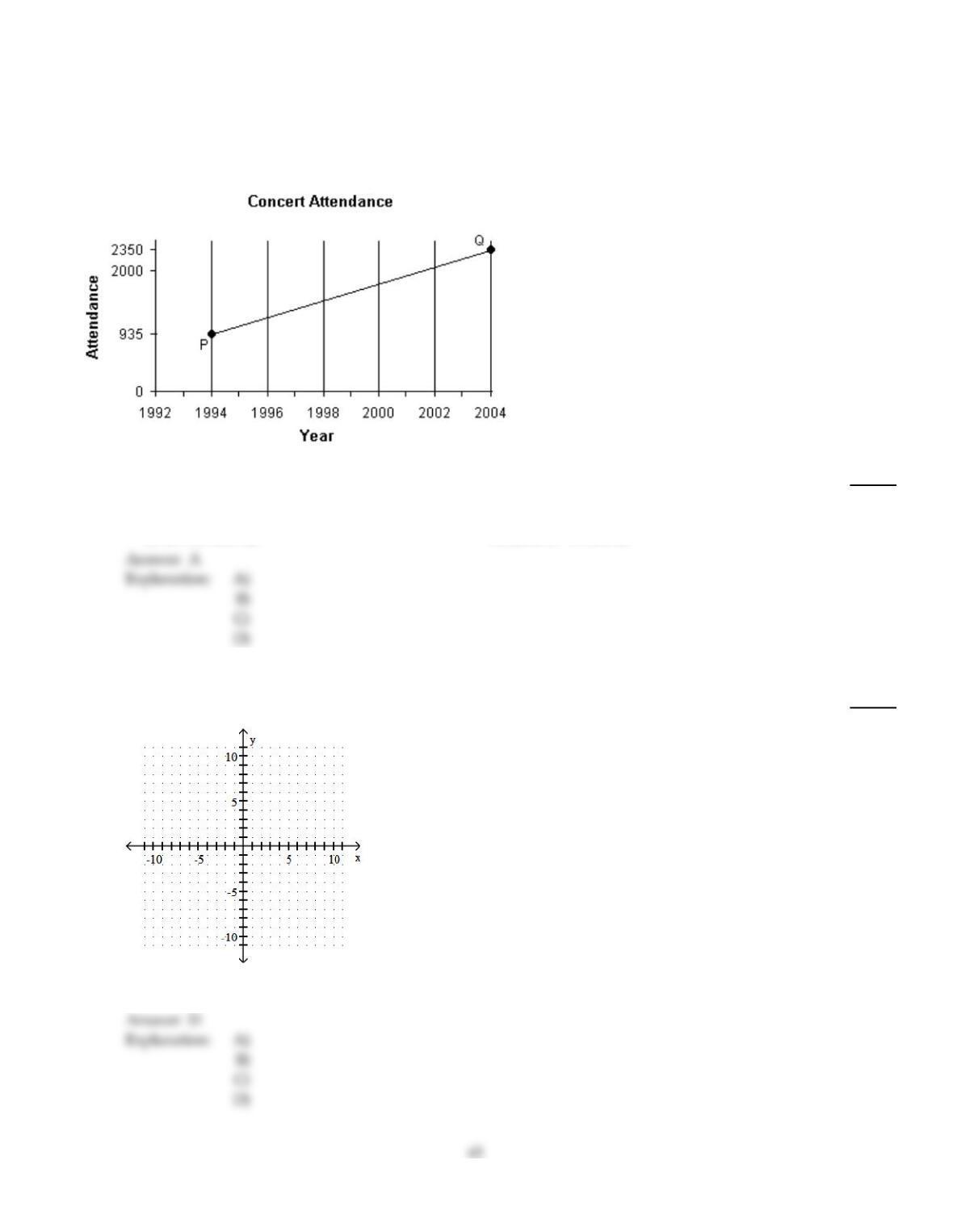
Attending concerts is a favorite form of entertainment for many people. The graph shows concert attendance gradually
increased from 1994 to 2004 for concerts at a small town‘s outdoor concert venue. In 1994, the average attendance was 935,
as represented by the point P(1994, 935). In 2004, the average attendance was 2350, as represented by the point
Q(2004, 2350). We can find an equation of the line segment PQ using a system of equations, and then we can use the
equation to approximate the attendance in any of the years between 1994 and 2004.
121)
Write the system of equations formed from the given points, P and Q, and then solve the system
using the elimination method.
121)
A)
{(141.5, –281,216)}
B)
{(145.7, –239,394)}
C)
{(92.0, 34,590)}
D)
{(103.5, –204,239)}
Solve the system of equations by graphing. If the system is inconsistent or the equations are dependent, say so.
122)
x = – y
y + x = 6
122)
A)
{(1, 5)}
B)
{(1, 1)}
C)
{(x, y)|x = – y} (dependent equations)
D)
(inconsistent system)
Without graphing, answer the following questions for the linear system.
(i) Is the system inconsistent, are the equations dependent, or neither?
(ii) Is the graph a pair of intersecting lines, a pair of parallel lines, or one line?
(iii) Does the system have one solution, no solution, or an infinite number of solutions?
123)
2x – y = 5
–2x + 2y = 10
123)
A)
(i) inconsistent
(ii) parallel lines
(iii) no solution
B)
(i) dependent
(ii) one line
(iii) infinite number of solutions
C)
(i) neither
(ii) intersecting lines
(iii) one solution
Solve the problem.
124)
A contractor mixes concrete from bags of pre–mix for small jobs. How many bags with 9% cement
should he mix with 10 bags of 10.5% cement to produce a mix containing 10% cement?
124)
A)
20 bags
B)
15 bags
C)
7 bags
D)
5 bags
125)
A child’s coin bank contains $1.85 in pennies and nickels. If the number of pennies is 31 less than 3
times the number of nickels, how many pennies are in the bank?
125)
A)
3 pennies
B)
40 pennies
C)
27 pennies
D)
50 pennies
126)
A paper boy collected $6.35, part in nickels and part in dimes. If the number of nickels was 12 more
than one–half the number of dimes, how many nickels were there?
126)
A)
25 nickels
B)
7 nickels
C)
35 nickels
D)
46 nickels
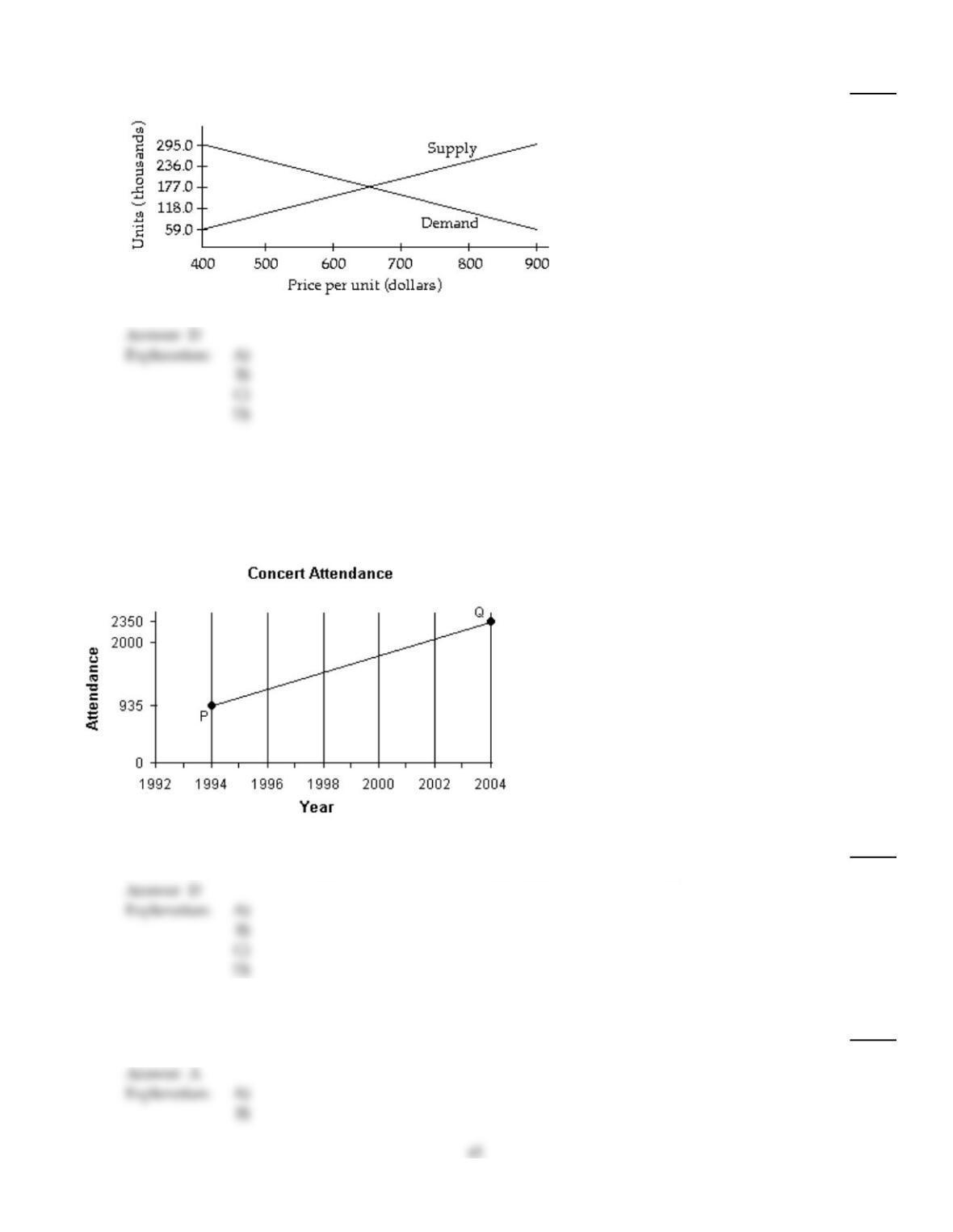
127)
The graphs below represent the supply and demand for a product at various prices per unit. At
what price does supply equal demand?
127)
A)
$400
B)
$900
C)
$177
D)
$650
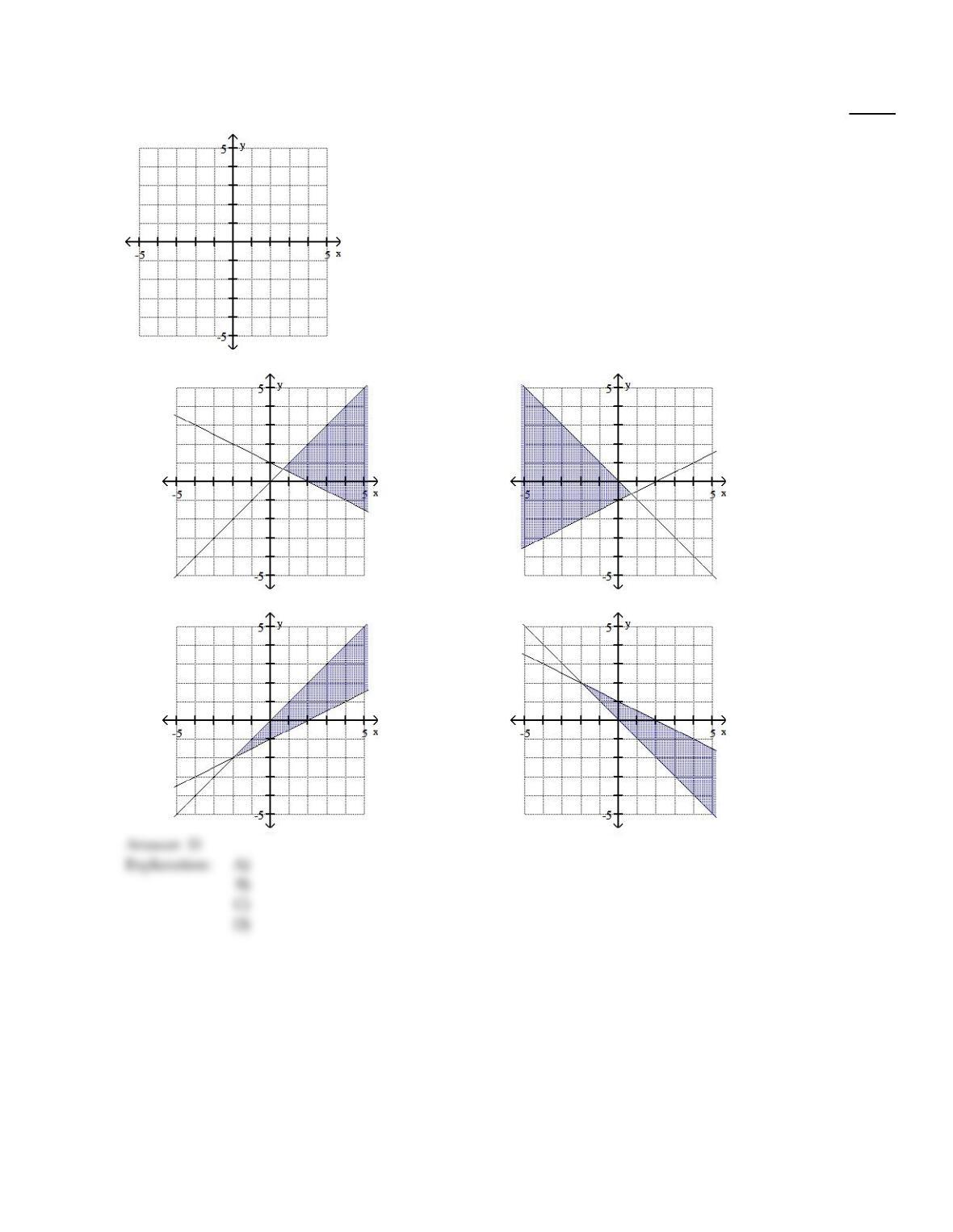
Attending concerts is a favorite form of entertainment for many people. The graph shows concert attendance gradually
increased from 1994 to 2004 for concerts at a small town‘s outdoor concert venue. In 1994, the average attendance was 935,
as represented by the point P(1994, 935). In 2004, the average attendance was 2350, as represented by the point
Q(2004, 2350). We can find an equation of the line segment PQ using a system of equations, and then we can use the
equation to approximate the attendance in any of the years between 1994 and 2004.
128)
After forming an equation for the segment, PQ, solve for y, when x =1996.
128)
A)
51,423.2
B)
2347
C)
218,222
D)
1218
Indicate whether the statement is true or false.
129)
A system of linear inequalities can have solutions in all quadrants.
129)
A)
True
B)
False
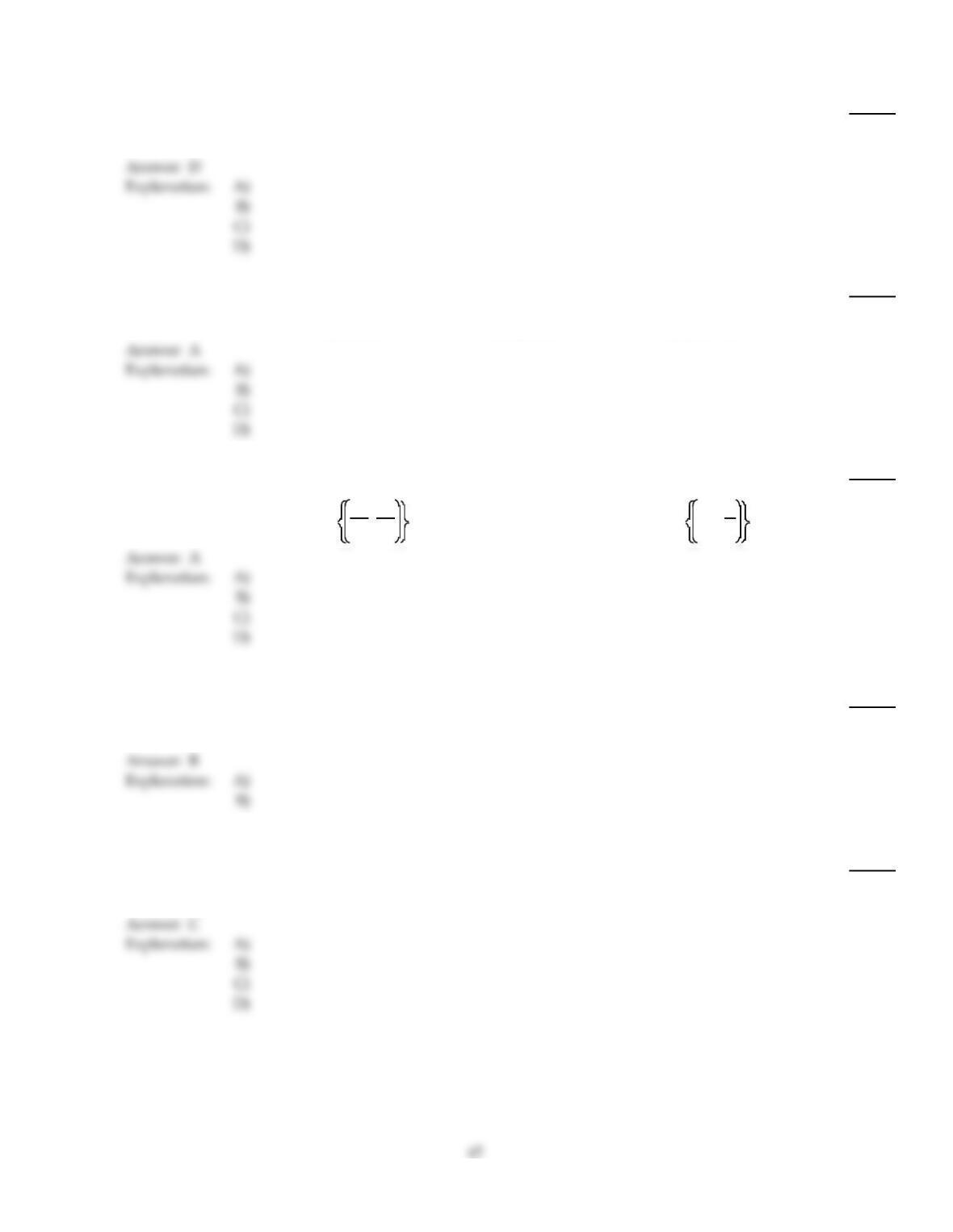
Graph the solution of the system.
130)
x + 2y
2
x + y 0
130)
A)
B)
C)
D)
46
Solve the system by the elimination method.
131)
x + y =2
x – y = – 6
131)
A)
{(–3, 5)}
B)
{(2, 5)}
C)
D)
{(–2, 4)}
132)
x + y =6
x + y = – 4
132)
A)
B)
{(0, 0)}
C)
{(0, 2)}
D)
{(6, –4)}
133)
8x =6y + 2
8x =6y – 6
133)
A)
B)
1
16 , 1
12
C)
{(6, 2)}
D)
0, –1
3
Indicate whether the statement is true or false.
134)
When graphing a system of linear inequalities, the final shaded region is made up of all points
which belong to the graphs of either of the individual inequalities.
134)
A)
True
B)
False
Solve the problem.
135)
A certain number is three times as large as a second number. Their sum is 104. What are the two
numbers?
135)
A)
24 and 72
B)
24 and 80
C)
26 and 78
D)
81 and 23
Indicate whether the statement is true or false.
136)
It is impossible for a system of two linear inequalities to have exactly one solution.
136)
A)
True
B)
False
Solve by the substitution method.
137)
3x +3y = 5
9x = 10 +9y
137)
A)
B)
25
18 , 5
18
C)
{(x, y)|3x +3y = 5}
D)
1
18 , 5
18
Without graphing, answer the following questions for the linear system.
(i) Is the system inconsistent, are the equations dependent, or neither?
(ii) Is the graph a pair of intersecting lines, a pair of parallel lines, or one line?
(iii) Does the system have one solution, no solution, or an infinite number of solutions?
138)
x – 3y = 6
3y + 1 = x
138)
A)
(i) inconsistent
(ii) parallel lines
(iii) no solution
B)
(i) neither
(ii) intersecting lines
(iii) one solution
C)
(i) dependent
(ii) one line
(iii) infinite number of solutions
Solve the problem.
139)
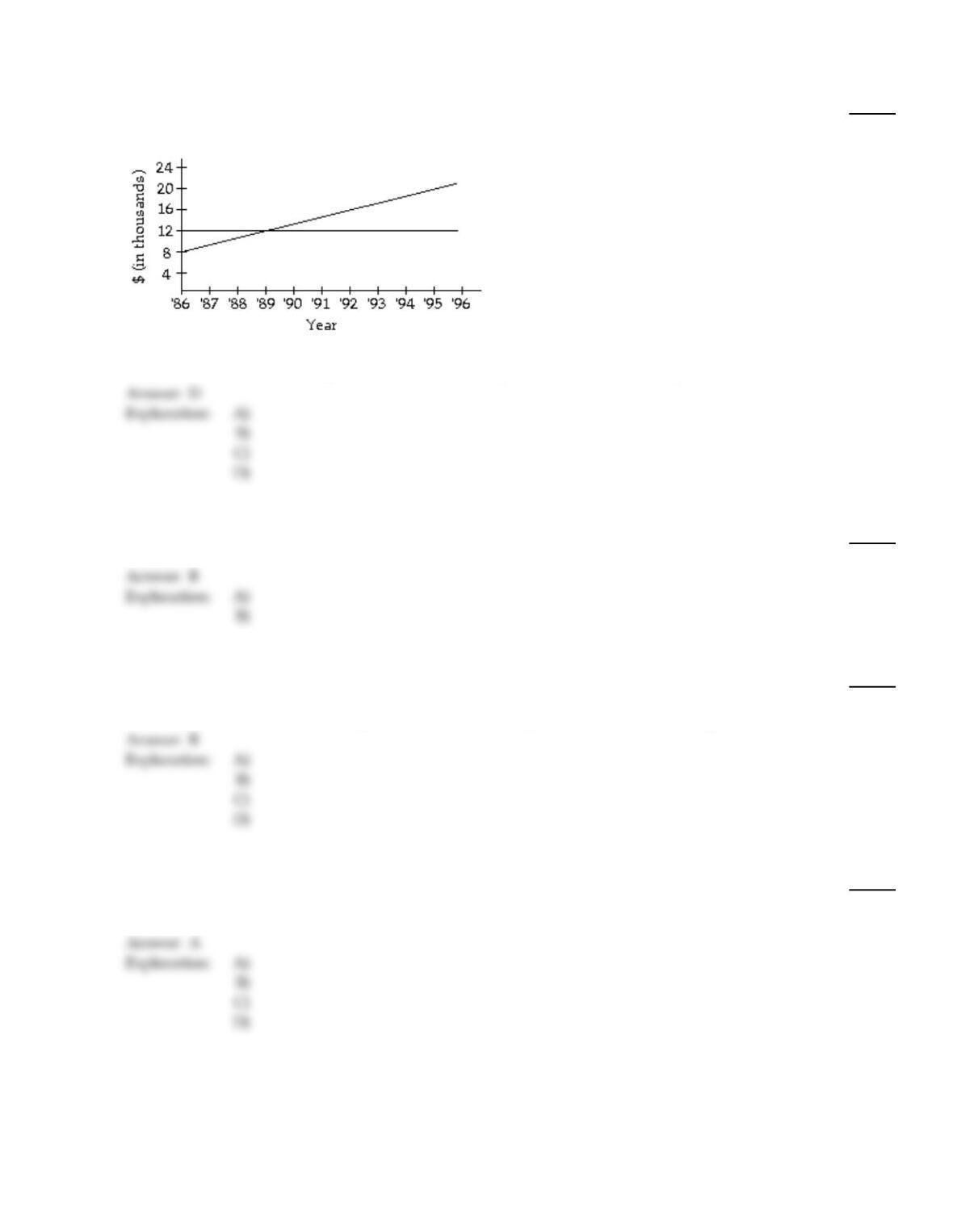
Carlos doesn’t trust banks, so his savings are hidden under his mattress. Betsy has her savings in an
investment at simple interest. In approximately what year did they have the same amount?
139)
A)
1988
B)
1996
C)
1986
D)
1989
Indicate whether the statement is true or false.
140)
Every system of linear inequalities has infinitely many solutions.
140)
A)
True
B)
False
Solve the problem.
141)
A sum of money amounting to $4.50 consists of dimes and quarters. If there are 21 coins in all, how
many are quarters?
141)
A)
7 quarters
B)
16 quarters
C)
5 quarters
D)
21 quarters
Solve the system by the elimination method.
142)
–4x + 7y =49
–2x + 3y =21
142)
A)
{(0, 7)}
B)
{(–1, 8)}
C)
D)
{(0, 8)}
49
Solve by the substitution method.
143)
–0.5x – 0.5y =4.5
–0.2x – 0.5y =2.7
143)
A)
{(–6.6, –0.7)}
B)
{(–6, –3)}
C)
{(–2.7, 1.5)}
D)
Solve the system by the elimination method.
144)
x – 4y = – 8
2x – 4y =0
144)
A)
{(9, 8)}
B)
{(8, 4)}
C)
{(–8, 3)}
D)
Solve the problem.
145)
Find two numbers whose sum is 45 and whose difference is 15.
145)
A)
30 and 15
B)
31 and 14
C)
17 and 32
D)
28 and 17
146)
Lisa biked at 14 mph for a time but got a flat tire. She then walked at 2 mph. She traveled a total of
40 miles. Had she biked the whole time, she would have gone 112 miles. How many hours did she
walk?
146)
A)
2 hr
B)
6 hr
C)
7 hr
D)
5 hr
Without graphing, answer the following questions for the linear system.
(i) Is the system inconsistent, are the equations dependent, or neither?
(ii) Is the graph a pair of intersecting lines, a pair of parallel lines, or one line?
(iii) Does the system have one solution, no solution, or an infinite number of solutions?
147)
5x – 25y =20
y =1
5x –4
5
147)
A)
(i) neither
(ii) intersecting lines
(iii) one solution
B)
(i) inconsistent
(ii) parallel lines
(iii) no solution
C)
(i) dependent
(ii) one line
(iii) infinite number of solutions
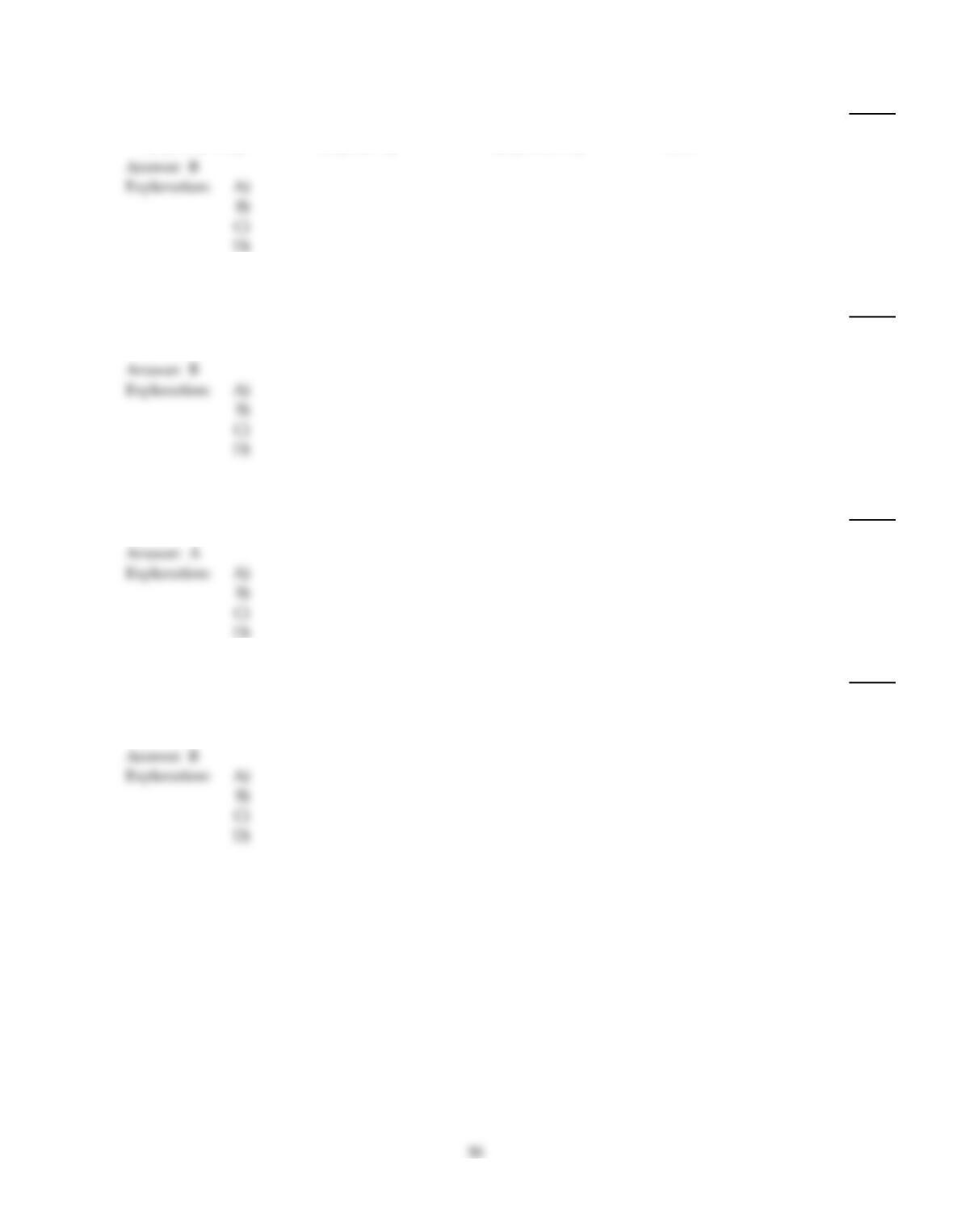
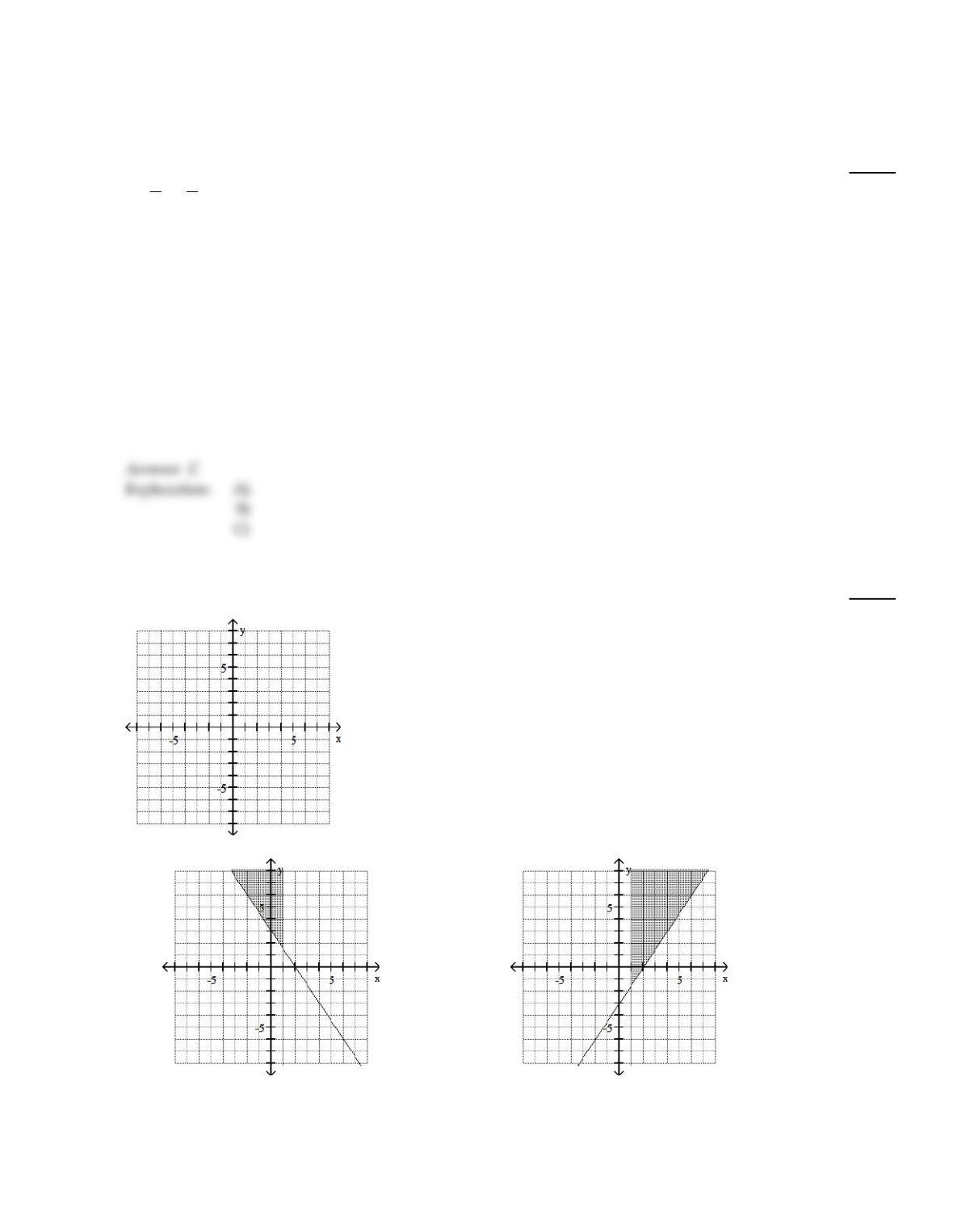
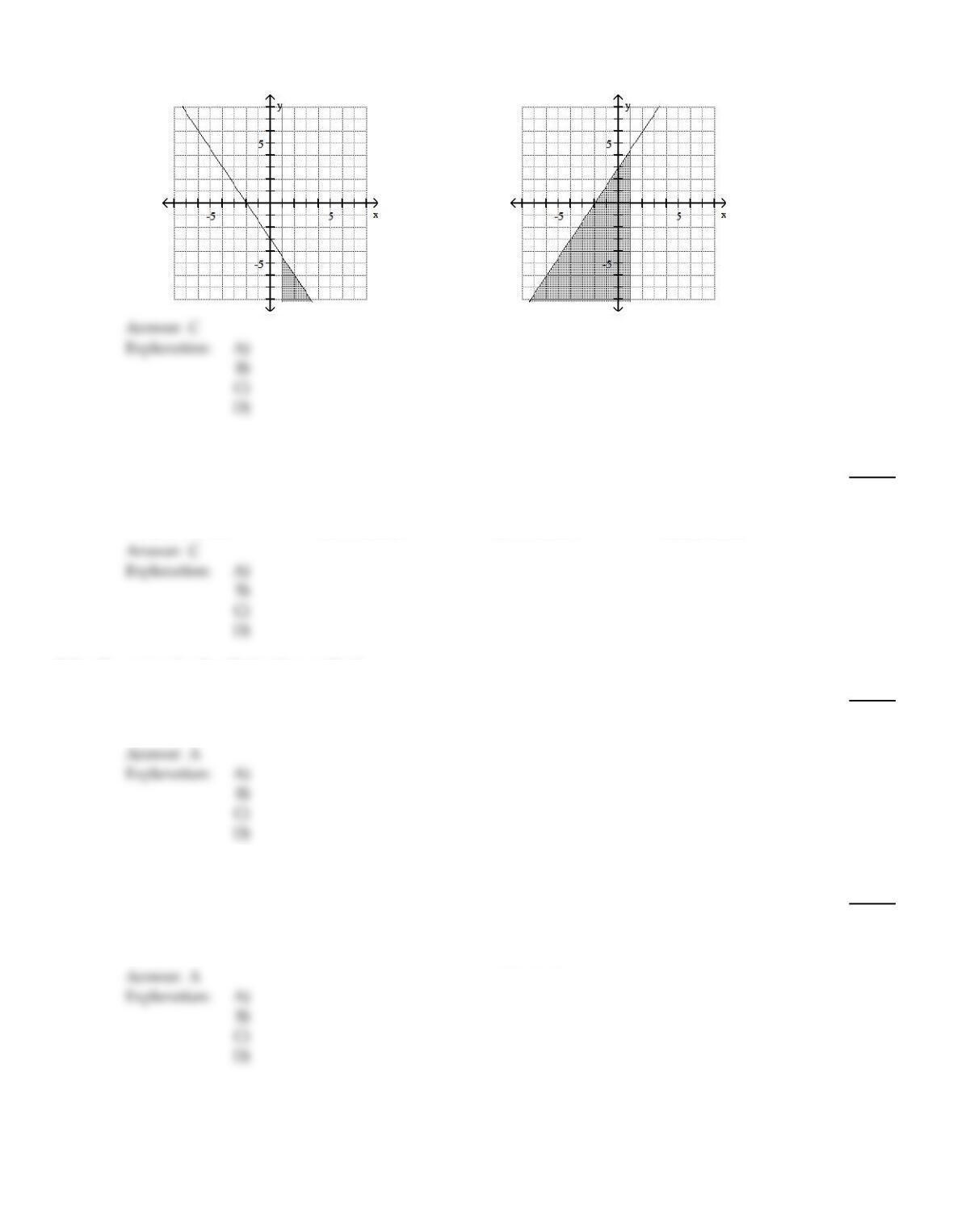
Graph the solution of the system.
148)
3x + 2y –6
x – 1
0
148)
A)
B)
51
C)
D)
Solve the problem.
149)
Anne and Nancy use a metal alloy that is 13% copper to make jewelry. How many ounces of an
alloy that is 11% copper must be mixed with an alloy that is 16% copper to form 55 ounces of the
desired alloy?
149)
A)
27 ounces
B)
35 ounces
C)
33 ounces
D)
22 ounces
Solve the system by the elimination method.
150)
x + 4y =16
–2x + 5y =20
150)
A)
{(0, 4)}
B)
C)
{(–4, 0)}
D)
{(1, 3)}
Solve by the substitution method.
151)
–6x + 6y =42
2x – 4y = – 14
151)
A)
{(–7, 0)}
B)
{(x, y)|2x – 4y = – 14}
C)
D)
{(–8, 1)}
Graph the system of inequalities. Indicate the solution by shading.
52
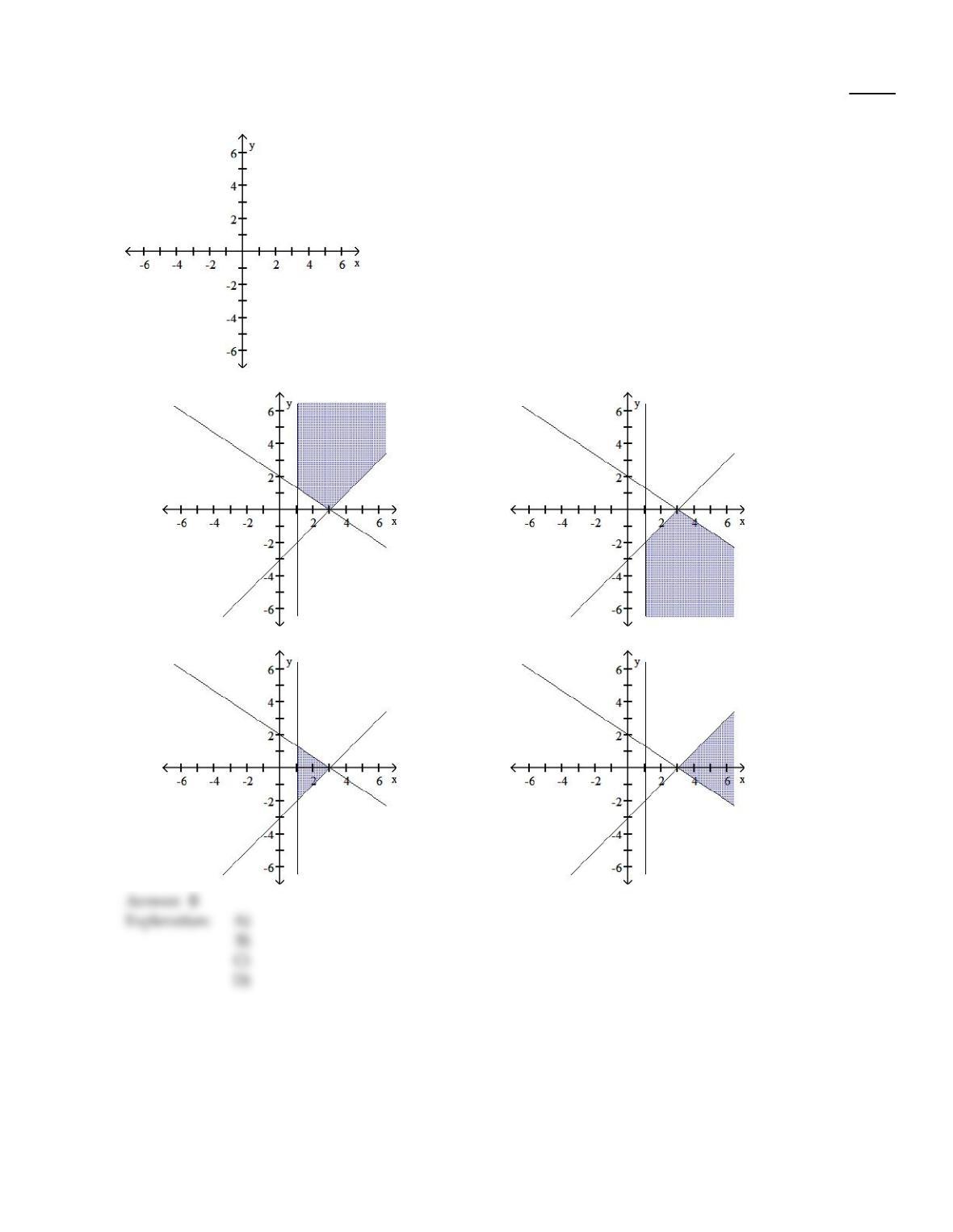
152)
2x + 3y 6
x – y 3
x
1
152)
A)
B)
C)
D)
53
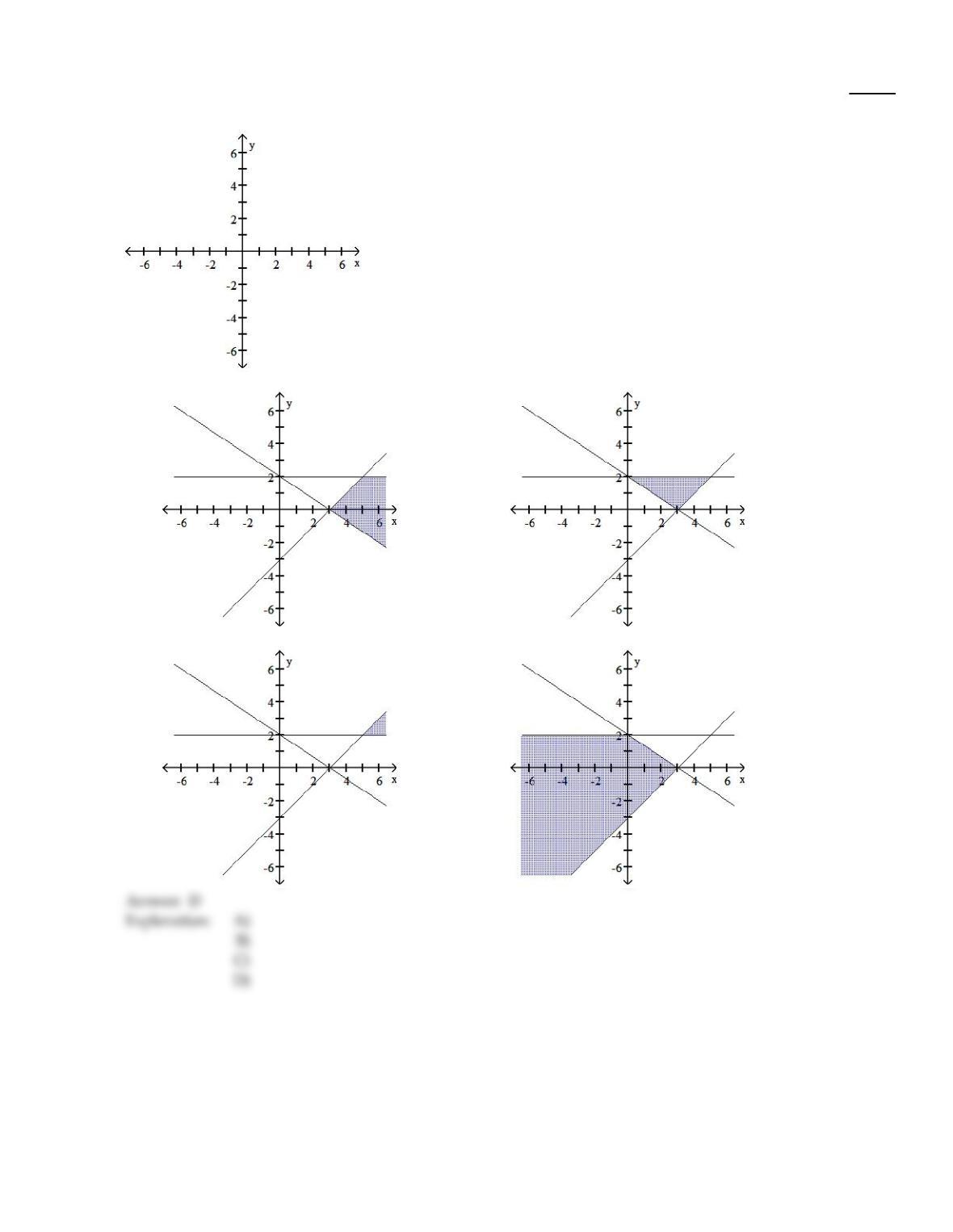
153)
2x + 3y 6
x – y
3
y 2
153)
A)
B)
C)
D)
54
Solve the system by the elimination method.
154)
8x + 5y =16
–5x + 2y = – 10
154)
A)
{(1, 1)}
B)
C)
{(2, 1)}
D)
{(2, 0)}
Solve by the substitution method.
155)
x + 7y =5
2x + 8y =10
155)
A)
{(5, 0)}
B)
{(x, y)|x + 7y =5}
C)
D)
{(–5, –1)}
156)
–0.9x + 0.5y =0
0.8x – 0.1y = – 3.1
156)
A)
B)
{(–5, –9)}
C)
{(x, y)| –0.9x + 0.5y =0}
D)
{(–9, –5)}
Solve the system by the elimination method.
157)
x – 3y =17
9x – 3y =33
157)
A)
{(5, 2)}
B)
C)
{(3, –6)}
D)
{(2, –5)}
Solve the problem.
158)
One number is five times larger than another. The difference of the numbers is 52. Find the
numbers.
158)
A)
11 and 67
B)
13 and 65
C)
11 and 55
D)
62 and 10
159)
Candy and Delvis are riding bicycles in the same direction. Candy is traveling at the speed of 4
miles per hour, and Delvis is traveling at the speed of 7 miles per hour. In 3 hours what is the
distance between them?
159)
A)
6 miles
B)
18 miles
C)
10 miles
D)
9 miles
Solve the system of equations by graphing. If the system is inconsistent or the equations are dependent, say so.
160)
3x – 2y = 4
–6x + 4y = 7
160)
A)
{(1, 2)}
B)
{(x, y)|3x – 2y = 4} (dependent equations)
C)
{(2, 1)}
D)
(inconsistent system)
Answer Key
Testname: C15
57
Answer Key
Testname: C15
Answer Key
Testname: C15
Answer Key
Testname: C15