170. Based on the following summary of shareholders’ equity accounts, answer the following questions. No
dividends were paid during the Year 1 and Year 2.
December 31, Year 1
December 31, Year 2
Common stock, $5 par value
$1,000,000
$1,250,000
Additional paid-in capital
1,500,000
2,000,000
Net unrealized loss on investment
in marketable equity securities
(100,000)
(150,000)
Retained earnings
2,000,000
2,500,000
Less: Cost of treasury shares
(200,000)
(224,000)
Total shareholders’ equity
$4,200,000
$5,376,000
a.
What is net income during Year 2?
b.
How many additional common shares were issued in Year 2?
c.
What was the cost per share of the treasury stock acquired during Year 2? 2,000 additional shares were acquired during the year.
d.
What price was paid for the additional common shares issued in Year 2?
e.
What happened to the portfolio of long-term marketable equity securities?
a.
$500,000 ($2,500,000 – $2,000,000)
b.
50,000 (($1,250.000 – $1,000,000) / $5)
c.
$12 (($224,000 – $200,000) / 2,000)
d.
$15 ($2,000,000 – $1,500,000) / 50,000 = $10 + $5 par
e.
Cost is $150,000 greater than market at December 31, Year 2 or $50,000 change from Year 1 to Year 2.
171. Based on the following information, determine how many shares of common stock would be outstanding if
all conversion features were exercised.
Convertible Bonds Payable
$ 80,000
Convertible Preferred Stock – par
50,000
Common Stock – par
2,000,000
Additional Paid-in Capital
1,800,000
Retained Earnings
3,000,000
Shares held in Treasury
(600,000)
Additional information:
a.
Common stock was issued when the market price was $10 per share
b.
The treasury stock was acquired when the market value per share was $15.
c.
Current fair market value of the common stock is $18 per share.
d.
Each share of $1,000 par value preferred stock is convertible to 50 shares of common stock.
e.
Each $1,000 face value bond can be converted to 40 shares of common stock. The bonds were issued at par.
172. Prepare journal entries for the following transactions:
a.Issue 15,000 shares, selling price is $45 and par value is $1.
b.Buy back 650 shares of outstanding stock at $48 per share.
c.Sell 500 shares of treasury stock at $50 per share.
Cash
675,000
Common Stock
15,000
Additional Paid-in Capital
660,000
b.
Treasury Stock
31,200
Cash
31,200
c.
Cash
25,000
Treasury Stock
24,000
Additional Paid-in Capital-Treasury Shares
1,000
165,700 shares if fully converted
Common stock
($2,000,000/$10)
200,000
shares
Less: Treasury shares
($600,000/$15)
(40,000)
Plus: Convertible preferred
[($50,000/$1,000) ´ 50]
2,500
Plus: Convertible bonds
[($80,000/$1,000) ´ 40]
3,200
Total
165,700
173. Prepare journal entries to record each of the following transactions for Gordon’s Biking Supplies (GBS) on
January 1, Year 1.
a. GBS issues $100,000 of convertible bonds at 98% of par. Without the conversion feature, the bonds would
have traded at 88% of par. The bonds each have a $1,000 face value and an 8% stated rate. Each bond can be
converted into 50 shares of stock with a $5 par value. The bonds have a 10-year maturity and the straight line
method of discount amortization is used. Interest is paid annually on January 1.
b. Prepare any entry necessary on December 31, Year 1.
c. Prepare any entry necessary on December 31, Year 2.
d. On January 1, Year 3, $25,000 par value of bonds are converted when the market price per share $25. (Hint:
do not record a gain or loss on conversion.)
174. Prepare the journal entries necessary to record the following transactions for the Falcon Company:
a.
On January 1, Year 1, the company issued 10,000 shares of common stock (par value $5) at $15 per share.
b.
On January 1, Year 2, the company issued $200,000 of convertible bonds at par. The bonds have a face value of $1,000, pay 8%
annually and are convertible into 40 shares of common shares. Without the conversion feature, the bonds would have been issued at 98.
c.
On June 1, Year 2, the company repurchased 8,000 of the common shares when the market price per share was $25.
d.
On January 1, Year 3, the convertible bonds were exchanged for treasury shares. The market price of common stock on that date is $30.
(Hint: recognize a gain or loss on conversion.)
a.
Cash
150,000
Additional Paid-in Capital
100,000
Cash
200,000
Convertible Bonds Payable
200,000
Cash
200,000
Convertible Bonds Payable
200,000
Loss on Bond Conversion
40,000
a.
Cash
98,000
Discount on Bonds Payable
2,000
Convertible Bonds Payable
100,000
Discount on Bonds Payable
Interest Payable
8,000
c.
Interest Expense
8,200
Interest Payable
8,000
Convertible Bonds Payable
25,000
Common Stock – $5 par
6,250
Discount on Bonds Payable
175. Alfonsio Corp. has an extensive stock option program for its employees. Prepare journal entries to record
the following transactions:
a.
On July 1, Year 1, Alfonsio issues 10,000 stock options to employees when the market price per share is $5. The option allows the holder
the right to acquire shares at $6 per share. Par value of the common shares is $1.
b.
On July 31, Year 1, 1,000 stock options previously granted when the market value per share was $4 expire.
c.
On August 31, Year 1, 4,000 stock options were exercised when the market value per share was $5. The options allowed the holder to
acquire the shares at $4 per share and the options were granted when the market price per share was $3.
176. Prepare journal entries to record each of the following Year 1 transactions for Satar Co.
a.Issue 12,000 shares of common stock with a par value of $2 for $5 a share.
b.Issue 30 shares of 8% cumulative preferred stock with a par value of $1,000 for $1,100 a share.
c.Pay dividends of $10,000 with cash.
d.Repurchase 1,000 shares of common stock for $6 a share.
e.Resell 400 shares of the treasury stock for $7 a share.
Common Stock—Par Value
24,000
Preferred Stock Dividends
2,400
Cash
6,000
Cash
16,000
177. On January 1, 2013, the records of the Camrole Corporation showed these balances:
Common stock—authorized 78,000 shares at $100 par;
issued 30,800 shares …………………………..
$3,080,000
Paid-In capital in excess of par ………………….
264,800
Retained earnings ……………………………….
2,960,000
During 2013 and 2014, these transactions occurred:
July 1, 2013
Declared stock dividend (from unissued stock) of 1 share for each 2 shares outstanding, issued September 1. (Prior to
the declaration, the market value of the unissued stock was $115 per share.)
June 1, 2014
Declared stock dividend (from unissued stock) of 1 share for each 10 shares outstanding, issued August 1. (Prior to the
declaration, the market value of the unissued stock was $120 per share.)
Provide the entries to record the declaration and payment of the stock dividends during 2013 and 2014.
178. Upon organization on January 1, 2013, Olley Inc. was authorized to issue 200,000 shares of $10 par
common stock in multiples of 100 shares. During 2013, 110,000 shares were sold at $65 per share; 6,000 shares
were later reacquired as treasury stock at $72 per share. A stock split of 2-for-1 on all issued shares was
approved on December 31, 2013.
During 2014, these dividend and
treasury stock transactions occurred:
April 12
Declared and paid a 10
percent stock dividend
on all outstanding
shares.
Oct. 17
All treasury stock was
sold at $81 per share.
2013
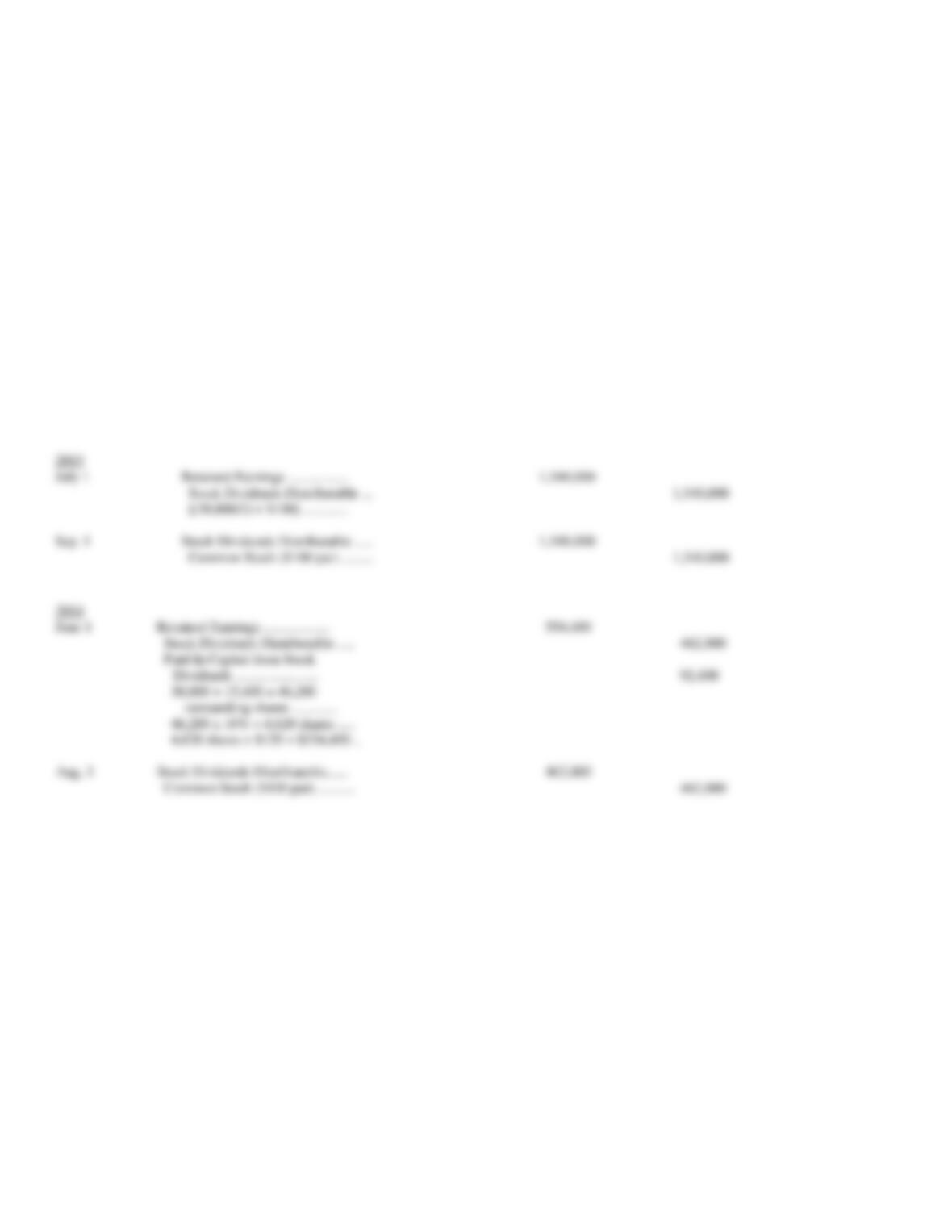
July 1
Retained Earnings ……………..
1,540,000
Stock Dividends Distributable …
1,540,000
[(30,800/2) x $100] ………….
Sep. 1
Stock Dividends Distributable …..
1,540,000
Common Stock ($100 par) ………
1,540,000
2014
June 1
Retained Earnings ……………….
554,400
Paid-In Capital from Stock
92,400
30,800 + 15,400 = 46,200
46,200 x 10% = 4,620 shares …..
4,620 shares x $120 = $554,400 ..
Aug. 1
Stock Dividends Distributable……
462,000
Common Stock ($100 par) ………..
462,000
Dec. 4
Declared and paid
these dividends:
•
$1 cash dividend per share for common stock outstanding
•
Property dividend of 1 share of Hall Co. common stock for
each 10 shares of Olley stock held. The cost to the company
for 1 share of Hall Co. common stock was $25 with a current
market value of $30.
Provide the entries to record the declaration and payment of the dividends on December 4, 2014.
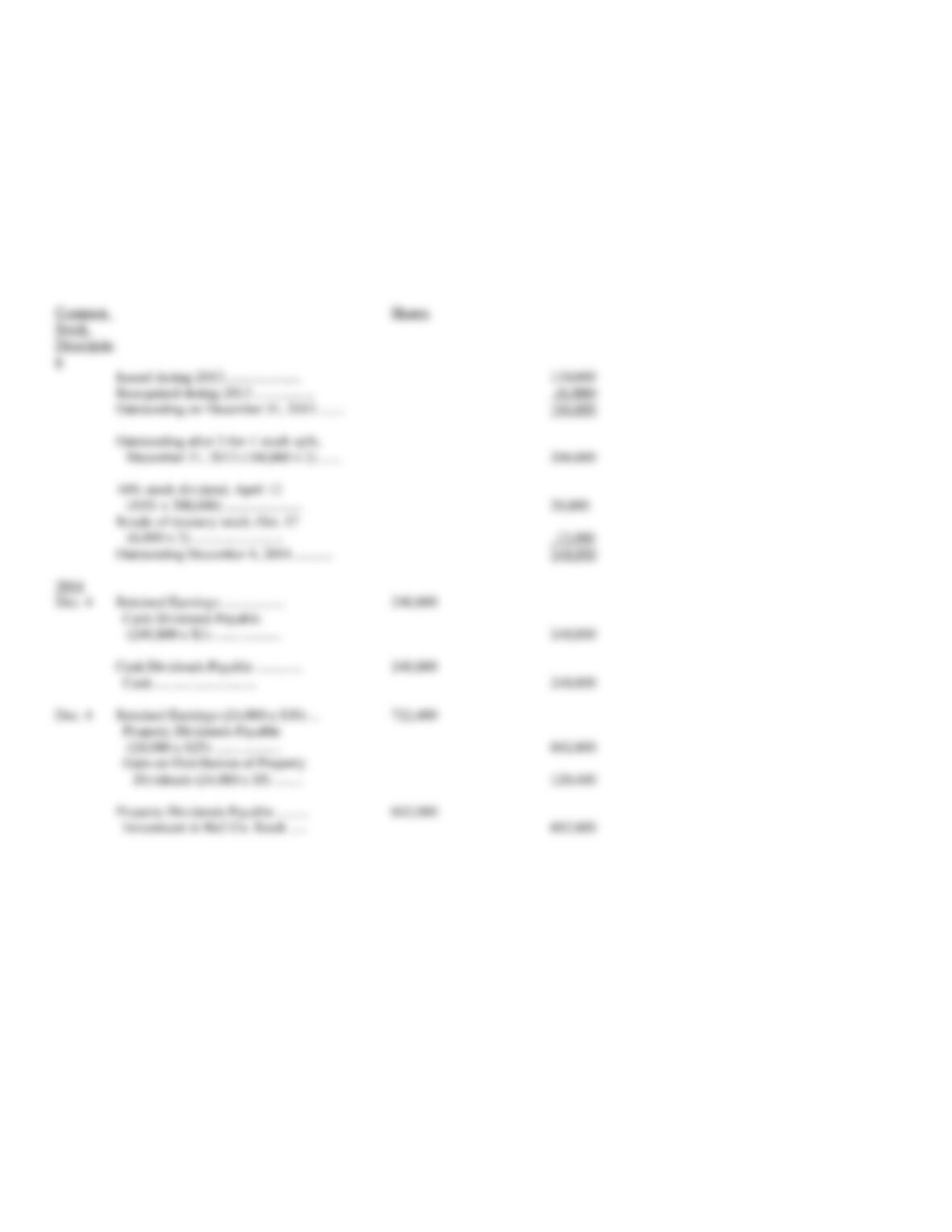
n
Reacquired during 2013 ……………..
(6,000)
Outstanding on December 31, 2013 …….
104,000
Resale of treasury stock, Oct. 17
(6,000 x 2) ……………………..
12,000
Outstanding December 4, 2014 ………..
240,800
2014
Dec. 4
Retained Earnings ………………
240,800
Cash Dividends Payable ………….
240,800
240,800
Dec. 4
Retained Earnings (24,080 x $30) …
722,400
Property Dividends Payable
(24,080 x $25) ……………….
602,000
Property Dividends Payable ………
602,000
179. Selected data from the comparative balance sheets of Mock Company as of December 31, Year 1, and
Year 2 appear below:
Year 1
Year 2
Preferred stock, 12%, $100 Par, Issued at Par
$ 0
$ 600,000
Common Stock, $30 Par
300,000
345,000
Additional Paid-in Capital
120,000
177,000
Retained Earnings
1,260,000
1,320,000
Total
$1,680,000
$2,442,000
Less Cost of Treasury Shares (Cost of 1,500 shares)
(72,000)
–
Total Shareholders’ Equity
$1,608,000
$2,442,000
The following transactions occurred during Year 2:
a.
March 1, Year 2: The company resold the Treasury shares on the market for $57 per share.
b.
June 30, Year 2: The company declared and issued a 10-percent stock dividend at a time when the market price was $63 per share.
c.
September 15, Year 2: The company issued additional shares of common stock on the open market for cash.
d.
November 16, Year 2: The company issued new preferred shares on the open market for cash.
e.
December 31, Year 2: Net income for Year 2 was $195,000. The company declared and paid cash dividends of $72,000 on the last day of
the year.
Required:
Prepare journal entries for each of the transactions and events affecting these shareholders’ equity accounts during Year 2.
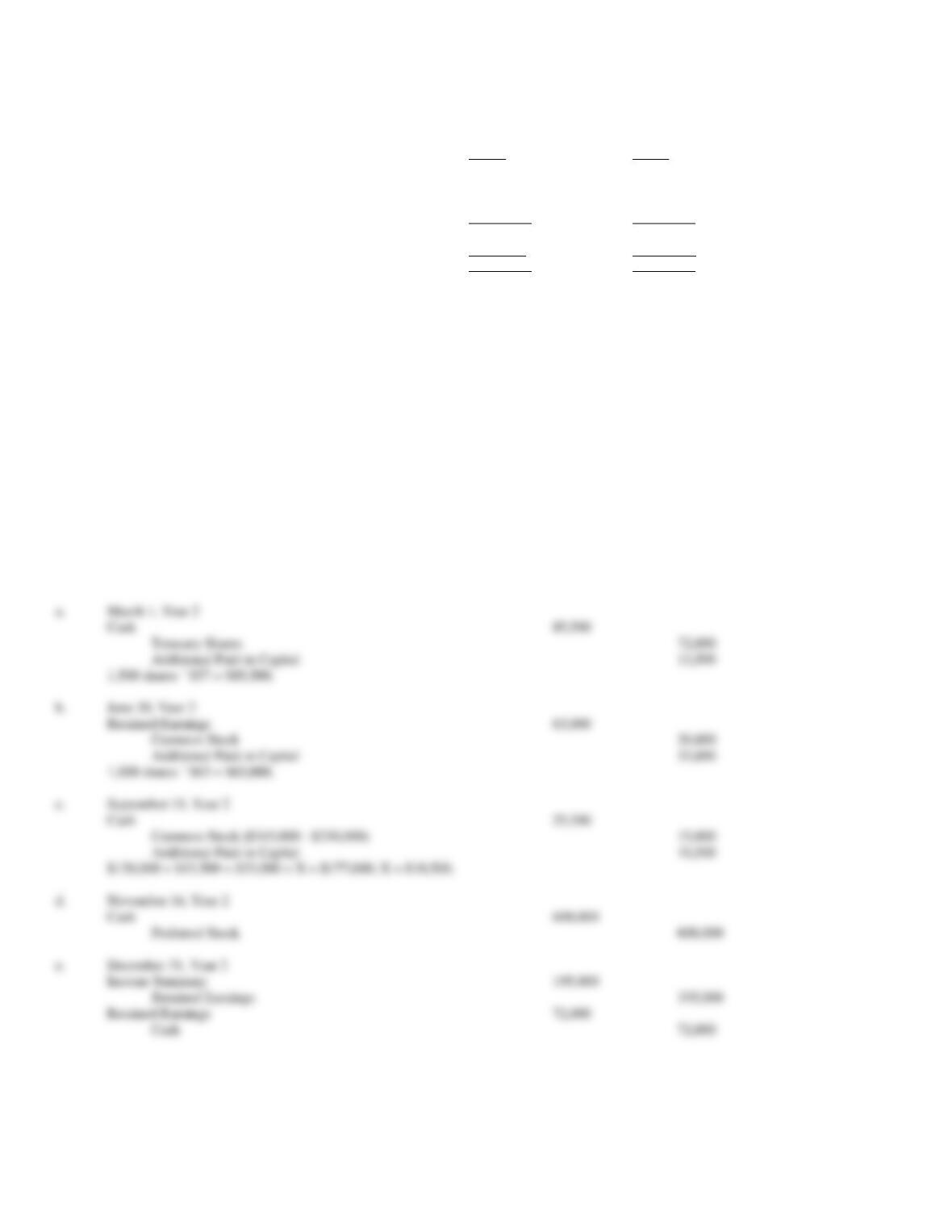
a.
March 1, Year 2
Cash
85,500
Additional Paid-in Capital
13,500
1,500 shares ´ $57 = $85,500.
b.
June 30, Year 2
Retained Earnings
63,000
Common Stock
30,000
Additional Paid-in Capital
33,000
1,000 shares ´ $63 = $63,000.
September 15, Year 2
Cash
25,500
Common Stock ($345,000 – $330,000)
15,000
Additional Paid-in Capital
10,500
$120,000 + $13,500 + $33,000 + X = $177,000; X = $10,500.
d.
November 16, Year 2
Cash
600,000
Preferred Stock
600,000
e.
December 31, Year 2
Income Summary
195,000
Retained Earnings
195,000
Retained Earnings
72,000
180. The data below are from the December 31, 2013, balance sheet of the Harrison Corporation:
Common stock, $50 par, 3,000 shares issued and
outstanding …..……..……………………….
$150,000
Paid-in capital in excess of par ………………….
45,000
Retained earnings ……………………………….
75,000
During 2014, the following transactions affecting corporate capital were recorded:
Aug. 16
Purchased 400 shares of treasury stock at $78 per share.
Oct. 23
Purchased 225 shares of stock at $71 per share and
immediately retired the stock.
Nov. 3
Sold 150 shares of the treasury stock purchased on Aug. 16
at $81 per share.
Assuming the cost method is used for treasury stock and that retained earnings are to be reduced minimally in stock reacquisition transactions,
provide the entries required to record the above transactions.
181. Prepare journal entries to record each of the following transactions for Freight Co.
a.
Freight Co. issues stock warrants for $20,000 cash. The warrants allow holders to purchase 5,000 common shares (par value $5) for $50
each.
b.
One-half of the warrants are exercised.
c.
The remaining warrants expire.
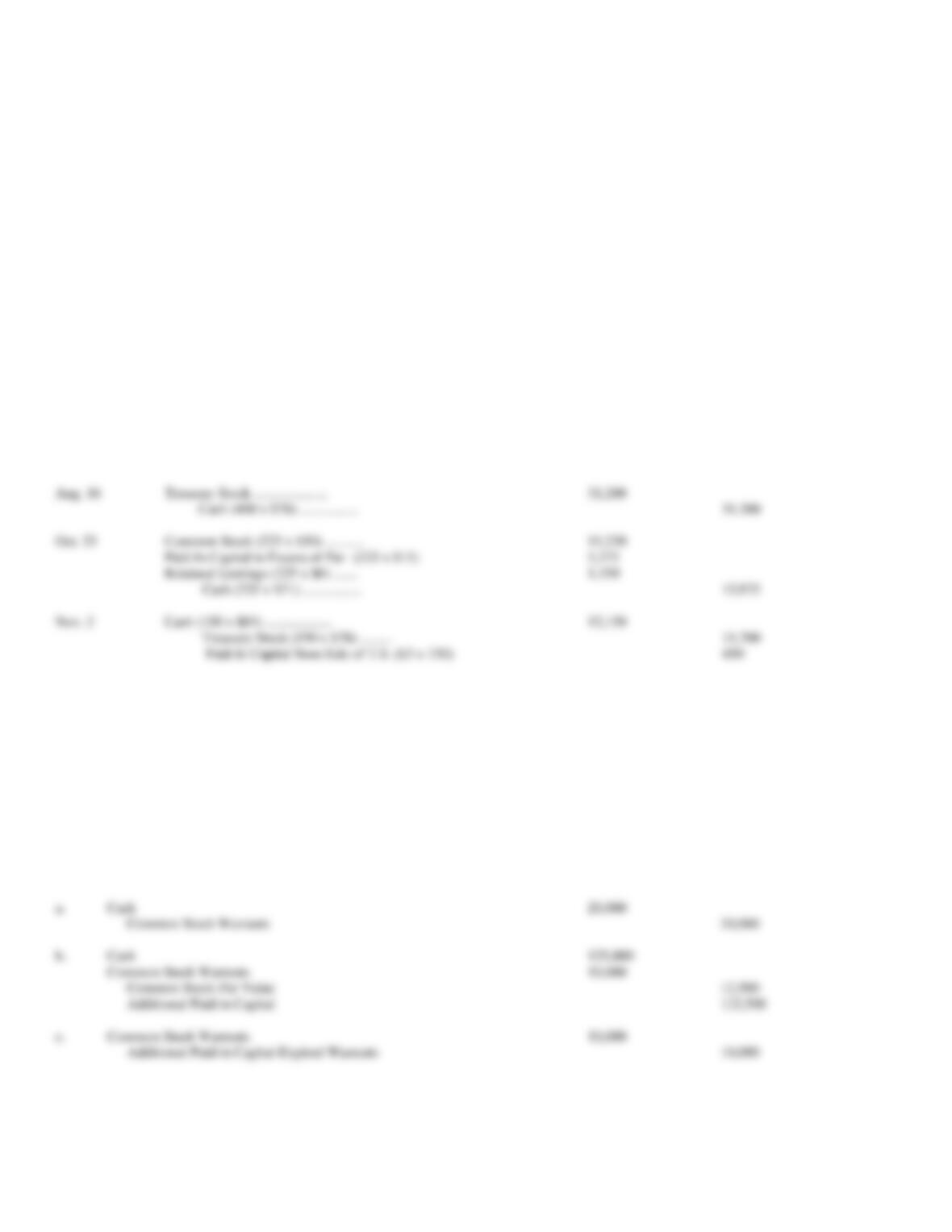
a.
Cash
20,000
Common Stock Warrants
20,000
b.
Cash
125,000
Common Stock Warrants
10,000
Common Stock-Par Value
12,500
Additional Paid-in Capital
122,500
c.
Common Stock Warrants
10,000
Additional Paid-in Capital-Expired Warrants
10,000
Aug. 16
Treasury Stock …………………
31,200
Cash (400 x $78) ……………..
31,200
Oct. 23
Common Stock (225 x $50) ………..
11,250
Paid-In Capital in Excess of Par (225 x $15)
3,375
Retained Earnings (225 x $6) …….
1,350
Cash (225 x $71) ……………..
15,975
Nov. 3
Cash (150 x $81) ……………….
12,150
Treasury Stock (150 x $78) ………
11,700
Paid-In Capital from Sale of T.S. ($3 x 150)
182. The Parker Company wants to raise additional equity capital. The company decides to issue 5,000 shares
of $25 par preferred stock with detachable warrants. The package of the stock and warrants sells for $105. Each
warrant enables the holder to purchase two shares of $10 par common stock at $30 per share. Immediately
following the issuance of the stock, the stock warrants are selling at $14 each. The market value of the preferred
stock without the warrants is $96.
(1)
Prepare a journal entry for Parker Company to record the issuance of the preferred stock and the detachable warrants.
(2)
Assuming that all the warrants are exercised, prepare a journal entry for Parker to record the exercise of the warrants.
(3)
Assuming that only 70 percent of the warrants are exercised, prepare a journal entry for Parker to record the exercise and
expiration of the warrants.
(1)
Cash (5,000 x $105) ………………..…..
525,000
Common Stock Warrants …………………
66,818
14/110 x $105 x 5,000 = $ 66,818
Value assigned to preferred stock:
(2)
Common Stock (10,000 x $10) ……………
100,000
Common Stock Warrants (70% x $66,818) …….
46,773
Cash (7,000 x $30) ………………….….
210,000
Common Stock (7,000 x $10) …………….
70,000
Paid-In Capital in Excess of Par-Common
Common Stock Warrants (30% x $66,818) …….
20,045
183. Describe convertible preferred share features from the perspective of the preferred shareholders and the
issuing firms. Preferred shares may provide for redemption by the issuing firm in the future. What types of
redemption rights or obligations do redeemable preferred shares carry?
184. Describe common stockholder rights.
COMMON SHAREHOLDERS’ EQUITY
185. Discuss why firms may issue capital stock (preferred or common) for cash or for noncash assets. Discuss
the issuance of capital stock for services received.
ISSUING CAPITAL STOCK
186. What is shareholders’ equity?
187. Most publicly traded firms operate as corporations. Discuss three advantages of the corporate form.