19) Firms do not have market power in which of the following market structures?
A) perfect competition only
B) perfect competition and monopolistic competition
C) oligopoly
D) monopoly
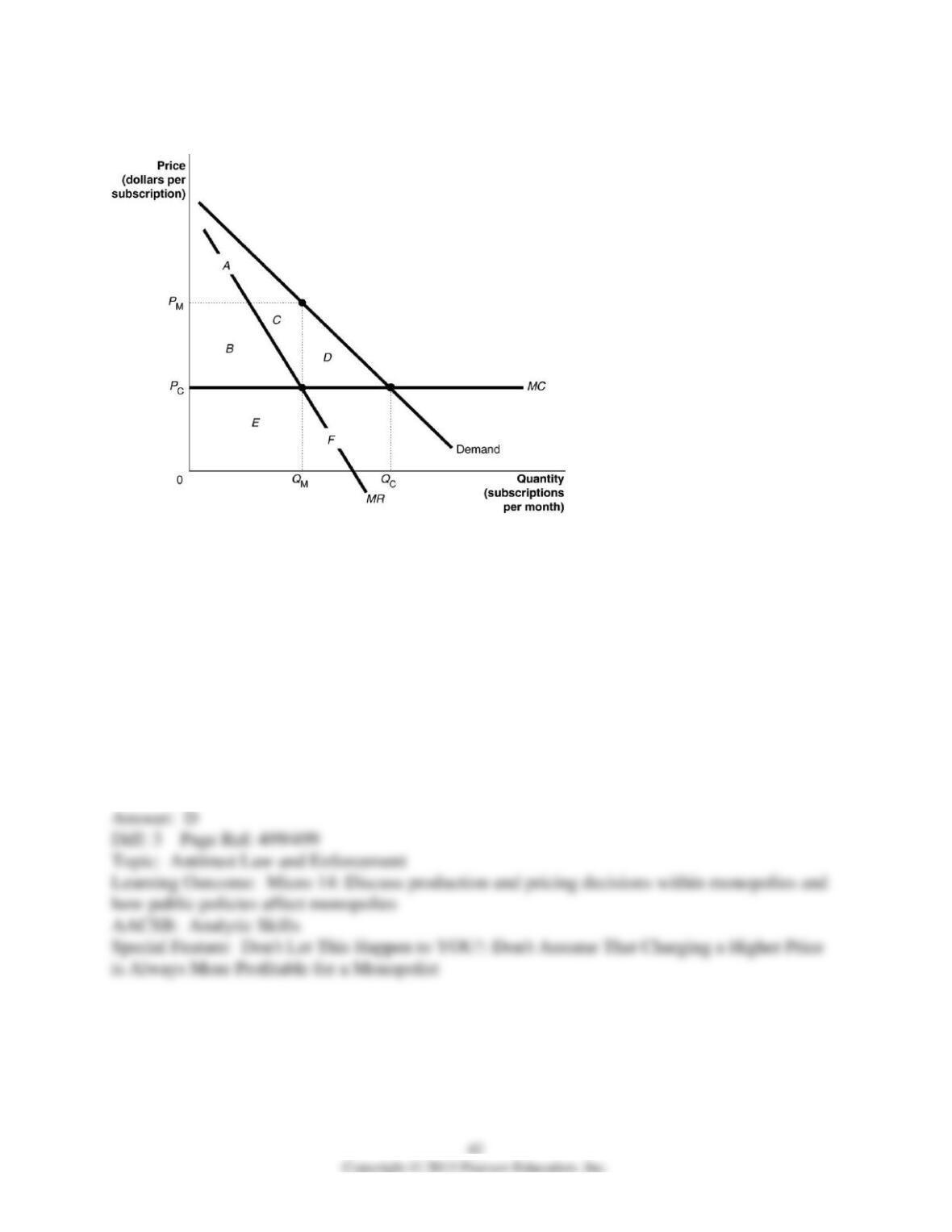
Figure 15-7
In 2011, Verizon was granted permission to enter the market for cable TV in Upstate New York,
ending the virtual monopoly that Time Warner Cable had in most local communities in the
region. Figure 15-7 shows the cable television market in Upstate New York.
20) Refer to Figure 15-7. Suppose the local government imposes a $2.50 per month tax on cable
companies. What happens to the price charged by the cable company following the imposition of
this tax?
A) The price rises from PM to (PM + $2.50).
B) The price rises from PM but it increases by an amount less than $2.50.
C) The price rises from PM but it increases by an amount greater than $2.50 to reflect the
monopoly’s markup.
D) The price remains at PM.
21) The size of a deadweight loss in a market is reduced by
A) government legislating a ceiling price.
B) government legislating a price floor.
C) market price being close to marginal cost.
D) creative destruction.
22) A market economy benefits from market power
A) if the majority of the population are entrepreneurs.
B) if firms with market power do research and development with the profits earned.
C) if market power gets so bad the government creates public enterprises.
D) under no circumstances.
23) Which of the following statements is consistent with the views of Joseph Schumpeter?
A) Research and development by competitive firms is responsible for most technological
changes.
B) An economy benefits from firms having market power because these firms are more likely to
be able to commit funds for research and development.
C) Enforcement of antitrust laws is necessary to promote competition among firms.
D) A lack of competition discourages firms from developing new technologies.
24) If a per-unit tax on output sold is imposed on a monopoly’s product, the monopolist will
increase its market price by the full amount of the tax.
25) Suppose a monopoly is producing its profit-maximizing output level. Now suppose the
government imposes a lump-sum tax on the monopoly, independent of its output. As a result the
monopoly’s profit will fall.
26) In reality, because few markets are perfectly competitive, some loss of economic efficiency
occurs in the market for nearly every good or service.
27) Market power in the United States causes a huge loss of economic efficiency.
28) How do the price and quantity of a monopoly compare to that of a perfectly competitive
industry?
29) Suppose that a perfectly competitive industry becomes a monopoly. What effect will this
have on consumer surplus, producer surplus, and deadweight loss?
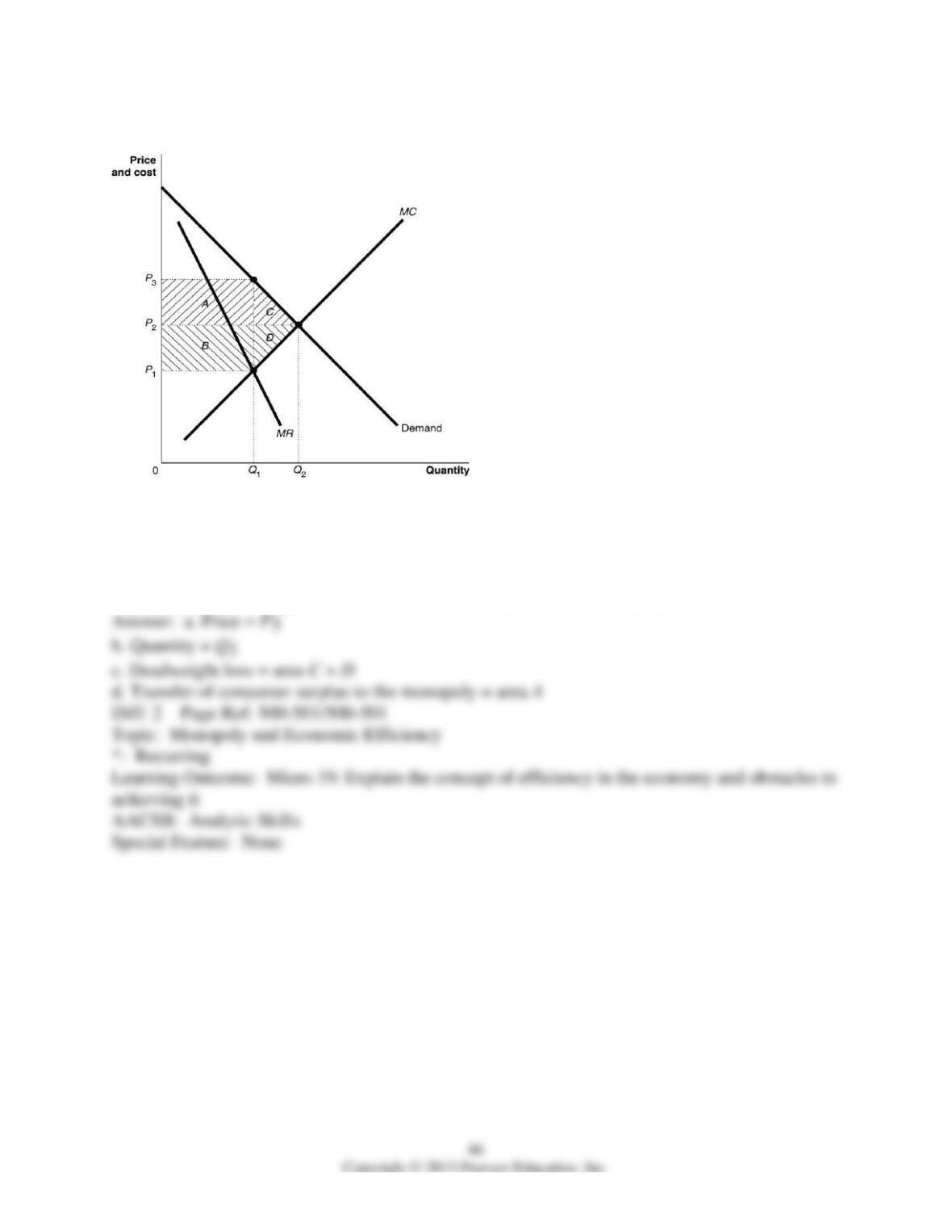
Figure 15-8
30) Refer to Figure 15-8. From the monopoly graph above, identify the following:
a. The profit maximizing price
b. The profit maximizing quantity
c. The area representing deadweight loss
d. The area representing the transfer of consumer surplus to the monopoly
15.5 Government Policy toward Monopoly
1) The first important federal law passed to regulate monopolies in the United States was the
A) Cellar-Kefauver Act.
B) Clayton Act.
C) Federal Trade Commission Act.
D) Sherman Act.
2) The Sherman Act prohibited
A) marginal cost pricing.
B) setting price above marginal cost.
C) collusive price agreements among rival sellers.
D) selling below average total cost.
3) The Clayton Act prohibited
A) all vertical mergers.
B) all horizontal mergers.
C) any merger if its effect was to substantially lessen competition or create a monopoly.
D) all conglomerate mergers.
4) The Federal Trade Commission (FTC) Act
A) gave the FTC full power to regulate mergers.
B) closed the loopholes in the Sherman and Clayton Acts.
C) divided authority to police mergers between the FTC and the Department of Justice.
D) prohibited charging buyers different prices if the result would reduce competition.
5) A merger between the Ford Motor Company and General Motors would be an example of a
A) vertical merger.
B) horizontal merger.
C) conglomerate merger.
D) trust.
6) A merger between U.S. Steel and General Motors would be an example of a
A) vertical merger.
B) horizontal merger.
C) conglomerate merger.
D) conspiracy in restraint of trade.
7) When a proposed merger between two companies is reviewed by the government, the relevant
market is defined by
A) whether or not there are close substitutes for the products of the two firms.
B) how elastic the demand is for each firm’s product.
C) counting the number of firms that produce the same product.
D) how much advertising is done in the industry.
8) A Herfindahl-Hirschman Index is calculated by
A) summing the amount of sales by the four largest firms and dividing by total industry sales.
B) dividing the number of firms wanting to merge by the total number in the industry.
C) summing the squares of the market shares of each firm in the industry.
D) summing the advertising expenditures of the firms that want to merge by total industry
advertising expenditures.
9) Suppose an industry is made up of 25 firms, all with equal market share. The four-firm
concentration ratio of this industry is
A) 16%.
B) 20%.
C) 25%.
D) It cannot be determined from the information given.
10) Consider an industry that is made up of nine firms each with a market share (percent of sales)
as follows:
a. Firm A: 30%
b. Firm B: 20%
c. Firms C, D and E: 10% each
d. Firms F, G, H and J: 5% each
What is the value of the four-firm concentration ratio and how is the industry categorized?
A) 50%; monopolistic competition
B) 70%; oligopoly
C) 75%; oligopoly
D) 80%; strongly oligopolistic
11) Consider an industry that is made up of nine firms each with a market share (percent of sales)
as follows:
a. Firm A: 30%
b. Firm B: 20%
c. Firms C, D and E: 10% each
d. Firms F, G, H and J: 5% each
What is the value of the Herfindahl-Hirschman Index and how is the industry categorized?
A) 1700; moderately concentrated
B) 1425; moderately concentrated
C) 1600; moderately concentrated
D) 2600; highly concentrated
12) A possible advantage of a horizontal merger for the economy is that
A) the merging firms could avoid losses.
B) the merged firm might reap economies of scale which could translate into lower prices.
C) the degree of competition in the industry will be intensified.
D) the government stands to collect more corporate income tax revenue.
13) The government estimated that by allowing the merger between AT&T and T-Mobile to go
through, the Herfindahl Hirschman Index for the national market would increase from about
2,400 to about 3,100. According to the merger standards of the Department of Justice and the
FTC, these index numbers indicate that the market is ________ concentrated, and the merger
________ be challenged.
A) moderately; may
B) moderately; will
C) highly; may
D) highly; will
14) The standards used by the Department of Justice and the FTC to evaluate a potential merger
are based on market concentration as determined by the
A) Herfindahl-Hirschman Index.
B) Clayton Antitrust Act.
C) Anti-Collusion Task Force.
D) Robinson-Patman Act.
15) A merger between two competitors may be approved by the Department of Justice and the
FTC if the two companies can substantiate ________ as a result of the merger.
A) increases in revenue for the merged company
B) an increase in the HHI to over 1,800
C) decreases in marginal revenue for the merged company
D) increases in economic efficiency
16) Natural monopolies in the United States are generally regulated by
A) the Federal Trade Commission.
B) the Department of Justice.
C) local or state regulatory commissions.
D) the Department of Commerce.
17) If a natural monopoly regulatory commission sets a price where marginal cost is equal to
demand
A) the firm would earn monopoly profits.
B) economic efficiency would not be achieved.
C) the firm would incur a loss.
D) the firm would break even.
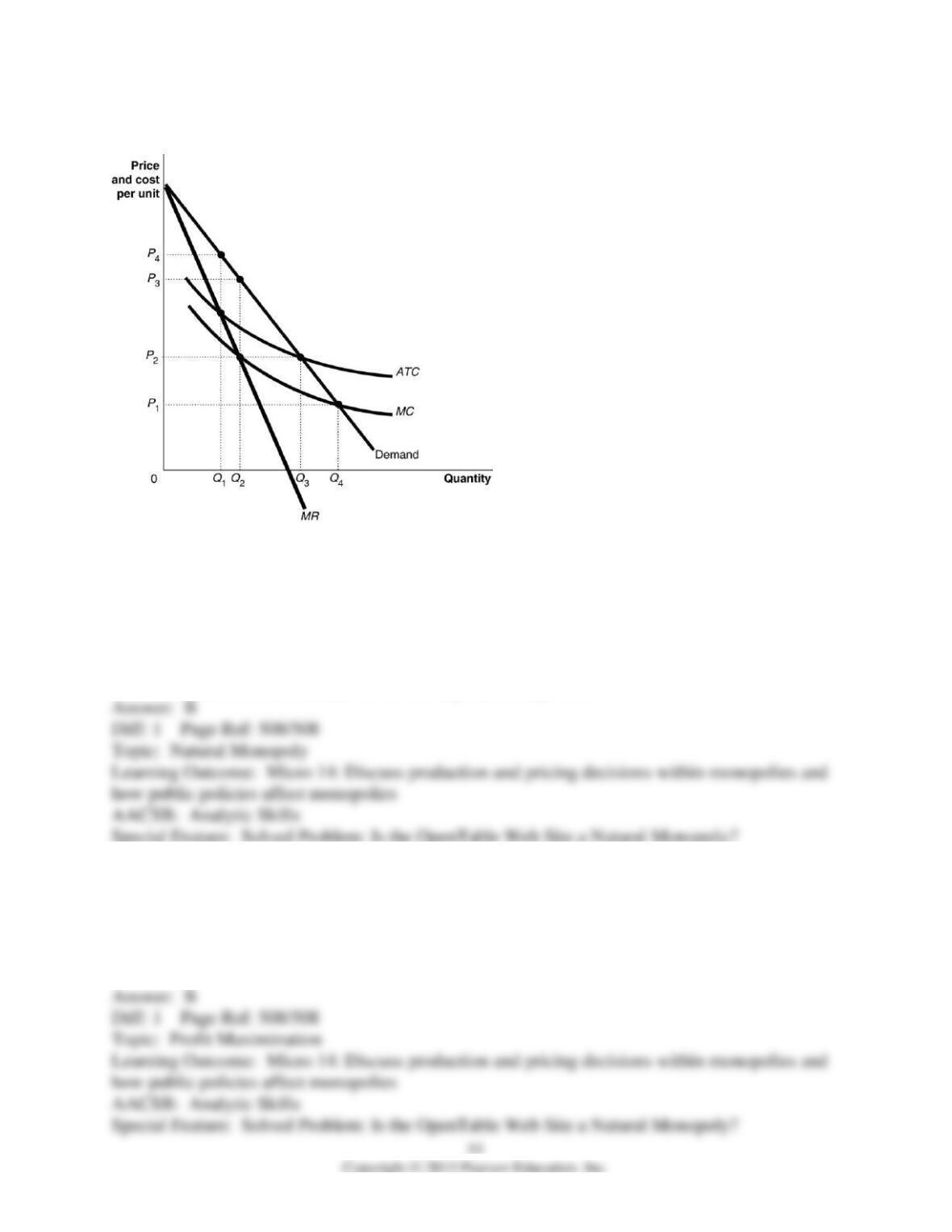
Figure 15-9
Figure 15-9 shows the cost and demand curves for the Erickson Power Company.
18) Refer to Figure 15-9. Erickson Power is a natural monopoly because
A) it is a power company and all power companies are natural monopolies.
B) average total cost is still declining when it intersects demand.
C) of its continually declining marginal revenue curve as output rises.
D) its marginal cost lies entirely below its long-run average cost.
19) Refer to Figure 15-9. The firm would maximize profit by producing
A) Q1 units.
B) Q2 units.
C) Q3 units.
D) Q4 units.
20) Refer to Figure 15-9. The profit-maximizing price is
A) P1.
B) P2.
C) P3.
D) P4.
21) Refer to Figure 15-9. If the government regulates Erickson Power Company so that the firm
can earn a normal profit, the price would be set at ________ and the output level is ________.
A) P1, Q4
B) P2, Q3
C) P2, Q2
D) P3, Q2
22) Refer to Figure 15-9. What is the economically efficient output level and what is the price at
that level?
A) Q4, P1
B) Q3, P2
C) Q2, P2
D) Q2, P3
23) Refer to Figure 15-9. Why won’t regulators require that Erickson Power produce the
economically efficient output level?
A) because there is insufficient demand at that output level
B) because at the economically efficient output level, the marginal cost of producing the last unit
sold exceeds the consumers’ marginal value for that last unit
C) because Erickson Power will earn zero profit
D) because Erickson Power will sustain persistent losses and will not continue in business in the
long run
24) Economic efficiency requires that a natural monopoly’s price be
A) equal to average total cost where it intersects the demand curve.
B) equal to marginal cost where it intersects the demand curve.
C) equal to average variable cost where it intersects the demand curve.
D) equal to the lowest price the firm can charge and still make a normal profit.
25) In regulating a natural monopoly, the price strategy that ensures the highest possible output
and zero profit is one that sets price
A) equal to average total cost where it intersects the demand curve.
B) equal to marginal cost where it intersects the demand curve.
C) equal to average variable cost where it intersects the demand curve.
D) corresponding to the demand curve where marginal revenue equals zero.
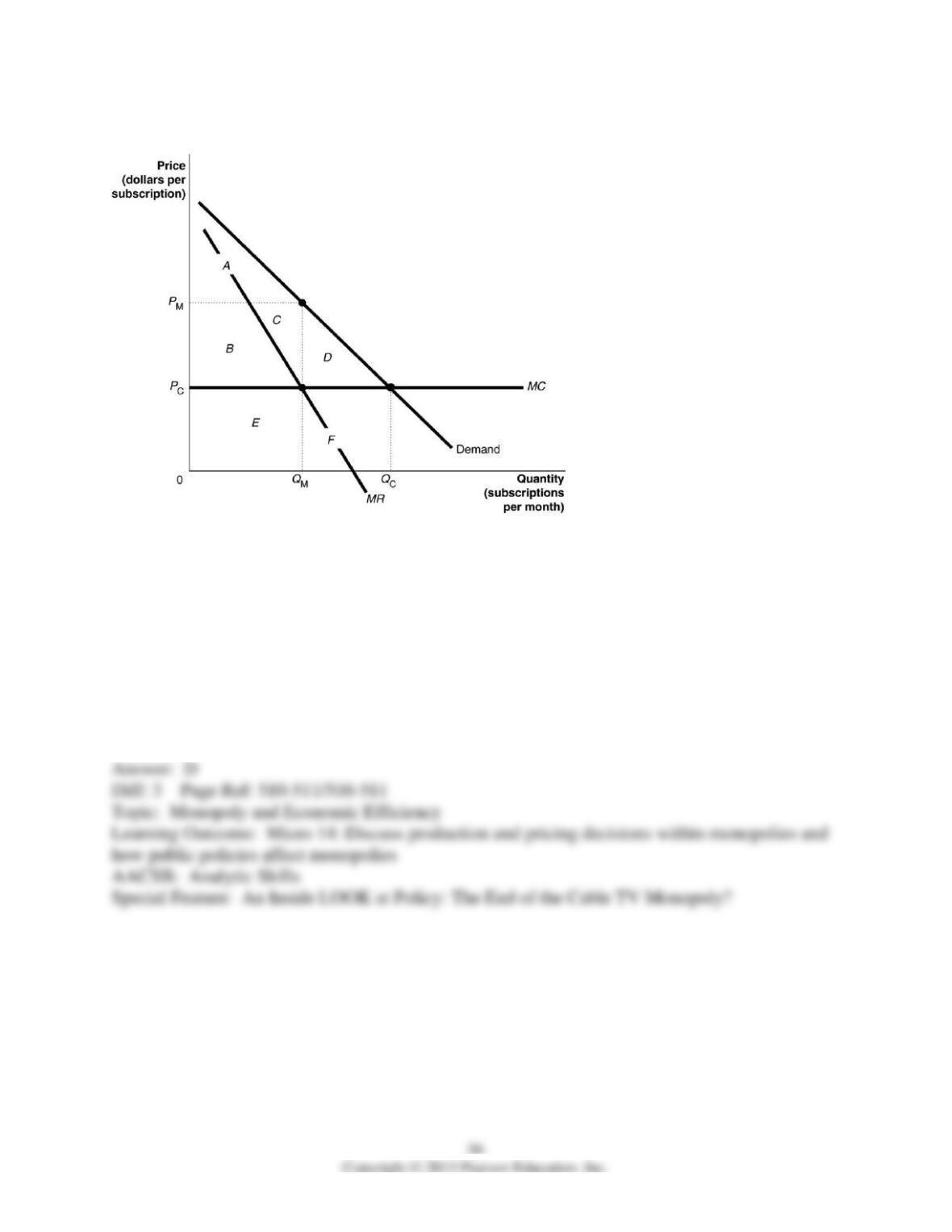
Figure 15-7
In 2011, Verizon was granted permission to enter the market for cable TV in Upstate New York,
ending the virtual monopoly that Time Warner Cable had in most local communities in the
region. Figure 15-7 shows the cable television market in Upstate New York.
26) Refer to Figure 15-7. Following the entry of Verizon, the subscription price falls from PM
to PC. What is the increase in consumer surplus as a result of this change?
A) the area A + B + C
B) the area B + C
C) the area D + F
D) the area B + C + D
27) Refer to Figure 15-7. What is the size of the deadweight loss prior to Verizon entering the
market and what happens to this deadweight loss after Verizon does enter the market?
A) The deadweight loss of area D is converted to consumer surplus.
B) The deadweight loss of area C+D is converted to consumer surplus
C) The deadweight loss of area D is converted to producer surplus.
D) The total deadweight loss is the area D+F; D is converted to consumer surplus and F to
producer surplus.
28) A product’s price approaches its marginal cost as market concentration increases.
29) A vertical merger is one that takes place between two companies producing different goods
or services for one specific finished product.
30) Holding everything else constant, government approval of horizontal mergers is more likely
to be granted if the “market” that firms are in are broadly defined rather than narrowly defined.
31) The U.S. government would never approve a proposed merger between two firms that could
significantly increase the newly merged firm’s market power even if the efficiency gains from the
newly merged firm could make consumers better off.
32) Identify two ways by which the government controls monopolies?
33) a. What is the difference between a horizontal merger and a vertical merger?
b. Give an example of each type of merger.
c. Could a horizontal merger be welfare improving?
34) Consider two industries, industry Q and industry Z. In industry Q there are 10 companies,
each with a market share of 10% of total sales. In industry Z, there are eight companies. One
company has a 65% market share and each of the other seven firms has a market share of 5%.
a. Calculate the four-firm concentration ratio for each industry.
b. Calculate the Herfindahl-Hirschman Index (HHI) for each industry.
c. What do the values of the two concentration measures imply about the degree of market
power in the two industries?
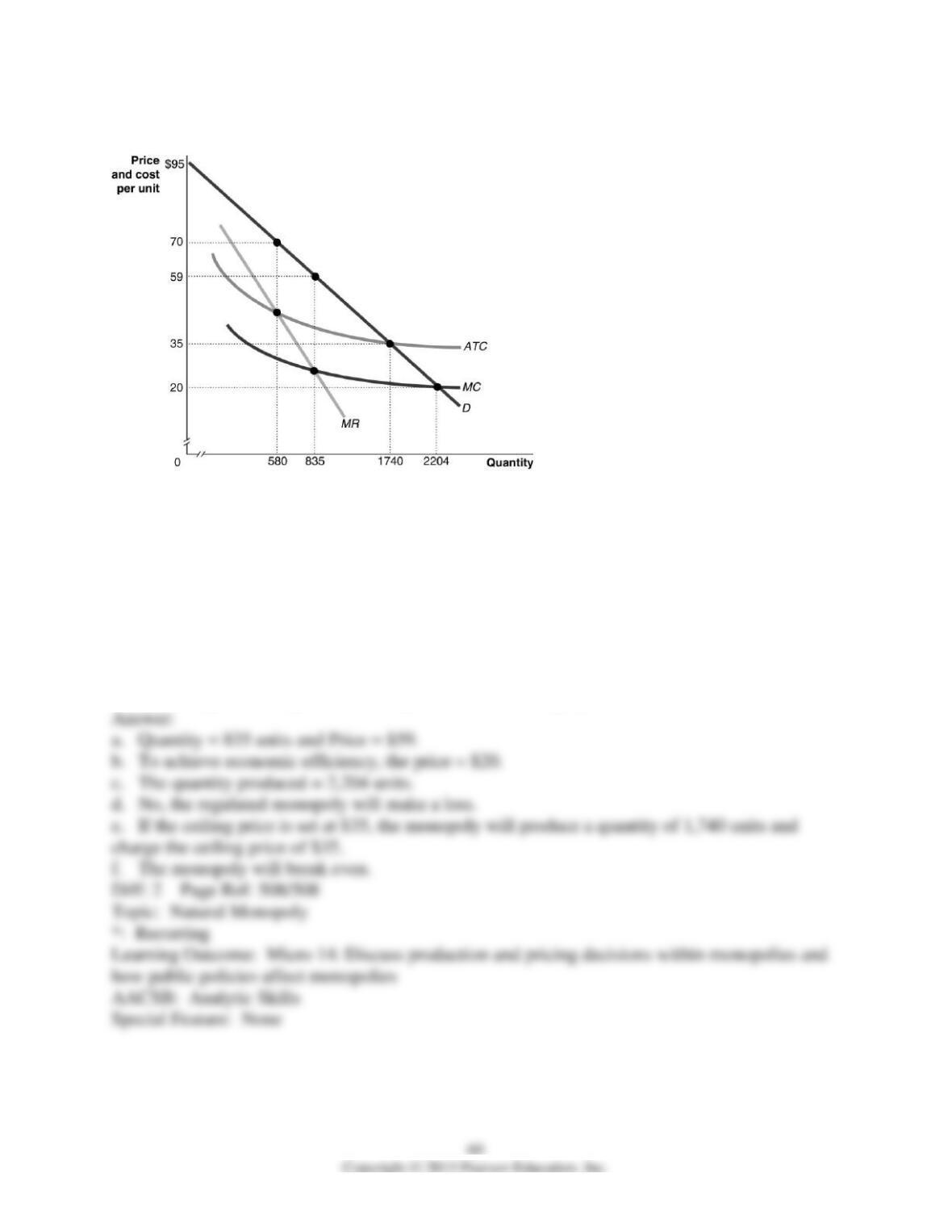
Figure 15-10
35) Refer to Figure 15-10 to answer the following questions.
a. What quantity will this monopoly produce and what price will it charge?
b. Suppose the monopoly is regulated. If the regulatory agency wants to achieve economic
efficiency, what price should it require the monopoly to charge?
c. To achieve economic efficiency, what quantity will the regulated monopoly produce?
d. Will the regulated monopoly make a profit if it charges the price that will achieve economic
efficiency?
e. Suppose the government decides to regulate the monopoly by imposing a price ceiling of
$35. What quantity will the monopoly produce and what price will the monopoly charge?
f. With the price ceiling of $35, what profit will the monopoly earn?