Stockholders’ Equity
15 – 37
DERIVATIONS — CPA Adapted (cont.)
No. Answer Derivation
EXERCISES
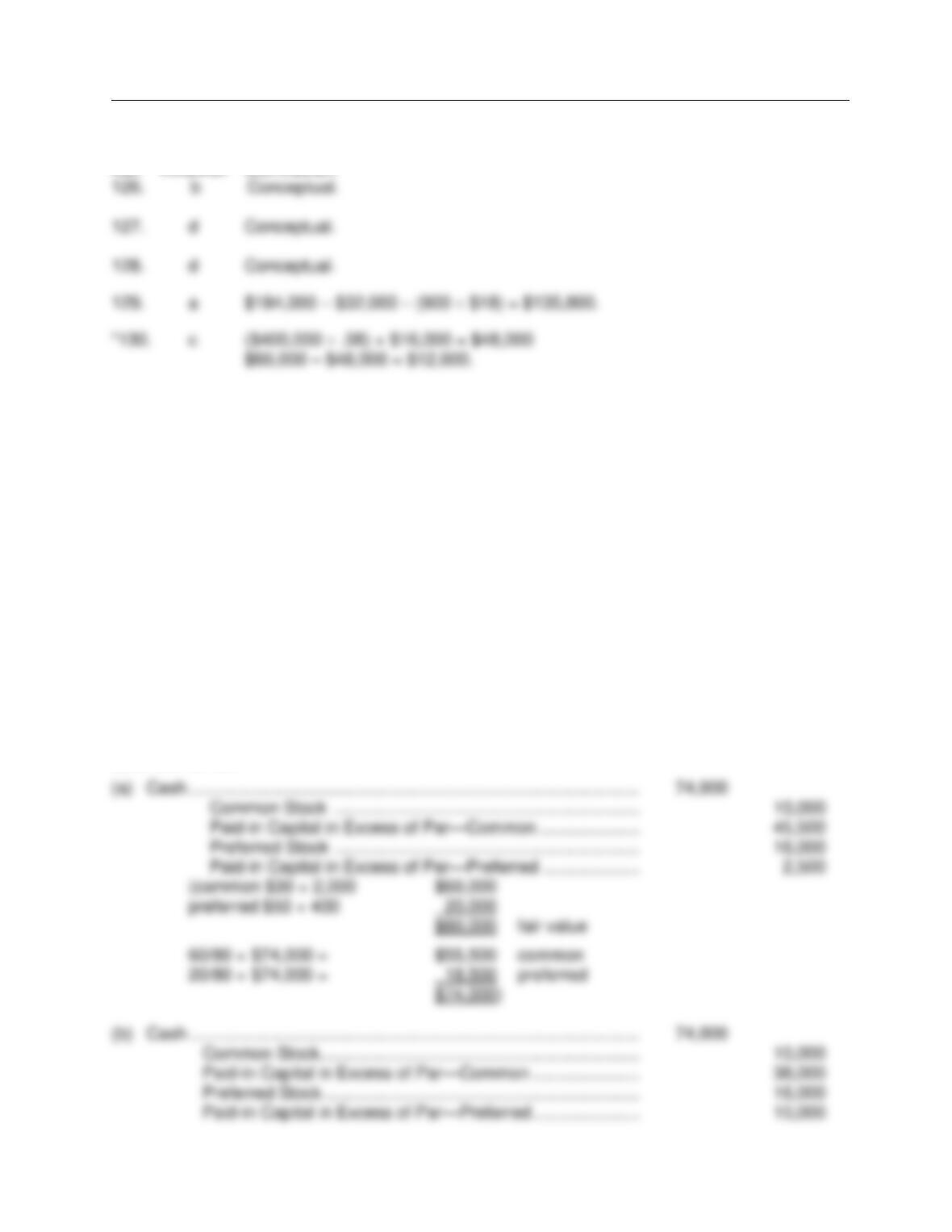
Ex. 15-131—Lump sum issuance of stock.
Parker Corporation has issued 2,000 shares of common stock and 400 shares of preferred stock
for a lump sum of $74,000 cash.
Instructions
(a) Give the entry for the issuance assuming the par value of the common stock was $5 and the
fair value $30, and the par value of the preferred stock was $40 and the fair value $50. (Each
valuation is on a per share basis and there are ready markets for each stock.)
(b) Give the entry for the issuance assuming the same facts as (a) above except the preferred
stock has no ready market and the common stock has a fair value of $24 per share.
Solution 15-131
Test Bank for Intermediate Accounting, Fifteenth Edition
15 – 38
Ex. 15-132—Treasury stock.
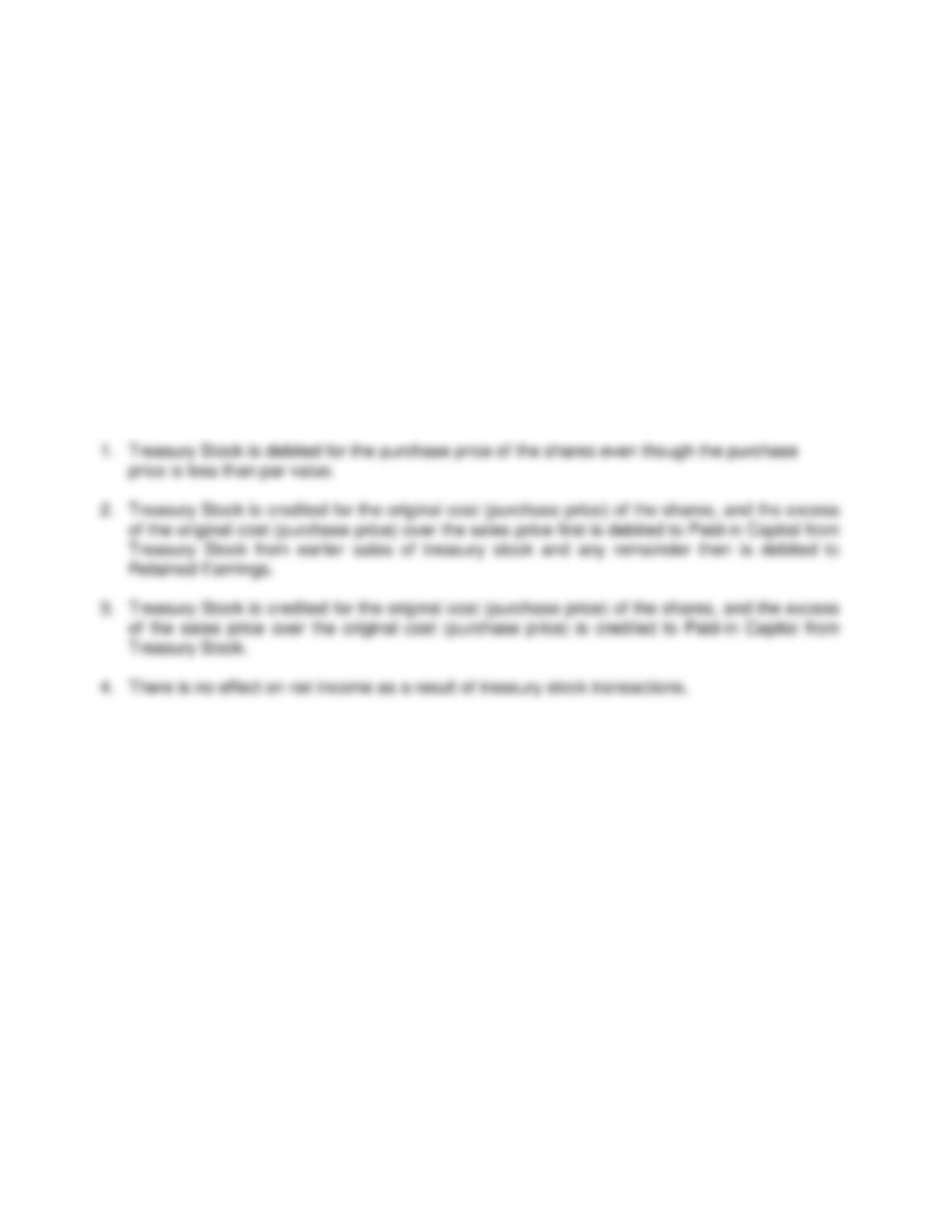
For numerous reasons, a corporation may reacquire shares of its own capital stock. When a
company purchases treasury stock, it usually accounts for the stock using the cost method.
Instructions
Explain how a company would account for each of the following:
1. Purchase of treasury shares at a price less than par value.
2. Subsequent resale of treasury shares at a price less than purchase price, but more than par
value.
3. Subsequent resale of treasury shares at a price greater than both purchase price and par
value.
4. Effect on net income.
Solution 15-132
Ex. 15-133—Treasury stock.
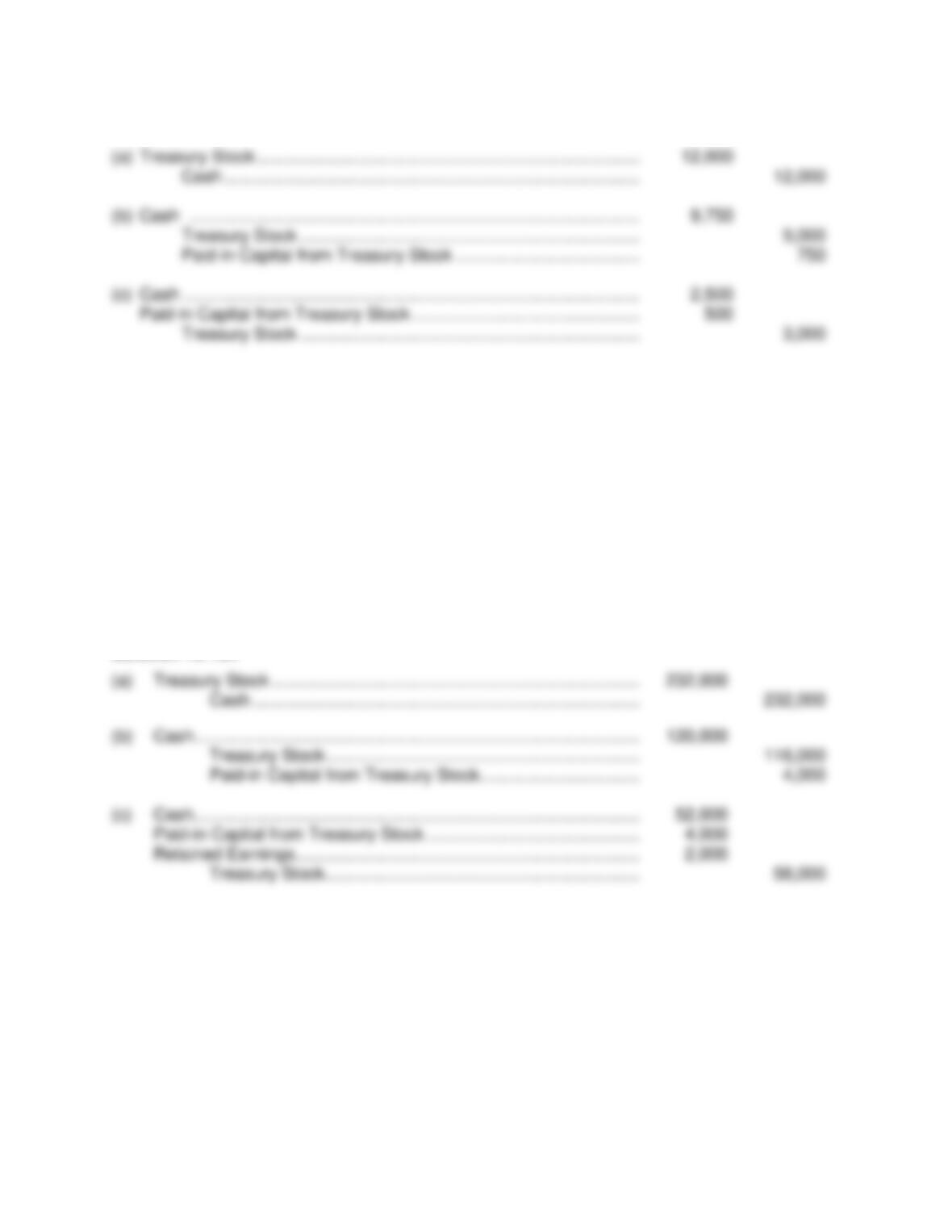
Agler Corporation’s balance sheet reported the following:
Capital stock outstanding, 5,000 shares, par $30 per share $150,000
Paid-in capital in excess of par 80,000
Retained earnings 100,000
The following transactions occurred this year:
(a) Purchased 200 shares of capital stock to be held as treasury stock, paying $60 per share.
(b) Sold 150 of the shares of treasury stock at $65 per share.
(c) Sold the remaining shares of treasury stock at $50 per share.
Instructions
Prepare the journal entry for these transactions under the cost method of accounting for treasury
stock.
Stockholders’ Equity
15 – 39
Solution 15-133
Ex. 15-134—Treasury stock.
Ellison Company’s balance sheet shows:
Common stock, $20 par $3,000,000
Paid-in capital in excess of par 1,050,000
Retained earnings 750,000
Instructions
Record the following transactions by the cost method.
(a) Bought 8,000 shares of its common stock at $29 a share.
(b) Sold 4,000 treasury shares at $30 a share.
(c) Sold 2,000 shares of treasury stock at $26 a share.
Solution 15-134
Ex. 15-135—Treasury stock.
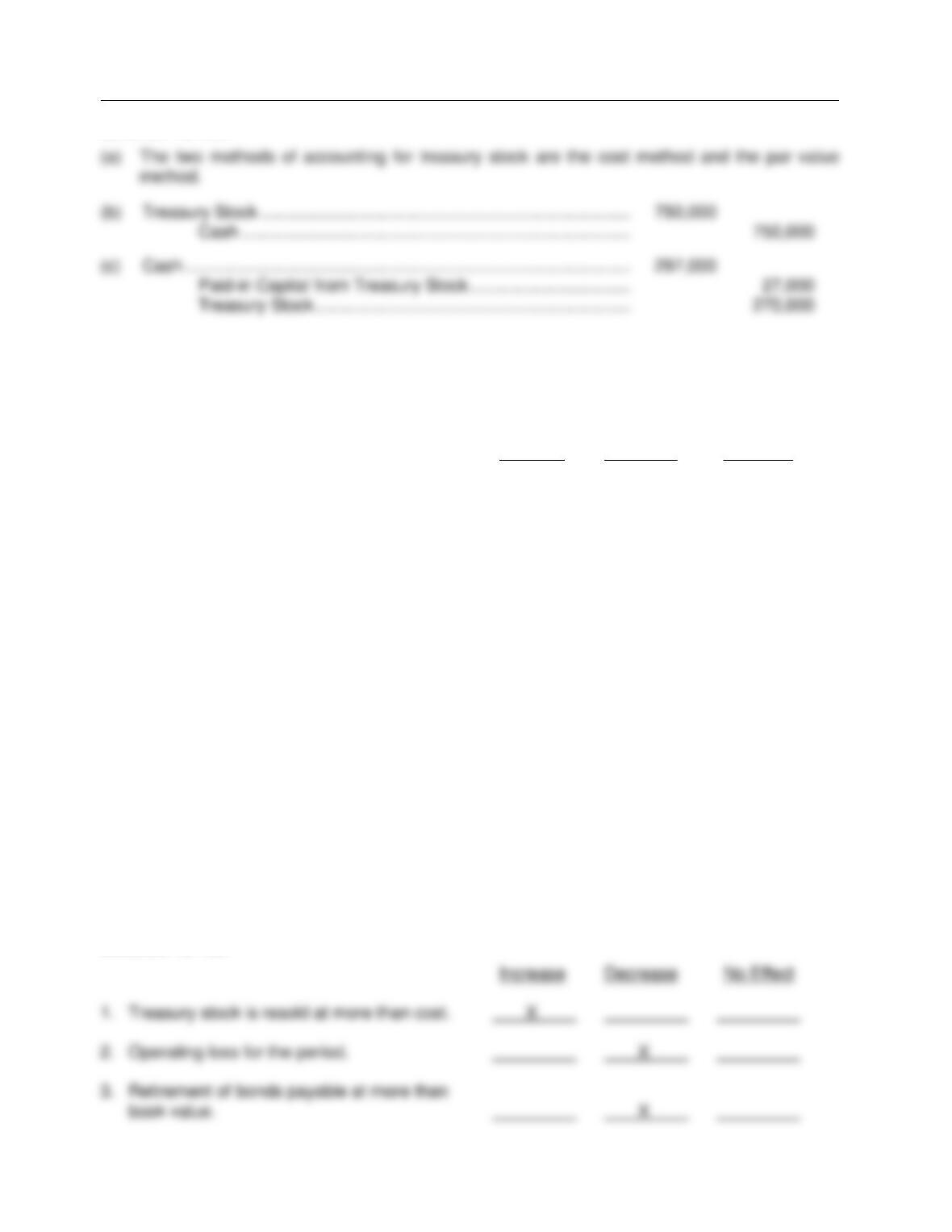
In 2014, Mordica Co. issued 300,000 of its 500,000 authorized shares of $10 par value common
stock at $35 per share. In January, 2015, Mordica repurchased 25,000 shares at $30 per share.
Assume these are the only stock transactions the company has ever had.
Instructions
(a) What are the two methods of accounting for treasury stock?
(b) Prepare the journal entry to record the purchase of treasury stock by the cost method.
(c) 9,000 shares of treasury stock are reissued at $33 per share. Prepare the journal entry to
record the reissuance by the cost method.
Test Bank for Intermediate Accounting, Fifteenth Edition
15 – 40
Solution 15-135
Ex. 15-136—Stockholders’ Equity.
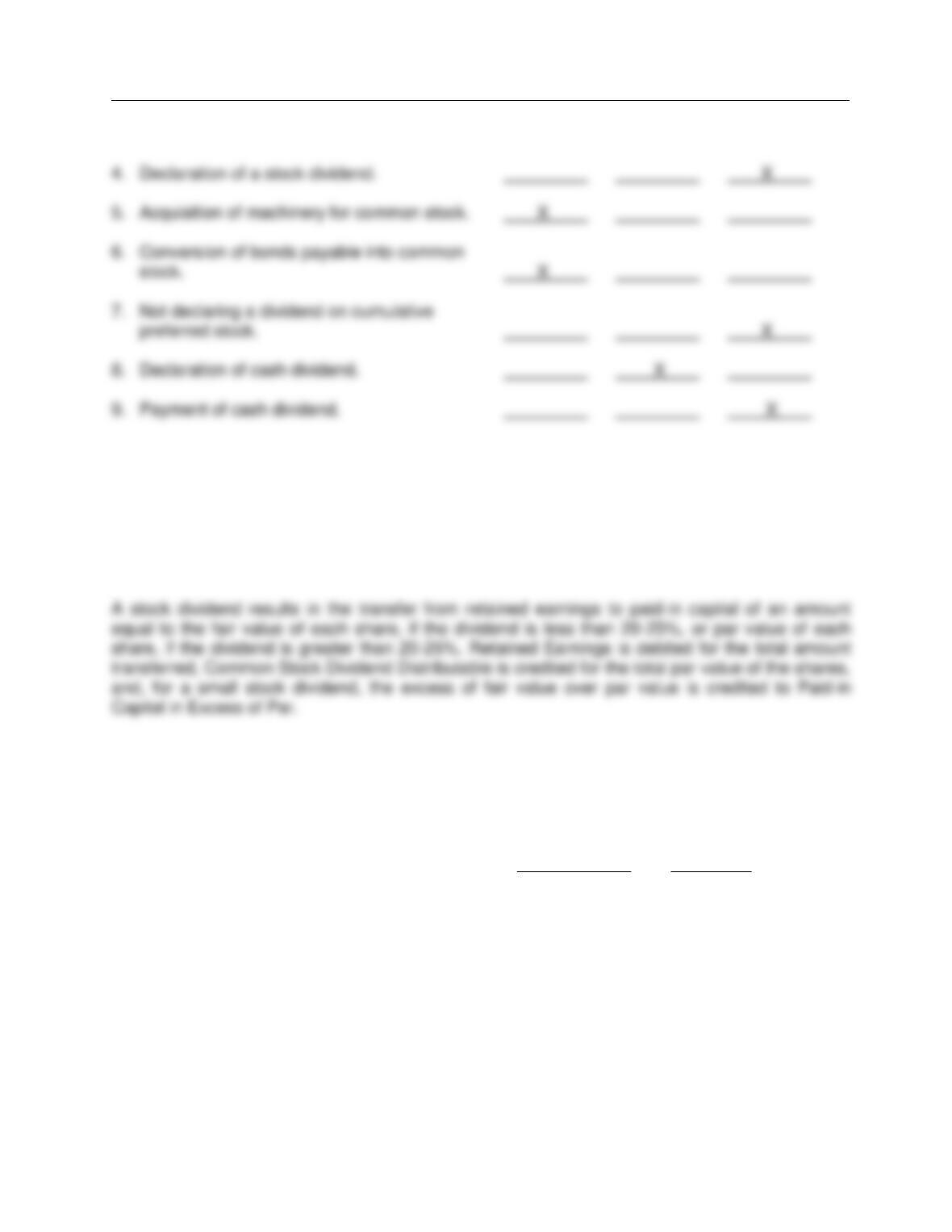
Indicate the effect of each of the following transactions on total stockholders’ equity by placing an
“X” in the appropriate column.
Increase Decrease No Effect
1. Treasury stock is resold at more than cost. ________ ________ ________
2. Operating loss for the period. ________ ________ ________
3. Retirement of bonds payable at more than
book value. ________ ________ ________
4. Declaration of a stock dividend. ________ ________ ________
5. Acquisition of machinery for common stock. ________ ________ ________
6. Conversion of bonds payable into common
stock. ________ ________ ________
7. Not declaring a dividend on cumulative
preferred stock. ________ ________ ________
8. Declaration of cash dividend. ________ ________ ________
9. Payment of cash dividend. ________ ________ ________
Solution 15-136
Stockholders’ Equity
15 – 41
Solution 15-136 (Cont.)
Ex. 15-137—Stock dividends.
Describe the journal entry for a stock dividend on common stock (which has a par value).
Solution 15-137
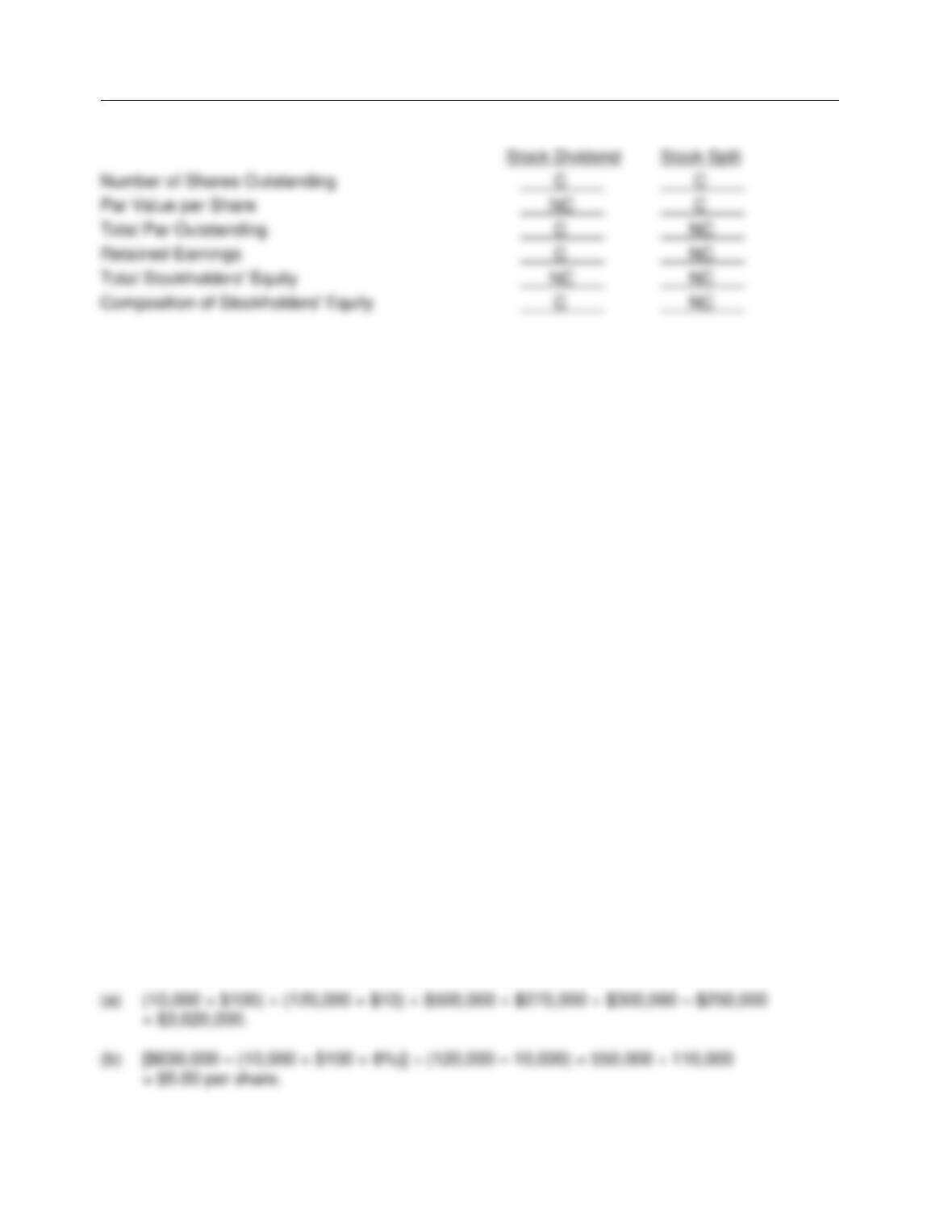
Ex. 15-138—Stock dividends and stock splits.
Indicate the principal effects of a stock dividend versus a stock split on the issuing corporation.
Respond in the spaces as follows: “C” for change; “NC” for no change.
Stock Dividend Stock Split
Number of Shares Outstanding ________ ________
Par Value per Share ________ ________
Total Par Outstanding ________ ________
Retained Earnings ________ ________
Total Stockholders’ Equity ________ ________
Composition of Stockholders’ Equity ________ ________
Test Bank for Intermediate Accounting, Fifteenth Edition
15 – 42
Solution 15-138
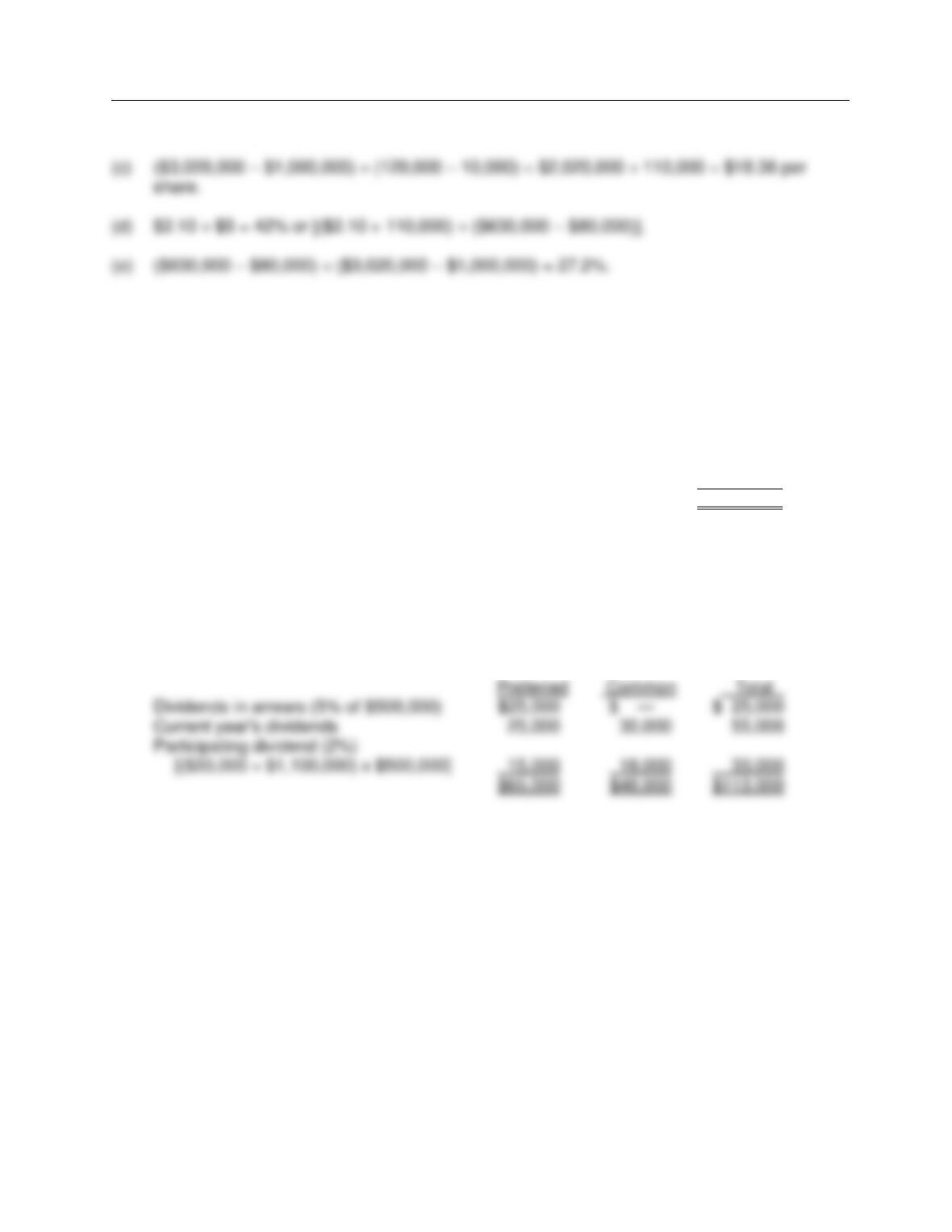
Ex. 15-139—Computation of selected financial ratios.
The following information pertains to Parsons Co.:
Preferred stock, cumulative:
Par value per share $100
Dividend rate 8%
Shares outstanding 10,000
Dividends in arrears none
Common stock:
Par value per share $10
Shares issued 120,000
Dividends paid per share $2.10
Market price per share $48.00
Additional paid-in capital $500,000
Unappropriated retained earnings (after closing) $270,000
Retained earnings appropriated for contingencies $300,000
Common treasury stock:
Number of shares 10,000
Total cost $250,000
Net income $630,000
Instructions
Compute (assume no changes in balances during the past year):
(a) Total amount of stockholders’ equity in the balance sheet
(b) Earnings per share of common stock
(c) Book value per share of common stock
(d) Payout ratio of common stock
(e) Return on common stock equity
Solution 15-139
Stockholders’ Equity
15 – 43
Solution 15-139 (Cont.)
*Ex. 15-140—Dividends on preferred stock.
The stockholders’ equity section of Lemay Corporation shows the following on December 31,
2015:
Preferred stock—5%, $100 par, 5,000 shares outstanding $ 500,000
Common stock—$10 par, 60,000 shares outstanding 600,000
Paid-in capital in excess of par 200,000
Retained earnings 113,000
Total stockholders‘ equity $1,413,000
Instructions
Assuming that all of the company‘s retained earnings are to be paid out in dividends on 12/31/15
and that preferred dividends were last paid on 12/31/13, show how much the preferred and
common stockholders should receive if the preferred stock is cumulative and fully participating.
*Solution 15-140
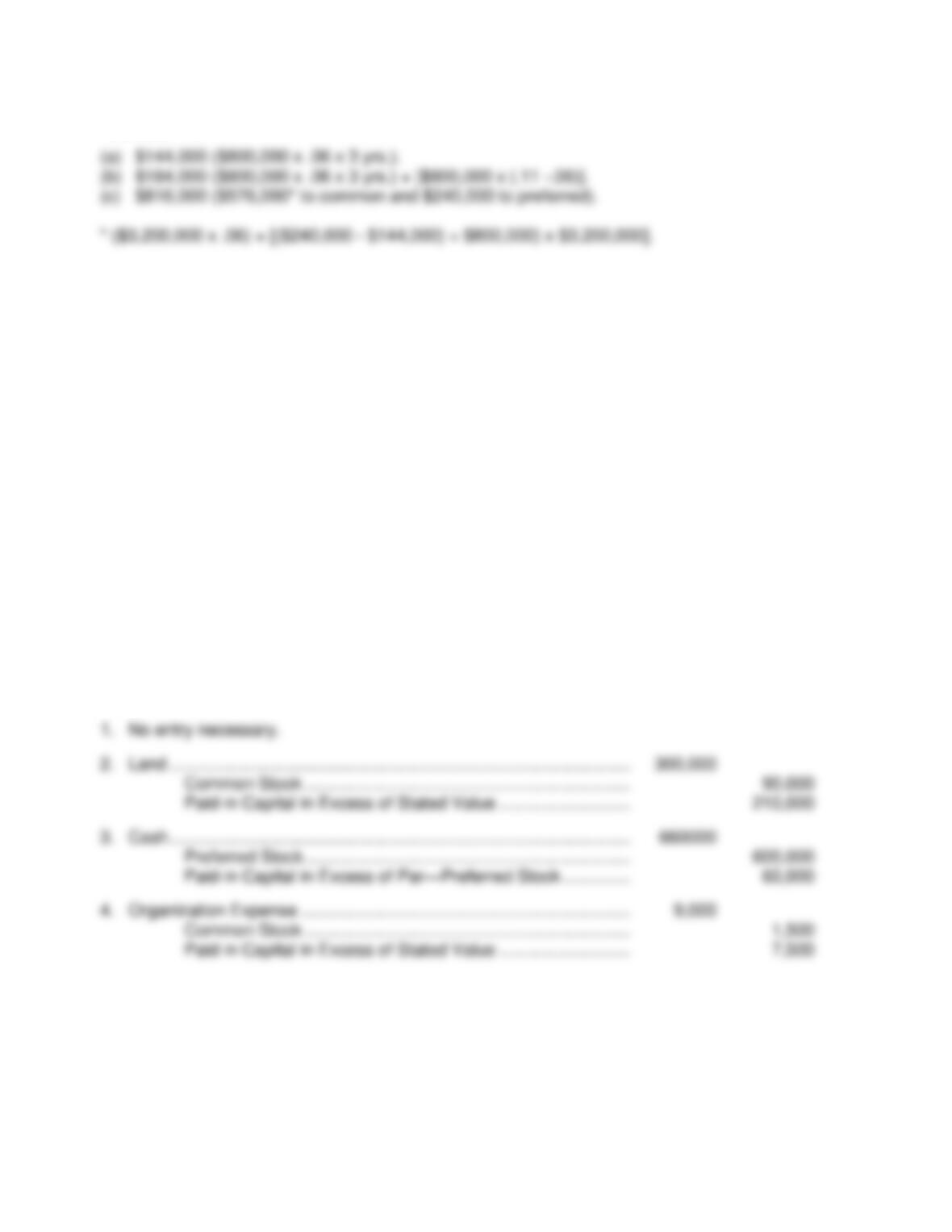
*Ex. 15-141—Dividends on preferred stock.
In each of the following independent cases, it is assumed that the corporation has $800,000 of
6% preferred stock and $3,200,000 of common stock outstanding, each having a par value of
$10. No dividends have been declared for 2013 and 2014.
(a) As of 12/31/15, it is desired to distribute $250,000 in dividends. How much will the preferred
stockholders receive if their stock is cumulative and nonparticipating?
(b) As of 12/31/15, it is desired to distribute $800,000 in dividends. How much will the preferred
stockholders receive if their stock is cumulative and participating up to 11% in total?
(c) On 12/31/15, the preferred stockholders received a $240,000 dividend on their stock which is
cumulative and fully participating. How much money was distributed in total for dividends
during 2015?
Test Bank for Intermediate Accounting, Fifteenth Edition
15 – 44
*Solution 15-141
PROBLEMS
Pr. 15-142—Equity transactions.
Presented below is information related to Wyrick Company:
1. The company is granted a charter that authorizes issuance of 15,000 shares of $100 par
value preferred stock and 40,000 shares of no-par common stock.
2. 9,000 shares of common stock are issued to the founders of the corporation for land valued
by the board of directors at $300,000. The board establishes a stated value of $10 a share for
the common stock.
3. 6,000 shares of preferred stock are sold for cash at $110 per share.
4. The company issues 150 shares of common stock to its attorneys for costs associated with
starting the company. At that time, the common stock was selling at $60 per share.
Instructions
Prepare the general journal entries necessary to record these transactions.
Solution 15-142

Stockholders’ Equity
15 – 45
Pr. 15-143—Treasury stock transactions.
The original sale of the $50 par value common shares of Gray Company was recorded as follows:
Cash …………………………………………………………………………….. 290,000
Common Stock ……………………………………………………. 250,000
Paid-in Capital in Excess of Par ……………………………… 40,000
Instructions
Record the treasury stock transactions (given below) under the cost method:
Transactions:
(a) Bought 400 shares of common stock as treasury shares at $62.
(b) Sold 120 shares of treasury stock at $60.
(c) Sold 60 treasury shares at $68.
Solution 15-143
Pr. 15-144—Stock dividends.
The stockholders’ equity section of Benton Corporation’s balance sheet as of December 31, 2014
is as follows:
Stockholders’ Equity
Common stock, $5 par value; authorized, 2,000,000 shares;
issued, 400,000 shares $2,000,000
Paid-in capital in excess of par 850,000
Retained earnings 3,000,000
$5,850,000
The following events occurred during 2015:
1. Jan. 5 30,000 shares of authorized and unissued common stock were sold for $8 per
share.
2. Jan. 16 Declared a cash dividend of 20 cents per share, payable February 15 to stock-
holders of record on February 5.
3. Feb. 10 40,000 shares of authorized and unissued common stock were sold for $12 per
share.
Test Bank for Intermediate Accounting, Fifteenth Edition
15 – 46
Pr. 15-144 (Cont.)
4. March 1 A 30% stock dividend was declared and issued. Fair value per share is currently
$15.
5. April 1 A two-for-one split was carried out. The par value of the stock was to be reduced
to $2.50 per share. Fair value on March 31 was $18 per share.
6. July 1 A 15% stock dividend was declared and issued. Fair value is currently $10 per
share.
7. Aug. 1 A cash dividend of 20 cents per share was declared, payable September 1 to
stockholders of record on August 21.
Instructions
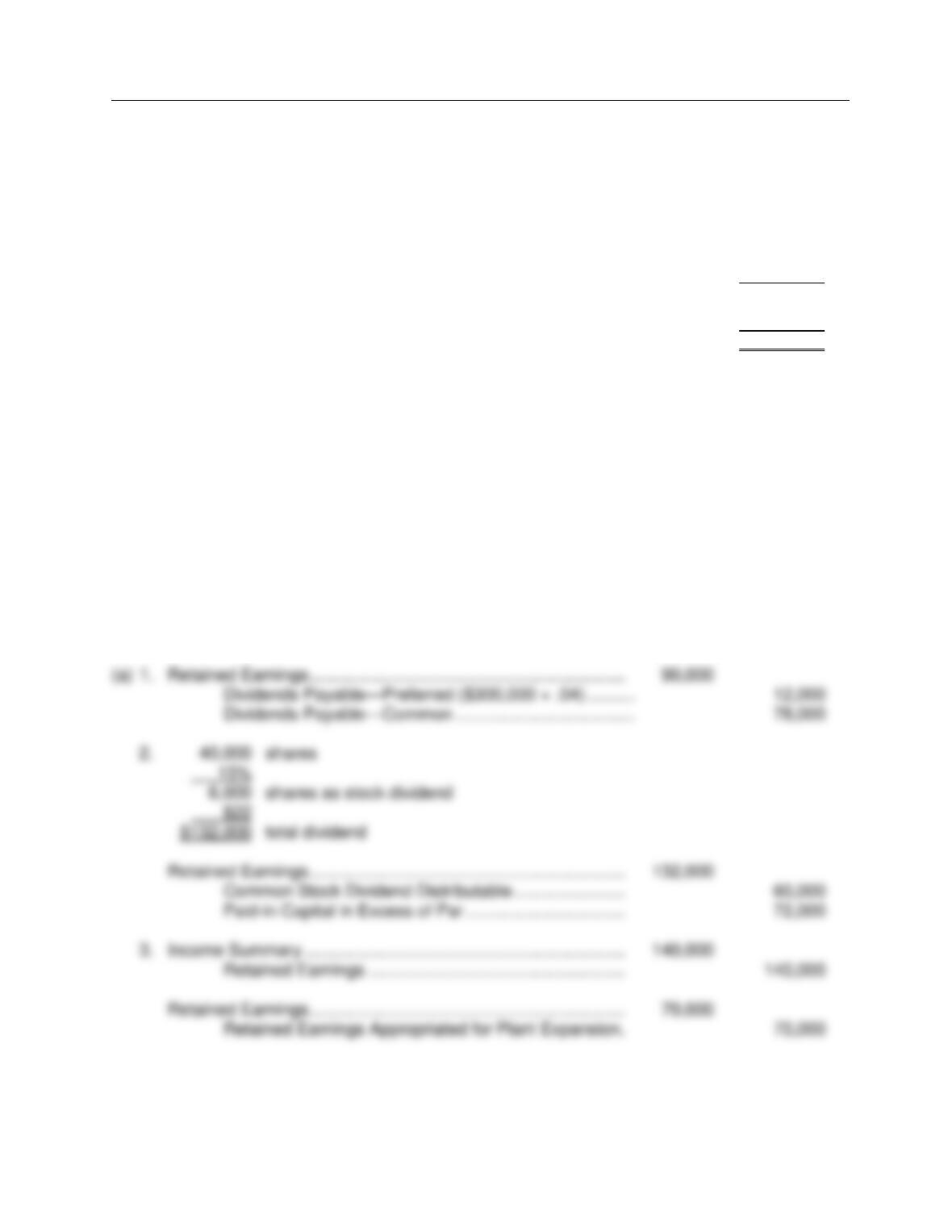
Enter the above events into the following work sheet showing how each event affects the column.
Event No. 1 will serve as an example.
Common Stock
No. of Total Paid-in Capital In
Item Shares Issued Par Value Excess of Par Retained Earnings
Beginning Balance—1/1/13 400,000 $2,000,000 $850,000 $3,000,000
Event #1—Jan. 5 30,000 150,000 90,000 -0-
Balance 430,000 $2,150,000 $940,000 $3,000,000
Event # 2—Jan. 16 (and events 3 through 7)
Solution 15-144
Stockholders’ Equity
15 – 47
Pr. 15-145—Equity transactions.
Foley Corporation has the following capital structure at the beginning of the year:
4% Preferred stock, $50 par value, 20,000 shares authorized,
6,000 shares issued and outstanding $ 300,000
Common stock, $10 par value, 60,000 shares authorized,
40,000 shares issued and outstanding 400,000
Paid-in capital in excess of par 110,000
Total paid-in capital 810,000
Retained earnings 440,000
Total stockholders‘ equity $1,250,000
Instructions
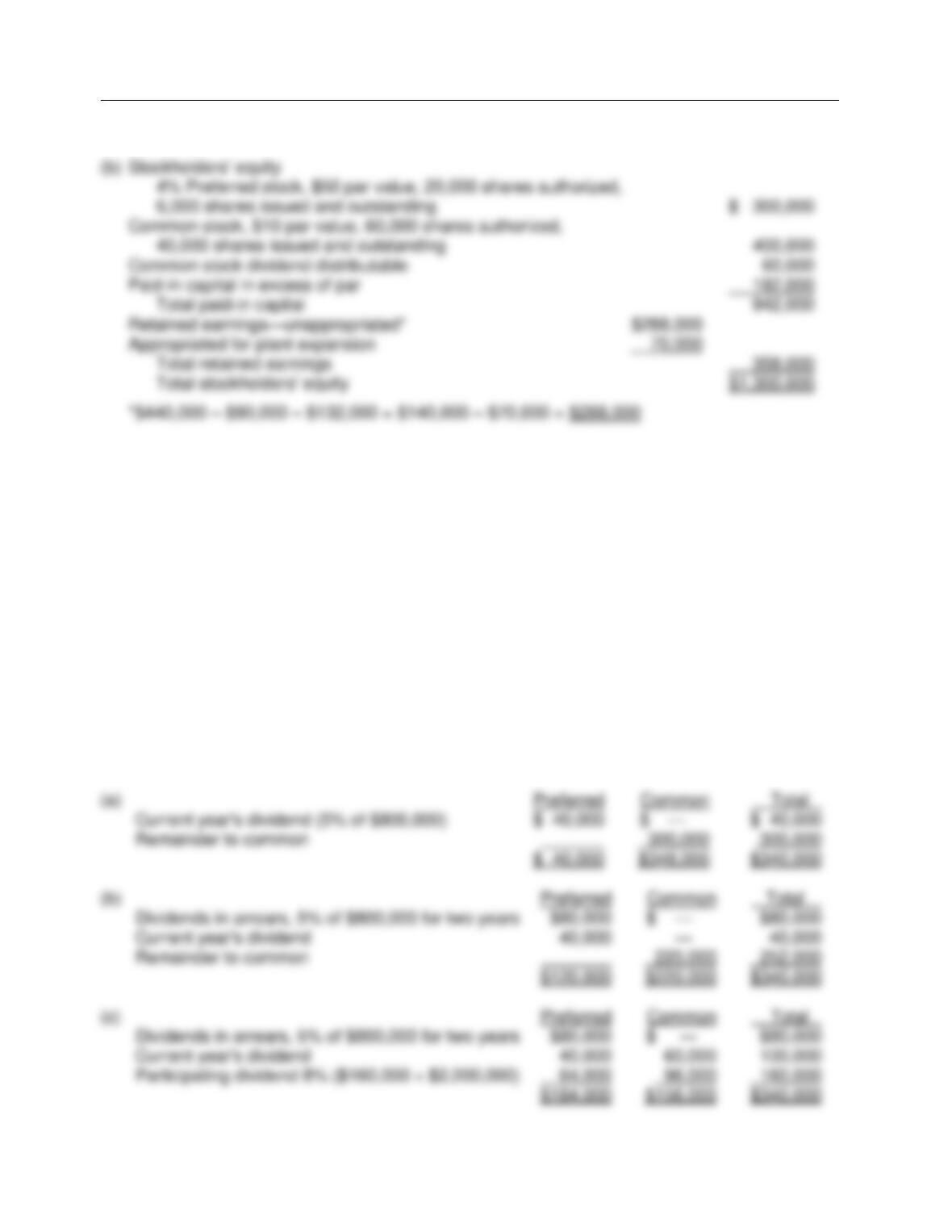
(a) Record the following transactions which occurred consecutively (show all calculations).
1. A total cash dividend of $90,000 was declared and payable to stockholders of record.
Record dividends payable on common and preferred stock in separate accounts.
2. A 15% common stock dividend was declared. The average fair value of the common stock
is $22 a share.
3. Assume that net income for the year was $140,000 (record the closing entry) and the
board of directors appropriated $70,000 of retained earnings for plant expansion.
(b) Construct the stockholders’ equity section incorporating all the above information.
Solution 15-145
Test Bank for Intermediate Accounting, Fifteenth Edition
15 – 48
Solution 15-145 (Cont.)
*Pr. 15-146—Dividends on preferred and common stock.
Rensing, Inc., has $800,000 of 5% preferred stock and $1,200,000 of common stock outstanding,
each having a par value of $10 per share. No dividends have been paid or declared during 2013
and 2014. As of December 31, 2015, it is desired to distribute $340,000 in dividends.
Instructions
How much will the preferred and common stockholders receive under each of the following
assumptions:
(a) The preferred is noncumulative and nonparticipating.
(b) The preferred is cumulative and nonparticipating.
(c) The preferred is cumulative and fully participating.
(d) The preferred is cumulative and participating to 9% total.
*Solution 15-146

Stockholders’ Equity
15 – 49
Solution 15-146 (Cont.)
IFRS QUESTIONS
True/False
1. In the United States, like many other countries, banks are major creditors as well as the
largest investors.
2. The IFRS statement of recognized income and expenses is identical to the U.S. GAAP
statement of retained earnings – beginning balance retained earnings, plus net income, less
dividends, equals ending balance retained earnings.
3. Under IFRS companies report preference shares at par value as the last item in the equity
section.
4. Under IFRS true no-par shares should be carried in the accounts at issue price without any
share premium reported.
5. Under IFRS compliance requirements the revaluation surplus is not considered contributed
capital.
Answers to True/False:
Multiple Choice
6. The accounting for treasury stock retirements under IFRS requires
a. a charge for the entire amount to paid-in capital.
b. a charge for the excess to paid-in capital, depending on the original transaction related to
the issuance of the stock.
c. a charge for the excess of the cost of treasury stock over par value to retained earnings.
d. an allocation for the difference between paid-in capital and retained earnings.

Test Bank for Intermediate Accounting, Fifteenth Edition
15 – 50
7. The Revaluation Surplus of IFRS is
a. similar to U.S. GAAP in that it allows both increases and decreases in valuation.
b. similar to U.S. GAAP in that it only allows for the decrease in valuation.
c. similar to U.S. GAAP in that it only allows for the increase in valuation.
d. different than U.S. GAAP in that it allows the increase in valuation.
8. The IFRS statement of recognized income and expenses
a. does not recognize charges to equity such as revaluation surplus values.
b. is a required report under IFRS reporting requirements.
c. reports the items that were charged directly to equity such as revaluation surplus.
d. is similar to the U.S. GAAP income statement in that it only reports revenues and
expenses of the period.
9.Under IFRS compliance requirements the Revaluation Surplus is
a. only utilized to record the changes in depreciable items – plant and equipment.
b. considered as revenue when utilizing the U.S. GAAP formatted income statement.
c. utilized to record the changes in property, plant, and equipment and intangible assets.
d. reported as contributed capital.
10. The current project of the IASB and the FASB related to financial statement presentation
indicates
a. that the IFRS statement of recognized income and expenses will most likely be adopted
by the FASB as a U.S. requirement in the near future.
b. that the IFRS statement of recognized income and expenses will probably be eliminated.
c. that the U.S. GAAP standard for reporting comprehensive income will most likely be
adopted by the IASB for IFRS.
d. that hybrid financial instruments are unacceptable.
Answers to Multiple Choice:
Short Answer
11. Briefly describe some of the similarities and differences between U.S. GAAP and IFRS with
respect to the accounting for stockholders’ equity.
Stockholders’ Equity
15 – 51
12. Briefly discuss the implications of the financial statement presentation project for the reporting
of stockholders’ equity.
to IFRS in the area of hybrid financial instruments.