66) What is the most soluble salt of the following set?
A) AgCN with Ksp = 6.0 × 10⁻¹⁷
B) Al(OH)3 with Ksp = 1.9 × 10⁻³³
C) Fe(OH)3 with Ksp = 2.6 × 10-39
D) Sn(OH)2 with Ksp = 1.6 × 10⁻¹⁹
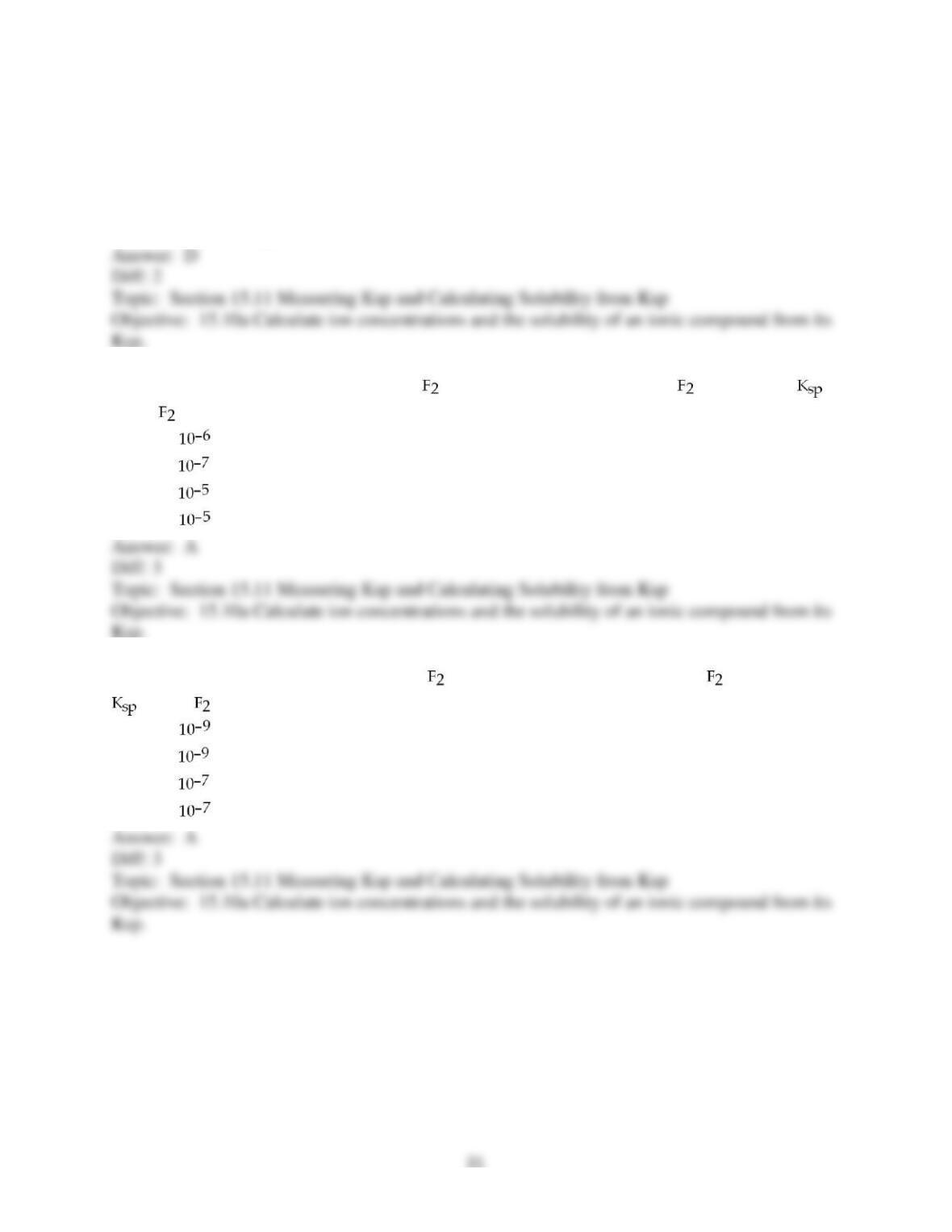
67) One liter of a saturated solution of Ba contains 1.32 g of dissolved Ba . What is the
for Ba ?
A) 1.7 ×
B) 4.4 ×
C) 5.7 ×
D) 8.8 ×
68) One liter of a saturated solution of Mg contains 0.0726 g of dissolved Mg . What is the
for Mg ?
A) 6.3 ×
B) 1.6 ×
C) 3.2 ×
D) 6.4 ×
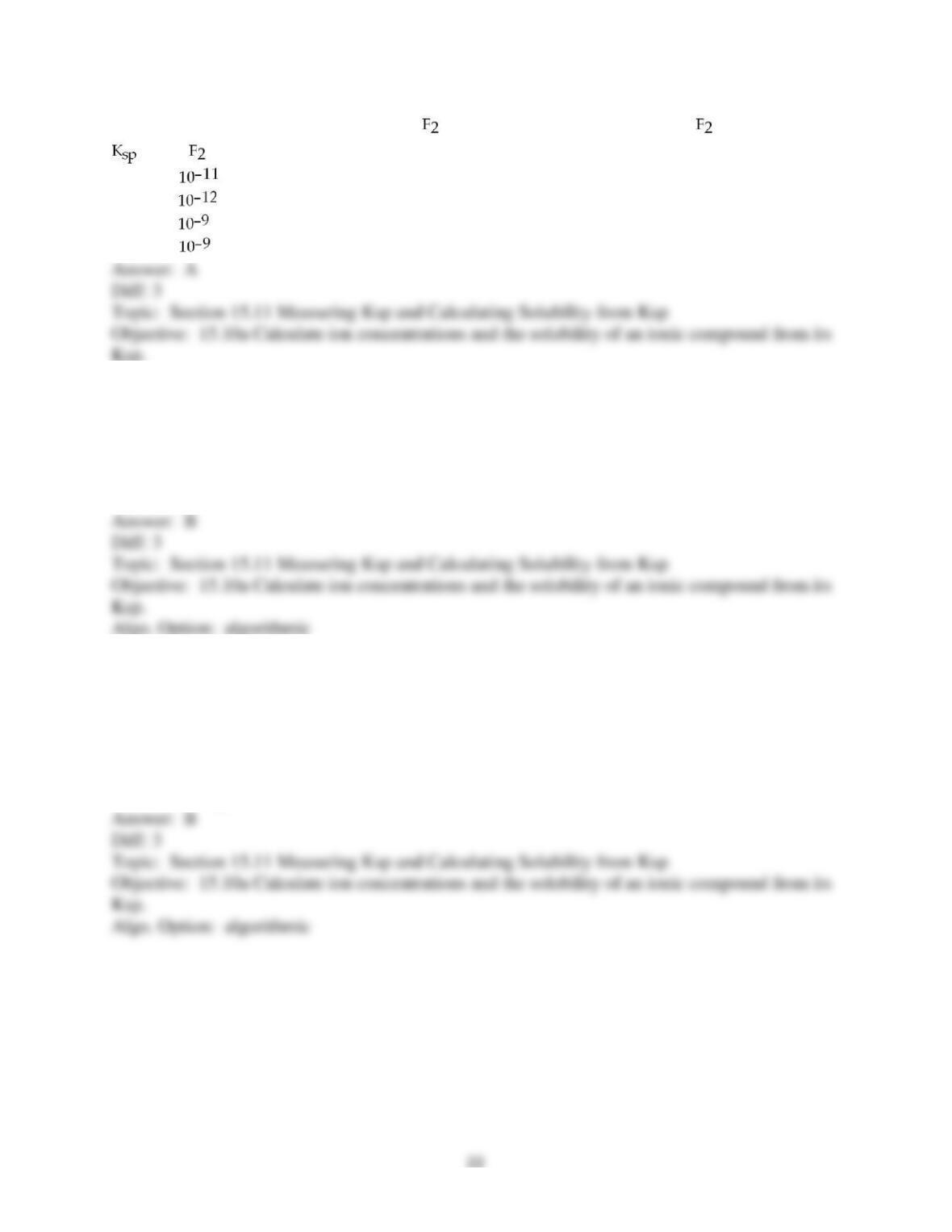
69) One liter of a saturated solution of Ca contains 0.0167 g of dissolved Ca . What is the
for Ca ?
A) 3.9 ×
B) 9.6 ×
C) 2.8 ×
D) 3.7 ×
70) Calculate the Ksp for silver sulfate if the solubility of Ag2SO4 in pure water is 4.5 g/L.
A) 3.0 × 10⁻⁶
B) 1.2 × 10⁻⁵
C) 2.1 × 10⁻⁴
D) 4.2 × 10⁻⁴
71) Calculate the solubility (in g/L) of silver carbonate in water at 25°C if the Ksp for Ag2CO3
is 8.4 × 10⁻¹².
A) 8.0 × 10⁻⁴ g/L
B) 3.5 × 10⁻² g/L
C) 4.4 × 10⁻² g/L
D) 5.6 × 10⁻² g/L
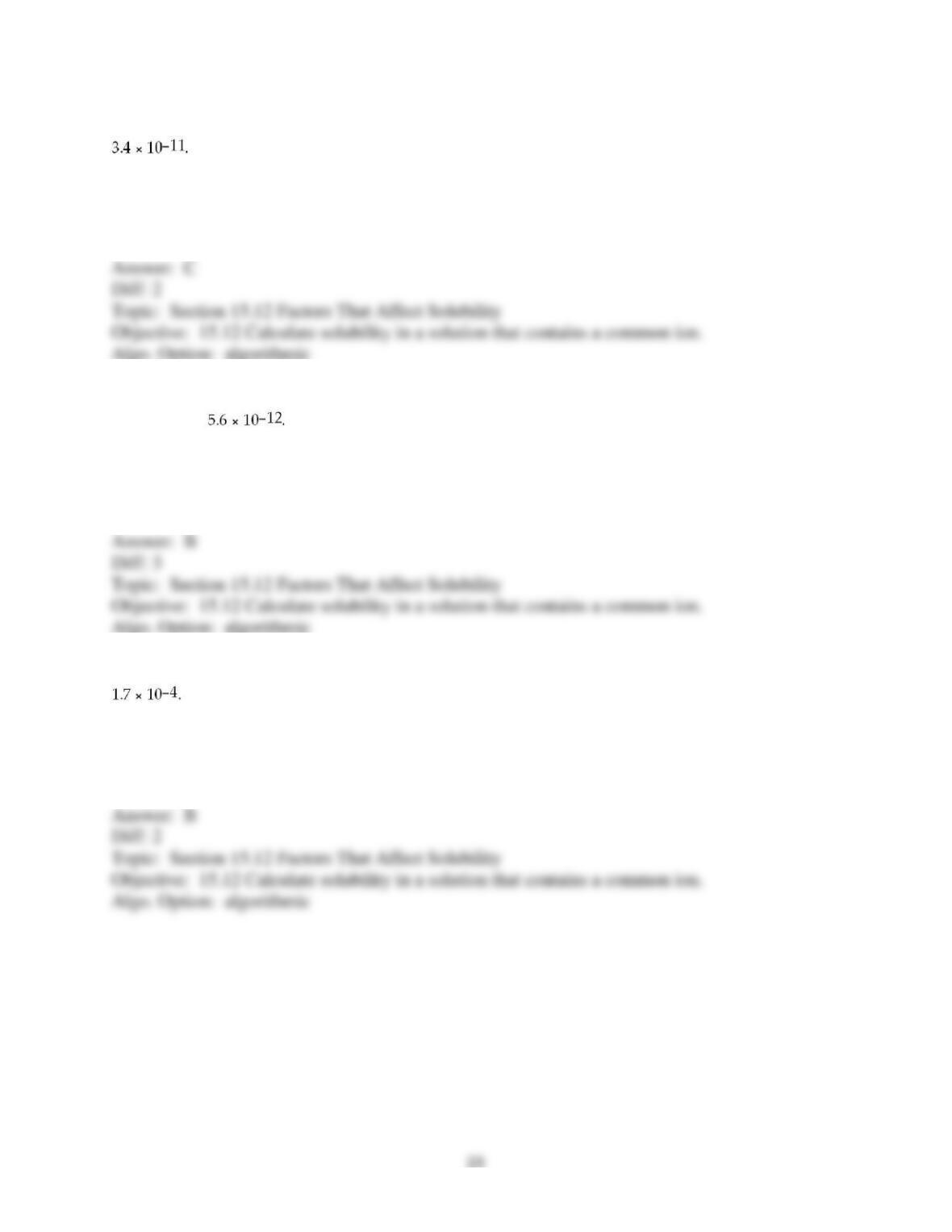
72) What is the molar solubility of CaF2 in 0.10 M NaF solution at 25°C? The Ksp for CaF2 is
A) 8.5 × 10⁻¹⁰ M
B) 3.4 × 10⁻¹⁰ M
C) 3.4 × 10⁻⁹ M
D) 2.0 × 10⁻⁴ M
73) What is the molar solubility of Mg(OH)2 in a basic solution with a pH of 12.00? Ksp for
Mg(OH)2 is
A) 5.6 × 10⁻¹⁰ M
B) 5.6 × 10⁻⁸ M
C) 2.4 × 10⁻⁶ M
D) 1.1 × 10⁻⁴ M
74) Calculate the molar solubility of thallium(I) chloride in 0.30 M NaCl at 25°C. Ksp for TlCl is
A) 5.1 × 10⁻⁵ M
B) 5.7 × 10⁻⁴ M
C) 7.1 × 10⁻³ M
D) 1.3 × 10⁻² M
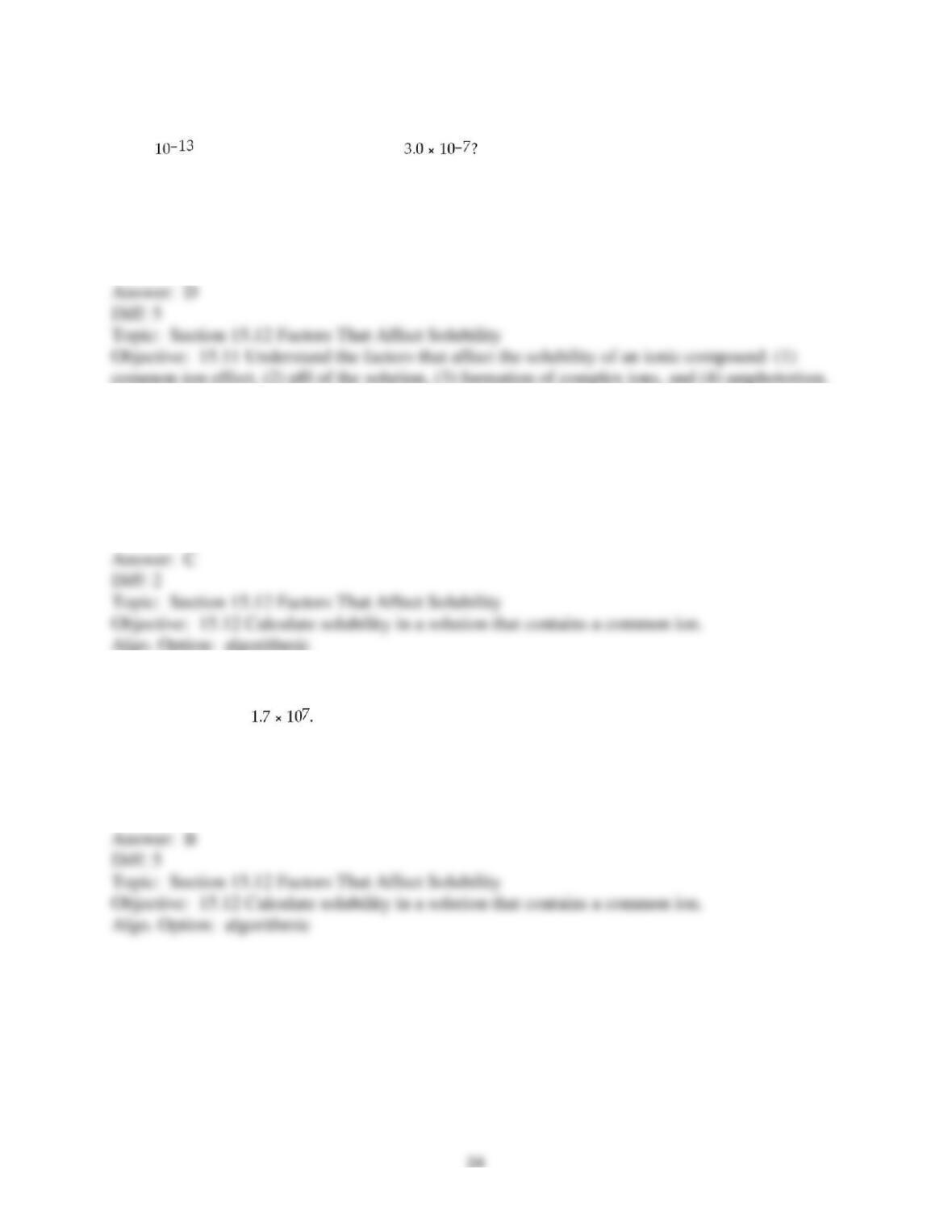
75) What is the molar solubility of lead(II) chromate in 0.10 M HNO3 if the Ksp for PbCrO4 is
2.8 × and the Ka2 for H2CrO4 is Note that H2CrO4 is considered to be a strong
acid.
A) 9.2 × 10⁻¹¹ M
B) 2.9 × 10⁻¹⁰ M
C) 9.3 × 10⁻⁷ M
D) 3.1 × 10⁻⁴ M
76) In which of the following solutions would solid PbCl2 be expected to be the least soluble at
25°C?
A) 0.1 M HCl
B) 0.1 M NaCl
C) 0.1 M CaCl2
D) 0.1 M KNO3
77) What is the molar solubility of AgCl in 0.10 M NH3? Ksp for AgCl is 1.8 × 10⁻¹⁰ and the Kf
for Ag(NH3)2+ is
A) 1.3 × 10⁻⁵ M
B) 5.0 × 10⁻³ M
C) 5.5 × 10⁻³ M
D) 5.5 × 10⁻² M
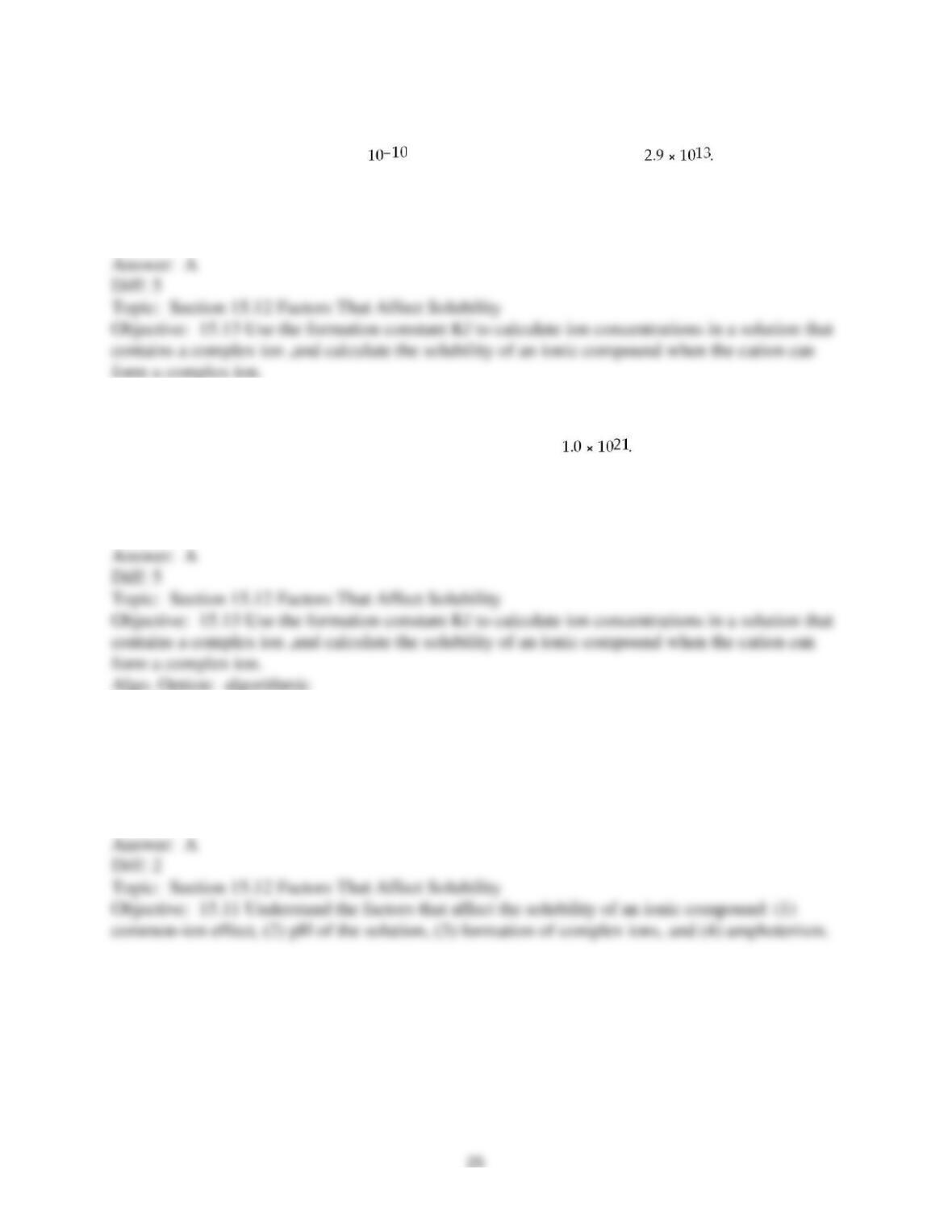
78) What is the molar solubility of AgCl in 1.0 M K2S2O3 if the complex ion Ag(S2O3)23-
forms? The Ksp for AgCl is 1.8 × and the Kf for Ag(S2O3)23- is
A) 0.50 M
B) 1.0 M
C) 1.5 M
D) 2.0 M
79) What is the molar solubility of AgCl in 0.10 M NaCN if the colorless complex ion Ag(CN)2–
forms? Ksp for AgCl is 1.8 × 10⁻¹⁰ and Kf for Ag(CN)2– is
A) 0.050 M
B) 0.10 M
C) 0.20 M
D) 0.40 M
80) Which of the following metal hydroxides are amphoteric?
A) Al(OH)3, Zn(OH)2, Cr(OH)3, Sn(OH)2
B) Cu(OH)2 , Mn(OH)2, Fe(OH)2, Fe(OH)3
C) Be(OH)2, Ca(OH)2, Ba(OH)2, Sr(OH)3
D) LiOH, NaOH, KOH, RbOH
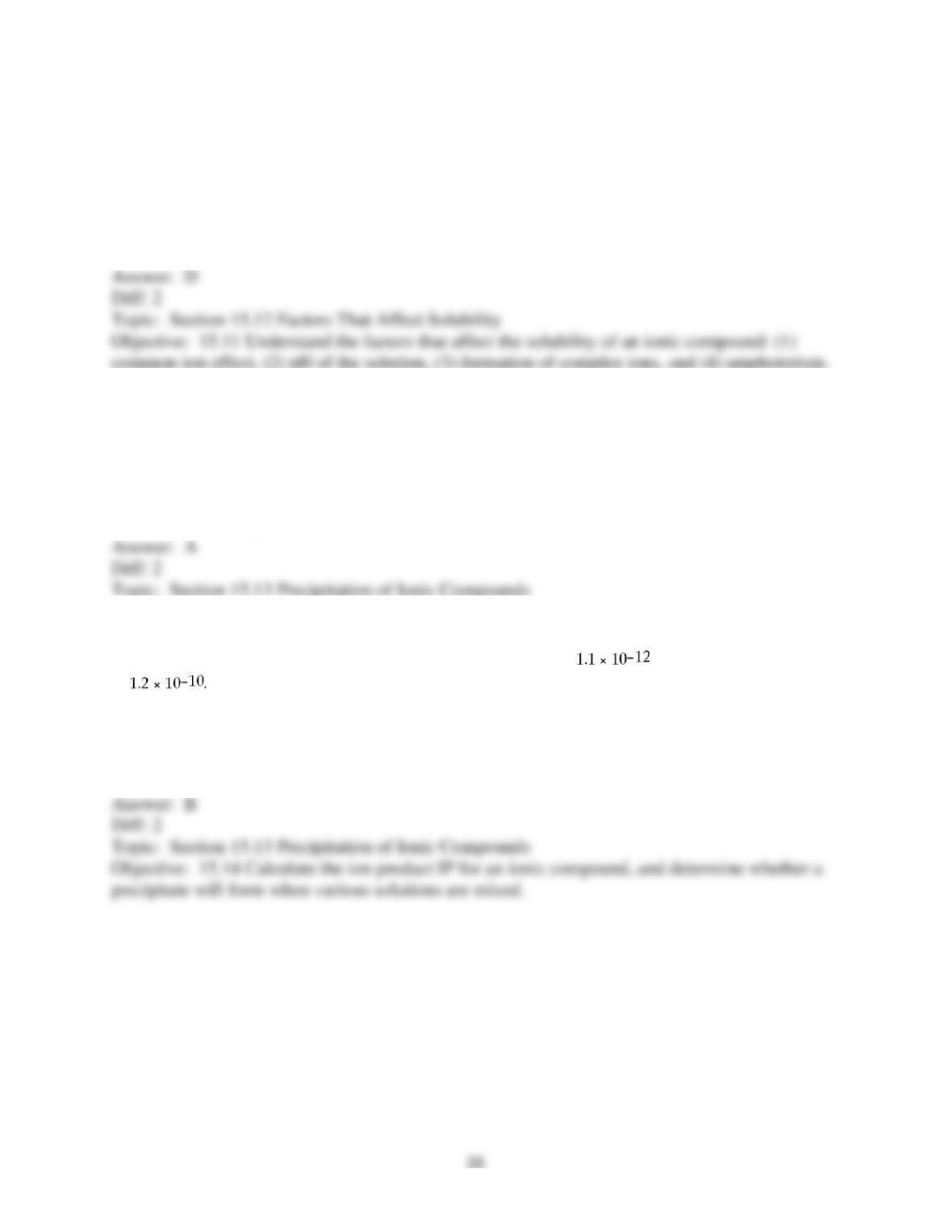
81) Which of the following reactions are not consistent with the concept of acid base
amphoterism?
A) Al(OH)3(s) + OH–(aq) → Al(OH)4–(aq)
B) Al(OH)3(s) + 3 H3O+(aq) → Al3+(aq) + 6 H2O(l)
C) H2O(l) + H2O(l) ⇌ H3O+(aq) + OH–(aq)
D) Al(OH)3(s) ⇌ Al3+(aq) + 3 OH–(aq)
82) Precipitation of an ionic compound will occur upon mixing of desired reagents if the initial
ion product is
A) greater than the Ksp.
B) equal to the pKsp.
C) equal to the Ksp.
D) less than the Ksp.
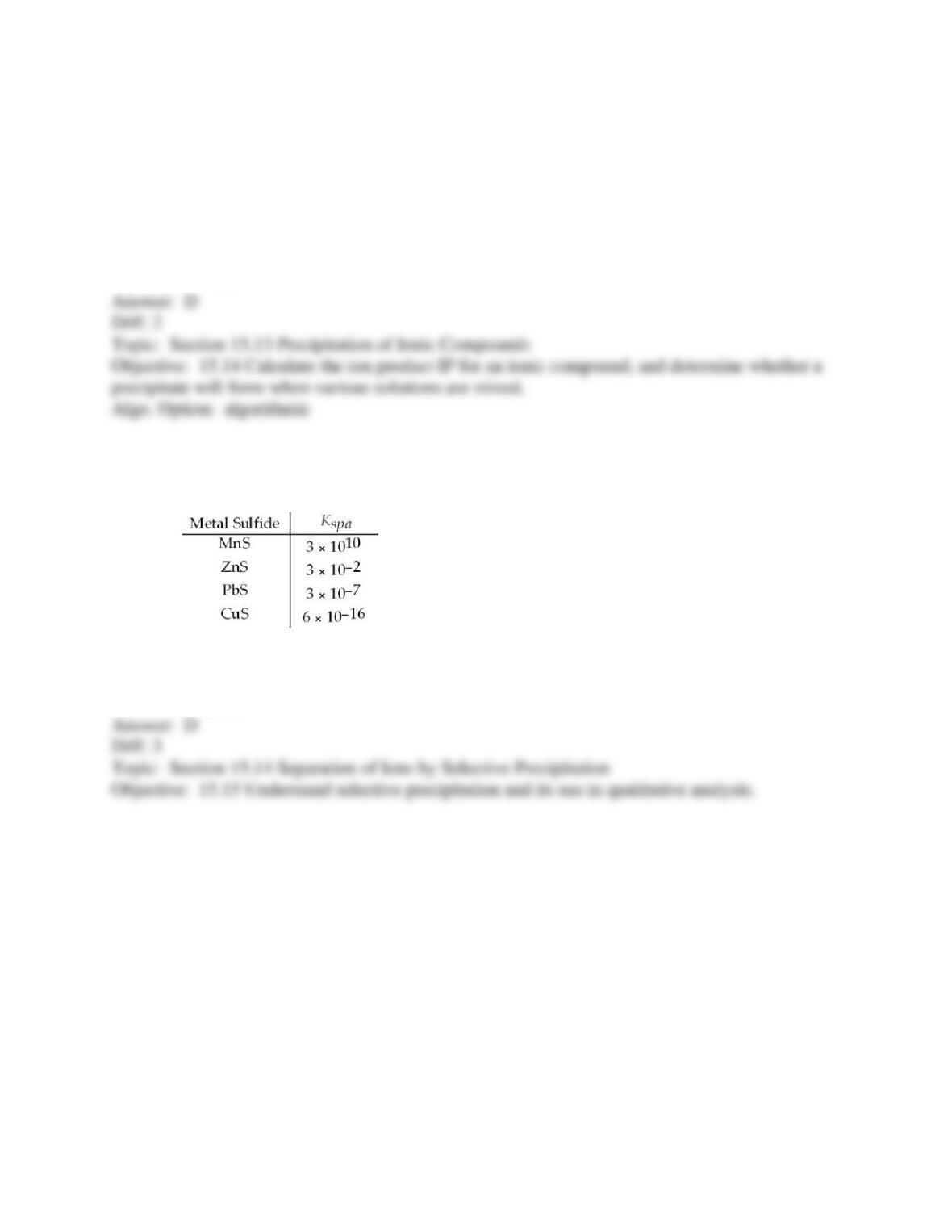
83) Potassium chromate is slowly added to a solution containing 0.20 M AgNO3 and 0.20 M
Ba(NO3)2. Describe what happens if the Ksp for Ag2CrO4 is and the Ksp of BaCrO4
is
A) The BaCrO4 precipitates first out of solution.
B) The Ag2CrO4 precipitates first out of solution and then BaCrO4 precipitates.
C) Both BaCrO4 and Ag2CrO4 precipitate simultaneously out of solution.
D) Neither BaCrO4 nor Ag2CrO4 precipitates out of solution.
27
84) 0.10 M potassium chromate is slowly added to a solution containing 0.20 M AgNO3 and
0.20 M Ba(NO3)2. What is the Ag+ concentration when BaCrO4 just starts to precipitate? Ksp
for Ag2CrO4 and BaCrO4 are 1.1 × 10⁻¹² and 1.2 × 10⁻¹⁰, respectively.
A) 6.5 × 10⁻⁵ M
B) 1.3 × 10⁻⁴ M
C) 3.2 × 10⁻⁴ M
D) 4.3 × 10⁻² M
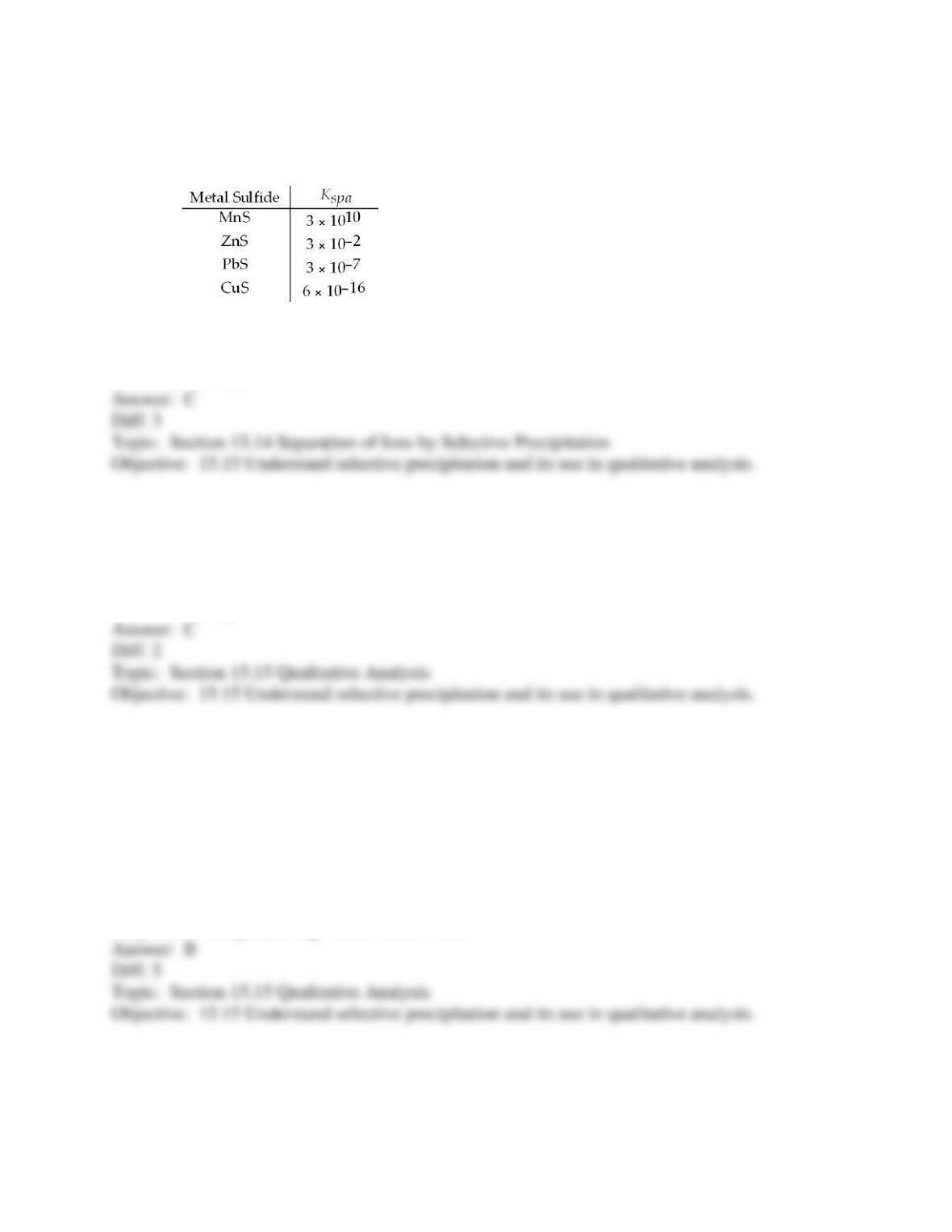
85) Which metal sulfides can be precipitated from a solution that is 0.01 M in Mn2+, Zn2+,
Pb2+ and Cu2+ and 0.10 M in H2S at a pH of 1.0?
A) MnS
B) CuS
C) PbS, CuS
D) ZnS, PbS, CuS
28
86) Which metal sulfides can be precipitated from a solution that is 0.01 M in Mn2+, Zn2+,
Pb2+ and Cu2+ and 0.10 M in H2S at a pH of 0.50?
A) MnS
B) CuS
C) PbS, CuS
D) ZnS, PbS, CuS
87) Which metal ions can be precipitated out of solution as chlorides?
A) Ag+, Hg2+, Co2+
B) Cu2+, Cd2+, Bi3+
C) Ag+, Hg22+, Pb2+
D) Na+, K+, Mg2+
88) A solution may contain the following ions Ag+, Cu2+, Cd2+, Mn2+, Ni2+ and Na+. A white
precipitate formed when 0.10 M HCl was added and after this was removed the solution was
treated with H2S gas under acidic conditions and no precipitate formed. When the solution was
made basic and again treated with H2S gas a dark colored precipitate formed. If no further tests
were made then what conclusions can you draw?
A) possible ions present Ag+, Mn2+, Ni2+
B) possible ions present Ag+, Mn2+, Ni2+, Na+
C) possible ions present Ag+, Cu2+, Cd2+
D) possible ions present Ag+, Cu2+, Cd2+, Na+
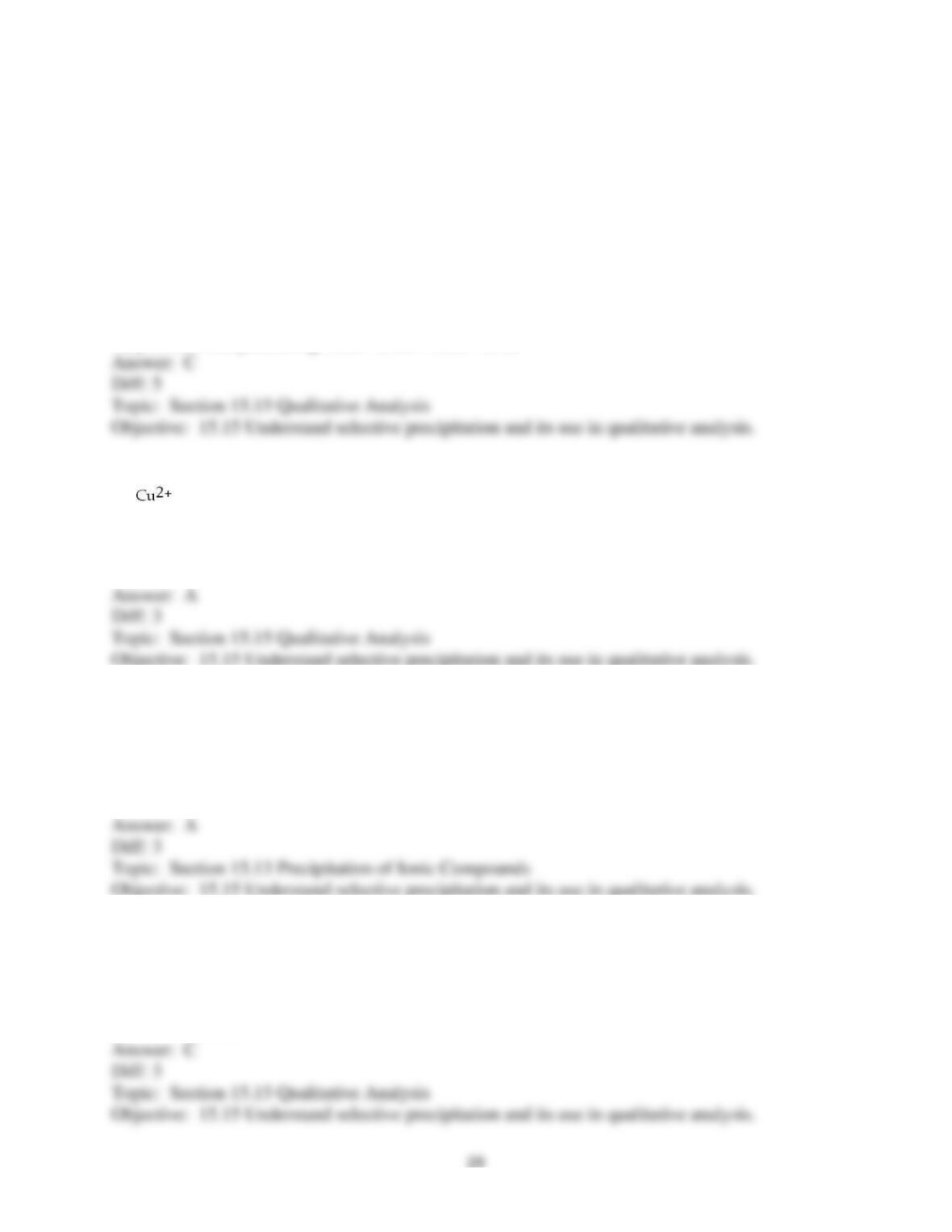
89) A solution may contain the following ions Ag+, Cu2+, Mn2+, Ca2+, and Na+. No precipitate
formed when 0.10 M HCl was added but a dark colored precipitate formed when H2S was added
to an acidic portion of the solution. After the removal of the solid the solution was made basic
and more H2S was added and a dark precipitate again formed. Treatment of the filtrate with
(NH4)2CO3 resulted in a white precipitate. If no further tests were made then what conclusions
can you draw?
A) possible ions present Cu2+, Mn2+, Na+
B) possible ions present Cu2+, Mn2+, Ca2+
C) possible ions present Cu2+, Mn2+, Ca2+, Na+
D) possible ions present Ag+, Cu2+, Mn2+, Ca2+, Na+
90) Which set of ions precipitate as sulfides?
A) , Pb2+, Sn2+
B) Pb2+, Fe2+, Ca2+
C) Co2+, Ba2+, K+
D) NH4+, Na+, K+
91) Which pair of ions can be separated by the addition of chloride ion?
A) Ag+ and Co2+
B) Cu2+ and Bi3+
C) Pb2+ and Hg22+
D) Ca2+ and Ba2+
92) Which pair of ions can be separated by the addition of sulfide ion?
A) Ag+ and Mn2+
B) Cu2+ and Bi3+
C) Pb2+ and Ca2+
D) Ca2+ and Ba2+
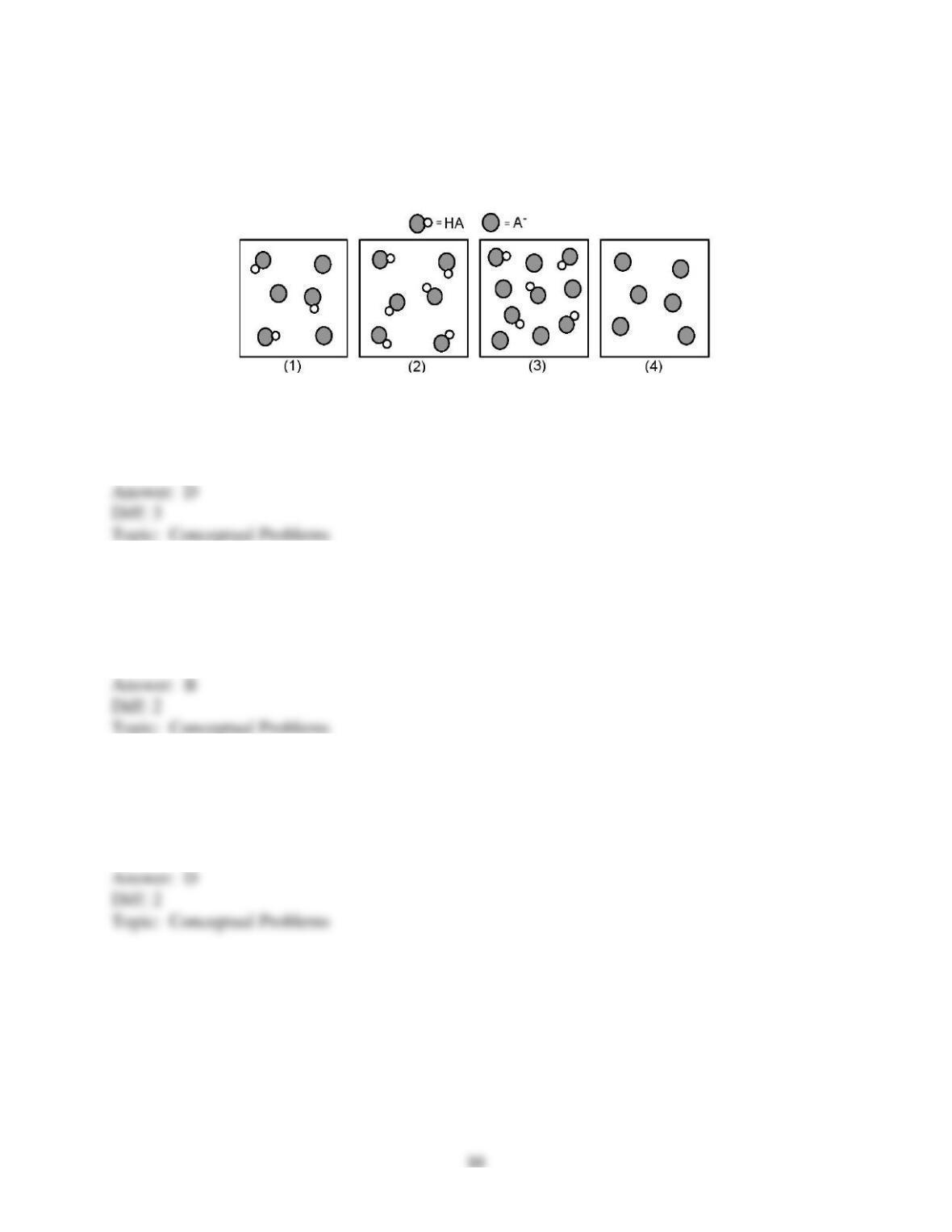
The following pictures represent solutions that contain a weak acid HA and/or its potassium salt
KA. Unshaded spheres represent H atoms and shaded spheres represent A– ions. (K+, H3O+,
OH–, and solvent H2O molecules have been omitted for clarity.)
93) Which solution has the highest pH?
A) (1)
B) (2)
C) (3)
D) (4)
94) Which solution has the lowest pH?
A) (1)
B) (2)
C) (3)
D) (4)
95) Which solution has the largest percent dissociation of HA?
A) (1)
B) (2)
C) (3)
D) (4)
96) Which of the solutions are buffer solutions?
A) (1) and (2)
B) (1) and (3)
C) (2) and (3)
D) (2) and (4)
97) Which solution has the greatest buffer capacity?
A) (1)
B) (2)
C) (3)
D) (4)
98) For which solution(s) is pH = pKa?
A) only solution (1)
B) only solution (2)
C) only solution (3)
D) solutions (1) and (3)
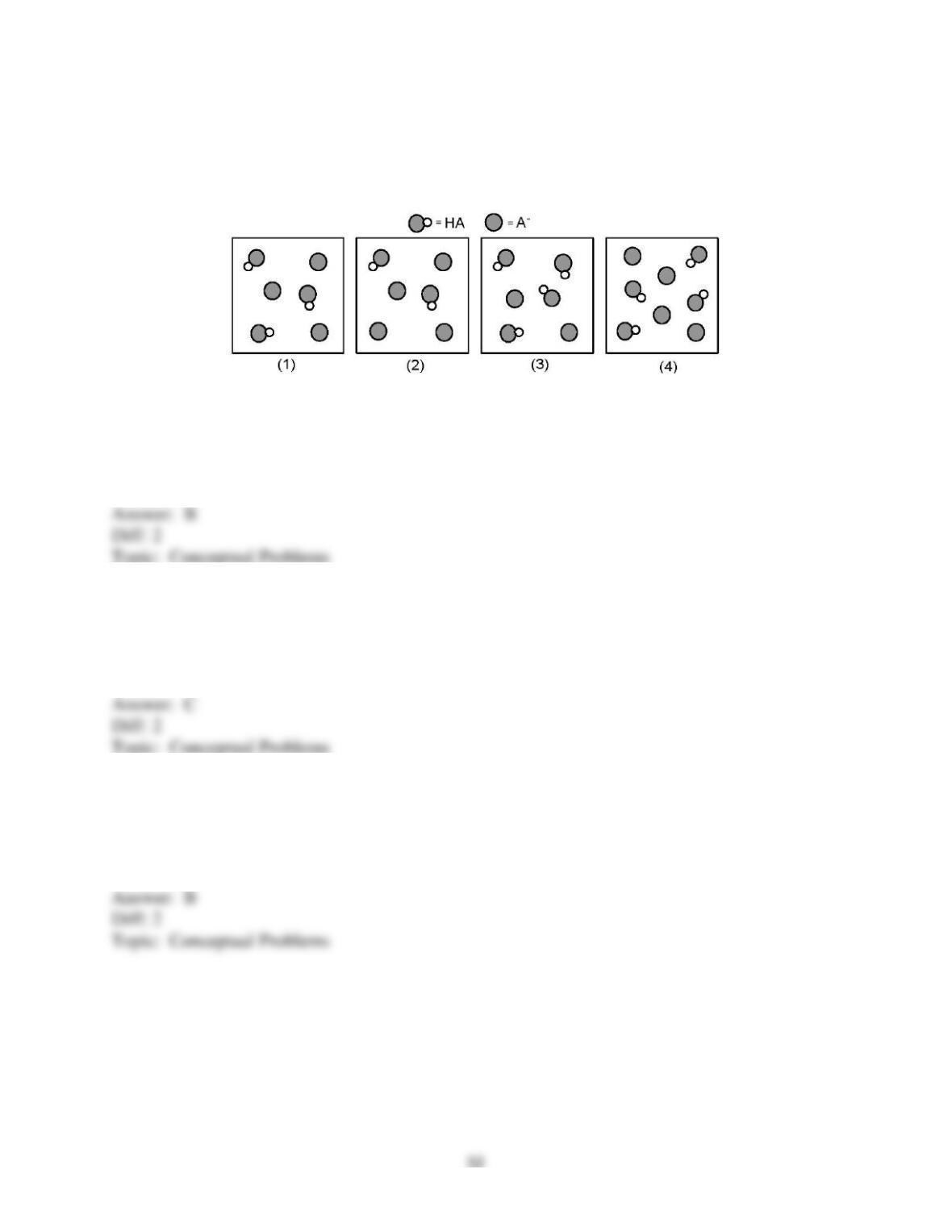
The following pictures represent solutions that contain a weak acid HA (pKa = 5.0) and its
potassium salt KA. Unshaded spheres represent H atoms and shaded spheres represent A– ions.
(K+, H3O+, OH–, and solvent H2O molecules have been omitted for clarity.)
99) Which solution has the highest pH?
A) (1)
B) (2)
C) (3)
D) (4)
100) Which solution has the lowest pH?
A) (1)
B) (2)
C) (3)
D) (4)
101) Which solution has the largest percent dissociation of HA?
A) (1)
B) (2)
C) (3)
D) (4)
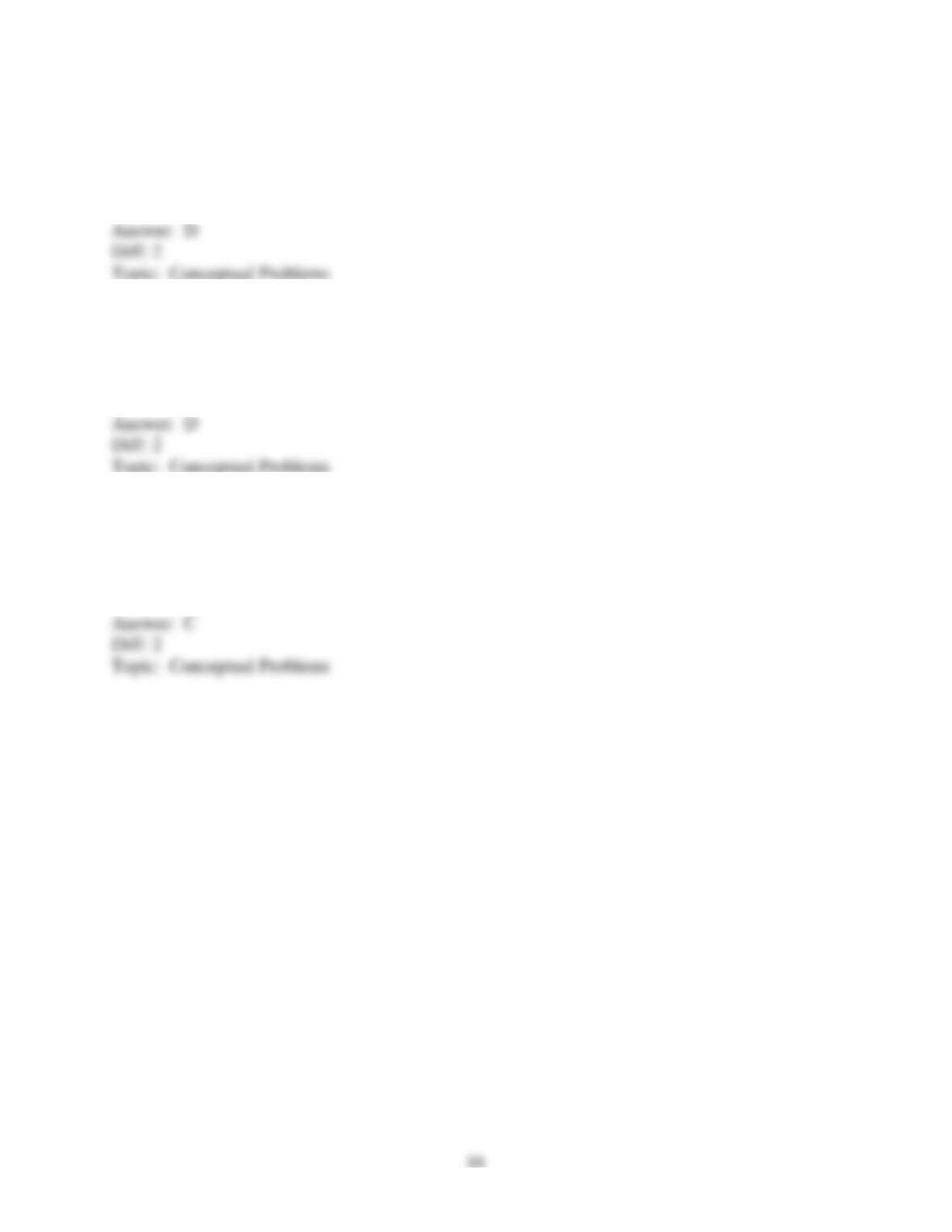
102) Which of these solutions are buffers?
A) (1) and (2)
B) (1) and (3)
C) (1), (2) and (3)
D) All are buffer solutions.
103) Which solution has the greatest buffer capacity?
A) (1)
B) (2)
C) (3)
D) (4)
104) For which of these solutions is pH = pKa?
A) All have pH = pKa.
B) (1), (2) and (3)
C) (1) and (4)
D) (2) and (3)
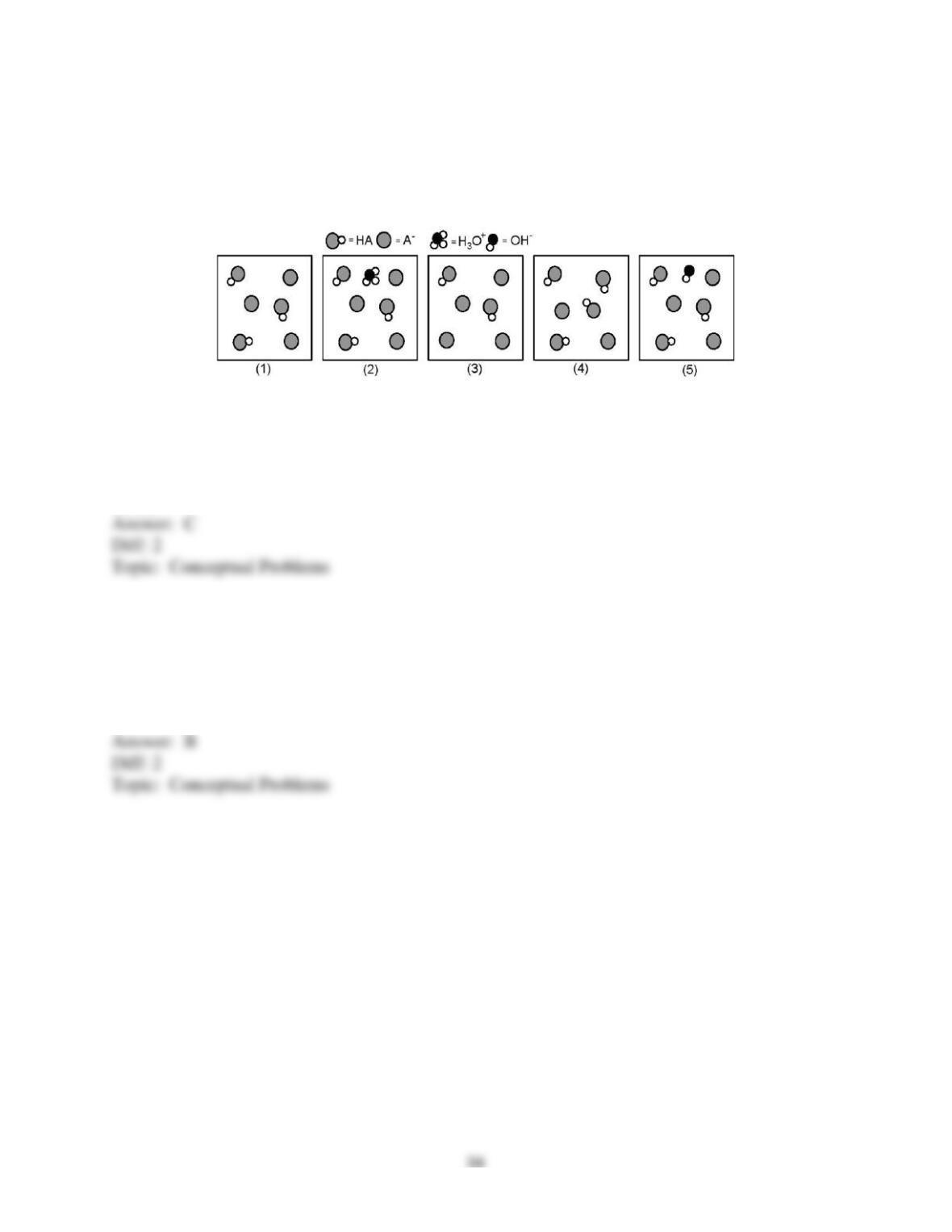
The following pictures represent solutions that contain a weak acid HA (pKa = 5.0) and its
potassium salt KA. Unshaded spheres represent H atoms, black spheres represent oxygen atoms,
and shaded spheres represent A– ions. (K+, H3O+ initially present, OH– initially present and
solvent water molecules have been omitted for clarity.)
105) Which picture represents the equilibrium state of the solution after addition of one H3O+
ion to the solution shown in picture (1)?
A) (2)
B) (3)
C) (4)
D) (5)
106) Which picture represents the equilibrium state of the solution after addition of one OH– ion
to the solution shown in picture (1)?
A) (2)
B) (3)
C) (4)
D) (5)
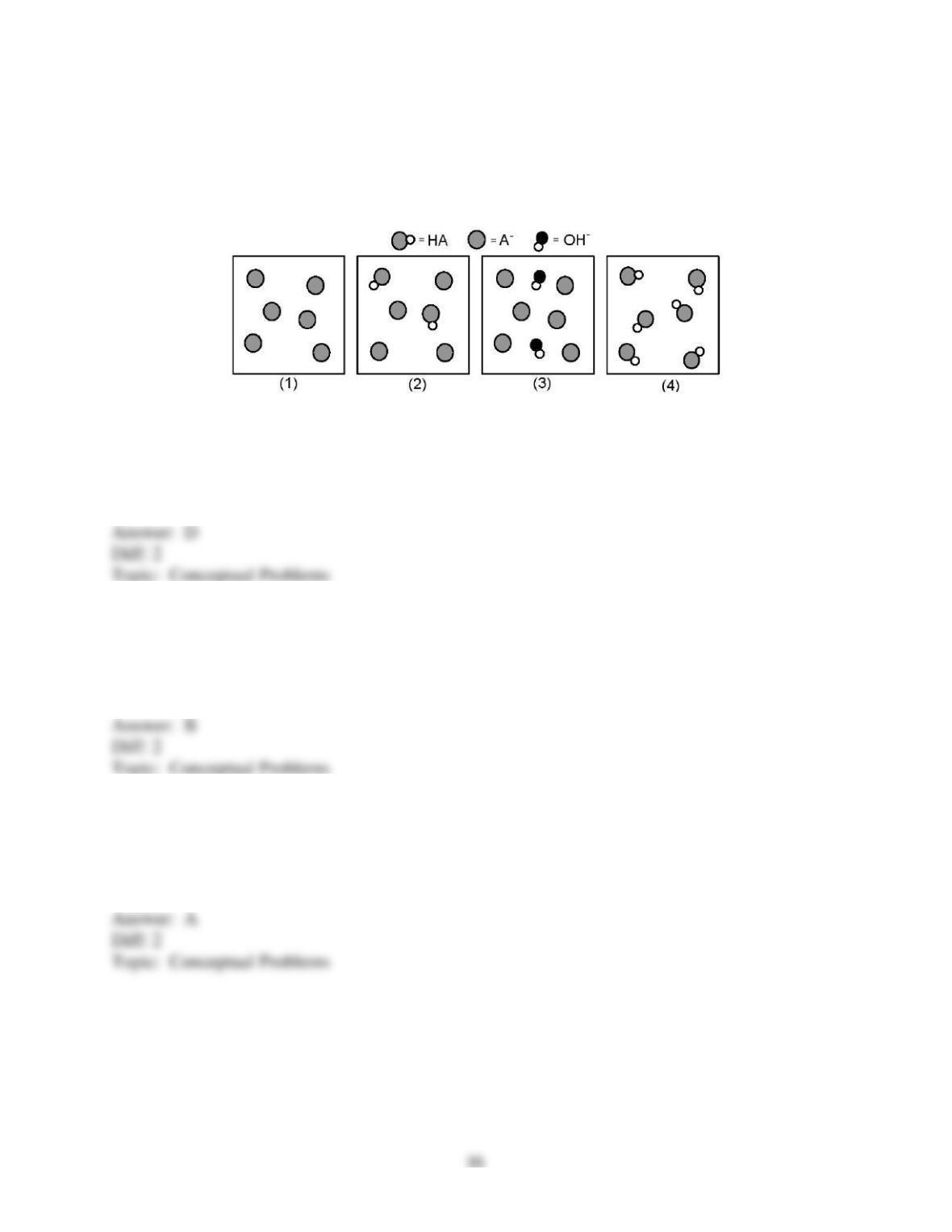
The following pictures represent solutions at various points in the titration of a weak acid HA
with aqueous KOH. Unshaded spheres represent H atoms, black spheres represent oxygen atoms,
and shaded spheres represent A– ions. (K+, H3O+ initially present, OH– initially present and
solvent water molecules have been omitted for clarity).
107) Which picture represents the solution before the addition of any KOH?
A) (1)
B) (2)
C) (3)
D) (4)
108) Which picture represents the solution before the equivalence point?
A) (1)
B) (2)
C) (3)
D) (4)
109) Which picture represents the solution at the equivalence point?
A) (1)
B) (2)
C) (3)
D) (4)
110) Which picture represents the solution after the equivalence point?
A) (1)
B) (2)
C) (3)
D) (4)
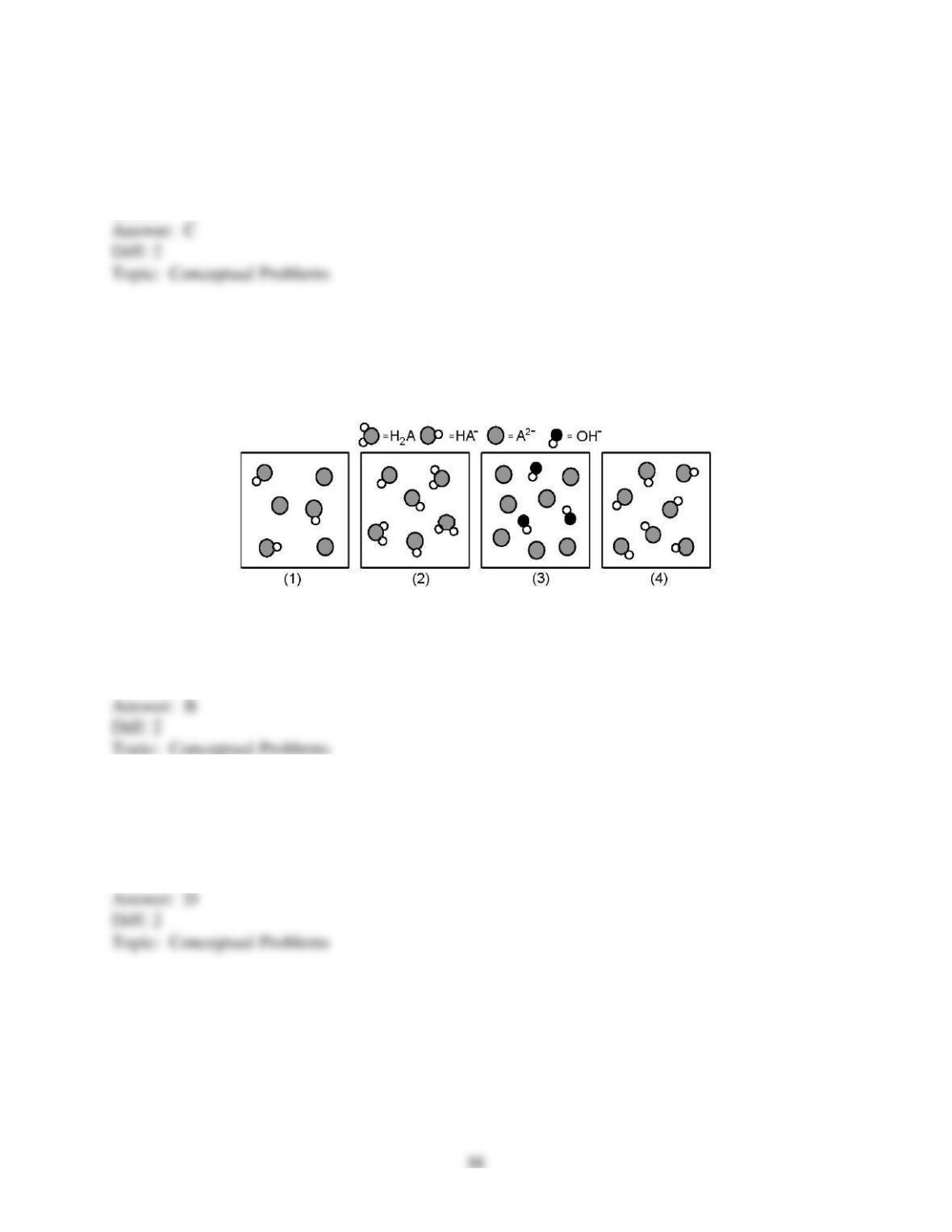
The following pictures represent solutions at various stages in the titration of a weak diprotic
acid H2A with aqueous KOH. Unshaded spheres represent H atoms, black spheres represent
oxygen atoms, and shaded spheres represent A2- ions. (K+, H3O+ initially present, OH– initially
present and solvent water molecules have been omitted for clarity).
111) Which picture represents the system halfway to the first equivalence point?
A) (1)
B) (2)
C) (3)
D) (4)
112) Which picture represents the system at the first equivalence point?
A) (1)
B) (2)
C) (3)
D) (4)
113) Which picture represents the system halfway between the first and second equivalence
points?
A) (1)
B) (2)
C) (3)
D) (4)
114) Which picture represents the system beyond the second equivalence point?
A) (1)
B) (2)
C) (3)
D) (4)
115) Which picture represents the system with the highest pH?
A) (1)
B) (2)
C) (3)
D) (4)
116) Which picture represents the system with the lowest pH?
A) (1)
B) (2)
C) (3)
D) (4)
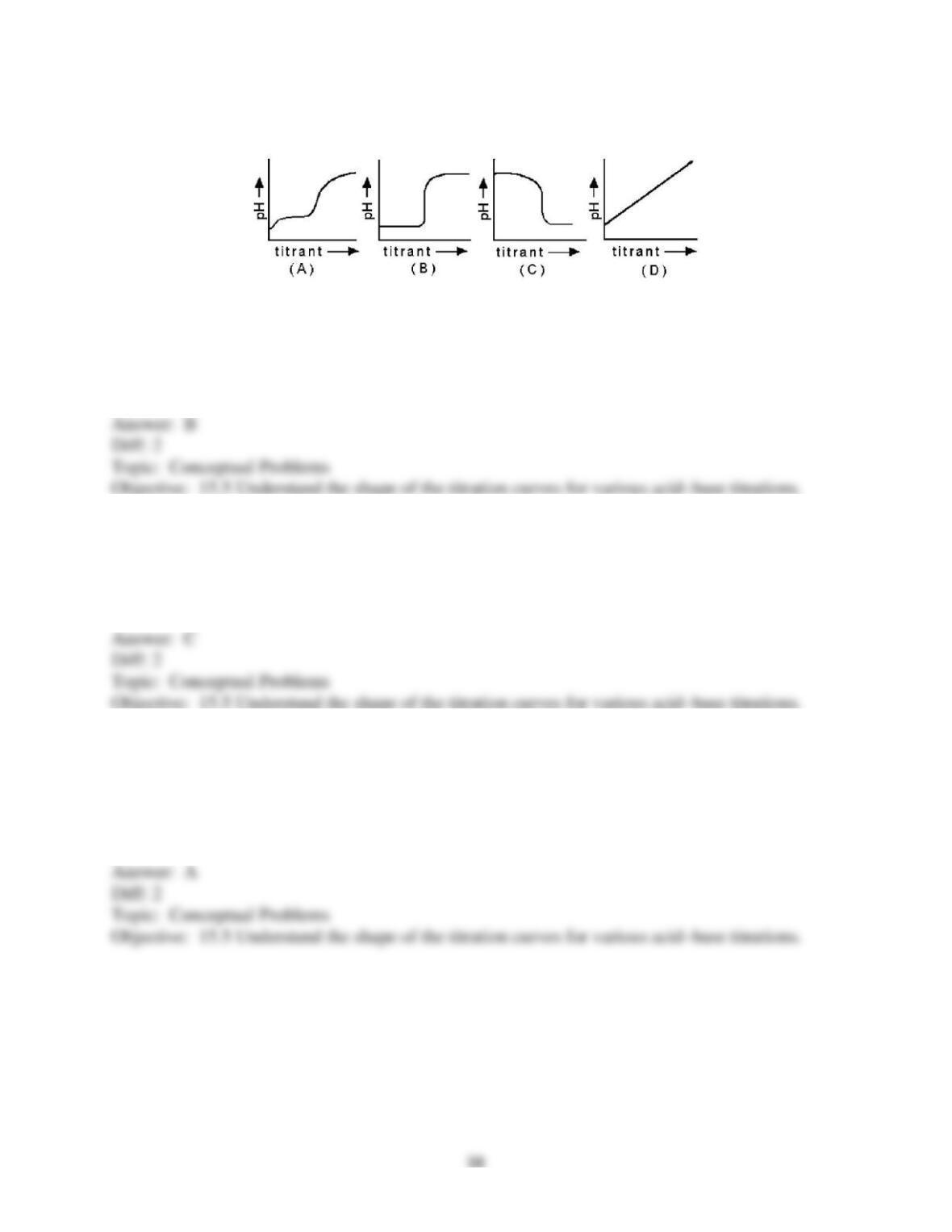
Use the graphs below to answer the following questions.
117) What is the characteristic pH-titrant curve for the titration of a strong acid by a strong base?
A) A
B) B
C) C
D) D
118) What is the characteristic pH-titrant curve for the titration of a strong base by a strong acid?
A) A
B) B
C) C
D) D
119) What is the characteristic pH-titration curve for the titration of a weak acid by a strong
base?
A) A
B) B
C) C
D) D
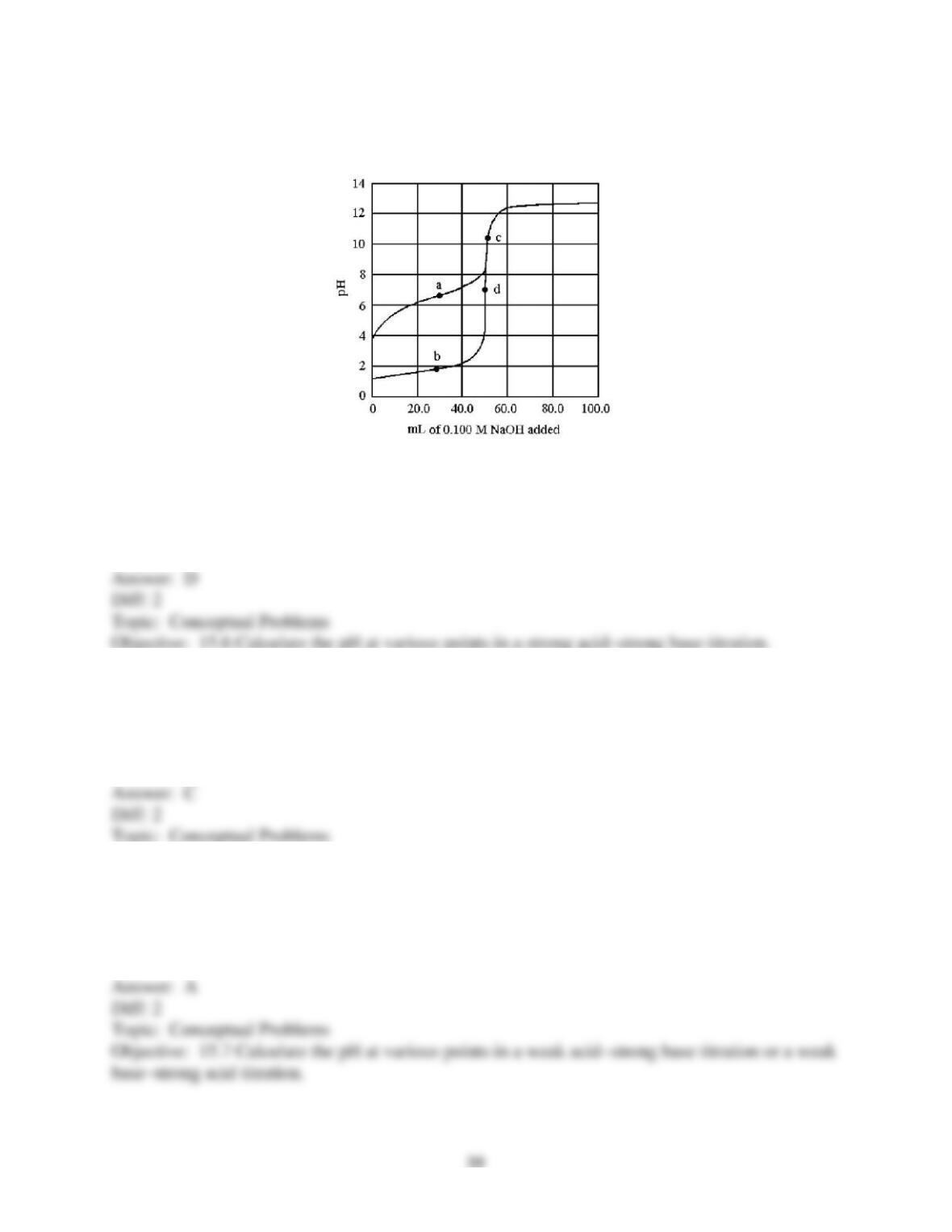
The following plot shows two titration curves, each representing the titration of 50.00 mL of
0.100 M acid with 0.100 M NaOH.
120) Which point a-d represents the equivalence point for the titration of a strong acid?
A) point a
B) point b
C) point c
D) point d
121) Which point a-d represents the equivalence point for the titration of a weak acid?
A) point a
B) point b
C) point c
D) point d
122) At which point a-d is the pKa of the acid equal to the pH?
A) point a
B) point b
C) point c
D) point d
123) Which points a-d represent the half-equivalence point and the equivalence point,
respectively, for the titration of a weak acid?
A) points a and b
B) points a and c
C) points b and d
D) points c and d
124) Which point a-d represents a buffer region?
A) point a
B) point b
C) point c
D) point d