99. A stock split that is accomplished by a change in par value that is not proportional to the new number of
shares or if the firm does not change the par value, the firm
100. Which of the following is/are true regarding a reverse stock split?
101. Which of the following is not true regarding a reverse stock split?
102. (CMA adapted, Jun 87 #4) The major segments of the statement of retained earnings for a period are
103. Firms may periodically distribute net assets generated by earnings to shareholders as a dividend. Firms
104. A firm must pay all current and previously postponed preferred dividends before it can pay any dividends
on common shares, thus the preferred shares have the feature called
105. Baldwin Corporation
Excerpts from the Statement of Financial Position for Baldwin Corporation as of September 30, Year 5, are
presented below.
Cash
$ 950,000
Accounts receivable (net)
1,675,000
Inventories
2,806,000
Total current assets
$5,431,000
Accounts payable
$1,004,000
Accrued liabilities
785,000
Total current liabilities
$1,789,000
The Board of directors of Baldwin Corporation met on October 4, Year 5, and declared regular quarterly cash dividends amounting to $750,000
($0.60 per share). The dividend is payable on October 25, Year 5, to all shareholders of record as of October 12, Year 5.
Assume that the only transactions to affect Baldwin Corporation during October Year 5 are the dividend transactions and that the closing entries have
been made.
(CMA adapted, Dec 89 #15) Refer to the Baldwin Corporation example. Baldwin’s total shareholders’ equity would be

106. Baldwin Corporation
Excerpts from the Statement of Financial Position for Baldwin Corporation as of September 30, Year 5, are
presented below.
Cash
$ 950,000
Accounts receivable (net)
1,675,000
Inventories
2,806,000
Total current assets
$5,431,000
Accounts payable
$1,004,000
Accrued liabilities
785,000
Total current liabilities
$1,789,000
The Board of directors of Baldwin Corporation met on October 4, Year 5, and declared regular quarterly cash dividends amounting to $750,000
($0.60 per share). The dividend is payable on October 25, Year 5, to all shareholders of record as of October 12, Year 5.
Assume that the only transactions to affect Baldwin Corporation during October Year 5 are the dividend transactions and that the closing entries have
been made.
(CMA adapted, Dec 89 #16) Refer to the Baldwin Corporation example. If the dividend declared by Baldwin Corporation had been a 10 percent
stock dividend instead of a cash dividend, Baldwin’s current liabilities would have been
107. Baldwin Corporation
Excerpts from the Statement of Financial Position for Baldwin Corporation as of September 30, Year 5, are
presented below.
Cash
$ 950,000
Accounts receivable (net)
1,675,000
Inventories
2,806,000
Total current assets
$5,431,000
Accounts payable
$1,004,000
Accrued liabilities
785,000
Total current liabilities
$1,789,000
The Board of directors of Baldwin Corporation met on October 4, Year 5, and declared regular quarterly cash dividends amounting to $750,000
($0.60 per share). The dividend is payable on October 25, Year 5, to all shareholders of record as of October 12, Year 5.
Assume that the only transactions to affect Baldwin Corporation during October Year 5 are the dividend transactions and that the closing entries have
been made.
(CMA adapted, Dec 89 #17) Refer to the Baldwin Corporation example. If the dividend declared by Baldwin Corporation had been a ten percent
stock dividend instead of a cash dividend, Baldwin’s total shareholders’ equity would have been
108. How would a stock split affect each of the following?
Total
Stockholders’ Additional
Assets Equity Paid-In Capital
109. When a dividend is declared and paid in stock,
110. On September 1, 2013, Marker Corporation declared and issued a 20 percent common stock dividend.
Prior to this date, Marker had 20,000 shares of $2 par value common stock that were both issued and
outstanding. The market value of Marker’s stock was $20 per share at the time the dividend was issued. As a
result of this stock dividend, Marker’s total stockholders’ equity
111. A stock dividend indicates
112. A firm may postpone or omit
113. How would total stockholders’ equity be affected by the declaration of each of the following?
Stock Stock
Dividend Split
114. On September 30, Pineville Corporation declared and issued a 10% common stock dividend. Prior to this
dividend, Pineville had 50,000 shares of $5 par value common stock issued and outstanding. The fair value of
Pineville’s common stock was $52 per share on September 30. As a result of this stock dividend, Pineville’s
total stockholders’ equity
115. Treasury stock or treasury shares are shares a firm has previously issued and later reacquired. Which of
the following is/are true?
116. Treasury stock or treasury shares are shares a firm has previously issued and later reacquired. Reasons for
reacquiring outstanding common stock include which of the following?
117. Treasury stock or treasury shares are shares a firm has previously issued and later reacquired. Which of
the following is/are true?
118. Treasury stock or treasury shares are shares a firm has previously issued and later reacquired. Which of
the following is/are true?
119. Treasury stock or treasury shares are shares a firm has previously issued and later reacquired. Which of
the following is/are not true?
120. Treasury stock or treasury shares are shares a firm has previously issued and later reacquired. Which of
the following is/are not true?
121. U.S. GAAP and IFRS on accounting for repurchases and reissuances of treasury shares follow the
principle that
122. Firms use this method when management and the governing board do not intend to reissue shares within a
reasonable amount of time or when jurisdiction-specific corporation laws define reacquired shares as retired
shares.
123. When a firm reacquires common shares under the Cost Method:
124. When a firm reacquires common shares under the Par Value Method for Repurchased Shares:
125. When a firm reacquires common shares under the Constructive Retirement Method for Repurchased
Shares:
126. When a firm uses the par value method to account for treasury shares, ________________.
The par value method requires specific identification of the date and initial proceeds of the shares repurchased,
which is why firms seldom use this method.
127. In some cases, particularly when the reissue of treasury stock results from the exercise of employee stock
options, the amount paid by the firm to reacquire the treasury shares exceeds the subsequent reissue price. If the
firm uses the cost method, it debits the balance to
128. Treasury shares arise when a corporation reacquires its own previously issued common shares. A reason
for reacquiring outstanding common stock is to use the treasury shares in various option arrangements. When
holders of stock options, stock rights, stock warrants, and convertible securities exercise their options, firms
usually receive
129. Treasury stock can be defined as
130. A firm owns 1,000 treasury shares which it acquired for $15 per share (par value $1). The firm sells 500 of
the treasury shares for $20 per share. Using the cost method, what is the entry to record the sale of the treasury
stock using the cost method?
131. Gains and losses on the purchase and resale of treasury stock may be reflected only in
132. At the date of the financial statements, common stock shares issued would exceed common stock shares
outstanding as a result of the
133. Which of the following is/are an appropriate presentation of treasury stock?
134. The following was abstracted from the accounts of the Anderson Corp. at year-end:
Total income since incorporation ………………….
$420,000
Total cash dividends paid ………………………..
130,000
Proceeds from sale of donated stock …………….…
45,000
Total value of stock dividends distributed …………
30,000
Excess of proceeds over cost of treasury stock sold …
70,000
What should be the current balance of Retained Earnings?
135. Which of the following is issued to shareholders by a corporation as evidence of the ownership of rights to
acquire its unissued or treasury stock?
136. (CMA adapted, Jun 88 #19) Which one of the following items would likely increase earnings per share
(EPS) of a corporation?
137. In some cases, particularly when the reissue of treasury stock results from the exercise of employee stock
options, the amount paid by the firm to reacquire the treasury shares exceeds the subsequent reissue price. If the
firm applied the constructive retirement method, it is unlikely that the reissue price would be so low as to
require a debit to _____.
138. In what way are stock rights generally different from stock warrants?
139. If the accountant cannot objectively measure the value of the stock warrants separately from the value of
the bond or preferred stock at date of issuance, the accountant credits
140. (CMA adapted, Dec 89 #8) On January 1, Year 1, Toga Corporation granted stock options to top
management. The options were exercisable within 4 years from the date of grant only if the employee was still
in Toga’s employ. When computing year-end earnings per share at December 31, Year 1, Toga should
141. The accounting for stock options is complex because firms often include
142. The accounting for employee stock options involves the firm debiting _____ and crediting _____ for the
amortized amount of the fair value of the stock options on the date of the grant over the requisite service
period.
143. Corporations often sell, or exchange for goods and services, various call options on their shares. Which of
the following is not true?
144. Which of the following is not true regarding stock rights?
145. Which of the following is not true regarding stock rights?
146. Which of the following is true?
147. When employees exercise their employee stock options, the firm debits _____ for the proceeds, debits
_____ for any amounts credited to that account, credits _____ for the par value of the shares issued and credits
_____ for any excess of the cash received plus the amount amortized over the par value of the shares issued.
148. Which of the following is true?
149. Which of the following is not true regarding stock warrants?
150. Firms sometimes issue bonds or preferred stock with stock warrants. Which of the following is/are not
true?
151. Which of the following is/are true regarding stock rights?
152. Which of the following is/are true regarding stock warrants?
153. Which of the following is/are true?
154. The accounting for employee stock options involves
155. Which of the following is/are not true?
156. The accounting for employee stock options does not involve
157. Which of the following is/are true concerning an employee stock options’ time value element?
158. The accounting for employee stock options involves amortizing the fair value of the stock options on the
date of the grant over the requisite service period, which is
159. Regarding employee stock options (ESOs), which of the following is not true?
160. An understanding of the accounting for employee stock options (ESOs) requires several definitions. Which
of the following is not true?
161. Which of the following is/are true concerning an employee stock options’ benefit element?
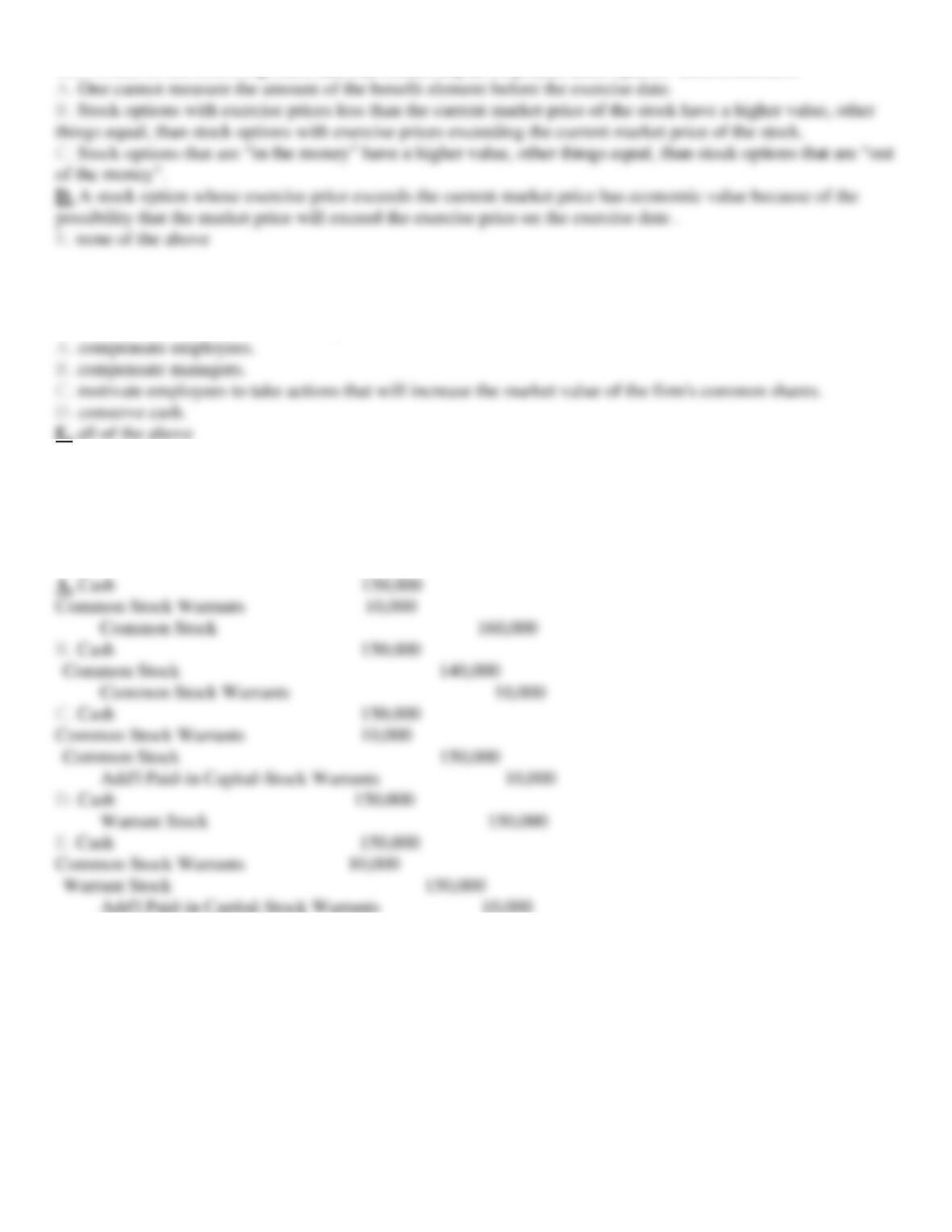
162. Which of the following is/are not true concerning an employee stock options’ benefit element?
163. Firms occasionally issue stock options in order to
164. If 10,000 stock warrants are issued to the general public for $10,000, and later those warrants and
$150,000 are exchanged for 10,000 shares of no-par stock, the entry to record the exercise of the warrants
would be:
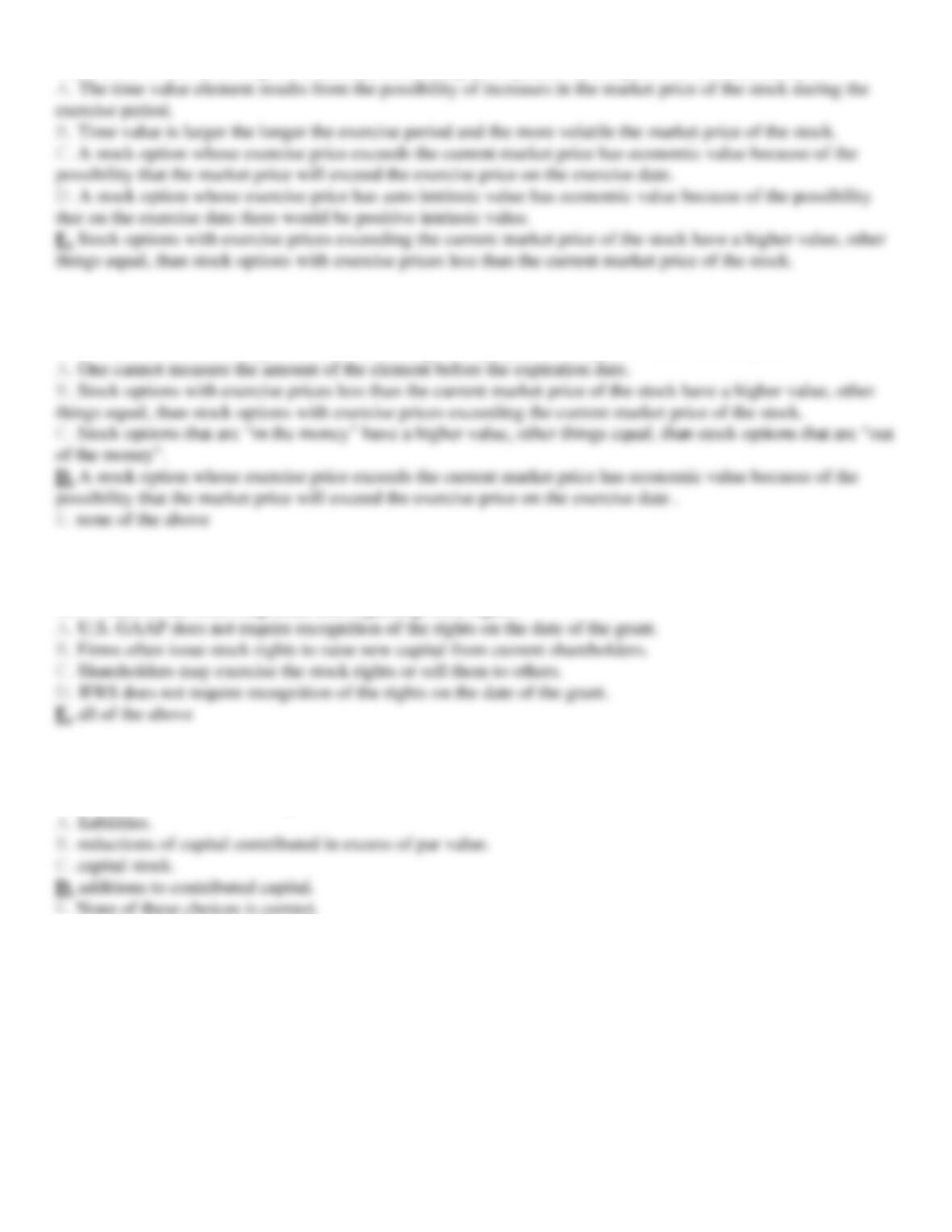
165. Which of the following is/are not true concerning an employee stock options’ time value element?
166. Which of the following is/are true concerning an employee stock options’ time value element?
167. Which of the following is/are true regarding stock rights?
168. Stock warrants outstanding should be classified as
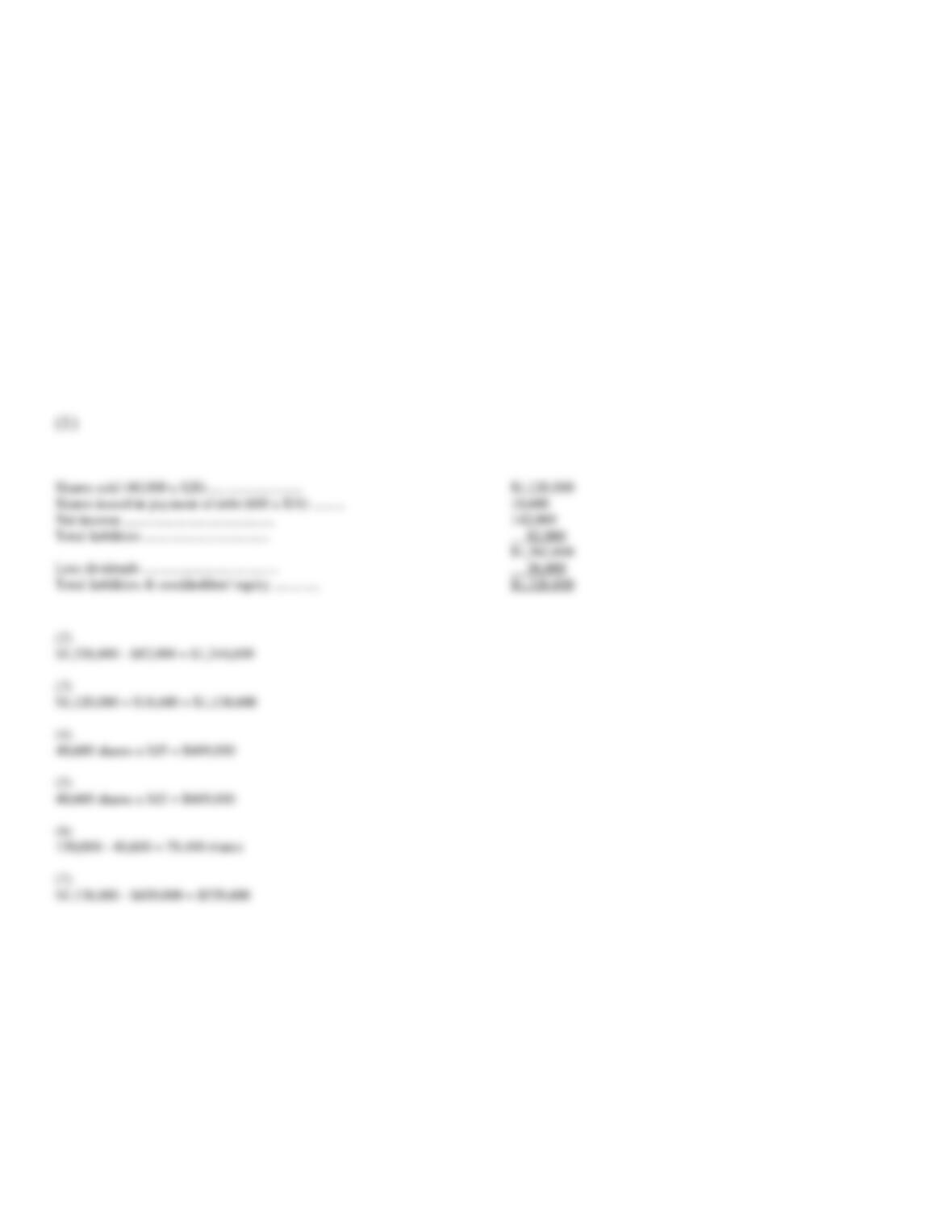
169. Backup Corp. received a charter authorizing 120,000 shares of common stock at $15 par value per share.
During the first year of operations, 40,000 shares were sold at $28 per share. 600 shares were issued in payment
of a current operating debt of $18,600. In the first year, the net income was $142,000.
During the year, dividends of $36,000 were paid to stockholders. At the end of the year, total liabilities were
$82,000. Use the given data to compute the following items at the end of the first year (show all computations):
(1)
Total liabilities and stockholders’ equity
(2)
Stockholders’ equity
(3)
Contributed capital
(4)
Issued capital stock (par)
(5)
Outstanding capital stock (par)
(6)
Unissued capital stock (number of shares)
(7)
Paid-In capital in excess of par value
Shares sold (40,000 x $28) ………………………
$1,120,000
Shares issued in payment of debt (600 x $31) ………
18,600
142,000
82,000
$1,362,600
36,000
Total liabilities & stockholders’ equity ………….
$1,326,600