16) How many of the following are WEAK acids?
HNO2 HF HNO3 H2PO4⁻
A) 0
B) 1
C) 3
D) 4
E) 2
17) Identify the food that is NOT acidic.
A) beer
B) apple
C) egg white
D) soda
E) wine
18) Calculate the pOH of a solution that contains 3.9 x 10⁻⁵ M H3O⁺ at 25°C.
A) 5.41
B) 4.41
C) 9.59
D) 8.59
E) 0.59
19) Calculate the pH of a solution that contains 3.9 x 10⁻⁵ M H3O⁺ at 25°C.
A) 5.41
B) 4.41
C) 9.59
D) 8.59
E) 0.59
20) Calculate the pH of a solution that contains 2.4 × 10⁻⁵ M H3O⁺ at 25°C.
A) 2.40
B) 9.38
C) 4.62
D) 8.38
E) 5.62
21) Calculate the pOH of a solution that contains 2.4 × 10⁻⁵ M H3O⁺ at 25°C.
A) 2.40
B) 9.38
C) 4.62
D) 8.38
E) 5.62
22) Calculate the pOH in an aqueous solution with a pH of 7.85 at 25°C.
A) 4.15
B) 5.15
C) 6.15
D) 7.15
E) 8.15
23) Calculate the hydronium ion concentration in an aqueous solution that contains 2.50 × 10⁻⁶ M in
hydroxide ion.
A) 4.00 × 10⁻⁷ M
B) 4.00 × 10⁻⁸ M
C) 4.00 × 10⁻⁹ M
D) 5.00 × 10⁻⁹ M
24) Calculate the hydroxide ion concentration in an aqueous solution that contains 3.50 × 10⁻⁴ M in
hydronium ion.
A) 2.86 × 10⁻³ M
B) 2.86 × 10⁻¹⁰ M
C) 2.86 × 10⁻¹¹ M
D) 3.50 × 10⁻¹¹ M
25) A solution with a hydrogen ion concentration of 3.25 × 10⁻⁶ M is ________ and has a hydroxide ion
concentration of ________.
A) acidic, 3.08 × 10⁻⁸ M
B) acidic, 3.08 × 10⁻⁹ M
C) basic, 3.08 × 10⁻⁸ M
D) basic, 3.08 × 10⁻⁹ M
26) A solution with a hydroxide ion concentration of 4.15 × 10⁻⁶ M is ________ and has a hydrogen ion
concentration of ________.
A) acidic, 2.41 × 10⁻⁸ M
B) acidic, 2.41 × 10⁻⁹ M
C) basic, 2.41 × 10⁻⁸ M
D) basic, 2.41 × 10⁻⁹ M
27) Calculate the pH for an aqueous solution of acetic acid that contains 2.15 × 10⁻³ M hydronium ion.
A) 4.65 × 10⁻¹² M
B) 2.15 × 10⁻³ M
C) 2.67
D) 11.33
28) Calculate the pH for an aqueous solution of pyridine that contains 2.15 × 10⁻⁴ M hydroxide ion.
A) 4.65 × 10⁻¹¹
B) 2.15 × 10⁻⁴
C) 3.67
D) 10.33
29) What is the hydroxide ion concentration and the pH for a hydrochloric acid solution that has a
hydronium ion concentration of 1.50 × 10⁻² M?
A) 6.67 × 10⁻¹² M, 2.82
B) 6.67 × 10⁻¹² M, 11.18
C) 6.67 × 10⁻¹³ M, 1.82
D) 6.67 × 10⁻¹³ M, 12.17
30) What is the hydronium ion concentration and the pH for an aqueous solution of NH3 that has a
hydroxide ion concentration of 2.25 × 10⁻² M?
A) 4.44 × 10⁻¹² M and 2.65
B) 4.44 × 10⁻¹² M and 11.35
C) 4.44 × 10⁻¹³ M and 1.65
D) 4.44 × 10⁻¹³ M and 12.35
19
31) What is the hydronium ion concentration of an acid rain sample that has a pH of 3.45?
A) 2.82 × 10⁻¹¹ M
B) 3.55 × 10⁻⁴ M
C) 3.45 M
D) 10.55 M
32) What is the hydroxide ion concentration of a lye solution that has a pH of 9.20?
A) 6.31 × 10⁻¹⁰ M
B) 1.58 × 10⁻⁵ M
C) 4.80 M
D) 9.20 M
33) What is the pH of a 0.020 M HClO4 solution?
A) 0.020
B) 0.040
C) 1.70
D) 12.30
34) An aqueous solution at 25.0°C contains [H+] = 0.099 M. What is the pH of the solution?
A) 1.00
B) -1.00
C) 13.0
D) 0.0990
E) 1.00 ×
35) The pH of an aqueous solution at 25.0°C is 10.66. What is the molarity of H+ in this solution?
A) 2.2 × 10⁻¹¹
B) 4.6 × 10⁻⁴
C) 3.3
D) 1.1 × 10⁻¹³
E) 4.6 × 10¹⁰
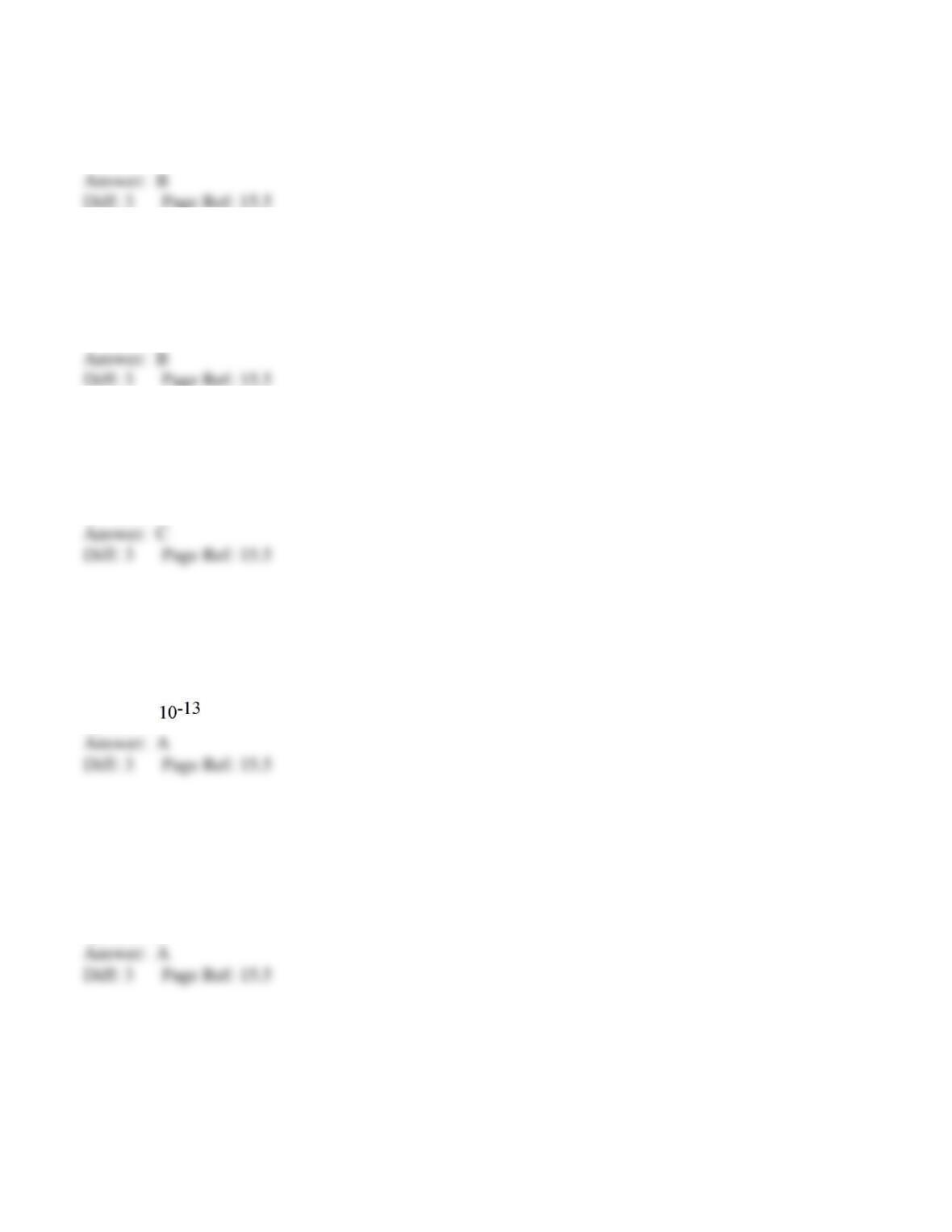
36) Calculate the molarity of hydroxide ion in an aqueous solution that has a pOH of 5.00.
A) 1.0 × 10⁻⁵
B) 9.00
C) 1.0 × 10⁻⁹
D) 5.0 ×
E) 9.0 × 10⁻¹⁴
37) Which of the following acids is the STRONGEST? The acid is followed by its Ka value.
A) HF, 3.5 × 10⁻⁴
B) HCN, 4.9 × 10⁻¹⁰
C) HNO2, 4.6 × 10⁻⁴
D) H COOH, 1.8 × 10⁻⁴
E) HClO2, 1.1 × 10⁻²
38) Which of the following acids is the WEAKEST? The acid is followed by its Ka value.
A) HF, 3.5 × 10⁻⁴
B) HCN, 4.9 × 10⁻¹⁰
C) HNO2, 4.6 × 10⁻⁴
D) H COOH, 1.8 × 10⁻⁴
E) HClO2, 1.1 × 10⁻²
39) What is the hydronium ion concentration of a 0.500 M acetic acid solution with Ka = 1.8 × 10⁻⁵?
The equation for the dissociation of acetic acid is:
CH3CO2H(aq) + H2O(l) ⇌ H3O+(aq) + CH3CO2–(aq).
A) 3.0 × 10⁻² M
B) 4.2 × 10⁻² M
C) 3.0 × 10⁻³ M
D) 4.2 × 10⁻³ M
40) What is the hydronium ion concentration of a 0.150 M hypochlorous acid solution with
Ka = 3.5 × 10⁻⁸? The equation for the dissociation of hypochlorous acid is:
HOCl(aq) + H2O(l) ⇌ H3O+(aq) + OCl–(aq).
A) 1.9 × 10⁻⁴ M
B) 7.2 × 10⁻⁴ M
C) 2.8 × 10⁻⁵ M
D) 7.2 × 10⁻⁵ M
41) The acid-dissociation constant at 25.0°C for hypochlorous acid (HClO) is 3.0 × 10⁻⁸. At
equilibrium, the molarity of H3O+ in a 0.010 M solution of HClO is ________.
A) 1.7 × 10⁻⁵
B) 0.010
C) 5.8 × 10⁻¹⁰
D) 4.76
E) 2.00
42) Calculate the pH of a 0.800 M NaCH3CO2 solution. Ka for acetic acid, CH3CO2H, is 1.8 × 10⁻⁵.
A) 2.42
B) 4.68
C) 9.32
D) 11.58
43) Calculate the pH of a 1.60 M KBrO solution. Ka for hypobromous acid, HBrO, is 2.0 × 10⁻⁹.
A) 2.55
B) 4.25
C) 9.75
D) 11.45
44) Which of the following is a STRONG base?
A) I–
B) NH3
C) CH3OH
D) NO3⁻
E) LiOH
45) Which of the following is a WEAK base?
A) NH(CH3)2
B) N2
C) NaOH
D) CH2CI2
E) None of the above are weak bases.
46) Determine the [OH⁻] concentration in a 0.235 M NaOH solution.
A) 4.25 × 10⁻¹⁴ M
B) 0.470 M
C) 2.13 × 10⁻¹⁴ M
D) 0.118 M
E) 0.235 M
47) Determine the pH of a 0.741 M LiOH solution at 25°C.
A) 0.130
B) 13.87
C) 0.741
D) 13.26
E) 1.48
48) Determine the pOH of a 0.741 M LiOH solution at 25°C.
A) 0.130
B) 13.87
C) 0.741
D) 13.26
E) 1.48
49) Determine the pH of a 0.232 M Mg(OH)2 solution at 25°C.
A) 12.73
B) 13.37
C) 13.67
D) 0.333
E) 0.634
50) Determine the pOH of a 0.348 M Ba(OH)2 solution at 25°C.
A) 13.08
B) 13.54
C) 13.84
D) 0.157
E) 0.458
51) Determine the [OH–] concentration of a 0.123 M Sr(OH)2 solution at 25°C.
A) 4.06 x 10⁻¹⁴ M
B) 0.123 M
C) 0.246 M
D) 8.13 x 10⁻¹⁴ M
E) 0.0615 M
52) A 7.0 × 10⁻³ M aqueous solution of Ca(OH)2 at 25.0°C has a pH of ________.
A) 12.15
B) 1.85
C) 1.4 × 10⁻²
D) 7.1 × 10⁻¹³
E) 11.85
53) What is the pH of a 0.040 M Ba(OH)2 solution?
A) 1.10
B) 1.40
C) 12.60
D) 12.90
54) What is the pH of a 0.100 M NH3 solution that has Kb = 1.8 × 10⁻⁵? The equation for the
dissociation of NH3 is
NH3(aq) + H2O(l) ⇌ NH4+(aq) + OH–(aq).
A) 1.87
B) 2.87
C) 11.13
D) 10.13
24
55) What is the pH of a 0.30 M pyridine solution that has Kb = 1.9 × 10⁻⁹? The equation for the
dissociation of pyridine is
C5H5N(aq) + H2O(l) ⇌ C5H5NH+(aq) + OH–(aq).
A) 4.62
B) 8.72
C) 9.38
D) 10.38
56) Determine the ammonia concentration of an aqueous solution that has a pH of 11.00. The equation
for the dissociation of NH3 (Kb = 1.8 × 10⁻⁵) is
NH3(aq) + H2O(l) ⇌ NH4+(aq) + OH–(aq).
A) 3.0 M
B) 0.056 M
C) 1.8 × 10⁻² M
D) 1.0 × 10⁻³ M
57) The acid-dissociation constant of hydrocyanic acid (HCN) at 25.0°C is 4.9 × 10⁻¹⁰. What is the pH
of an aqueous solution of 0.080 M sodium cyanide (NaCN)?
A) 11.11
B) 2.89
C) 1.3 × 10⁻³
D) 7.8 × 10⁻¹²
E) 3.9 × 10⁻¹¹
58) Calculate the pH of a 1.60 M CH3NH3Cl solution. Kb for methylamine, CH3NH2, is 3.7 × 10⁻⁴.
A) 1.61
B) 5.18
C) 8.82
D) 12.39
59) The base-dissociation constant of ethylamine (C2H5NH2) is 6.4 × 10⁻⁴ at 25.0°C. The [H+] in a
1.6 × 10⁻² M solution of ethylamine is ________ M.
A) 3.5 × 10⁻¹²
B) 2.9 × 10⁻³
C) 3.1 × 10⁻¹²
D) 3.2 × 10⁻³
E) 11.46
60) Which one of the following salts, when dissolved in water, produces the solution with the highest
pH?
A) KHCO3
B) CsClO4
C) RaO
D) CH3CH3NH3Cl
61) If an equal number of moles of the weak acid HCN and the strong base KOH are added to water, is
the resulting solution acidic, basic, or neutral?
A) acidic
B) basic
C) neutral
D) There is insufficient information provided to answer this question.
62) Which one of the following salts, when dissolved in water, produces the solution with the highest
pH?
A) RbI
B) RbBr
C) RbCl
D) RbF
63) Which one of the following salts, when dissolved in water, produces the solution with a pH closest
to 7.00?
A) NH4Br
B) Ca O
C) K HSO4
D) CsI
64) Which one of the following salts, when dissolved in water, produces the solution with the lowest
pH?
A) NaCl
B) KCl
C) MgCl2
D) AlCl3
65) Which one of the following will form an acidic solution in water?
A) NH4Cl
B) KF
C) KI
D) KNO3
E) None of the above solutions will be acidic.
66) Which of the following is a polyprotic acid?
A) HI
B) H2SO4
C) HCN
D) CCl4
E) HC2H3O2
67) Which of the following is a triprotic acid?
A) HI
B) H2SO4
C) H3PO4
D) CCl4
E) HC2H3O2
68) Calculate the pH of a 0.080 M carbonic acid solution, H2CO3(aq), that has the stepwise dissociation
constants Ka1 = 4.3 × 10⁻⁷ and Ka2 = 5.6 × 10⁻¹¹.
A) 1.10
B) 3.73
C) 6.37
D) 10.25
69) Calculate the pH of a 0.60 M H2SO3, solution that has the stepwise dissociation constants
Ka1 = 1.5 × 10⁻² and Ka2 = 6.3 × 10⁻⁸.
A) 1.02
B) 1.06
C) 1.82
D) 2.04
70) Calculate the concentration of bicarbonate ion, HCO3–, in a 0.010 M H2CO3 solution that has the
stepwise dissociation constants Ka1 = 4.3 × 10⁻⁷ and Ka2 = 5.6 × 10⁻¹¹.
A) 6.6 × 10⁻⁵ M
B) 4.3 × 10⁻⁷ M
C) 4.3 × 10⁻⁹ M
D) 5.6 × 10⁻¹¹ M
71) What is the pH of a 0.40 M H2Se solution that has the stepwise dissociation constants
Ka1 = 1.3 × 10⁻⁴ and Ka2 = 1.0 × 10⁻¹¹?
A) 2.14
B) 3.89
C) 4.28
D) 5.57
72) What is the selenide ion concentration [Se2-] for a 0.100 M H2Se solution that has the stepwise
dissociation constants of Ka1 = 1.3 × 10⁻⁴ and Ka2 = 1.0 × 10⁻¹¹?
A) 3.6 × 10⁻³ M
B) 1.3 × 10⁻⁴ M
C) 1.3 × 10⁻⁵ M
D) 1.0 × 10⁻¹¹ M
73) Identify the strongest acid.
A) HFO4
B) HFO3
C) HFO2
D) HFO
E) Not enough information is given.
74) Which of the following is a Lewis acid?
A) BBr3
B) CCl4
C) NH3
D) CHBr3
E) None of the above are Lewis acids.
28
75) Which of the following is a Lewis base?
A) AlF3
B) H2O
C) SiF4
D) C5H12
E) None of the above are Lewis bases.
76) List the compound in marble that is destroyed by acid rain.
A) NH4OH
B) NaHCO3
C) CaCO3
D) KOH
E) LiOH
Matching Questions
Match the following.
A) produces protons in aqueous solution
B) electron pair donor
C) proton acceptor
D) proton donor
E) produces hydroxide ions in aqueous solution
F) electron pair acceptor
1) Arrhenius acid
Diff: 1 Page Ref: 15.3
2) Arrhenius base
Diff: 1 Page Ref: 15.3
3) Brønsted-Lowry acid
Diff: 1 Page Ref: 15.3
4) Brønsted-Lowry base
Diff: 1 Page Ref: 15.3
5) Lewis acid
Diff: 1 Page Ref: 15.11
6) Lewis base
Diff: 1 Page Ref: 15.11
Short Answer Questions
1) What does the term amphoteric mean?
2) What is the difference between a strong and weak acid?
3) What is the autoionization of water?
4) Do both protons ionize instantaneously from a diprotic acid such as H2CO3? Explain your answer.
5) Describe the relationship between molecular structure and acid strength.
Answer:
6) Describe a molecule that can be a Lewis acid.
7) List the major source of energy in the United States.
8) List the compound that is formed from the reaction of carbon dioxide with water.