59. [Appendix] Which of the following is not a shortage cost?
Use the following to answer questions 60-62:
Hackett Co. uses an EOQ model to determine its purchase quantities for the year. The following information is
available: annual demand 40,000 units of material; cost of placing an order $20; cost of carrying the material in
inventory $10 per unit. The material costs $100 per unit.
Hilton – Chapter 15
60. [Appendix] Using the EOQ formula, what is the order quantity (round to nearest whole unit)?
61. [Appendix] What is the number of orders that need to be placed and the annual holding cost (round to
nearest whole number)?
62. [Appendix] What is the total annual cost of the inventory policy (round to nearest whole number)?
63. [Appendix] The annual carrying costs are
Refer To: 15-65
64. [Appendix] The annual ordering costs are
Refer To: 15-65
65. [Appendix] Using the EOQ formula, the economic order quantity, rounded up to the nearest unit is
Refer To: 15-65
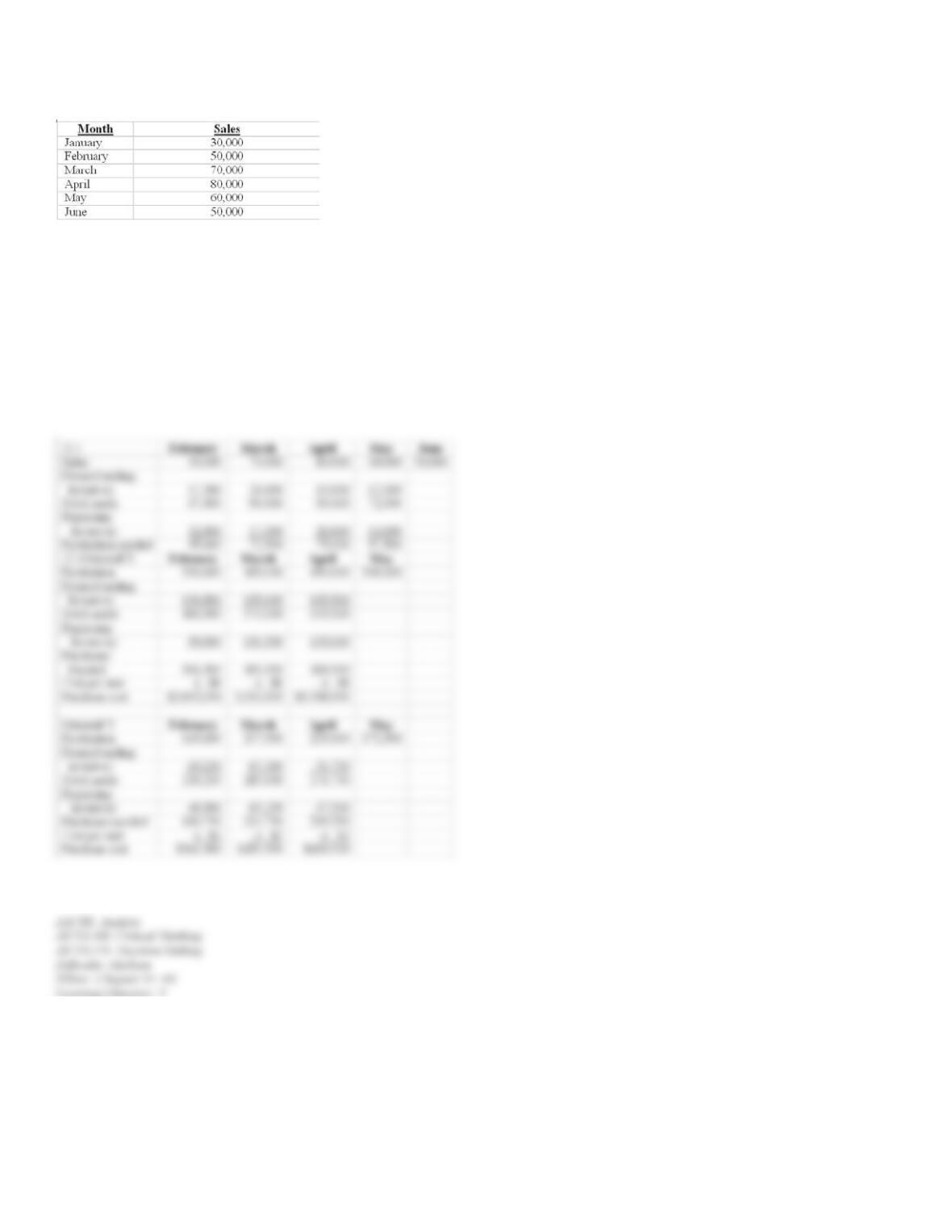
66. Pascal CO. has developed the following sales budget for the first six months of the coming year”
The beginning inventory on January 1 is 8,000 units. The desired ending inventory for the coming year is to be
25 percent of next month’s sales.
Each unit requires 6 units of material X at $8 per unit and 3 units of material Y at $2 per unit. There are 99,000
units of X and 49,500 units of Y on hand January 1 and the desired ending inventory for these will be 30
percent of next month’s needs for the coming year.
Required:
(1) Prepare production budgets for February, March and April
(2) Prepare purchase budgets for materials X and Y in units and dollars for the same months.
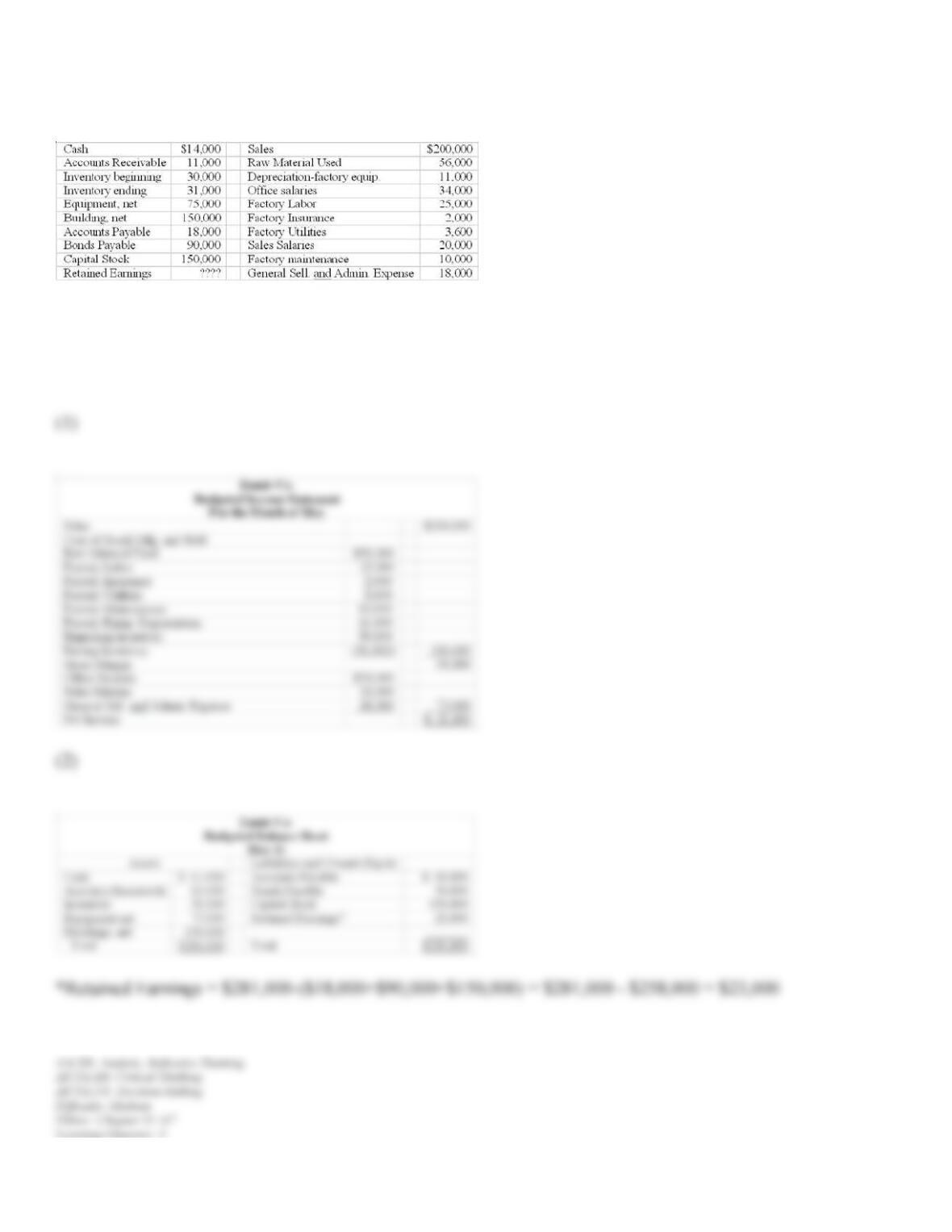
67. The following information was pulled off the various schedules of the master budget prepared by Zamir Co.
and other accounts for May:
All materials purchased were used
Required:
(1) Prepare a budgeted income statement for May
(2) Prepare a budgeted balance sheet for May
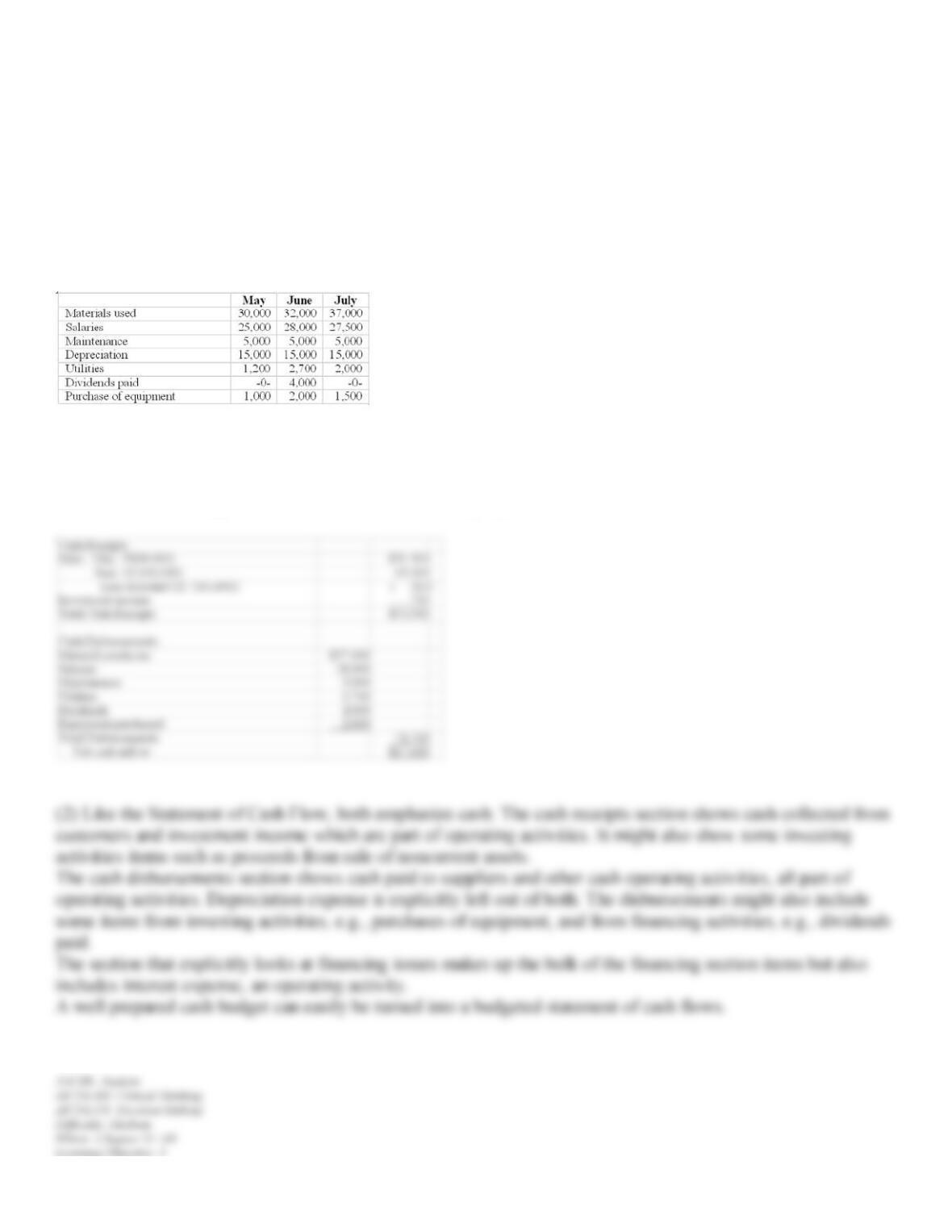
68. Ledford Corporation has the following information available from various schedules to prepare its cash
budget for the June:
Receipts:
Sales (terms 2/10, net 30): May $90,000, June $100,000, July $120,000
Collection pattern: 65% in month of sale, 70% take the discount
35% in month after sale
Income from investments: May $500; June $750; July $350
Disbursements: all expenses are paid for when incurred. Materials are purchased and paid for in the month
before they are used.
Required:
(1) Prepare the cash budget for June
(2) While you are not asked to prepare a budgeted cash flow statement, what similarities, if any, are there
between the cash budget and a Statement of Cash Flow prepared under the direct method?
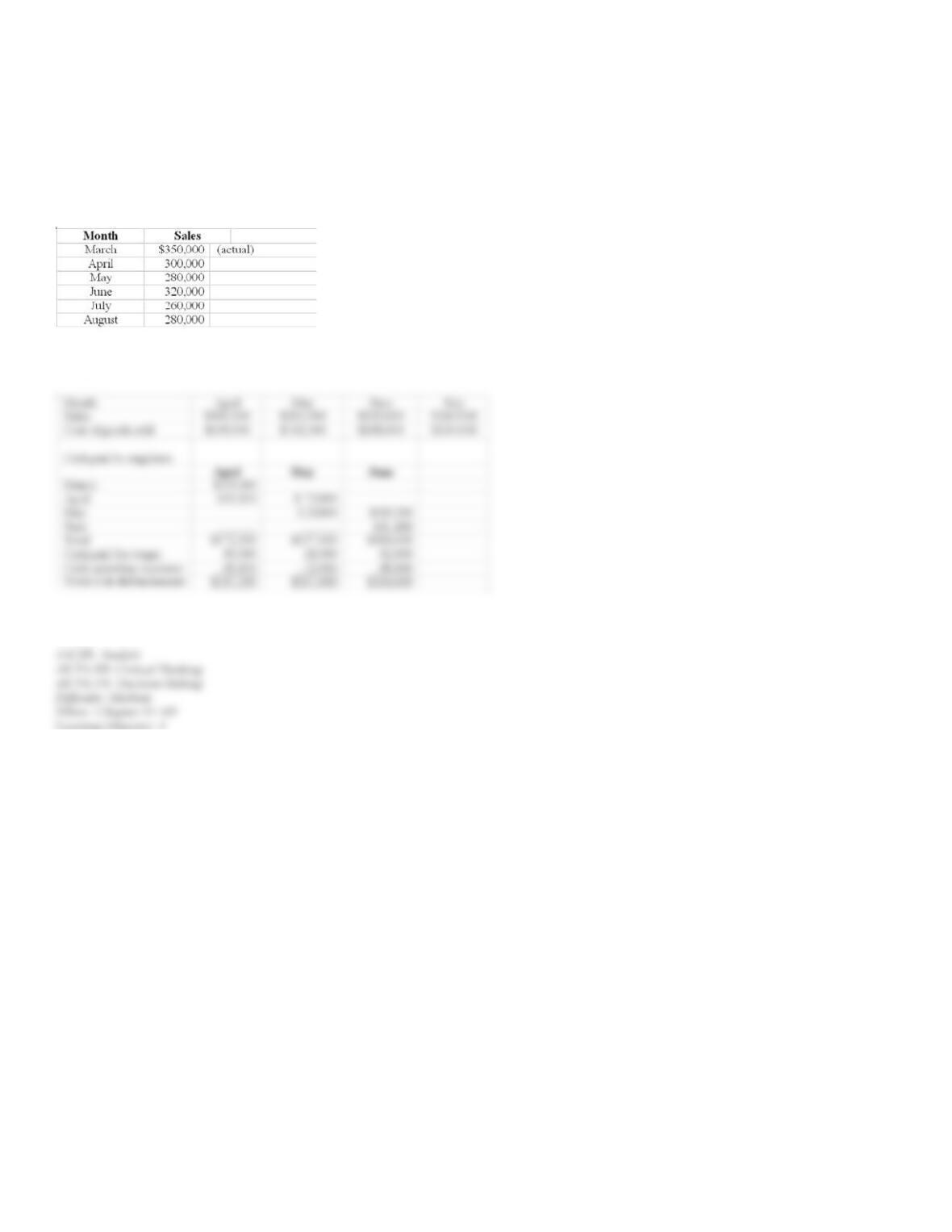
69. Commodore Company, a retailer, has developed the sales budget for the next six months of its rolling
budget. Gross profit has averaged 35 percent of sales over the last 3 months and this trend is expected to
continue. Purchases of merchandise are made a month before needed and are paid 60 percent in the month of
purchase and 40 percent the following month. Wages, estimated at 10 percent of sales, are paid in the month of
sale while operating expenses, 15 percent of sales, are paid in the month of the sale. There is a $63,000 balance
in Accounts Payable on March 31, all of which is paid in April.
Required:Prepare a schedule of cash disbursements for April, May, and June.
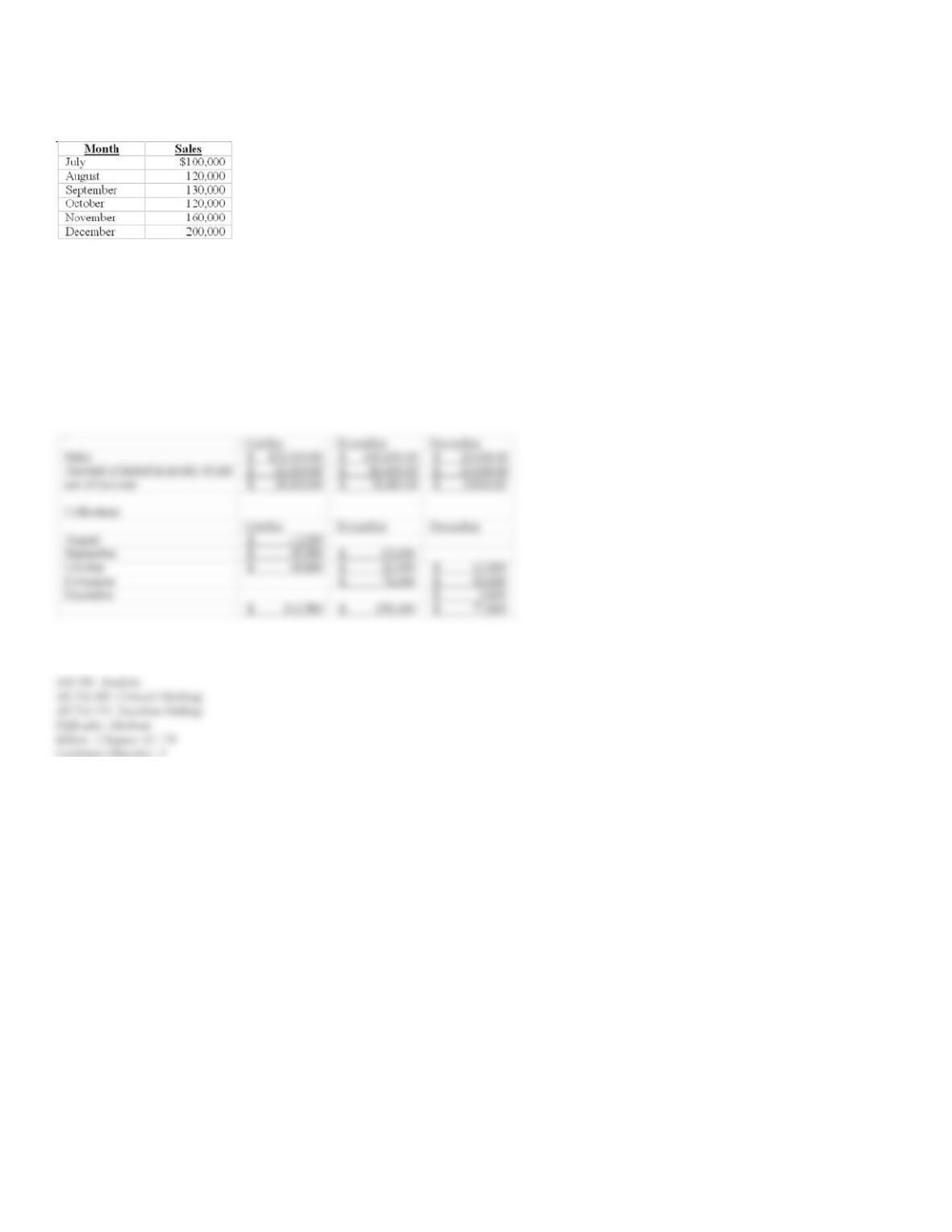
70. Prefetto Company is in the process of preparing its cash budget for the year. The sales forecast for the last
six months of the year follows:
The historical analysis of payment patterns of their customers has provided the following percentages:
50 percent in month of sale
35 percent in month after sale
10 percent in second month after sale
5 uncollectible
Payments made in the month of sale receive a 2 percent discount.
Required: Prepare a detailed Cash Collections from Sales Schedule for October, November, and December.
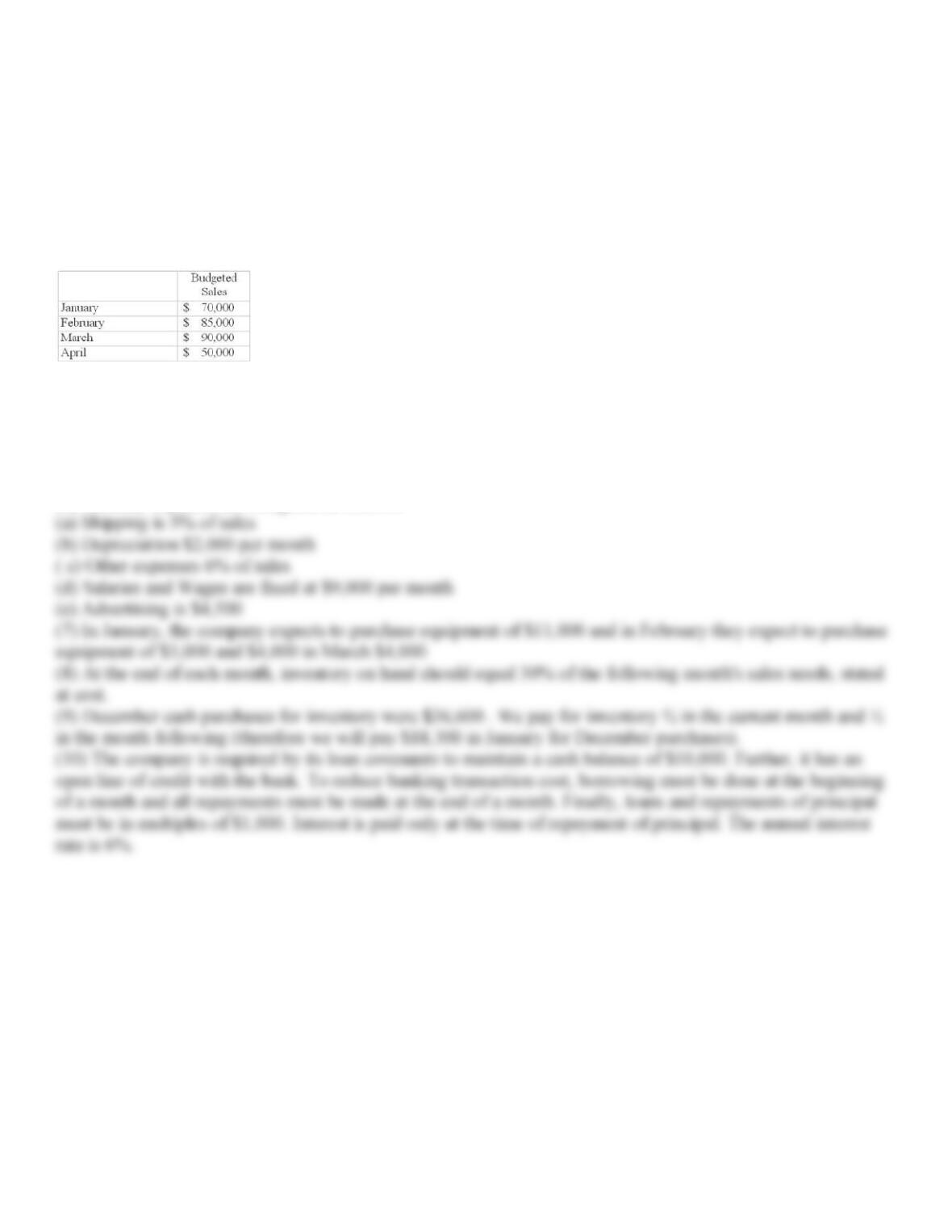
71. Charmed Enterprises, a chocolate distribution company, prepares its master budget on a monthly and
quarterly basis.
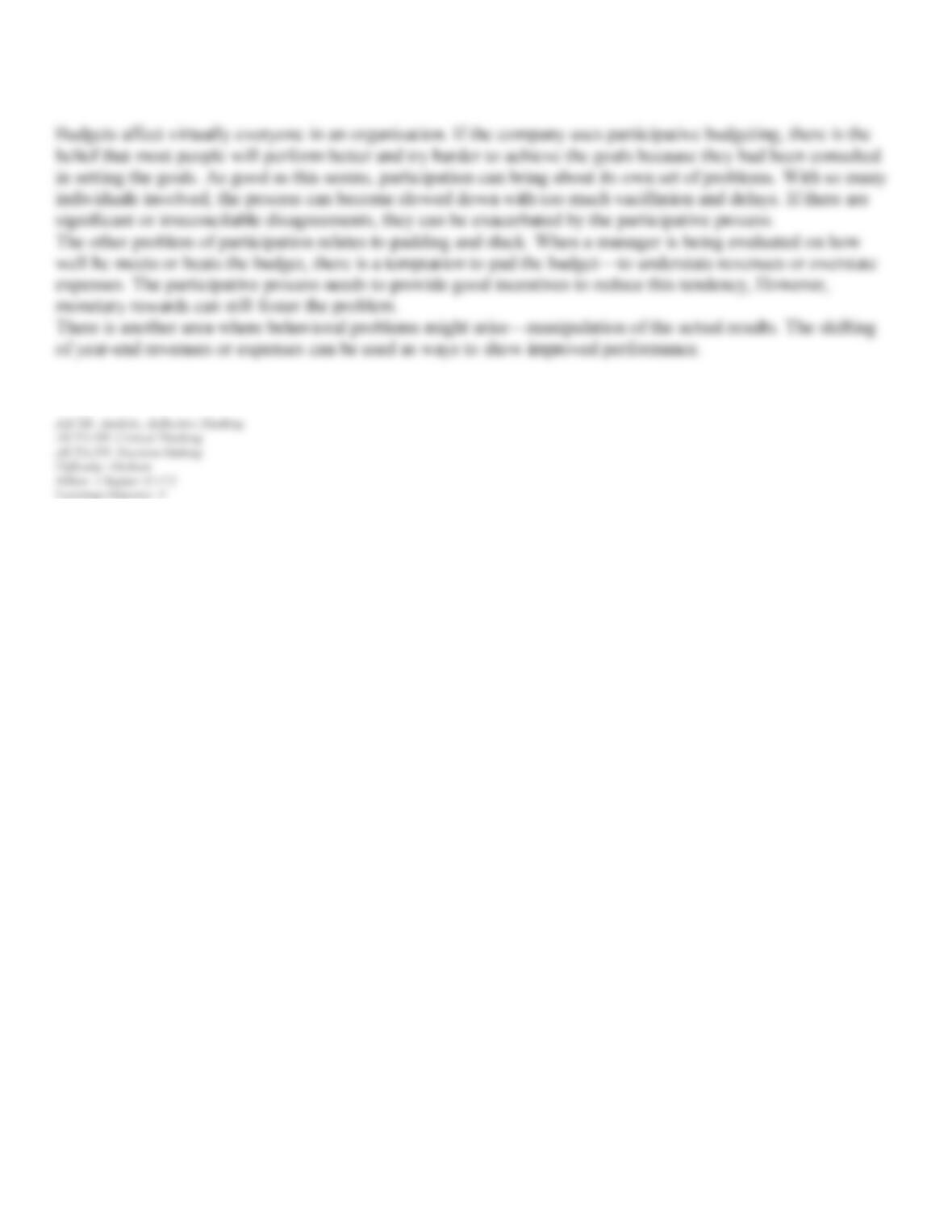
For the months of January, February and March, you are to compute the:
(a) Schedule of expected cash collections
(b) Inventory purchase budget and Cash Disbursements
(c) Cash budget
(1) Actual Sales in December were $60,000
(2) Budgeted Sales for January, February, March and April are
(3) Sales are collected at a rate of 30% for cash, and 70% on credit. All payments on credit sales are collected in
the month following the sale. $42,000 is the balance in accounts receivable at December 31, 2005. The
beginning cash balance is $10,000 with no loans outstanding.
(4) Beginning inventory at January 1, 2006 is $12,600
(5) The companies gross profit rate is 40%
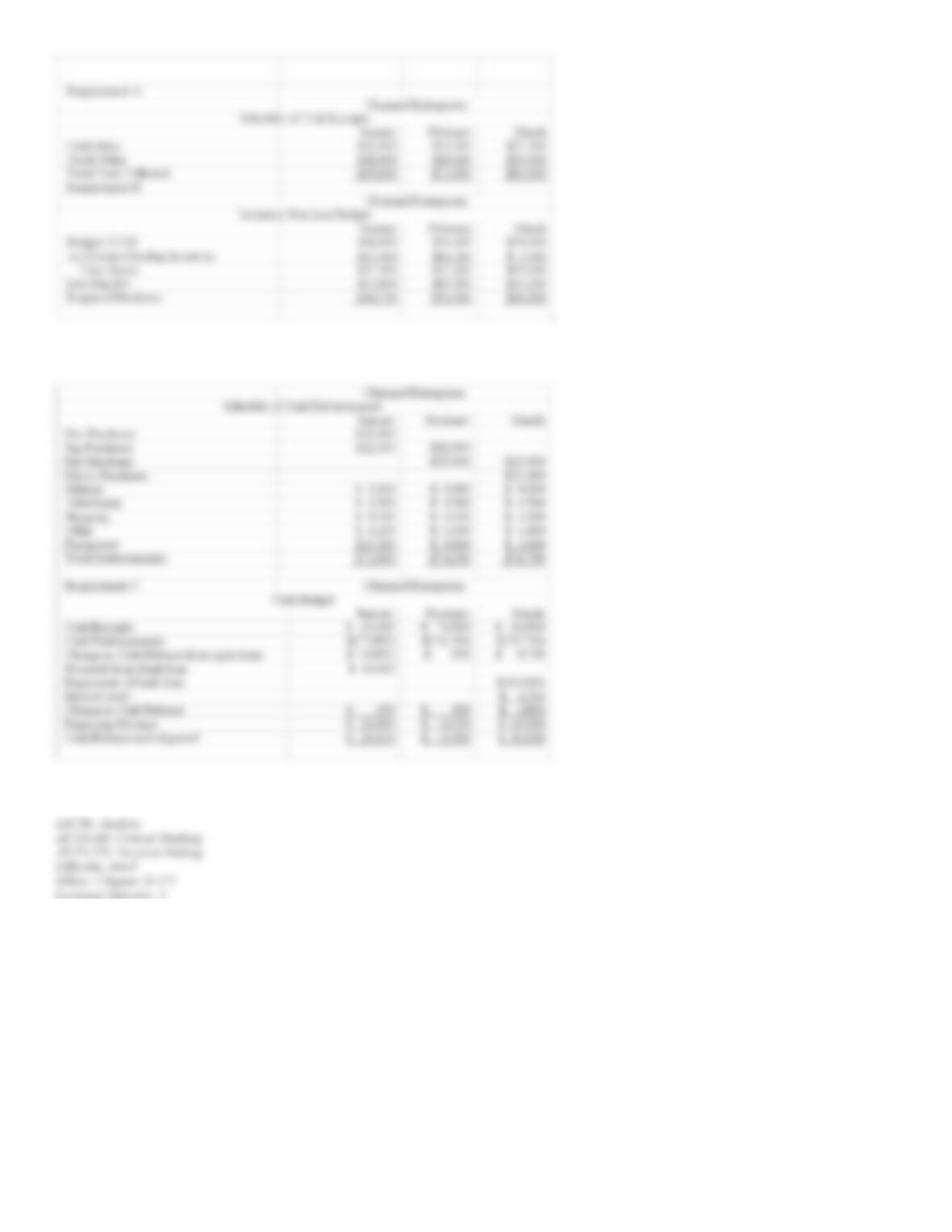
(6) Monthly expenses are budgeted as follows:
72. What are some of the behavioral issues that can arise when performance is evaluated by comparing actual
results to the budget?
73. The sales revenue budget is the starting point for the master budget. Because of its importance, forecasting
the sales for the coming budget period is crucial.
Required:
(1) List at least five factors that are considered when forecasting sales.
(2) Briefly describe the two specific forecasting models discussed in the text: the Delphi method and
econometric models.
74. Briefly describe zero-base budgeting and contrast it with base budgeting.
75. [Appendix] John, Stuart, Mills Company uses 10,000 units of material X per year. The material costs $100
per unit. The cost of placing an order is $160 and the cost of carrying a unit in inventory for a year is $20.
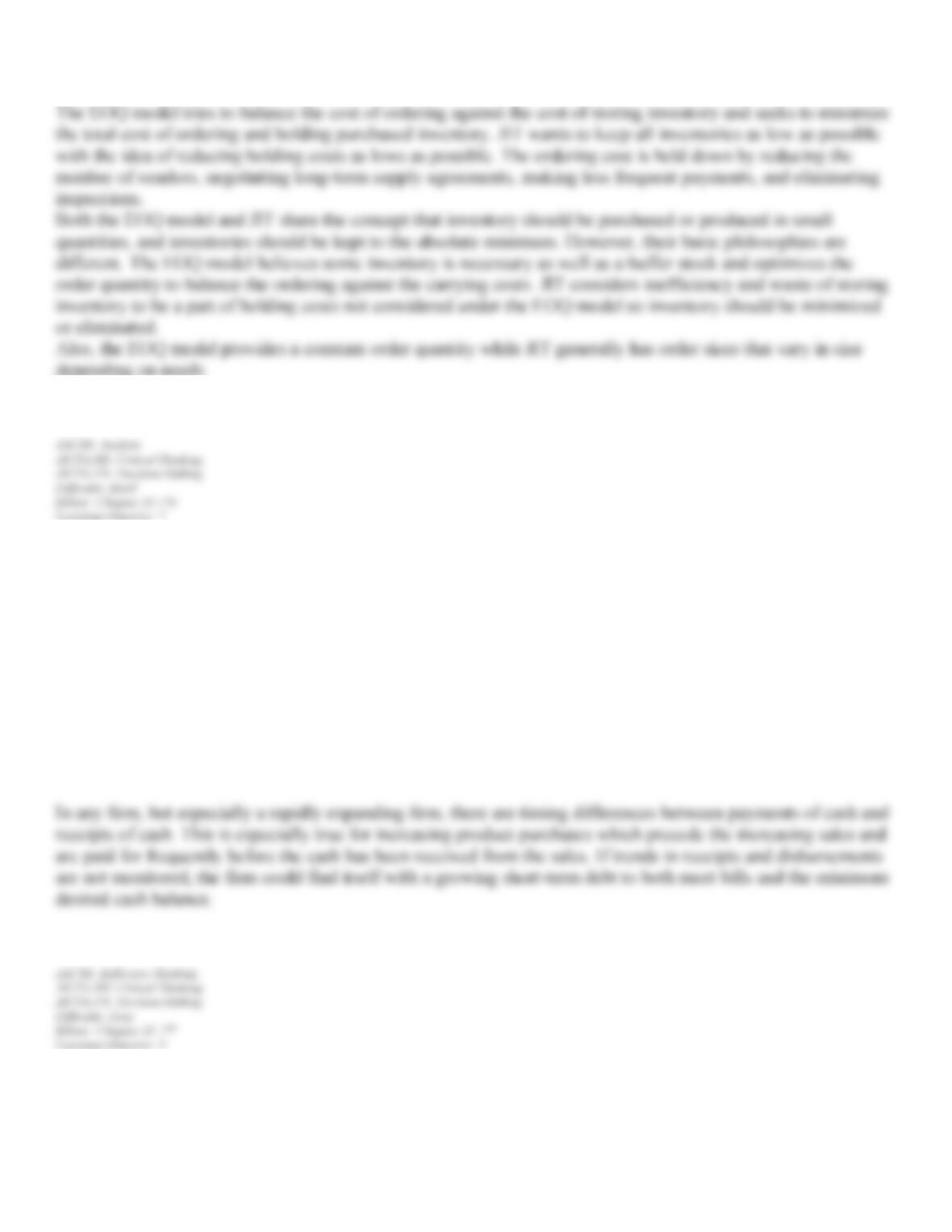
Required: (1) Prepare a tabular analysis to find the economic order quantity using the table format below.
(2) Find the EOQ using the formula approach.
(3) What might cause the answers as to the optimal order to quantity to differ between 1 and 2?
76. [Appendix] Compare and contrast the EOQ model with just–in-time purchasing.
77. Dierberg Company is a fast growing company with monthly sales for the current year estimated at a
relatively steady upward trend. Past history has shown that all sales are collected within two months with
negligible uncollectibles. The product for a given month is purchased partially in the month before sale and the
rest during the month of sale and is paid for over a two month period. Property and income taxes are paid
quarterly while other expenses are paid as incurred. The company has a desired ending cash balance for each
month of $150,000 and, when necessary borrows to meet shortfalls and invests overages.
The success of the company has been sudden and Ms. Hatley, the controller, is concerned about meeting the
goals of the company without getting into serious short-term financial difficulties. As a result, she has been very
conscientious about preparing the cash budget and keeping it up–to-date as conditions warrant.
Required: Why is cash budgeting important for a rapidly expanding firm such as Dierberg Company?
78. Adair Company has been busy over the first few years of its existence in penetrating its market and gaining
a respectable market share. To facilitate this, Mr. Adair, the CEO, and his controller, Mr. Brown, have been
developing the annual master budgets. To date this approach has worked well.
Adair has been acquired by a company in a related business but will continue to operate as an independent
subsidiary. The CFO of the acquiring company, Mr. Horwitz, has suggested to Mr. Adair that, since it was
expected that his company would continue to grow, it adopt a departmental budgeting system; a suggestion Mr.
Adair agreed to readily. Mr. Horwitz explained to Adair‘s departmental managers the concepts of a
departmental participative budgeting system and their involvement. The managers were encouraged to take the
information and come back with suggestions which could then be put into a formal budget process.
Required:
(1) What benefits will accrue to Adair under this new budgeting system?
(2) What behavioral issues might arise for departmental managers and for production workers.
(3) What is the most probable long-term reaction of Adair‘s people to the participative budget system.
79. Kessler and Son is a small business that, after struggling for a while, has taken off. Mr. Kessler Jr. has been
attending various seminars to improve his business knowledge and has brought back several new ideas to see if
they can be implemented in the company. One idea that he felt was very urgent to implement was for his father
and him and others in managerial positions to sit down and develop a strategic plan and a budget process for the
company. This had not been done when the company started so he would have to do some persuading to get the
others accepting and involved. One other thing he had learned at one of his seminars was that something like
this had to be accepted at the top before others would accept it.
Required: What kinds of issues should Mr. Kessler bring up to get his idea accepted?
80. Ms. Alvarez, head of the Research and Development Department of Armco Company, is preparing the
budget for her department for the next year. As part of her preparation, she started to look over the various
projects in process and was surprised to see the number of projects that were still being funded although they
were not moving forward. Since it was very difficult for her to go to a person and say their pet project would no
longer be funded because it was going nowhere, she was looking for a more objective way to handle the issue.
She had heard about zero–based budgeting and was considering adopting it, with her boss’ approval.
Required: What kind of information should Ms. Alvarez bring to her boss to help win approval for her to
change how she develops her budget? Also bring in the idea of base budgeting.
81. Discuss budgeting, its role in strategic planning and the five purposes of budgeting systems.
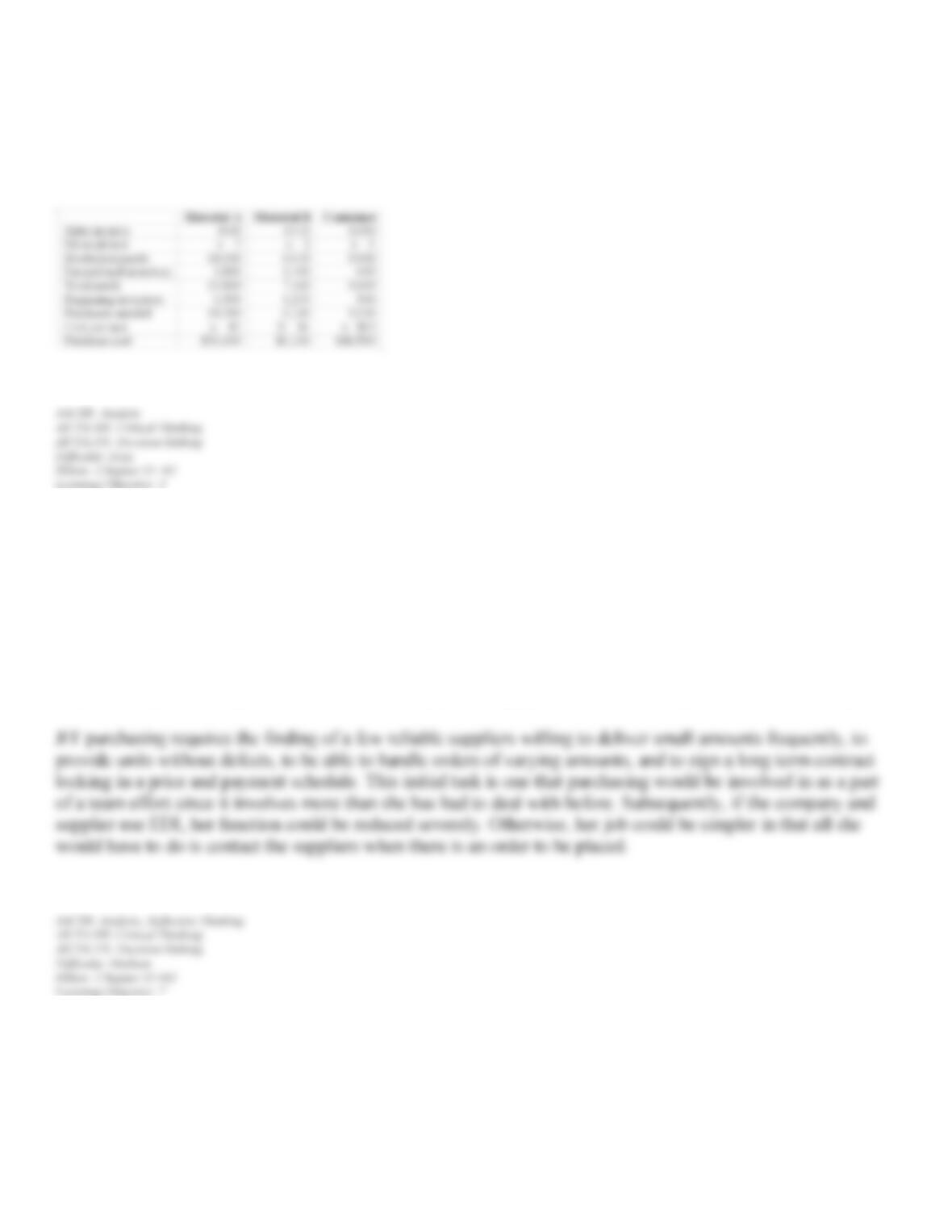
82. Moore Inc. manufactures a product that uses three different materials in the following amounts: 3 pounds of
material A per unit at $2.00 per pound; 2 pints of material B per unit at $1.00 per pint; and 1 container at $15
per container. The company has 1,500 pounds of A, 1,200 pints of B and 500 containers on hand September 30
and wants an ending inventory equal to 120 percent of beginning inventory. The company expects to sell 3,000
containers of this product in October. Purchases of material are paid for in the month of purchase.
Required: How much materials have to be purchased in October and at what Cost?
83. [Appendix] Ms. Marx, the purchasing agent for ESM Company has been dealing with placing orders for
materials where the quantities have been developed using an EOQ model. Since the amount of each order is
known as well as the timing of the order, her main tasks relate to finding a supplier who can get the material to
the company on time and with the appropriate quality. The price paid can vary somewhat if she has to start
dealing with a new supplier or the existing supplier raises the price.
The Company has been discussing the possibility of moving to a JIT purchasing system. Ms Marx has heard of
JIT but does not know how it might impact her job.
Required: Explain briefly to Ms. Marx what a JIT purchasing system entails and its potential effect on her job.