College Physics: A Strategic Approach, 3e (Knight)
Chapter 15 Traveling Waves and Sound
15.1 Conceptual Questions
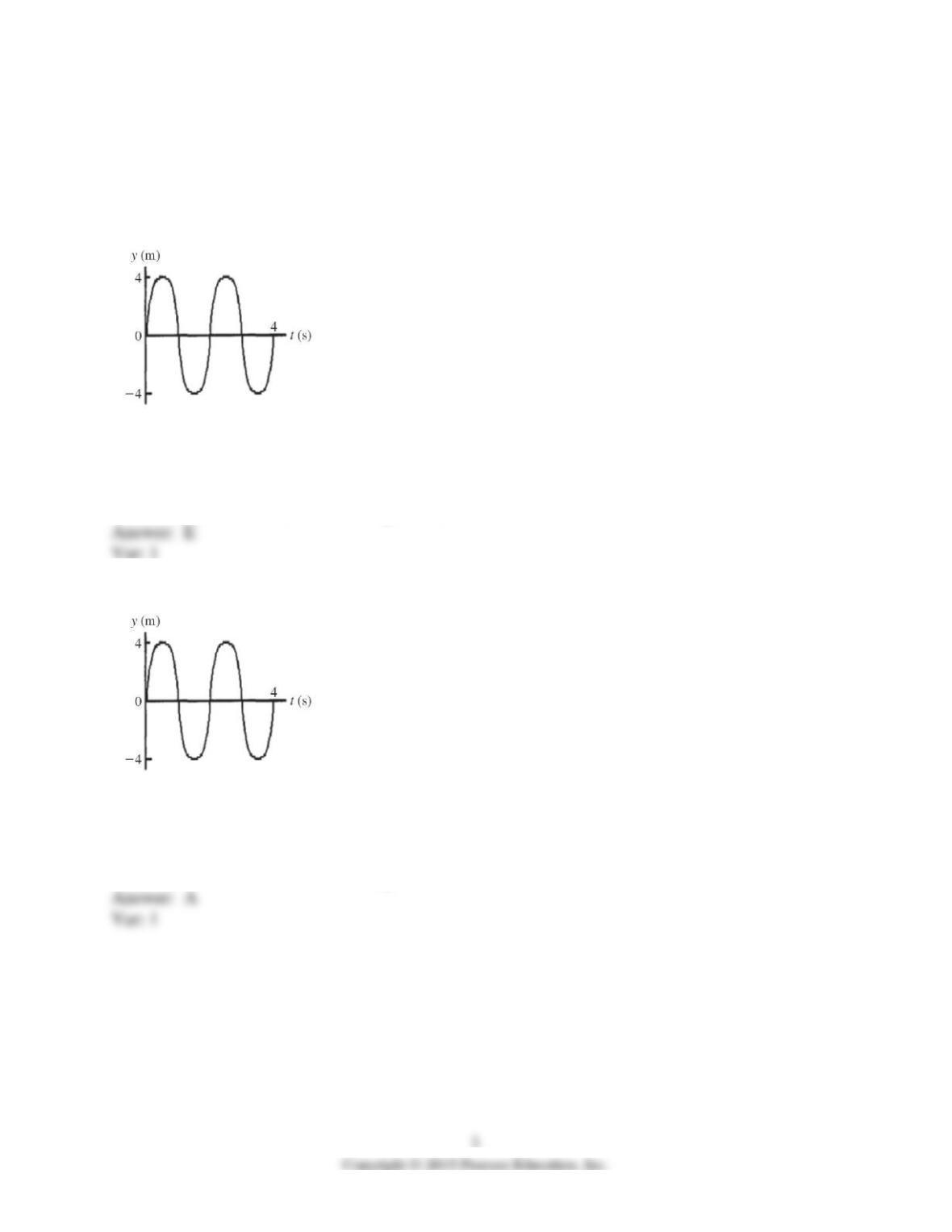
1) What is the wavelength of the wave shown in the figure?
A) 8 m.
B) 4 m.
C) 2 m.
D) 1 m.
E) It cannot be determined from the given information.
2) What is the frequency of the wave shown in the figure?
A) 0.5 Hz.
B) 1 Hz.
C) 2 Hz.
D) 4 Hz.
E) It cannot be determined from the given information.
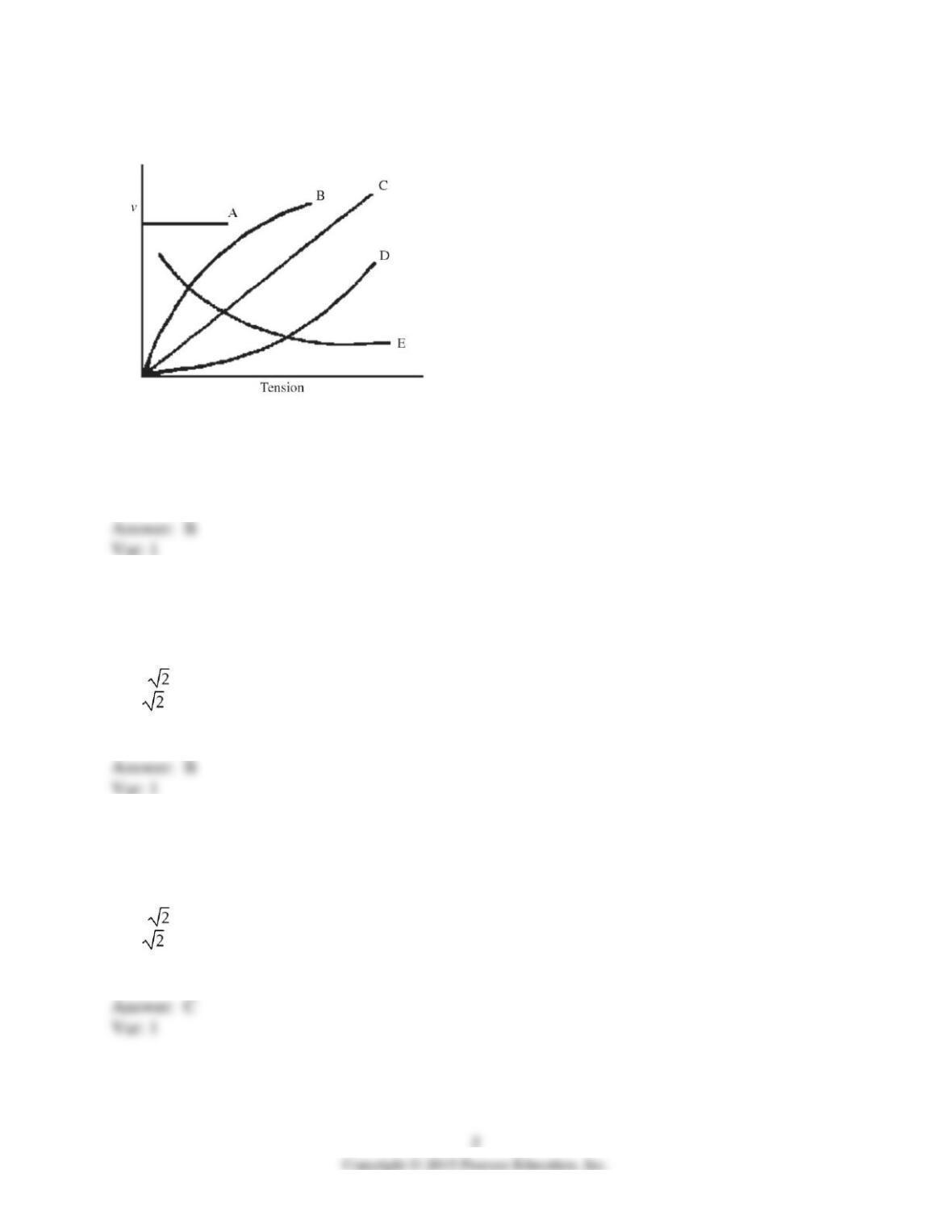
3) Which one of the curves shown in the figure best represents the variation of wave speed v as a
function of tension for transverse waves on a stretched string?
A) A
B) B
C) C
D) D
E) E
4) A string of mass m is under tension, and the speed of a wave in the string is v. What will be
the speed of a wave in the string if the mass of the string is increased to 2m but with no change in
the length or tension?
A) v/2
B) v/
C) v
D) 2v
E) 4v
5) A string of length L is under tension, and the speed of a wave in the string is v. What will be
the speed of a wave in the string if the length is increased to 2L but with no change in the mass or
tension?
A) v/2
B) v/
C) v
D) 2v
E) 4v

6) When a certain string is under tension T, the speed of a wave in the string is v. What will be
the speed of a wave in the string if the tension is increased to 2T without changing the mass or
length of the string?
A) v/2
B) v/
C) v
D) 2v
E) 4v
7) Four waves are described by the following equations, where distances are measured in meters
and times in seconds.
I. y = 0.12 cos(3x – 21t)
II. y = 0.15 sin(6x + 42t)
III. y = 0.13 cos(6x + 21t)
IV. y = -0.23 sin(3x – 42t)
Which of these waves have the same speed?
A) I and II
B) I and III
C) II and III
D) III and IV
E) II and IV
8) Four waves are described by the following equations, where distances are measured in meters
and times in seconds.
I. y = 0.12 cos(3x – 21t)
II. y = 0.15 sin(6x + 42t)
III. y = 0.13 cos(6x + 21t)
IV. y = -0.23 sin(3x – 42t)
Which of these waves have the same period?
A) I and III, and also II and IV
B) I and IV, and also II and III
C) I and II, and also III and IV
D) All of them have the same period.
E) They all have different periods.

9) The intensity of the waves from a point source at a distance d from the source is I. What is the
intensity at a distance 2d from the source?
A) 4I
B) 2I
C) I/2
D) I/4
E) I/
10) The intensity of the waves from a point source at a distance d from the source is I. At what
distance from the sources is the intensity equal to 2I?
A) d/2
B) d/
C) d/4
D) d/8
11) Why does the intensity of waves from a small source decrease with the square of the distance
from the source?
A) The waves run out of energy as they travel.
B) The waves spread out as they travel.
C) The medium through which the waves travel absorbs the energy of the waves.
D) The waves slow down as they travel away from the source.
E) The frequency of the waves decreases as they get farther from the source.
12) Seven seconds after a brilliant flash of lightning, thunder shakes the house. Approximately
how far was the lightning strike from the house?
A) much closer than one kilometer
B) about one kilometer away
C) about two kilometers away
D) much farther away than two kilometers
E) It is impossible to say.
13) What characteristics of a sound wave are related to the “pitch” of a musical note? (There
could be more than one correct choice.)
A) amplitude
B) wavelength
C) frequency
D) period

14) Sound A has a high pitch and sound B has a low pitch. Which of the following statements
about these two sounds are correct? (There could be more than one correct choice.)
A) The wavelength of A is longer than the wavelength of B.
B) The period of A is shorter than the period of B.
C) The frequency of A is greater than the frequency of B.
D) Sound B travels faster than sound B through air.
E) The amplitude of A is larger than the amplitude of B.
15) You double your distance from a sound source that is radiating equally in all directions.
What happens to the intensity of the sound? It reduces to
A) one-half its original value.
B) one-fourth its original value.
C) one-sixteenth its original value.
D) none of the above
16) Suppose that a sound source is emitting waves uniformly in all directions. If you move to a
point twice as far away from the source, the frequency of the sound will be
A) unchanged.
B) half as great.
C) one-fourth as great.
D) twice as great.
17) As you are moving very quickly toward a speaker emitting a pure tone, which characteristics
of the sound get larger? (There may be more than one correct choice.)
A) frequency
B) amplitude
C) wavelength
D) period
E) loudness

18) In many cartoon shows, a character runs off a cliff, realizes his predicament, and lets out a
scream. He continues to scream as he falls. If the physical situation is portrayed correctly, from
the vantage point of an observer at the top of the cliff leaning over the edge, the pitch of the
scream as he falls should be
A) higher than the original pitch and constant.
B) higher than the original pitch and increasing as he falls.
C) lower than the original pitch and constant.
D) lower than the original pitch and decreasing as he falls.
E) It is impossible to predict.
19) In many cartoon shows, a character runs off a cliff, realizes his predicament, and lets out a
scream. He continues to scream as he falls. If the physical situation is portrayed correctly, from
the vantage point of an observer at the foot of the cliff, the pitch of the scream as he falls should
be
A) higher than the original pitch and constant.
B) higher than the original pitch and increasing as he falls.
C) lower than the original pitch and constant.
D) lower than the original pitch and decreasing as he falls.
E) It is impossible to predict.
1) A fisherman fishing from a pier observes that the float on his line bobs up and down, taking
2.4 s to move from its highest point to its lowest point. He also estimates that the distance
between adjacent wave crests is 48 m. What is the speed of the waves going past the pier?
A) 1.0 m/s
B) 20 m/s
C) 10 m/s
D) 5.0 m/s
E) 120 m/s
2) A tsunami, an ocean wave generated by an earthquake, propagates along the open ocean at
700 km/hr and has a wavelength of 750 km. What is the frequency of the waves in such a
tsunami?
A) 0.93 Hz
B) 0.00026 Hz
C) 1.1 Hz
D) 6.8 Hz
E) 0.15 Hz
3) What is the frequency of a pressure wave of wavelength 2.5 m that is traveling at 1400 m/s?
A) 178 Hz
B) 1.78 kHz
C) 560 Hz
D) 5.6 kHz
4) If a wave has a speed of 362 m/s and a period of 4.17 ms, what is its wavelength?
A) 1510 m
B) 1.51 m
C) 86.8 m
D) 86,800 m
E) 0.0115 m
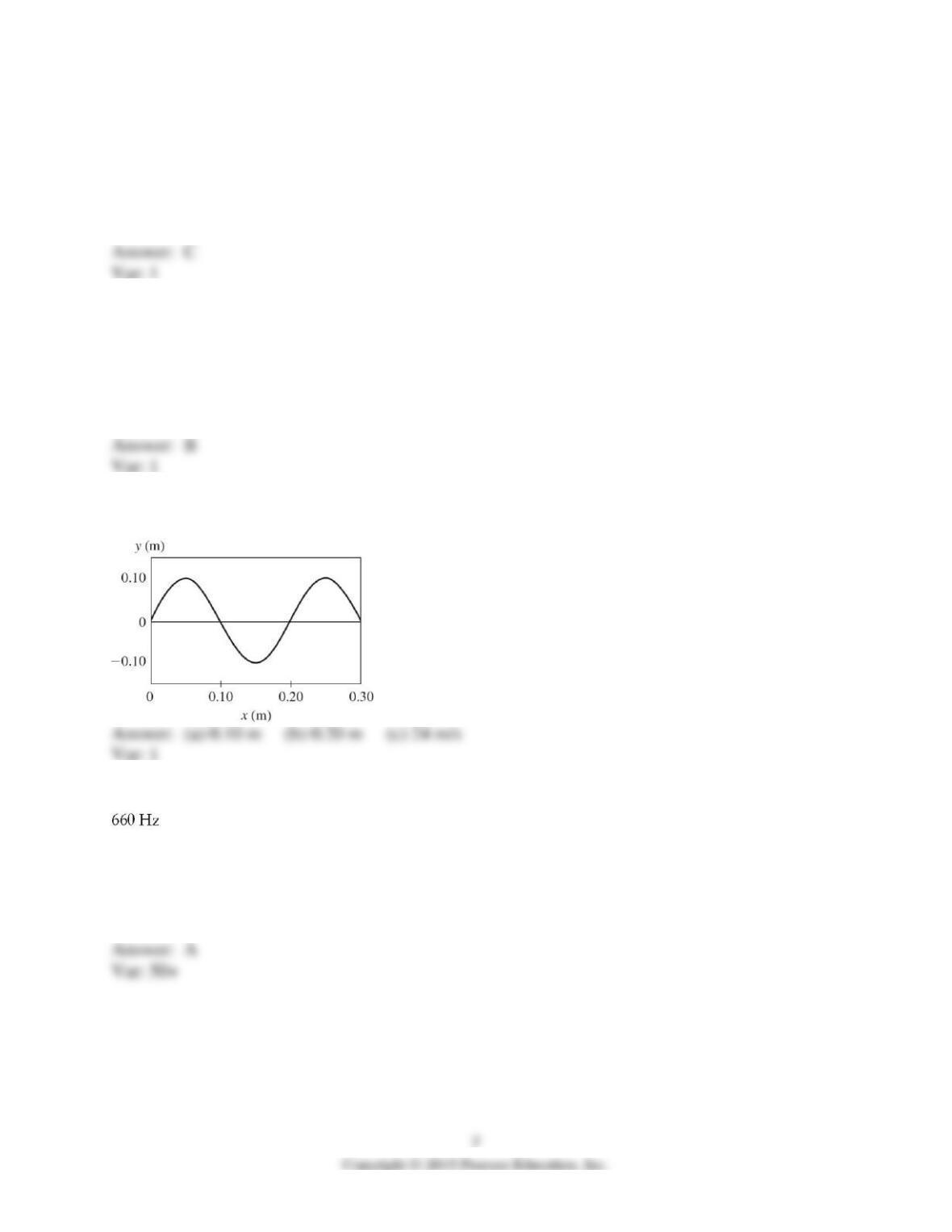
5) The figure shows a “snapshot” of a wave at a given instant of time. The frequency of this
wave is 120 Hz. What are the (a) amplitude, (b) wavelength, and (c) speed of this wave?
6) The speed of sound in steel is 5000 m/s. What is the wavelength of a sound wave of frequency
in steel?
A) 7.58 m
B) 2.41 m
C) 1.21 m
D) 0.829 m
E) 0.132 m

7) Crests of an ocean wave pass a pier every If the waves are moving at what is the
wavelength of the ocean waves?
A) 56 m
B) 28 m
C) 64 m
D) 48 m
8) Transverse waves travel at in a string that is subjected to a tension of If the
string is long, what is its mass?
A) 0.515 kg
B) 0.216 kg
C) 0.366 kg
D) 0.597 kg
9) A piano wire of linear mass density 0.0050 kg/m is under a tension of 1350 N. What is the
wave speed in this wire?
A) 130 m/s
B) 260 m/s
C) 520 m/s
D) 1040 m/s
10) A wave whose wavelength is 0.500 m is traveling down a 500-m long wire whose total mass
is 25 kg and is under a tension of 2000 N.
(a) What is the speed of the wave on the wire?
(b) Find the frequency of this wave.
11) The density of aluminum is 2700 kg/m3. If transverse waves travel at in an aluminum
wire of diameter what is the tension on the wire?
A) 65 N
B) 39 N
C) 52 N
D) 78 N

12) A rope with a total mass of 25.0 kg is tied to a tree on one side of a 125-m wide ravine. You
are pulling on the other end of the rope with a force of 415 N. If you pluck the rope at your end,
how long will it take the pulse to travel across the ravine to the tree?
13) A 2.31-kg rope is stretched between supports that are 10.4 m apart, and has a tension in it of
49.2 N. If one end of the rope is slightly tweaked, how long will it take for the resulting
disturbance to reach the other end?
A) 0.699 s
B) 0.720 s
C) 0.664 s
D) 0.615 s
14) A 1.1-kg uniform bar of metal is 0.40 m long and has a diameter of 2.0 cm. When someone
bangs one end of this bar, a 1.5 MHz shock wave is travels along the length of the bar and
reaches the other end in 0.12 ms. What is the wavelength of the shock wave in the metal?
A) 2.2 mm
B) 2.6 mm
C) 3.0 mm
D) 3.4 mm
E) 3.8 mm
15) A 10-gram wire that is 6.0 m long is under tension. When a transverse wave of frequency
280 Hz travels along the wire, its wavelength is 0.60 m,and its amplitude is 8.4 mm. How much
time does it take for a crest of the transverse wave to travel the length of the wire?
A) 36 ms
B) 31 ms
C) 40 ms
D) 44 ms
E) 49 ms

16) A 90-gram wire that is 1.0 m long is under tension. When a transverse wave of frequency
890 Hz travels down the wire, its wavelength is 0.10 m and its amplitude is 6.5 mm. What is the
tension in the wire?
A) 710 N
B) 820 N
C) 930 N
D) 1000 N
E) 1100 N
17) An earthquake generates three kinds of waves: surface waves (L-waves), which are the
slowest and weakest, shear (S) waves, which are transverse waves and carry most of the energy,
and pressure (P) waves, which are longitudinal waves and are the fastest. The speed of P waves
is approximately 7 km/s, and that of S waves is about 4 km/s. People do not generally feel the P
waves, but animals seem to be sensitive to them. If a person reports that her dog started barking
20 seconds “before the earthquake,” then approximately how far was the origin of the
earthquake?
A) 100 km
B) 200 km
C) 300 km
D) 400 km
E) 500 km
18) A 15-m rope is pulled taut with a tension of 140 N. It takes 0.545 s for a wave to propagate
along the rope. What is the mass of the rope?
A) 1.7 kg
B) 2.1 kg
C) 2.8 kg
D) 5.1 kg
E) 3.2 kg
19) Two steel wires are stretched with the same tension. The first wire has a diameter of 0.610
mm and the second wire has a diameter of 0.910 mm. If the speed of waves traveling along the
first wire is 54.0 m/s, what is the speed of waves traveling along the second wire?
A) 24.9 m/s
B) 27.2 m/s
C) 36.2 m/s
D) 81.0 m/s
E) 100 m/s

20) A crane lifts a 2500-kg beam at a steady rate of 15 cm/s using a steel cable whose mass per
unit length is 0.65 kg/m. What is the speed of transverse waves on this cable?
A) 230 m/s
B) 580 m/s
C) 1200 m/s
D) 1900 m/s
E) 190 m/s
21) A crane lifts a 2500-kg beam using a steel cable whose mass per unit length is 0.650 kg/m.
What is the speed of transverse waves on this cable if the upward acceleration of the beam is a
steady 3.00 m/s2?
A) 194 m/s
B) 578 m/s
C) 1220 m/s
D) 1880 m/s
E) 222 m/s
22) A wire that is 1.0 m long with a mass of 90 g is under a tension of 710 N. When a transverse
wave travels on the wire, its wavelength is 0.10 m and its amplitude is 6.5 mm. What is the
frequency of this wave?
A) 890 Hz
B) 920 Hz
C) 1000 Hz
D) 1200 Hz
E) 1500 Hz
23) What is the wave speed in a brass wire with a radius of 0.500 mm stretched with a tension of
125 N? The density of brass is 8.60 × 10³ kg/m3.
A) 0.121 m/s
B) 100 m/s
C) 136 m/s
D) 500 m/s
E) 68.8 m/s
24) The vertical displacement y(x,t) of a horizontal string aligned along the x-axis is given by the
equation y(x,t) = (6.00 mm) cos[(3.25 m-1)x – (7.22 s-1)t]. What are the (a) wavelength and (b)
period of this wave?

25) The vertical displacement y(x,t) of a horizontal string aligned along the x-axis is given by the
equation y(x,t) = (6.00 mm) cos[(3.25 m-1)x – (7.22 s-1)t]. What are the (a) speed and (b)
amplitude of this wave?
26) Find the speed of an ocean wave whose displacement is given by the equation
where x and y are in meters and t is in seconds.
A) 2.5 m/s
B) 1.9 m/s
C) 3.5 m/s
D) 4.5 m/s
27) What are the wavelength (in meters) and frequency (in hertz) of a wave whose displacement
is given by the equation y = 0.5 sin(0.20x + 120t), where x and y are in meters and t is in
seconds?
A) 10 m, 0.50 Hz
B) 5.0 m, 10 Hz
C) 19 m, 120 Hz
D) 31 m, 19 Hz
E) 0.20 m, 120 Hz
28) Light from a laser forms a 1.31-mm diameter spot on a wall. If the light intensity in the spot
is what is the power output of the laser? Assume that all the light emitted by the
laser hits the spot.
A) 21.3 mW
B) 13.2 mW
C) 17.9 mW
D) 24.7 mW
29) Calculate the light intensity 1.45 m from a light bulb that radiates 100 W equally in all
directions.
A) 3.78 W/m2
B) 4.36 W/m2
C) 47.6 W/m2
D) 54.7 W/m2