ch15 Key
1. A slightly inaccurate sales forecast will not affect the other schedules comprising the master budget.
2. The master budget is a comprehensive profit plan tying together all phases of an organization’s operations.
3. The idea behind participative budgeting is to involve employees throughout an organization in the budgetary
process with the belief that they will be more willing to accept it.
4. Strategic long-range plans are usually stated in rather specific terms.
5. Econometric models can include many relevant predictors that can be manipulated in order to examine
different hypothetical conditions and relate them to the sales forecast.
6. Base-budgeting is similar to zero-based budgeting in that it sets the initial budget for virtually everything to
zero.
7. Padding the budget or manipulating reported results in order to maximize one’s personal gain or that of others
is considered unethical behavior.
8. [Appendix] In addition to helping management decide how much to order at a time, the EOQ model can help
in deciding when to order and how much inventory should be held as a safety stock.
9. The master budget is a detailed plan for the coming year, expressed in quantitative terms.
10. The master budget is based on many assumptions and estimates of known parameters.
11. A financial planning model is a set of mathematical relationships expressing interactions between the
various operational, financial, and environmental events that determine the overall results of an organization’s
activities.
12. Budgetary padding is the difference between the revenue or cost projections provided and an actual revenue
or cost.
13. Critical success factors are the key strengths most responsible for making an organization successful.
14. Where direct labor belongs on the cost hierarchy depends on management‘s ability to adjust the
organization’s labor force to match short-term requirements, as well as management’s attitude about making
such adjustments.
15. Under zero-based budgeting, the budget for virtually every activity in the firm is initially set to zero and
each activity must be justified in terms of its continued usefulness in order to receive funding during the
budgetary process.
16. The concept of cost management whereby costs are actively managed is key to the emerging philosophy of
contemporary budgeting and financial planning.
17. All organizations begin the budgeting process with plans for (1) the goods or services to be provided and (2)
the revenue to be available from sales or other sources.
18. When constructing a budget using ABC concepts, it is difficult to understand why costs occur and hard to
mange costs to improve profitability.
19. Activity Based Budgeting recognizes that all costs can be easily divided into fixed and variable costs.
20. [Appendix] The EOQ formula ignores the costs of holding inventory in calculating the optimum economic
order quantity.
21. [Appendix] The JIT philosophy is that inventories should be minimized by more frequent deliveries in
smaller quantities.
22. [Appendix] While the economics underlying the EOQ support the JIT viewpoint that inventory should be
purchased or produced in small quantities, thus keeping inventories to a minimum, their basic philosophies are
quite different.
23. Which of the following is not a purpose of budgeting?
24. When preparing a sales forecast, which of the following is not a factor to be considered?
25. Which of the following is a difference between master budgets for nonprofit organizations and those for
other companies?
26. Multinational firms have additional challenges when preparing budgets. Which of the following is not such
a challenge?
27. Which of the following is typically considered fixed under traditional budgeting processes, but considered
variable under activity based budgeting:
28. Direct labor is not a unit level cost when:
29. Tarheel Company produces and sells specialized portfolio cases. It expects to sell 20,000 cases next year at
$75 each. There is a beginning inventory of 1,500 cases and the company wants to have an ending inventory
equal to 30 percent of this year’s sales. How many cases need to be produced?
Use the following to answer questions 30-31:
Butler Company produces tea sets. The following sales have been predicted for the third quarter of the year:
The inventory on hand July 1st was 2,000 sets. The ending finished goods inventory is budgeted at 20 percent
of the next month’s sales. The sets sell for $200 each. October sales are estimated at 8,000 sets.
Hilton – Chapter 15
30. How many sets should Butler Company produced in July?
31. How many sets should be produced in September?
32. Carson Inc., a retail establishment, expects sales of $500,000 of a particular item in March. Its gross profit
percentage is 60 percent. The ending inventory in February of this item cost $40,000 and the company wants an
ending inventory of $38,000 (cost). How much needs to be purchased?
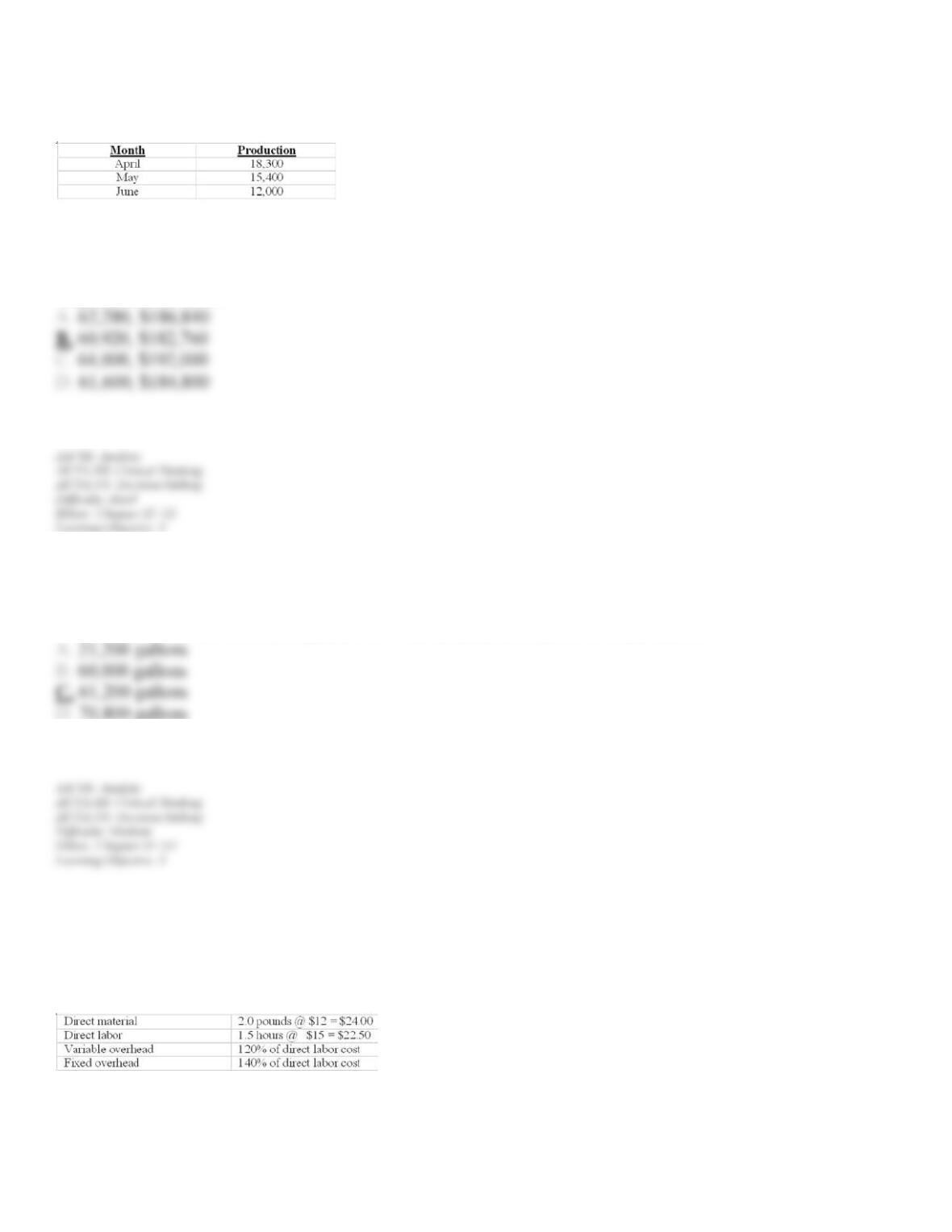
33. Lexington, Inc. has developed the following production budget for one of its products for the second quarter
of the year:
Each unit takes 4 pounds of material 256, which costs $3 per pound. Lexington, Inc. has 1,600 pounds of
material on hand March 30th and wants an ending inventory of material 256 at 5 percent of the next month’s
production. Production in July is expected to be 12,000 units. How much material 256 needs to be purchased in
May and at what cost?
34. Loft Company has the following information for next month: planned production of 20,000 units which
require 3 gallons of Material A each; beginning inventory of Material A of 4,800 gallons; desired ending
inventory of Material A of 6,000 gallons. How much material A needs to be purchased?
Use the following to answer questions 35-36:
Chang Inc. has developed the following units costs for the production of one of its products, based on a normal
activity of 10,000 units per month:
Hilton – Chapter 15
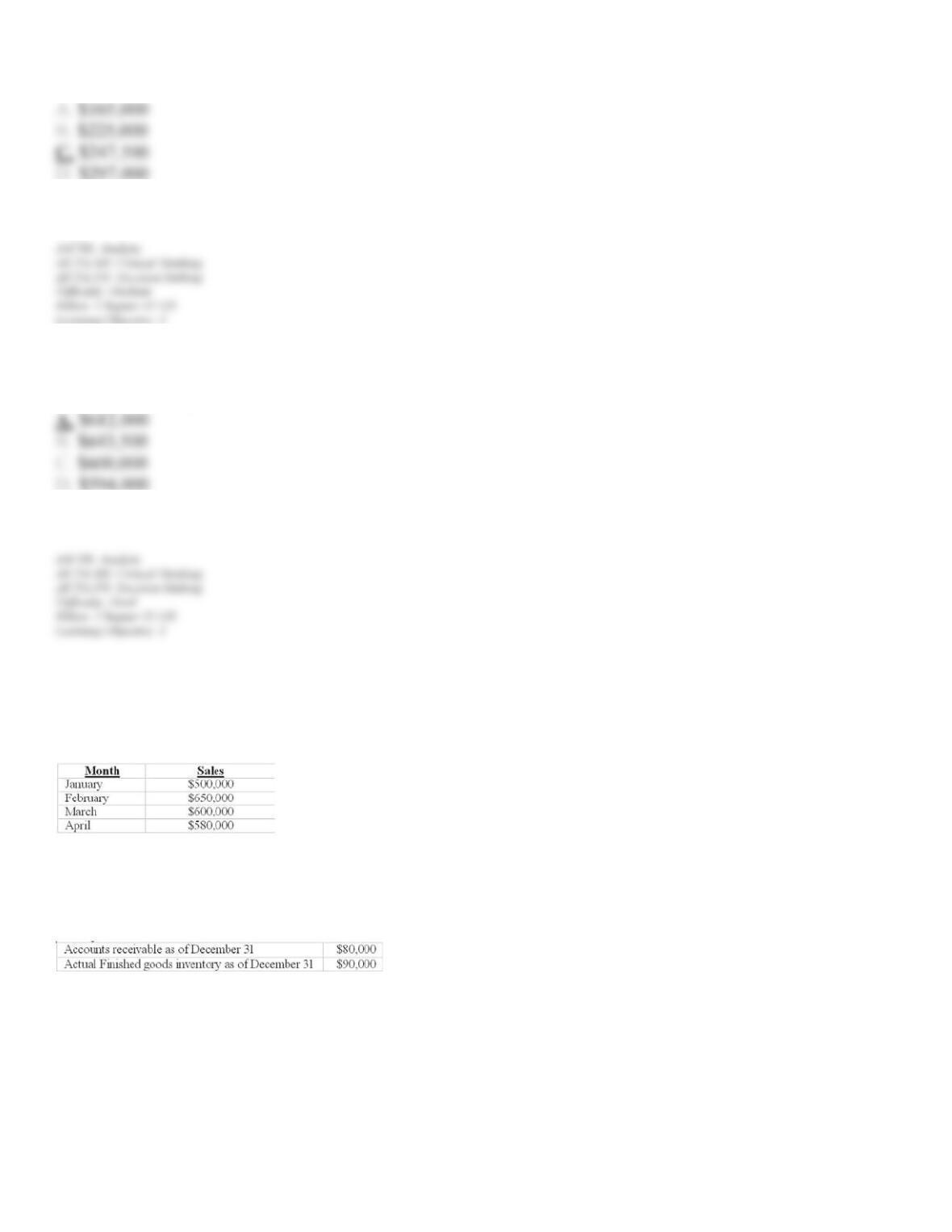
35. What is the total amount of direct labor budgeted for a month in which production is expected to be 11,000
units?
36. What is the total amount of overhead included in the overhead budget for a month in which production is
expected to be 11,000 units?
Use the following to answer questions 37-38:
Jorge Inc. has developed the following sales forecast for the first third of the year:
Collection pattern:
60 percent in the month of sale
40 percent in the month after sale
The company’s selling price is $20 per unit and they desire an ending inventory equal to 30 percent of the next
month‘s sales.
Hilton – Chapter 15
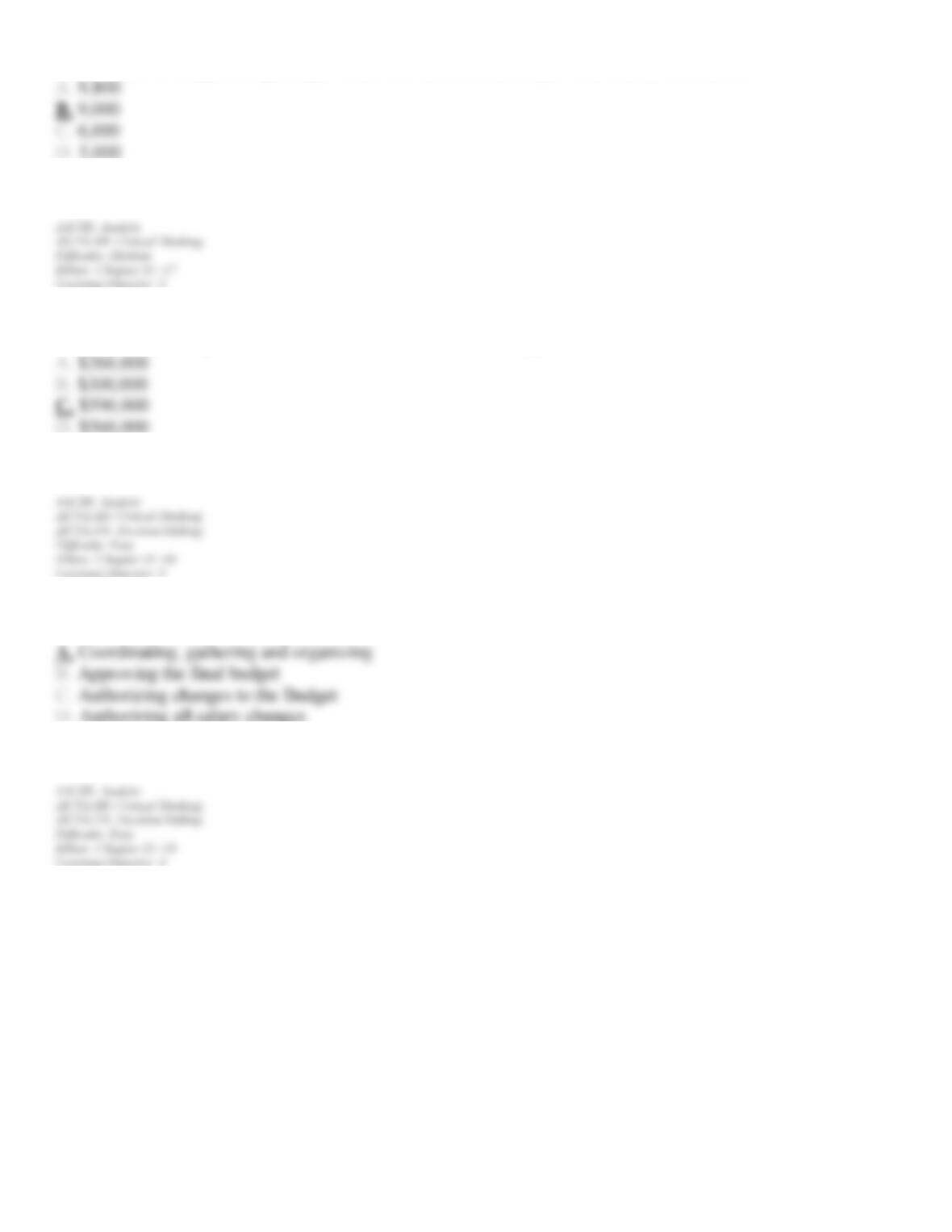
37. What is the budgeted beginning balance in units for finished goods inventory on March 1?
38. How much is expected to be collected from sales in February?
39. The Budget Director is responsible for
40. The _____is(are) the person(s) responsible for directing and coordinating the overall budgeting process in
large organizations.
41. Which of the following is not a reason for padding a budget with slack?
Use the following to answer questions 42-43:
Hessen is a wholesaler. The sales budget for November is $500,000 with a gross margin percentage of 65
percent. All purchases are paid for in the month following the purchase. Hessen’s beginning inventory is
$40,000 and an ending inventory, stated at cost, of $32,000 is desired. The beginning balance in accounts
payable is $200,000.
Hilton – Chapter 15
42. What is the November 30th balance in accounts payable?
43. What is the cash paid for purchases in November?
Use the following to answer questions 44-46:
Williams Pharmacy Inc. has the following sales budget for the first two quarters of next year:
Cash collections have been determined to follow the pattern below:
60 percent of sales collected in month of sales
25 percent of sales collected in month after sale
12 percent of sales collected two months after sale
3 percent of sales is uncollectible
Hilton – Chapter 15
44. Cash collections for March are
45. What is the ending balance of accounts receivable for March, assuming uncollectibles are written off after
the second month?
46. Cash collections for April are
47. The ____is a schedule of expected cash receipts and disbursements that predicts the effect on the cash
position at given levels of operations.

Use the following to answer questions 48-50:
Carlos Co. produces tables. The sales estimated for the third quarter of the year are as follows:
The beginning inventory finished goods balance should equal 25 percent of each month’s sales for the third
quarter and 20 percent of each month’s sales for the fourth quarter. October sales are estimated at 20,000 tables.
The cost of producing a table is $185.
Hilton – Chapter 15
48. How many tables will be produced in August?
49. How many tables will be produced in the quarter?
50. What will be the cost of goods manufactured in September?
Use the following to answer questions 51-54:
Abracadabra Co. manufactures magic sets. The sales planned for next year are 22,000 sets. Beginning material
inventory is sufficient to produce 5,000 sets. Beginning work in process inventory is 1,000 sets that are 100
percent complete as to materials and 60 percent complete as to labor and overhead; there is no ending inventory.
The finished goods inventory has a beginning inventory of 3,000 sets and a target inventory of 5,000 sets for
December 31. The sets sell for $75. Direct materials cost $15; direct labor is $10; and manufacturing overhead
is $12.
Hilton – Chapter 15
51. What will be the total sales for the year?
52. How many sets will be produced?
53. What will be the amount of cost of goods sold?
54. What will be the total costs of direct materials used during the year?
55. Each of the following are facility level costs expect:
56. Which of the following is not a shortcoming of participative budgeting?
57. [Appendix] Which of the following is not an ordering cost?
58. [Appendix] Which of the following is not a holding cost?