Chemistry: The Central Science, 13e (Brown et al.)
Chapter 15 Chemical Equilibrium
15.1 Multiple-Choice Questions
1) At equilibrium, ________.
A) all chemical reactions have ceased
B) the rates of the forward and reverse reactions are equal
C) the rate constants of the forward and reverse reactions are equal
D) the value of the equilibrium constant is 1
E) the limiting reagent has been consumed
2) What role did Karl Bosch play in development of the Haber-Bosch process?
A) He discovered the reaction conditions necessary for formation of ammonia.
B) He originally isolated ammonia from camel dung and found a method for purifying it.
C) Haber was working in his lab with his instructor at the time he worked out the process.
D) He developed the equipment necessary for industrial production of ammonia.
E) He was the German industrialist who financed the research done by Haber.
3) In what year was Fritz Haber awarded the Nobel Prize in chemistry for his development of a process
for synthesizing ammonia directly from nitrogen and hydrogen?
A) 1954
B) 1933
C) 1918
D) 1900
E) 1912

4) Which one of the following is true concerning the Haber process?
A) It is a process used for shifting equilibrium positions to the right for more economical chemical
synthesis of a variety of substances.
B) It is a process used for the synthesis of ammonia.
C) It is another way of stating Le Châtelier’s principle.
D) It is an industrial synthesis of sodium chloride that was discovered by Karl Haber.
E) It is a process for the synthesis of elemental chlorine.
5) Which one of the following will change the value of an equilibrium constant?
A) changing temperature
B) adding other substances that do not react with any of the species involved in the equilibrium
C) varying the initial concentrations of reactants
D) varying the initial concentrations of products
E) changing the volume of the reaction vessel
6) Which of the following expressions is the correct equilibrium-constant expression for the equilibrium
between dinitrogen tetroxide and nitrogen dioxide?
N2O4 (g) 2NO2 (g)
A)
B)
C)
D) [NO2][N2O4]
E) [NO2]2[N2O4]
7) Which of the following expressions is the correct equilibrium-constant expression for the following
reaction?
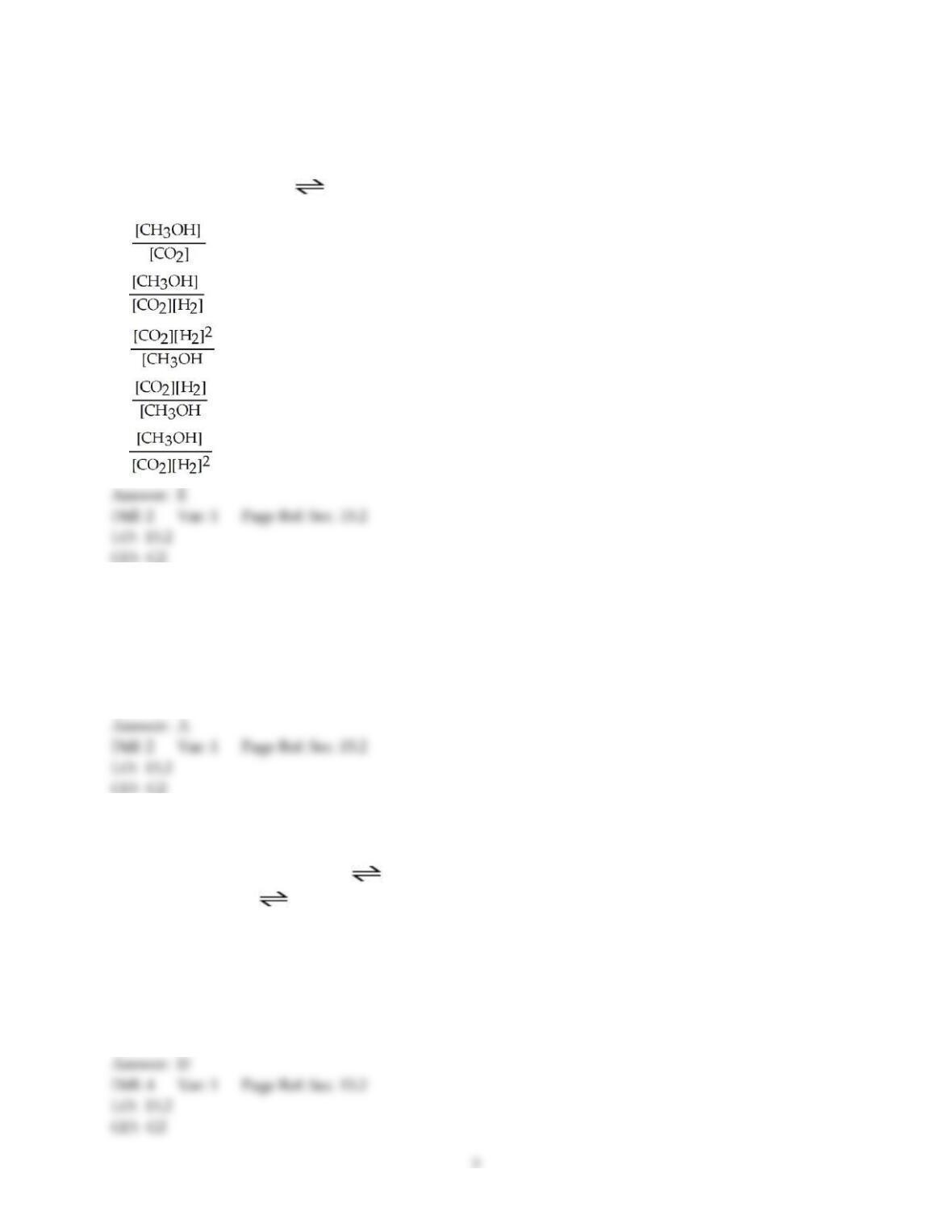
CO2 (g) + 2H2 (g) CH3OH (g)
A)
B)
C)
D)
E)
8) The equilibrium-constant expression depends on the ________ of the reaction.
A) stoichiometry
B) mechanism
C) stoichiometry and mechanism
D) the quantities of reactants and products initially present
E) temperature
9) The equilibrium constant for reaction 1 is K. The equilibrium constant for reaction 2 is ________.
(1) SO2 (g) + (1/2) O2 (g) SO3 (g)
(2) 2SO3 (g) 2SO2 (g) + O2 (g)
A) K2
B) 2K
C) 1/2K
D) 1/K2
E) -K2
10) The equilibrium expression for Kp for the reaction below is ________.
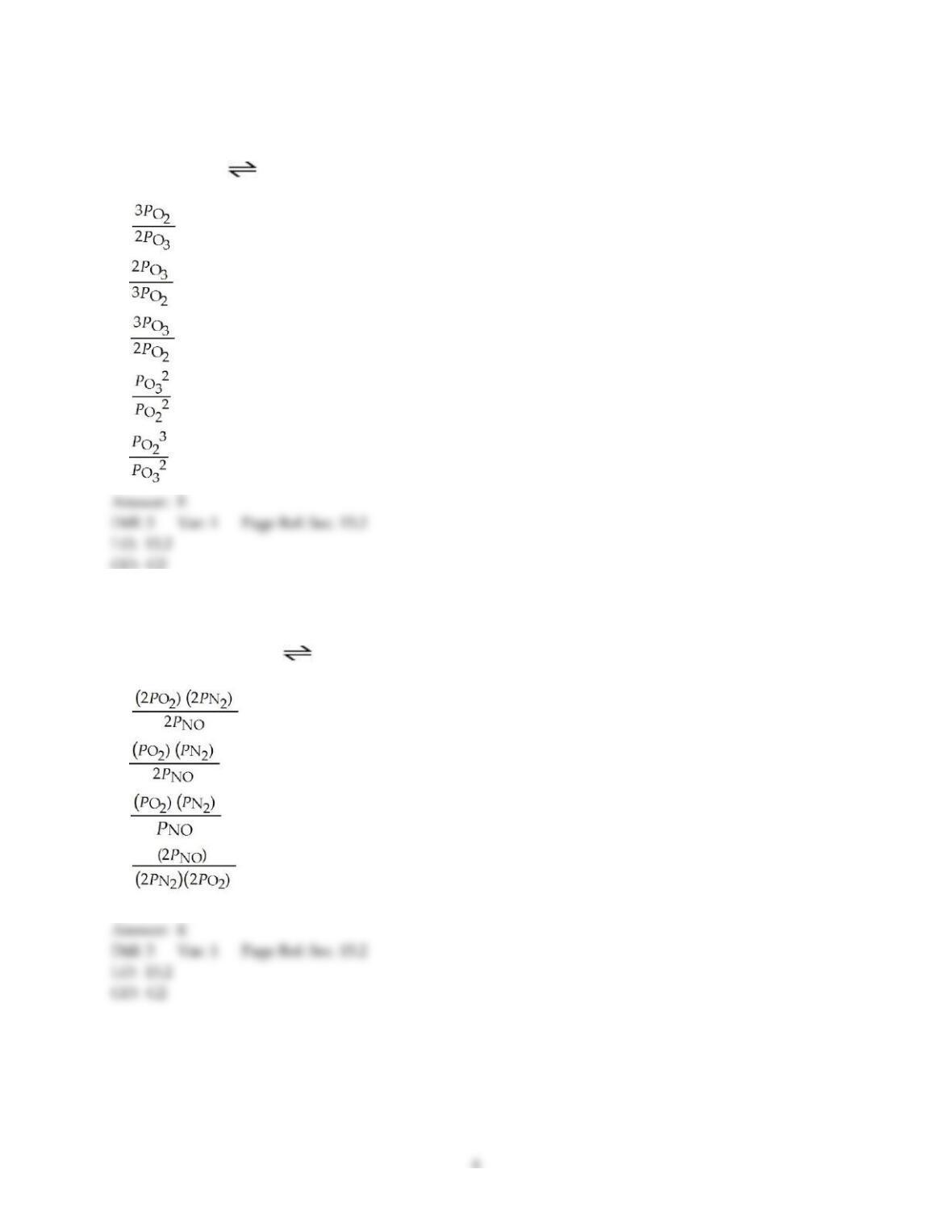
2O3 (g) 3O2 (g)
A)
B)
C)
D)
E)
11) The equilibrium expression for Kp for the reaction below is ________.
N2 (g) + O2 (g) 2NO (g)
A)
B)
C)
D)
E) none of the above
12) The Keq for the equilibrium below is 7.52 × 10⁻² at 480.0 °C.
2Cl2 (g) + 2H2O (g) 4HCl (g) + O2 (g)
What is the value of Keq at this temperature for the following reaction?
2HCl (g) + O2 (g) Cl2 (g) + H2O (g)
A) 13.3
B) 3.65
C) -0.0376
D) 5.66 × 10⁻³
E) 0.274
13) The Keq for the equilibrium below is 5.4 × 10¹³ at 480.0 °C.
2NO (g) + O2 (g) 2NO2 (g)
What is the value of Keq at this temperature for the following reaction?
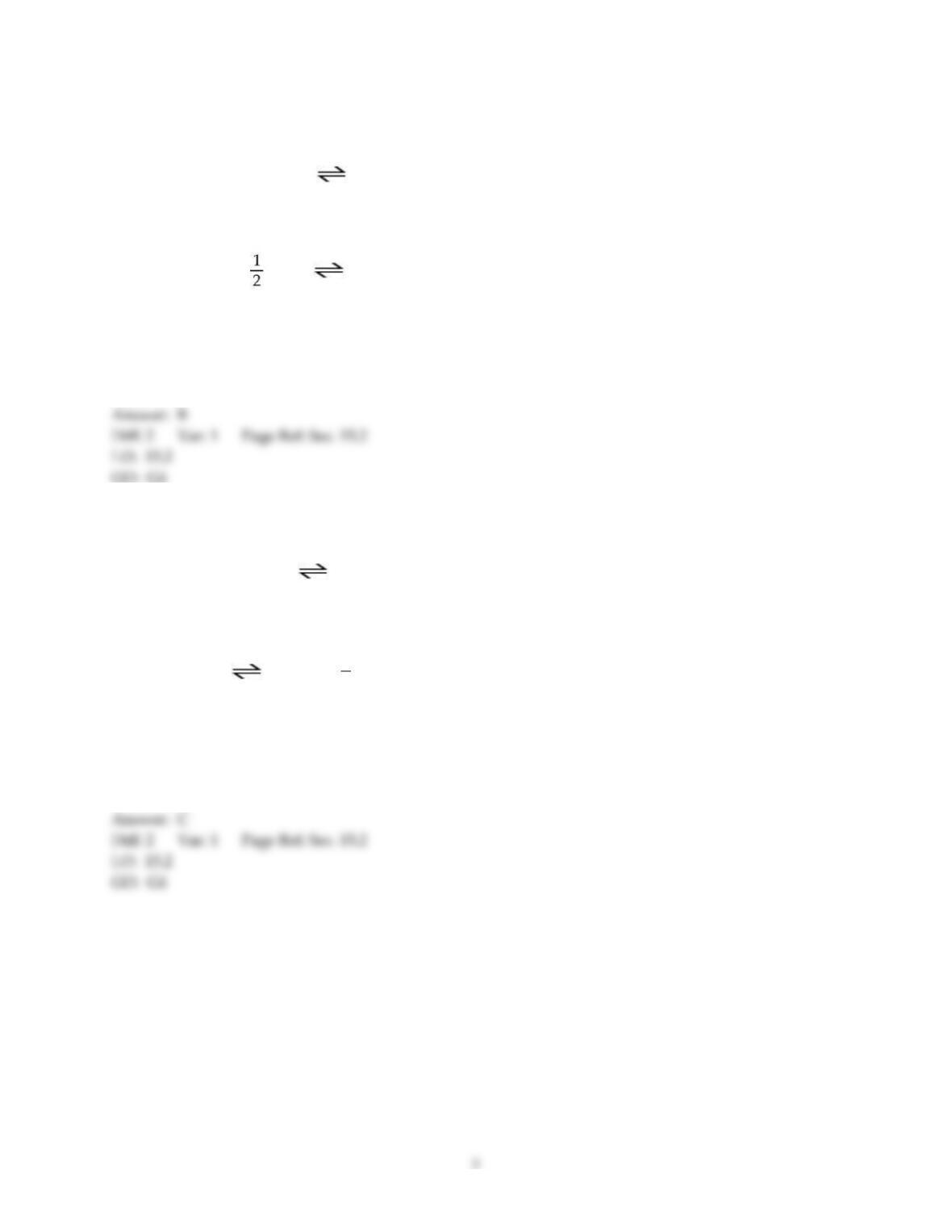
NO2 (g) NO (g) +
2
1
O2 (g)
A) 5.4 × 10⁻¹³
B) 5.4 × 10¹³
C) 1.4 × 10⁻⁷
D) 5.66 × 10⁻³
E) none of the above
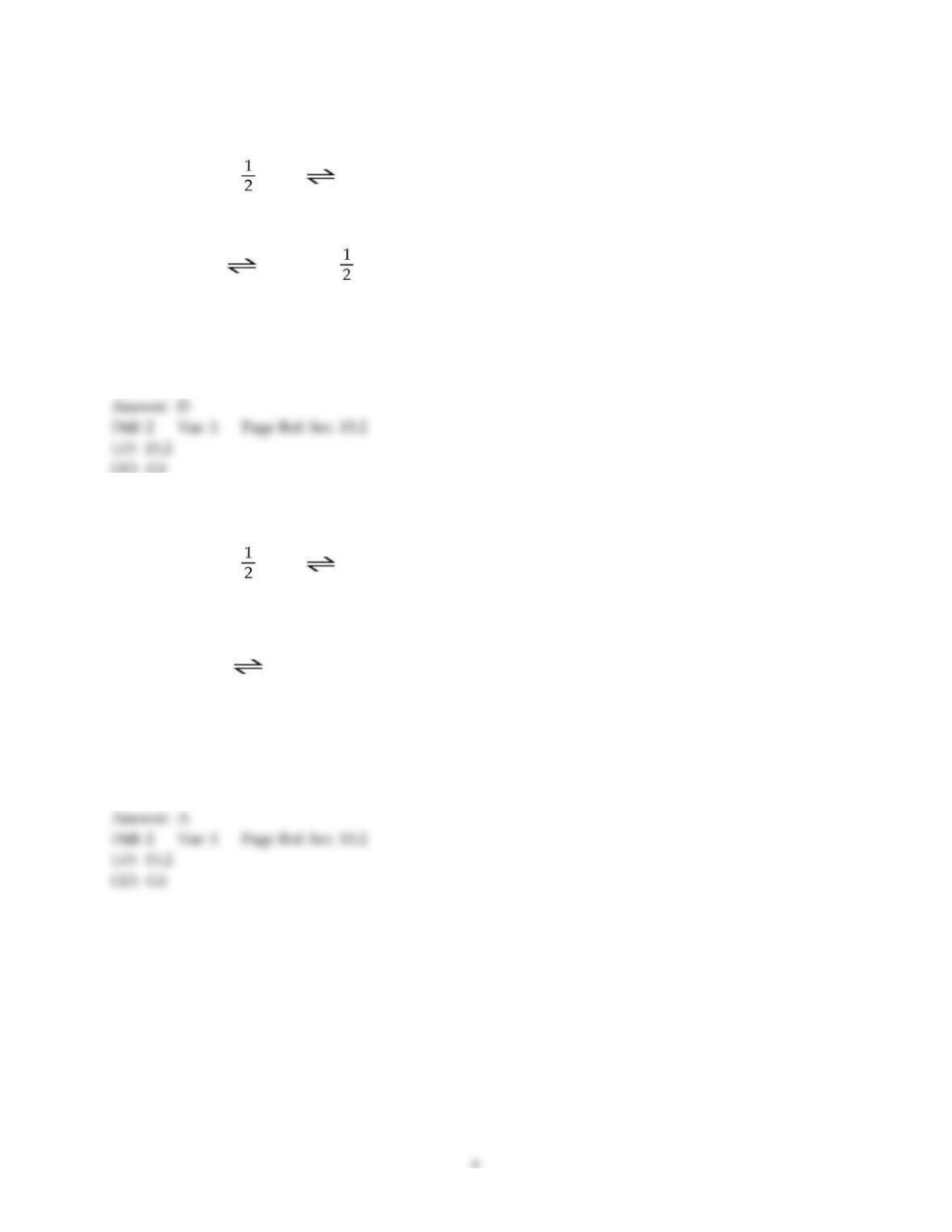
14) The Keq for the equilibrium below is 0.112 at 700.0 °C.
SO2 (g) + O2 (g) SO3 (g)
What is the value of Keq at this temperature for the following reaction?
SO3 (g) SO2 (g) + O2 (g)
A) 0.224
B) 0.0125
C) 0.112
D) 8.93
E) -0.112
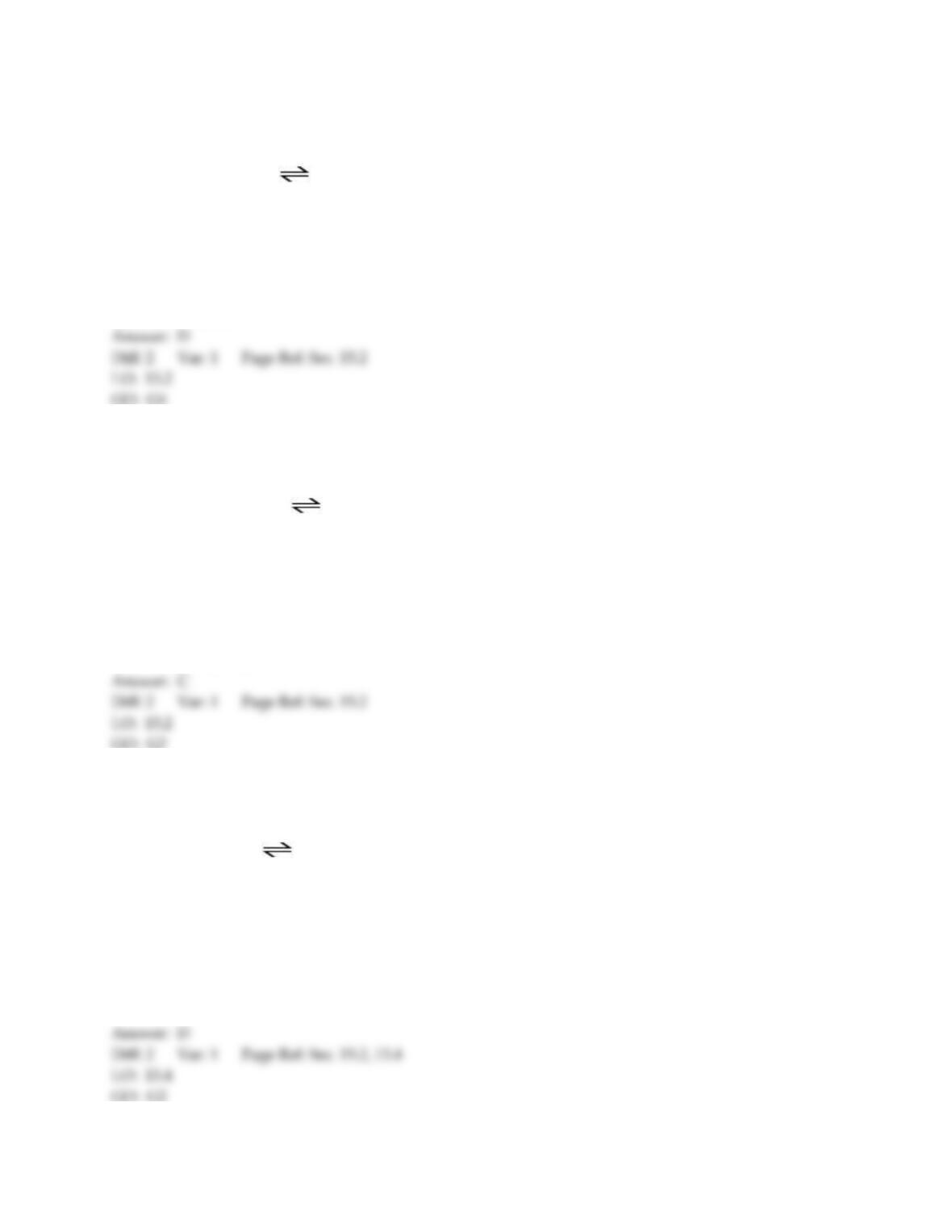
15) The Keq for the equilibrium below is 0.112 at 700.0 °C.
SO2 (g) + O2 (g) SO3 (g)
What is the value of Keq at this temperature for the following reaction?
2SO3 (g) 2SO2 (g) + O2 (g)
A) 79.7
B) 2.99
C) 17.86
D) 4.46
E) 8.93
7
16) Given the following reaction at equilibrium, if Kc = 1.90 × 10¹⁹ at 25.0 °C, Kp = ________.
H2 (g) + Br2 (g) 2 HBr (g)
A) 5.26 × 10⁻²⁰
B) 1.56 × 10⁴
C) 6.44 × 10⁵
D) 1.90 × 10¹⁹
E) none of the above
17) Which of the following expressions is the correct equilibrium-constant expression for the reaction
below?
2SO2 (g) + O2 (g) 2SO3 (g)
A) [SO3] / [SO2][O2]
B) [SO2] / [SO3]
C) [SO3]2 / [SO2]2[O2]
D) [SO3]2 / [SO2]2[O2]2
E) [SO3] / [SO2][O2]2
18) Which of the following expressions is the correct equilibrium-constant expression for the reaction
below?
(NH4)2Se (s) 2NH3 (g) + H2Se (g)
A) [NH3][H2Se] / [(NH4)2Se]
B) [(NH4)2Se] / [NH3]2[H2Se]
C) 1 / [(NH4)2Se]
D) [NH3]2[H2Se]
E) [NH3]2[H2Se] / [(NH4)2Se]
19) Which of the following expressions is the correct equilibrium-constant expression for the reaction
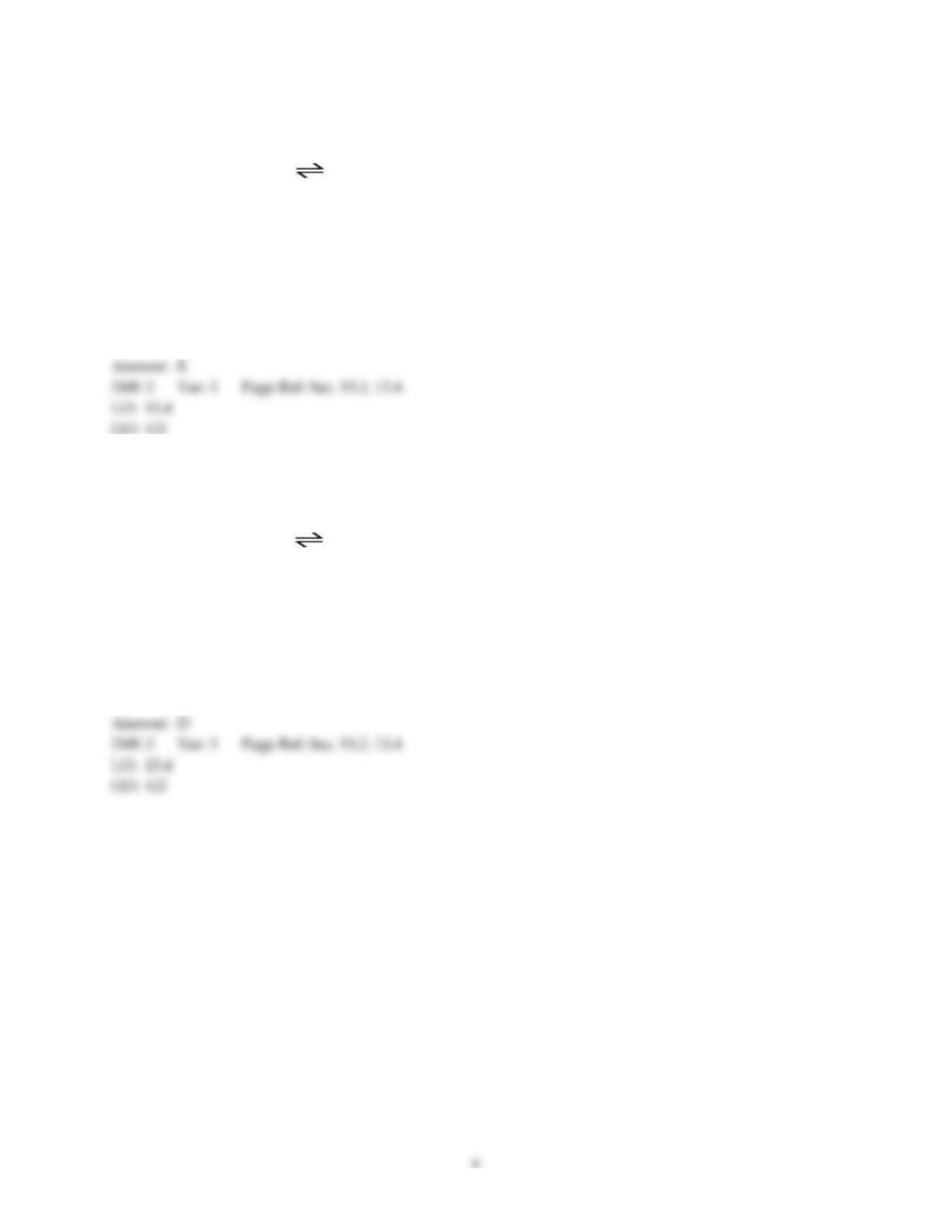
below?
CO2 (s) + H2O (l) H+ (aq) + HCO3– (aq)
A) [H+][HCO3–] / [CO2]
B) [CO2] / [H+][HCO3–]
C) [H+][HCO3–] / [CO2][H2O]
D) [CO2][H2O] / [H+][HCO3–]
E) [H+][HCO3–]
20) Which of the following expressions is the correct equilibrium-constant expression for the reaction
below?
HF (aq) + H2O (l) H3O+ (aq) + F– (aq)
A) [HF][H2O] / [H3O+][F–]
B) 1 / [HF]
C) [H3O+][F–] / [HF][H2O]
D) [H3O+][F–] / [HF]
E) [F–] / [HF]
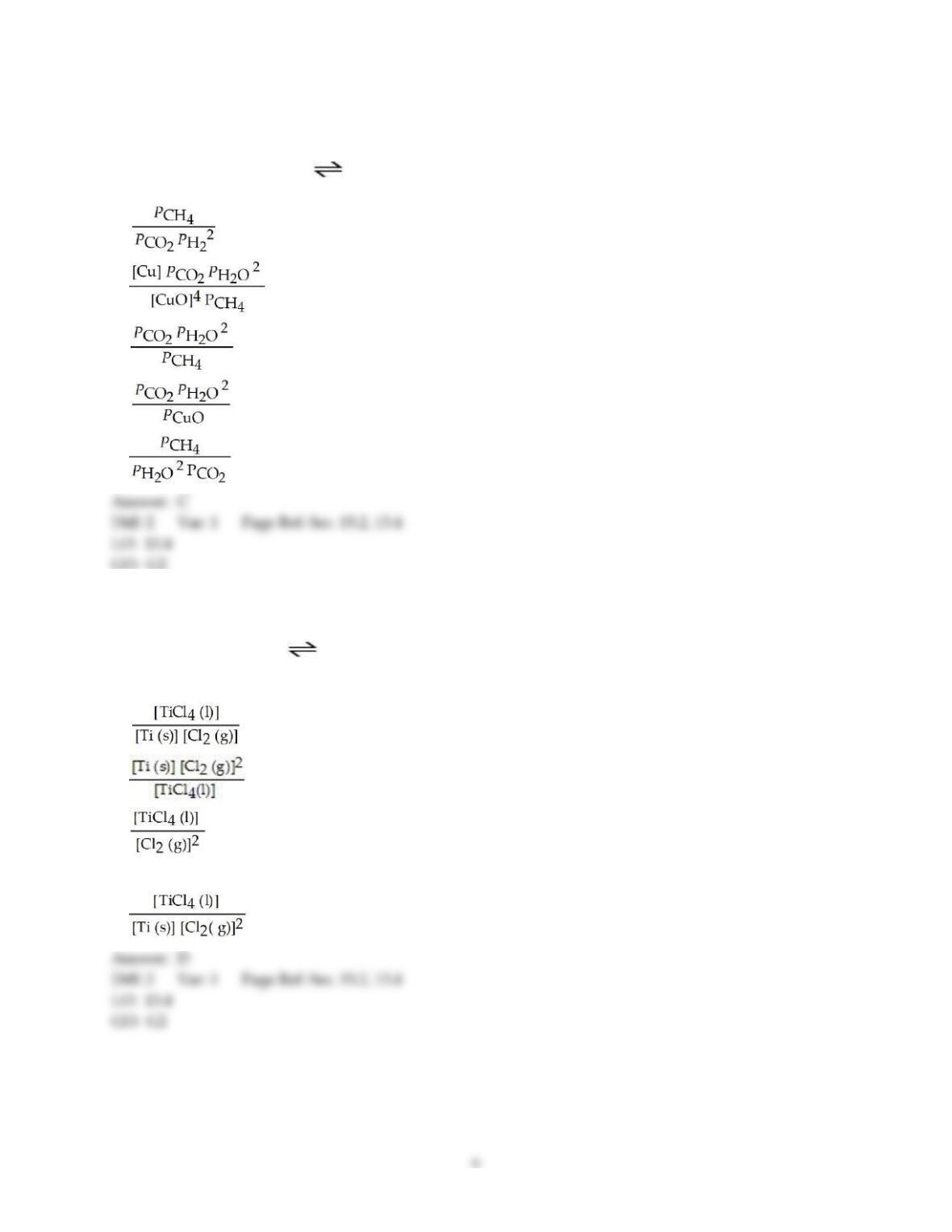
21) The expression for Kp for the reaction below is ________.
4CuO (s) + CH4 (g) CO2 (g) + 4Cu (s) + 2H2O (g)
A)
B)
C)
D)
E)
22) The equilibrium-constant expression for the reaction
Ti (s) + 2Cl2 (g) TiCl4 (l)
is given by
A)
B)
C)
D) [Cl2 (g)]–2
E)
23) The equilibrium constant for the gas phase reaction
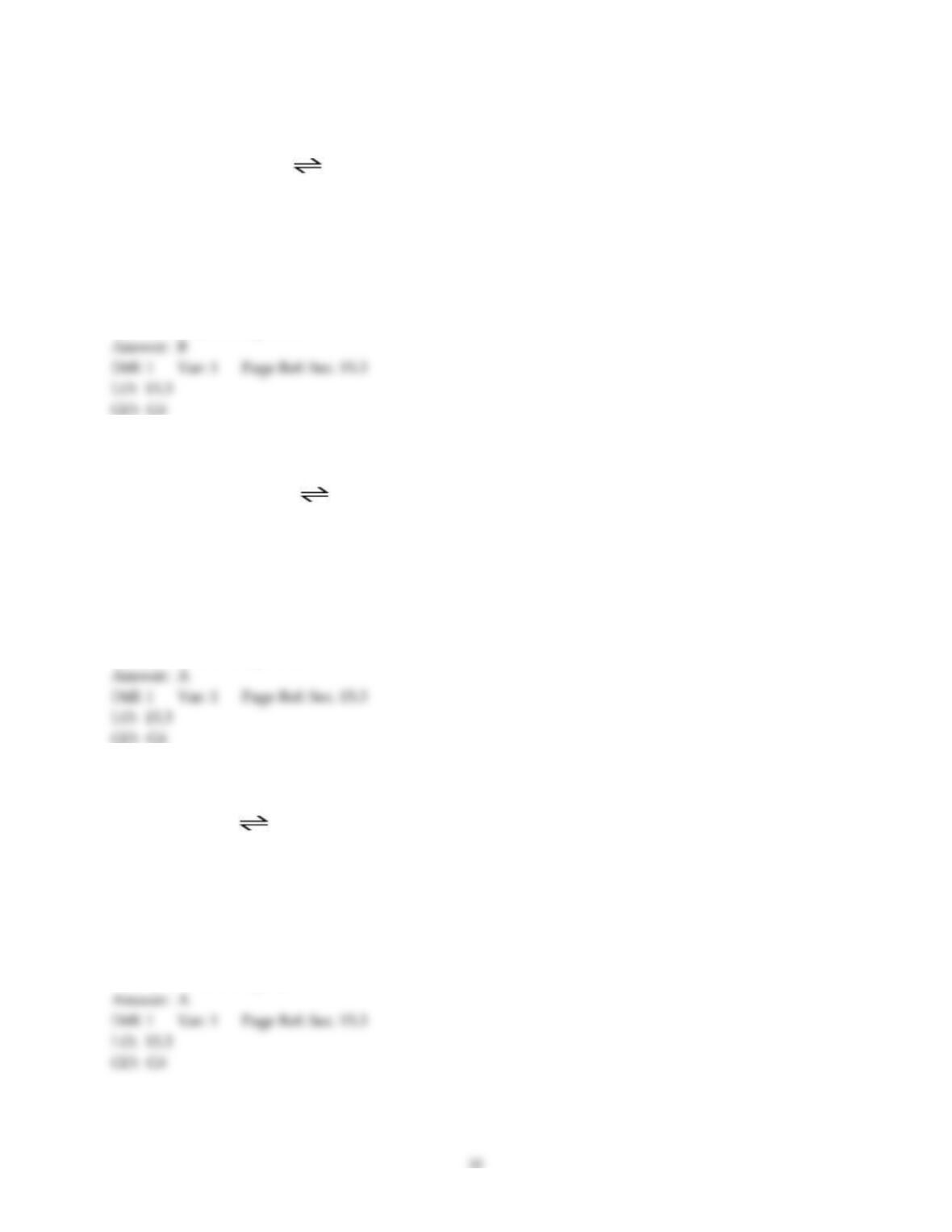
N2 (g) + 3H2 (g) 2NH3 (g)
is Keq = 4.34 × 10⁻³ at 300 °C. At equilibrium, ________.
A) products predominate
B) reactants predominate
C) roughly equal amounts of products and reactants are present
D) only products are present
E) only reactants are present
24) The equilibrium constant for the gas phase reaction
2SO2 (g) + O2 (g) 2SO3 (g)
is Keq = 2.80 × 10² at 999 K. At equilibrium, ________.
A) products predominate
B) reactants predominate
C) roughly equal amounts of products and reactants are present
D) only products are present
E) only reactants are present
25) The equilibrium constant for the gas phase reaction
2NH3 (g) N2 (g) + 3H2 (g)
is Keq = 230 at 300 °C. At equilibrium, ________.
A) products predominate
B) reactants predominate
C) roughly equal amounts of products and reactants are present
D) only products are present
E) only reactants are present
26) The equilibrium constant for the gas phase reaction
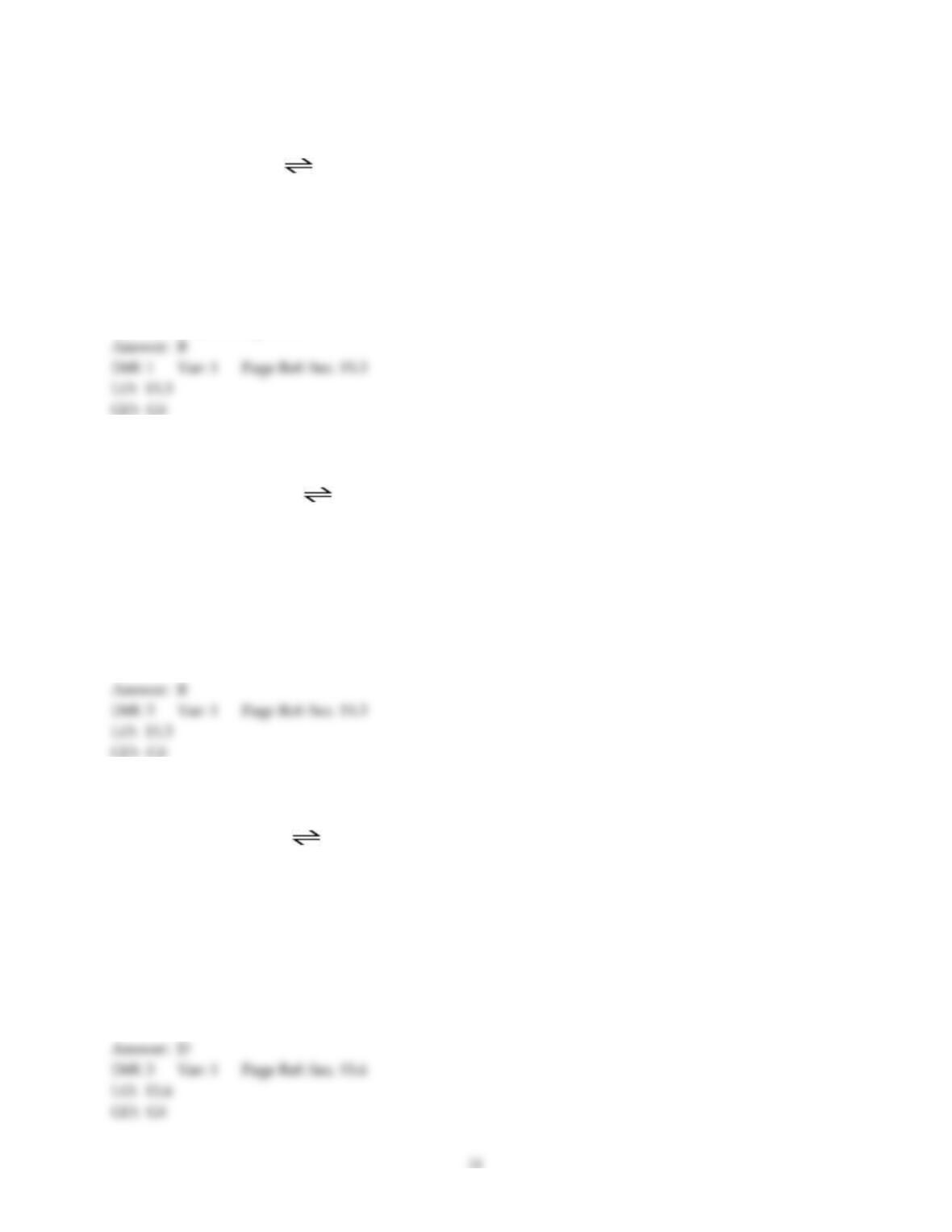
N2 (g) + O2 (g) 2NO (g)
is Keq = 4.20 × 10⁻³¹ at 30 °C. At equilibrium, ________.
A) products predominate
B) reactants predominate
C) roughly equal amounts of products and reactants are present
D) only products are present
E) only reactants are present
27) Consider the following equilibrium.
2 SO2 (g) + O2 (g) 2 SO3 (g)
The equilibrium cannot be established when ________ is/are placed in a 1.0-L container.
A) 0.25 mol SO2 (g) and 0.25 mol O2 (g)
B) 0.75 mol SO2 (g)
C) 0.25 mol of SO2 (g) and 0.25 mol of SO3 (g)
D) 0.50 mol O2 (g) and 0.50 mol SO3 (g)
E) 1.0 mol SO3 (g)
28) At 400 K, the equilibrium constant for the reaction
Br2 (g) + Cl2 (g) 2BrCl (g)
is Kp = 7.0. A closed vessel at 400 K is charged with 1.00 atm of Br2 (g), 1.00 atm of Cl2 (g), and 2.00 atm of
BrCl (g). Use Q to determine which of the statements below is true.
A) The equilibrium partial pressures of Br2, Cl2, and BrCl will be the same as the initial values.
B) The equilibrium partial pressure of Br2 will be greater than 1.00 atm.
C) At equilibrium, the total pressure in the vessel will be less than the initial total pressure.
D) The equilibrium partial pressure of BrCl (g) will be greater than 2.00 atm.
E) The reaction will go to completion since there are equal amounts of Br2 and Cl2.
29) Which of the following statements is true?
A) Q does not change with temperature.
B) Keq does not change with temperature, whereas Q is temperature dependent.
C) K does not depend on the concentrations or partial pressures of reaction components.
D) Q does not depend on the concentrations or partial pressures of reaction components.
E) Q is the same as Keq when a reaction is at equilibrium.
30) How is the reaction quotient used to determine whether a system is at equilibrium?
A) The reaction quotient must be satisfied for equilibrium to be achieved.
B) At equilibrium, the reaction quotient is undefined.
C) The reaction is at equilibrium when Q < Keq.
D) The reaction is at equilibrium when Q > Keq.
E) The reaction is at equilibrium when Q = Keq.
31) Of the following equilibria, only ________ will shift to the left in response to a decrease in volume.
A) H2 (g) + Cl2 (g) 2 HCl (g)
B) 2 SO3 (g) 2 SO2 (g) + O2 (g)
C) N2 (g) + 3H2 (g) 2 NH3 (g)
D) 4 Fe (s) + 3 O2 (g) 2 Fe2O3 (s)
E) 2HI (g) H2 (g) + I2 (g)
32) Of the following equilibria, only ________ will shift to the right in response to a decrease in volume.
A) H2 (g) + Cl2 (g) 2 HCl (g)
B) 2 SO3 (g) 2 SO2 (g) + O2 (g)
C) N2 (g) + 3H2 (g) 2NH3 (g)
D) 2 Fe2O3 (s) 4 Fe (s) + 3O2 (g)
E) 2HI (g) H2 (g) + I2 (g)
33) In which of the following reactions would increasing pressure at constant temperature not change the
concentrations of reactants and products, based on Le Châtelier’s principle?
A) N2 (g) + 3H2 (g) 2NH3 (g)
B) N2O4 (g) 2NO2 (g)
C) N2 (g) + 2O2 (g) 2NO2 (g)
D) 2N2 (g) + O2 (g) 2N2O (g)
E) N2 (g) + O2 (g) 2NO (g)
34) In which of the following reactions would increasing pressure at constant temperature change the
concentrations of reactants and products, based on Le Châteliers principle?
A) N2 (g) + 3H2 (g) 2NH3 (g)
B) N2O4 (g) 2NO2 (g)
C) N2 (g) + 2O2 (g) 2NO2 (g)
D) 2N2 (g) + O2 (g) 2N2O (g)
E) all of the above
35) Consider the following reaction at equilibrium:
2NH3 (g) N2 (g) + 3H2 (g)
Le Châtelier’s principle predicts that the moles of H2 in the reaction container will increase with
________.
A) some removal of NH3 from the reaction vessel (V and T constant)
B) a decrease in the total pressure (T constant)
C) addition of some N2 to the reaction vessel (V and T constant)
D) a decrease in the total volume of the reaction vessel (T constant)
E) an increase in total pressure by the addition of helium gas (V and T constant)
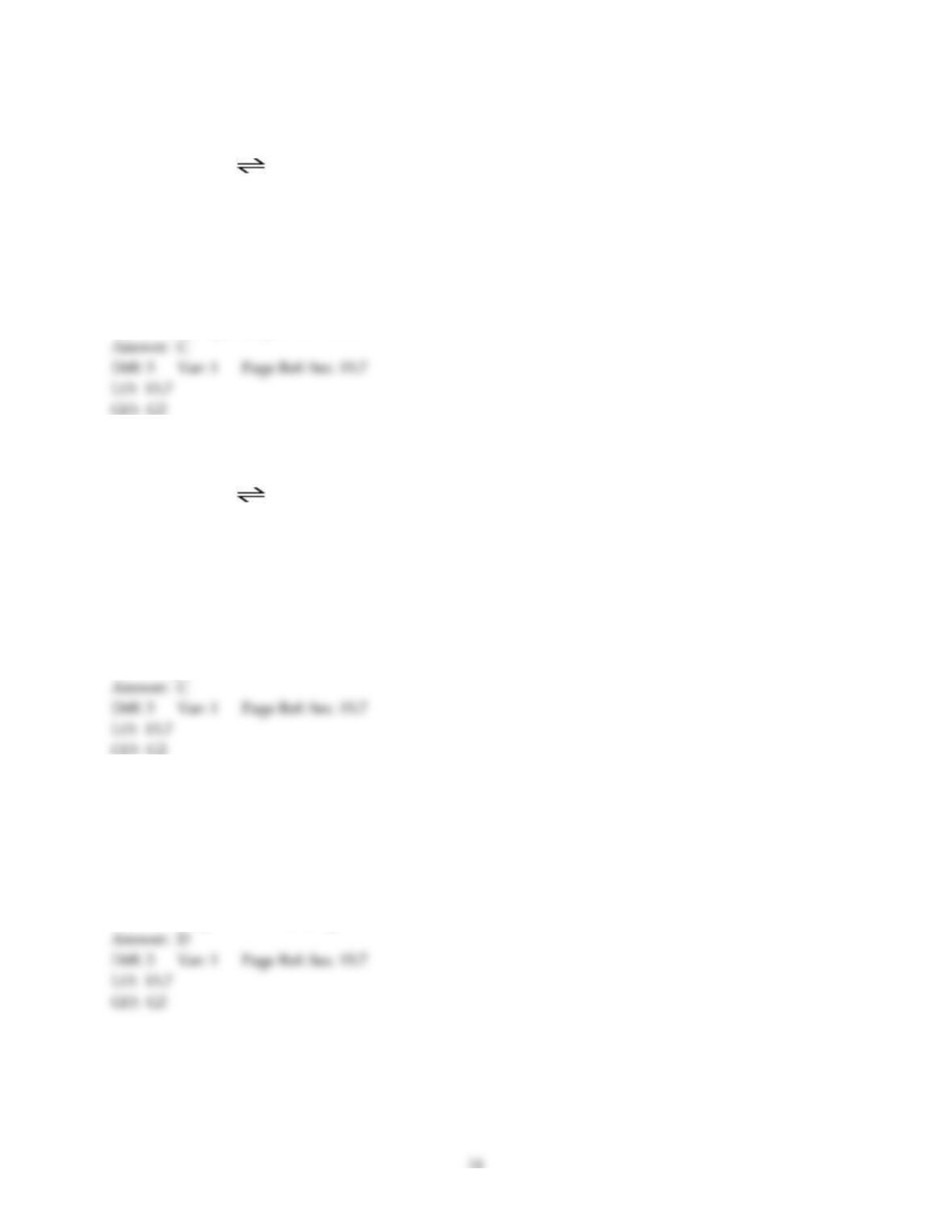
36) Consider the following reaction at equilibrium:
2CO2 (g) 2CO (g) + O2 (g) ΔH° = -514 kJ
Le Châtelier’s principle predicts that an increase in temperature will ________.
A) increase the partial pressure of O2 (g)
B) decrease the partial pressure of CO2 (g)
C) decrease the value of the equilibrium constant
D) increase the value of the equilibrium constant
E) increase the partial pressure of CO
37) Consider the following reaction at equilibrium.
2CO2 (g) 2CO (g) + O2 (g) ΔH° = -514 kJ
Le Châtelier’s principle predicts that the equilibrium partial pressure of CO (g) can be maximized by
carrying out the reaction ________.
A) at high temperature and high pressure
B) at high temperature and low pressure
C) at low temperature and low pressure
D) at low temperature and high pressure
E) in the presence of solid carbon
38) The effect of a catalyst on an equilibrium is to ________.
A) increase the rate of the forward reaction only
B) increase the equilibrium constant so that products are favored
C) slow the reverse reaction only
D) increase the rate at which equilibrium is achieved without changing the composition of the
equilibrium mixture
E) shift the equilibrium to the right
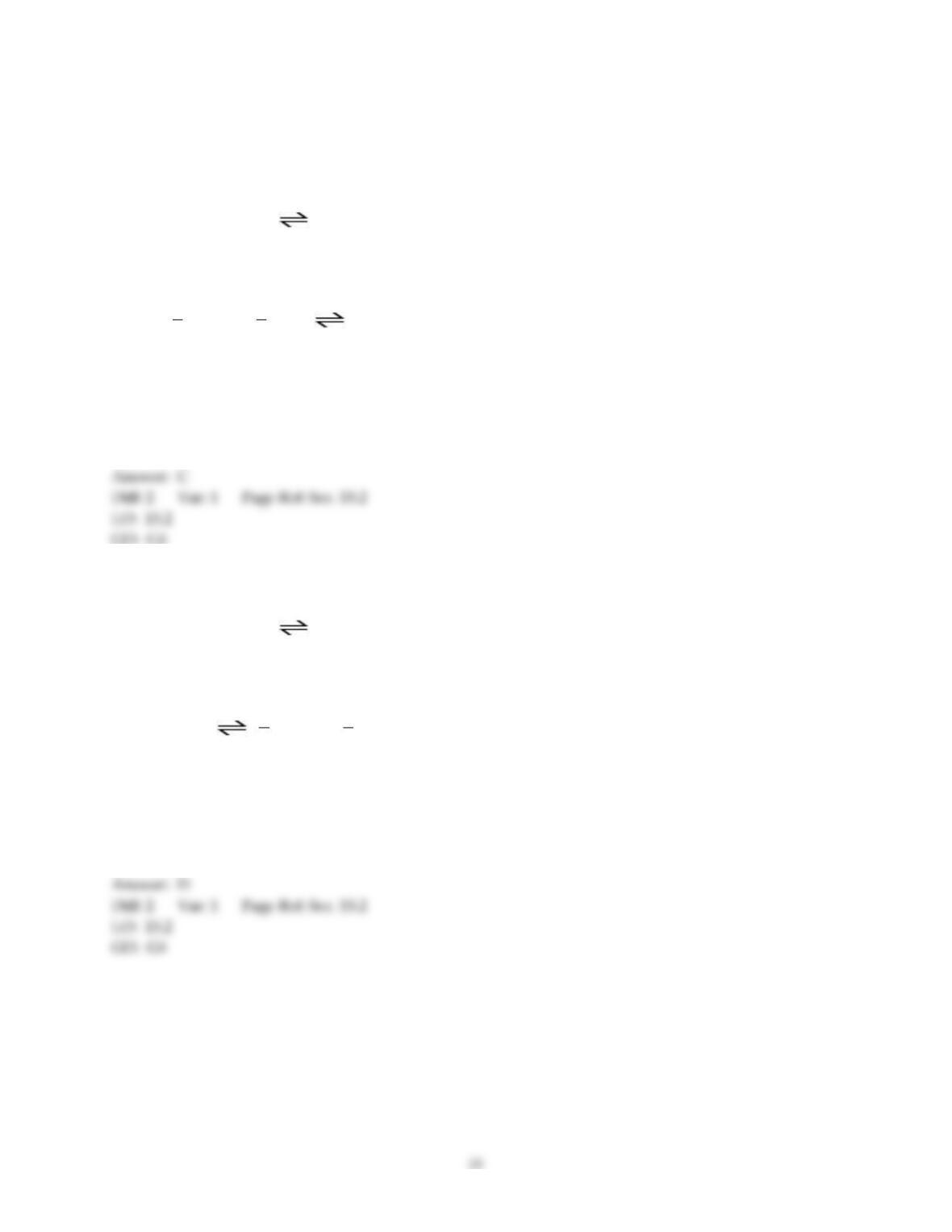
15.2 Bimodal Questions
1) The value of Keq for the equilibrium
H2 (g) + I2 (g) 2HI (g)
is 794 at 25 °C. What is the value of Keq for the equilibrium below?
2
1
H2 (g) +
2
1
I2 (g) HI (g)
A) 397
B) 0.035
C) 28
D) 1588
E) 0.0013
2) The value of Keq for the equilibrium
H2 (g) + I2 (g) 2HI (g)
is 794 at 25 °C. At this temperature, what is the value of Keq for the equilibrium below?
HI (g)
2
1
H2 (g) +
2
1
I2 (g)
A) 1588
B) 28
C) 397
D) 0.035
E) 0.0013

3) The value of Keq for the equilibrium
H2 (g) + I2 (g) 2HI (g)
is 54.0 at 427 °C. What is the value of Keq for the equilibrium below?
HI (g)
2
1
H2 (g) +
2
1
I2(g)
A) 27
B) 7.35
C) 0.136
D) 2.92 × 10³
E) 3.43 × 10⁻⁴
4) The value of Keq for the equilibrium
CO2 (g) + 2H2 (g) CH3OH (g)
is 14.5 at 483 °C. What is the value of Keq for the equilibrium below?
2
1
CO2 + H2 (g)
2
1
CH3OH (g)
A) 7.30
B) 7.35
C) 0.136
D) 3.81
E) 6.90 × 10⁻²
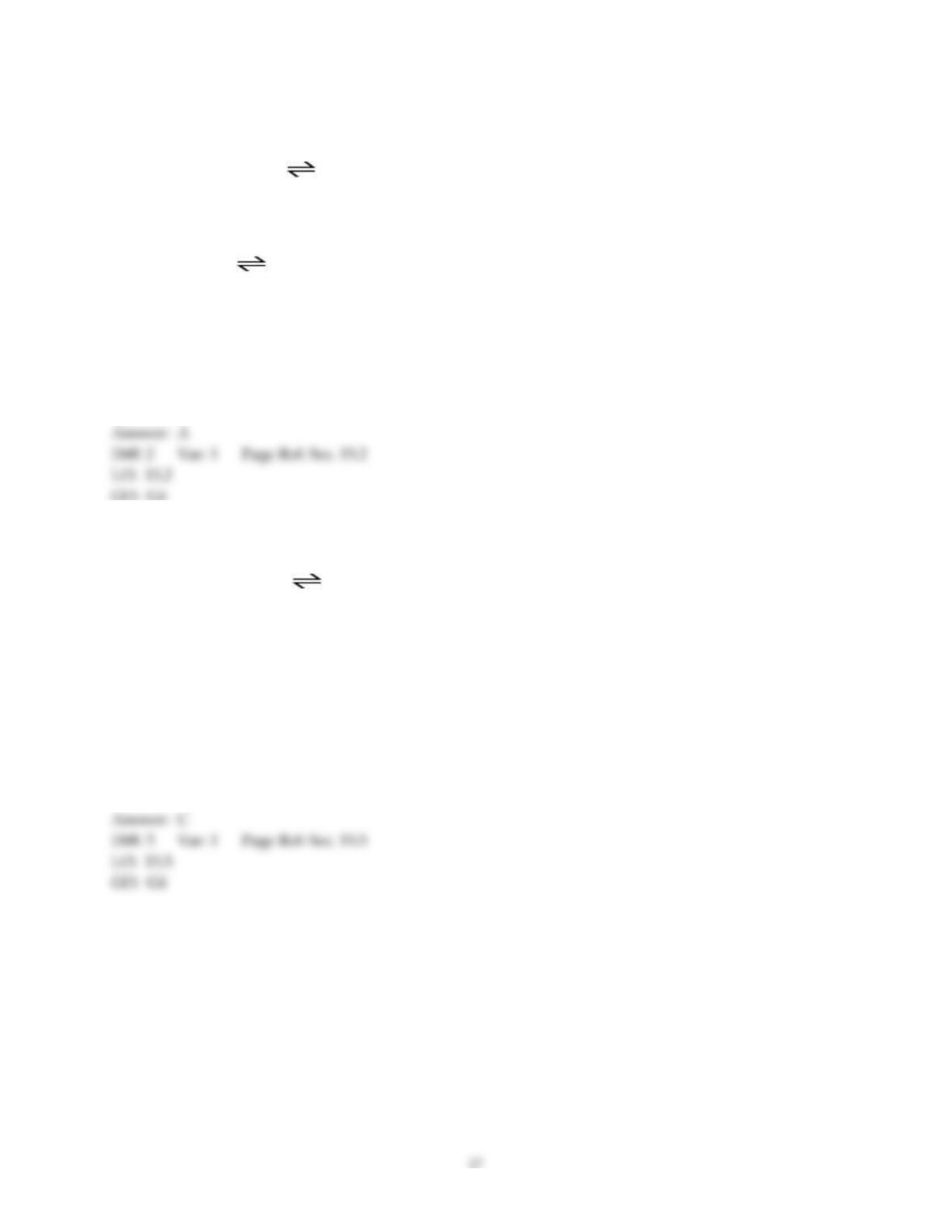
5) The value of Keq for the equilibrium
N2 (g) + O2 (g) 2 NO (g)
is 4.2 × 10⁻³¹ at 27 °C. What is the value of Keq for the equilibrium below?
4 NO (g) 2 N2 (g) + 2 O2 (g)
A) 5.7 × 1060
B) 8.4 × 10⁻³¹
C) 4.2 × 1031
D) 8.4 × 1031
E) none of the above
6) Consider the following chemical reaction:
CO (g) + 2H2(g) CH3OH(g)
At equilibrium in a particular experiment, the concentrations of CO and H2 were 0.15 M and 0.36, M
respectively. What is the equilibrium concentration of CH3OH? The value of Keq for this reaction is 14.5
at the temperature of the experiment.
A) 14.5
B) 7.61 × 10⁻³
C) 2.82 × 10⁻¹
D) 3.72 × 10⁻³
E) 1.34 × 10⁻³
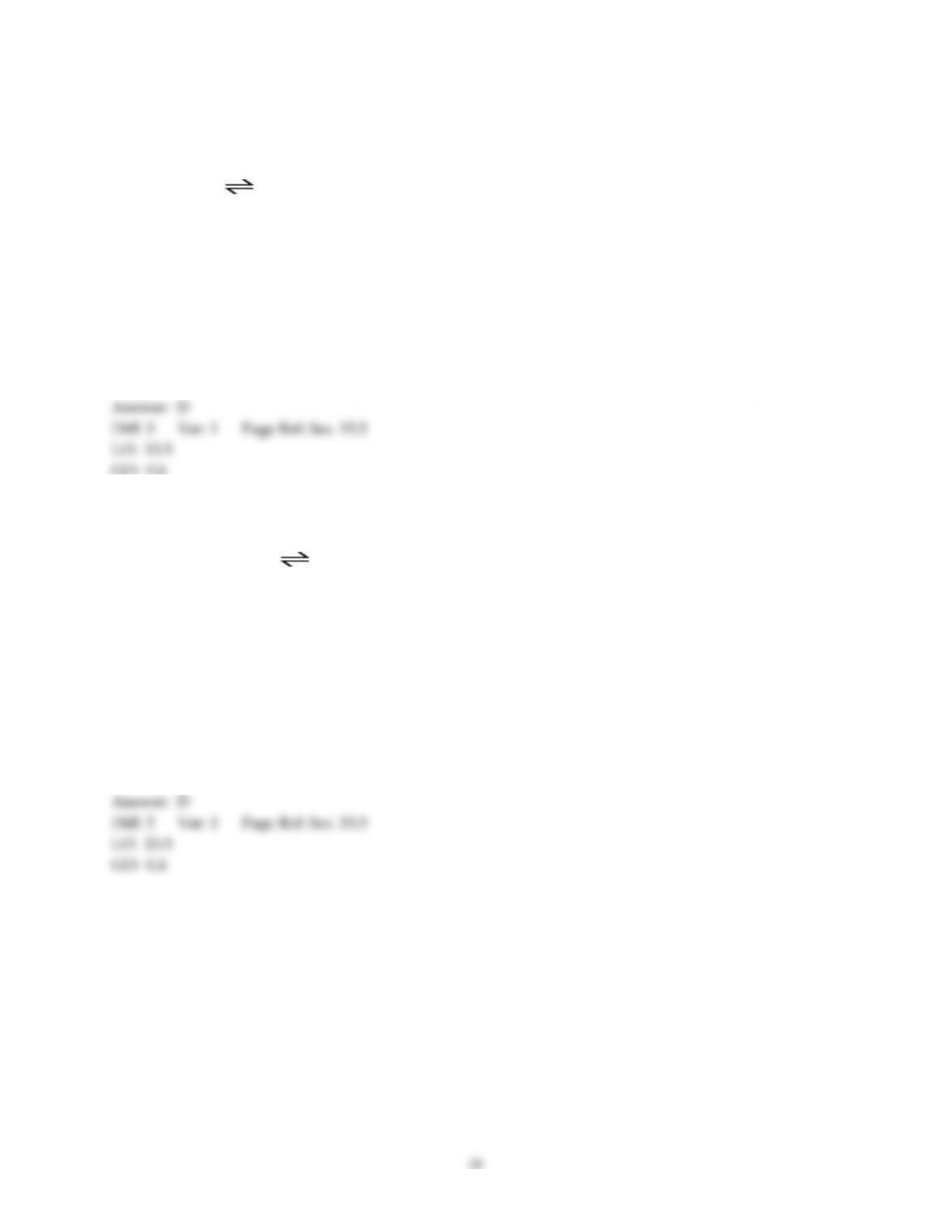
7) A reaction vessel is charged with hydrogen iodide, which partially decomposes to molecular hydrogen
and iodine:
2HI (g) H2(g) + I2(g)
When the system comes to equilibrium at 425 °C, PHI = 0.708 atm, and PH2 = PI2 = 0.0960 atm. The value
of Kp at this temperature is ________.
A) 6.80 × 10⁻²
B) 1.30 × 10⁻²
C) 54.3
D) 1.84 × 10⁻²
E) Kp cannot be calculated for this gas reaction when the volume of the reaction vessel is not given.
8) Acetic acid is a weak acid that dissociates into the acetate ion and a proton in aqueous solution:
HC2H3O2 (aq) C2H3O2– (aq) + H+ (aq)
At equilibrium at 25 °C a 0.100 M solution of acetic acid has the following concentrations:
[HC2H3O2] = 0.0990 M, [C2H3O2–] = 1.33 × 10⁻³ M and [H+] = 1.33 × 10⁻³ M. The equilibrium constant,
Keq, for the ionization of acetic acid at 25 °C is ________.
A) 5.71 × 10⁴
B) 0.100
C) 1.75 × 10⁻⁷
D) 1.79 × 10⁻⁵
E) 5.71 × 10⁶
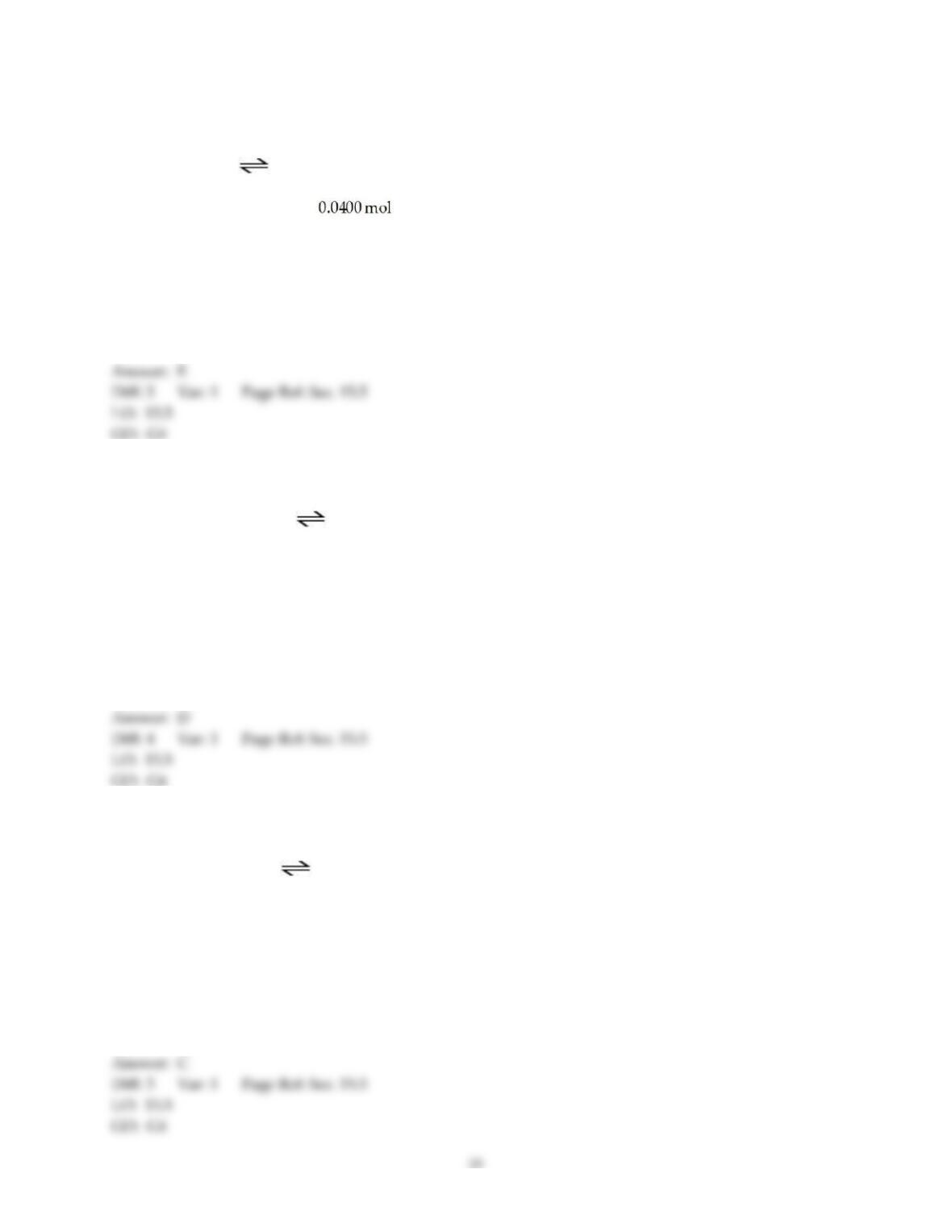
9) Dinitrogentetraoxide partially decomposes according to the following equilibrium:
N2O4 (g) 2 NO2 (g)
A 1.00-L flask is charged with ofN2O4. At equilibrium at 373 K, 0.0055 mol of N2O4 remains.
Keq for this reaction is ________.
A) 2.2 × 10⁻⁴
B) 13
C) 0.22
D) 0.022
E) 0.87
10) Given the following reaction:
CO (g) + 2 H2(g) CH3OH (g)
In an experiment, 0.42 mol of CO and 0.42 mol of H2 were placed in a 1.00-L reaction vessel. At
equilibrium, there were 0.29 mol of CO remaining. Keq at the temperature of the experiment is ________.
A) 2.80
B) 0.357
C) 14.5
D) 17.5
E) none of the above
11) A sealed 1.0 L flask is charged with 0.500 mol of I2 and 0.500 mol of Br2. An equilibrium reaction
ensues:
I2 (g) + Br2 (g) 2IBr (g)
When the container contents achieve equilibrium, the flask contains 0.84 mol of IBr. The value of Keq is
________.
A) 11
B) 4.0
C) 110
D) 6.1
E) 2.8