General Chemistry: Atoms First, 2e (McMurry and Fay)
Chapter 15 Applications of Aqueous Equilibria
15.1 Multiple Choice Questions
1) Which is a net ionic equation for the neutralization of a strong acid with a strong base?
A) HCl(aq) + NaOH(aq) ⇌ H2O(l) + NaCl(aq)
B) H3O+(aq) + OH–(aq) ⇌ 2 H2O(l)
C) HF(aq) + NaOH(aq) ⇌ H2O(l) + NaF(aq)
D) HF(aq) + OH–(aq) ⇌ H2O(l) + F–(aq)
2) Which is a net ionic equation for the neutralization of a weak acid with a strong base?
A) HCl(aq) + NaOH(aq) ⇌ H2O(l) + NaCl(aq)
B) H3O+(aq) + OH–(aq) ⇌ 2 H2O(l)
C) HF(aq) + NaOH(aq) ⇌ H2O(l) + NaF(aq)
D) HF(aq) + OH–(aq) ⇌ H2O(l) + F–(aq)
3) Which is a net ionic equation for the neutralization reaction of a strong acid with a weak base?
A) HCl(aq) + NaOH(aq) ⇌ H2O(l) + NaCl(aq)
B) H3O+(aq) + OH–(aq) ⇌ 2 H2O(l)
C) HCl(aq) + NH3(aq) ⇌ NH4Cl(aq)
D) H3O+(aq) + NH3(aq) ⇌ NH4+(aq) + H2O(l)
4) Which is a net ionic equation for the neutralization reaction of a weak acid with a weak base?
A) H3O+(aq) + OH–(aq) ⇌ 2 H2O(l)
B) HF(aq) + NH3(aq) ⇌ NH4+(aq) + F–(aq)
C) HF(aq) + OH–(aq) ⇌ H2O(l) + F–(aq)
D) H3O+(aq) + NH3(aq) ⇌ NH4+(aq) + H2O(l)
2
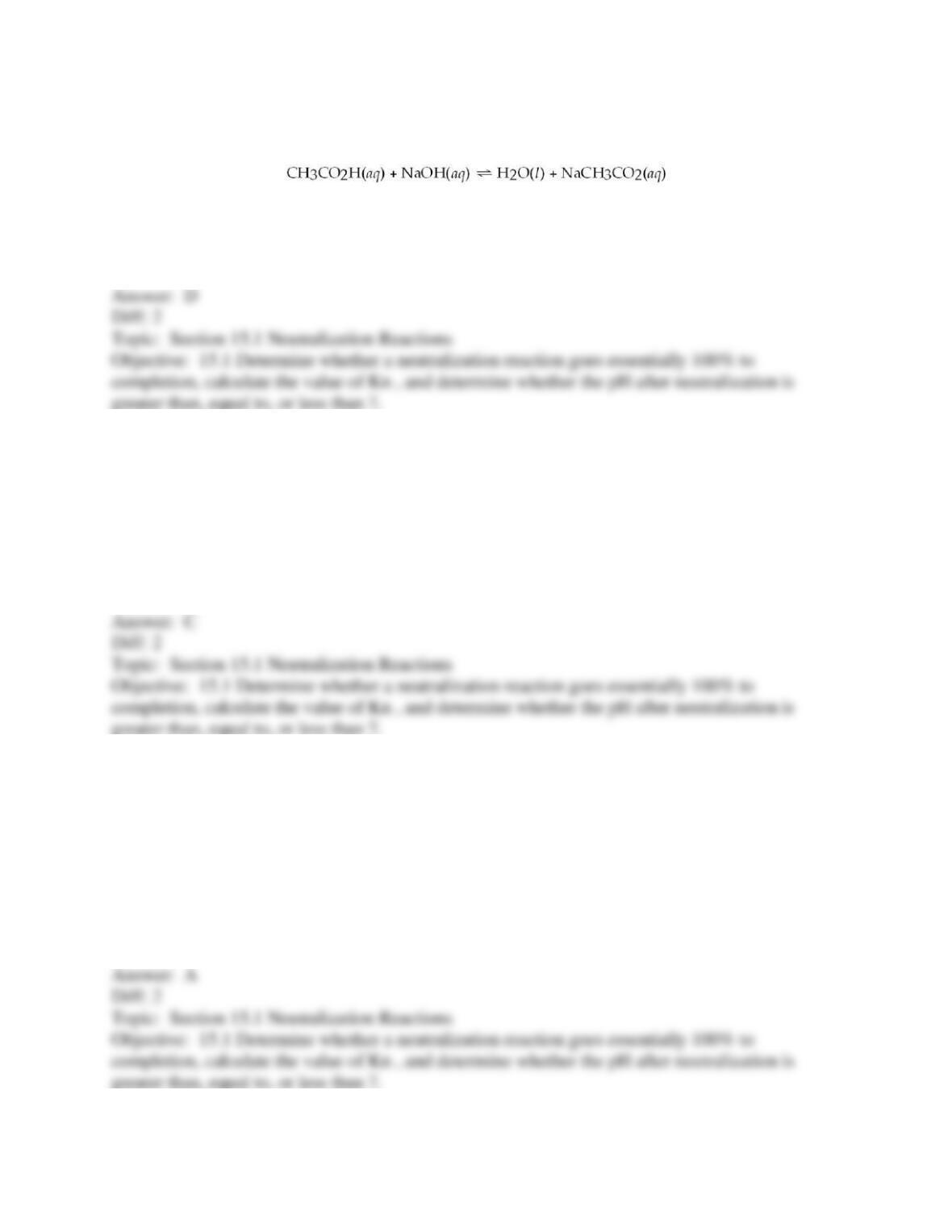
5) What is the approximate value of the equilibrium constant, Kn, for the neutralization of acetic
acid with sodium hydroxide, shown in the equation below? The Ka for acetic acid is 1.8 × 10⁻⁵.
A) 1.8 × 10⁻¹⁹
B) 5.6 × 10⁻¹⁰
C) 1.8 × 10⁻⁸
D) 1.8 × 10⁹
6) What is the approximate value of the equilibrium constant, Kn, for the neutralization of
pyridine with hydrochloric acid, shown in the equation below? The Kb for pyridine is 1.8 × 10⁻⁹.
HCl(aq) + C5H5N(aq) ⇌ C5H5NHCl(aq)
A) 5.6 × 10⁻¹⁰
B) 5.6 × 10⁻⁶
C) 1.8 × 10⁵
D) 5.6 × 10⁸
7) What is the approximate value of the equilibrium constant, Kn, for the neutralization of
nitrous acid with ammonia, shown in the equation below? The Ka for HNO2 is 4.5 × 10⁻⁴ and
the Kb for NH3 is 1.8 × 10⁻⁵.
HNO2(aq) + NH3(aq) ⇌ NH4NO2(aq)
A) 8.1 × 10⁵
B) 1.8 × 10⁹
C) 4.5 × 10¹⁰
D) 8.1 × 10¹⁹
8) What is the approximate value of the equilibrium constant, Kn, for the neutralization of
hydrochloric acid with sodium hydroxide, shown in the equation below?
HCl(aq) + NaOH(aq) ⇌ H2O(l) + NaCl(aq)
A) 1.0 × 10²
B) 1.0 × 10⁷
C) 1.0 × 10¹⁴
D) 1.0 × 1028
9) Which of these neutralization reactions has a pH = 7 when equal molar amounts of acid and
base are mixed.
A) CH3CO2H(aq) + NaOH(aq) ⇌ H2O(l) + NaCH3CO2(aq)
B) HCl(aq) + C5H5N(aq) ⇌ C5H5NHCl(aq)
C) HCl(aq) + NaOH(aq) ⇌ H2O(l) + NaCl(aq)
D) HNO2(aq) + NH3(aq) ⇌ NH4NO2(aq)
10) Which of these neutralization reactions has a pH < 7 when equal molar amounts of acid and
base are mixed.
A) CH3CO2H(aq) + NaOH(aq) ⇌ H2O(l) + NaCH3CO2(aq)
B) HCl(aq) + C5H5N(aq) ⇌ C5H5NHCl(aq)
C) HCl(aq) + NaOH(aq) ⇌ H2O(l) + NaCl(aq)
D) H2SO4(aq) + 2 KOH(aq) ⇌2 H2O(l) + K2SO4(aq)
11) Which of these neutralization reactions has a pH > 7 when equal moles of acid and base are
mixed.
A) CH3CO2H(aq) + NaOH(aq) ⇌ H2O(l) + NaCH3CO2(aq)
B) HCl(aq) + C5H5N(aq) ⇌ C5H5NHCl(aq)
C) HCl(aq) + NaOH(aq) ⇌ H2O(l) + NaCl(aq)
D) H2SO4(aq) + 2 KOH(aq) ⇌2 H2O(l) + K2SO4(aq)
12) What is the common ion in a solution prepared by mixing 0.10 M NaCH3CO2 with 0.10 M
CH3CO2H?
A) H3O+
B) Na+
C) CH3CO2–
D) OH–
13) When 50 mL of 0.10 M NH4Cl is added to 50 mL of 0.10 M NH3, relative to the pH of the
0.10 M NH3 solution the pH of the resulting solution will
A) become 7.
B) decrease.
C) increase.
D) remain the same.
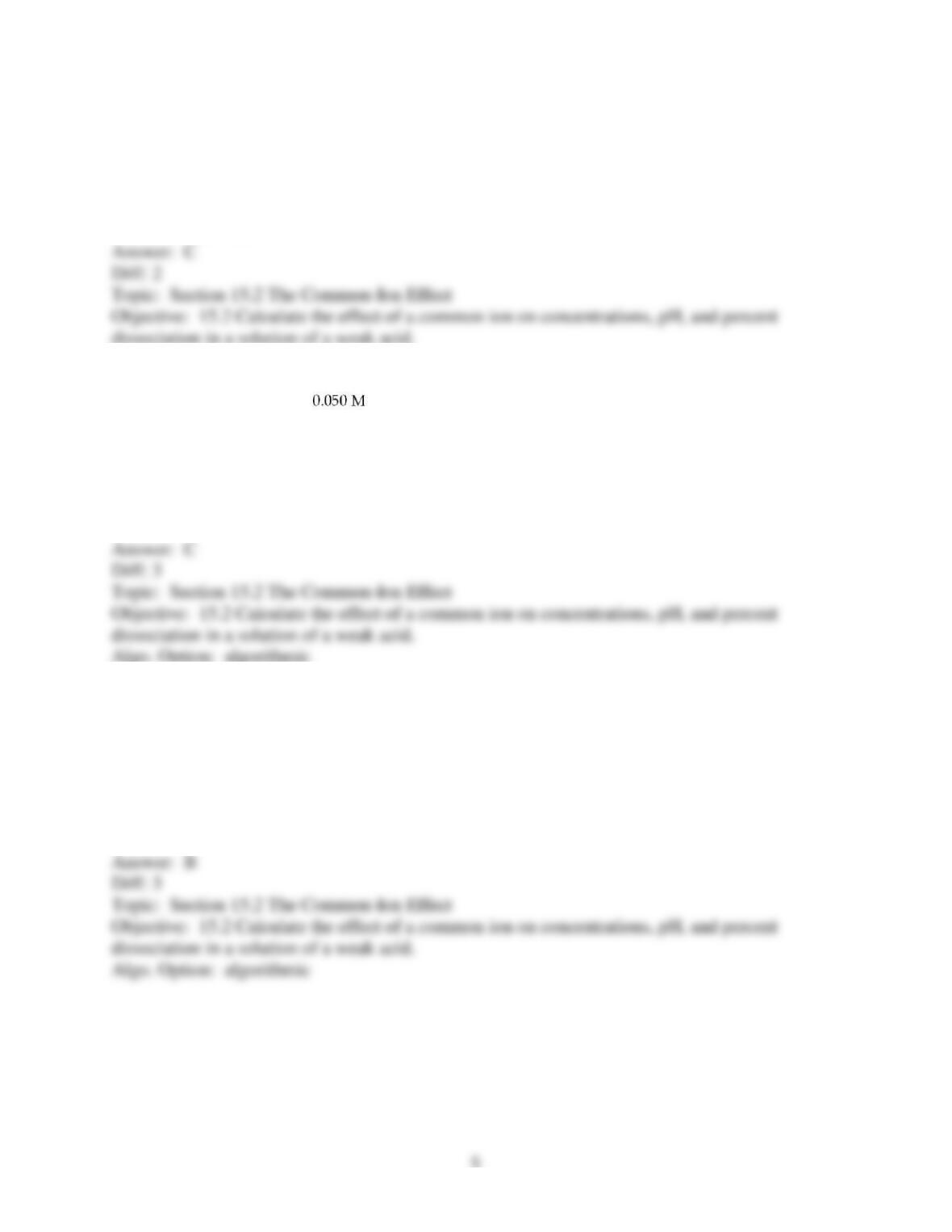
14) When 50 mL of 0.10 M NaF is added to 50 mL of 0.10 M HF, relative to the pH of the 0.10
M HF solution the pH of the resulting solution will
A) become 7.
B) decrease.
C) increase.
D) remain the same.
15) What is the hydronium ion concentration in a solution prepared by mixing 50.00 mL of 0.10
M HCN with 50.00 mL of NaCN? Assume that the volumes of the solutions are additive
and that Ka = 4.9 × 10⁻¹⁰ for HCN.
A) 2.4 × 10⁻¹⁰ M
B) 4.9 × 10⁻¹⁰ M
C) 9.8 × 10⁻¹⁰ M
D) 7.0 × 10⁻⁶ M
16) What is the pH of a solution prepared by mixing 25.00 mL of 0.10 M CH3CO2H with 25.00
mL of 0.050 M CH3CO2Na? Assume that the volume of the solutions are additive and that Ka =
1.8 × 10⁻⁵ for CH3CO2H.
A) 2.87
B) 4.44
C) 4.74
D) 5.05
17) What is the pH of a solution prepared by mixing 50.00 mL of 0.10 M NH3 with 25.00 mL of
0.10 M NH4Cl? Assume that the volume of the solutions are additive and that Kb = 1.8 × 10⁻⁵
for NH3.
A) 8.95
B) 9.26
C) 9.56
D) 11.13
18) What is the pH of a solution prepared by mixing 25.00 mL of 0.10 M methylamine,
CH3NH2, with 25.00 mL of 0.10 M methylammonium chloride, CH3NH3Cl? Assume that the
volume of the solutions are additive and that Kb = 3.70 × 10⁻⁴ for methylamine.
A) 10.27
B) 10.57
C) 10.87
D) 11.78
19) When equal molar amounts of the following sets of compounds are mixed in water, which
will not form a buffer solution?
A) NaH2PO4 with Na2HPO4
B) NH3 with NH4Cl
C) CH3CO2H with NaCH3CO2
D) HNO3 with NaNO3
7
20) Which of the following combinations of chemicals could be used to make a buffer solution?
A) HCl/NaOH
B) HCl/NH3
C) HCl/H3PO4
D) NaOH/NH3
21) Which statement about buffers is true?
A) Buffers have a pH = 7.
B) Buffers consist of a strong acid and its conjugate base.
C) A buffer does not change pH on addition of a strong acid or strong base.
D) Buffers resist change in pH upon addition of small amounts of strong acid or strong base.
22) What is the pH of a buffered system made by dissolving 17.42 g of KH2PO4 and 20.41 g of
K2HPO4 in water to give a volume of 200.0 mL? The Ka2 for dihydrogen phosphate is 6.2 × 10⁻⁸
and the equilibrium reaction of interest is
H2PO4–(aq) + H2O(l) ⇌ H3O+(aq) + HPO4–(aq).
A) 7.03
B) 7.17
C) 7.38
D) 7.58
23) What is the pH of a buffer system made by dissolving 10.70 grams of NH4Cl and 20.00 mL
of 12.0 M NH3 in enough water to make 1.000 L of solution? Kb = 1.8 × 10⁻⁵ for NH3.
A) 9.18
B) 9.26
C) 9.34
D) 11.03
24) TRIS {(HOCH2)3CNH2} is one of the most common buffers used in biochemistry. A
8
solution is prepared by adding enough TRIS and 12 M HCl(aq) to give 1.00 L of solution with
[TRIS] = 0.30 M and [TRISH+] = 0.60 M. What is the pH of this buffered system if the pKb is
5.92?
A) 5.92
B) 6.22
C) 7.78
D) 8.08
25) A buffer solution is prepared by dissolving 0.200 mol of NaH2PO4 and 0.100 mol of NaOH
in enough water to make 1.00 L of solution. What is the pH of the / buffer if the
A) 6.91
B) 7.21
C) 7.51
D) 7.71
26) What is the pH of 1 L of 0.30 M TRIS, 0.60 M TRISH+ buffer to which one has added 5.0
mL of 12 M HCl? The Kb for the TRIS/TRISH+ is
A) 5.92
B) 6.36
C) 7.36
D) 7.64
27) A buffer solution is prepared by dissolving 27.22 g of KH2PO4 and 3.37 g of KOH in
enough water to make 0.100 L of solution. What is the pH of the / buffer if the
A) 6.84
B) 7.00
C) 7.21
D) 7.84
28) What is the [CH3CO2–]/[CH3CO2H] ratio necessary to make a buffer solution with a pH of
4.44? Ka = 1.8 × 10⁻⁵ for CH3CO2H.
A) 0.50:1
B) 0.94:1
C) 1.1:1
D) 2.0:1
29) What is the pH of a buffer solution made by mixing 50.0 mL of 0.100 M potassium hydrogen
phthalate with 13.6 mL of 0.100 M NaOH and diluting the mixture to 100.0 mL with water? The
Ka2 for hydrogen phthalate is
A) 3.25
B) 5.08
C) 5.51
D) 5.94
30) What volume of 0.100 M NaOH is needed to make 100.0 mL of a buffer solution with a pH
of 6.00 if one starts with 50.0 mL of 0.100 M potassium hydrogen phthalate? The Ka2 for
potassium hydrogen phthalate is
A) 22.4 mL
B) 27.6 mL
C) 30.2 mL
D) 37.8 mL
31) What is the magnitude of the change in pH when 0.005 moles of HCl is added to 0.100 L of
a buffer solution that is 0.100 M in CH3CO2H and 0.100 M The Ka for acetic acid
is
A) 0.00
B) 0.20
C) 0.47
D) 1.30
32) What is the magnitude of the change in pH when 1.8 g of NaOH is added to 1.00 L of a
solution that is 0.100 M in N and 0.100 M in N Cl? for N is 1.8 × .
A) 0.42
B) 0.00
C) 0.19
D) 1.33
33) What is the resulting pH when 0.005 moles of KOH is added to 0.100 L of a buffer solution
that is 0.100 M in H2PO4– and 0.100 M HPO42- and the
A) 5.21
B) 5.61
C) 6.73
D) 7.69
34) What is the Henderson-Hasselbalch equation for the acidic buffer HA/A–?
A) pH = -log[H3O+]
B) pH = 14 – pOH
C) pH = pKa + log{[A–]/[HA]}
D) pH = pKa – log{[A–]/[HA]}
35) What is not a correct expression for the weak acid HA?
A) Ka = [H3O+][A–]/[HA]
B) pKa = pH – log{[A–]/[HA]}
C) pKa = logKa
D) pKa = 14 – pKb
36) Which is the best acid to use in the preparation of a buffer with pH = 3.3?
A) HOI (Ka = 2.0 × 10⁻¹¹)
B) HNO2 (Ka = 4.5 × 10⁻⁴)
C) HNO3
D) HIO3 (Ka = 1.7 × 10⁻¹)
37) Which is the best acid to use in the preparation of a buffer with pH = 9.3?
A) CH3NH2 (Kb = 3.7 × 10⁻⁴)
B) NH3 (Kb = 1.8 × 10⁻⁵)
C) NH2OH (Kb = 9.1 × 10⁻⁹)
D) C6H5NH2 (Kb = 4.3 × 10⁻¹⁰)
38) What is the percent dissociation of glycine if the solution has a pH = 8.60 and a pKa = 9.60?
A) 50%
B) 9%
C) 5%
D) 1%
39) What is the percent dissociation of acetic acid if the solution has a pH = 4.74 and a pKa =
4.74?
A) 100%
B) 50%
C) 10%
D) 1%
40) What is the percent dissociation of ascorbic acid if the solution has a pH = 5.50 and a pKa =
4.10?
A) 96%
B) 10%
C) 5%
D) 1%
13
41) At what pH is the amino acid glycine with a Ka of 2.51 × 10⁻¹⁰ sixty-six (66%) percent
dissociated?
A) 9.60
B) 9.89
C) 10.10
D) 10.60
42) What volume of 5.00 × 10⁻³ M HNO3 is needed to titrate 100.00 mL of 5.00 × 10⁻³ M
Ca(OH)2 to the equivalence point?
A) 12.5 mL
B) 50.0 mL
C) 100. mL
D) 200. mL
43) What is the pH of a solution made by mixing 30.00 mL of 0.10 M HCl with 40.00 mL of
0.10 M KOH? Assume that the volumes of the solutions are additive.
A) 0.85
B) 1.85
C) 12.15
D) 13.15
44) Which of the following titrations result in a basic solution at the equivalence point?
A) HI titrated with NaCH3CO2
B) HOCl titrated with NaOH
C) HBr titrated with KOH
D) Pb(NO3)2 titrated with NaI
45) What is the pH at the equivalence point of a weak acid-strong base titration?
A) pH < 7
B) pH = 7
C) pH > 7
D) pH = 14.00
46) What is the approximate pH at the equivalence point of a weak acid-strong base titration if
25 mL of aqueous formic acid requires 29.80 mL of 0.0567 M NaOH? Ka = 1.8 × 10⁻⁴ for
formic acid.
A) 2.46
B) 5.88
C) 8.12
D) 11.54
47) What is the approximate pH at the equivalence point of a weak acid-strong base titration if
25 mL of aqueous hydrofluoric acid requires 30.00 mL of 0.400 M NaOH? Ka = 6.76 × 10⁻⁴ for
HF.
A) 1.74
B) 5.75
C) 8.25
D) 12.26
48) Formic acid (HCO2H, Ka = 1.8 × 10⁻⁴) is the principal component in the venom of stinging
ants. What is the molarity of a formic acid solution if 25.00 mL of the formic acid solution
requires 29.80 mL of 0.0567 M NaOH to reach the equivalence point?
A) 0.0134 M
B) 0.0476 M
C) 0.0567 M
D) 0.0676 M
49) What is the pH of the resulting solution if 30.00 mL of 0.10 M acetic acid is added to 10.00
mL of 0.10 M NaOH? Assume that the volumes of the solutions are additive. Ka = 1.8 × 10⁻⁵ for
CH3CO2H.
A) 9.56
B) 8.95
C) 5.05
D) 4.44
50) What is the pH of a solution made by mixing 30.00 mL of 0.10 M acetic acid with 30.00 mL
of 0.10 M KOH? Assume that the volumes of the solutions are additive. Ka = 1.8 × 10⁻⁵ for
CH3CO2H.
A) 5.28
B) 7.00
C) 8.72
D) 10.02
51) What is the pH of a solution made by mixing 30.00 mL of 0.10 M acetic acid with 40.00 mL
of 0.10 M KOH? Assume that the volumes of the solutions are additive. Ka = 1.8 × 10⁻⁵ for
CH3CO2H.
A) 8.26
B) 9.26
C) 11.13
D) 12.15
52) Which of the following titrations result in an acidic solution at the equivalence point?
A) CH3COOH titrated with NaOH
B) KF titrated with KOH
C) HCl titrated with NaOH
D) C5H5N titrated with HCl
53) Sodium hypochlorite, NaOCl, is the active ingredient in household bleach. What is the
concentration of hypochlorite ion if 20.00 mL of bleach requires 28.30 mL of 0.500 M HCl to
reach the equivalence point?
A) 0.208 M
B) 0.353 M
C) 0.708 M
D) 1.21 M
54) What is the pH at the equivalence point of a weak base-strong acid titration if 20.00 mL of
NaOCl requires 28.30 mL of 0.50 M HCl? Ka = 3.0 × 10⁻⁸ for HOCl.
A) 0.30
B) 3.18
C) 3.76
D) 4.03
55) What is the pH of the resulting solution if 25 mL of 0.432 M methylamine, CH3NH2, is
added to 15 mL of 0.234 M HCl? Assume that the volumes of the solutions are additive. Ka =
2.70 × 10⁻¹¹ for CH3NH3+.
A) 3.11
B) 3.74
C) 10.26
D) 10.89
56) Sulfurous acid, H2SO3 has acid dissociation constants Ka1 = 1.5 × 10⁻² and Ka2 = 6.3 ×
10–8. What is the pH after 10.00 mL of 0.1000 M NaOH is added to 10.00 mL of 0.1000 M
H2SO3?
A) 1.82
B) 3.60
C) 4.51
D) 7.20
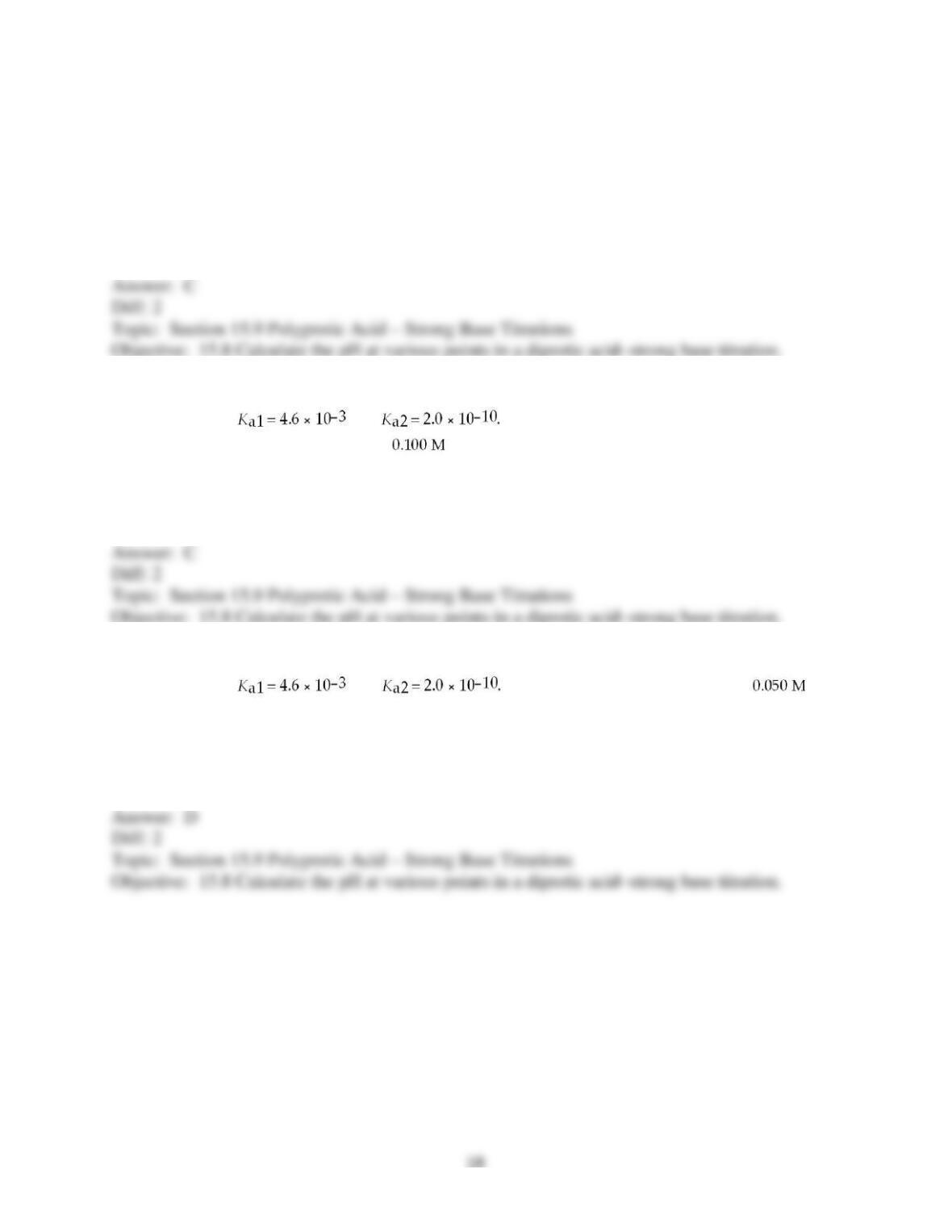
57) Oxalic acid, H2C2O4 has acid dissociation constants Ka1 = 5.9 × 10⁻² and Ka2 = 6.4 × 10–
5. What is the pH after 20.00 mL of 0.0500 M NaOH is added to 5.00 mL of 0.2000 M
H2C2O4?
A) 1.23
B) 2.10
C) 2.70
D) 4.19
58) The dissociation equilibrium constants for the protonated form of alanine (a diprotic amino
acid, H2X+) are and What is the pH of 50.00 mL of a 0.0500 M
solution of alanine after 25.00 mL of NaOH has been added?
A) 2.34
B) 4.85
C) 6.02
D) 6.72
59) The dissociation equilibrium constants for the protonated form of alanine (a diprotic amino
acid, H2X+) are and What is the pH of 50.00 mL of a
solution of alanine after 37.50 mL of 0.100 M NaOH has been added?
A) 4.85
B) 6.02
C) 7.39
D) 9.70
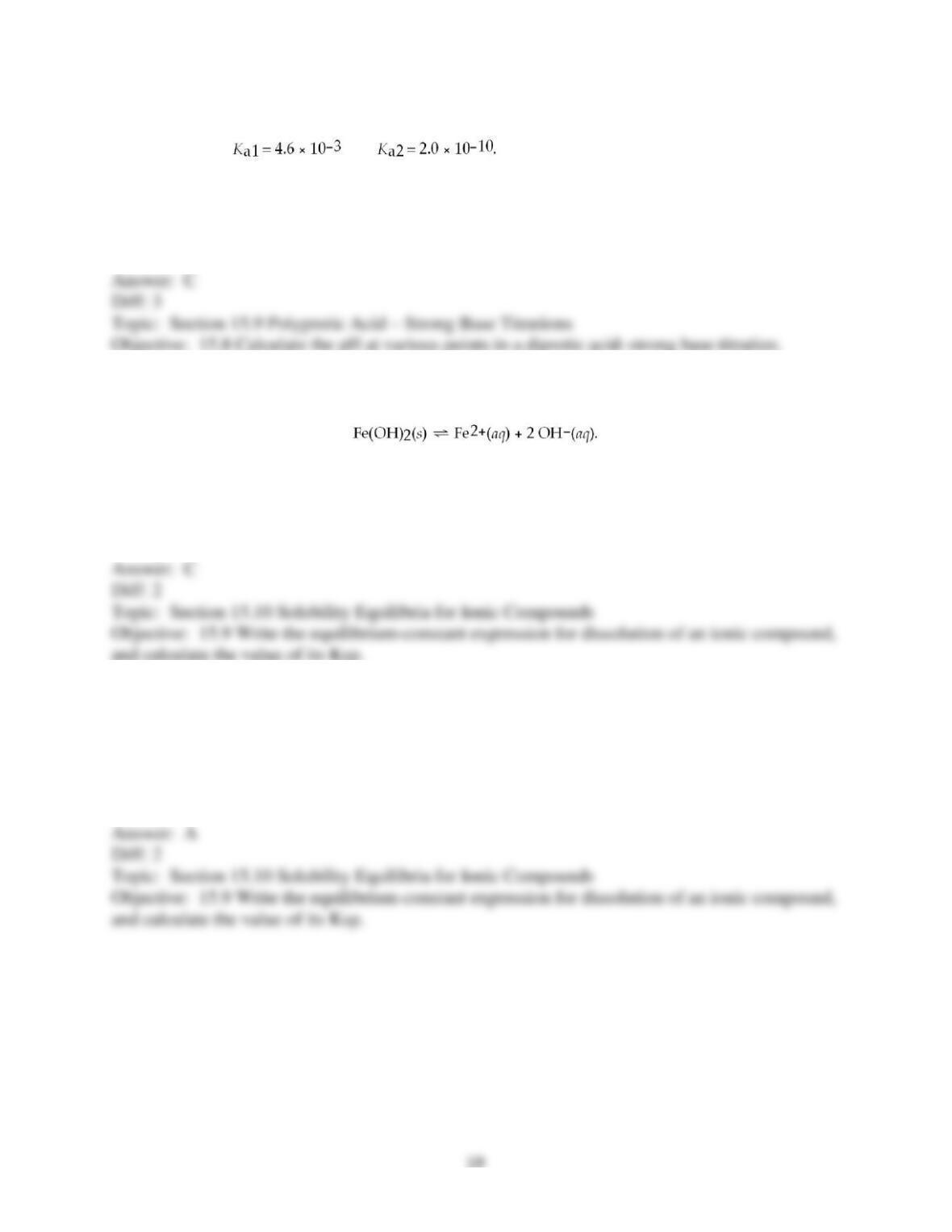
60) The dissociation equilibrium constants for the protonated form of alanine (a diprotic amino
acid H2X+) are and What is the pH of 50.00 mL of a 0.100 M
solution of alanine after 100.00 mL of 0.100 M NaOH has been added?
A) 9.70
B) 10.69
C) 11.85
D) 12.70
61) The balanced equation for the solubility equilibrium of Fe(OH)2 is shown below. What is
the equilibrium constant expression for the Ksp of Fe(OH)2?
A) Ksp = {[Fe2+][OH–]2}/{[Fe(OH)2][H2O]}
B) Ksp = {[Fe2+][OH–]2}/[Fe(OH)2]
C) Ksp = [Fe2+][OH–]2
D) Ksp = 1/{[Fe2+][OH–]2}
62) What is the equilibrium constant expression for the Ksp of Ca3(PO4)2?
A) Ksp = [Ca2+]3[PO43-]2
B) Ksp = {[Ca2+]3[PO43-]2}/[Ca3PO4]
C) Ksp = {[Ca2+]3[PO43-]2}/{[Ca3PO4][H2O]}
D) Ksp = 1/{[Ca2+]3[PO43-]2}
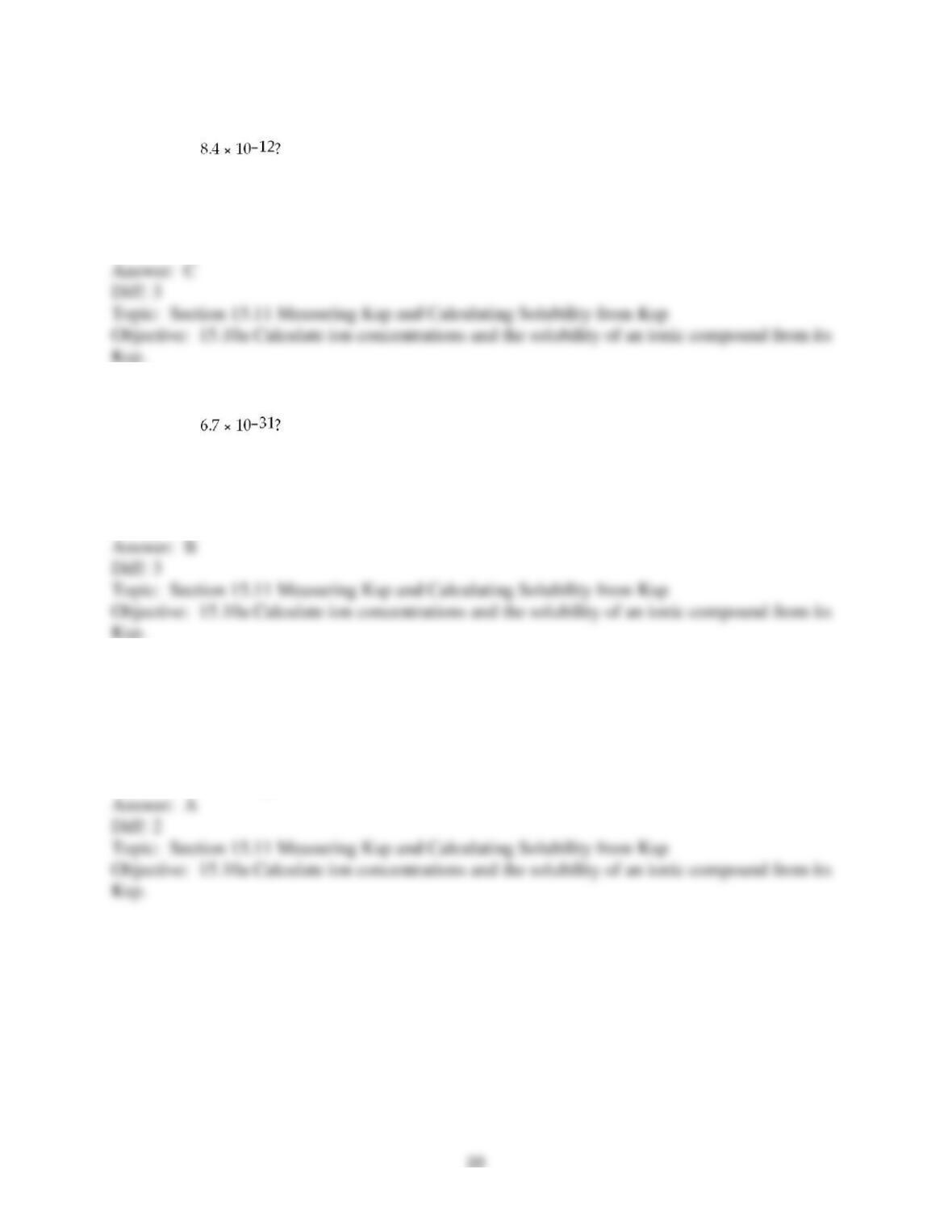
63) What is the silver ion concentration for a saturated solution of Ag2CO3 if the Ksp for
Ag2CO3 is
A) 2.90 × 10⁻⁶ M
B) 2.03 × 10⁻⁴ M
C) 2.56 × 10⁻⁴ M
D) 4.06 × 10⁻⁴ M
64) What is the chromium ion concentration for a saturated solution of Cr(OH)3 if the Ksp for
Cr(OH)3 is
A) 8.19 × 10⁻¹⁶ M
B) 1.26 × 10⁻⁸ M
C) 2.17 × 10⁻⁸ M
D) 3.76 × 10⁻⁸ M
65) What is the most soluble salt of the following set?
A) Ba(OH)2 with Ksp = 5.0 × 10⁻³
B) Ca(OH)2 with Ksp = 4.7 × 10⁻⁶
C) Cd(OH)2 with Ksp = 5.3 × 10⁻¹⁵
D) Fe(OH)2 with Ksp = 2.5 × 10-37