Microeconomics, 4e (Hubbard/O’Brien)
Chapter 15 Monopoly and Antitrust Policy
15.1 Is Any Firm Ever Really a Monopoly?
1) To enter a local cable television market, a firm needs a license from the city government. This
is an example of
A) a government-imposed barrier.
B) occupational licensing.
C) a natural monopoly.
D) the government maintaining consistent standards in the broadcast industry.
2) The National Football League owns the NFL Network, a 24-hour cable channel devoted
entirely to pro football. The network is available through satellite providers but several major
cable companies, including Time Warner, do not offer the network. If Taylor chooses to pay a
higher monthly charge by switching from cable to a satellite provider so he can watch the NFL
Network and Harriet chooses not to do the same, then
A) Taylor has lost some consumer surplus by paying the additional fee.
B) Harriet has gained some consumer surplus by not having to pay the additional fee.
C) Harriet’s demand for sports entertainment is more price elastic than Taylor’s demand.
D) Taylor’s demand for sports entertainment is more price elastic than Harriet’s demand.
3) A monopoly is a seller of a product
A) with many substitutes.
B) without a close substitute.
C) with a perfectly inelastic demand.
D) without a well-defined demand curve.
4) If we use a narrow definition of monopoly, then a monopoly is defined as a firm
A) that has been granted special production rights by the government.
B) that can ignore the actions of all other firms because it produces a superior product compared
to its rivals’ products.
C) that can ignore the actions of all other firms because it produces a product for which there are
no close substitutes.
D) that has the largest market share in an industry.
5) Which of following is the best example of a monopoly if we use a broader definition of
monopoly?
A) Spuds McKenzie, a wealthy potato farmer in Idaho
B) Cheap Gas, one of two gasoline stations in a large rural community
C) Santos Tacos, the only taqueria in the small town of Santosville
D) Zippie Rentals, a sports car rental service in the downtown Boston area
6) In Walnut Creek, California, there are three very popular supermarkets: Safeway, Whole
Foods and Lunardi’s. While Safeway remains open twenty-four hours a day, Whole Foods and
Lunardi’s close at 9 pm. Which of the following statements is true?
A) Safeway is a monopoly all day because it produces a service that has no close substitutes.
B) Safeway has a monopoly at midnight but not during the day.
C) Safeway can ignore the pricing decisions of the other two supermarkets.
D) Safeway probably has a higher markup to compensate for its higher cost of production.
7) A monopoly is characterized by all of the following except
A) there are only a few sellers each selling a unique product.
B) entry barriers are high.
C) there are no close substitutes to the firm’s product.
D) the firm has market power.
8) Peet’s Coffee and Teas produces some flavorful varieties of Peet’s brand coffee. Is Peet’s a
monopoly?
A) Yes, there are no substitutes to Peet’s coffee.
B) No, although Peet’s coffee is a unique product, there are many different brands of coffee that
are very close substitutes.
C) Yes, Peet’s is the only supplier of Peet’s coffee in a market where there are high barriers to
entry.
D) No, Peet’s is not a monopoly because there are many branches of Peet’s.
9) In 2011, Microsoft filed a complaint with the European Commission accusing Google of
taking steps to monopolize the Internet search engine business. Microsoft’s primary complaint
was that
A) Google is the only Internet search engine available to Windows operating system users.
B) the European Union contracts exclusively with Google for its Internet search engine use.
C) Google has prevented competitors from gaining access to needed content and data to provide
search results to consumers.
D) Google owns the Internet advertising companies that pay for ads on search engine sites, and
has prohibited ads from being sold to competitors.
10) A firm that has the ability to control to some degree the price of the product it sells
A) is also able to dictate the quantity purchased.
B) faces a demand curve that is inelastic throughout the range of market demand.
C) is a price maker.
D) faces a perfectly inelastic demand curve.
11) A monopolist faces
A) a perfectly elastic demand curve.
B) a perfectly inelastic demand curve.
C) a horizontal demand curve.
D) a downward-sloping demand curve.
12) Compared to a monopolistic competitor, a monopolist faces
A) a more elastic demand curve.
B) a more inelastic demand curve.
C) a more elastic demand curve at higher prices and a more inelastic demand curve at lower
prices.
D) a demand curve that has a price elasticity coefficient of zero.
13) A monopoly differs from monopolistic competition in that
A) a monopoly has market power while a firm in monopolistic competition does not have any
market power.
B) a monopoly can never make a loss but a firm in monopolistic competition can.
C) in a monopoly there are significant entry barriers but there are low barriers to entry in a
monopolistically competitive market structure.
D) a monopoly faces a perfectly inelastic demand curve while a monopolistic competitor faces
an elastic demand curve.
14) Which of the following is a characteristic shared by a perfectly competitive firm and a
monopoly?
A) Each must lower its price to sell more output.
B) Each sets a price for its product that will maximize its revenue.
C) Each maximizes profits by producing a quantity for which marginal revenue equals marginal
cost.
D) Each maximizes profits by producing a quantity for which price equals marginal cost.
15) Consider the following characteristics:
a. a market structure with barriers to entry
b. demand curves that are easily identified
c. firm cannot make zero profits in the long run
d. firm can reap long run profits.
Which of the characteristics in the list above is shared by an oligopolist and a monopolist?
A) a, b, c and d
B) a, b and d
C) a, c, and d
D) a and d
16) A monopoly is defined as a firm that has the largest market share in an industry.
17) The market demand curve facing a monopolist is more elastic than the market demand curve
facing a monopolistic competitor.
18) Joe Santos owns the only pizza parlor in a small town that is also home to a McDonald’s, a
Taco Bell and a Kentucky Fried Chicken. Using a broad definition of a monopoly, Joe has a
monopoly.
19) What is a monopoly? Can a firm be a monopoly if close substitutes for its product exists?
15.2 Where Do Monopolies Come From?
1) To maintain a monopoly, a firm must have
A) a perfectly inelastic demand.
B) an insurmountable barrier to entry.
C) marginal revenue equal to demand.
D) few competitors.
2) Which one of the following about a monopoly is false?
A) A monopoly could make profits in the long run.
B) A monopoly could break even in the long run.
C) A monopoly must have some kind of government privilege or government imposed barrier to
maintain its monopoly.
D) A monopoly status could be temporary.
3) A local electricity-generating company has a monopoly that is protected by an entry barrier
that takes the form of
A) control of a key raw material.
B) network externalities.
C) economies of scale.
D) perfectly inelastic demand curve.
4) A patent or copyright is a barrier to entry based on
A) ownership of a key necessary raw material.
B) large economies of scale as output increases.
C) government action to protect a producer.
D) widespread network externalities.
5) A public franchise
A) is a corporation that is owned by stockholders.
B) results from ownership of a key raw material.
C) is a government designation that a private firm is the only legal producer of a good or service.
D) is an unregulated monopoly necessary for the public good.
6) An example of a monopoly based on control of a key resource is
A) Major League Baseball.
B) the Paul Ecke Ranch monopoly on poinsettias.
C) Microsoft’s Windows operating system.
D) the U.S. Food and Drug Administration.
7) A United States government patent lasts
A) forever.
B) 50 years.
C) 20 years.
D) 7 years.
8) Governments grant patents to encourage
A) research and development on new products.
B) competition.
C) low prices.
D) firms to form public enterprises.
9) Governments grant patents to
A) compensate firms for research and development costs.
B) encourage competition.
C) encourage low prices.
D) encourage firms to reveal secret production techniques.
10) For which of the following firms is patent protection of vital importance?
A) furniture producers
B) software firms
C) pharmaceutical firms
D) auto makers
11) One reason patent protection is vitally important to pharmaceutical firms is
A) successful new drugs are not profitable. If firms are not granted patents many would go out of
business and health care would be severely diminished.
B) the approval process for new drugs through the Food and Drug Administration can take more
than 10 years and is very costly. Patents enable firms to recover costs incurred during this
process.
C) that taxes on profits from drugs are very high; profits from patent protection enable firms to
pay these taxes.
D) the high salaries pharmaceutical firms pay to scientists and doctors make their labor costs
higher than for any other business. Profits from patents are needed to pay these labor costs.
12) Research has shown that most economic profits from selling a prescription drug are
eliminated 20 years after the drug is first offered for sale. The main reason for the elimination of
profits is
A) after 20 years most people who have taken the drug have passed away or are cured of the
illness the drug was intended to treat.
B) firms sell their patent rights to other firms so that they can concentrate on finding drugs to
treat new illnesses.
C) the quantity demanded of the drug has increased enough that the demand becomes inelastic
and revenue falls.
D) after 20 years patent protection is ended and other firms can produce less expensive generic
versions of the drug.
13) What is the difference between a public franchise and a public enterprise?
A) A public franchise grants a firm the right to be the sole legal provider of a good or service. A
public enterprise refers to a service that is provided directly to consumers through the
government.
B) A public enterprise grants a firm the right to be the sole legal provider of a good or service. A
public franchise refers to a service that is provided directly to consumers through the
government.
C) A public enterprise is owned by the public through its holdings of shares of stock in the
enterprise. A public franchise is a firm owned by the government.
D) Both refer to a service provided directly to consumers through the government, but “public
franchise” is a term more commonly used in the United States while “public enterprise” is more
commonly used in European countries.
14) The United States Post Office
A) faces no competition for its mail services.
B) has a monopoly in the provision of first-class mail service.
C) can safely ignore the prices for mail services charges by its rivals such as FedEx and UPS.
D) is an example of a monopoly that results from the ownership of a key resource: first class
mail service.
15) The Aluminum Company of America (Alcoa) had a monopoly until the 1940s because
A) it was a public enterprise.
B) it had a patent on the manufacture of aluminum.
C) the company had a secret technique for making aluminum from bauxite.
D) it had control of almost all the available supply of bauxite.
16) The Ecke’s family virtual monopoly on commercial poinsettia production by grafting
together two varieties of the plant ended around 1996 when university researchers were able to
independently make the same discovery. The Ecke family did not patent their grafting process.
Would the Ecke’s have been better off if they had patented their process of growing poinsettias?
A) Yes, it would have allowed them to earn economic profits indefinitely.
B) That depends on how long they had a monopoly before university researchers made the
discovery. If the discovery was made after the period of time when patents expire, then the Ecke
family is not any better off.
C) No, even with a patent protection, the Ecke family cannot prevent government-funded
academic institutions from researching into plant breeding.
D) No, seeking patent protection necessitates divulging enough information that would enable
others to information to discover ways of grafting poinsettias that were similar to the Ecke
method but that did not violate the patent.
17) The De Beers Company, one of the longest-lived monopolies, is facing increasing
competition. One source of competition comes from people who might resell their previously
owned diamonds. Why is De Beers worried that people might resell their previously owned
diamonds?
A) because De Beers will not be able to guarantee the quality of previously owned diamonds and
fears that its reputation might be harmed
B) because the availability of previously owned diamonds would increase the market demand for
diamonds and dilute De Beers’ monopoly
C) because previously owned diamonds would be a close substitute to newly mined diamonds
and therefore reduce De Beers’ market power
D) because the availability of previously owned diamonds would make the market demand curve
for diamonds more inelastic and force De Beers to lower its price
18) What is a network externality?
A) It refers to having a network of suppliers and buyers for a good or service.
B) It refers to lobbying to form a public enterprise.
C) It refers to a situation in which a product’s usefulness increases with the number of people
using it.
D) It refers to a product that requires connection to a network for it to be useful.
19) A virtuous cycle occurs
A) when lobbyists petition members of Congress to grant a public franchise; the lobbyist then
raise money for those Congress members who granted the franchise.
B) when monopoly profits are used to create new products for additional monopoly profits.
C) when a firm can attract enough buyers initially to increase a product’s usefulness to attract
even more buyers.
D) when a firm’s sales volume reaches a level where the firm can take advantage of economies of
scale; thereby reducing the price of the product to further boost its sales.
20) For a natural monopoly to exist,
A) a firm must continually buy up its rivals.
B) a firm’s long-run average cost curve must exhibit diseconomies of scale beyond the
economically efficient output level.
C) a firm’s long-run average cost curve must exhibit economies of scale throughout the relevant
range of market demand.
D) a firm must have a government-imposed barrier.
21) In a natural monopoly, throughout the range of market demand
A) marginal cost is above average total cost and pulls average total cost upward.
B) average total cost is above marginal cost and pulls marginal cost upward.
C) marginal cost is below average total cost and pulls average total cost downward.
D) there are diseconomies of scale.
22) A natural monopoly is characterized by large fixed costs relative to variable costs.
23) For a natural monopoly, the marginal cost of producing an additional unit of its product is
relatively small.
24) The National Football League has long-term leases with the stadiums in major cities. Control
of these stadiums is an entry barrier to a potential new football league.
25) Most pharmaceutical firms selling prescription drugs continue to earn economic profits long
after the patents on the prescription drugs expire because they have established a strong foothold
in the market.
26) Provide two examples of a government barrier to entry?
27) How does a network externality serve as a barrier to entry? Is this barrier surmountable?
Explain.
28) What gives rise to a natural monopoly? How do consumers benefit from a natural monopoly?
15.3 How Does a Monopoly Choose Price and Output?
1) The demand curve for the monopoly’s product is
A) the market demand for the product.
B) more elastic than the market demand for the product.
C) more inelastic than the market demand for the product.
D) undefined.
2) A monopolist’s profit maximizing price and output correspond to the point on a graph
A) where average total cost is minimized.
B) where total costs are the smallest relative to price.
C) where marginal revenue equals marginal cost and charging the price on the market demand
curve for that output.
D) where price is as high as possible.
3) Microsoft hires marketing and sales specialists to decide what prices it should set for its
products, whereas a wealthy corn farmer in Iowa, who sells his output in the world commodity
market, does not. Why is this so?
A) because Microsoft is large enough to hire the best people in the field
B) because Microsoft could potentially lose sales if it sets prices indiscriminately
C) because the wealthy corn farmer is a price taker who chooses his optimal output
independently of market price but Microsoft’s optimal output depends on the price it selects
D) because unlike Microsoft, the wealthy corn farmer is probably a monopolist
4) Because a monopoly’s demand curve is the same as the market demand curve for its product,
A) the monopoly’s marginal revenue equals its price.
B) the monopoly is a price taker.
C) the monopoly must lower its price to sell more of its product.
D) the monopoly’s average total cost always falls as it increases its output.
5) If a theatre company expects $250,000 in ticket revenue from five performances and $288,000
in ticket revenue if it adds a sixth performance, the
A) marginal revenue of the sixth performance is $48,000.
B) marginal revenue of the sixth performance is $38,000.
C) cost of staging the sixth performance is probably higher than the cost of staging the previous
five.
D) company will be making a loss on the sixth performance because its ticket sales will be less
than the average received from the previous five.
6) If a monopolist’s price is $50 per unit and its marginal cost is $25, then
A) to maximize profit the firm should increase output.
B) to maximize profit the firm should decrease output.
C) to maximize profit the firm should continue to produce the output it is producing.
D) Not enough information is given to say what the firm should do to maximize profit.
7) If a monopolist’s marginal revenue is $25 a unit and its marginal cost is $25, then
A) to maximize profit the firm should increase output.
B) to maximize profit the firm should decrease output.
C) to maximize profit the firm should continue to produce the output it is producing.
D) Not enough information is given to say what the firm should do to maximize profit.
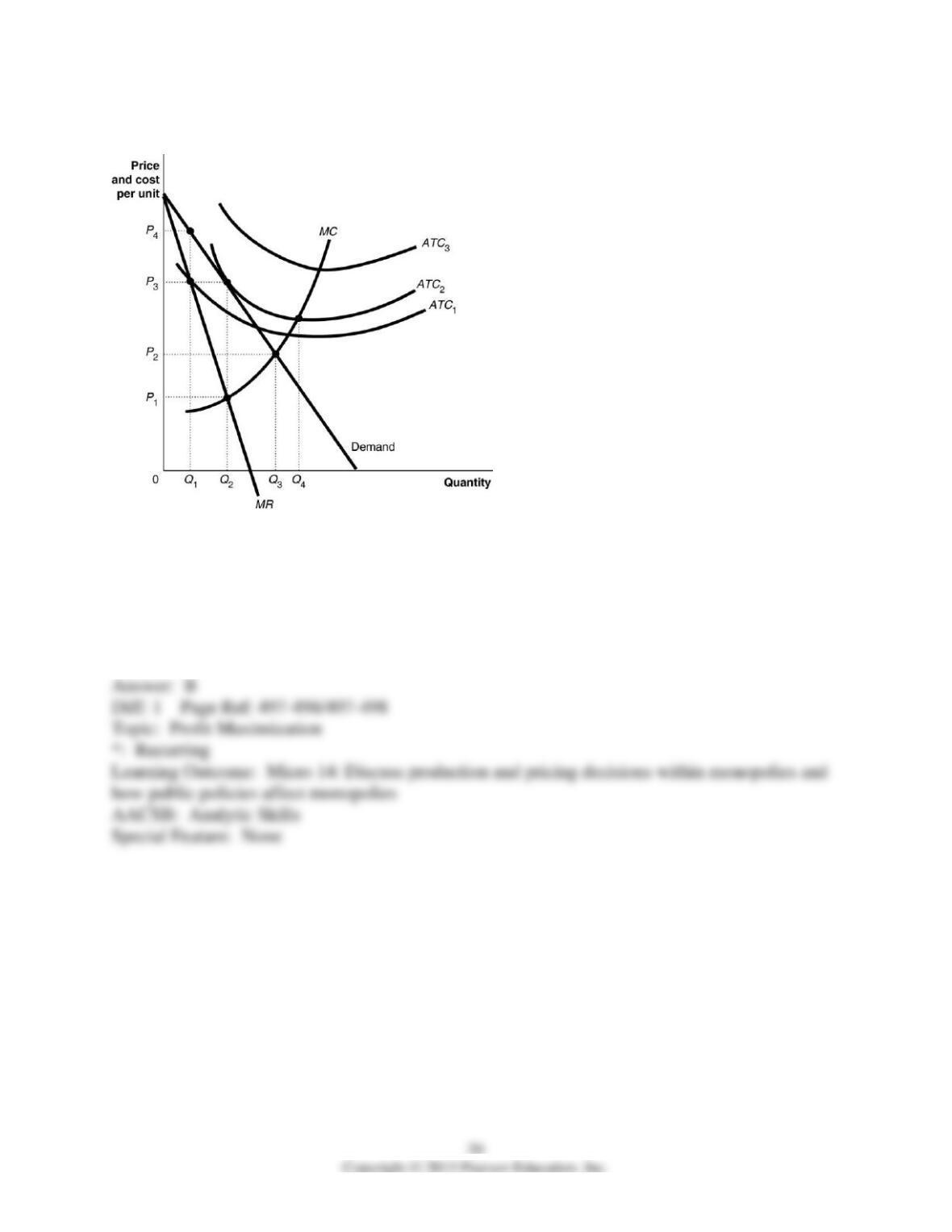
Figure 15-1
Figure 15-1 above shows the demand and cost curves facing a monopolist.
8) Refer to Figure 15-1. To maximize profit, the firm will produce
A) Q1.
B) Q2.
C) Q3.
D) Q4.