Chapter 15—The Strategic Use of Managerial Accounting
Information Key
1. The key to achieving long-term growth and success is for a company to:
2. When a company’s goal is to provide the same or better value to customers at a lower cost than its
competitors, then the company is pursuing a:
3. Which of the following statements is false regarding the cost leadership strategy?
4. Johnson’s Hardware store is a locally owned and operated hardware store located in Richmond, Virginia. The
store is known for its great customer service and knowledgeable sales people. The store’s primary competition
includes a large national chain hardware and lumber store. Johnson’s strategy for obtaining a competitive
advantage is probably:
5. When a company’s goal is to distinguish a product or service it offers from those of its competitors, the
company is most likely pursuing a:
6. When a company intentionally selects or emphasizes a particular market or customer segment in which to
compete, the company is most likely pursuing a:
7. When increases or decreases in price affect the demand for a product, the product is described as being:
8. The demand for products whereby price increases or decreases have little effect on the demand for such
products is often described as being:
9. In the long run, the price of a product must be high enough to provide a profit as well as covering:
10. Which of the following formulas is correct for the determination of target cost?
11. When the price of a product is established by market conditions and firms determine the desired cost of the
product that must be met in order to reach a target profit, the company is using:
12. A computer manufacturer has determined that in order to be competitive, the selling price of their desktop
computer should not exceed $1,400. The company has determined that in order to earn a sufficient profit, the
cost of the computer should not exceed $800. Determining the maximum cost of the computer in this fashion is
called:
13. To analyze the tradeoffs between product cost and product functionality, companies frequently use:
14. A manufacturer is developing a new type of consumer electronic which will have a target price of $325. In
order to maintain a target profit equal to 30 percent of the new product’s cost, the target cost should be:
15. A manufacturer is developing a new type of vacuum cleaner which will have a target price of $450. In order
to maintain a target profit equal to 35 percent of the new product’s cost, the target cost should be:
16. Chaudron Ltd. plans to come out with a new line of pots and pans. Marketing studies have indicated that a
target price of $500 should be set for a complete set of pots and pans. If the company’s target profit is 40 percent
of cost, what should be the target cost for the new product line?
17. Which type of pricing is a company using when a desired markup is added to the product’s base cost to
determine the sales price?
18. In cost-plus pricing, the markup percentage:
19. In cost-plus pricing, the markup percentage should be sufficient to:
20. HNT Inc. has begun production on a new type of television satellite dish. The primary cost of the dish is
direct materials with a cost of $50. Direct labor is estimated to be $8 per unit, overhead is estimated to be $10
per unit, and selling and administrative expenses are estimated to be $5 per unit.
If HNT desires a profit of $75 per unit, what is the required markup on direct materials?

21. Putnam Inc. has begun production on a new electronic product. The primary cost of the product is direct
materials with a cost of $30. Direct labor is estimated to be $5 per unit, overhead is estimated to be $3 per unit,
and selling and administrative expenses are estimated to be $2 per unit.
If Putnam desires a profit of $50 per unit, what is the required markup on direct materials?
22. Benning Inc.
Benning Inc. manufactures and installs residential decks. The company is preparing to bid on a competitive job.
Benning estimates that the job will have the following costs:
Direct materials
$1,600
Direct labor
900
Overhead
400
Selling and administrative costs
240
Benning would like to earn a $1,500 profit on the job. The company applies a markup on cost of goods sold to arrive at an initial bid price.
Refer to the Benning Inc. information above. What is the markup percentage on the above job?
23. Benning Inc.
Benning Inc. manufactures and installs residential decks. The company is preparing to bid on a competitive job.
Benning estimates that the job will have the following costs:
Direct materials
$1,600
Direct labor
900
Overhead
400
Selling and administrative costs
240
Benning would like to earn a $1,500 profit on the job. The company applies a markup on cost of goods sold to arrive at an initial bid price.
Refer to the Benning Inc. information above. What should be Benning’s initial bid?
24. Walters Inc.
Walters Inc. power washes commercial and residential buildings. The company is preparing to bid on a
competitive job involving a large commercial building. Walters estimates that the job will have the following
costs:
Direct materials
$ 500
Direct labor
1,500
Overhead
400
Selling and administrative costs
200
Walters would like to earn a $1,600 profit on the job. The company applies a markup on cost of goods sold to arrive at an initial bid price.
Refer to the Walters Inc. information above. What is the markup percentage on the above job?
25. Walters Inc.
Walters Inc. power washes commercial and residential buildings. The company is preparing to bid on a
competitive job involving a large commercial building. Walters estimates that the job will have the following
costs:
Direct materials
$ 500
Direct labor
1,500
Overhead
400
Selling and administrative costs
200
Walters would like to earn a $1,600 profit on the job. The company applies a markup on cost of goods sold to arrive at an initial bid price.
Refer to the Walters Inc. information above. What should be Walters initial bid?
26. Which of the following pricing strategies is used most often in service industries in which labor is the
primary cost incurred?
27. Jones and Martin Consulting Inc. charges its clients a fee equal to 15 percent of the cost savings that result
from the consulting services they provide. Jones and Martin is most likely using:
28. When foreign companies sell products in the United States below cost in order to drive out competition, the
practice is called:
29. When a company prices a new product at a low initial price but still above cost to build market share or to
quickly establish a customer base, they are most likely using:
30. When a company prices a new product at an extremely low price, often below cost, for the purpose of
injuring or eliminating competitors, they are most likely using:
31. Immediately after a recent hurricane off the coast of Florida, some companies doubled the normal price for
plywood. Companies that do this are often accused of:
32. Which of the following types of pricing strategies is most likely to be considered illegal?
33. Value chain analysis requires a thorough understanding of:
34. Which of the following statements about the value chain is false?
35. Fundamental decisions concerning the basic size and scope of an organization’s operations are often
classified as:
36. Fundamental decisions concerning how a company is organized and how decisions are made within the
company are often classified as:
37. Fundamental decisions concerning the day-to-day activities undertaken as a product is manufactured or a
service provided are often classified as:
38. Which of the following activities is not a structural activity decision?
39. Which of the following activities is not an organizational activity decision?
40. Which of the following activities is not an operational activity decision?
41. Relationships among activities that are performed within a company’s portion of the value chain are often
called:
42. Relationships that are performed between a company’s own value chain and those of its suppliers and
customers are called:
43. The primary goal of supply-chain management is:
44. Which of the following statements regarding supply-chain management is false?
45. In customer relationship management (CRM), a company should differentiate its customers by:
47. Which of the following would be the least likely to be found when a company customizes its business to its
customers?
48. The cost dimension of activity-based management focuses on:
49. Which of the following statements about activity-based management (ABM) is true?
50. Which of the following is a goal of activity-based management (ABM)?
51. In order to identify and eliminate non-value-added activities and costs, companies may implement:
52. The primary goal of activity-based management (ABM) is to:
53. The term used to describe a linked set of value-creating activities is called:
54. Which of the following would be the best example of a non-value-added activity?
55. Which of the following is true regarding activity-based management (ABM)?
56. Which of the following statements is true regarding non-value-added activities?
57. List and briefly describe the goals of the three primary strategies that companies use to obtain a competitive
advantage.
58. What are meant by the terms elastic and inelastic demand? Give an example of each.
59. Briefly describe what is meant by the term “target pricing”.
60. Briefly describe what is meant by the term “cost-plus pricing”.
61. William Eller has just started up his own CPA firm. The firm will provide mostly audit services to its
clients. William anticipates that some audits will take as little as three days while others may take up to three
weeks. What kind of pricing strategy would you suggest that William use and why?
62. Explain the difference between penetration pricing and price skimming.
63. L. Baker is the store owner and manager for a local home improvement store located in a town along the
east coast of the United States. In September, a nearby town was devastated by a hurricane and, as a
consequence, his store anticipates a tremendous increase in sales of building supplies. He has been advised to
quickly double the sales prices on his most popular supplies to take advantage of the increased demand.
Do you think it would be legal and/or ethical for L. Baker to double his prices? Why or why not?
64. What is a “value chain”? Give several examples of activities in a value chain.
65. Briefly describe supply-chain management and give one specific example of its application.
66. What is the goal of customer relationship management (CRM)? List at least two types of processes a
company can perform to achieve its goal.
67. How can a manager determine whether an activity is value-added or non-value-added? Why is it beneficial
to make this determination? Provide one example of a value-added and non-value-added activity in the
production of a bicycle.

68. A manufacturer is developing a new type of consumer electronic which will have a target price of $250. The
company likes to maintain a target profit equal to 30 percent of the product’s cost.
Required: Calculate the target cost of the product.
69. A manufacturer is developing a new board game geared towards children. To be competitive with other
board games, the company has set a target price of $25 for the game. The company likes to maintain a target
profit equal to 35 percent of the product’s cost.
Required: Calculate the target cost of the product.
70. A food manufacturer is developing a new frozen dinner that will be made using only organic ingredients. To
be competitive with frozen food items, the company has set a target price of $5 for the product. The company
likes to maintain a target profit equal to 55 percent of the product’s cost.
Required: Calculate the target cost of the product.
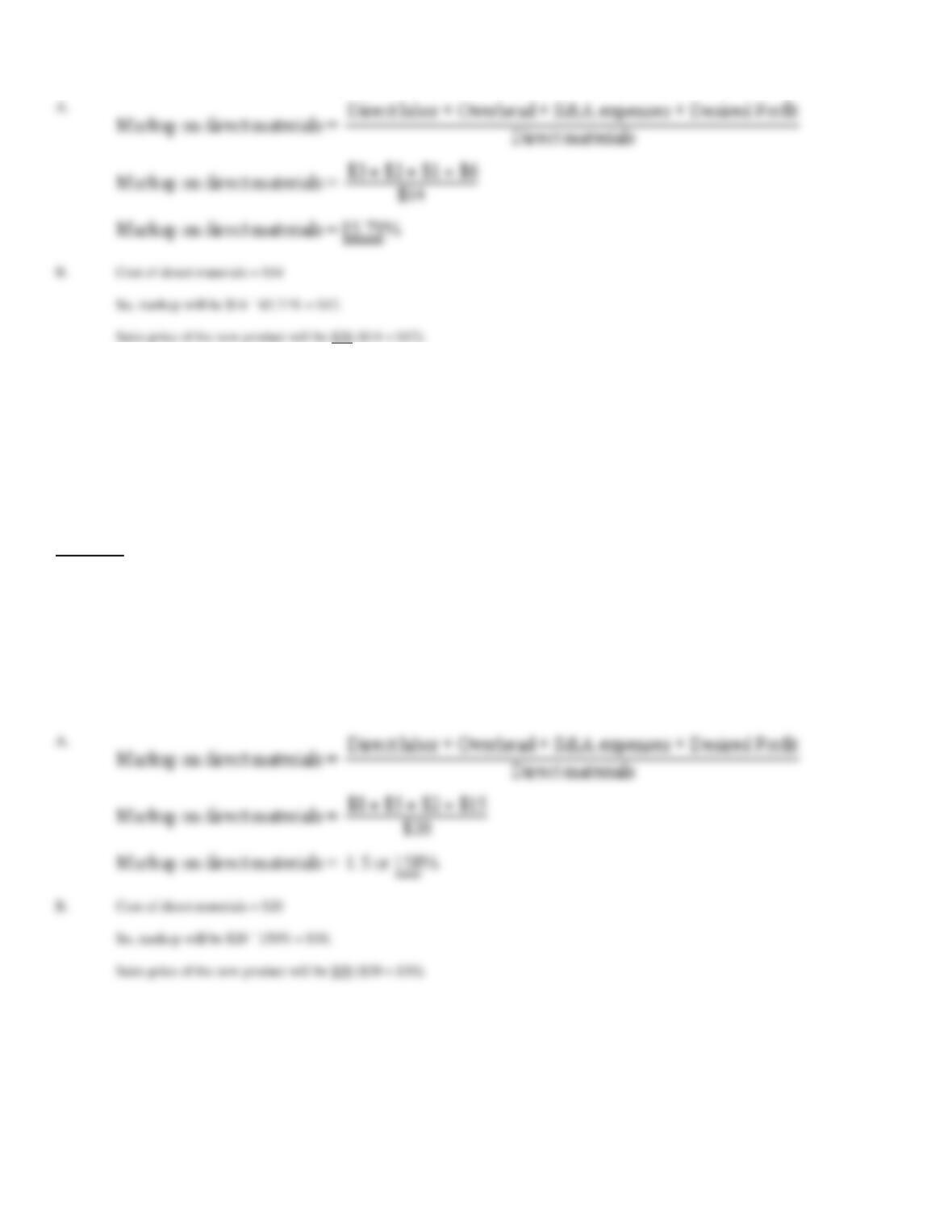
71. JEB Inc. has begun production on a new product. The primary cost of the product is direct materials with a
cost of $14. Direct labor is estimated to be $3 per unit, overhead is estimated to be $2 per unit, and selling and
administrative expenses are estimated to be $1 per unit.
JEB desires a profit of $6 per unit.
Required:
A.
What is the required markup percentage on direct materials in order to achieve the desired profit? Round the percentage to two decimal
places.
B.
What will be the sales price of the new product?
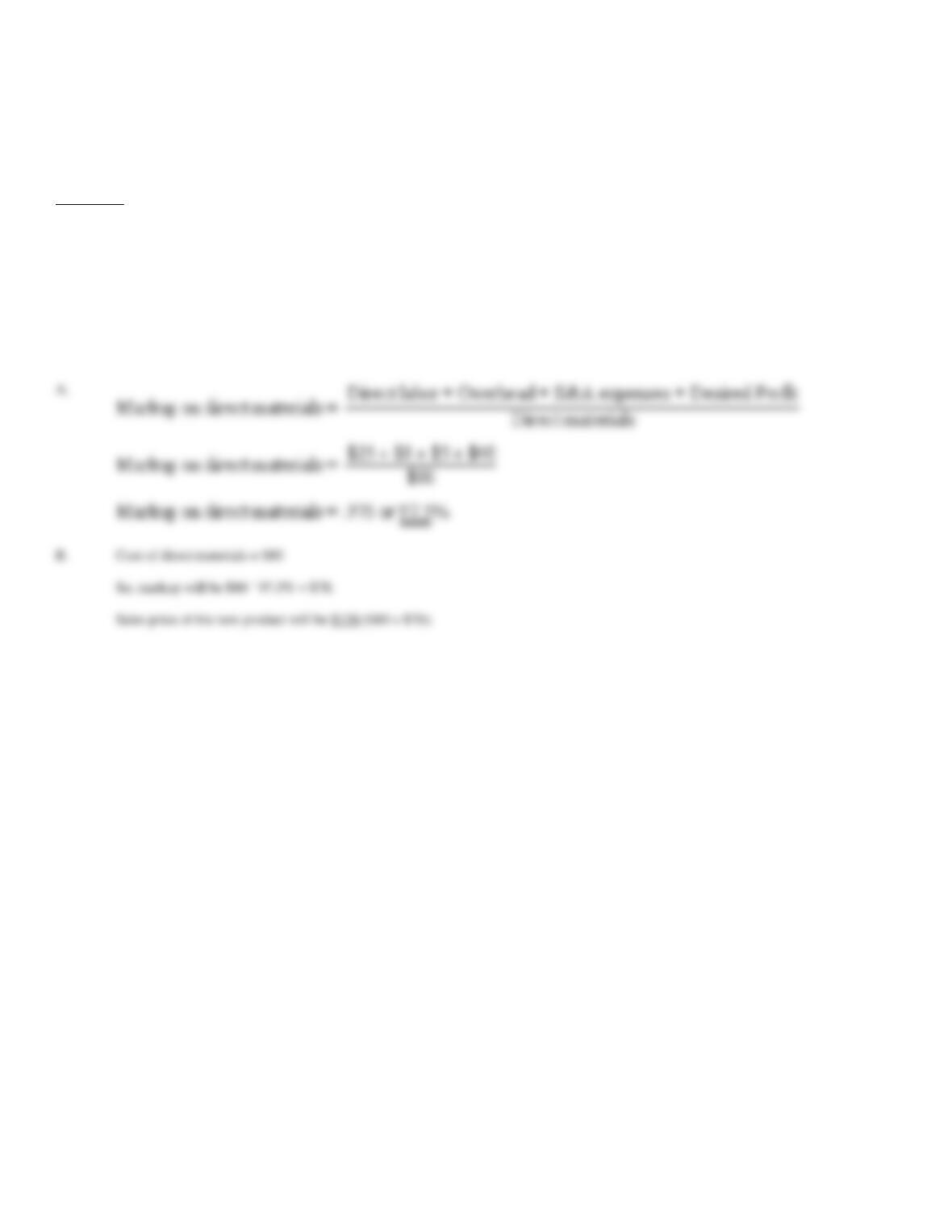
72. Tamara Ltd. has begun production on a new product. The primary cost of the product is direct materials
with a cost of $20. Direct labor is estimated to be $8 per unit, overhead is estimated to be $5 per unit, and
selling and administrative expenses are estimated to be $2 per unit.
Tamara desires a profit of $15 per unit.
Required:
A.
What is the required markup percentage on direct materials in order to achieve the desired profit? Round the percentage to two decimal
places.
B.
What will be the sales price of the new product?
So, markup will be $20 ´ 150% = $30.
Sales price of the new product will be $50 ($20 + $30).
B.
Cost of direct materials = $14
So, markup will be $14 ´ 85.71% = $12.
Sales price of the new product will be $26 ($14 + $12).
73. Justin Manufacturing Inc. has begun production on a new product. The primary cost of the product is direct
materials with a cost of $80. Direct labor is estimated to be $25 per unit, overhead is estimated to be $8 per unit,
and selling and administrative expenses are estimated to be $5 per unit.
Justin desires a profit of $40 per unit.
Required:
A.
What is the required markup percentage on direct materials in order to achieve the desired profit? Round the percentage to two decimal
places.
B.
What will be the sales price of the new product?
B.
Cost of direct materials = $80
So, markup will be $80 ´ 97.5% = $78.
Sales price of the new product will be $158 ($80 + $78).