Environment: Science Behind the Stories, 2e Cdn. Ed. (Withgott)
Chapter 15 Global Climate Change
15.1 Graph and Figure Interpretation Questions
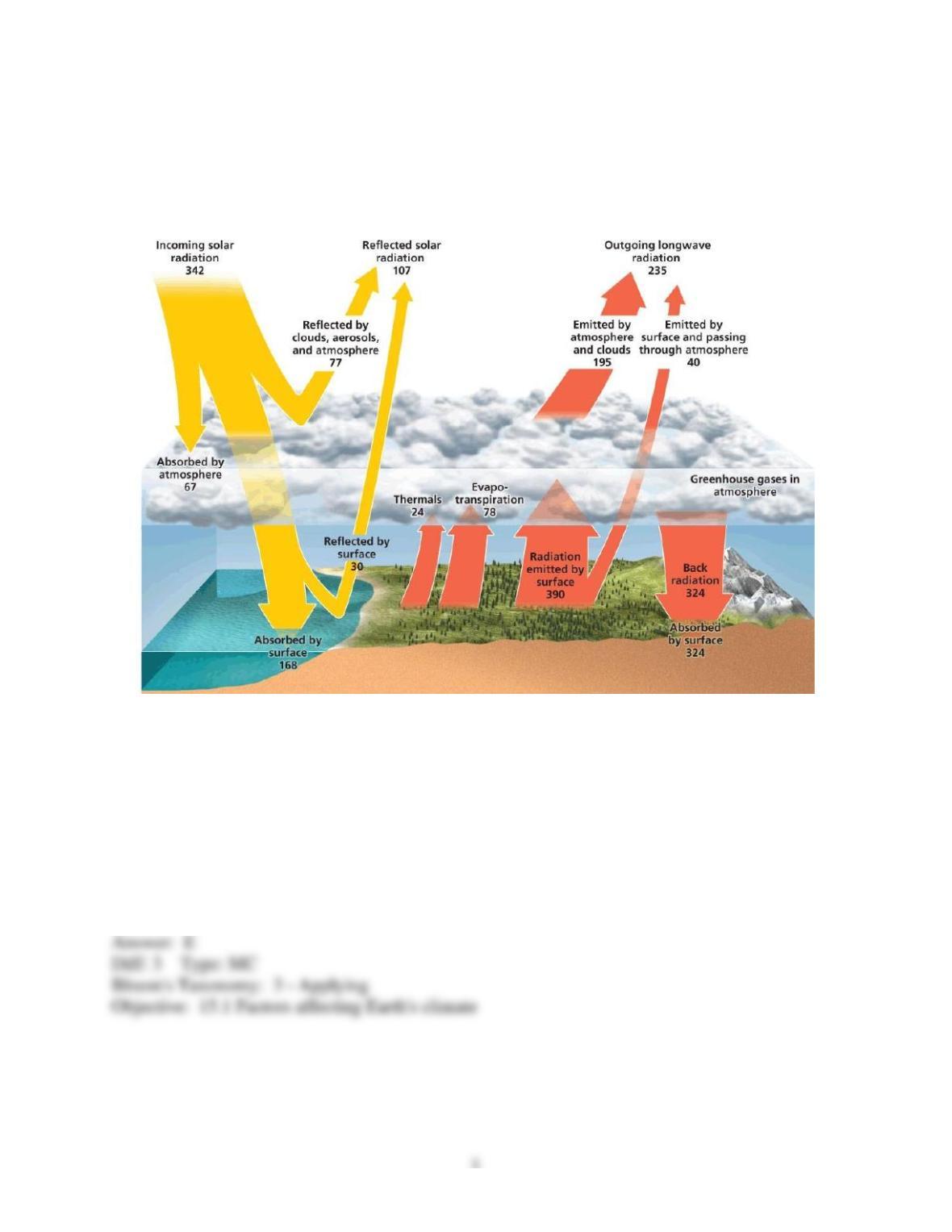
Figure 15.1
Use Figure 15.1 to answer the following questions.
1) Refer to Figure 15.1. What percentage of solar radiation is likely to increase the most as a
result of the geo-engineering scheme in which sulphur aerosols are injected into the atmosphere?
A) 40
B) 107
C) 195
D) 67
E) 77

2) Refer to Figure 15.1. What is the value of the planetary albedo according to this figure?
A) = 324/390
B) = 107/342
C) = 77/342
D) = (24+78)/168
E) = 390/324
3) Refer to Figure 15.1. What is the number on the arrow that best describes the greenhouse
effect?
A) 235
B) 342
C) 390
D) 77
E) 324
15.2 Matching Questions
Match the following.
A) sulphate aerosol
B) An Inconvenient Truth
C) argon
D) ammonia
E) nitrous oxide
F) water vapour
G) ozone
H) methane
I) carbon dioxide
J) biodiesel
K) The Day After Tomorrow
1) Predominant greenhouse gas produced by burning fossil fuels
2) Produced by microbes decomposing matter in landfills
3) By-product of feedlots, chemical manufacturing, auto emissions, and fertilizer use
4) Most abundant natural greenhouse gas
5) Compound that contributes to short-term atmospheric cooling
6) Greenhouse gas that absorbs the Sun’s incoming short–wavelength radiation
7) In 2006-2007 millions of lay citizens were powerfully educated about the reality, evidence,
and consequences of global climate change by this film
Diff: 1 Type: MA
Bloom’s Taxonomy: 1 – Remembering
Objective: 15.5 Response to climate change
15.3 Short Answer Questions
1) Define the term greenhouse gas and list examples.
2) Using the environmental properties discussed in this chapter (atmosphere, ocean currents,
pollutants), explain why protecting the environment often requires international legislation.
3) Distinguish between the terms weather and climate, and briefly discuss how each affects
species distribution within ecosystems.
4) Briefly explain how increased evaporation may affect the Earth’s temperature.
5) Briefly explain why there can be seasonal variation in carbon dioxide concentrations in the
troposphere.
6) Explain how human health may suffer or benefit from global climate change.
7) What is the difference between global warming and global climate change?
8) The greenhouse gas produced by herds of cattle is ________.
9) ________ act as carbon sinks, and their removal, especially in areas where they are slow to
recover, can reduce the biosphere’s ability to absorb carbon dioxide from the atmosphere.
10) In what two major environmental problems are halocarbons involved?
11) Give an example of positive feedback in climate change.
12) ________ is the separation and differential concentration of isotopes of slightly different
mass.
13) Water in the ocean evaporates. Water vapour drifts over the land and precipitates in the form
of rain. List the three reservoirs of water—ocean, vapour, rain—in the order of increasing
enrichment in deuterium.
14) List some paleoclimate properties that correlate well in the last 800 000 years based on the
Antarctic ice cores.
15) Climate change skeptics often imply that since cold and warm periods existed long before
humans this proves that climate changes are natural, so whatever climate changes we observe
now must also be “natural” and therefore we cannot be responsible for them. What’s the problem
with this argument? Can you use the results from the ice core to illustrate your point?
15.4 Multiple-Choice Questions
1) The largest source of anthropogenic greenhouse gases in Canada is ________, followed by
________.
A) oil, gas, and coal industries; transportation
B) electricity generation; transportation
C) transportation; oil, gas, and coal industries
D) electricity generation; oil, gas, and coal industries
E) oil, gas, and coal industries; electricity generation

2) The atmosphere around Earth is warmed because ________.
A) warm air cannot escape, as in a greenhouse
B) molecules in the atmosphere can absorb radiation from Earth
C) fossil fuels release heat during burning
D) plants absorb CO2
E) plants release CO2
3) Earth’s climate ________.
A) has been stable over the history of the planet
B) is changing as a result of natural and human processes
C) will stabilize over the next century, according to the predictions of most scientists
D) has been documented to have changed once because of the evolution of green
photosynthesizing plants
E) history is undeterminable because there is no method of studying past climates
4) Of the following greenhouse gases, ________ concentrations have increased the most since
1750.
A) water vapour
B) carbon dioxide
C) nitrous oxide
D) ozone
E) methane
5) Carbon dioxide is ________.
A) the most potent of the greenhouse gases (per molecule of gas)
B) the most abundant greenhouse gas
C) more potent than methane (per molecule of gas)
D) the main anthropogenic greenhouse gas produced in Canada
E) the only greenhouse gas presently increasing in the atmosphere

6) Milankovitch cycles ________.
A) refer to shifts in the temperature of surface water in the middle latitudes of the Pacific Ocean
B) are changes in Earth’s rotation and orbit around the Sun that may trigger climate variation
C) describe the timing of the northern lights in the thermosphere
D) describe the transpiration, evaporation, and precipitation of Earth’s water
E) describe the pattern of upwelling and downwelling in the ocean
7) The exceptionally strong warming of the eastern Pacific is referred to as ________.
A) the Coriolis effect
B) La Niña
C) El Niño
D) Eastern Pacific Shallow Water Warming
E) Eastern Pacific Deep Water Warming
8) The Intergovernmental Panel on Climate Change ________.
A) constructed the Kyoto Protocol
B) performed the research included in the climate change findings
C) is an international panel that concluded that climate change has influenced biomes and
economies
D) fines companies that pollute
E) could not achieve its objectives because of lack of popular support
9) The reports from Mauna Loa demonstrated ________.
A) an increase in CO2 from the 1950s to the present
B) that sediments deposited on the seafloor can yield clues about past climates
C) that as distances from cities decreased, CO2 concentrations increased
D) that CO2 levels have been stable over the last 40 years
E) the presence of El Niño
10) Carbon-based fuels from lithospheric reservoirs ________.
A) have formed slowly over many millions of years
B) is readily lost from Earth’s surface in the absence of humans
C) is formed from the deposition, partial decay, and compression of inorganic matter
D) cannot be lost to the atmosphere by human processes once stabilized on Earth’s surface
E) will be lost before the end of the decade
11) The Kyoto Protocol ________.
A) increased federal funding for controlling greenhouse gas emissions from U.S. power plants
B) required concessions in greenhouse gas emissions equally from all countries
C) required increases in nuclear power generation
D) emission targets will likely be met and maybe even be exceeded by Canada
E) was intended to reduce emissions of greenhouse gases to levels lower than those of 1990
12) Which of the following will be most seriously affected by the sea-level rise?
A) Bangladesh
B) Newfoundland
C) Greenland
D) shores of the Aral Sea
E) the southern coast of the United Kingdom (the “white cliffs of Dover”)
13) The use of public transportation is ________.
A) higher in Canada than in Europe
B) increasing rapidly in the face of concerns over climate change
C) not subsidized by the Canadian government
D) the best option for decreasing the use of fossil fuels for transportation
E) more expensive than driving a car

11
14) Hydrogen fuel cells, biodiesel, hydrogen fuel cells, and long-term electric batteries are
potential solutions to
A) reducing carbon emissions from transportation
B) carbon sequestration
C) cap-and-trade emission control
D) replacing coal as a major fuel for generating electricity
E) cutting back the carbon emissions from hydroelectric plants
15) Growing rice results in the release of ________ into the atmosphere.
A) methane
B) nitrous oxides
C) ozone
D) carbon dioxide
E) sulphate aerosols
16) Canadians are using public transportation for approximately ________% of their
transportation needs.
A) 1
B) 4
C) 7
D) 11
E) 15
17) El Niño and La Niña ________.
A) both decrease water temperatures in the eastern Pacific Ocean
B) both increase precipitation in the western Pacific Ocean
C) both increase water temperatures in the western Pacific Ocean
D) occur in precise patterns every 10 years
E) produce changes of opposite direction in temperature between eastern and western Pacific
Ocean
18) The greenhouse effect involves warming of Earth’s surface and the ________.

12
A) troposphere
B) mesosphere
C) stratosphere
D) thermosphere
E) ionosphere
19) As water warms, it ________.
A) increases in density
B) expands
C) sinks
D) dissolves increased amounts of carbon dioxide from the atmosphere
E) is irreversibly altered
20) Hydroelectric power generation ________.
A) produces high quantities of greenhouse gases
B) may have some undesirable effects, but results in zero-emissions of greenhouse gases
C) produces pollutants that contribute significantly to acid precipitation
D) uses fuel cells to generate electricity
E) is an alternative to fossil fuels and causes emissions of fewer greenhouse gases
21) According to the Canadian Regional Climate Model by Environment Canada (Figure 15.18
in the textbook), by the mid-twentieth century winter snow cover will change in various ways in
the different regions of Canada. List the regions in order of decreasing snow cover (i.e., with the
highest increase/smallest decrease first, and the largest decrease last):
A) Prairies, Rocky Mountains, high Arctic
B) high Arctic, Rocky Mountains, Prairies
C) high Arctic, Prairies, Rocky Mountains
D) Prairies, high Arctic, Rocky Mountains
E) Rocky Mountains, high Arctic, Prairies
22) Close to ________% of the fuel you pump into your automobile does not move your vehicle
down the road.

A) 45
B) 55
C) 65
D) 75
E) 85
23) Subsidies for mass transit in Canada ________.
A) come mostly from the federal government
B) increase ridership significantly
C) increase the cost of public transportation
D) are mostly from private corporations
E) do not exist
24) Kyoto is to carbon dioxide as Montreal is to ________.
A) nitrous oxide
B) ozone
C) methane
D) chlorofluorocarbons
E) carbon monoxide
25) Among the eight countries belonging to the G8 (France, Germany, Italy, Japan, the United
Kingdom, the United States, Canada, and Russia), which position does Canada hold in
reductions of greenhouse gases emissions below the emissions from 1990? (“1st” would mean
achieving the deepest cut in emissions of all eight countries, and “8th” would mean having the
lowest cut or the highest increase in emissions)
A) 7th
B) 8th
C) 6th
D) 5th
E) 4th
26) The most recent analyses of polar ice cores have given us the ability to profile global climate
change back as far as ________ years.
A) 800 000
B) 100 000
C) 1000
D) 50 000
E) 300 000 000
27) Recent evidence from polar ice core analysis shows that, with the exception of the last two
centuries, carbon dioxide levels have never exceeded ________ ppm in the last several hundred
thousand years.
A) 500
B) 1000
C) 25
D) 300
E) 200