1
Test Items
Chapter 15: Understanding Students with Visual Impairments
Multiple Choice
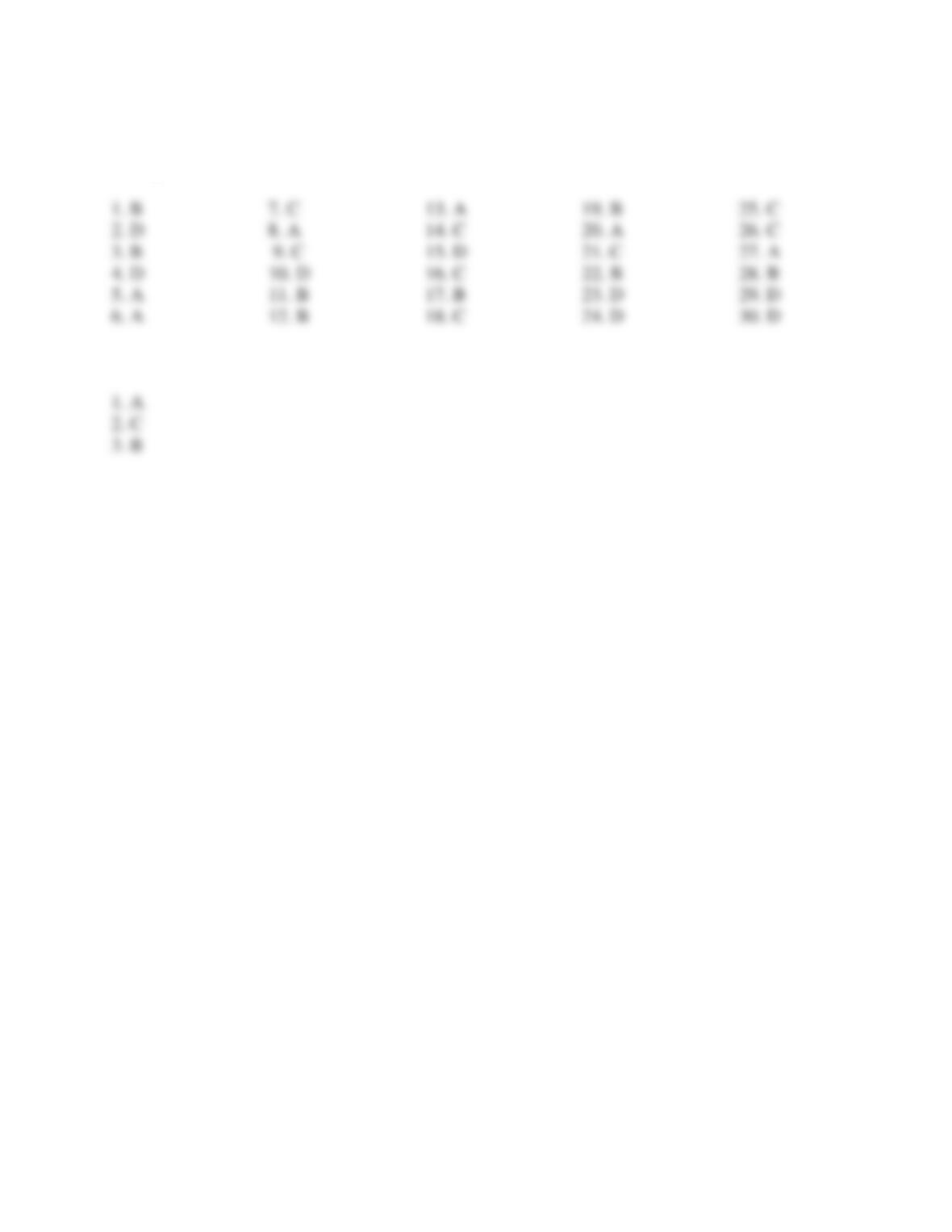
1. Most individuals with visual impairments:
A. Use braille
B. Read print
C. Use audiobooks
D. Rely on others to read to them
2. Which of the following is determined by having an individual read the letters on a chart, each
line of which is composed of letters written with a certain size print?
A. Field of vision
B. Tunnel vision
C. Functional blindness
D. Visual acuity
3. Individuals who typically use braille for efficient reading and writing are considered which
of the following?
A. Low vision
B. Functionally blind
C. Totally blind
D. Legally blind
4. A person is legally blind if:
A. Their acuity is 20/20 even with glasses
B. Their acuity is 20/10 even with glasses
C. Their field of vision is less than 80 degrees
D. Their field of vision is less than 20 degrees
5. Best estimates indicate that how many students have a visual disorder that interferes with
learning?
A. 1 or 2 in 1,000
B. 3 or 5 in 100
C. 1 or 2 in 100
D. 3 or 5 in 1,000
2
6. Almost as soon as babies are born, vision helps them to organize, synthesize, and:
A. Give meaning to their perceptions
B. Learn prereading skills
C. Develop strong motor skills
D. Develop strong auditory skills
7. Although people with visual impairments are a heterogeneous group, they have one
characteristic in common:
A. Limited ability to learn to read
B. Limited ability to develop independent skills
C. Limited ability to learn incidentally
D. Limited ability to interact with others
8. Each of the following may be a reason why touch is not always an effective substitute for
vision EXCEPT that some objects are too:
A. Heavy
B. Big
C. Dangerous
D. Fragile
9. Problems with early motor development are related to limitations in:
A. Range and variety of experiences
B. Incidental learning
C. Ability to get around
D. Interaction with the environment
10. Having a poor sense of one’s ability to effect change in one’s life is associated with
limitations in:
A. Range and variety of experiences
B. Incidental learning
C. Ability to get around
D. Interaction with the environment
11. What kind of visual impairment do students who experience vision loss after having
unimpaired vision have?
A. Congenital
B. Adventitious
C. Acquired
D. Prenatal
3
12. Cataracts, or clouding of vision, results from damage to the:
A. Retina
B. Lens
C. Cornea
D. Cones
13. Color blindness and poor contrast sensitivity result from damage to the:
A. Cones
B. Optic nerve
C. Retina
D. Lens
14. Which of the following describes how a student uses vision in a variety of natural
environments and activities?
A. Environmental observations
B. Teachers and parents
C. Functional vision assessments
D. Learning media assessments
15. What term is used to describe the options for the format of reading and literacy materials?
A. Braille
B. Instructional format
C. Audiotapes
D. Learning medium
16. Which of the following includes a functional vision assessment, student’s approaches to new
situations, the nature and stability of the eye condition, visual stamina, and motivation?
A. Environmental observations
B. Teachers and parents
C. Learning media assessment
D. Functional vision assessment
17. The expanded core curriculum includes all of the following areas EXCEPT which of the
following?
A. Compensatory skills and communication modes
B. Reading, writing, and math skills
C. Recreation and leisure skills
D. Orientation and mobility skills
4
18. Each of the following is a valuable method for determining the level of functioning of
students with visual impairments in the expanded core curriculum EXCEPT:
A. Observation in natural environments
B. Authentic assessments
C. Standardized assessments
D. Performance assessments
19. When designing IEPs for students with visual impairments, some important decisions to
consider are provision of instruction to support student success, location of services, and:
A. The school’s budget
B. Nonacademic priorities
C. Staffing needs
D. Braille services
20. Some students may need specialized instruction related to writing braille with a:
A. Slate and stylus
B. Tactile tool
C. Braille recorder
D. Pen and paper
21. Each is recommended for math teachers to make their instruction more accessible EXCEPT:
A. Speak about math consistently and clearly
B. Verbalize whatever you write
C. Avoid using manipulatives for activities
D. Give advance copies of transparencies and notes
22. Adapted materials for students with visual impairments may include braille and large-print
maps, measuring devices, graph paper, writing paper, calendars, and:
A. Computers
B. Flash cards
C. Children’s stories
D. Rubrics
23. What is the curriculum used for teaching literacy skills to students with visual impairments
whose first language is not English?
A. Modified language instruction
B. Adapted ESL
C. Bilingual language instruction
D. There is none
5
24. Which of the following enlarges an image to the desired size and projects it onto a television
or computer screen?
A. Optical character reader
B. The cloze procedure
C. Closed captioning
D. Closed circuit television
25. Effective teaching strategies for teaching daily living skills to students with visual
impairments include each of the following EXCEPT:
A. Hand-over-hand demonstrations
B. Gradual fading of prompts
C. Verbal instructions
D. Significant practice
26. An IDEA-related service for students with visual impairments to know where they are in
their environment and how to move around that environment safely is:
A. Environmental Education
B. Kinesthetic instruction
C. Orientation and mobility training
D. Transition services
27. Early intervention programs for young children with visual impairments are generally:
A. Home-based
B. Held in a private facility
C. School-based
D. Hospital-based
28. Which of the following programs emphasizes strategies that enhance a student’s acquisition
of body image, language, early self-help skills, sensorimotor skills, concepts, orientation, and
early social interactions?
A. Transition
B. Early childhood
C. Functional
D. Academic
29. Teachers of older visually impaired students should emphasize career-awareness skills, social
skills, knowledge of human sexuality, self-help skills, and:
A. Reading skills
B. Writing skills
C. Math skills
D. Advocacy skills
6
30. Informal measures used to determine students’ skill levels include all of the following
EXCEPT:
A. Teacher observations
B. Evaluation of needed prompt levels
C. Curriculum-based tests
D. Parent interviews
Praxis style questions
1. Jessica is a student with visual impairments. She doesn’t say hello to peers in hallways or
acknowledge peers’ presence when entering the room. How can you help Jessica with her
social interaction and greetings to peers?
A. Teach peers to say both her name and their own in greeting.
B. Tell Jessica she appears unfriendly and needs to speak to her friends.
C. Have a conference with Jessica’s parents to discuss Jessica’s aloofness.
D. Tell Jessica’s peers to ignore her until she speaks to them.
2. Sherry is functionally blind and seems uninterested during class demonstrations or teacher-
directed activities. What can you do to help Sherry become an active member of the class?
A. Ignore her inattentive behavior.
B. Seat Sherry in the front of the room.
C. Provide large print or braille materials for Sherry.
D. Develop a behavior plan for Sherry.
3. Marcus is a visually impaired student who is a loner on the playground, choosing to play or
walk alone. How help Marcus play with others?
A. Require Marcus to join a group to play at recess.
B. Set up games or other activities that Marcus can play with his peers.
C. Leave Marcus alone, if he chooses to be alone he must be happy.
D. Seek help from the school counselor.
Short Answer
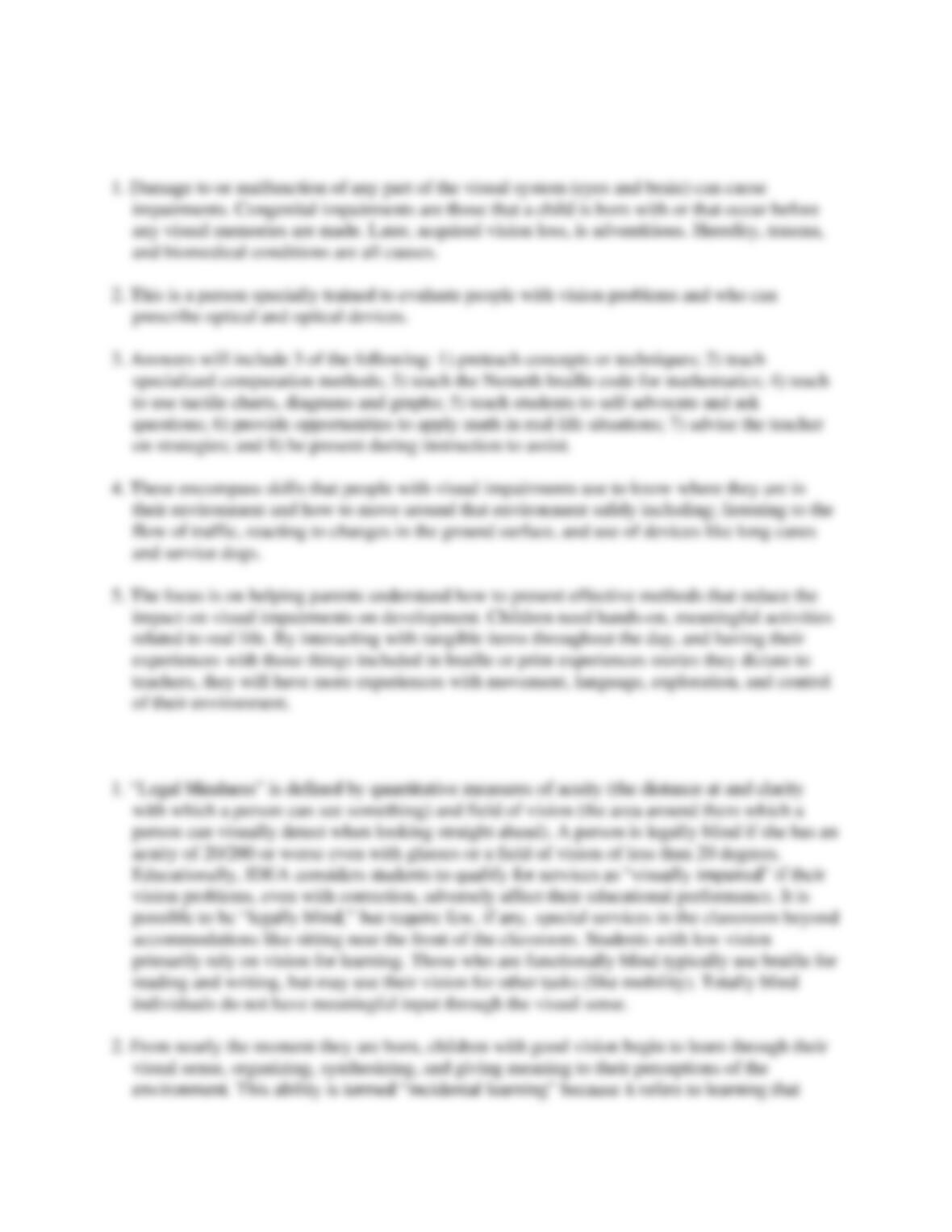
1. Briefly describe the causes of visual impairments.
2. Describe the role of a low vision specialist.
3. List three things a teacher of students with visual impairments (TVI) can do to support a
general education teacher mathematics teacher.
4. What are orientation and mobility skills?
5. What is the focus of early childhood education and how does collecting “tangible memories”
facilitate this?
7
Essay
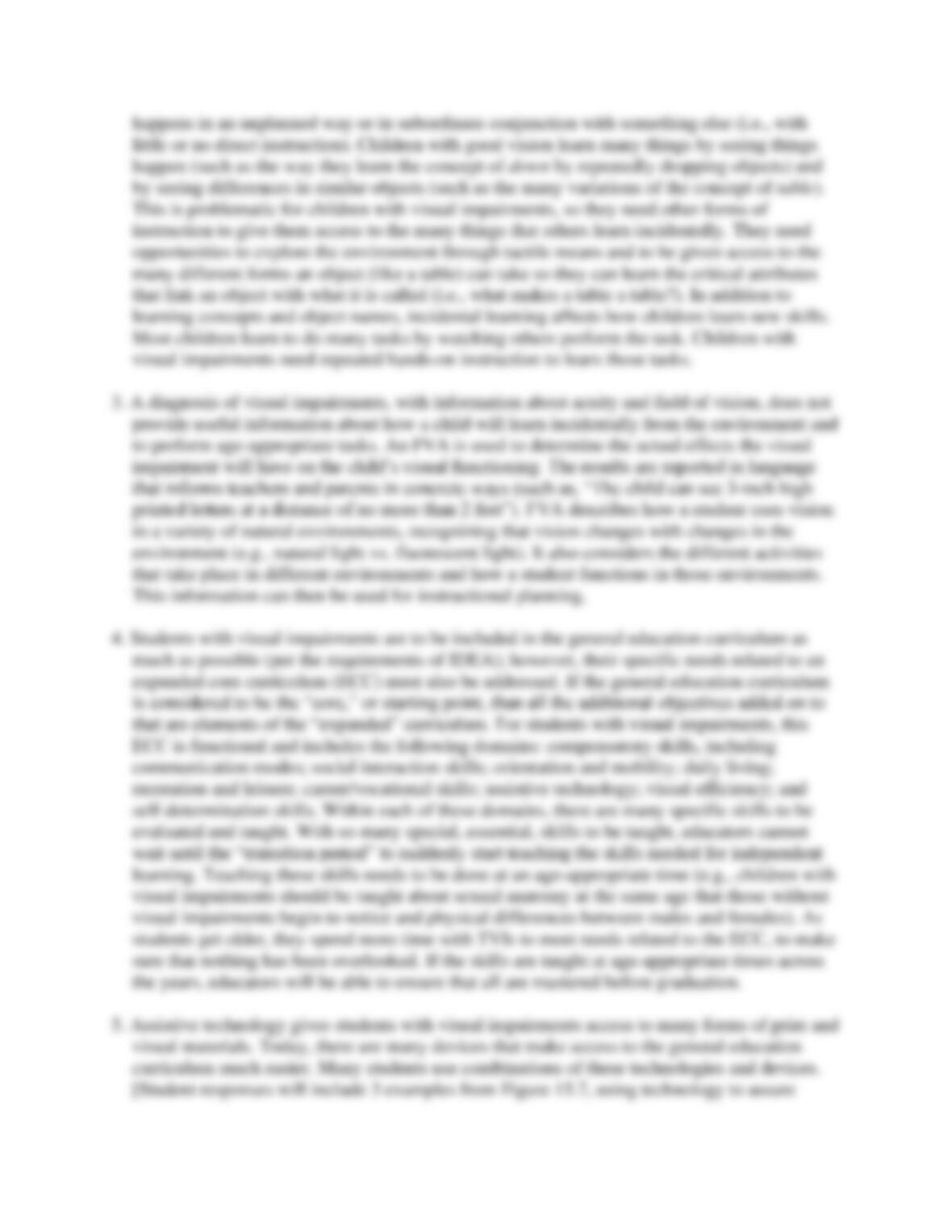
1. Differentiate between the legal and educational definitions of visual impairment.
2. Describe incidental learning and its challenges for students with visual impairments.
3. Describe functional vision assessment (FVA).
4. What is the expanded core curriculum? Identify the domains within it and explain how so
many skills can be taught.
5. Describe the advantages of assistive technology and problems associated with teachers’ use of
the internet and interactive software programs. Include 3 examples of how students use
technology to access print materials and create products in the general curriculum.
8
Chapter 15
Multiple Choice
Praxis
9
Short Answer
Essay
10
11