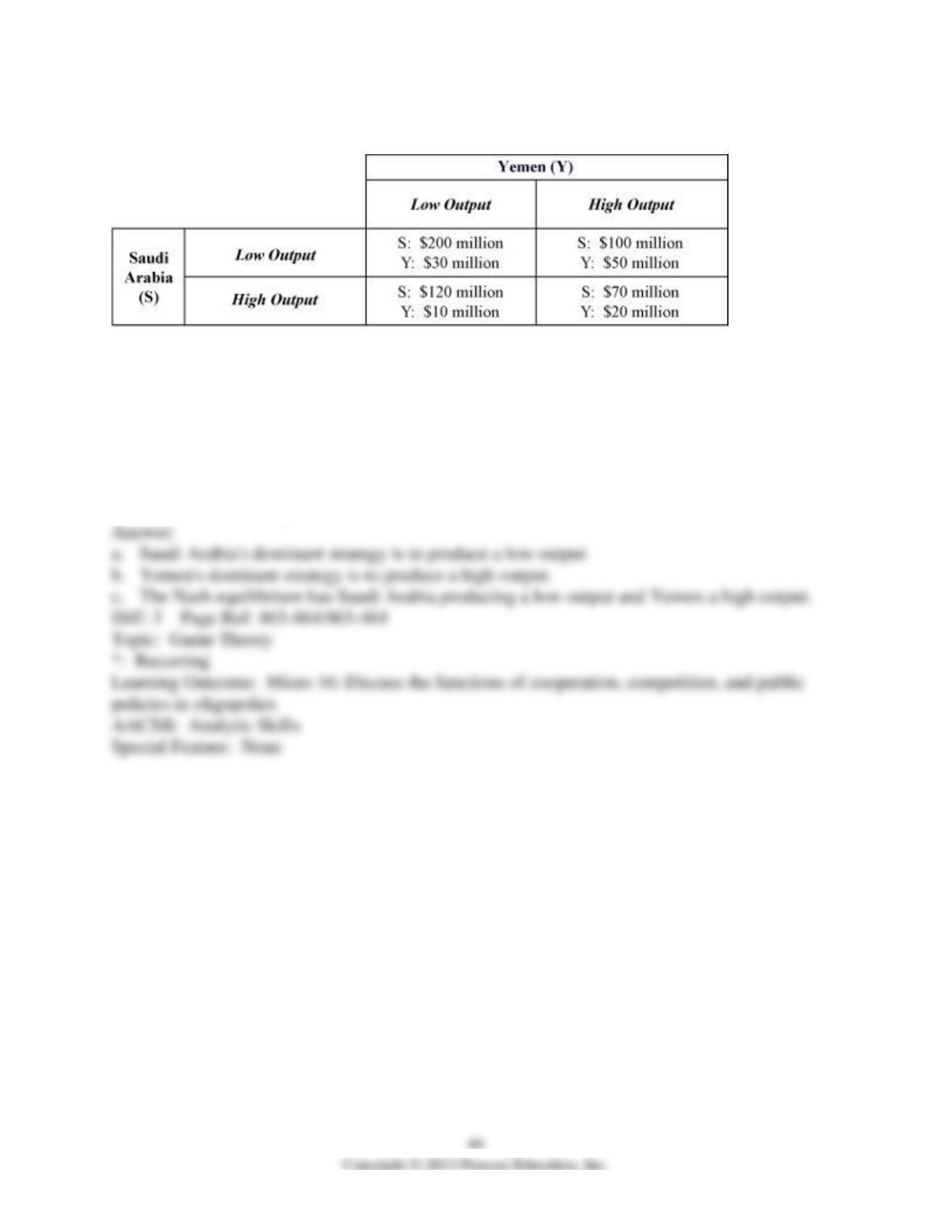
Table 14-6
62) Refer to Table 14-6. Saudi Arabia and Yemen must decide how much oil to produce. Since
the demand for oil is inelastic, relatively low production rates drive up prices and profits. Saudi
Arabia, the world’s largest and lowest cost producer, is able to influence market price; it has an
incentive to keep output low. Yemen, on the other hand, is a relatively high cost producer with
much smaller reserves. Use the payoff matrix in Table 14-6 to answer the following questions.
a. What is the dominant strategy for Saudi Arabia?
b. What is the dominant strategy for Yemen?
c. What is the Nash equilibrium?
63) There are two firms in the residential paint industry, Cool Shades (C) and Warm Hues (W).
They collude to share the market equally. They jointly set a monopoly price and split the
quantity demanded at that price. Here are their options:
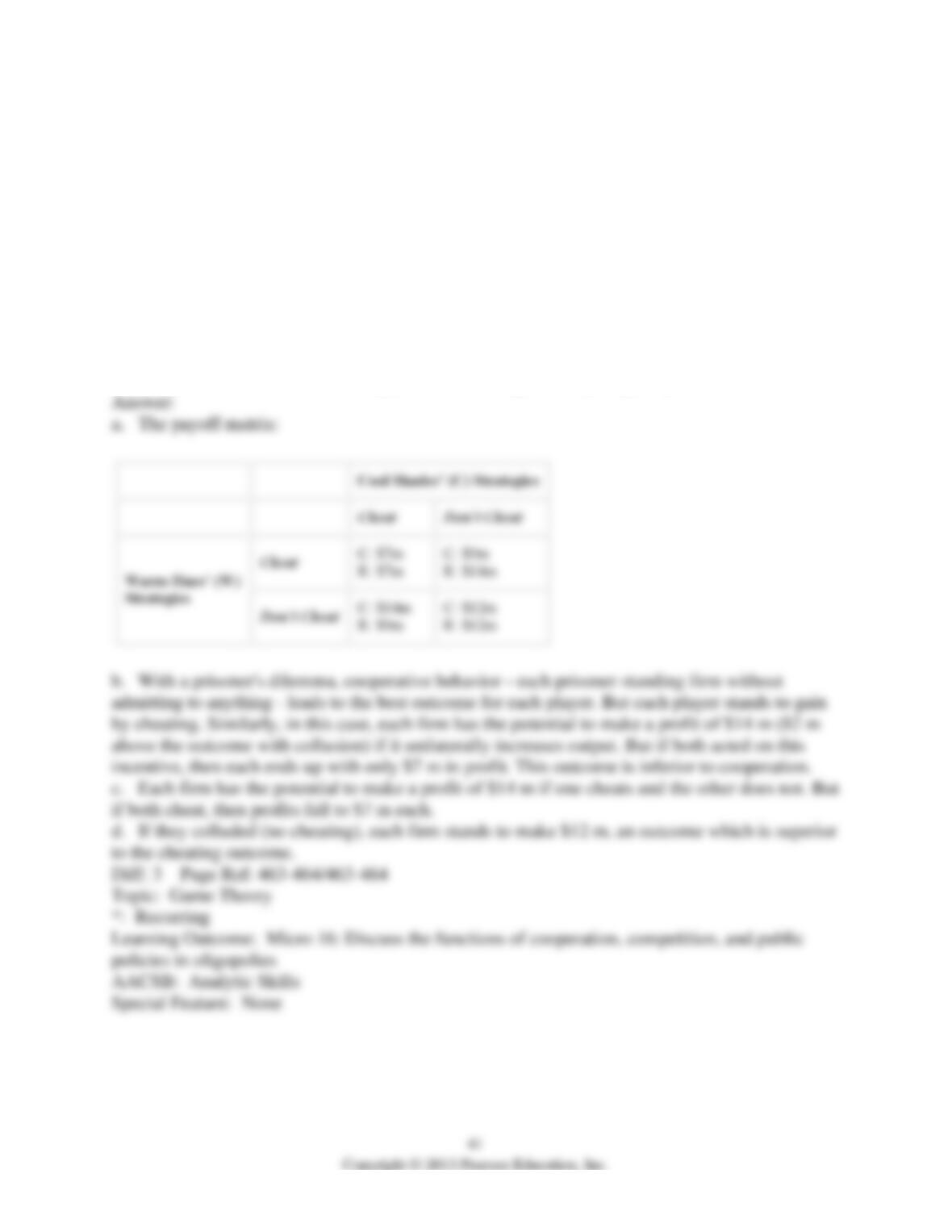
i. They continue to collude (no cheating) and make $12 million each in profits.
ii. One firm cheats and the other does not. The firm that cheats makes a profit
of $14 million whereas the firm that doesn’t makes a profit of $9 million.
iii. They both cheat and each firm makes a profit of $7 million.
a. Construct a payoff matrix for these two firms.
b. How does this situation relate to the prisoner’s dilemma?
c. If each firm acted noncooperatively, how much profit would each make?
d. Are the firms better off colluding (with no cheating) or competing? Explain.
14.3 Sequential Games and Business Strategy
1) In many business situations one firm will act first, and then other firms will respond. To help
analyze these types of situations economists use
A) retaliation games.
B) follow-the-leader-games.
C) sequential games.
D) bargaining games.
2) All of the following are ways by which existing firms can deter the entry of new firms into an
industry except
A) continuously producing new and improved products.
B) earning less than maximum profit.
C) advertising products aggressively.
D) threatening to raise prices.
3) Sequential games are used to analyze
A) firms that are subject to the prisoner’s dilemma.
B) cartels.
C) second-price auctions.
D) situations in which one firm acts and other firms respond.
4) A sequential game can be used to analyze whether a retail firm should build a large store or a
small store in a city, when the correct choice depends on whether a competing firm will build a
new store in the same city. Which of the following is used to analyze this type of decision?
A) a decision tree
B) a decision matrix
C) a sequential matrix
D) an either-or graph
5) Decision trees are commonly used to illustrate how firms make business decisions that depend
on the actions of rival firms. A decision tree has boxes that contain points that represent when
firms must make the decisions contained in the boxes. What are these points called?
A) option points
B) decision nodes
C) either-or terminals
D) decision options
6) When Wal-Mart decides to build a new retail store in a town, it will decide to build a large
store rather than a small store if the large store is expected to earn a greater economic profit.
What other motive would Wal-Mart have for choosing to build a large store?
A) A larger store will help Wal-Mart maintain its position as the leading retail company in the
world more than a smaller store would.
B) A larger store will give Wal-Mart greater political influence in the community.
C) A larger store may deter entry into the town by a rival firm.
D) Because of economies of scale, the average total cost of production is less for a larger store
than a smaller store.
7) Sequential games are often used to analyze which two types of business strategies?
A) whether to invest in research and development and whether to offer employees an early
retirement package
B) deciding to merge with another firm and deciding how much to spend on an advertising
campaign
C) deciding to end production of an unprofitable product and deciding to shut down temporarily
D) deterring entry by another firm and bargaining between firms
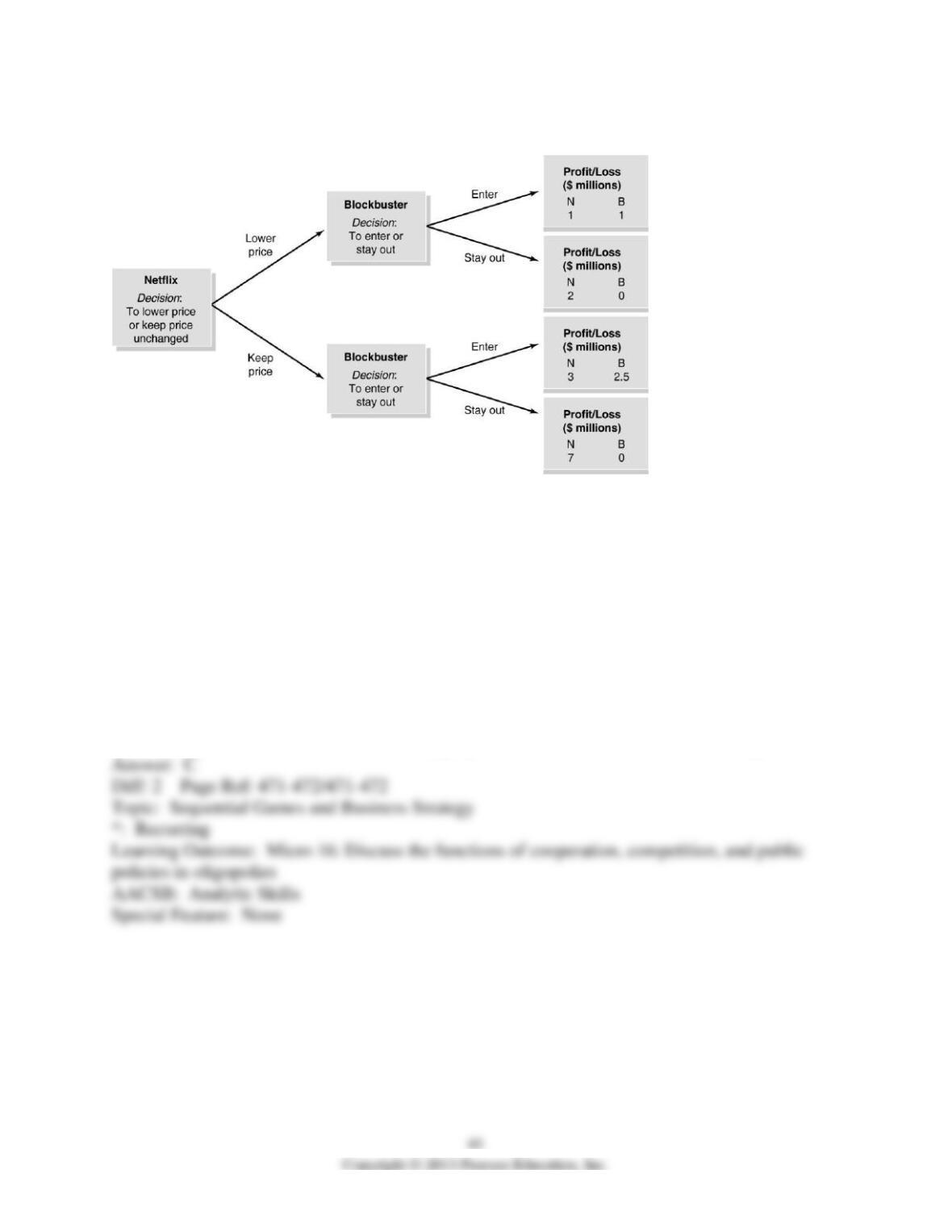
Figure 14-1
A few years ago Netflix (N) pioneered an online DVD rental service. Blockbuster (B), a brick
and mortar DVD/video rental company, waited until Netflix had been in business for over a year
before deciding whether to establish its own online rental service. At this point, Netflix had to
decide whether or not to lower its subscription price in order to deter Blockbuster’s entry into the
market. Figure 14-1 shows the decision tree for the Netflix-Blockbuster entry game.
8) Refer to Figure 14-1. If Netflix lowers its price will this deter Blockbuster from setting up an
online DVD rental service?
A) Yes, because Blockbuster stands to lose $1 million if it competes with Netflix.
B) Yes, because Blockbuster will make a smaller profit than Netflix if it chooses to compete.
C) No, because Blockbuster will make a profit if it competes with Netflix.
D) No, because Blockbuster will make a larger profit than Netflix if it chooses to compete.
9) Refer to Figure 14-1. Does it make sense for Netflix to lower its price in order to deter
Blockbuster’s entry into the online DVD rental market?
A) Yes, because Netflix stands to make a profit of $7 million by lowering its price and keeping
Blockbuster out of the market.
B) No, because Netflix will make a higher profit by keeping its subscription price unchanged,
whether Blockbuster enters the market or not.
C) Yes, because it is always profitable to remain a monopoly.
D) No, because Blockbuster will enter the market regardless of Netflix’s decision about its
subscription price.
10) What is a subgame?
A) It is one that begins at any node of the tree, including the game itself.
B) It is one that begins at any decision node of the tree except the first decision node.
C) It is one that starts at the final decision node of the tree.
D) It is a simultaneous game embedded in a sequential game.
11) Why are decision trees useful to managers who plan business strategies?
A) Decision trees explain the level of concentration in an industry.
B) Decision trees can be used to increase the amount of product differentiation; this enables
managers to charge higher prices for their products.
C) Decision trees provide a systematic way of thinking through the implications of a strategy.
D) Using a decision tree always leads to a dominant strategy.
12) A subgame-perfect equilibrium is a Nash equilibrium in which no player can make himself
better off by changing his decision at any decision node.
13) The prisoner’s dilemma is used to analyze business situations in which one firm acts first and
then other firms respond.
14) Explain why selling output at a price below that at which marginal revenue equals marginal
cost (MR = MC) might serve to deter entry of a potential competitor.
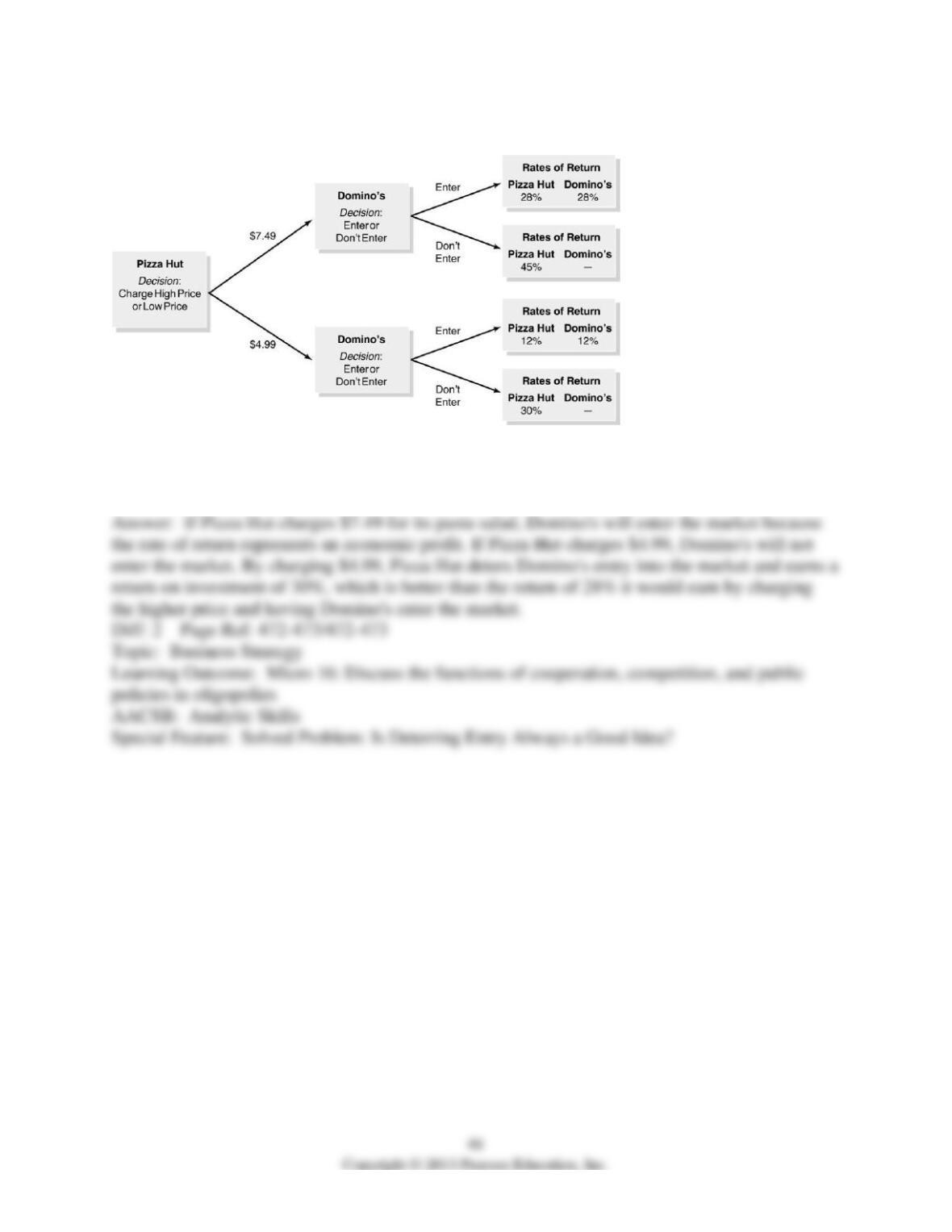
Figure 14-2
15) Refer to Figure 14-2 Use the decision tree to determine whether Pizza Hut should deter
Domino’s from entering the market for pasta salad. Assume that each firm must earn a 25%
return on investment to break even. Explain Pizza Hut’s decision process.
49
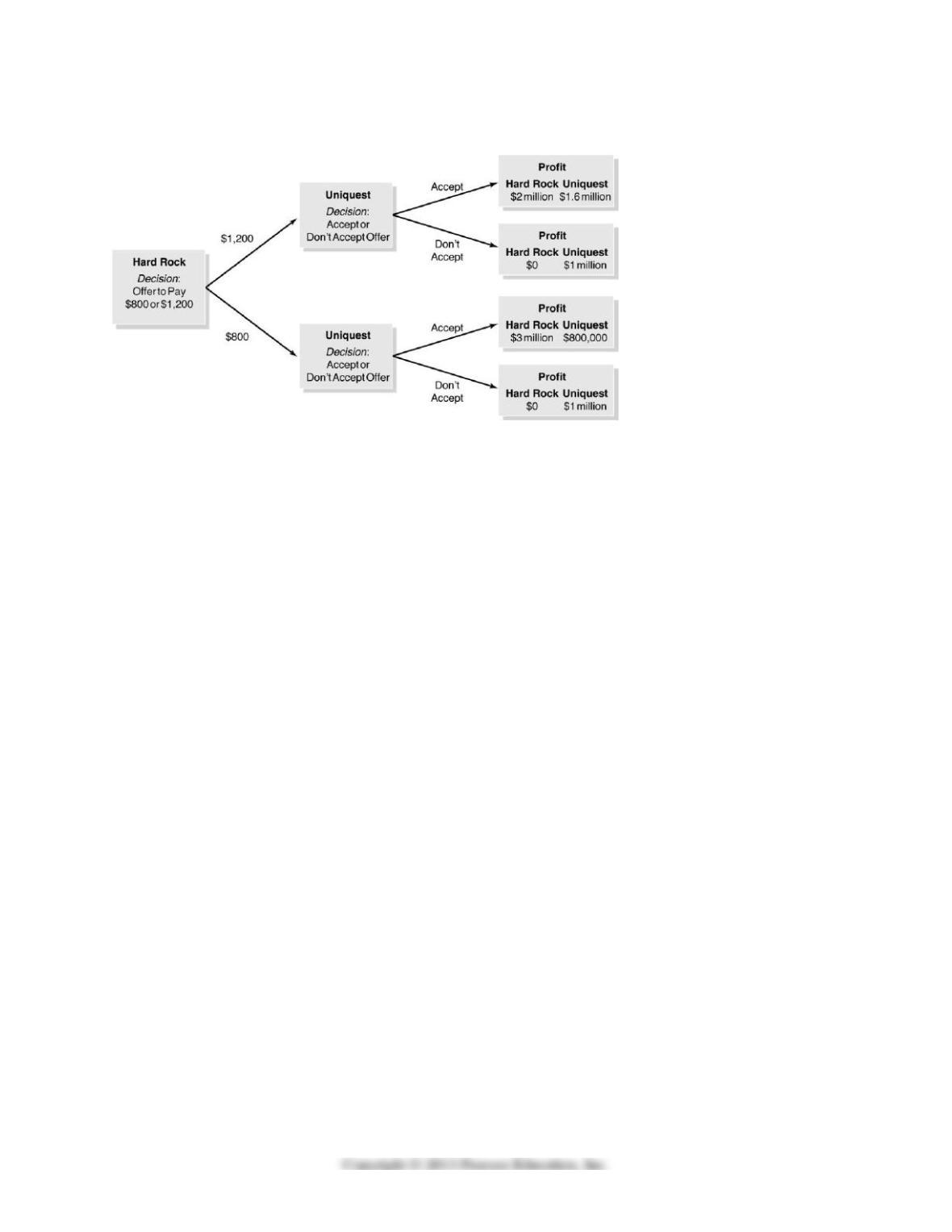
Figure 14-3
16) Refer to Figure 14-3. Uniguest, Inc. is a company that provides PCs with internet access and
touch-sensitive screens to hotels. Suppose the Hard Rock Hotel and Casino in Las Vegas informs
Uniguest that it is considering installing these systems in its hotel rooms. The Hard Rock expects
to be able to charge higher prices for these rooms if it installs Uniguest’s systems in its rooms.
The two companies begin bargaining over what price the Hard Rock will pay Uniguest for its
systems, and the decision tree shown above illustrates this bargaining game. Note that the profit
figures listed in the decision tree are additional profits for the Hard Rock and total profits for
Uniguest.
a. Suppose the Hard Rock offers Uniguest $1,200 per system. Will Uniguest accept or reject this
offer? Why?
b. Suppose the Hard Rock offers Uniguest $800 per system. Will Uniguest accept or reject this
offer? Why?
c. Suppose Uniguest attempts to obtain a favorable outcome from the bargaining by telling the
Hard Rock it will reject an $800-per-system offer. If the Hard Rock does not believe the threat is
credible, what will it do? Why? What will Uniguest do? Why?
d. Is there a sub-game perfect equilibrium in this situation? Explain.
14.4 The Five Competitive Forces Model
1) A large majority of the personal computers (PCs) in the United States use an operating system
purchased from Microsoft. Microsoft’s relationship with PC manufacturers is an example of
which of Porter’s competitive forces?
A) the threat from new entrants
B) the bargaining power of suppliers
C) the bargaining power of buyers
D) competition from substitute goods or services
2) The five competitive forces model was developed by
A) Michael Porter.
B) John Nash.
C) Michael Spence.
D) Porter Smith.
3) Which of the following is not one of the five competitive forces?
A) the threat from potential entrants
B) the bargaining power of buyers
C) the firm’s ability to differentiate its product
D) the bargaining power of suppliers
4) Assume that the four-firm concentration ratio in an industry is 85 percent. Which of the
following statements uses one of the five competitive forces to argue that this industry may be
more competitive than its concentration ratio suggests?
A) The high concentration may be due to patents owned by the largest firms but competition will
increase when patent rights expire.
B) If high concentration is the result of large firms owning much of the available supply of a key
input, the industry will become more competitive when new sources of the input are discovered
by other firms.
C) Even though concentration is high, large firms in the industry may act competitively by
spending large sums on advertising.
D) The threat of entry into this industry can cause firms in the industry to lower their prices and
profits in order to deter entry.
5) Which of the following statements is generally true?
A) Rivalry is less the larger the number of firms in an industry.
B) The smaller the number of firms in an industry, the greater the rivalry.
C) The larger the number of firms in an industry, the greater the rivalry.
D) The degree of rivalry in an industry is largely independent of the number of firms.
6) A supplier of an input is unlikely to have bargaining power if
A) the input supplied is specialized.
B) many firms can supply the input.
C) it is the sole supplier of the input.
D) it has a patent on the input.
7) In 2011, the Educational Testing Service (ETS) charged $49 to take the Scholastic Aptitude
Test (SAT) but $160 to take the Graduate Record Exam (GRE). One reason for this difference in
price is
A) more people took the SAT than the GRE in 2011.
B) the GRE is a longer test with more questions.
C) an average, those who take the GRE have higher incomes than those who take the SAT.
D) the ETS faces competition in the market for the SAT but no competition for the GRE.
8) By the 21st century few people purchased printed encyclopedias. Which of the following
competitive forces best explains this?
A) competition from substitutes
B) the bargaining power of buyers
C) the bargaining power of suppliers
D) the threat from potential entrants
9) For years economists believed that market structure explained the ability of some firms to earn
economic profits. For example, firms in industries with little competition and high barriers to
entry would earn higher profits than firms in competitive industries with low entry barriers.
Which of the following has caused economists to question this explanation and seek other
explanations for why firms are profitable?
A) Studies have shown that, on average, firms in competitive industries earn higher profit rates
than firms in industries with little competition.
B) In recent years new technologies have increased the potential entry of new firms in industries
with high entry barriers.
C) Studies have shown that firms in industries that have little competition and high entry barriers
are not very profitable. Economists conclude from this that some competition is necessary in
order to force firms to lower their costs and develop products that satisfy new consumer
demands.
D) The market structure explanation fails to explain how firms in the same industry can have
very different levels of profit.
10) In recent years online bookseller Amazon.com has lowered its profits by offering some of its
customers free shipping and building more warehouses to hold its inventories. Which of the
following explains Amazon.com’s actions?
A) Amazon.com feared government regulation if its profits were too high.
B) Amazon.com took these actions to deter entry into its market by new online booksellers.
C) Amazon.com took these actions to compete more effectively with existing online booksellers.
D) Amazon.com was forced to take these actions because of the bargaining power of its
suppliers.
11) An example of a supplier that used its bargaining power to charge high prices to its
customers is
A) Wal-Mart, which required many of its suppliers to alter their distribution systems to
accommodate Wal-Mart’s need to control the flow of goods to its stores.
B) the firms that supply paper napkins to McDonald’s restaurants.
C) the Technicolor Company, the sole producer of cameras and film that movie studios needed to
produce color movies in the 1930s and 1940s.
D) the publishers of the Encyclopedia Britannica.
12) Prices of PlayStation3 game systems are similar at almost every large retailer and little price
competition occurs among these retailers. An explanation for this is
A) retailers are all price takers.
B) retailers have lobbied state governments to allow them to collude legally to set the prices of
certain products.
C) pricing PlayStation3 game systems is a repeated game. Over a long period of time a
cooperative equilibrium has been reached where retailers charge high prices for these systems.
D) retailers are in a prisoner’s dilemma which causes them to all charge the same price for
PlayStation 3 game systems.
13) Intel’s introduction of the “Ultrabook”, which the company hopes will successfully rival
Apple’s MacBook Air, best describes which of the five competitive forces?
A) the bargaining power of buyers
B) the threat from potential entrants
C) competition from substitute goods or services
D) competition from existing firms
14) Competition in the form of advertising, better customer service, or longer warranties can also
reduce profits by raising costs.
15) According to Porter’s Five Competitive Forces Model, similar products produced by different
firms within the industry affects a firm’s ability to raise prices far more than substitutable
products produced outside the industry.
16) Does the strength of each of the five competitive forces from Michael Porter’s model remain
constant over time? Briefly explain.
17) The four-firm concentration ratio in the breakfast cereal industry is 78 percent. How does the
five competitive forces model provide better insight into the degree of competition in the
breakfast cereal industry than just observing the concentration ratio?