19) A dominant strategy is
A) an equilibrium where each firm chooses the best strategy, given the strategies of other firms.
B) a strategy chosen by two firms that decide to charge the same price or otherwise not to
compete.
C) a strategy that is obviously the best for each firm that is a party to a business decision.
D) a strategy that is the best for a firm no matter what strategies other firms use.
20) Who won a Nobel Prize in economics for his work in the development of game theory?
A) John von Neuman
B) Oskar Morgenstern
C) John Nash
D) Howard Schultz
21) Two firms would sometimes be better off if they got together and agreed to charge a high
price, rather than to compete and risk having to charge a lower, competitive price. What is the
greatest deterrent to this strategy?
A) The firms may find that the price they charge is greater than the price that would maximize
their profits.
B) An agreement by firms to charge high prices is illegal. The government can fine the firms and
send their managers to jail.
C) Consumers may resent having to pay high prices and not buy from either of the firms.
D) One of the firms may decide to lower its price and take business away from the firm that
charged the high price.
22) An equilibrium in a game in which players pursue their own self-interest is called
A) a Nash equilibrium.
B) a cooperative equilibrium.
C) a noncooperative equilibrium.
D) a prisoner’s dilemma.
23) When an oligopoly market is in Nash equilibrium,
A) firms have colluded to set their prices.
B) firms will not behave as profit maximizers.
C) a firm will not take into account the strategies of its rivals.
D) a firm will choose its best pricing strategy, given the strategies that it observes other firms
have taken.
24) The Brooks Appliance Store and the Lefingwell Appliance Store (both are located in the
same city) each sell an identical washer-dryer. The owner of each store considered offering the
washer-dryer for $700, but decided on a price of $500. If this is a Nash equilibrium we can
conclude that
A) each store owner feared charging the higher price would result in being undercut by the other
store charging the lower price.
B) the owners of the stores feared that charging $700 could be used as evidence of collusion.
C) charging $500 was the most profitable strategy for each store, regardless of what price was
charged by the other store.
D) the stores were less concerned about making a profit from the washer-dryers than they were
with attracting customers who would also buy other appliances.
25) eBay is an online auction site where more than 200 million items are auctioned annually.
What type of auctions are run on eBay?
A) noncooperative auctions
B) second-price auctions
C) cooperative auctions
D) double-blind auctions
26) A baseball hat worn by the Boston Red Sox Hall of Fame outfielder Ted Williams was
auctioned on eBay. The three highest bidders and their bids were:
Roger Bulava $5,000
Tony Millasiti $4,900
Joe Albano $4,200
What price did Roger have to pay for the Ted Williams hat?
A) $4,200
B) $4,700 (the average of the three highest bids)
C) $4,900
D) $5,000
27) A game in which pursuing dominant strategies results in noncooperation that leaves all
parties worse off is a
A) prisoner’s dilemma.
B) cooperative equilibrium.
C) first-price auction.
D) zero-sum game.
28) Why does a prisoner’s dilemma lead to a noncooperative equilibrium?
A) because each player had agreed before the game started to minimize the harm that he can
inflict on the other players
B) because each player is uncertain how other players will play the game
C) because players must choose from a limited number of non-dominant strategies
D) because each rational player has a dominant strategy to play a certain way regardless of what
other players do
29) Prisoner’s dilemma games imply that cooperative behavior between two people or two firms
always breaks down. But reality teaches us that people and firms often cooperate successfully to
achieve their goals. Why do the results from prisoner’s dilemma games fail to predict real world
results?
A) Prisoner’s dilemma games do not permit people or firms from reneging on agreements, which
often occurs in real word situations.
B) The prisoner’s dilemma does not apply to most business situations that are repeated over and
over.
C) Prisoner’s dilemma games predict the behavior of people and firms that engage in illegal
activity; most people and firms do not resort to illegal activity.
D) Most real world situations involve more than two people or firms; the prisoner’s dilemma is
only applicable to situations that involve two parties.
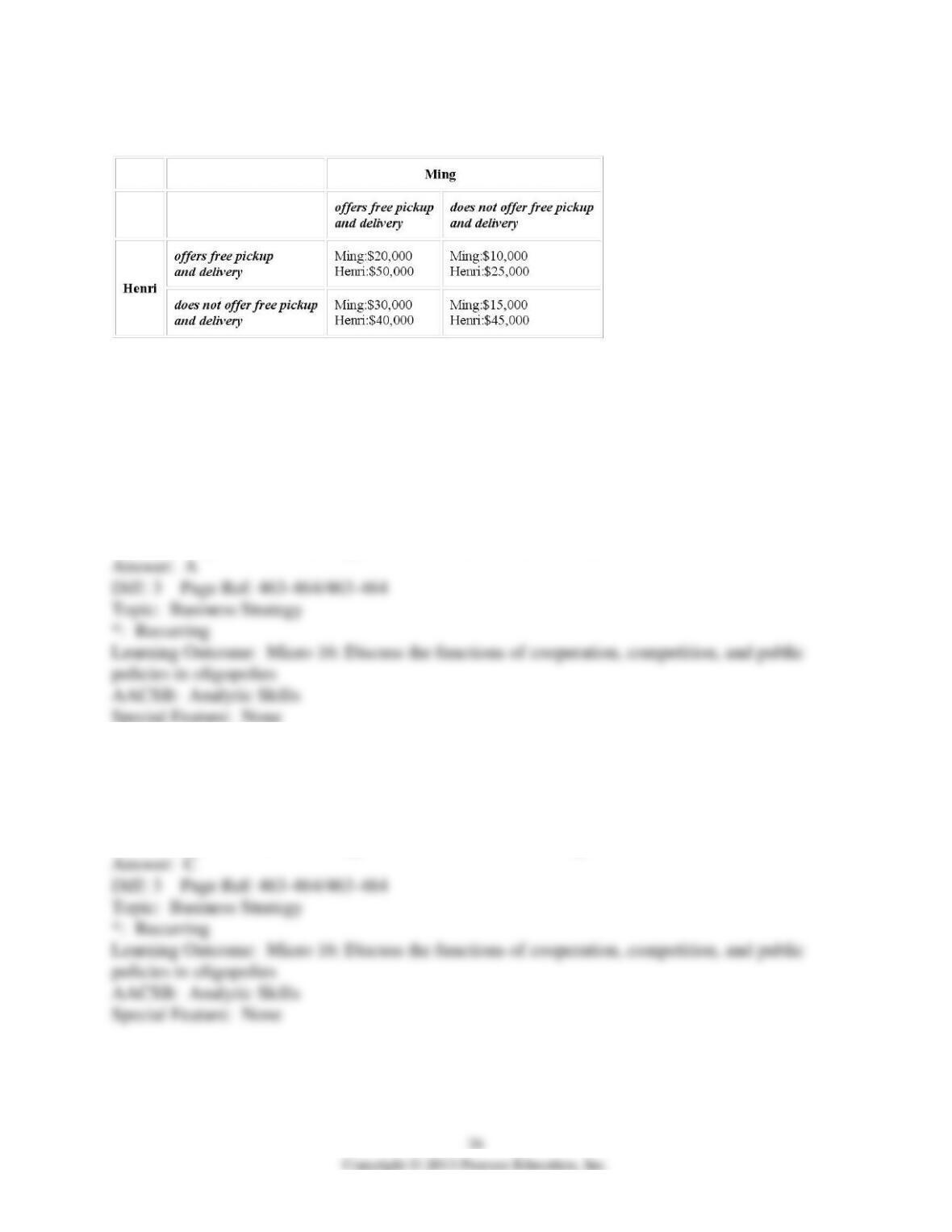
Table 14-2
Ming and Henri each run one of the two dry cleaning facilities in the town of Scaraby. Both
consider offering free pickup and delivery services. Table 14-2 shows the payoff matrix
containing the expected quarterly profits for each firm.
30) Refer to Table 14-2. Does Ming have a dominant strategy? If yes, what is it?
A) Yes, Ming’s dominant strategy is to offer free pickup and delivery.
B) No, Ming does not a dominant strategy – his best outcome depends on what Henri does.
C) Yes, Ming’s dominant strategy is to not to offer free pickup and delivery.
D) Yes, Ming’s dominant strategy is to wait to see what Henri does first.
31) Refer to Table 14-2. Does Henri have a dominant strategy? If yes, what is it?
A) Yes, Henri’s dominant strategy is to not offer free pickup and delivery.
B) Yes, Henri’s dominant strategy is to offer free pickup and delivery.
C) No, Henri does not have a dominant strategy – his best outcome depends on what Ming does.
D) Yes, Henri’s dominant strategy is to wait and see what Ming does first.
32) Refer to Table 14-2. What is the Nash equilibrium in this game?
A) There is no Nash equilibrium.
B) Ming offers free pickup and delivery, but Henri does not.
C) Henri offers free pickup and delivery, but Ming does not.
D) Both Ming and Henri offer free pickup and delivery.
33) An equilibrium in a game in which players pursue their own self-interests and do not
cooperate is called a
A) cartel equilibrium.
B) noncooperative equilibrium.
C) prisoner’s dilemma equilibrium.
D) dominant strategy equilibrium.
34) A cooperative equilibrium results when firms
A) choose the best strategy regardless of what other players do.
B) choose the strategy that maximizes the total game payoff.
C) choose the strategy that minimizes the payoff to other players.
D) choose a strategy by random chance.
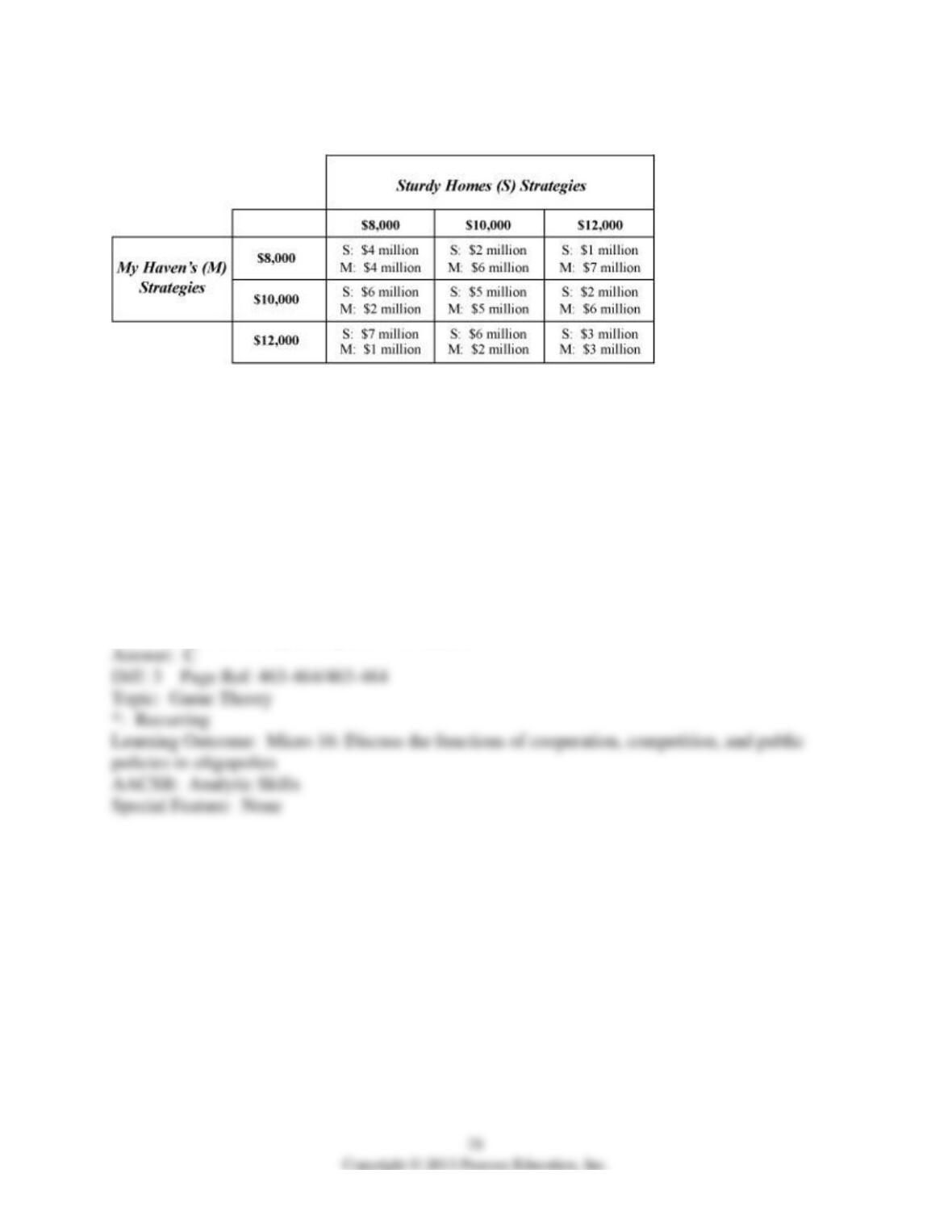
Table 14-3
There are two mobile home manufacturers in Nevada, Sturdy Homes (S) and My Haven (M).
Sturdy Homes has been in the market for a long time and must now compete with newcomer, My
Haven. Suppose that Sturdy Homes believes that My Haven will match any price it sets. Use
Table 14-3 to answer the following question and assume throughout that Sturdy Homes believes
that My Haven will match any price it sets.
35) Refer to Table 14-3. What price will Sturdy Homes charge and what profit does Sturdy
Homes expect to make?
A) Price = $8,000; expected profit = $7 million
B) Price = $8,000; expected profit = $4 million
C) Price = $10,000; expected profit = $5 million
D) Price = $12,000; expected profit = $3 million
Table 14-4
Pepsi
Pepsi
Don’t Advertise
Advertise
Coca-Cola
Don’t
advertise
Coca-Cola earns $1,500
million profit/Pepsi earns
$1,500 million profit
Coca-Cola earns $800
million profit/Pepsi earns
$1,800 million profit
Coca-Cola
Advertise
Coca-Cola earns $1,800
profit/Pepsi earns $800
million profit
Coca-Cola earns $1,000
million profit/Pepsi earns
$1,000 million profit
The payoff matrix shown above assumes that Pepsi and Coca-Cola must decide whether to
advertise their products. The matrix shows how much profit each firm will earn if it does or does
not advertise. The amount of profit for one firm depends on whether the other firm advertises.
36) Refer to Table 14-4. Which of the following statements is true?
A) Neither Pepsi nor Coca-Cola have a dominant strategy.
B) Pepsi’s dominant strategy is to advertise; Coca-Cola’s dominant strategy is to not advertise.
C) Coca-Cola’s dominant strategy is to advertise; Pepsi’s dominant strategy is to not advertise.
D) The dominant strategy for both firms is to advertise.
37) Refer to Table 14-4. Which of the following statements is true?
A) Given that Coca-Cola advertises, Pepsi’s best strategy is to not advertise.
B) Given that Pepsi advertises, Coca-Cola’s best strategy is to advertise.
C) Pepsi and Coca-Cola will agree to collude in order to maximize their profits.
D) Neither Pepsi nor Coca-Cola will advertise; this decision will decrease their costs and allow
each firm to earn more than $1,800 million in profits.
38) Which of the following explains why two firms, Apex and Bongo, would engage in implicit
collusion, rather than explicit collusion?
A) Implicit collusion allows Apex to increase its profits at the expense of Bongo without Bongo
knowing that collusion has occurred; if Apex engages in explicit collusion, Bongo will realize
collusion has taken place and retaliate against Apex.
B) Implicit collusion is less costly to both firms than explicit collusion; therefore, profits will be
greater for both firms if they engage in implicit collusion.
C) explicit collusion is illegal; if the managers of Apex and Bongo engage in implicit collusion
they may be within the law.
D) Implicit collusion always has an enforcement mechanism that forces both firms to collude;
explicit collusion does not have an enforcement mechanism.
39) Which of the following is an example of implicit collusion?
A) product differentiation
B) a retaliation strategy
C) a second-price auction
D) price leadership
40) A form of implicit collusion where one firm in an oligopoly announces a price change which
is matched by other firms in the same industry is
A) “follow the leader” pricing.
B) price leadership.
C) retaliation pricing.
D) “tit-for-tat” pricing.
41) Which of the following best explains why airlines often cut their ticket prices at the last-
minute in order to fill the remaining empty seats on their flights?
A) Fixed costs in the airline industry are very large, but the marginal cost of flying one more
passenger is very low.
B) Airlines receive a subsidy from the government for each flight that is fully booked and
departs on time.
C) The Federal Aviation Administration ranks each airline based on the percentage of flights that
are fully booked. These rankings affect the decisions of firms to use a particular airline to fly
their employees to business meetings.
D) Cutting prices makes the airlines more popular with their customers, who may fly with the
same airline in the future as the result of buying low-price tickets.
42) A study conducted by economists at the University of Chicago found that when Southwest
Airlines begins flying a new route, ticket prices on other airlines for that route ________,
indicating that airlines ________.
A) stay relatively unchanged; may begin practicing implicit price collusion when Southwest
enters a market
B) drop by an average of 29 percent; may have been practicing implicit price collusion before
Southwest’s entry into the market
C) rise by an average of 65 percent; know they can practice implicit price collusion once
Southwest announces it is entering a market.
D) first drop and then rise back to their original levels; temporarily stop practicing implicit price
collusion until Southwest becomes established, then return to their collusive pricing strategies
43) The Organization of Petroleum Exporting Countries (OPEC) controls about 75 percent of the
world’s proven oil reserves. Economists refer to OPEC as a cartel because
A) OPEC is a monopoly, but it is located outside of the boundaries of any one country. This is
the definition of a cartel.
B) this is the term used for an oligopoly that is controlled by national governments rather than
private firms.
C) it is a group of firms that collude to restrict output to increase prices and profits.
D) this is the term economists use to describe an oligopoly that sells a standardized product, such
as oil, rather than a differentiated product, such as automobiles.
44) Since 1972, the world price of oil has been largely determined by OPEC, which controls
about 75 percent of the world’s proven oil reserves. Since 1972 the price of oil has
A) fluctuated. OPEC’s situation is an example of a prisoner’s dilemma.
B) risen slowly, but steadily. Members of OPEC fear that if they raise the price of oil too quickly
this will lead oil-buying nations to accuse OPEC of price gouging, which is illegal under
international law.
C) steadily fallen through the 1970s, then risen continually in the years since then. OPEC’s
actions are an example of implicit collusion.
D) been tied by OPEC to the rate of inflation in the United States. If, for example, the rate of
inflation is 5 percent in one year, OPEC will raise the price of oil by 5 percent the next year.
45) Collusion makes firms better off because if they act as a single entity (a cartel) they can
reduce output and increase their prices and profits. But some cartels have failed and others are
unstable. Which of the following is a reason why cartels often break down?
A) Most cartels do not have a dominant strategy.
B) When a cartel is profitable the amount of competition it faces increases.
C) Members of a cartel may resent having to share their profits equally.
D) Each member of a cartel has an incentive to “cheat” on the collusive agreement by producing
more than its share when everyone else sticks with the collusive agreement.
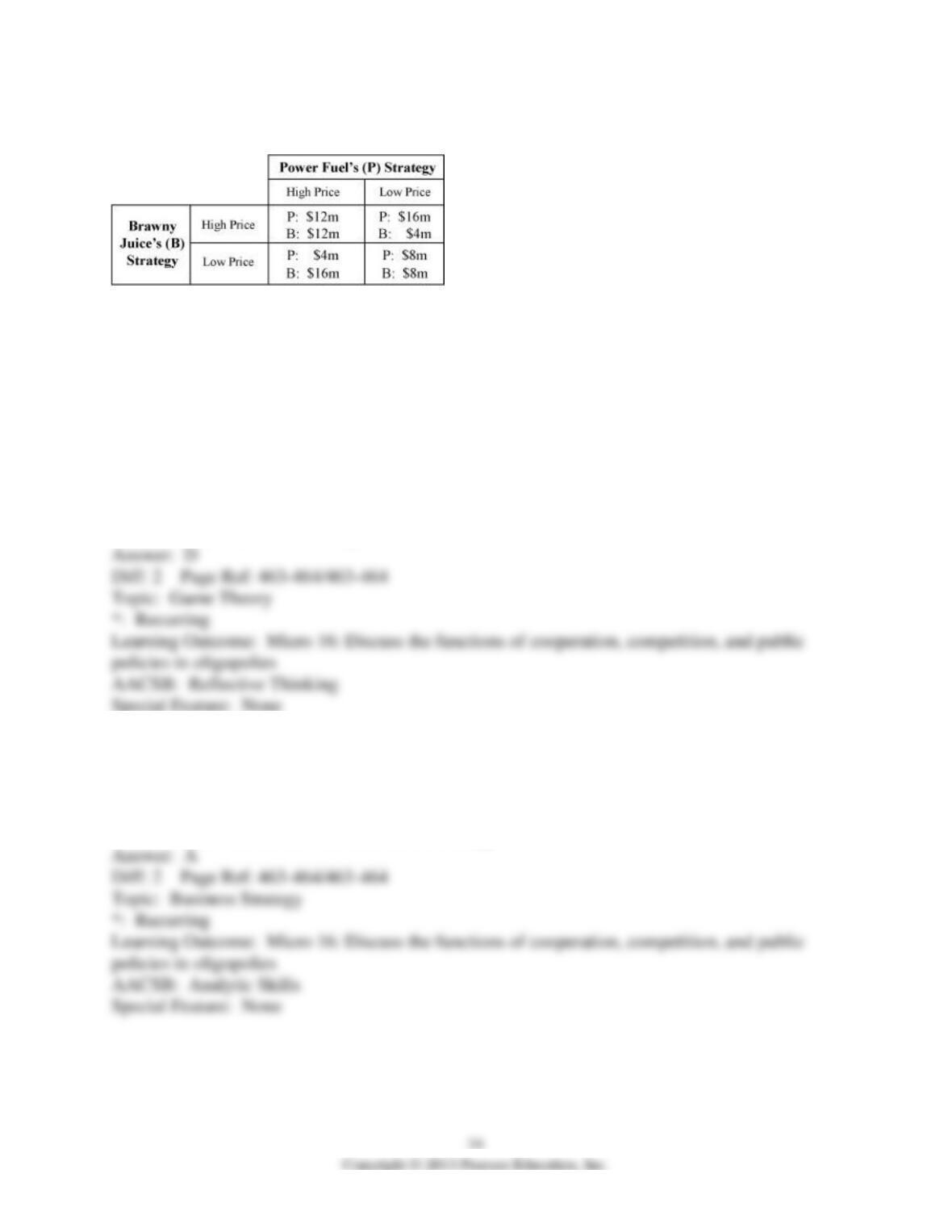
Table 14-5
Two rival oligopolists in the athletic supplements industry, the Power Fuel Company and the
Brawny Juice Company, have to decide on their pricing strategy. Each can choose either a high
price or a low price. Table 14-5 shows the payoff matrix with the profits that each firm can
expect to earn depending on the pricing strategy it adopts.
46) Refer to Table 14-5. If the firms act out of individual self-interest, which prices will they
select?
A) Both firms will select a high price.
B) Brawny Juice will select a high price, Power Fuel will select a low price.
C) Brawny Juice will select a low price, Power Fuel will select a high price.
D) Both firms will select a low price.
47) Refer to Table 14-5. Which of the following is true?
A) Power Fuel’s dominant strategy is to select a low price.
B) Brawny Juice’s dominant strategy is to select a high price.
C) Power Fuel does not have a dominant strategy.
D) Brawny Juice does not have a dominant strategy.
48) Refer to Table 14-5. If Brawny Juice selects a high price, what is Power Fuel’s best strategy
and what will Power Fuel earn as a result of this strategy?
A) Power Fuel will select a low price and earn $8 million.
B) Power Fuel will select a low price and earn $16 million.
C) Power Fuel will select a high price and earn $12 million.
D) Power Fuel will select a high price and earn $16 million.
49) Refer to Table 14-5. If the firms cooperate, what prices will they select?
A) Both firms will select a low price.
B) Brawny Juice will select a high price, Power Fuel a low price.
C) Both firms will select a high price.
D) Brawny Juice will select a low price, Power Fuel a high price.
50) Refer to Table 14-5. If the two firms collude, is there an incentive for either to cheat on the
collusion agreement?
A) No, neither firm can gain by cheating.
B) Yes, but only Brawny Juice is in a position to gain by cheating.
C) Yes, but only Power Fuel is in a position to gain by cheating.
D) Yes, either firm can gain if it alone cheats.
51) Natural resource cartels such as OPEC are inherently unstable because their members
operate with excess capacity and have an incentive to cheat on their output quotas.
52) Because many business situations are repeated games, firms may be able to avoid the
prisoner’s dilemma and implicitly collude to keep prices high.
53) Firms are more likely to find themselves in a prisoner’s dilemma in sequential games as
opposed to simultaneous games.
54) A fundamental assumption in game theory is that players do not interact with each other.
55) In a Nash equilibrium, all players select non-dominant strategies.
56) Price leadership is a form of explicit collusion where one firm in an oligopoly announces a
price change and expects all other firms to follow suit.
57) What is the difference between explicit collusion and implicit collusion?
58) Why do economists refer to the pricing strategies of oligopoly firms as a prisoner’s dilemma
game?
59) Explain why member firms of a cartel like OPEC have incentives to agree to a low cartel
production level and then produce more than its quota.
60) On January 2, 1971, all cigarette advertising was banned on U.S. television and radio
stations. Did this ban likely increase or decrease the profits of cigarette companies in 1971?
Briefly explain.
61) Consider two single-malt whiskey distillers, Laphroaig and Knockando. If they advertise,
they can both sell more whiskey and increase their revenue. However, the cost of advertising
more than offsets the increased revenue so that each distiller ends up with a lower profit than if
they do not advertise. On the other hand, if only one advertises, that distiller increases its market
share and also its profit.
a. Construct a payoff matrix using the following hypothetical information: If neither distiller
advertises, each earns a profit of $35 million per year. If both advertise, each earns a profit of
$20 million per year. If one advertises and the other does not, the distiller who advertises earns a
profit of $50 million and the distiller who does not advertise earns a profit of $9 million.
b. If Laphroaig wants to maximize profit, will it advertise? Briefly explain.
c. If Knockando wants to maximize profit, will it advertise? Briefly explain.
d. Is there a dominant strategy for each distiller? Briefly explain.