Microeconomics, 4e – Testbank 2 (Hubbard)
Chapter 14 Oligopoly: Firms in Less Competitive Markets
14.1 Oligopoly and Barriers to Entry
1) What do Wal-Mart, the Microsoft Corporation, and the Dell computer company have in
common?
A) Each achieved a dominant position in its industry because it owned a key input in the
production of its product.
B) The industry in which each firm competes is an oligopoly because of government-imposed
barriers to entry.
C) Each company was founded in the same state.
D) The profitability of each firm depends on its interactions with other firms.
2) Which of the following is not part of an oligopolist’s business strategy?
A) deciding on how to manage relations with suppliers
B) choosing what new technologies to adopt
C) selecting which new markets to enter
D) independently setting a product’s price without consideration of its rivals’ pricing policies
3) Oligopoly differs from perfect competition and monopolistic competition in that
A) barriers to entry are lower in oligopoly industries than they are in perfectly competitive and
monopolistically competitive industries.
B) demand and marginal revenue curves are more useful for analyzing oligopoly than they are
for analyzing perfect competition and monopolistic competition.
C) because oligopoly firms often react when other firms in their industry change their prices, it is
difficult to know what the oligopolist’s demand curve looks like.
D) the concentration ratios of oligopoly industries are lower than they are for perfectly
competitive and monopolistically competitive firms.
4) We can draw demand curves for firms in perfectly competitive and monopolistically
competitive industries, but not for oligopoly firms. The reason for this is
A) there are no barriers to entry in perfectly competitive and monopolistically competitive
industries. There are high barriers to entry in oligopoly industries.
B) we can assume that the prices charged by perfectly competitive and monopolistically
competitive firms have no impact on rival firms. For oligopoly this assumption is unrealistic.
C) that perfectly competitive and monopolistically competitive firms are price takers. Oligopoly
firms are price makers.
D) perfectly competitive and monopolistically competitive firms sell standardized products.
Oligopoly firms sell differentiated products.
5) When large firms in oligopoly markets cut their prices,
A) rival firms will also cut their prices to avoid losing sales.
B) rival firms will not change their prices because most of their customers have signed contracts
that commit them to doing business with the same firms for the life of their contracts.
C) we don’t know for sure how rival firms will respond.
D) rival firms will not cut their prices because they fear that the federal government will accuse
them of collusion.
6) The fraction of an industry’s sales that are accounted for by the largest firms is called
A) the four-firm competition ratio.
B) the four-firm concentration ratio.
C) the four-firm industry ratio.
D) the four-firm oligopoly ratio.
7) A four-firm concentration ratio measures
A) the extent to which industry sales are concentrated among the four largest firms in the
industry.
B) the price elasticity of demand among the four largest firms in an industry.
C) the number of firms in an industry.
D) the price elasticity of demand in an industry.
8) As a measure of competition in an industry, concentration ratios have several flaws. One of
these flaws is that concentration ratios
A) assume that all industries have low barriers to entry.
B) assume that a ratio less than 40 percent means an industry is perfectly competitive.
C) assume there are only four firms in an industry.
D) are calculated for the national market, even though competition in some industries is mainly
local.
9) Which of the following is not a characteristic of oligopoly?
A) the ability to influence price
B) a small number of firms
C) low barriers to entry
D) interdependent firms
10) Which of the following is not a barrier to entry?
A) an inelastic demand curve
B) economies of scale
C) ownership of a key input
D) a patent
11) Economies of scale will create a barrier to entry in an oligopoly industry when
A) a firm’s minimum efficient scale occurs where long-run average total costs are constant.
B) the typical firm’s long-run average total cost curve reaches a minimum at a level of output that
is a large fraction of total industry sales.
C) the typical firm’s long-run average total cost curve reaches a minimum at a level of output that
is a small fraction of total industry sales.
D) the industry’s four-firm concentration ratio is less than 40 percent.
12) If economies of scale are relatively important in an industry, the typical firm’s
A) marginal cost curve will decline continuously until it reaches minimum efficient scale.
B) long-run average cost curve will begin rising before it reaches minimum efficient scale.
C) long-run average cost curve will reach a minimum at a level of output that leaves room for a
large number of firms to enter the industry.
D) long-run average cost curve will reach a minimum at a level of output that is a relatively large
fraction of total industry sales.
13) A patent is an example of
A) how ownership of a key input creates a barrier to entry.
B) a government-imposed barrier to entry.
C) occupational licensing.
D) how market failure can lead to oligopoly.
14) For many years the Aluminum Company of America (Alcoa) controlled most of the world’s
supply of high quality bauxite, the ore needed to produce aluminum. What type of entry barrier
was responsible for Alcoa’s position in the aluminum industry?
A) ownership of a key input
B) a government-imposed barrier
C) a patent on the manufacture of aluminum
D) economies of scale
15) Which of the following is not an example of a government-imposed entry barrier?
A) patents
B) occupational licensing
C) barriers to international trade
D) antitrust legislation
16) Consider a U-shaped long-run average cost curve that has a minimum efficient scale at 6,000
units of output. In this case, this industry would be
A) perfectly competitive if the market quantity demanded is 20,000 units.
B) monopolistically competitive if the market quantity demanded is 12,000 units.
C) an oligopoly if the market quantity demanded is 18,000 units.
D) an oligopoly if the four-firm concentration ratio is more than 10 percent.
17) Hewlett-Packard will not raise the prices of its personal computers without first considering
how Dell might respond. This is evidence of
A) interdependence.
B) collusion.
C) cutthroat competition.
D) price fixing.
18) If economies of scale are relatively unimportant in an industry, the typical firm’s long-run
average total cost curve will reach a minimum at a level of output that is a ________ fraction of
total industry sales. The industry will be ________.
A) large; competitive
B) large; an oligopoly
C) small; competitive
D) small; an oligopoly
19) A patent is a government-imposed entry barrier because
A) it allows a firm to achieve economies of scale.
B) it is a key input owned by the firm that is granted the patent.
C) it limits the quantity of a good that can be imported into a country.
D) it gives a firm the exclusive right to a new product for a period of 20 years from the date the
product is invented.
20) An example of a government-imposed barrier to entry gives a firm the exclusive right to a
new product for a period of 20 years from the date the product is invented. This entry barrier is
known as
A) a copyright.
B) a patent.
C) an exclusive marketing agreement.
D) a tariff.
21) The De Beers Company blocked competition
A) in the diamond market by controlling the output of most of the world’s diamond mines.
B) by controlling the supply of most of the world’s high-quality bauxite, the mineral used to
produce aluminum.
C) in the market for fresh and frozen cranberries because it controls about 80 percent of the
cranberry crop.
D) because it has lower costs of producing than other department stores due to economies of
scale.
22) Of all barriers to entry, the most important are those that are due to
A) ownership of a key input.
B) economies of scale.
C) government-imposed barriers.
D) the Herfindahl-Hirschman Index.
23) Which industry has the highest four-firm concentration ratio?
A) discount department stores
B) college bookstores
C) retail gasoline stations
D) cigarettes
24) Which government agency publishes four-firm concentration ratios?
A) the Economic Council
B) the Federal Reserve System
C) the U.S. Bureau of the Census
D) the Treasury Department
25) The profit-maximizing level of output and the profit-maximizing price for an oligopolist
cannot be calculated when we don’t know
A) what the concentration ratio for the oligopolist’s industry is.
B) what the minimum efficient scale in the oligopolist’s industry is.
C) the demand curve and the marginal revenue curve of the oligopolist.
D) the type of barrier to entry that exists in the oligopolist’s industry.
26) Because of the shortcomings of concentration ratios, some economists prefer another
measure of competition called
A) the Competition Index.
B) the Marginal Revenue-Marginal Cost Index.
C) the Economic Profit Index.
D) the Herfindahl-Hirschman Index.
27) Ocean Spray is considered to be an oligopoly firm because, until the 1990s, it faced little
competition in the market for fresh and frozen cranberries. Why?
A) Ocean Spray had a patent on the production of cranberries that gave the company the
exclusive right to market its product for 20 years. The 20-year period ended in the 1990s.
B) Until the 1990s, Ocean Spray controlled almost the entire supply of cranberries.
C) Ocean Spray was able to achieve significant economies of scale in the production of
cranberries. Beginning in the 1990s, other firms finally achieved economies of scale as well, but
Ocean Spray still controls about 80 percent of the cranberry market.
D) The federal government imposed a high tariff on cranberry imports. During the 1990s the
tariff was eliminated, but Ocean Spray still controls about 80 percent of the cranberry market.
28) The people firms hire to attempt to convince state legislators and members of Congress to
pass laws that are favorable to the economic interests of the firms are called
A) economic advisors.
B) legislative assistants.
C) government bureaucrats.
D) lobbyists.
29) Doctors and lawyers in every state need a license to practice. This is an example of
A) consumer protection laws.
B) consumer advocacy.
C) occupational licensing.
D) ownership of a key input.
30) The justification for occupational licensing laws is that they protect the public from
incompetent practitioners (for example, lawyers and medical doctors), but the laws also result in
A) higher prices and restrictions on the number of people who can enter the professions affected
by the laws.
B) economies of scale.
C) ownership of a key input.
D) an increase in the amount of output required to achieve minimum efficient scale.
31) A consequence of the quota that has been imposed on the importation of sugar into the
United States is
A) consumers are protected from eating unsafe products made from cheap imported sugar.
B) competition in the U.S. sugar market is reduced.
C) the cost of producing cereal, chocolate and candy products in the United States is reduced.
D) the market for sugar in the United States has become monopolistically competitive rather than
oligopolistic.
32) If firms are protected by substantial barriers to entry, short-run profits can turn into long-run
profits.
33) The four-firm concentration ratio of the aircraft industry is over 80 percent. Most economists
would consider this industry an oligopoly.
34) The most important barrier to entry is economies of scale.
35) Because of the flaws of the concentration ratio as a measure of the extent of competition in
an industry, some economists prefer another measure of competition, the Herfindahl-Hirschman
Index.
36) In an oligopoly, minimum efficient scale is likely to occur at a level of output that is a large
fraction of industry sales.
37) The breakfast cereal industry has a four-firm concentration ratio of 78 percent. Is this enough
information to classify the industry as an oligopoly? Is a high concentration ratio evidence that
an industry is not competitive?
38) Firms in an oligopoly are said to be interdependent. What does this mean?
39) Most economists are concerned about entry barriers. Why is this so important to them?
14.2 Using Game Theory to Analyze Oligopoly
1) Game theory was developed in the 1940s by John von Neuman, a mathematician, and an
economist named
A) John Nash.
B) John Maynard Keynes.
C) Oskar Morgenstern.
D) Milton Friedman.
2) An oligopoly between two firms is called
A) a biopoly.
B) an oligopoly; there are no special terms used for oligopolies with different numbers of firms.
C) a dual-firm oligopoly.
D) a duopoly.
3) The study of how people make decisions in situations in which attaining their goals depends
on their interactions with others is called
A) game theory.
B) oligopoly.
C) competitive analysis.
D) strategic analysis.
4) In economics, the study of the decisions of firms in industries where the profits of each firm
depend on its interactions with other firms is called
A) decision theory.
B) game theory.
C) market structure analysis.
D) profit analysis.
5) The approach economists use to analyze competition among oligopolists is called
A) marginal analysis.
B) game theory.
C) oligopoly theory.
D) competition among the few.
6) Economists use game theory to analyze oligopolies because
A) real markets are too complicated to analyze without using games.
B) it is more enjoyable for economists and students to learn by playing games.
C) game theory helps us to understand why interactions among firms are crucial in determining
profitable business strategies.
D) game theory is useful in understanding the actions of firms that are price takers.
7) In game theory, the three key characteristics of a game are
A) rules, strategies, and payoffs.
B) rules, regulations, and payoffs.
C) winners, losers, and rules.
D) risks, rewards, and penalties.
8) All games share three characteristics. Two of these characteristics are rule and strategies.
What is the third characteristic called?
A) competition
B) collusion
C) results
D) payoffs
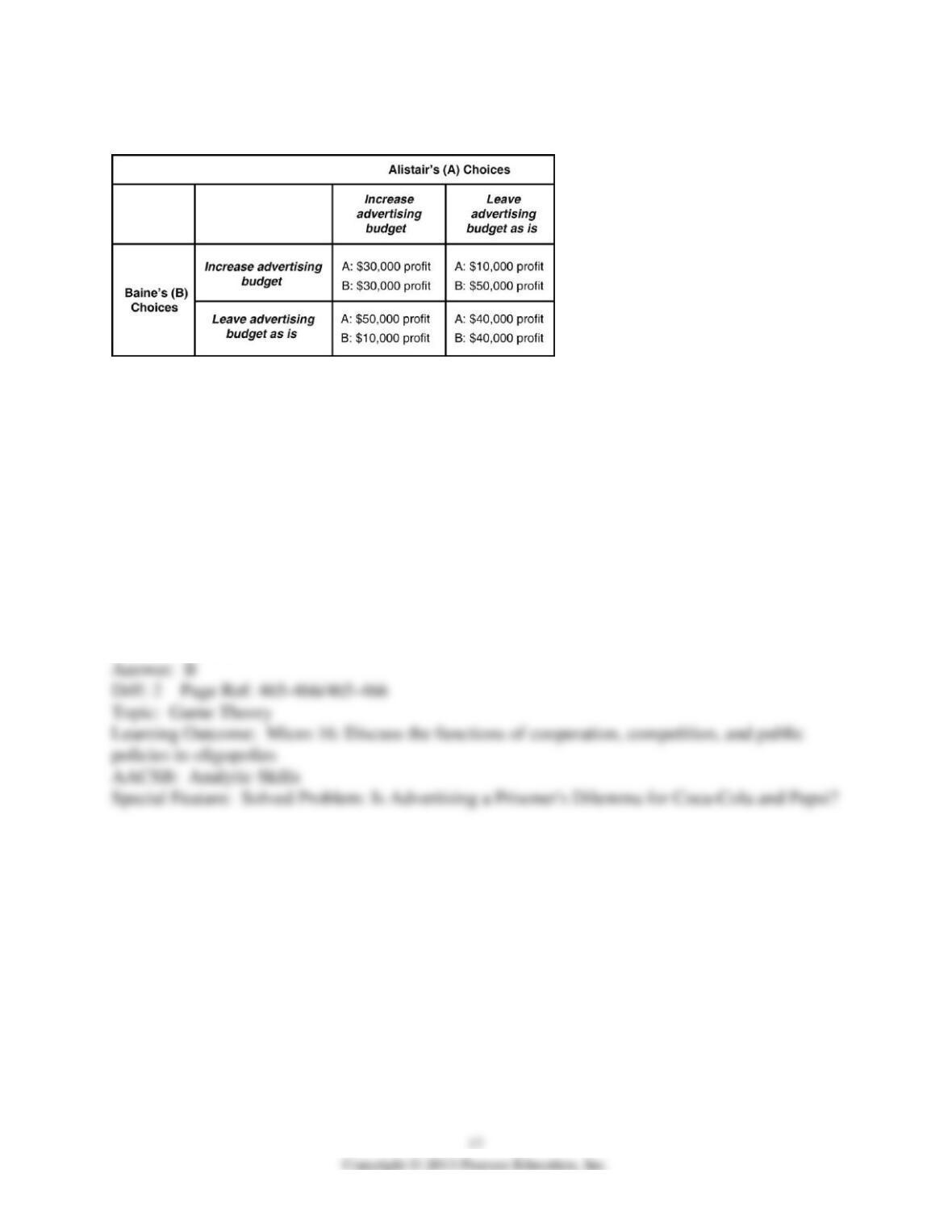
Table 14-1
Alistair Luggage and Baine Baggage are the only firms selling luggage in the upscale town of
Montecito. Each firm must decide on whether to increase its advertising spending to compete for
customers. If one firm increases its advertising budget but the other does not, then the firm with
the higher advertising budget will increase its profit. Table 14-1 shows the payoff matrix for this
advertising game.
9) Refer to Table 14-1. If Alistair assumes that Baine would increase its advertising budget, what
should it do?
A) Alistair should keep its own budget the same and allow Baine to incur the higher cost.
B) Alistair should also increase its advertising spending.
C) Alistair should reduce its advertising spending.
D) Being a duopolist, Alistair is not affected by Baine’s choices because it has a secure 50
percent market share.
10) Refer to Table 14-1. Does Alistair have a dominant strategy and if so, what is it?
A) Yes, Alistair should increase its advertising budget.
B) Yes, Alistair should keep its advertising budget as is.
C) There are two dominant strategies: if Baine increases its advertising budget, then Alistair’s
best bet is to keep its budget the same but if Baine does not increase its spending then Alistair
should raise its advertising budget
D) No, there is no dominant strategy.
11) Refer to Table 14-1. Does Baine have a dominant strategy and if so, what is it?
A) Yes, Baine should increase its advertising budget.
B) Yes, Baine should keep its advertising budget as is.
C) There are two dominant strategies: if Alistair increases its advertising budget, then Baine’s
best bet is to keep its budget the same but if Alistair does not increase its spending then Baine
should raise its advertising budget
D) No, there is no dominant strategy.
12) Refer to Table 14-1. What is the Nash equilibrium in this game?
A) There is no Nash equilibrium.
B) Baine increases its advertising budget, but Alistair does not.
C) Alistair increases its advertising budget, but Baine does not.
D) Both Alistair and Baine increase their advertising budgets.
19
13) Refer to Table 14-1. How are the firms in this advertising game caught in a prisoner’s
dilemma?
A) They are not in a prisoner’s dilemma because there is one clear strategy for each.
B) They would be more profitable if they refrained from advertising but each fears that if it does
not advertise, it will lose customers.
C) Since each firm is uncertain about the other’s behavior, each will adopt a wait-and-see attitude
which results in no increase in market share and no new customers.
D) Only the first mover is caught in a prisoner’s dilemma because the second has a chance to
observe and respond.
14) A set of actions that a firm takes to achieve a goal is the definition of a
A) business plan.
B) business strategy.
C) business prospectus.
D) business goal.
15) A situation in which each firm chooses the best strategy given the strategies chosen by other
firms is called a
A) Nash equilibrium.
B) dominant strategy.
C) collusion.
D) pay-off matrix.
16) Collusion occurs when
A) a firm chooses a level of output to maximize its own profit.
B) two firms’ price and output decisions come into conflict.
C) there is an agreement among firms to charge the same price or otherwise not to compete.
D) firms refuse to follow their price leaders.
17) An agreement among firms to charge the same price or otherwise not to compete is called
A) a pay-off matrix.
B) a subgame-perfect equilibrium.
C) a Nash equilibrium.
D) collusion.
18) A table that shows the possible payoffs each firm earns from every combination of strategies
by all firms is called
A) an earnings table.
B) a payoff table.
C) a payoff matrix.
D) a strategic matrix.