
Fundamentals of Corporate Finance 3e Test Bank
AICPA: Industry/Sector Perspective
45.
Your boss asks you to compute the company’s cash conversion cycle. Looking at the financial
statements, you see that the average inventory for the year was $126,300, accounts receivable
were $97,900, and accounts payable were at $115,100. You also see that the company had
credit sales of $324,000 and that cost of goods sold was $282,000. What is your firm’s cash
conversion cycle? Round to the nearest day.
A)
119 days
B)
34 days
C)
57 days
D)
125 days
Ans:
D
OR 125 days
Fundamentals of Corporate Finance 3e Test Bank
46.
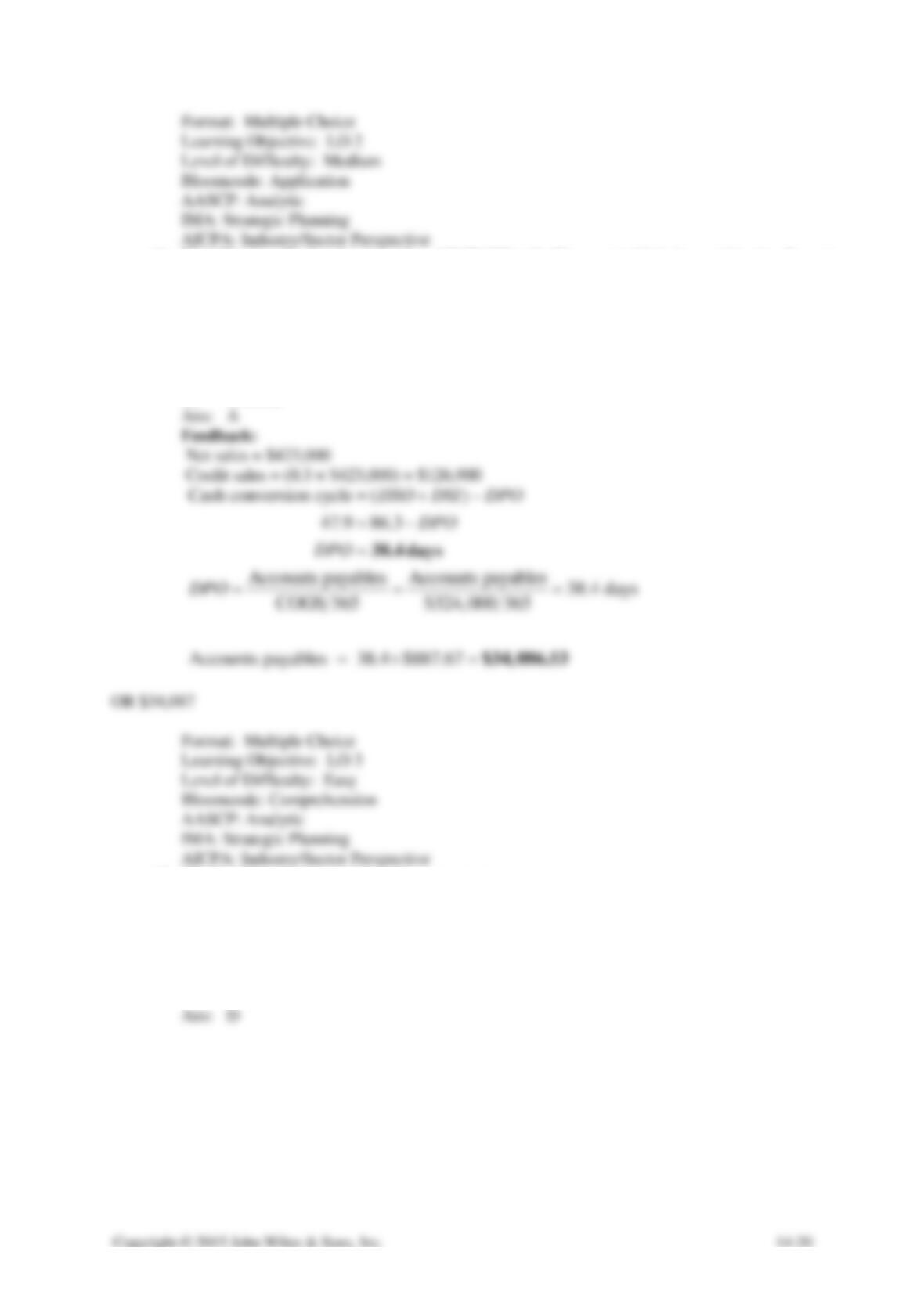
West Handicrafts, Inc. has net sales of $423,000 with 30 percent of it being credit sales. Its cost
of goods sold is $324,000. The firm’s cash conversion cycle is 47.9 days. The firm’s operating
cycle is 86.3 days. What is the firm’s accounts payable? Round to the nearest dollar. Do not
round your intermediate calculations.
A)
$34,087
B)
$126,900
C)
$71,203
D)
$56,322
Ans:
A
47.
The flexible current asset investment strategy
A)
has a high percent of current assets to sales, is generally perceived to be a low-risk and
low-return course of action.
B)
calls for management to invest large amounts in cash, short-term investments, and
inventory.
C)
leads to high levels of accounts receivable.
D)
All of the above
Ans:
D
AICPA: Industry/Sector Perspective
Fundamentals of Corporate Finance 3e Test Bank
48.
Which of the following is NOT true about the flexible current asset investment strategy?
A)
The strategy promotes a liberal trade credit policy for customers.
B)
The strategy calls for management to invest large amounts in cash, short-term
investments, and inventory.
C)
The strategy is perceived be a high-risk and high-return course of action for management
to follow.
D)
The strategy’s downside is the high inventory carrying cost.
Ans:
C
49.
A restrictive current asset investment strategy calls for
A)
levels of current assets kept to a minimum.
B)
a firm barely investing in cash, marketable securities and inventory.
C)
tight terms of sale intended to curb credit sales and accounts receivable.
D)
All of the above
Ans:
D
50.
The restrictive current asset management strategy is a high-risk, high-return alternative to the
flexible strategy because of
A)
financial shortage costs.
B)
production shortage costs.
C)
human resources shortage costs.
D)
None of the above
Ans:
A
AICPA: Industry/Sector Perspective

Fundamentals of Corporate Finance 3e Test Bank
51.
Which of the following statements is true?
A)
Financial shortage costs arise mainly from illiquidity—shortage of cash or a lack of
marketable securities to sell for cash.
B)
Operating shortage costs result from lost production and sales.
C)
Operating shortage costs can be substantial, especially if the product markets are
competitive.
D)
All of the above.
Ans:
D
52.
Operating shortage costs that result from lost production and sales are caused by
A)
not holding enough raw materials in inventory.
B)
running out of finished goods.
C)
restrictive credit policies.
D)
All of the above.
Ans:
D
AICPA: Industry/Sector Perspective
53.
Which of the following statements about working capital trade-off is true?
A)
Financial managers need to balance shortage costs against carrying costs to find an
optimal management strategy.
B)
If carrying costs are greater than shortage costs, then the firm will maximize value by
adopting a more restrictive strategy.
C)
If shortage costs dominate carrying costs, the firm will need to move toward a more
flexible policy.
D)
All of the above
Ans:
D
AICPA: Industry/Sector Perspective

Fundamentals of Corporate Finance 3e Test Bank
AICPA: Industry/Sector Perspective
54.
Which of the following statements about working capital trade-off is NOT true?
A)
Financial managers need to balance shortage costs against carrying costs to find an
optimal management strategy.
B)
If carrying costs are smaller than shortage costs, then the firm will maximize value by
adopting a more restrictive strategy.
C)
If shortage costs dominate carrying costs, the firm will need to move toward a more
flexible policy.
D)
Management will try to find the level of current assets that minimizes the sum of the
carrying costs and shortage costs.
Ans:
B
55.
The aging schedule
A)
shows the breakdown of a firm’s accounts receivable by their date of sale.
B)
identifies and then tracks delinquent accounts to see that they are paid.
C)
is an important financial tool for analyzing the quality of a company’s receivables.
D)
All of the above.
Ans:
D
56.
Which of the following statements is NOT true?
A)
Accounts payable (trade credit), bank loans, and commercial paper are common sources
of short-term financing.
B)
An informal line of credit is a verbal agreement between the firm and the bank, allowing
the firm to borrow up to an agreed-upon limit.
C)
An informal line of credit is a special type of collateralized loan.
D)
A formal line of credit is also known as “revolving credit.”
Ans:
C
Fundamentals of Corporate Finance 3e Test Bank
57.
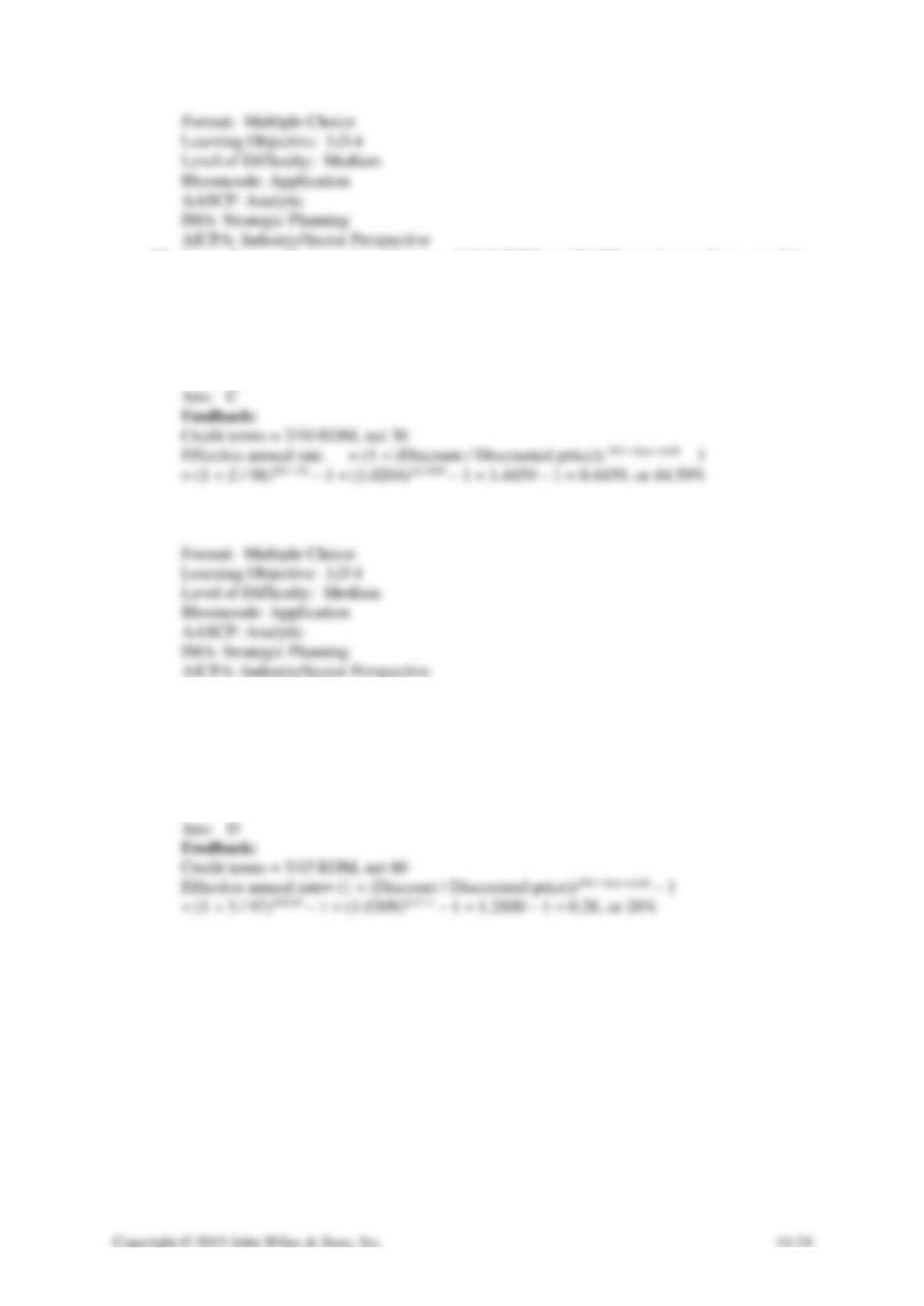
Senter Corp. sells its goods with terms of 2/10 EOM, net 30. What is the implicit cost of the
trade credit? Round your final percentage answer to 2 decimal places. Do not round your
intermediate calculations.
A)
18.50%
B)
30.00%
C)
44.59%
D)
21.89%
Ans:
C
Credit terms = 2/10 EOM, net 30
58.
Kearns, Inc. sells its goods with terms of 3/15 EOM, net 60. What is the implicit cost of the
trade credit? Round your final answer to the nearest whole percent. Do not round your
intermediate calculations.
A)
15%
B)
45%
C)
34%
D)
28%
Ans:
D
AICPA: Industry/Sector Perspective

Fundamentals of Corporate Finance 3e Test Bank
AICPA: Industry/Sector Perspective
59.
Which of the following statements is true of economic order quantity (EOQ)?
A)
The EOQ mathematically determines the minimum total inventory cost.
B)
The EOQ takes into account inventory reorder costs and inventory carrying costs.
C)
The optimal order size is determined by the EOQ model.
D)
All of the above
Ans:
D
60.
Which of the following statements is NOT true of economic order quantity (EOQ)?
A)
The economic order quantity (EOQ) mathematically determines the minimum total
inventory cost.
B)
The EOQ ignores inventory reorder costs and inventory carrying costs.
C)
The optimal order size is determined by the EOQ model.
D)
The EOQ is directly proportional to the sales per period.
Ans:
B
61.
Which of the following statements about just-in-time inventory management policy is NOT
true?
A)
It calls for the exact day-by-day, or even hour-by-hour raw material needs to be
delivered by the suppliers.
B)
If the supplier fails to make the needed deliveries, then production shuts down.
C)
A big disadvantage in this system is that there are high raw inventory costs.
D)
It eliminates obsolescence or loss to theft.
Ans:
C
Fundamentals of Corporate Finance 3e Test Bank
62.
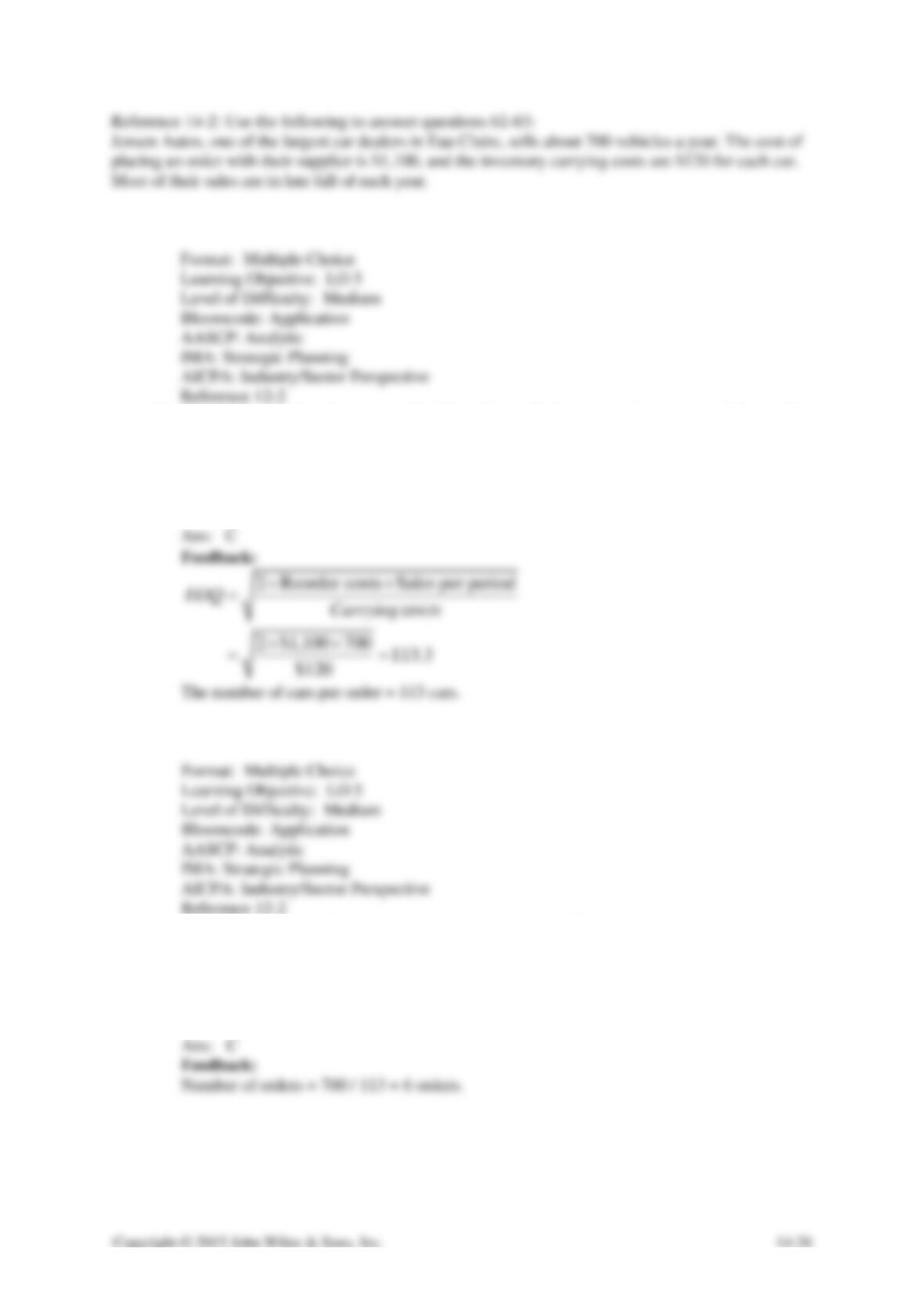
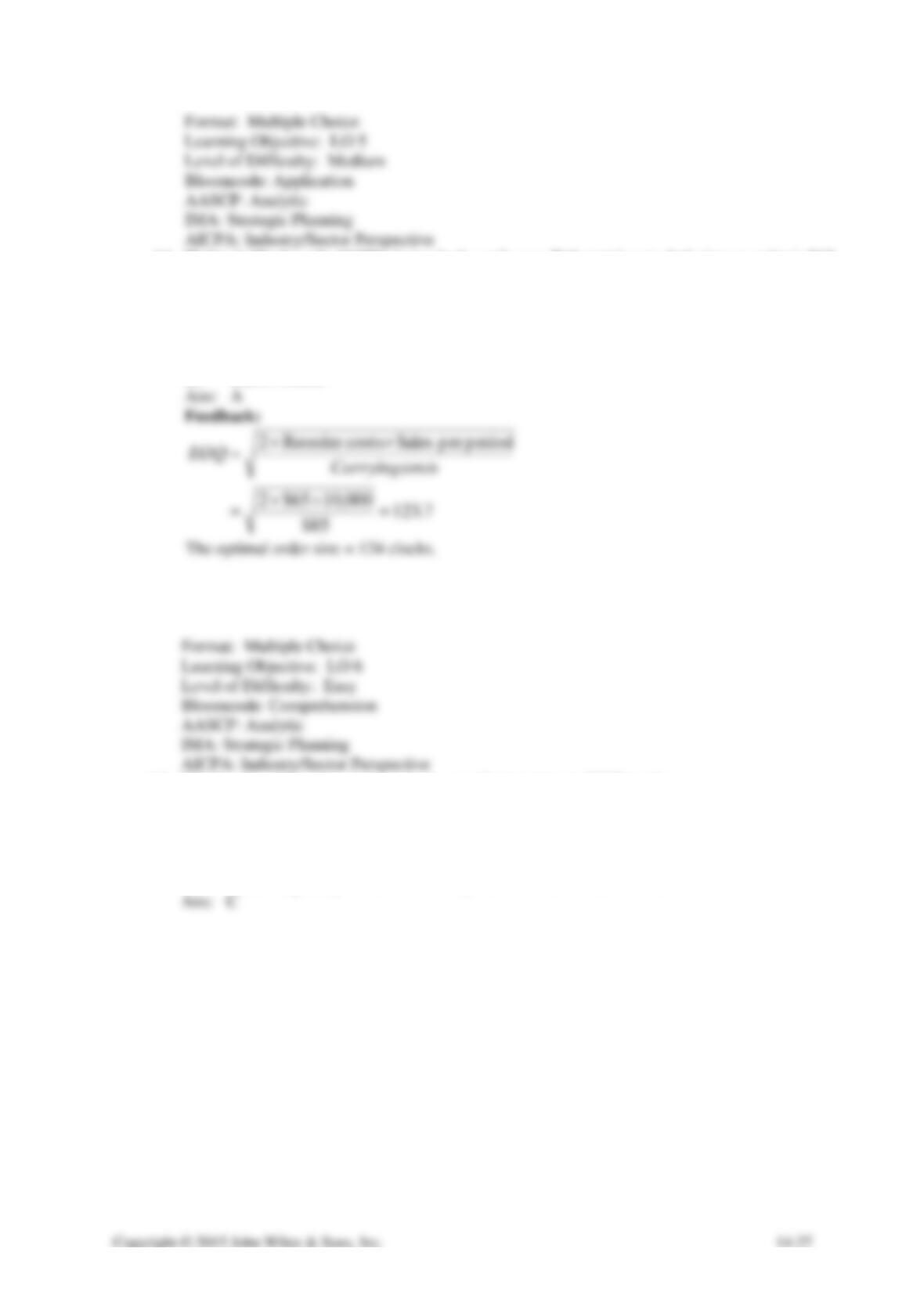
What is the number of cars per order? Round your final answer to the nearest whole number.
A)
80 cars
B)
101cars
C)
58 cars
D)
113 cars
Ans:
C
63.
How many orders will the dealer need to place this year? Round your answer to the whole
number.
A)
4 orders
B)
5 orders
C)
6 orders
D)
7 orders
Ans:
C
Number of orders = 700 / 113 = 6 orders.
Fundamentals of Corporate Finance 3e Test Bank
AICPA: Industry/Sector Perspective
64.
Ticktock Clocks sells 10,000 alarm clocks each year. If the total cost of placing an order is $65
and it costs $85 per year to carry the alarm clock in inventory, calculate the optimal order size
using the EOQ formula. Round your final answer to nearest whole number.
A)
124 clocks
B)
161 clocks
C)
15,294 clocks
D)
26,154 clocks
Ans:
A
65.
Which of the following statements about collection time is NOT true?
A)
Collection time, or float, is the time between when a customer makes a payment and
when the cash becomes available to the firm.
B)
Collection time can be broken down into three components.
C)
Delivery time or mailing time is not part of the collection time.
D)
Processing delay is one of the components of the collection time.
Ans:
C
Fundamentals of Corporate Finance 3e Test Bank
66.
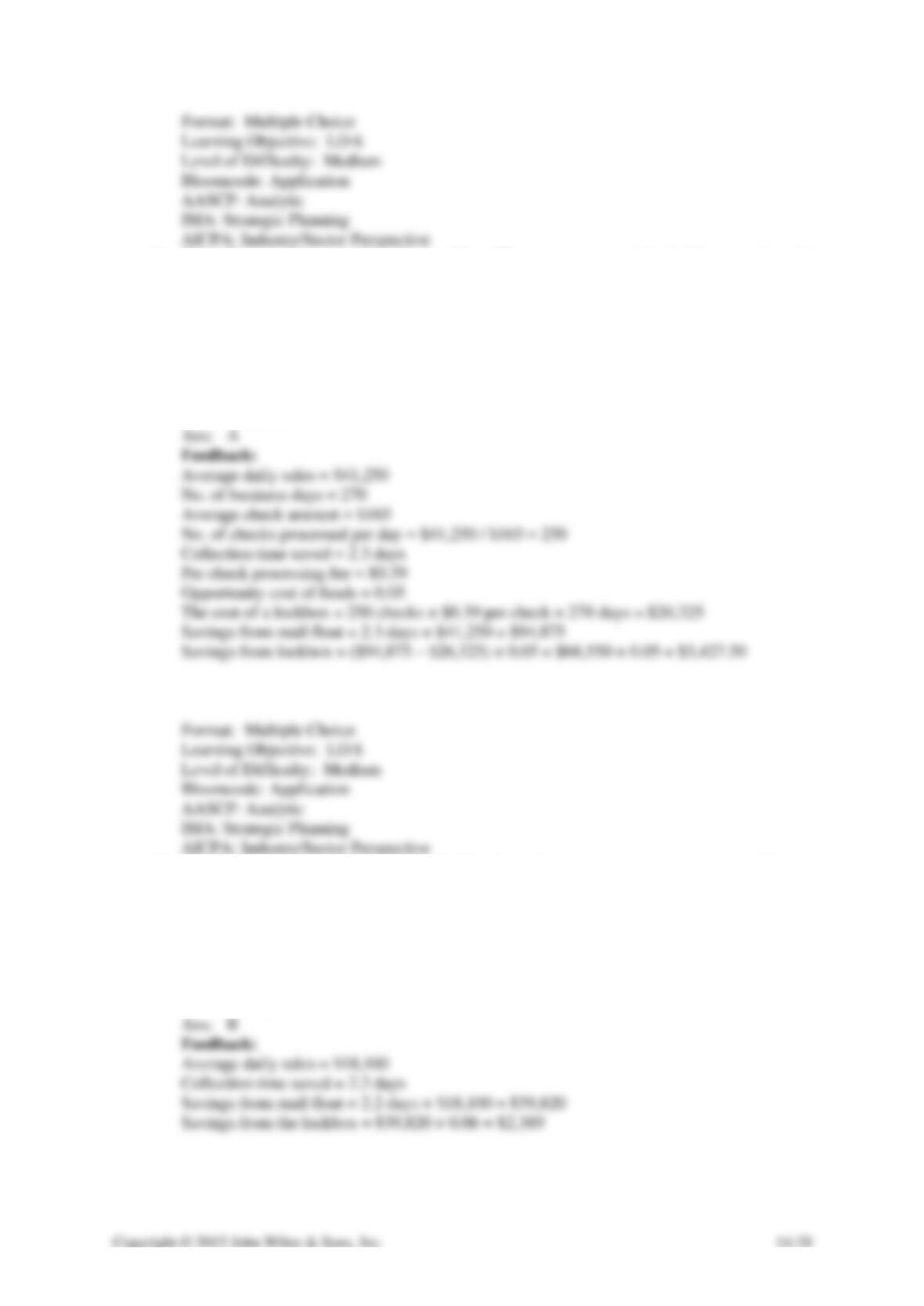
Porter Corp. has just signed up for a lockbox. Management expects the lockbox to reduce the
mail float by 2.3 days. The firm’s sales on average are $41,250 a day, with the average check
being $165. The bank charges $0.39 per processed check. Assume that there are 270 business
days in a year and the opportunity cost of funds is 5 percent. What will the firm’s savings be
from using the lockbox?
A)
$3,427.50
B)
$975.50
C)
$2,632.50
D)
$94,875.00
Ans:
A
67.
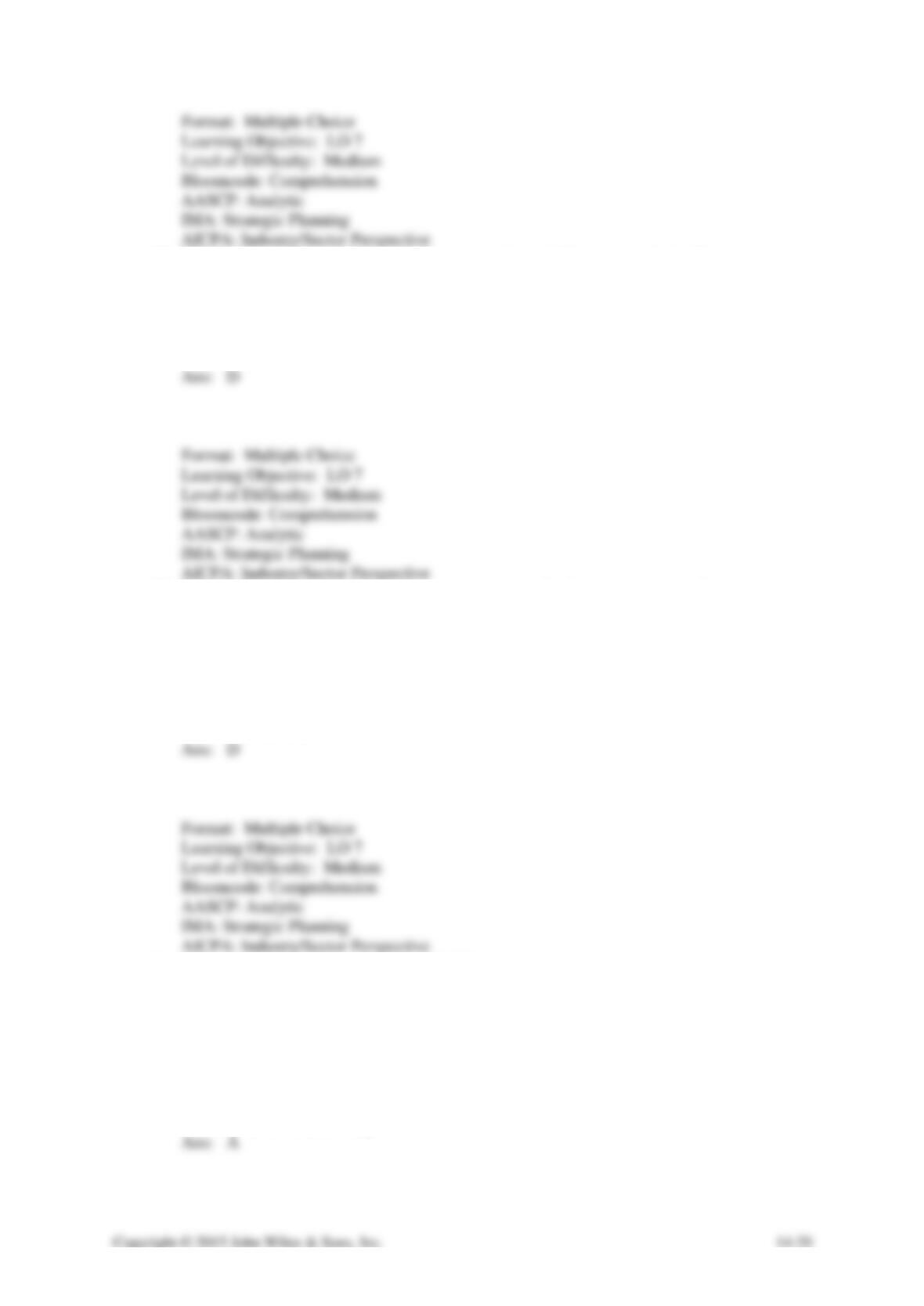
Rocky Corp. has daily sales of $18,100. The financial manager determined that a lockbox
would reduce the collection time by 2.2 days. Assuming the company can earn 6 percent
interest per year, what are the savings from the lockbox? Round your final answer to the nearest
dollar.
A)
$3,621
B)
$2,389
C)
$39,820
D)
$1,100
Ans:
B
Average daily sales = $18,100
Collection time saved = 2.2 days
Savings from mail float = 2.2 days × $18,100 = $39,820
Savings from the lockbox = $39,820 × 0.06 = $2,389
AICPA: Industry/Sector Perspective
Fundamentals of Corporate Finance 3e Test Bank
68.
Which of the following statements about maturity matching strategy is true?
A)
All seasonal working capital needs are funded with short-term borrowing.
B)
As the level of sales varies seasonally, short-term borrowing fluctuates with the level of
seasonal working capital.
C)
All fixed assets are funded with long-term financing.
D)
All of the above
Ans:
D
69.
Which of the following statements about short-term funding strategy is true?
A)
All seasonal working capital needs and a portion of permanent working capital and fixed
assets are funded with short-term debt.
B)
The downside to this strategy is that a portion of a firm’s long-term assets must be
periodically refinanced over their working lives.
C)
It can take advantage of an upward-sloping yield curve and lower a firm’s overall cost of
funding.
D)
All of the above
Ans:
D
70.
Which of the following statements is NOT true?
A)
Firms using maturity matching strategy fund all working capital needs with long-term
borrowing.
B)
Long-term financing strategy relies on long-term debt to finance both capital assets and
working capital.
C)
All permanent working capital and fixed assets are funded with long-term debt when
firms use a maturity matching strategy.
D)
Firms using a maturity matching strategy fund all seasonal working capital needs with
short-term borrowing.
AICPA: Industry/Sector Perspective
Fundamentals of Corporate Finance 3e Test Bank
71.
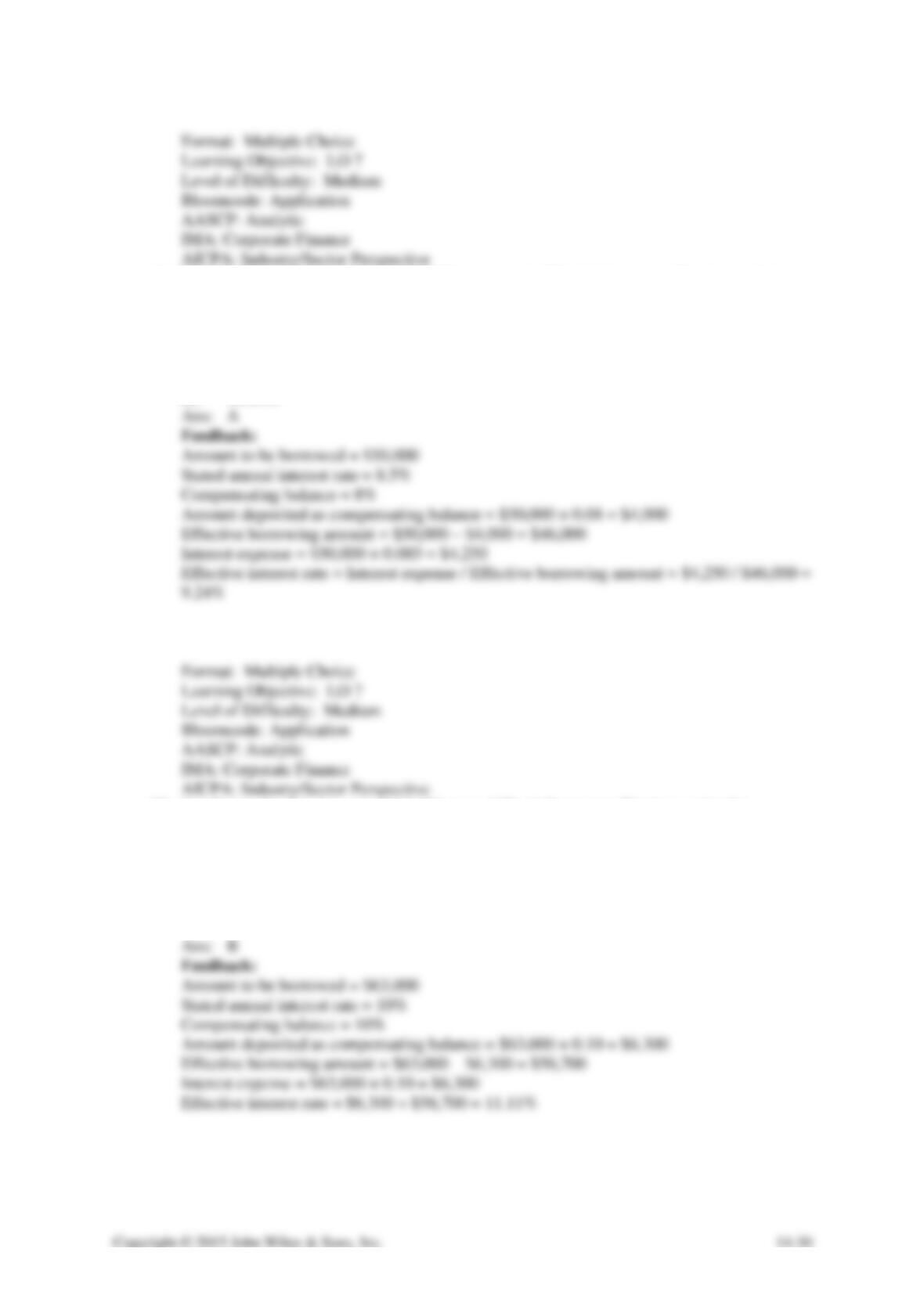
Serengeti Travels has borrowed $50,000 at a stated APR of 8.5 percent. The loan calls for a
compensating balance of 8 percent. What is the effective interest rate for this company? Round
your final percentage answer to two decimal places.
A)
9.24%
B)
8.50%
C)
8.00%
D)
16.50%
Ans:
A
72.
Sun Prairie Traders borrowed $63,000 at an APR of 10 percent. The loan called for a
compensating balance of 10 percent. What is the effective interest rate on the loan? Round your
final percentage answer to two decimal places.
A)
10.00%
B)
11.11%
C)
8.00%
D)
12.50%
Ans:
B
Fundamentals of Corporate Finance 3e Test Bank
73.
Good Homes Furnishings is borrowing $225,000. The loan requires a 10 percent compensating
balance, and the effective interest rate on loan is 8.25 percent. What is the stated APR on this
loan? Round your final percentage answer to two decimal places. Do not round your
intermediate calculations.
A)
10.00%
B)
11.11%
C)
7.43%
D)
8.25%
Ans:
C
74.
Maggie’s Bistro is borrowing $375,000. The loan requires an 8 percent compensating balance,
and the effective interest rate on the loan is 10.326 percent. What is the stated APR on this
loan? Round your final percentage answer to 1 decimal place. Do not round your intermediate
calculations.
A)
10.0%
B)
9.5%
C)
7.4%
D)
8.5%
Ans:
B
AICPA: Industry/Sector Perspective
Fundamentals of Corporate Finance 3e Test Bank
75.
Gibbs, Inc. has just set up a formal line of credit of $1 million with First National Bank. The
line of credit is good for up to five years. The bank will be charging them an interest rate of
6.25 percent on the loan, and in addition the firm will pay an annual fee of 50 basis points on
the unused balance. The firm borrowed $600,000 on the first day the credit line became
available. What is the firm’s effective interest rate on this line of credit? Round your final
percentage answer to 2 decimal places.
A)
8.00%
B)
7.25%
C)
6.58%
D)
8.25%
Ans:
C
$2,000) / $600,000 = 6.58%
AICPA: Industry/Sector Perspective
Fundamentals of Corporate Finance 3e Test Bank
76.
Trend, Inc. has just set up a formal line of credit of $5 million with First National Bank. The
line of credit is good for up to three years. The bank will be charging them an interest rate of
7.5 percent on the loan, and in addition, the firm will pay an annual fee of 50 basis points on the
unused balance. The firm borrowed $2,300,000 on the first day the credit line became available.
What is the firm’s effective interest rate on this line of credit? Round your final percentage
answer to one decimal place.
A)
8.5%
B)
7.2%
C)
9.0%
D)
8.1%
Ans:
D
Learning Objective: LO 7
77.
Storm Electronics has set up a formal line of credit of $2 million with First Kentucky Bank.
The line of credit is good for up to three years. The bank will be charging them an interest
rate of 6.25 percent on the loan, and in addition the firm will pay an annual fee of 60 basis
points on the unused balance. The firm borrowed $1,500,000 on the first day the credit line
became available. What is the firm’s effective interest rate on this line of credit? Round your
final percentage answer to two decimal places.
A)
7.50%
B)
6.45%
C)
6.25%
D)
7.15%
Ans:
B
AICPA: Industry/Sector Perspective
Fundamentals of Corporate Finance 3e Test Bank
Ans:
A
Factor discount = 2.875%
Simple monthly interest cost of factoring = 2.875 / (100 –2.875) = 2.875 / 97.125 = 0.0296
Simple annual interest cost of factors loan = 0.0296 × 12 = 35.5%.
79.
A firm sells $125,000 of its accounts receivable to factors at 3 percent discount. The firm’s
average collection period is one month. What is the dollar cost of the factoring service?
A)
$3,000
B)
$4,500
C)
$3,750
D)
$4,250
Ans:
C
Average collection period = 30 days
78.
Pride, Inc. sells $150,000 of its accounts receivable to factors at 2.875 percent discount. The
firm’s average collection period is 75 days. What is the simple annual interest cost of the factors
loan? Round your percentage answer to one decimal place.
A)
35.5%
B)
32.9%
C)
27.8%
D)
31.1%
Fundamentals of Corporate Finance 3e Test Bank
80.
Which of the following is a short-term financing instrument?
A)
Accounts payable
B)
Bank loans with a maturity of less than 1 year
C)
Commercial paper
D)
All of the above
Ans:
D
81.
What are some strategies that financial managers can follow in managing their working capital
accounts?
AICPA: Industry/Sector Perspective
Fundamentals of Corporate Finance 3e Test Bank
82.
Explain working capital trade-off.
83.
How does a just-in–time inventory management work?