
Exam
Name___________________________________
MULTIPLE CHOICE. Choose the one alternative that best completes the statement or answers the question.
1)
Which of the following hypothetical observations would contradict our theories about the
formation and evolution of white dwarfs?
1)
A)
discovery of a white dwarf with a 1.5 Msun mass main–sequence companion
B)
discovery of a white dwarf with a mass 1.5 times that of the Sun (1.5 Msun)
C)
discovery of a white dwarf at the center of a planetary nebula
D)
discovery of a white dwarf with a surface temperature of 6000 K
2)
Suppose you drop a clock toward a black hole. As you look at the clock from a high orbit, what will
you notice?
2)
A)
The clock will fall faster and faster, reaching the speed of light as it crosses the event horizon.
B)
Time on the clock will run slower as it approaches the black hole, and light from the clock will
be increasingly redshifted.
C)
The clock will fall toward the black hole at a steady rate, so that you‘ll see it plunge through
the event horizon within just a few minutes.
D)
Time on the clock will run faster as it approaches the black hole, and light from the clock will
be increasingly blueshifted.
3)
Which of statement below about black holes is not true?
3)
A)
A spaceship passing near a 10 solar mass black hole is much more likely to be destroyed than
a spaceship passing at the same distance from the center of a 10 solar mass main–sequence
star.
B)
If you watch someone else fall into a black hole, you will never see him (or her) cross the event
horizon; you’ll only see him fade from view as the light he emits or reflects becomes more and
more redshifted.
C)
Although we are not 100% certain that black holes exist, we have strong observational
evidence in favor of their existence.
D)
If you fell into a black hole, you would experience time to be running normally as you
plunged rapidly across the event horizon.

4)
Which of the following is closest in mass to a white dwarf?
4)
A)
the Sun
B)
the Moon
C)
Jupiter
D)
the Earth
5)
Rank the following 4 items in order of increasing density (low to high).
5)
A)
black hole singularity, main–sequence star, white dwarf, neutron star
B)
main–sequence star, neutron star, white dwarf, black hole singularity
C)
main–sequence star, white dwarf, neutron star, black hole singularity
D)
main–sequence star, black hole singularity, neutron star, white dwarf
6)
If you had something the size of a sugar cube that was made of neutron star matter, it would weigh
________.
6)
A)
about as much as a large mountain
B)
about as much as a truck
C)
about 50 pounds
D)
as much as the entire Earth
7)
When we see X–rays from an accretion disk in a binary system, we can’t immediately tell whether
the accretion disk surrounds a neutron star or a black hole. Suppose we then observe each of the
following phenomena in this system. Which one would rule out the possibility of a black hole?
7)
A)
visible and ultraviolet light from the companion star
B)
spectral lines from the companion star that alternately shift to shorter and longer wavelengths
C)
intense X–ray bursts
D)
bright X–ray emission that varies on a time scale of a few hours
8)
The more massive a white dwarf, the ________.
8)
A)
higher its temperature
B)
higher its luminosity
C)
larger its radius
D)
smaller its radius

9)
Pulsars are thought to be ________.
9)
A)
rapidly rotating neutron stars
B)
accreting black holes
C)
accreting white dwarfs
D)
unstable high–mass stars
10)
Which of the following is closest in size (radius) to a white dwarf?
10)
A)
the Earth
B)
the Sun
C)
a small city
D)
a basketball
E)
a football stadium
A
11)
A white dwarf supernova leaves behind
11)
A)
a white dwarf.
B)
a newborn star.
C)
nothing.
D)
a neutron star or black hole.
C
12)
Imagine that our Sun were magically and suddenly replaced by a black hole of the same mass (1
solar mass). What would happen to Earth in its orbit?
12)
A)
Earth would orbit faster, but at the same distance.
B)
Nothing; Earth’s orbit would remain the same.
C)
Earth would slowly spiral inward until it settled into an orbit about the size of Mercury’s
current orbit.
D)
Earth would almost instantly be sucked into oblivion in the black hole.
B
A

13)
Which of the following correctly describes how light will be affected as it tries to escape from a
massive object?
13)
A)
Visible light escaping from a compact massive object, such as a neutron star, will be
redshifted, but higher frequencies, such as X–rays and gamma rays, will not be affected.
B)
Less energetic light will not be able to escape from a compact massive object, such as a
neutron star, but more energetic light will be able to.
C)
Light escaping from a compact massive object, such as a neutron star, will be redshifted.
D)
Light doesn’t have mass; therefore, it is not affected by gravity.
E)
Light escaping from a compact massive object, such as a neutron star, will be blueshifted.
14)
The maximum mass of a white dwarf is ________.
14)
A)
about the mass of our Sun
B)
limitless; there is no theoretical limit to the maximum mass of a white dwarf
C)
about 3 times the mass of our Sun
D)
about 1.4 times the mass of our Sun
15)
Observationally, how can we tell the difference between a white–dwarf supernova and a massive–star
supernova?
15)
A)
A massive–star supernova is brighter than a white–dwarf supernova.
B)
The light of a white–dwarf supernova fades steadily, while the light of a massive–star
supernova continues to brighten for many weeks.
C)
The spectrum of a massive–star supernova shows prominent hydrogen lines, while the
spectrum of a white–dwarf supernova does not.
D)
A massive–star supernova happens only once, while a white–dwarf supernova can repeat
periodically.
E)
We cannot yet tell the difference between a massive–star supernova and a white–dwarf
supernova.

16)
A typical neutron star is more massive than our Sun and about the size (radius) of ________.
16)
A)
Earth
B)
a small asteroid (10 km in diameter)
C)
the Moon
D)
Jupiter
17)
Order the following objects in increasing size (radius):
17)
A)
neutron star, white dwarf, Jupiter, Sun
B)
Jupiter, white dwarf, neutron star, Sun
C)
Jupiter, white dwarf, Sun, neutron star
D)
neutron star, Jupiter, white dwarf, Sun
18)
A white dwarf supernova event is very important to calibrating Hubble’s Law. Why? Choose the
best answer for the question.
18)
A)
It is a very rare event.
B)
It can only happen to white dwarfs.
C)
It is a very luminous standard candle.
D)
The white dwarf supernova in a galaxy tells us how fast a galaxy is expanding away from us.
19)
From a theoretical standpoint, what is a pulsar?
19)
A)
a star that is burning iron in its core
B)
a star that alternately expands and contracts in size
C)
a rapidly rotating neutron star
D)
a binary system that happens to be aligned so that one star periodically eclipses the other
E)
a neutron star or black hole that happens to be in a binary system

20)
What is the ultimate fate of an isolated white dwarf?
20)
A)
As gravity overwhelms the electron degeneracy pressure, it will explode as a supernova.
B)
As gravity overwhelms the electron degeneracy pressure, it will become a neutron star.
C)
The electron degeneracy pressure slowly overwhelms gravity and the white dwarf
evaporates.
D)
It will cool down and become a cold black dwarf.
E)
As gravity overwhelms the electron degeneracy pressure, it will explode as a nova.
21)
What is an accretion disk?
21)
A)
any flattened disk in space, such as the disk of the Milky Way Galaxy
B)
a disk of material found around every white dwarf in the Milky Way Galaxy
C)
a disk of hot gas swirling rapidly around a white dwarf, neutron star, or black hole
D)
a stream of gas flowing from one star to its binary companion star
22)
Which of the following statements about gamma ray bursts is not true?
22)
A)
The events responsible for gamma ray bursts apparently produce only gamma rays, and no
other light that we can hope to detect.
B)
Based on their distribution in the sky, we can rule out a connection between gamma ray
bursts and X–ray binaries in the Milky Way Galaxy.
C)
Gamma ray bursts are among the most luminous events that ever occur in the universe.
D)
Gamma ray bursts were originally discovered by satellites designed to look for signs of
nuclear bomb tests on Earth.

23)
Which of the following statements about electron degeneracy pressure and neutron degeneracy
pressure is true?
23)
A)
Electron degeneracy pressure is the main source of pressure in white dwarfs, while neutron
degeneracy pressure is the main source of pressure in neutron stars.
B)
Both electron degeneracy pressure and neutron degeneracy pressure help govern the internal
structure of a main–sequence star.
C)
In a black hole, the pressure coming from neutron degeneracy pressure is slightly greater than
that coming from electron degeneracy pressure.
D)
The life of a white dwarf is an ongoing battle between electron degeneracy pressure and
neutron degeneracy pressure.
24)
What is the ultimate fate of an isolated pulsar?
24)
A)
As gravity overwhelms the neutron degeneracy pressure, it will explode as a supernova.
B)
The neutron degeneracy pressure will eventually overwhelm gravity and the pulsar will
slowly evaporate.
C)
As gravity overwhelms the neutron degeneracy pressure, it will become a white dwarf.
D)
It will spin ever slower, the magnetic field will weaken, and it will become invisible.
E)
It will spin ever faster, becoming a millisecond pulsar.
25)
Consider again the civilization described in the previous question. (They live on a planet orbiting
10 AU from a close binary star system that consists of a 15 MSun red giant star and a 10 MSun black
hole surrounded by an accretion disk.) One foolhardy day, a daring individual in their space force
(let’s call him Major Tom) decides to become the first of his species to cross the event horizon of the
black hole. To add to the drama, he decides to go in wearing only a thin space suit, which offers no
shielding against radiation, no cushioning against any forces, and so on. Which of the following is
most likely to kill him first (or at least to start the process of killing him first)?
25)
A)
tidal forces due to the black hole
B)
the sucking force from the black hole, which will cause his head to explode
C)
X–rays from the accretion disk
D)
the crush of gravity at the singularity embedded within the black hole

26)
Consider an X–ray binary system in which a compact object, surrounded by an accretion disk, is in
a binary orbit with another star. All of the following statements about such accretion disks are true
except:
26)
A)
The accretion disk consists of material that spills off the companion star.
B)
X–rays are emitted by the hot gas in the accretion disk.
C)
The radiation from an accretion disk may vary rapidly in time.
D)
Several examples of flattened accretion disks being “fed” by a large companion star can be
seen clearly in photos from the Hubble Space Telescope.
E)
The compact object may be either a neutron star or a black hole.
27)
A typical white dwarf is ________.
27)
A)
as massive as the Sun but only about as large in size as Earth
B)
as massive as the Sun but only about as large in size as Jupiter
C)
about the same size and mass as the Sun but much hotter
D)
as large in diameter as the Sun but only about as massive as Earth
28)
Imagine comparing a 1.2 solar mass white dwarf to a 1.0 solar mass white dwarf. Which of the
following must be true?
28)
A)
The 1.2 solar mass white dwarf has a larger radius.
B)
The 1.2 solar mass white dwarf has a lower surface temperature.
C)
The 1.2 solar mass white dwarf is supported by neutron degeneracy pressure; the 1 solar mass
white dwarf is supported by electron degeneracy pressure.
D)
The 1.2 solar mass white dwarf has a smaller radius.
E)
The 1.2 solar mass white dwarf has a higher surface temperature.

29)
What kind of star is most likely to become a white–dwarf supernova?
29)
A)
a pulsar
B)
an O star
C)
a white dwarf star with a red giant binary companion
D)
a binary M star
E)
a star like our Sun
30)
A neutron star is ________.
30)
A)
the remains of a star that died in a massive star supernova (if no black hole were created)
B)
the remains of a star that died by expelling its outer layers in a planetary nebula
C)
an object that will ultimately become a black hole
D)
a star made mostly of elements with high atomic mass numbers, so that they have lots of
neutrons
31)
How do we know that pulsars must be neutron stars?
31)
A)
We have observed massive–star supernovae produce pulsars.
B)
No massive object, other than a neutron star, could spin as fast as we observe pulsars to spin
and remain intact.
C)
Pulsars have the same upper mass limit as neutron stars do.
D)
This is only a theory that has not yet been confirmed by observations.
E)
Telescopic images of pulsars and neutron stars look exactly the same.
32)
According to present understanding, a nova is caused by ________.
32)
A)
hydrogen fusion on the surface of a neutron star
B)
carbon fusion in the core of a white dwarf
C)
a white dwarf that gains enough mass to exceed the 1.4–solar–mass limit
D)
hydrogen fusion on the surface of a white dwarf

33)
Which statement about pulsars is not thought to be true?
33)
A)
All pulsars are neutron stars, but not all neutron stars are pulsars.
B)
Pulsars can form only in close binary systems.
C)
Pulsars are kept from collapsing by neutron degeneracy pressure.
D)
A pulsar must have a very strong magnetic field and rotate quite rapidly.
34)
Which of the following statements about degeneracy pressure is not true?
34)
A)
Black holes form when gravity overcomes neutron degeneracy pressure.
B)
Degeneracy pressure can arise only from interactions among electrons.
C)
Degeneracy pressure arises from a quantum mechanical effect that we don’t notice in our
daily lives.
D)
Degeneracy pressure can continue to support an object against gravitational collapse even if
the object becomes extremely cold.
B
35)
What is the basic definition of a black hole?
35)
A)
an object with gravity so strong that not even light can escape
B)
any object made from dark matter
C)
a compact mass that emits no visible light
D)
a dead star that has faded from view
A
36)
Which statement about accretion disks is not true?
36)
A)
The gas in the inner parts of the disk travels faster than the gas in the outer parts of the disk.
B)
Accretion disks are made primarily of hydrogen and helium gas.
C)
The gas in the inner parts of the disk is hotter than the gas in the outer parts of the disk.
D)
The primary factor determining whether a white dwarf has an accretion disk is the white
dwarf’s mass.
D
B

37)
Order these objects by size (radius) from smallest to largest:
37)
A)
3 solar mass neutron star, 3 solar mass black hole, 1 solar mass white dwarf, 0.5 solar mass
white dwarf.
B)
0.5 solar mass white dwarf, 1 solar mass white dwarf, a 3 solar mass black hole, a 3 solar
mass neutron star.
C)
3 solar mass black hole, 3 solar mass neutron star, 1 solar mass white dwarf, 0.5 solar mass
white dwarf.
D)
1 solar–mass white dwarf, 0.5 solar–mass white dwarf, a 3 solar–mass neutron star, a 3
solar–mass black hole.
E)
3 solar mass black hole, 3 solar mass neutron star, 0.5 solar mass white dwarf, 1 solar mass
white dwarf.
F)
0.5 solar mass white dwarf, 1 solar mass white dwarf, a 3 solar mass neutron star, a 3 solar
mass black hole.
38)
Suppose that a white dwarf is gaining mass through accretion in a binary system. What happens if
the mass someday reaches the 1.4 solar mass limit?
38)
A)
The white dwarf will explode completely as a white dwarf supernova.
B)
The white dwarf will undergo a nova explosion.
C)
The white dwarf will collapse to become a black hole.
D)
The white dwarf will collapse in size, becoming a neutron star.
A
39)
Will our Sun ever undergo a white dwarf supernova explosion? Why or why not?
39)
A)
Yes, about a million years after it becomes a white dwarf.
B)
Yes, right at the end of its double–shell burning stage of life.
C)
No, because the Sun’s core will never be hot enough to fuse carbon and other heavier
elements into iron.
D)
No, because it is not orbited by another star.
D
C

40)
Which of the following is closest in size (radius) to a neutron star?
40)
A)
a city
B)
a football stadium
C)
the Earth
D)
a basketball
E)
the Sun
41)
Suppose a white dwarf is gaining mass because of accretion from a binary companion. What
happens if its mass reaches the 1.4 solar mass limit?
41)
A)
The white dwarf (which is made mostly of carbon) suddenly detonates carbon fusion and this
creates a white dwarf supernova explosion.
B)
The white dwarf immediately collapses into a black hole, disappearing from view.
C)
A white dwarf can never gain enough mass to reach the limit because a strong stellar wind
prevents the accreting material from reaching it in the first place.
D)
The white dwarf undergoes a collapse and expels the excess mass in a nova eruption.
42)
Which of the following statements about novae is not true?
42)
A)
When a star system undergoes a nova, it brightens considerably, but not as much as a star
system undergoing a supernova.
B)
The word nova means “new star” and originally referred to stars that suddenly appeared in
the sky, then disappeared again after a few weeks or months.
C)
A nova involves fusion taking place on the surface of a white dwarf.
D)
Our Sun will probably undergo at least one nova when it becomes a white dwarf about 5
billion years from now.
E)
A star system that undergoes a nova may have another nova sometime in the future.

43)
Which of the following best describes why a white dwarf cannot have a mass greater than the
1.4–solar–mass limit?
43)
A)
The upper limit to a white dwarf‘s mass is something we have learned from observations, but
no one knows why this limit exists.
B)
White dwarfs are made only from stars that have masses less than the 1.4–solar–mass limit.
C)
White dwarfs get hotter with increasing mass, and above the 1.4–solar–mass limit they would
be so hot that even their electrons would melt.
D)
Electron degeneracy pressure depends on the speeds of electrons, which approach the speed
of light as a white dwarf’s mass approaches the 1.4–solar–mass limit.
44)
Based on current evidence, which of the following statements about gamma ray bursts is true?
44)
A)
They occur in the same types of close binary systems that produce X–ray bursts.
B)
All those that we have detected occurred in distant galaxies.
C)
All gamma ray bursts are produced by supernovae.
D)
They come primarily from the Milky Way’s central black hole.
Explanation:
45)
Which of the following best describes what would happen if a 1.5–solar–mass neutron star, with a
diameter of a few kilometers, were suddenly (for unexplained reason) to appear in your home
town?
45)
A)
The combined mass of Earth and the neutron star would cause the neutron star to collapse
into a black hole.
B)
It would crash into Earth, throwing vast amounts of dust into the atmosphere that, in turn,
would cool the Earth; this is probably what caused the extinction of the dinosaurs.
C)
The entire Earth would end up as a thin layer, about 1 cm thick, over the surface of the
neutron star.
D)
It would rapidly sink to the center of Earth.
Explanation:
46)
A 10 solar mass main sequence star will produce which of the following remnants?
46)
A)
neutron star
B)
white dwarf
C)
black hole
D)
none of the above
Explanation:
Explanation:
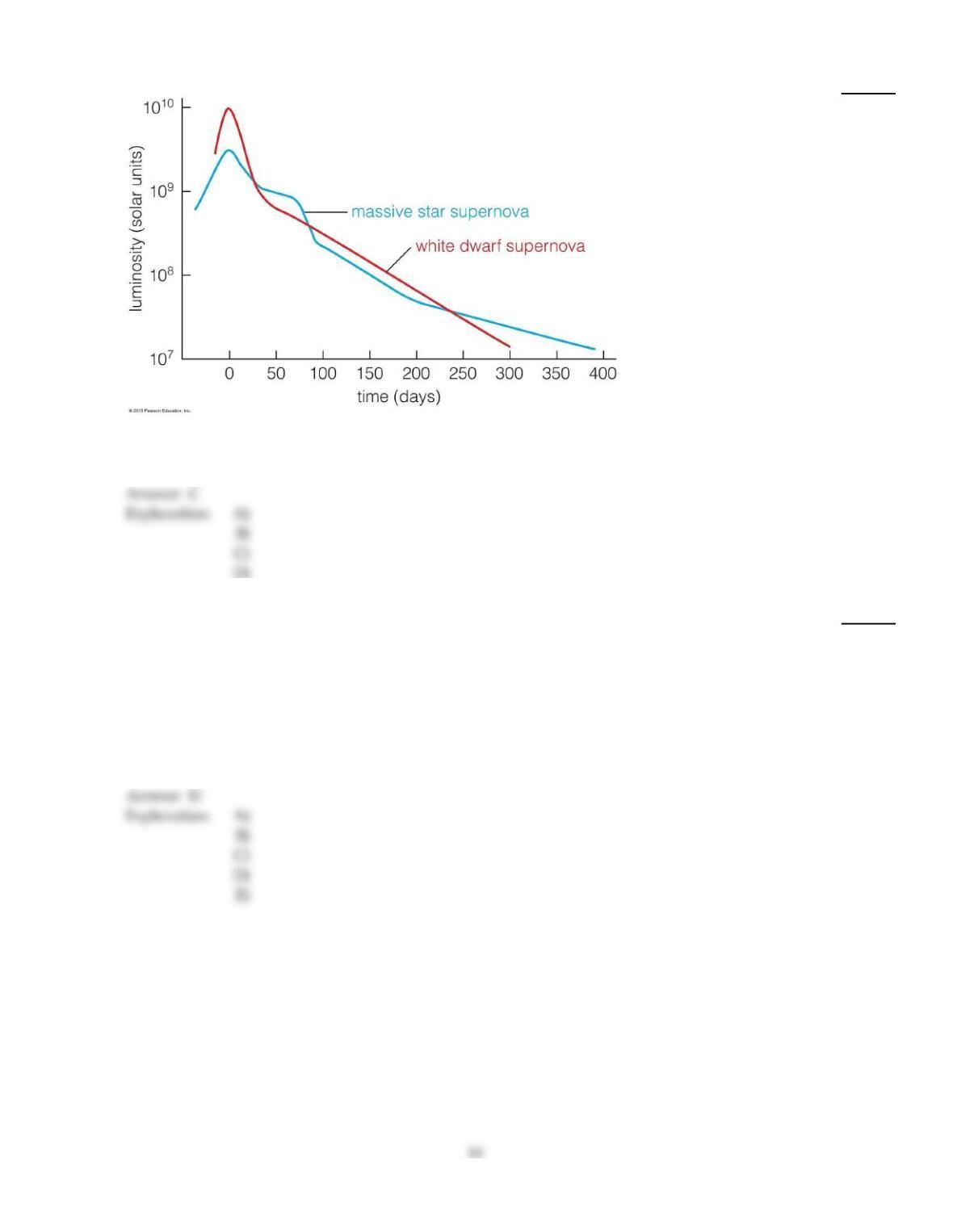
47)
This figure shows how the luminosity of supernovae change over time. How long does it take a
white dwarf supernova to decrease in luminosity by a factor of 100 from its peak?
47)
A)
about 25 days
B)
about 100 days
C)
about 200 days
D)
about 300 days
48)
What evidence suggests that long gamma ray bursts originate from supernovae of stars massive
enough to form black holes?
48)
A)
Some gamma ray bursts have been found to originate with galaxies that are actively forming
stars, and would thus have a few very massive (but short lived) stars.
B)
Rapid observations in other wavelengths show that some gamma ray bursts coincide with
points showing typical supernova light curves.
C)
The locations of gamma ray bursts suddenly begin blocking light from more distant stars.
D)
A and B
E)
B and C

49)
You want to determine whether a mystery object is a neutron star or a white dwarf. Which of the
following properties would demonstrate that it is definitely a neutron star?
49)
A)
Every decade or so, it erupts in a nova explosion.
B)
It dims and brightens more than twice per second.
C)
It is surrounded by a planetary nebula.
D)
It emits most strongly in visible and ultraviolet light.
50)
What do we mean by the event horizon of a black hole?
50)
A)
It is the very center of the black hole.
B)
It is the point beyond which neither light nor anything else can escape.
C)
It is the distance from the black hole at which stable orbits are possible.
D)
It is the place where X–rays are emitted from black holes.
51)
If you had something the size of a sugar cube that was made of white dwarf matter, it would weigh
________.
51)
A)
about 5 pounds
B)
as much as an average person
C)
as much as a truck
D)
as much as the entire Earth
52)
What makes us think that the star system Cygnus X–1 contains a black hole?
52)
A)
Cygnus X–1 is a powerful X–ray burster, so it must contain a black hole.
B)
It emits X–rays characteristic of an accretion disk, but the unseen star in the system is too
massive to be a neutron star.
C)
The fact that we see strong X–ray emission tells us that the system must contain a black hole.
D)
No light is emitted from this star system, so it must contain a black hole.

53)
How does an accretion disk around a neutron star differ from an accretion disk around a white
dwarf?
53)
A)
The accretion disk around a neutron star is more likely to give birth to planets.
B)
The accretion disk around a neutron star is made mostly of helium while the accretion disk
around a white dwarf is made mostly of hydrogen.
C)
The accretion disk around a neutron star always contains much more mass.
D)
The accretion disk around a neutron star is much hotter and emits higher–energy radiation.
54)
If you were to come back to our Solar System in 6 billion years, what might you expect to find?
54)
A)
a red giant star
B)
a black hole
C)
a white dwarf
D)
a rapidly spinning pulsar
E)
Everything will be essentially the same as it is now.
55)
A white dwarf is
55)
A)
a hot but very small main sequence star with a mass of less than 1.4 solar masses.
B)
the exposed core of a dead star, supported by neutron degeneracy pressure.
C)
a cool and very small main sequence star with a mass of less than 1.4 of a solar masses.
D)
the exposed core of a dead star, supported by electron degeneracy pressure.
E)
the name for the singularity at the center of a black hole.

56)
Consider again the civilization described in the previous question. (They live on a planet orbiting
10 AU from a close binary star system that consists of a 15 MSun red giant star and a 10 MSun black
hole surrounded by an accretion disk.) Through a bizarre (and scientifically unexplainable)
fluctuation in the space–time continuum, a copy of a book from that civilization arrives on your
desk; it is entitled Iguoonos: How We Evolved. In the first chapter, you learn that these beings evolved
from organisms that lived 5 billion years ago. Which of the following statements should you expect
to find as you continue to read this book?
56)
A)
They evolved from primitive wormlike creatures that had 13 legs, 4 eyes, and bald heads,
thus explaining why such critters are now considered a spectacular delicacy.
B)
Their immediate ancestors were chimpanzees.
C)
They believe that the presence of two stars in their system was critical to their evolution.
D)
They evolved on a different planet in a different star system, and moved to their current
location.
E)
As a result of traumatic experiences to their evolutionary ancestors, they dislike television.
57)
Which stars are more common?
57)
A)
neutron stars
B)
Neutron stars and black holes are about equally common.
C)
black holes
D)
white dwarfs
E)
White dwarfs and neutron stars are about equally common.
D
58)
You are studying a mystery companion to an evolved star, with mass transfer happening. Which of
the following properties suggests that the companion is definitely a black hole?
58)
A)
The mystery companion has a mass of over 1.4 solar masses.
B)
The mystery companion gives off periodic X–ray bursts.
C)
The mystery companion has a mass of over 3 solar masses.
D)
The mystery companion has an X–ray emitting accretion disk.
C
D

59)
Based on current understanding, the minimum mass of a black hole that forms during a massive star
supernova is roughly ________.
59)
A)
3 solar masses
B)
0.5 solar masses
C)
1.4 solar masses
D)
10 solar masses
60)
What is the upper limit to the mass of a white dwarf?
60)
A)
There is no upper limit.
B)
There is an upper limit, but we do not yet know what it is.
C)
2 solar masses
D)
1 solar mass
E)
1.4 solar masses
61)
A white dwarf is ________.
61)
A)
a brown dwarf that has exhausted its fuel for nuclear fusion
B)
an early stage of a neutron star
C)
a precursor to a black hole
D)
what most stars become when they die
62)
What is the origin of short gamma ray bursts?
62)
A)
the collision of stars in the dense nuclei of distant galaxies
B)
very powerful supernovae occurring in distant galaxies
C)
new stars forming in the Milky Way
D)
supernovae in the Milky Way
E)
It is not known, but it may be the collision of a neutron star with a black hole.

63)
Consider an object in orbit around a star. The star suddenly shrinks in size, but does not change its
mass. What happens to the object‘s orbit?
63)
A)
It remains in the same orbit.
B)
It settles into a smaller orbit, with similar distance from the surface as the original orbit.
C)
It is instantly ejected from its orbit.
D)
It gradually spirals into the star.
64)
After a massive–star supernova, what is left behind?
64)
A)
always a neutron star
B)
always a black hole
C)
always a white dwarf
D)
either a white dwarf or a neutron star
E)
either a neutron star or a black hole
65)
Which of the following observatories is most likely to discover a black hole in a binary system?
65)
A)
the SOFIA airborne infrared observatory
B)
the Hubble Space Telescope
C)
the Arecibo Radio Observatory
D)
the Chandra X–Ray Observatory
66)
The Crab Pulsar is pulsing in visible light 30 times per second. Why?
66)
A)
It is eclipsed by a companion 30 times per second.
B)
It rotates 30 times per second.
C)
A jet ejects energy and particles from a hot spot 30 times per second.
D)
It’s a mystery; no one really knows.

67)
What causes X–ray bursters?
67)
A)
Helium fusion, which occurs when the thin layer of accreted material on a neutron star
reaches 100 million K
B)
The mass of an accreting neutron star passes a critical threshold between 2 and 3 Msun and
explodes.
C)
The rapid rotation of the neutron star causes it to fly apart.
D)
The binary companion of a neutron star spirals in and combines with the neutron star.
68)
Imagine an advanced civilization living on a planet orbiting at a distance of 10 AU (1.5 billion
kilometers) from a close binary star system that consists of a 15 MSun red giant star and a 10 MSun
black hole. The black hole is surrounded by an accretion disk. Sometime within the next million
years or so, the civilization’s planet is likely to be doomed because ________.
68)
A)
the red giant will probably supernova within the next million years
B)
jets of material shot out of the accretion disk will shoot down their planet
C)
tidal forces from the black hole will rip the planet apart
D)
the planet’s orbit gradually will decay, as it is sucked in by the black hole
E)
the red giant star, which provides most of energy the civilization needs to exist, will soon be
destroyed in the accretion disk
69)
How does a black hole form from a massive star?
69)
A)
If enough mass is accreted by a neutron star, it will undergo a supernova explosion and leave
behind a black–hole remnant.
B)
During a supernova, if a star is massive enough for its gravity to overcome neutron
degeneracy pressure in the core, the core will collapse to a black hole.
C)
A black hole forms when two massive main–sequence stars collide.
D)
Any star that is more massive than 8 solar masses will undergo a supernova explosion and
leave behind a black hole remnant.
E)
If enough mass is accreted by a white dwarf star that it exceeds the 1.4 solar mass limit, it will
undergo a supernova explosion and leave behind a black–hole remnant.

70)
The surface of the neutron star RXJ2015 has a temperature of 10 million K. This neutron star glows
most strongly in
70)
A)
X–ray light.
B)
visible light.
C)
emission lines.
D)
infrared light.
E)
radio light.
71)
How is an X–ray burst (in an X–ray binary system) similar to a nova?
71)
A)
Both involve explosions on the surface of a stellar corpse.
B)
Both result in the complete destruction of their host stars.
C)
Both are thought to involve fusion of hydrogen into helium.
D)
Both typically recur every few hours to every few days.
72)
The white dwarf that remains when our Sun dies will be mostly made of ________.
72)
A)
hydrogen
B)
helium
C)
neutrons
D)
carbon
73)
The Schwarzschild radius of a black hole depends on ________.
73)
A)
both the mass and chemical composition of the black hole
B)
the way in which the black hole formed
C)
the observationally measured radius of the black hole
D)
only the mass of the black hole

74)
Why is there an upper limit to the mass of a white dwarf?
74)
A)
The more massive the white dwarf, the higher its temperature and hence the greater its
degeneracy pressure. Near 1.4 solar masses, the temperature becomes so high that all matter
effectively melts into subatomic particles.
B)
White dwarfs come only from stars with masses less than 1.4 solar masses.
C)
The more massive the white dwarf, the greater the degeneracy pressure and the faster the
speeds of its electrons. Near 1.4 solar masses, the speeds of the electrons approach the speed
of light, and no more mass can be supported.
D)
The upper limit to the masses of white dwarfs was determined through observations of white
dwarfs in binary systems, but no one knows why the limit exists.
75)
What kind of pressure supports a white dwarf?
75)
A)
electron degeneracy pressure
B)
thermal pressure
C)
neutron degeneracy pressure
D)
radiation pressure
E)
all of the above
76)
A teaspoonful of white dwarf material on Earth would weigh
76)
A)
a few pounds.
B)
a few grams.
C)
a few tons.
D)
about the same as the Earth.
E)
about the same as Mt. Everest.

77)
Degeneracy pressure stops the crush of gravity in all the following except
77)
A)
a white dwarf.
B)
a neutron star.
C)
a brown dwarf.
D)
a very massive main–sequence star.
E)
the central core of the Sun after hydrogen fusion ceases but before helium fusion begins.
78)
From an observational standpoint, what is a pulsar?
78)
A)
a star that changes color rapidly, from blue to red and back again
B)
an object that emits random “pulses” of light, sometimes with only a fraction of a second
between pulses and other times with several days between pulses
C)
a star that slowly changes its brightness, getting dimmer and then brighter, with a period of
anywhere from a few hours to a few weeks
D)
an object that emits flashes of light several times per second (or even faster), with near perfect
regularity
79)
Prior to 1991, most astronomers assumed that gamma–ray bursts came from neutron stars (with
accretion disks) within the Milky Way Galaxy. How do we now know that this hypothesis was
wrong?
79)
A)
Observations from the Compton Gamma–Ray Observatory showed that gamma–ray bursts
come randomly from all directions in the sky.
B)
We now know that gamma–ray bursts come not from neutron stars but from black holes.
C)
Observations from the Compton Gamma–Ray Observatory allowed us to trace gamma–ray
bursts to pulsating variable stars in distant galaxies.
D)
Theoretical work has proven that gamma rays cannot be produced in accretion disks.
E)
Observations from the Compton Gamma–Ray Observatory showed that gamma–ray bursts
occur too frequently to be attributed to neutron stars.

80)
How do we know what happens at the event horizon of a black hole?
80)
A)
Astronomers have analyzed the light from matter within the event horizon of many black
holes.
B)
Physicists have created miniature black holes in the lab.
C)
Astronomers have sent spacecraft through the event horizon of a nearby black hole.
D)
Astronomers have detected X–rays from accretion disks around black holes.
E)
We don’t know for sure; we only know what to expect based on the predictions of general
relativity.
81)
In which wavelength region(s) would we need to carry out observations in order to study the
accretion disk around a white dwarf in a binary system?
81)
A)
visible light
B)
X–ray light
C)
ultraviolet light
D)
A and B
E)
B and C
82)
Which of the following best describes what would happen if a 1.5 solar mass neutron star, with a
diameter of a few kilometers, were suddenly to appear in your hometown?
82)
A)
The entire mass of the Earth would end up as a thin layer, about 1 cm thick, over the surface
of the neutron star.
B)
It would crash through the Earth, creating a large crater, and exit the Earth on the other side.
C)
It would rapidly sink to the center of the Earth.
D)
It would crash into the Earth, throwing vast amounts of dust into the atmosphere which in
turn would cool the Earth. Such a scenario is probably what caused the extinction of the
dinosaurs.
E)
The combined mass of the Earth and the neutron star would cause the neutron star to collapse
into a black hole.

83)
According to our modern understanding, what is a nova?
83)
A)
an explosion on the surface of a white dwarf in a close binary system
B)
a rapidly spinning neutron star
C)
the explosion of a massive star at the end of its life
D)
the sudden formation of a new star in the sky
84)
Which statement concerning black hole masses and Schwarzschild radii is not true?
84)
A)
For black holes produced in massive star supernovae, Schwarzschild radii are typically a few
to a few tens of kilometers.
B)
In a binary system with a black hole, the Schwarzschild radius depends on the distance from
the black hole to the companion star.
C)
The more massive the black hole, the larger the Schwarzschild radius.
D)
Even an object as small as you could become a black hole if there were some way to compress
you to a size smaller than your Schwarzschild radius.
85)
Which of the following is not true about differences between novae and supernovae?
85)
A)
Novae are much less luminous than supernovae.
B)
The same star can undergo novae explosions more than once, but can undergo only a single
supernova.
C)
Supernovae eject gas into space, but novae do not.
D)
Novae occur only in binary star systems, while supernovae can occur both among single stars
and among binary star systems.

86)
Which of the following statements about black holes is not true?
86)
A)
If you watch someone else fall into a black hole, you will never see him or her cross the event
horizon. However, he or she will fade from view as the light he or she emits becomes more
and more redshifted.
B)
If you fell into a supermassive black hole (so that you could survive the tidal forces), you
would experience time to be running normally as you plunged across the event horizon.
C)
The event horizon of a black hole represents a boundary from which nothing can escape.
D)
If the Sun magically disappeared and was replaced by a black hole of the same mass, the
Earth would soon be sucked into the black hole.
E)
If we watch a clock fall toward a black hole, we will see it tick slower and slower as it falls
towards the black hole.
87)
Each Voyager spacecraft carries a “postcard” designed to be understandable to any aliens that might
someday encounter it. On the “postcard,” scientists pinpointed the location of Earth by
triangulating it between pulsars. Why did the scientists choose pulsars rather than some other type
of star?
87)
A)
Several pulsars are located within a dozen light–years of our solar system, making them
useful for finding our solar system.
B)
Pulsars are easy to identify by their almost perfectly steady periods of pulsation.
C)
Pulsars are very bright and therefore easy to find.
D)
We’re pretty sure that aliens will have only radio telescopes and not optical telescopes, so
they’ll have a better chance of seeing pulsars than ordinary stars.
B
88)
Imagine what would happen if Jupiter were suddenly replaced by a black hole with the same mass
as Jupiter.
88)
A)
The orbits of the solar system would be unaffected (including Jupiter’s).
B)
The entire solar system would instantly be sucked into the black hole.
C)
The other planets and the Sun would slowly be pulled into Jupiter.
D)
The other planets would slowly be pulled into Jupiter, but the Sun would be unaffected.
A
D

89)
A paperclip with the density of a neutron star would weigh (on the Earth)
89)
A)
more than the Earth.
B)
more than Mt. Everest.
C)
more than the Moon.
D)
about the same as a regular paperclip.
E)
a few tons.
90)
What causes the radio pulses of a pulsar?
90)
A)
The neutron star undergoes periodic explosions of nuclear fusion that generate radio pulses.
B)
A black hole near the neutron star absorbs energy and re–emits it as radio waves.
C)
As the neutron star spins, beams of radio radiation sweep through space. If one of the beams
crosses the Earth, we observe a pulse.
D)
The neutron star’s orbiting companion periodically eclipses the radio waves that the neutron
star emits.
E)
The vibration of the neutron star
91)
What do we mean by the singularity of a black hole?
91)
A)
It is the edge of the black hole, where one could leave the observable universe.
B)
The term is intended to emphasize the fact that an object can become a black hole only once,
and a black hole cannot evolve into anything else.
C)
It is the center of the black hole, a place of infinite density where the known laws of physics
cannot describe the conditions.
D)
It is the “point of no return” of the black hole; anything closer than this point will not be able
to escape the gravitational force of the black hole.
SHORT ANSWER. Write the word or phrase that best completes each statement or answers the question.
92)
What is the evidence that gamma–ray bursts originate from beyond the Milky Way
Galaxy?
92)
93)
Briefly describe how a nova event occurs.
93)
94)
What would happen if a small piece of neutron star material (say the size of a paper clip)
struck the Earth?
94)
95)
Explain why black holes in binary systems are associated with strong, steady X–ray
emission.
95)
96)
Briefly describe what you would see if your friend plunged into a black hole.
96)
97)
Why do white–dwarf supernovae all have the same maximum luminosity?
97)
98)
Suppose you find an X–ray binary system that shows X–ray bursts. Is it possible that this
system consists of a red giant and a black hole? Why or why not?
98)
99)
What is an X–ray burster? What causes the X–ray bursts?
99)
100)
Why would the earth’s orbit be unaffected were the Sun to suddenly become a black hole?
100)
101)
Why does the size of a white dwarf decrease with increasing mass?
101)
102)
Could our Sun ever undergo a nova or a white–dwarf supernova event? Why or why not?
102)
TRUE/FALSE. Write ‘T’ if the statement is true and ‘F’ if the statement is false.
103)
There is no upper limit to the mass of a neutron star.
103)
104)
No visible light can escape a black hole, but things such as gamma rays, X–rays, and neutrinos can.
104)
105)
All pulsars are neutron stars, but not all neutron stars are pulsars.
105)
106)
Neutron stars are the densest objects that we can directly observe in the universe.
106)

107)
Brown dwarfs, white dwarfs, and neutrons stars are all kept from collapsing by degeneracy
pressure.
107)
108)
The remnant left behind by a white–dwarf supernova is a neutron star.
108)
109)
More massive white dwarfs are smaller than less massive white dwarfs.
109)
110)
Light escaping from white dwarfs will show a gravitational redshift.
110)
111)
Our Sun will likely undergo a nova event in about 5 billion years.
111)
112)
The maximum mass for a white dwarf is 1.4 solar masses.
112)
113)
All massive–star supernovae leave behind black holes as remnants.
113)
ESSAY. Write your answer in the space provided or on a separate sheet of paper.
114)
“Negatively Defined” Objects: Summarize the best observational evidence that astronomers have for the existence
of stellar mass black holes. Contrast this with the observational evidence that pulsars exist. Do you agree or
disagree with the statement that the best evidence we have for stellar mass black holes is that we have detected
objects for which an alternate explanation is lacking? How does your answer influence your confidence in the
existence of black holes? Does the strong observational confirmation of Einstein’s general theory of relativity
(see Special Topic General Relativity and Spacetime in Section 14.3) increase your confidence in the existence of
black holes? Should it?
115)
The coolest white–dwarf: Surveys have been carried out to identify isolated white–dwarfs throughout the galaxy
and its globular clusters. They have been found to span a range of temperatures, with a sharp lower limit of
about 3000 K (i.e. many have been found at all temperatures from 10s of thousands of Kelvin down to 3000K,
but none cooler). What does this observation reveal about the age of our galaxy?

116)
Evidence that Pulsars are Neutron Stars: Suppose a friend of yours insists that pulsars are artificial time–signals
constructed by aliens. List and explain all of the observational evidence that pulsars are actually natural
phenomena, namely rapidly spinning neutron stars.
117)
Studying the Singularity: The singularity at the center of a black hole is predicted to be a region of zero volume
and infinite density that contains all of the black hole’s mass. It is a point at which all currently known physical
laws break down. Yet in a black hole, this “terrible point” is hidden from view behind an event horizon that
prevents any knowledge about the singularity reaching the outside universe. Astronomers continue to spend
considerable effort trying to understand the nature of these singularities, objects for which observational input,
it would seem, will be forever lacking? Are these astronomers practicing science? Argue both yes and no. Which
do you find convincing?

Answer Key
Testname: C14

Answer Key
Testname: C14
33
Answer Key
Testname: C14