
Chapter 14 – DNA: The Genetic Material
50. Which of the following DNA sequences is complementary to 5′ ATGGTCAGT 3′?
Chapter 14 – DNA: The Genetic Material
Clarify Question
• What is the key concept addressed by the question?
• What type of thinking is required?
• What key words does the question contain?
Gather Content
• What do you already know about base-pairing?
Consider Possibilities
• What other information is related to the question? Which information is most useful?
Choose Answer
• Given what you now know, what information and/or problem solving approach is most
likely to produce the correct answer?
Reflect on Process
• Did your problem-solving process lead you to the correct answer? If not, where did the
process break down or lead you astray? How can you revise your approach to produce a
Chapter 14 – DNA: The Genetic Material
more desirable result?
51. In DNA, a purine must always pair with a pyrimidine and vice versa in order to ensure
that
52. During DNA replication, which enzyme removes the RNA primers and then fills in the
gap?
53. If a mutation prevented synthesis of the beta subunit of DNA pol III, which would be
most affected?
Chapter 14 – DNA: The Genetic Material
Clarify Question
• What is the key concept addressed by the question?
• What type of thinking is required?
• What key words does the question contain?
Gather Content
• What do you already know about DNA polymerase?
Consider Possibilities
• Consider the different answer options. Which can you rule out?
Choose Answer
• Given what you now know, what information and/or problem solving approach is most
likely to produce the correct answer?
Reflect on Process
• Did your problem-solving process lead you to the correct answer? If not, where did the
process break down or lead you astray? How can you revise your approach to produce a
more desirable result?
Chapter 14 – DNA: The Genetic Material
54. Why does DNA pol I carry the number one?
55. You are asked to give a classroom demonstration of DNA supercoiling. To do so, you
take two different colored pieces of rubber tubing, twist them very tightly and excessively
around each other and join the ends of the tubing appropriately. Next, you relieve the
supercoiling by breaking one strand and unwinding it. In this demonstration, the breaking and
unwinding to relieve the supercoiling simulates the action of
Chapter 14 – DNA: The Genetic Material
Clarify Question
• What is the key concept addressed by the question?
• What type of thinking is required?
• What key words does the question contain?
Gather Content
• What do you already know about supercoiling?
Consider Possibilities
• What other information is related to the question? Which information is most useful?
Choose Answer
• Given what you now know, what information and/or problem solving approach is most
likely to produce the correct answer?
another version (“isomer”). That’s it!
Reflect on Process
• Did your problem-solving process lead you to the correct answer? If not, where did the
process break down or lead you astray? How can you revise your approach to produce a
more desirable result?
Chapter 14 – DNA: The Genetic Material
56. In which cells would you expect to find the highest level of telomerase?
Chapter 14 – DNA: The Genetic Material
Clarify Question
• What is the key concept addressed by the question?
• What type of thinking is required?
• What key words does the question contain?
Gather Content
• What do you already know about telomeres and telomerase?
Consider Possibilities
• What other information is related to the question? Which information is most useful?
Choose Answer
• Given what you now know, what information and/or problem solving approach is most
likely to produce the correct answer?
Reflect on Process
• Did your problem-solving process lead you to the correct answer? If not, where did the
process break down or lead you astray? How can you revise your approach to produce a
more desirable result?
Chapter 14 – DNA: The Genetic Material
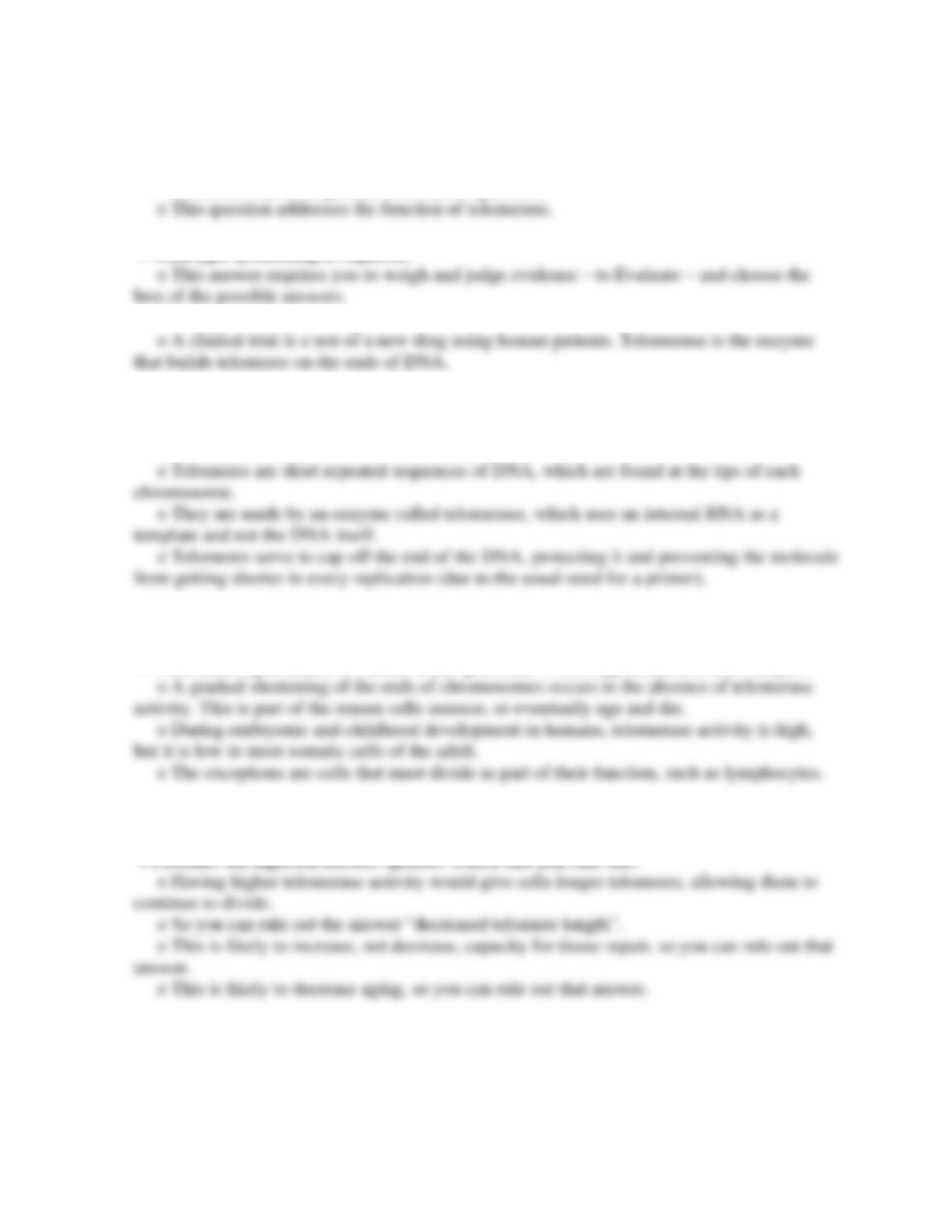
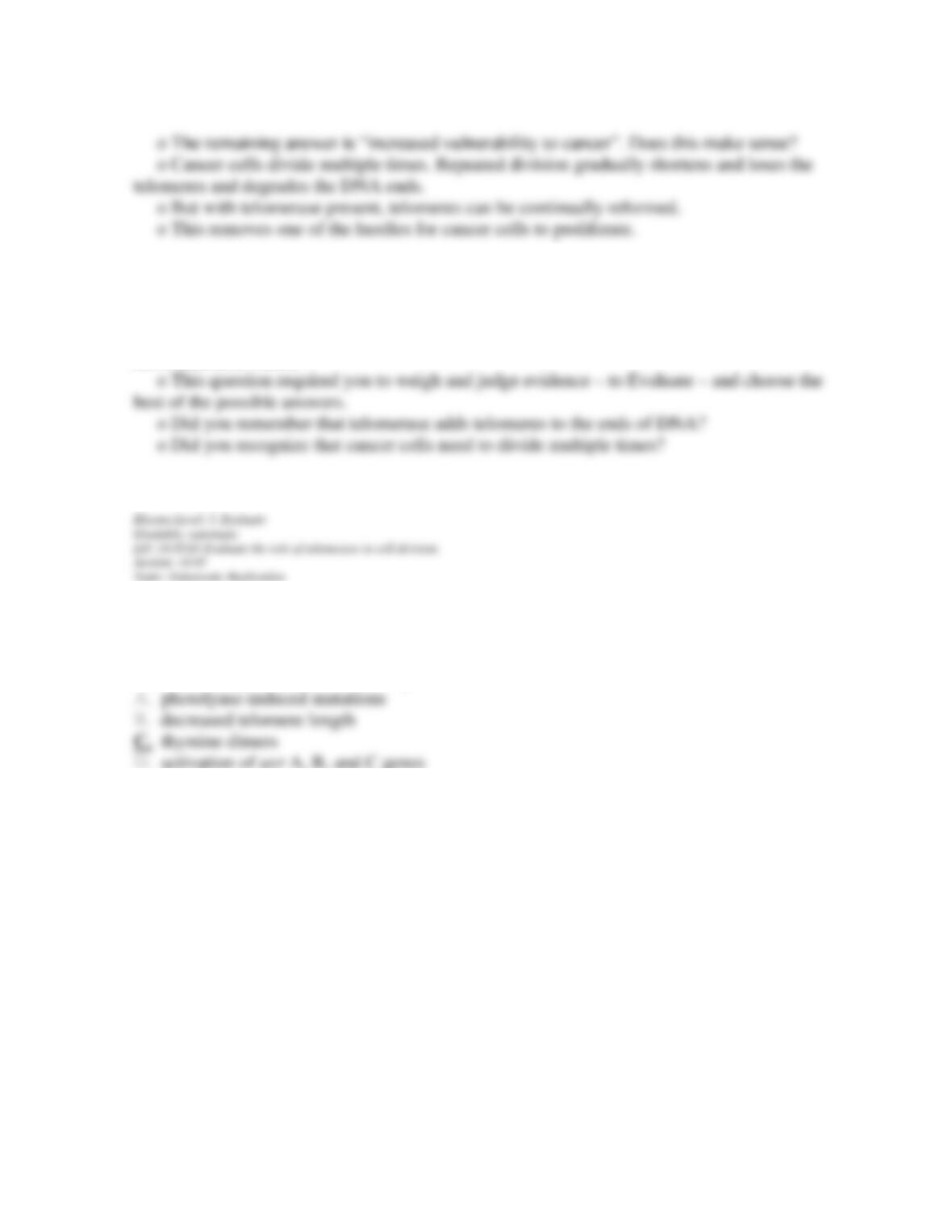
57. You are asked to participate in a clinical trial for a new drug that can activate telomerase.
Which of the following is a likely risk of such a drug?
Chapter 14 – DNA: The Genetic Material
Clarify Question
• What is the key concept addressed by the question?
• What type of thinking is required?
• What key words does the question contain?
Gather Content
• What do you already know about telomeres and telomerase?
Consider Possibilities
• What other information is related to the question? Which information is most useful?
Consider Possibilities
Choose Answer
• Given what you now know, what information and/or problem solving approach is most
likely to produce the correct answer?
Chapter 14 – DNA: The Genetic Material
Reflect on Process
• Did your problem-solving process lead you to the correct answer? If not, where did the
process break down or lead you astray? How can you revise your approach to produce a
more desirable result?
58. I think the proactive stance is a better attitude to promote than after-the-fact worrying!
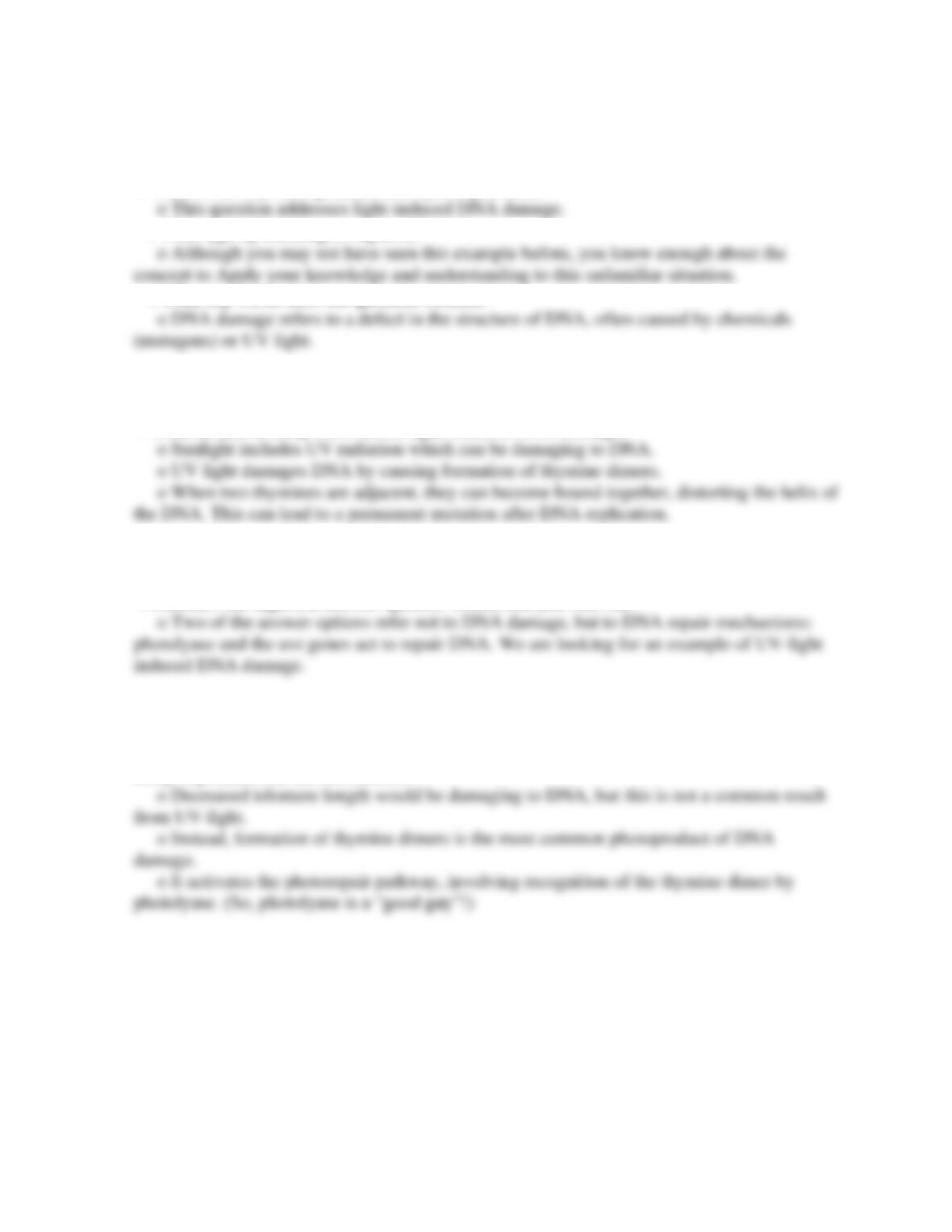
When planning a long week of sunbathing on the beach, What type of DNA damage should
sunbathers be aware of before hitting the beach?
Chapter 14 – DNA: The Genetic Material
Clarify Question
• What is the key concept addressed by the question?
• What type of thinking is required?
• What key words does the question contain?
Gather Content
• What do you already know about light-induced DNA damage?
Consider Possibilities
• Consider the different answer options. Which can you rule out?
Choose Answer
• Given what you now know, what information and/or problem solving approach is most
likely to produce the correct answer?
Chapter 14 – DNA: The Genetic Material
Reflect on Process
• Did your problem-solving process lead you to the correct answer? If not, where did the
process break down or lead you astray? How can you revise your approach to produce a
more desirable result?
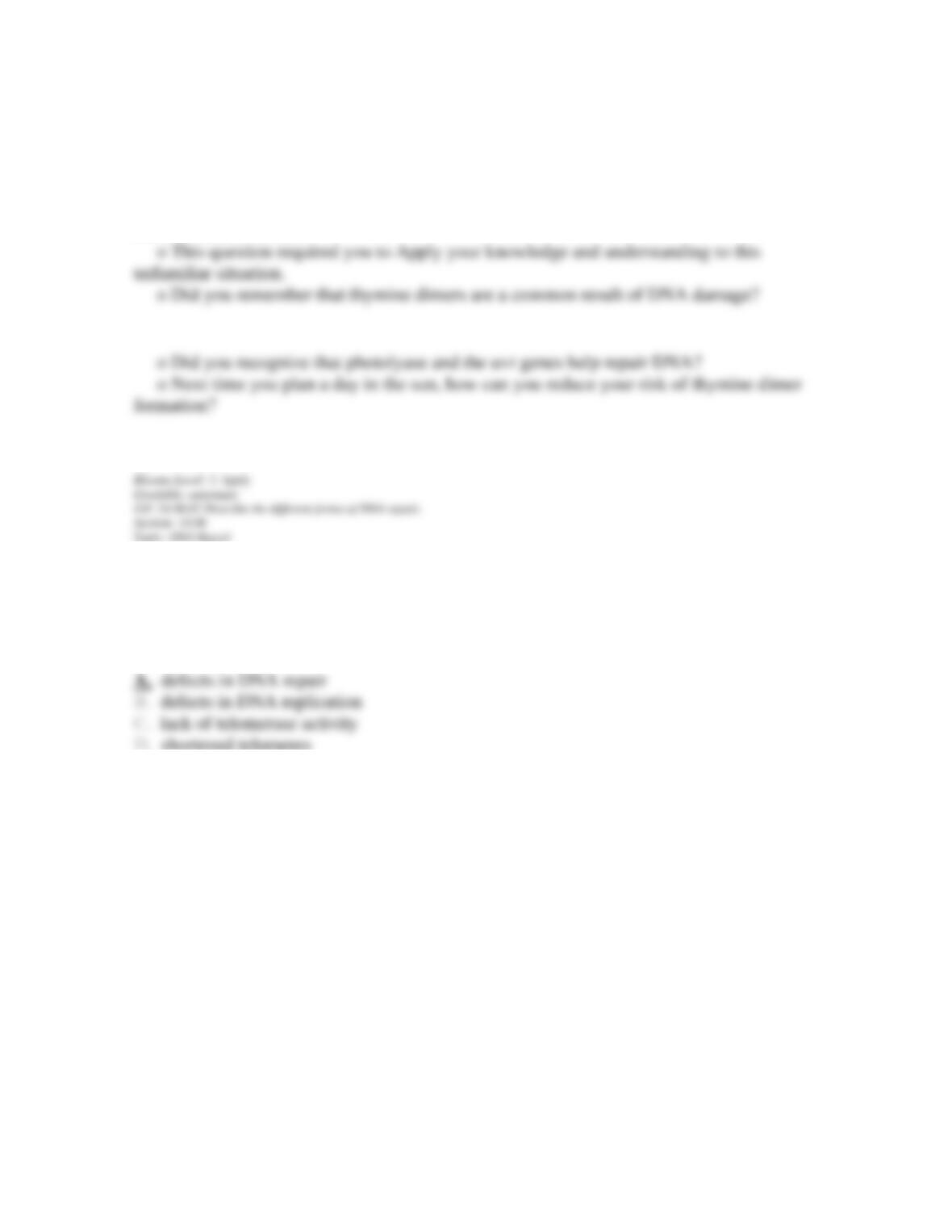
59. Xeroderma pigmentosum (XP) is a rare autosomal recessive disorder. Patients with XP
exhibit a cellular hypersensitivity to ultraviolet (UV) radiation, a high incidence of skin
cancer and premature aging. Based on these clinical characteristics, what is the most likely
cause for this disease?
Chapter 14 – DNA: The Genetic Material
Clarify Question
• What is the key concept addressed by the question?
• What type of thinking is required?
• What key words does the question contain?
Gather Content
• What do you already know about DNA replication and repair?
Consider Possibilities
• What other information is related to the question? Which information is most useful?
Choose Answer
• Given what you now know, what information and/or problem solving approach is most
likely to produce the correct answer?
Reflect on Process
Chapter 14 – DNA: The Genetic Material
• Did your problem-solving process lead you to the correct answer? If not, where did the
process break down or lead you astray? How can you revise your approach to produce a
more desirable result?