
Name:
Class:
Date:
chapter 14
Indicate whether the statement is true or false.
1. Integer programming (IP) models are optimization models in which all of the variables must be integers.
a.
True
b.
False
2. A 0-1 variable, also called a binary variable, is a variable that must equal 0 or 1.
a.
True
b.
False
3. Logistics problems are problems of finding the least expensive way to transport products from their origin to
their destination.
a.
True
b.
False
4. When we solve a linear programming problem with Solver, we cannot guarantee that the solution obtained is an optimal
solution.
a.
True
b.
False
5. A nonlinear programming problem (NLP) is an optimization problem in which the objective function and/or the
constraints are not linear functions of the decision variables.
a.
True
b.
False
6. When we solve a nonlinear programming problem (NLP), it is very possible that Solver will obtain the wrong answer.
a.
True
b.
False
7. Transshipment points are locations where goods neither originate nor end up, but goods are allowed to enter such
points to be shipped out to their eventual destinations.
a.
True
b.
False
8. Any integer programming problem involving 0-1 variables with only one constraint is called a knapsack problem.
a.
True
b.
False
9. Multiple optimal solutions are quite common in linear programming models.
a.
True
b.
False
10. In aggregate planning models, the number of workers available influences the possible production levels.
a.
True
b.
False
11. In transportation problems, shipping costs are often nonlinear due to quantity discounts.

Name:
Class:
Date:
chapter 14
a.
True
b.
False
12. A local optimal solution is better than all nearby solutions, but a solution far away might be better than it.
a.
True
b.
False
13. If all the supplies and demands for a transportation model are integers, then the optimal Solver solution may or may
not have integer-valued shipments.
a.
True
b.
False
14. In blending problems, if a quality constraint involves a quotient, then the problem will be nonlinear.
a.
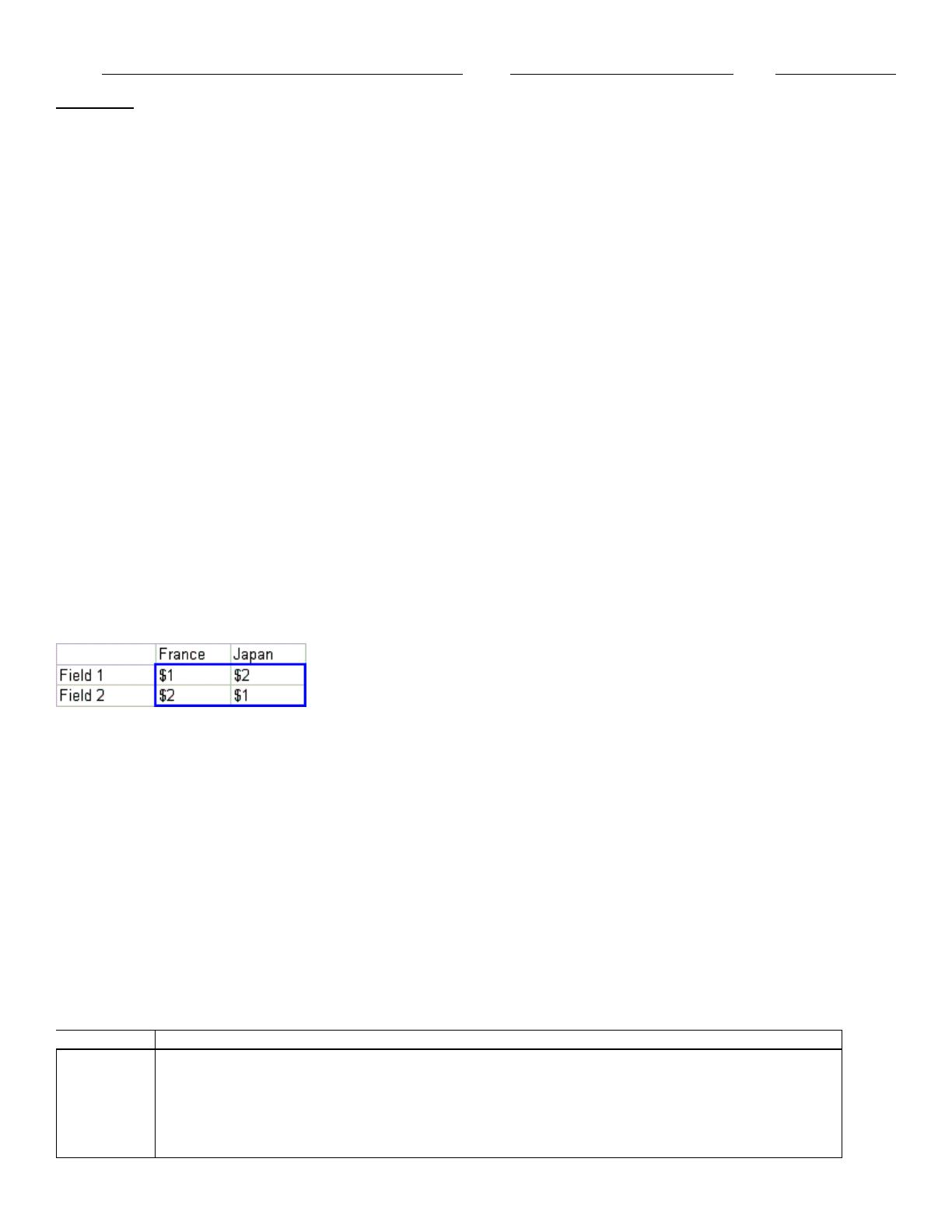
True
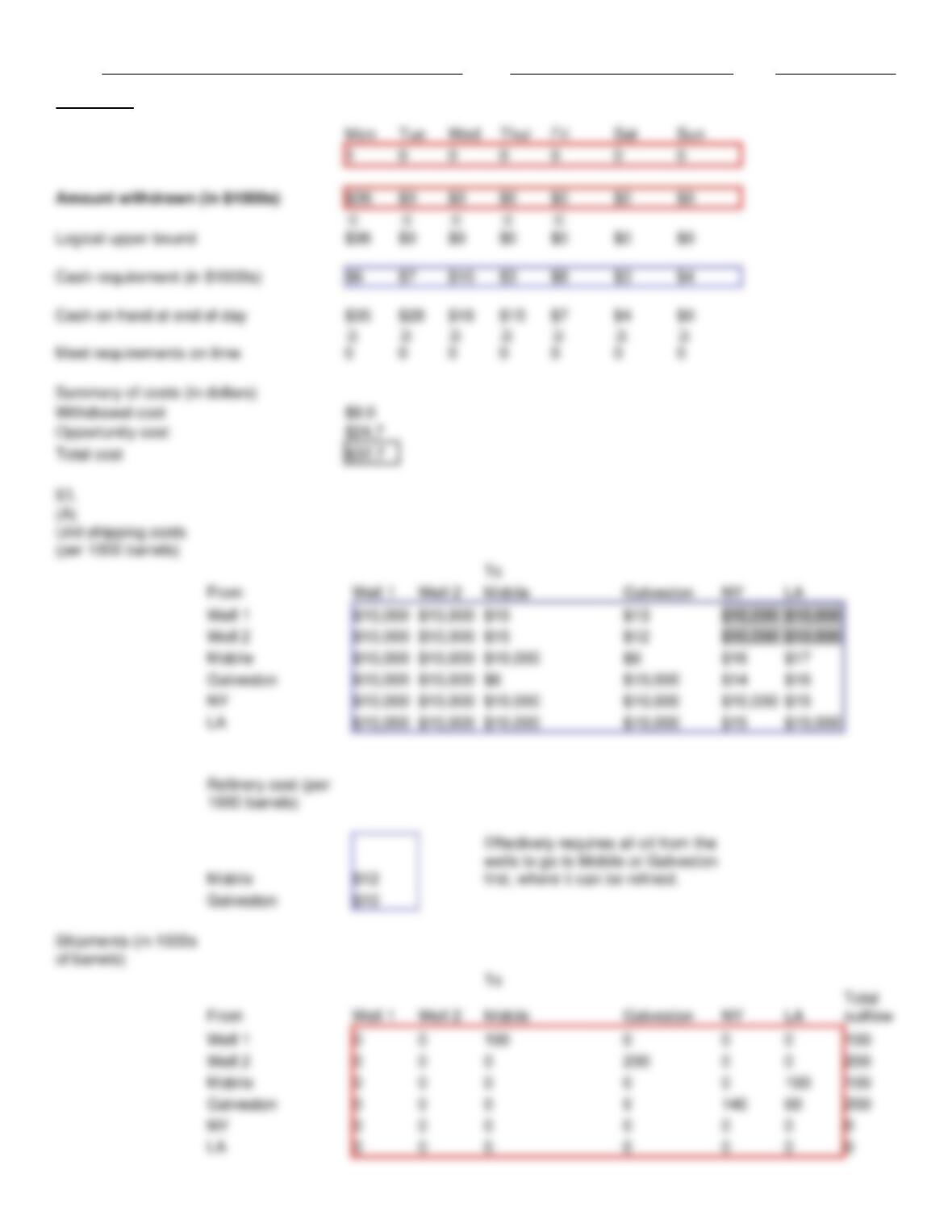
b.
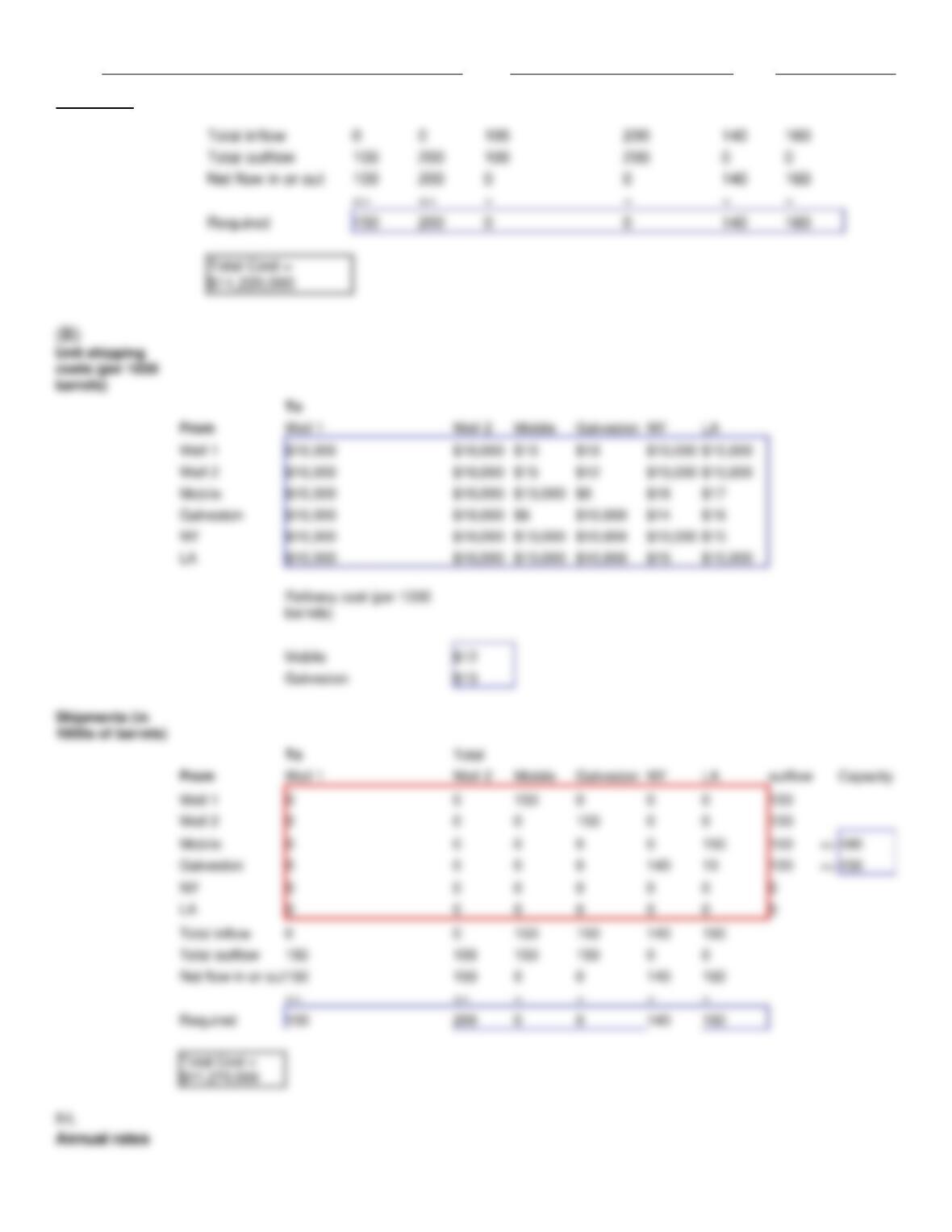
False
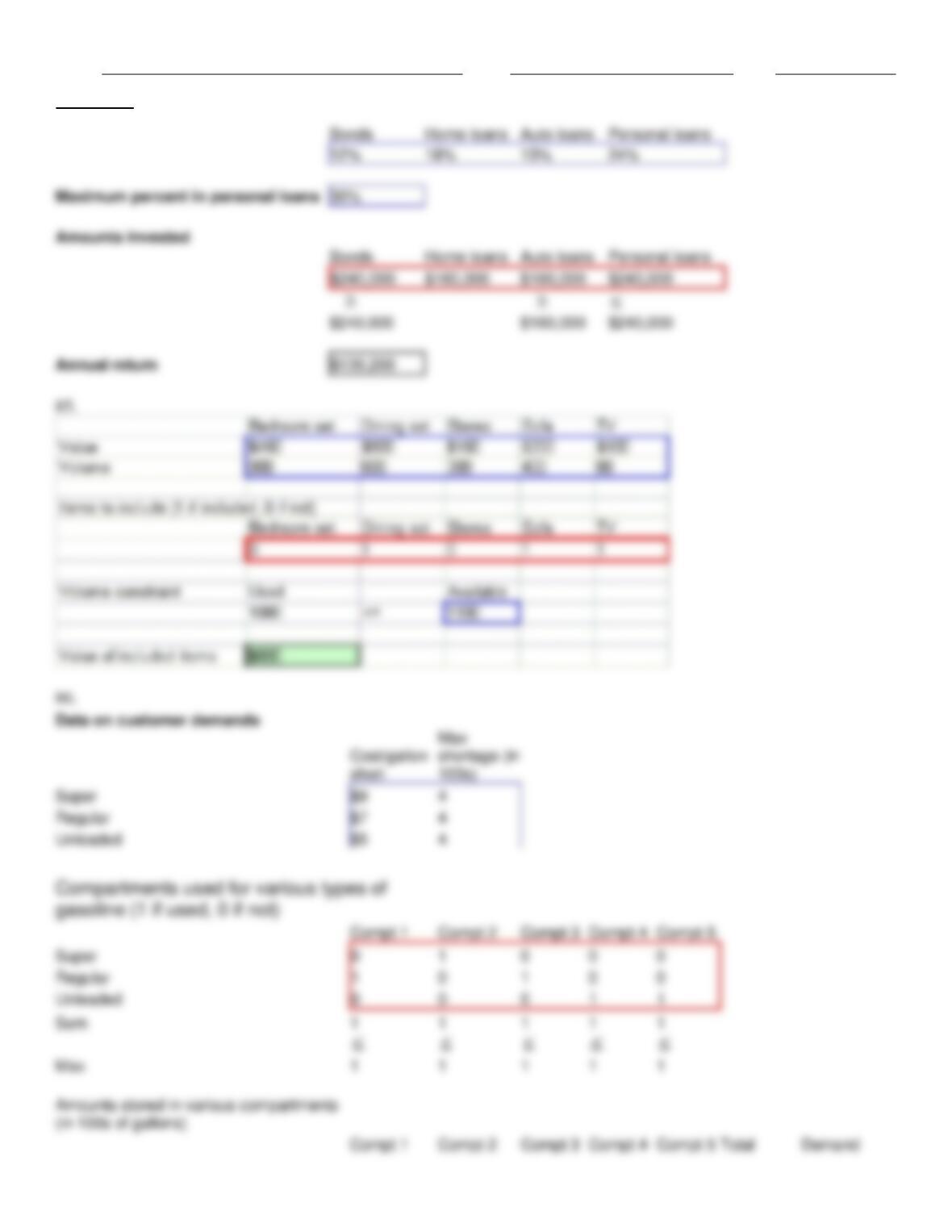
15. In network models of transportation problems, arcs represent the routes for getting a product from one node to
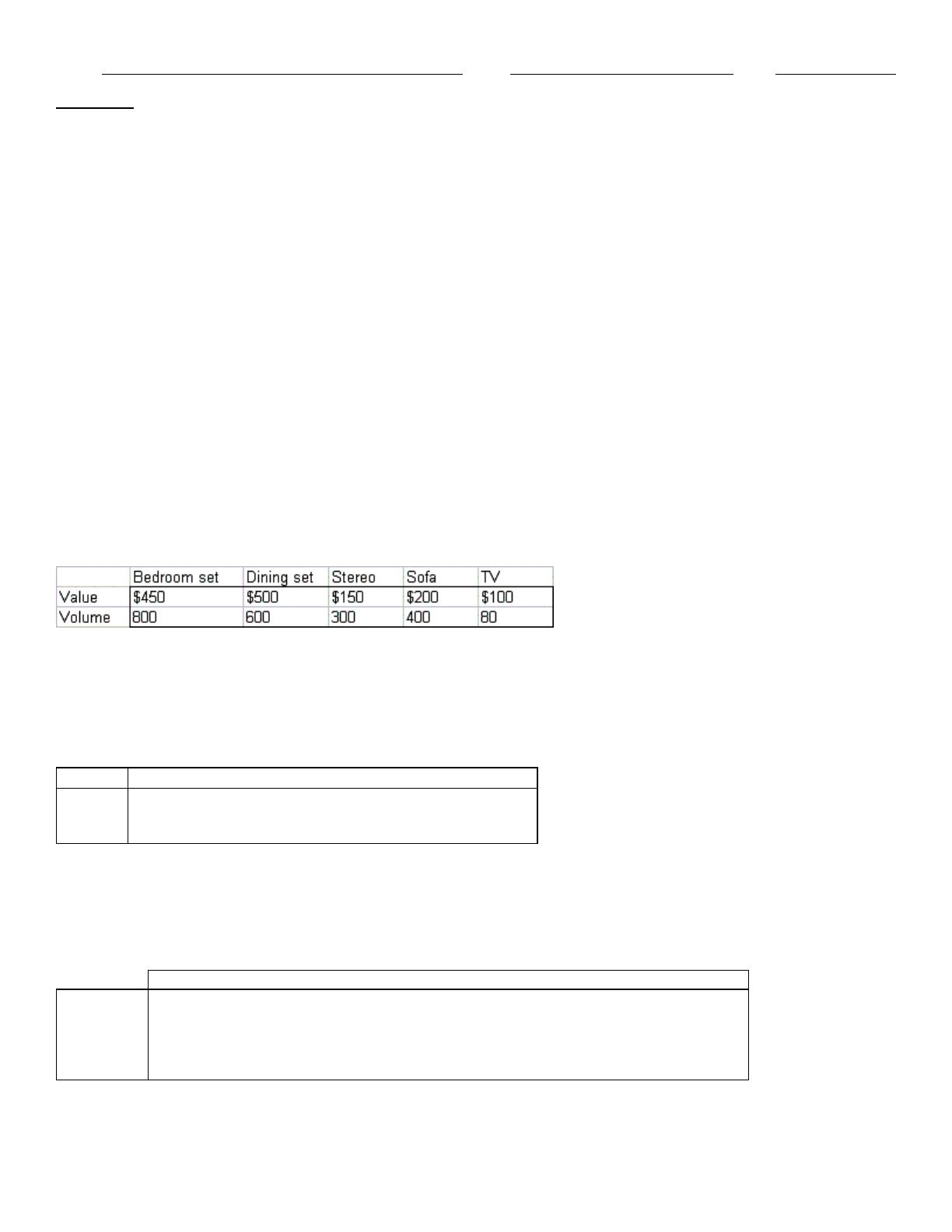
another.
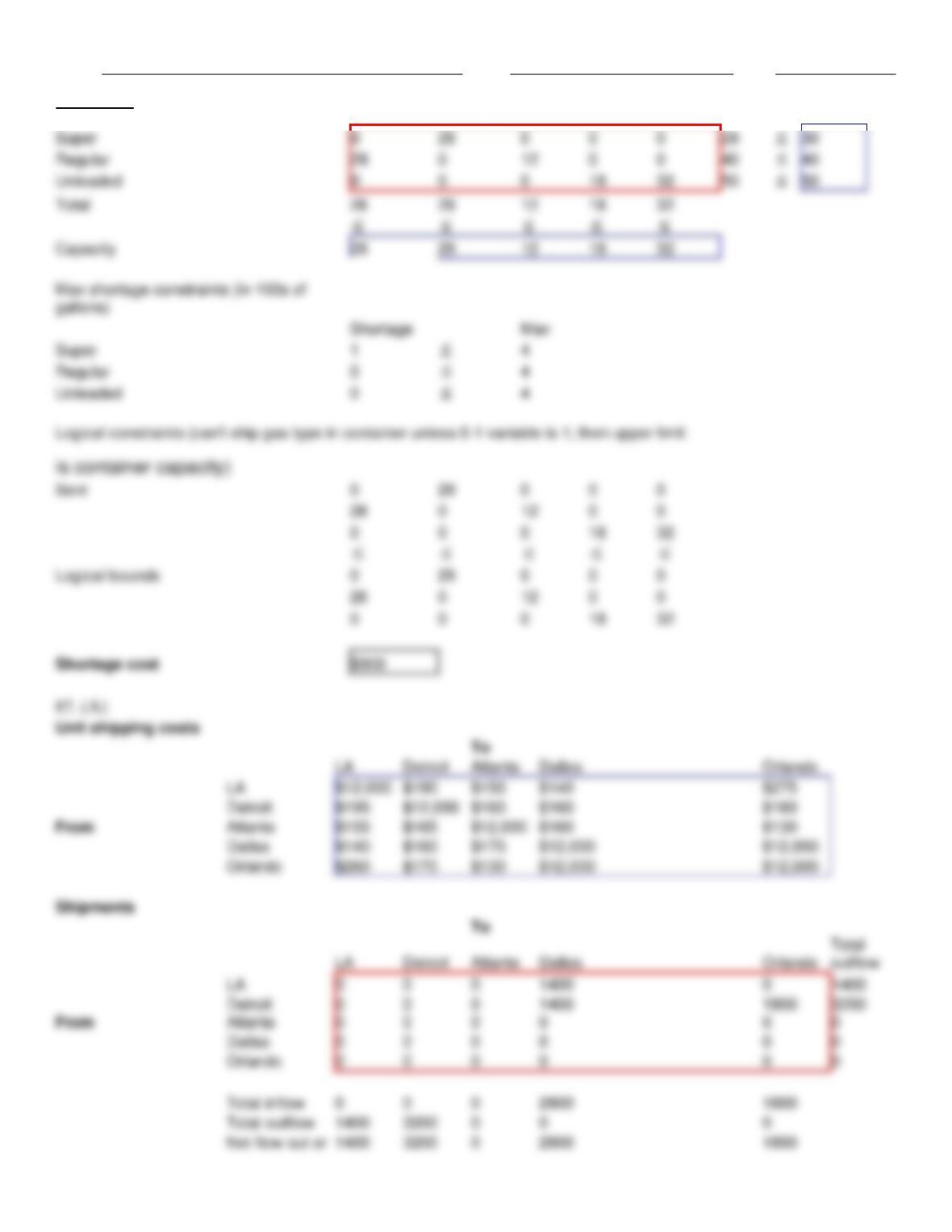
a.
True
b.
False
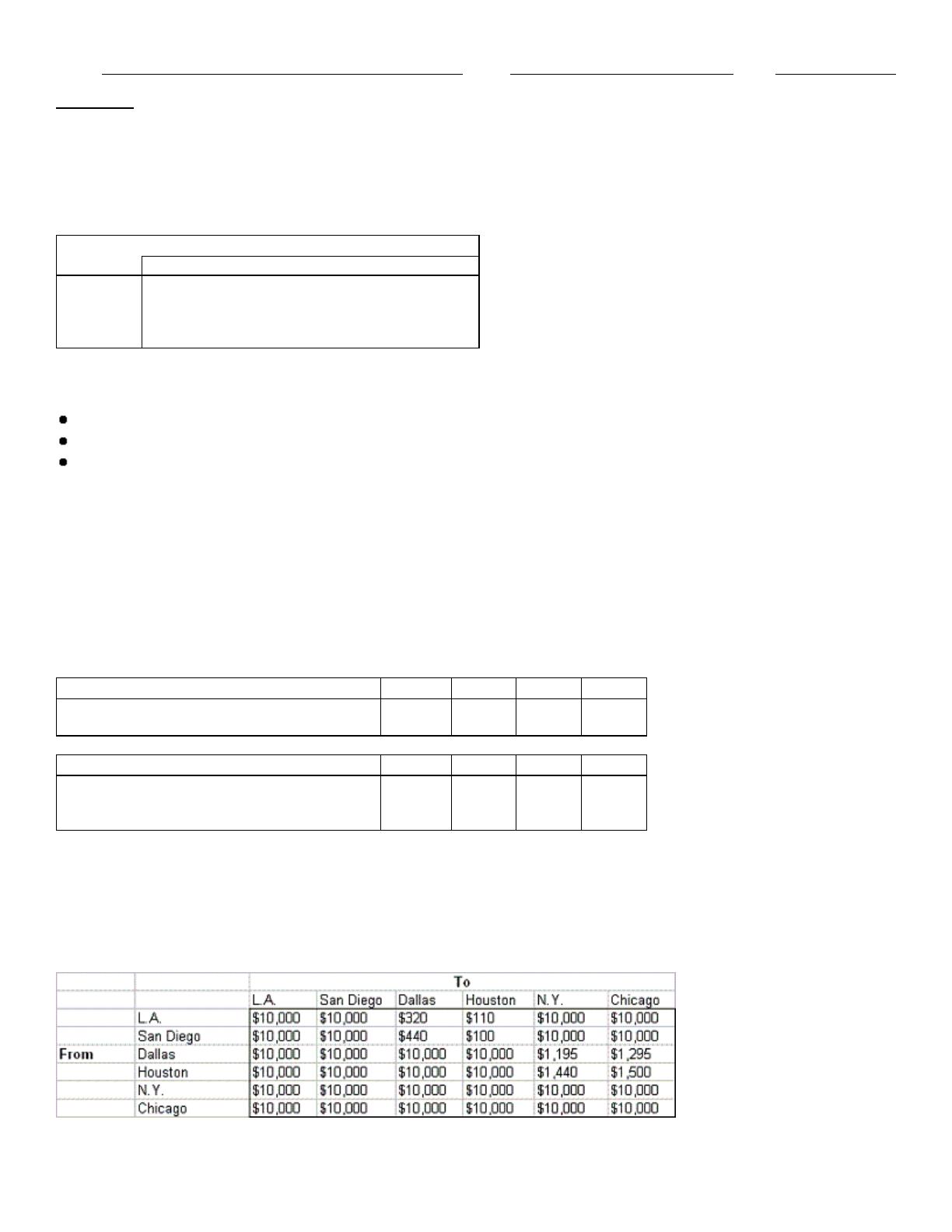
16. In transportation problems, shipments between supply points or between demand points are possible.
a.
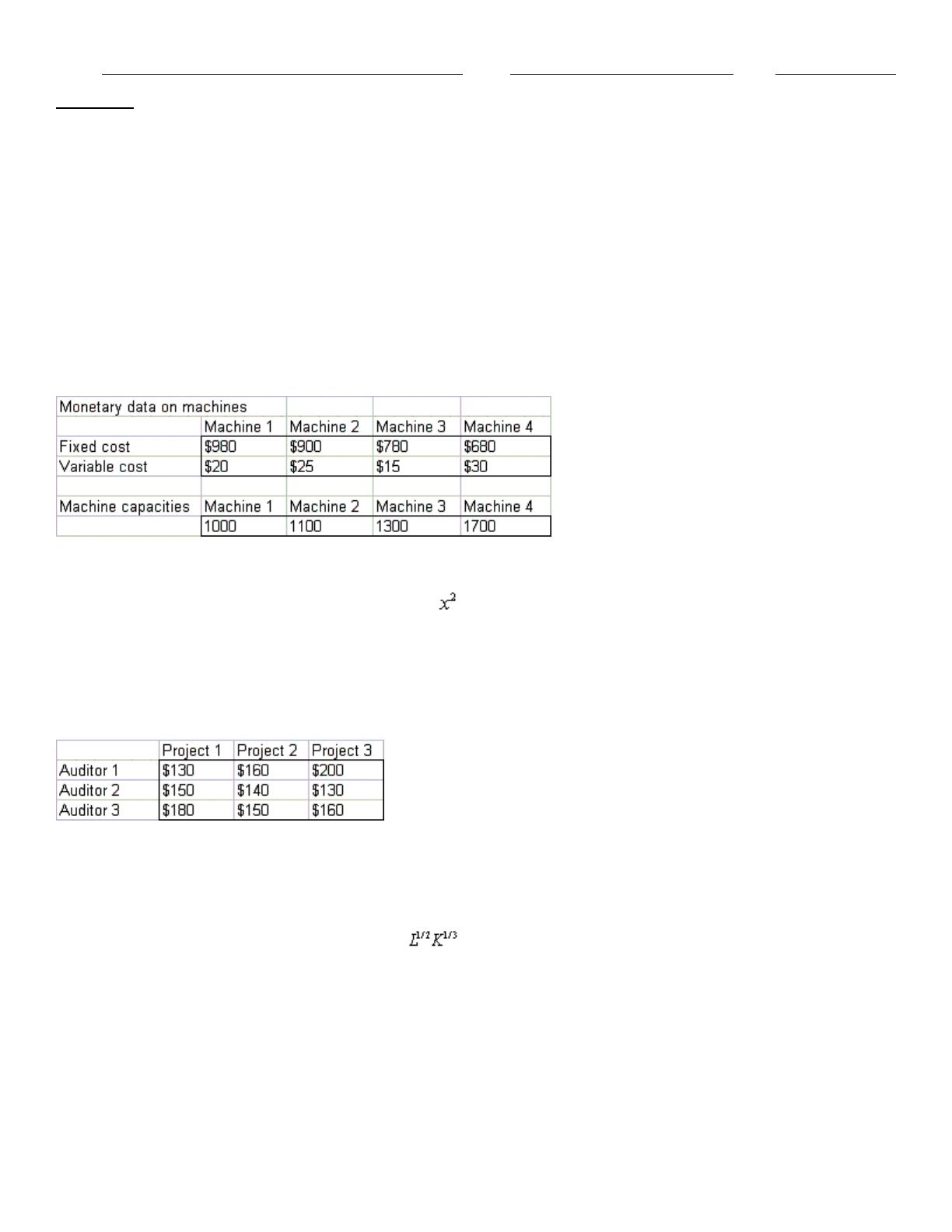
True
b.
False
17. A good shipping plan uses as many cheap routes as possible, but ultimately is constrained by capacities and
demands.
a.
True
b.
False
18. The LP relaxation of an integer programming (IP) problem is the same model as the IP model except that some
integer constraints are omitted.
a.
True
b.
False
19. Aggregate planning models are usually implemented through a rolling planning horizon.
a.
True
b.
False
20. In transportation problems, the three sets of input numbers that are required are capacities, demands and flows.
a.
True
b.
False
21. If Solver fails to find an optimal solution to an integer programming problem, we might be able to find a near optimal
solution by increasing the tolerance setting.
a.
True
b.
False
Name:
Class:
Date:
chapter 14
22. A global optimal solution is not necessarily the best solution overall.
a.
True
b.
False
23. In a set-covering model, each member of a given set (set 1) must be “covered” by an acceptable member of another
set (set 2). The objective of such problems is to minimize the number of elements in set 2 that are needed to cover all the
elements in set 1.
a.
True
b.
False
24. Solver may be unable to solve some integer programming problems, even when they have an optimal solution.
a.
True
b.
False
25. For some types of integer programming problems, their LP relaxation solutions are optimal.
a.
True
b.
False
26. In aggregate planning models, we can model backlogging of demand by allowing a month’s inventory to be negative.
a.
True
b.
False
27. The transportation model is a special case of the minimum cost network flow model (MCNFM).
a.
True
b.
False
28. If an LP problem is not correctly formulated, Solver will automatically indicate that it is infeasible when trying to solve
it.
a.
True
b.
False
29. In an optimized network flow model (MCNFM), all the available capacity will be used.
a.
True
b.
False
30. The flows in a general minimum cost network flow model (MCNFM) do all necessarily have to be from “left to right”;
that is, from supply points to demand points.
a.
True
b.
False
31. In a transportation problem, if it costs $4 per item to ship up to 200 items between cities, and $2 per item for each
additional item, the proportionality assumption of LP is satisfied.
a.
True
b.
False
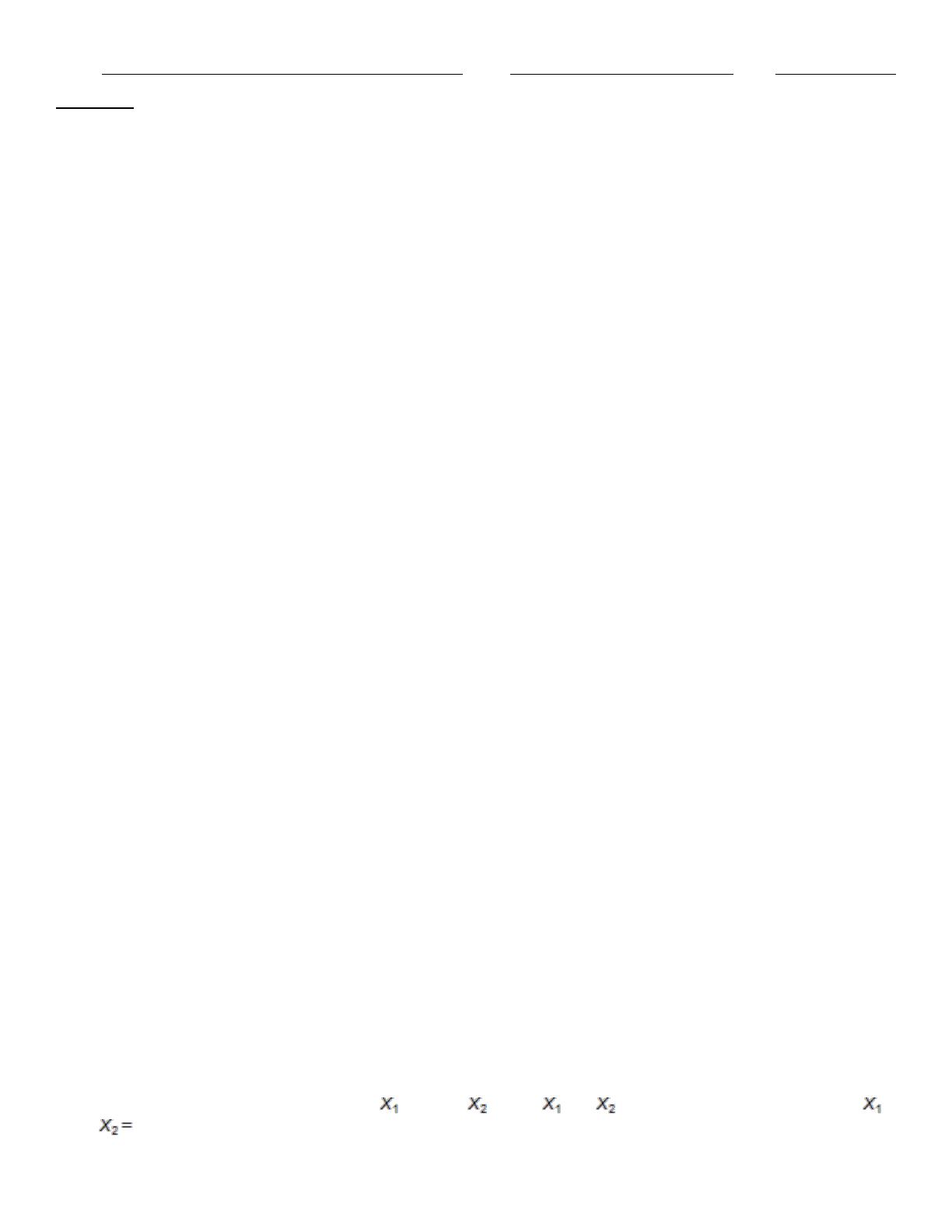
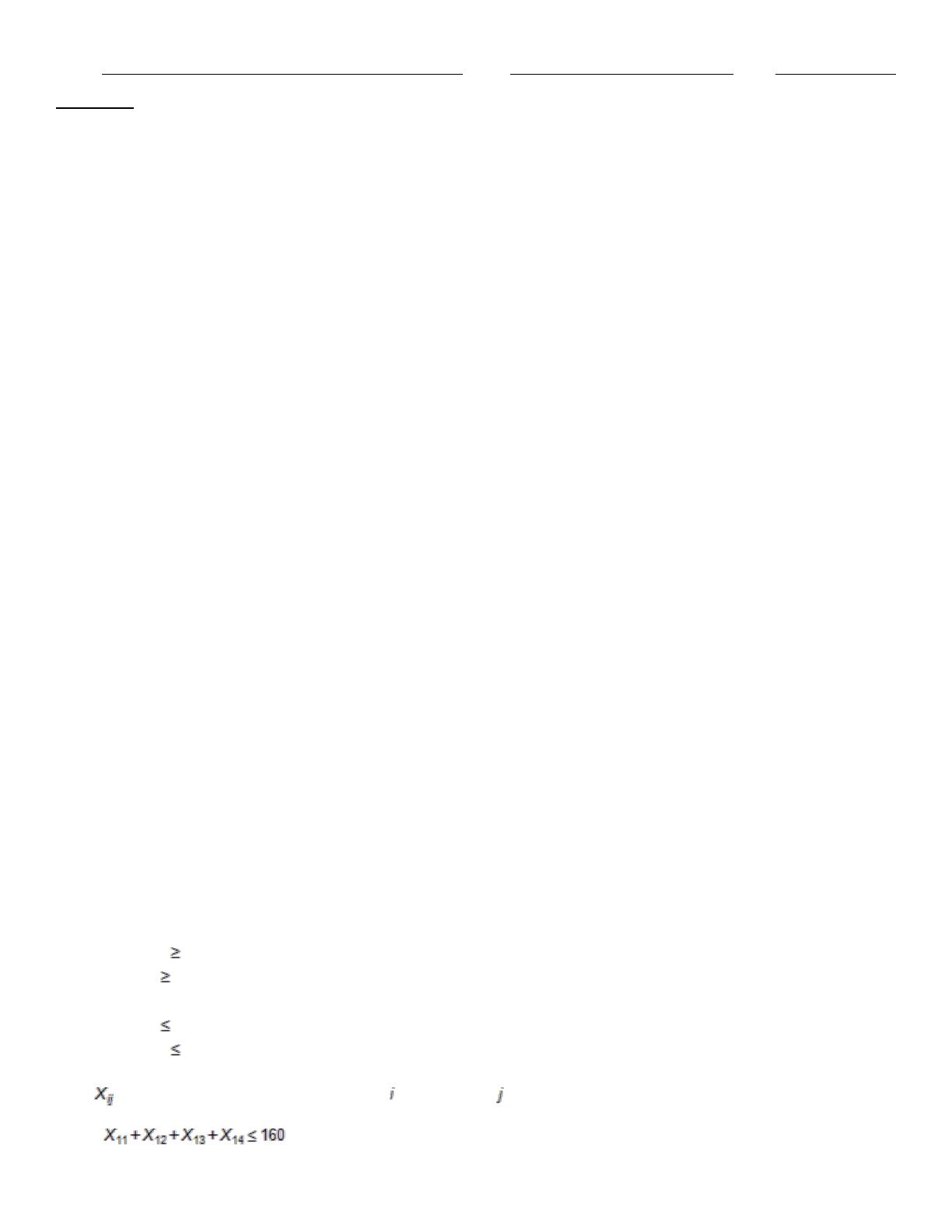
32. The optimal solution to an LP problem was 3.69 and 1.21. If and were restricted to be integers, then =
4 and 1 will be a feasible solution, but not necessarily an optimal solution to the IP problem.
Name:
Class:
Date:
chapter 14
a.
True
b.
False
33. Many of the most successful applications of optimization in the real world have been in the areas of scheduling,
blending, logistics and aggregate planning.
a.
True
b.
False
Indicate the answer choice that best completes the statement or answers the question.
34. Transportation and transshipment problems are both considered special cases of a class of linear programming
problems called
a.
minimum cost problems
b.
minimum cost network flow problems
c.
supply locations network problems
d.
demand locations network problems
35. A minimum cost network flow model (MCNFM) has the following advantage relative to the special case of a simple
transportation model:
a.
a MCNFM does not require capacity restrictions on the arcs of the network
b.
the flows in a general MCNFM don’t all necessarily have to be from supply locations to demand locations
c.
a MCNFM is generally easier to formulate and solve
d.
All of these options
36. The binary variables in the fixed cost models correspond to:
a.
the number of units or products produced
b.
the total profit
c.
the amount of labor hours
d.
a process for which a fixed cost occurs
37. In a typical minimum cost network flow model, the nodes indicate
a.
roads
b.
rail lines
c.
geographic locations
d.
rivers
38. In a minimum cost network flow model, the flow balance constraint for each demand node takes the form
a.
Flow out Flow in + Net supply
b.
Flow in Flow out + Net demand
c.
Flow in = Flow out
d.
Flow in Flow out + Net demand
e.
Flow out Flow in + Net demand
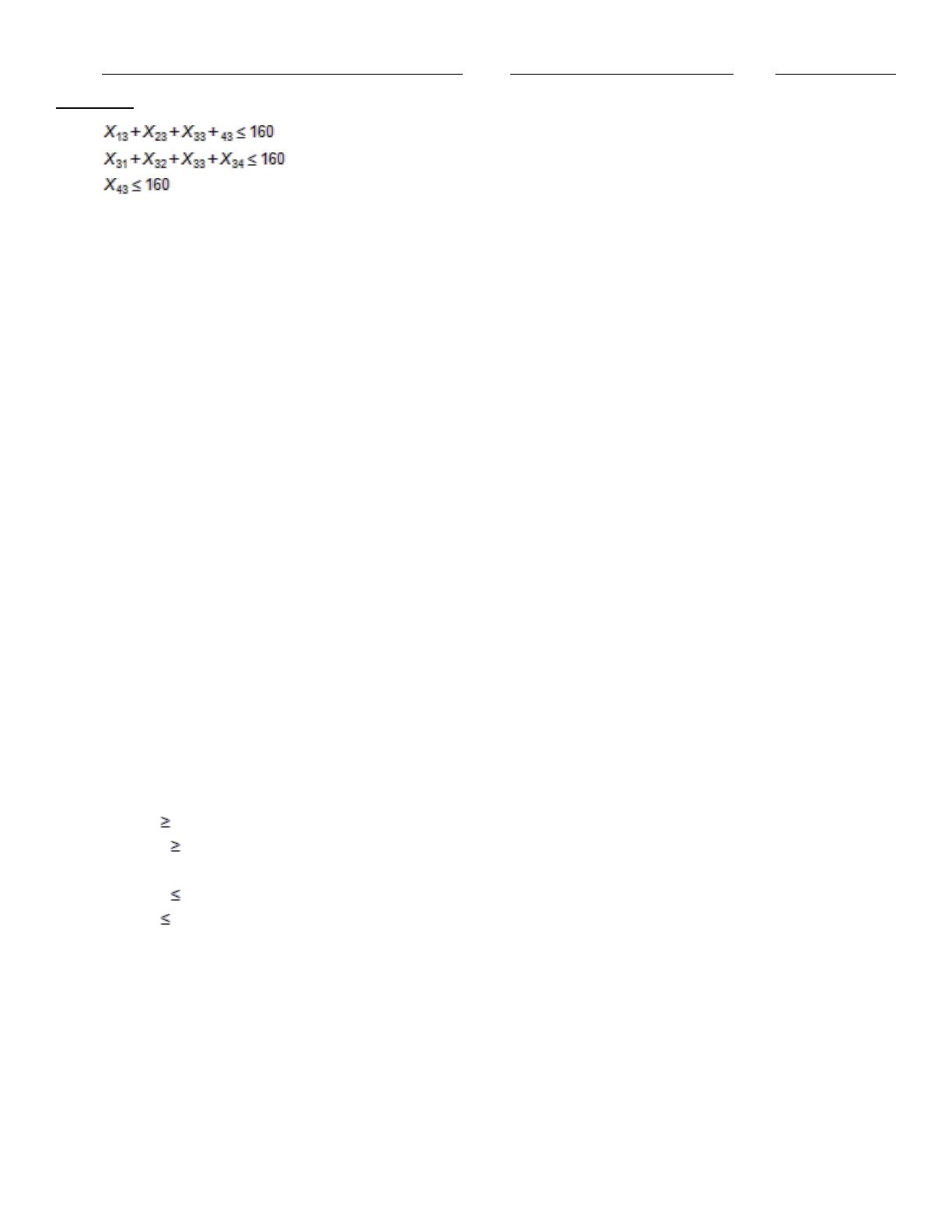
39. If refers to the number of hours employee works in week , then to indicate that the number of working hours of 4
employees in week 3 should not exceed 160 hours, we must have a constraint of the form
a.
Name:
Class:
Date:
chapter 14
b.
c.
d.
40. In a network representation of a transportation problem, the arcs generally represent:
a.
warehouses
b.
geographic locations
c.
flows
d.
capacities
41. In a network representation of a transportation problem, the nodes generally represent:
a.
warehouses
b.
geographic locations
c.
flows
d.
capacities
42. In aggregate planning models, which of the following statements are correct?
a.
The number of workers available influences the possible production levels
b.
We allow the workforce level to be modified each month through the hiring and firing of workers
c.
We eventually allow demand to be backlogged; that is, demand need not be met on time
d.
All of these options
43. In a transshipment problem, shipments
a.
can occur between any two nodes (suppliers, demanders, and transshipment locations)
b.
cannot occur between two supply locations
c.
cannot occur between two demand locations
d.
cannot occur between a transshipment location and a demand location
e.
cannot occur between a supply location and a demand location
44. The flow balance constraint for each transshipment node, in a minimum cost network flow model, takes the form
a.
Flow in Flow out + Net supply
b.
Flow out Flow in + Net supply
c.
Flow in = Flow out
d.
Flow out Flow in + Net supply
e.
Flow in Flow out + Net demand
45. Any integer program involving 0 – 1 variables with constraint(s) is called a knapsack problem.
a.
three
b.
two
c.
one
d.
zero
46. Many organizations must determine how to schedule employees to provide adequate service. If we assume that an
organization faces the same situation each week, this is referred to as
a.
static scheduling problem
Name:
Class:
Date:
chapter 14
b.
dynamic scheduling problem
c.
transportation scheduling problem
d.
All of these options
47. In a minimum cost network flow model, the flow balance constraint for each supply node takes the form
a.
Flow in Flow out + Net supply
b.
Flow out Flow in + Net demand
c.
Flow in = Flow out
d.
Flow out Flow in + Net supply
e.
Flow in Flow out + Net demand
48. Rounding the solution of a linear programming to the nearest integer values provides a(n)
a.
integer solution that is optimal
b.
integer solution that may be neither feasible nor optimal
c.
feasible solution that is not necessarily optimal
d.
infeasible solution
49. A typical transportation problem requires which of the following sets of input numbers:
a.
Capacities, demands and flows
b.
Capacities, demands and unit shipping costs
c.
Supplies, demands and flows
d.
Supplies, demands and arcs
50. Which of the following statements are false?
a.
Solver does not offer a sensitivity report for models with integer constraints
b.
Solver’s sensitivity report is not suited for questions about multiple input changes
c.
Solver’s sensitivity report is used primarily for questions about one-at-a time changes to input
d.
None of these options
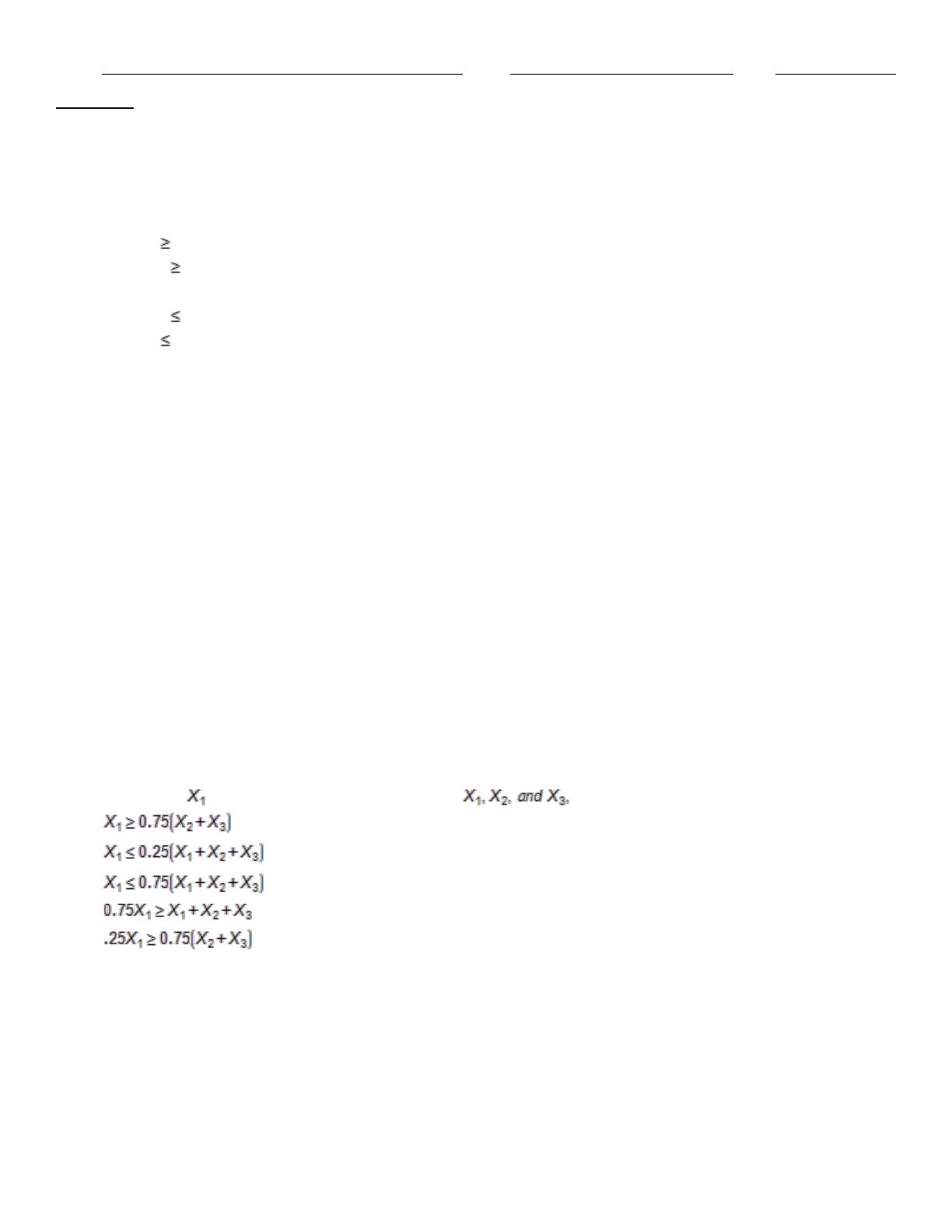
51. To specify that must be at most 75% of the blend of we must have a constraint of the form
a.
b.
c.
d.
e.
52. Workforce scheduling problems are often integer programming models, which means that they have:
a.
an integer objective function
b.
integer decision variables
c.
integer constraints
d.
all of these options
53. Which of the following is not a required input for a typical transportation problem?
a.
Capacities (or supplies)

Name:
Class:
Date:
chapter 14
b.
Demands
c.
Unit shipping (and possibly production) costs
d.
Distance from origins to destinations
54. In formulating a transportation problem as linear programming model, which of the following statements are correct?
a.
There is one constraint for each supply location
b.
There is one constraint for each demand location
c.
The sum of decision variables out of a supply location is constrained by the supply at that location
d.
The sum of decision variables out of all supply locations to a specific demand location is constrained by the
demand at that location
e.
All of these options
55. The decision variables in transportation problems are:
a.
profits
b.
costs
c.
flows
d.
capacities
56. Many organizations must determine how to schedule employees to provide adequate service. If we assume that an
organization faces the same situation each week, this is referred to as
a.
static scheduling problem
b.
dynamic scheduling problem
c.
transportation scheduling problem
d.
All of these options
57. Which of the following does not represent a broad class of applications of linear programming models?
a.
Blending models
b.
Financial portfolio models
c.
Logistics models
d.
Set covering models
e.
Forecasting models
58. A common characteristic of integer programming models is that they:
a.
are easy to solve graphically
b.
produce the same answer and standard linear programming models
c.
often produce multiple optimal solutions
d.
all of these options
59. The problem which deals with the direct distribution of products from supply locations to demand locations is called
a(n)
a.
transportation problem
b.
assignment problem
c.
network problem
d.
transshipment problem
60. Which of the following statements is a type of constraint that is often required in blending problems?
Name:
Class:
Date:
chapter 14
a.
Integer constraint
b.
Binary constraint
c.
Quality constraint
d.
None of these options
61. The objective in transportation problems is typically to:
a.
maximize profits
b.
maximize revenue
c.
minimize costs
d.
maximize feasibility
62. The constraints in a blending problem can be specified in a valid way and still lead to which of the following problems?
a.
Unboundedness
b.
Infeasibility
c.
Nonlinearity
d.
None of these options
63. In nonlinear models, which of the following statements are correct?
a.
Only the objective function is not a linear function of the decision variables
b.
Only the constraints are not linear functions of the decision variables
c.
The objective function and/or the constraints are not linear functions of the decision variables
d.
All of these options
64. Which of the following is true regarding multiple optimal solutions?
a.
All solutions have the same values for the decision variables
b.
All solutions have the same value for the objective function
c.
All solutions have the same shadow prices
d.
All of these options
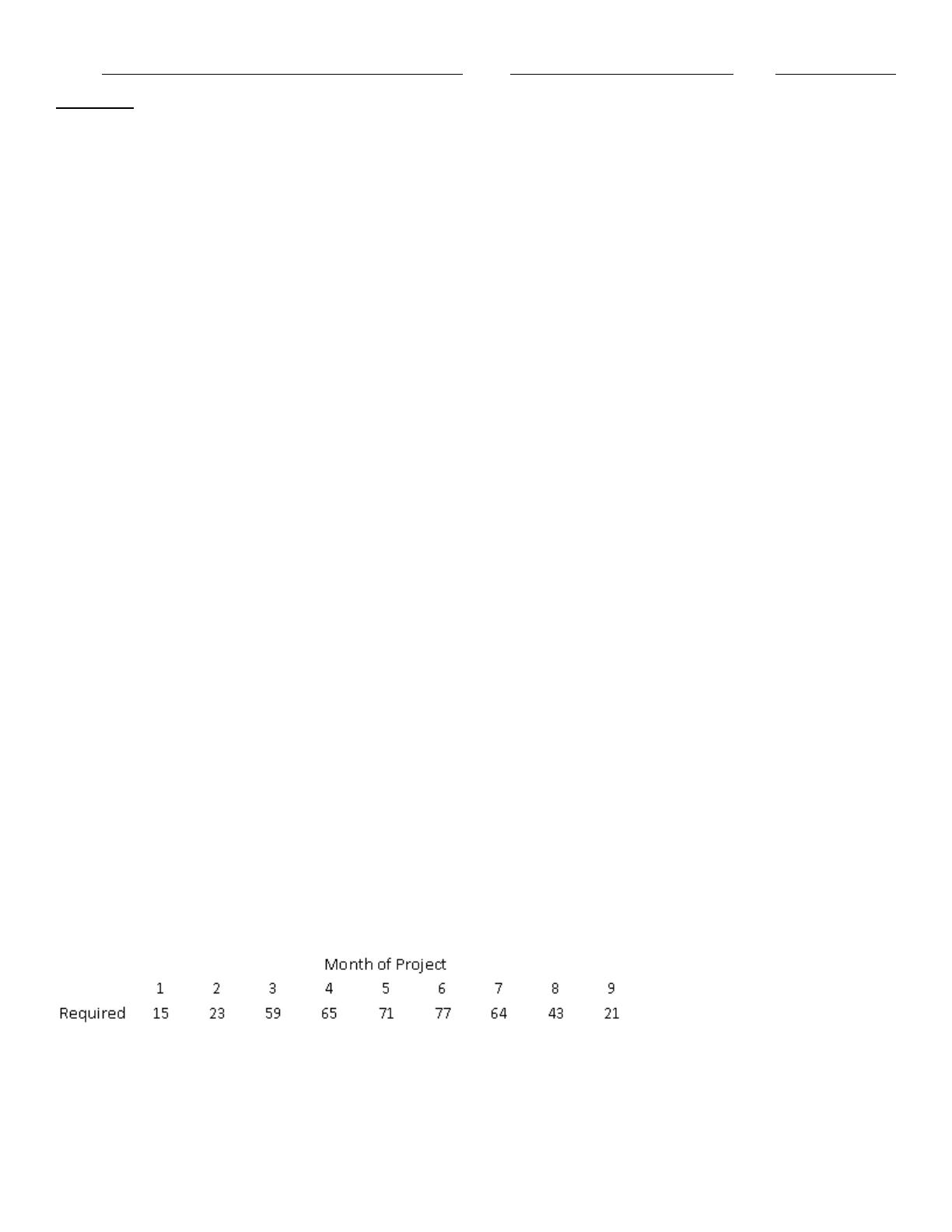
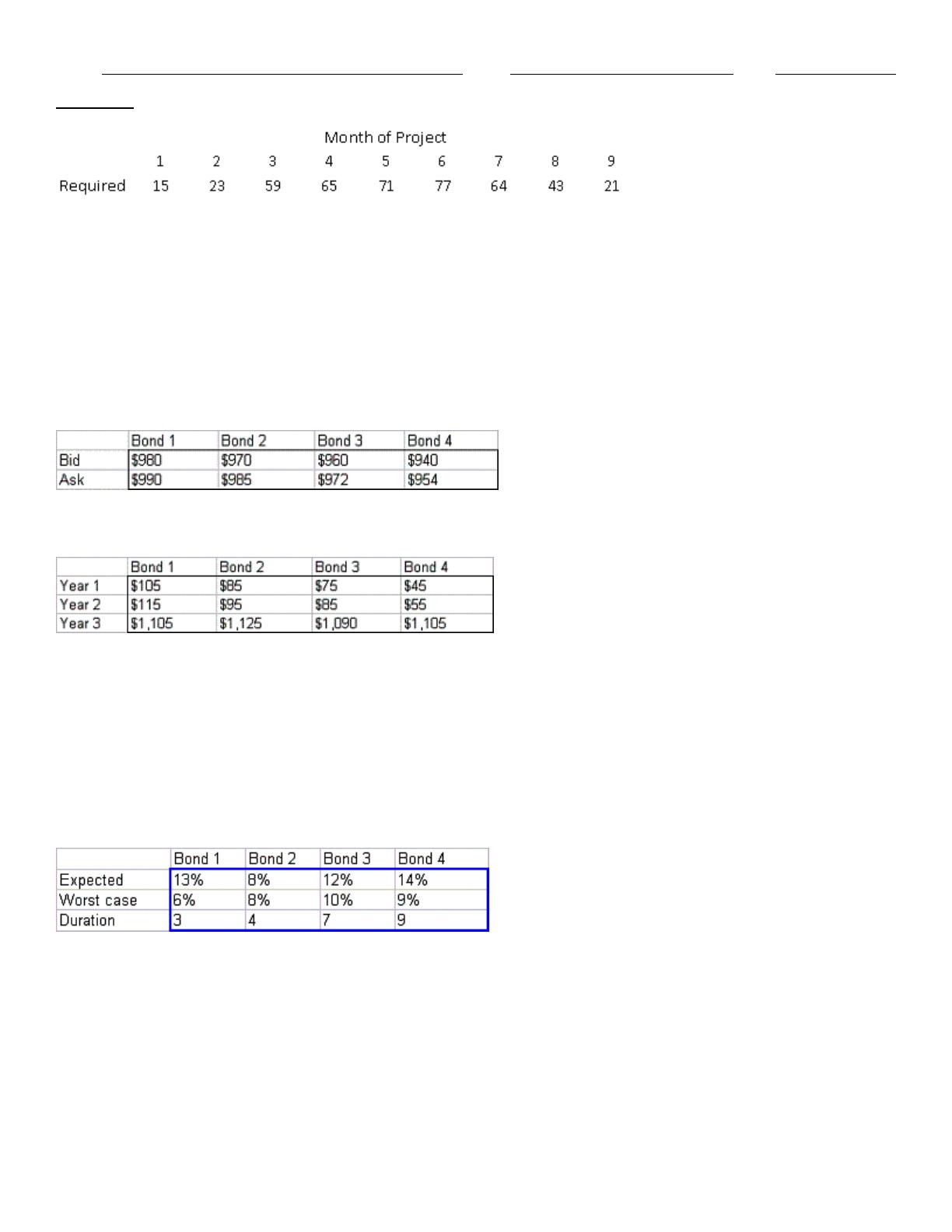
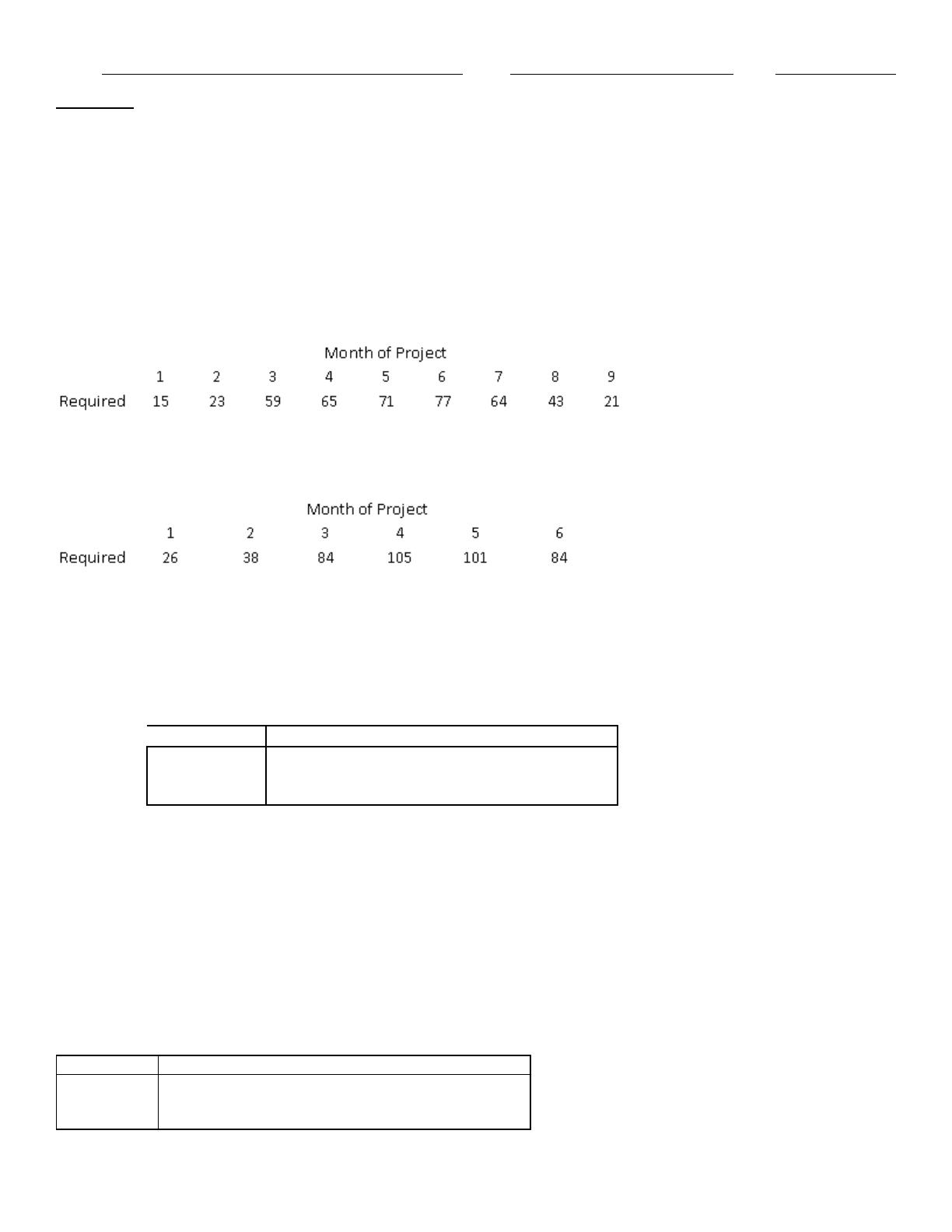
A construction company is preparing for a nine-month project, and will need to develop a staffing plan. The
company can assign up to 30 of its own full-time employees to the project, and will hire short-term contract
employees to make up any shortage in meeting the personnel requirements. Company employees earn $6,000
per month, while short-term contract employees make $8,600/month. Contract employees can be assigned to the
project beginning in any month, and their contract period is two months. The number of workers required for the
project by month is shown below:
65. The production manager believes the cost of the contract employees, who are currently in high demand,
could be somewhat higher – perhaps as high as $10,000 per month. Perform a sensitivity analysis to determine
the effect on the number of full-time employees that will be needed for the project.
66. A company blends silicon and nitrogen to produce two types of fertilizers. Fertilizer 1 must be at least 40%
nitrogen and sells for $75 per pound. Fertilizer 2 must be at least 70% silicon and sells for $45 per pound. The
Name:
Class:
Date:
chapter 14
company can purchase up to 9000 pounds of nitrogen at $16 per pound and up to 12,000 pounds of silicon at $12
per pound. Assuming that all fertilizer produced can be sold, determine how the company can maximize its profit.
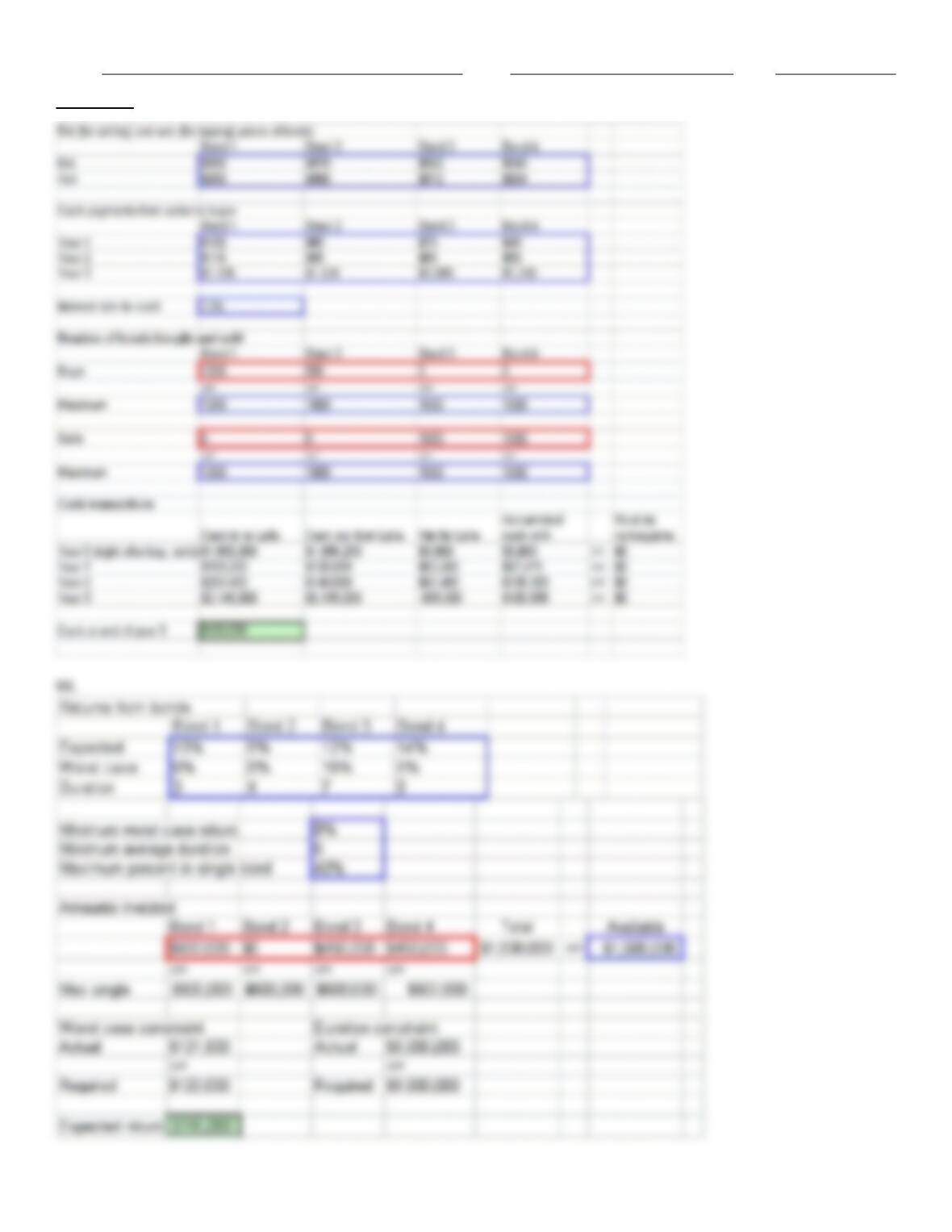
67. At time 0, you have $10,000. Investments A and B are available; their cash flows are shown in the table below:
Assume that any money not invested in A or B earns interest at an annual rate of 8%. Determine how to maximize your
cash on hand at time 3.
Investment
Time 0
Time 1
Time 2
Time 3
A
–$1.00
$0.20
$1.50
$0.00
B
$0.00
–$1.00
$0.00
$1.90
68. Discuss how the company’s optimal production schedule would be affected by a change in the cost of
increasing production from one quarter to the next.
A company supplies goods to three customers, each of whom requires 50 units. The company has two warehouses. In
warehouse 1, 75 units are available, and in warehouse 2, 55 units are available. The costs of shipping one unit from each
warehouse to each customer are shown in the table below.
To
From
Customer 1
Customer 2
Customer 3
Warehouse 1
$20
$40
$30
Warehouse 2
$15
$35
$45
Not shipped (shortage)
$100
$90
$115
There is a penalty for each unsatisfied customer unit of demand – with customer 1, a penalty cost of $100 is incurred; with
customer 2, $90; and with customer 3, $115.
69. Determine how to minimize the sum of shortage and shipping costs.
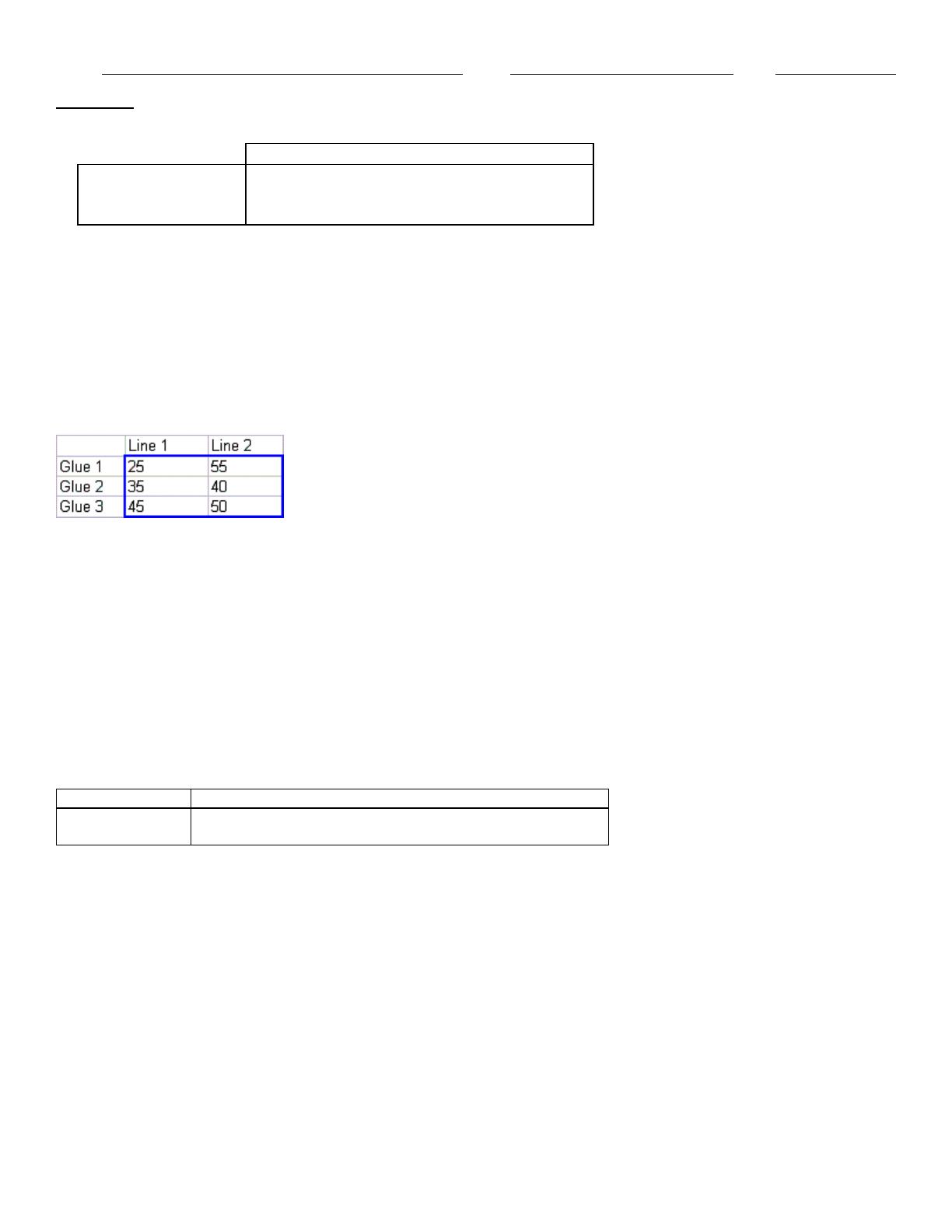
70. You are given the following means, standard deviations, and correlations for the annual return on three
stocks. The means are 0.12, 0.15, and 0.20. The standard deviations are 0.20, 0.30, and 0.40. The correlation
between stocks 1 and 2 is 0.65, between stocks 1 and 3 is 0.75, and between stocks 2 and 3 is 0.41. You have
$13,000 to invest and can invest no more than half of your money in any single stock. Determine the minimum
variance portfolio that yields an expected annual return of at least 0.14.
71. A company is considering investing a total amount of $2.50 million in four bonds. The expected annual return, the
worst-case annual return on each bond, and the “duration” of each bond are given in the table below.
Bond 1
Bond 2
Bond 3
Bond 4
Expected
16%
11%
14%
19%
Worst case
7%
9%
11%
10%
Duration
4
5
8
10
The duration of a bond is a measure of the bond’s sensitively to interest rates. The company wants to maximize the
expected return from its bond investments, subject to the following constraints:
∙ The worst-case return of the bond portfolio must be at least 90%.
∙ The average duration of the portfolio must be at most 7
∙ Because of diversification requirements, at most 35% of the total amount invested in a single bond.
Determine how the company can maximize the expected return on its investment.
Name:
Class:
Date:
chapter 14
A post office requires different numbers of full-time employees on different days of the week. The number of full-time
employees required each day is given in the table below.
Mon
Tue
Wed
Thu
Fri
Sat
Sun
20
16
18
22
17
19
14
Union rules state that each full-time employee must work five consecutive days and then receive two days off. The post
office wants to meet its daily requirements using only full-time employees. Its objective is to minimize the number of full-
time employees that must be hired.
72. (A) Use Solver to formulate and solve the post office’s problem.
(B) Suppose the post office has 30 full-time employees and is not allowed to hire or fire any employees.
Determine a schedule that maximizes the number of weekend days off received by the employees.
A meat market manager for a large grocery store is preparing a processing plan to stock the shelves with
sausage, ground meat, and jerky, which he can prepare from beef, pork and venison. Sausage and ground meat
can be made of any mix of the beef, pork and venison, as long at the fat contents are below 15% for sausage and
10% for ground meat. Sausage sells for $5/pound and ground meat sells for $3/pound. Jerky, which sells or
$10/pound, is made in a drying process from beef or venison. In the drying process, there is a 50% loss in weight
for jerky made from beef (e.g., one pound of beef yields 0.5 pounds of beef jerky) and a 30% loss in weight for
jerky made from venison. The market can sell at most 500 pounds of sausage, 1000 pounds of ground meat, and
100 pounds of jerky before their expiration dates. There are currently 1,000 pounds of beef (10% fat content), 500
pounds of pork (8% fat content), and 200 pounds of venison (2% fat content) available for processing.
73. What happens to the revenue when the optimal plan changes?
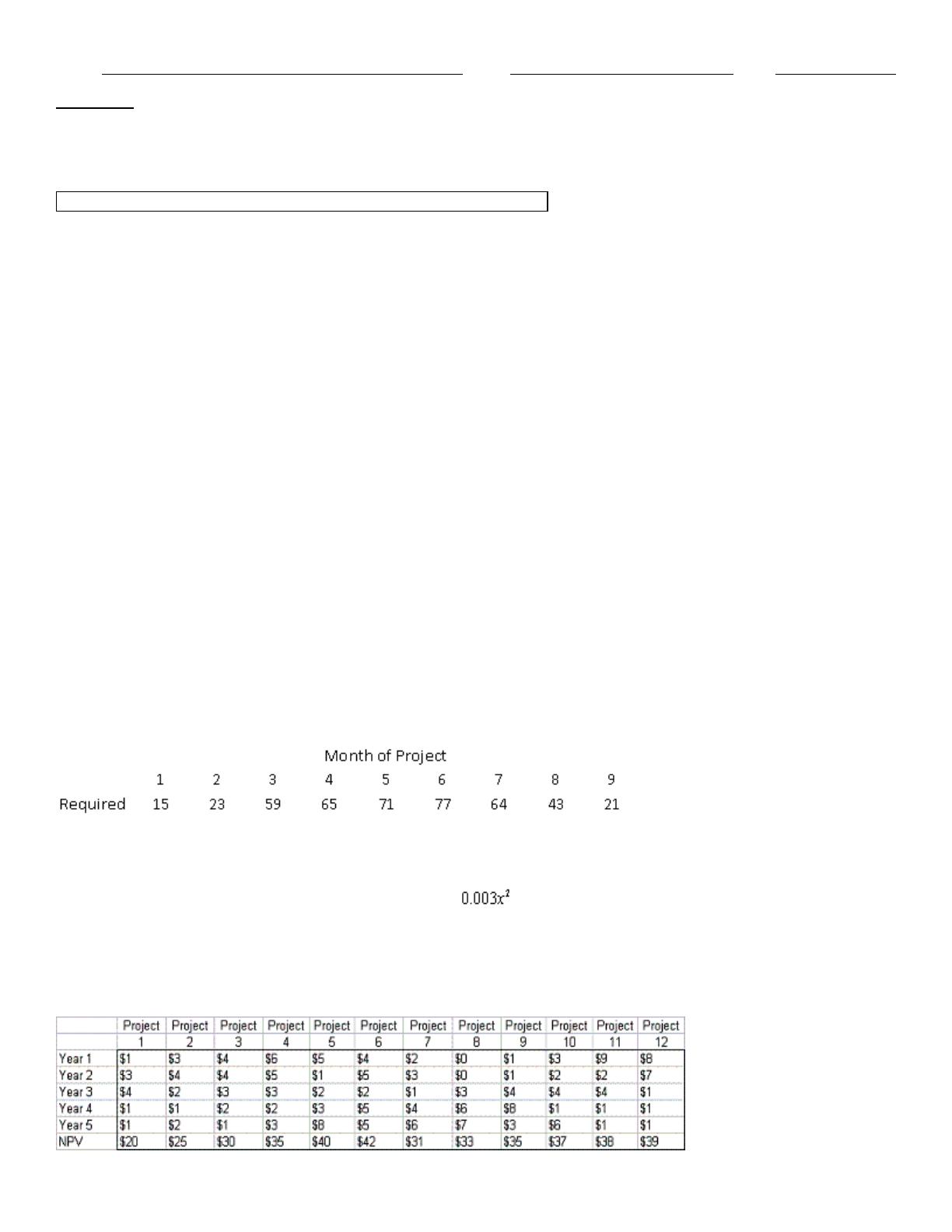
A construction company is preparing for a nine-month project, and will need to develop a staffing plan. The
company can assign up to 30 of its own full-time employees to the project, and will hire short-term contract
employees to make up any shortage in meeting the personnel requirements. Company employees earn $6,000
per month, while short-term contract employees make $8,600/month. Contract employees can be assigned to the
project beginning in any month, and their contract period is two months. The number of workers required for the
project by month is shown below:
74. Suppose the bonus for completing the project three months early is $250,000. What would be the net bonus to
the company, after adjusting for any difference in personnel costs under the accelerated schedule?
75. The cost per day of running a hospital is 250,000 + dollars, where x is the number of patients served
per day. What number of patients served per day minimizes the cost per patient of running the hospital?
76. The financial CEO is given a group of possible investments projects for his company’s capital. For each
project, he is given the NPV that each project would add to the firm, as well as the cash outflow required by each
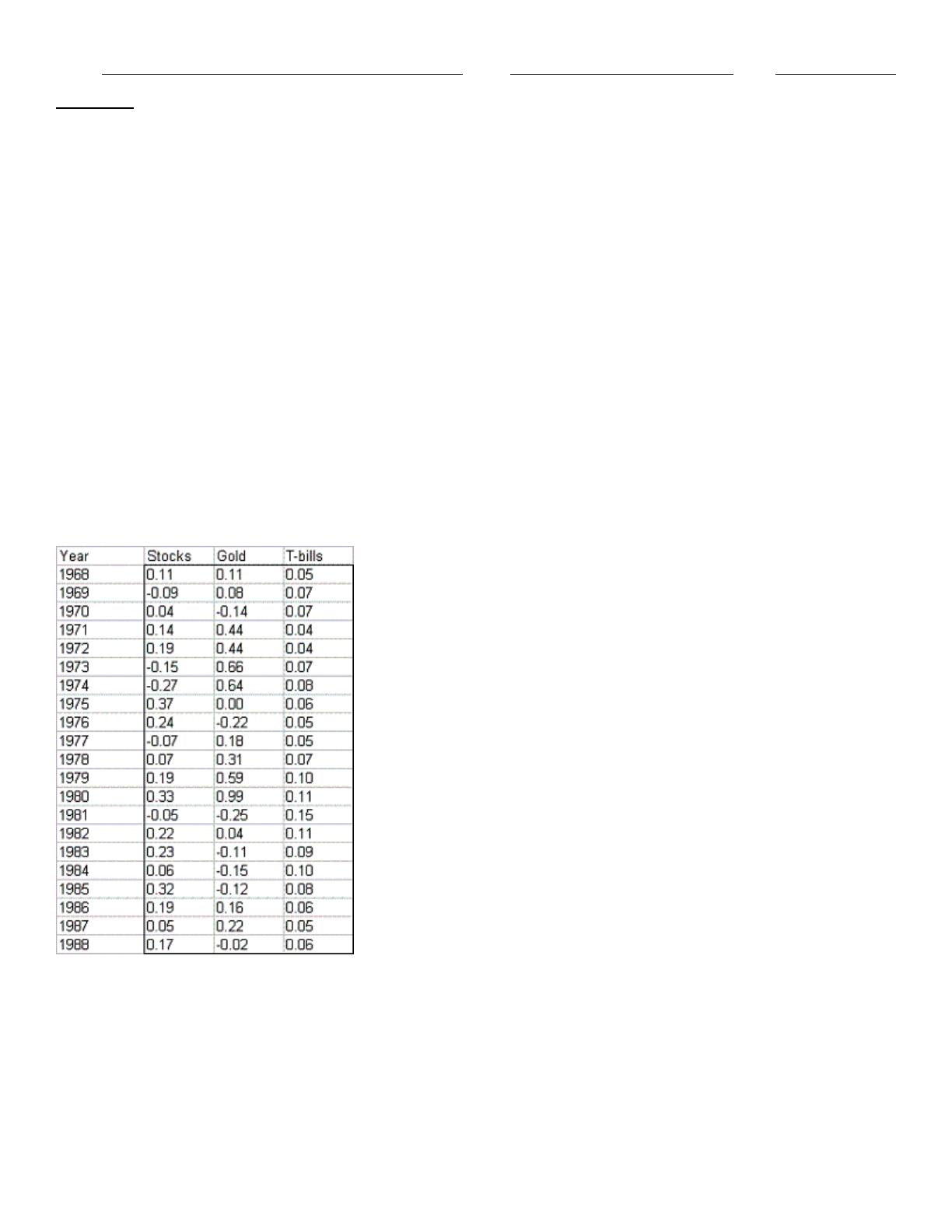
project during each year as shown in the table below:
Name:
Class:
Date:
chapter 14
Determine the investments that maximize the firm’s NPV. The firm has 30 million dollars available during each of
the next 5 years. All numbers are in millions of dollars.
A meat market manager for a large grocery store is preparing a processing plan to stock the shelves with
sausage, ground meat, and jerky, which he can prepare from beef, pork and venison. Sausage and ground meat
can be made of any mix of the beef, pork and venison, as long at the fat contents are below 15% for sausage and
10% for ground meat. Sausage sells for $5/pound and ground meat sells for $3/pound. Jerky, which sells or
$10/pound, is made in a drying process from beef or venison. In the drying process, there is a 50% loss in weight
for jerky made from beef (e.g., one pound of beef yields 0.5 pounds of beef jerky) and a 30% loss in weight for
jerky made from venison. The market can sell at most 500 pounds of sausage, 1000 pounds of ground meat, and
100 pounds of jerky before their expiration dates. There are currently 1,000 pounds of beef (10% fat content), 500
pounds of pork (8% fat content), and 200 pounds of venison (2% fat content) available for processing.
77. Suppose that later in the year, venison will be out of season, but the market will be able to obtain an
additional 300 pounds of pork for the same costs. Develop a processing plan in that case. How does the solution
change?
78. The risk index of an investment can be obtained by taking the absolute values of percentage changes in the
value of the investment for each year and averaging them. Suppose you are trying to determine what percentage
of your money you should invest in T-bills, gold, and stocks. The table below lists the annual returns (percentage
changes in value) for these investments for the years 1968–1988.
Name:
Class:
Date:
chapter 14
Let the risk index of a portfolio be the weighted average of the risk indexes of these investments, where the
weights are the fractions of your money assigned to the investments. Suppose that the amount of each
investment must be between 20% and 50% of the total invested. You would like the risk index of your portfolio to
equal 0.15, and your goal is to maximize the expected return on your portfolio. Determine the maximum expected
return on your portfolio, subject to the stated constraints. Use the average return earned by each investment
during the years 1968-1988 as your estimate of expected return.
79. Discuss how the company’s optimal production schedule would be affected by a change in the cost of
decreasing production from one quarter to the next.
80. During each 4-hour period, the police force in a small town in Ohio requires the following number of on-duty police
officers: 8 from midnight to 4 A.M.; 7 from 4 A.M. to 8 A.M.; 6 from 8 A.M. to noon; 6 from noon to 4 P.M.; 5 from 4 P.M. to
8 P.M.; and 4 from 8 P.M. to midnight. Each police officer works two consecutive 4-hour shifts. Determine how to minimize
the number of police officers needed to meet the town’s daily requirements.
81. An oil company controls two oil fields. Field 1 can produce up to 45 million barrels of oil per day, and field 2 can
produce up to 55 million barrels of oil per day. At field1, it costs $3 to extract and refine a barrel of oil; at field 2, the cost is
$2. The company sells oil to two countries: France and Japan. The shipping costs per barrel are shown below.
Each day, France is willing to buy up to 45 million barrels (at $6 per barrel), and Japan is willing to buy up to 35 million
barrels (at $6.50 per barrel). Determine how to maximize the company’s profit.
82. Suppose that on Monday morning you have $5000 in cash on hand. For the following seven days, the following cash
requirements must be met: Monday, $6,000; Tuesday, $7,000; Wednesday, $10,000; Thursday, $3,000; Friday, $8,000;
Saturday, $3,000; Sunday, $4,000. At the beginning of each day, you must decide how much money (if any) to withdraw
from the bank. It costs $8 to make a withdrawal of any size. You believe that the opportunity cost of having $1 of cash on
hand for a year is $0.25. Assume that opportunity costs are incurred on each day’s ending balance. Determine how much
money you should withdraw from the bank during each of the next 7 days.
An oil company produces oil at two wells. Well 1 can produce up to 150,000 barrels per day, and well 2 can produce up to
200,000 barrels per day. It is possible to ship oil directly from the wells to customers in Los Angeles and New York.
Alternatively, the company could transport oil to the ports of Mobile and Galveston and then ship it by tanker to New York
or Los Angeles. Los Angeles requires 160,000 barrels per day, and New York requires 140,000 barrels per day. The costs
(in dollars) of shipping 1000 barrels between various locations are shown below:
To
From
Well 1
Well 2
Mobile
Galveston
New York
Los Angeles
Well 1
$10,000
$10,000
$10
$13
$25
$28
Well 2
$10,000
$10,000
$15
$12
$26
$25
Mobile
$10,000
$10,000
$10,000
$6
$16
$17
Galveston
$10,000
$10,000
$6
$10,000
$14
$16
New York
$10,000
$10,000
$10,000
$10,000
$10,000
$15
Los Angeles
$10,000
$10,000
$10,000
$10,000
$15
$10,000
Name:
Class:
Date:
chapter 14
83. (A) Assume that before being shipped to Los Angeles or New York, all oil produced at the wells must be refined at
either Mobile or Galveston. To refine 10000 barrels of oil costs $12 at Mobile and $10 at Galveston. Assuming that both
Mobile and Galveston have infinite refinery capacity, determine how to minimize the daily cost of transporting and refining
the oil requirements of Los Angeles and New York.
(B) Rework (A) under the assumption that Galveston has a refinery capacity of 150,000 barrels per day, and Mobile has a
refinery capacity of 180,000 barrels per day.
84. Chemical Bank is attempting to determine where its assets should be invested during the current year. At present,
$800,000 is available for investment in bonds, home loans, auto loans, and personal loans. The annual rate of return on
each type of investment is known to be the following: bonds, 12%, home loans, 18%, auto loans, 15%, personal loans,
22%. To ensure that the bank’s portfolio is not too risky, the bank’s investment manager has placed the following
restrictions on the bank portfolio:
∙ No more than 30% of the total amount invested may be in personal loans
∙ The amount invested in home loans cannot exceed the amount invested in auto loans
∙ The amount invested in personal loans cannot exceed the amount invested in bonds.
Determine how the bank can maximize the annual return on its investment portfolio.
85. My friend Lee Meadow moved from Ferris State University in Michigan to Indiana University East in Indiana and has
rented a truck that can haul up to 1100 cubic feet of furniture. The volume and value of each item he considered moving
on the truck are giving below.
Which items did he take with him to Indiana? What is the value of these items?
86. An oil delivery truck contains five compartments, holding up to 2800, 2900, 1200, 1800, and 3200 gallons of fuel,
respectively. The company must deliver three types of fuel (super, regular, and unleaded) to a customer. The demands,
penalty per gallon short, and the maximum allowed shortage are shown in the table below. Each compartment of the truck
can carry only one type of gasoline. Determine how to load the truck in a way that minimizes shortage costs.
Demand
Cost (Gallon short)
Maximum shortage allowed
Super
3000
$9
400
Regular
4000
$7
400
Unleaded
5000
$5
400
An auto company produces cars at Los Angeles and Detroit, and has a warehouse in Atlanta. The company supplies cars
to dealers in Dallas and Orlando. The costs of shipping a car between various points are shown in the table below, where
“NA” means that a shipment is not allowed. Los Angeles can produce up to 1400 cars, and Detroit can produce up to
3200 cars. Dallas must receive 2800 cars, and Orlando must receive 1800 cars.
To
From
LA
Detroit
Atlanta
Dallas
Orlando
LA
$12,000
$190
$150
$140
$275
Detroit
$195
$12,000
$160
$160
$160
Atlanta
$155
$165
$12,000
$160
$130
Dallas
$140
$160
$170
$12,000
$12,000
Orlando
$260
$170
$130
$12,000
$12,000
87. (A) Determine how to minimize the cost of meeting demands at Dallas and Orlando.
(B) Modify the answer to (A) if shipments between Los Angeles and Detroit are not allowed.
Name:
Class:
Date:
chapter 14
88. An electronic company is considering opening warehouses in New York, Los Angeles, Madison, and Tampa. Each
warehouse can ship 125 units per week. The weekly fixed cost for keeping each warehouse open is $500 for New York,
$600 for Los Angeles, $400 for Madison, and $200 for Tampa. Region 1 of the country requires 90 units per week, region
2 requires 80 units per week, and region 3 requires 50 units per week. The costs (including production and shipping costs)
of sending one unit from a plant to a region are shown in the table below.
To
From
Region 1
Region 2
Region 3
NY
$25
$45
$55
LA
$52
$19
$30
Madison
$29
$38
$21
Tampa
$28
$54
$39
Show how the company can meet weekly demands at a minimum cost, subject to the above information and the following
restrictions:
If the New York warehouse is opened, then Los Angeles must be opened.
At most two warehouses can be opened.
Either the Tampa or the Los Angeles warehouses must be opened.
89. A statistician is currently trying to maximize his profit in the bond market. Four bonds are available for purchase and
sale at the bid and ask prices shown in the table below. The statistician can buy up to 1300 units of each bond at the ask
price or sell up to 1300 units of each bond at the bid price. During each of the next three years the person who sells a
bond will pay the owner of the bond the cash payments that are also shown in the table below. The statistician’s goal is to
maximize his revenue from selling bonds less his payments for buying bonds, subject to the constraint that after each
year’s payments are received, his current cash position (due only to cash payments from bonds and not purchases or
sales of bonds) is nonnegative. His current cash position can depend on past coupons and that cash accumulated at the
end of each year earns 12% annual interest. Determine how to maximize net profit from buying and selling bonds, subject
to the constraints previously described.
Bid (for selling) and ask (for buying) prices of bonds
Bond 1
Bond 2
Bond 3
Bond 4
Bid
$1,000
$99
$980
$960
Ask
$1,020
$1,015
$1,002
$184
Cash payments from seller to buyer
Bond 1
Bond 2
Bond 3
Bond 4
Year 1
$120
$100
$90
$70
Year 2
$140
$130
$110
$90
Year 3
$1,300
$1,320
$1,290
$1,310
An oil company has oil fields in San Diego and Los Angeles. The San Diego field can produce up to 500,000 barrels per
day, and the Los Angeles field can produce up to 400,000 barrels per day. Oil is sent from the fields to a refinery, either in
Dallas or in Houston. Assume that each refinery has unlimited capacity. To refine 100,000 barrels costs $725 at Dallas
and $950 at Houston. Refined oil is shipped to customers in Chicago and New York. Chicago customers require 400,000
barrels per day, and New York customers require 300,000 barrels per day. The costs of shipping 100,000 barrels of oil
(refined or unrefined) between cities are shown in the table below:
90. (A) Determine how to minimize the total cost of meeting all demands.
Name:
Class:
Date:
chapter 14
(B) If each refinery had a capacity of 380,000 barrels per day, how would you modify the model in (A)?
91. During the next 4 quarters, an automobile company must meet (on time) the following demands for cars: 4000 in
quarter 1; 2000 in quarter 2; 5000 in quarter 3; 1000 in quarter 4. At the beginning of quarter 1, there are 300 autos in
stock. The company has the capacity to produce at most 3000 cars per quarter. At the beginning of each quarter, the
company can change production capacity. It costs $100 to increase quarterly production capacity by 1 unit. For example,
it would cost $20,000 to increase capacity from 3000 to 3200. It also costs $60 per quarter to maintain each unit of
production capacity (even if it is unused during the current quarter). The variable cost of producing a car is $2200. A
holding cost of $160 per car is assessed against each quarter’s ending inventory. It is required that at the end of quarter 4,
plant capacity must be at least 4000 cars. Determine how to minimize the total cost incurred during the next 4 quarters.
92. A product can be produced on four different machines. Each machine has a fixed setup cost, variable
production cost per unit processed, and a production capacity, as shown below:
A total of 2000 units of the product must be produced. Determine how to minimize the total cost.
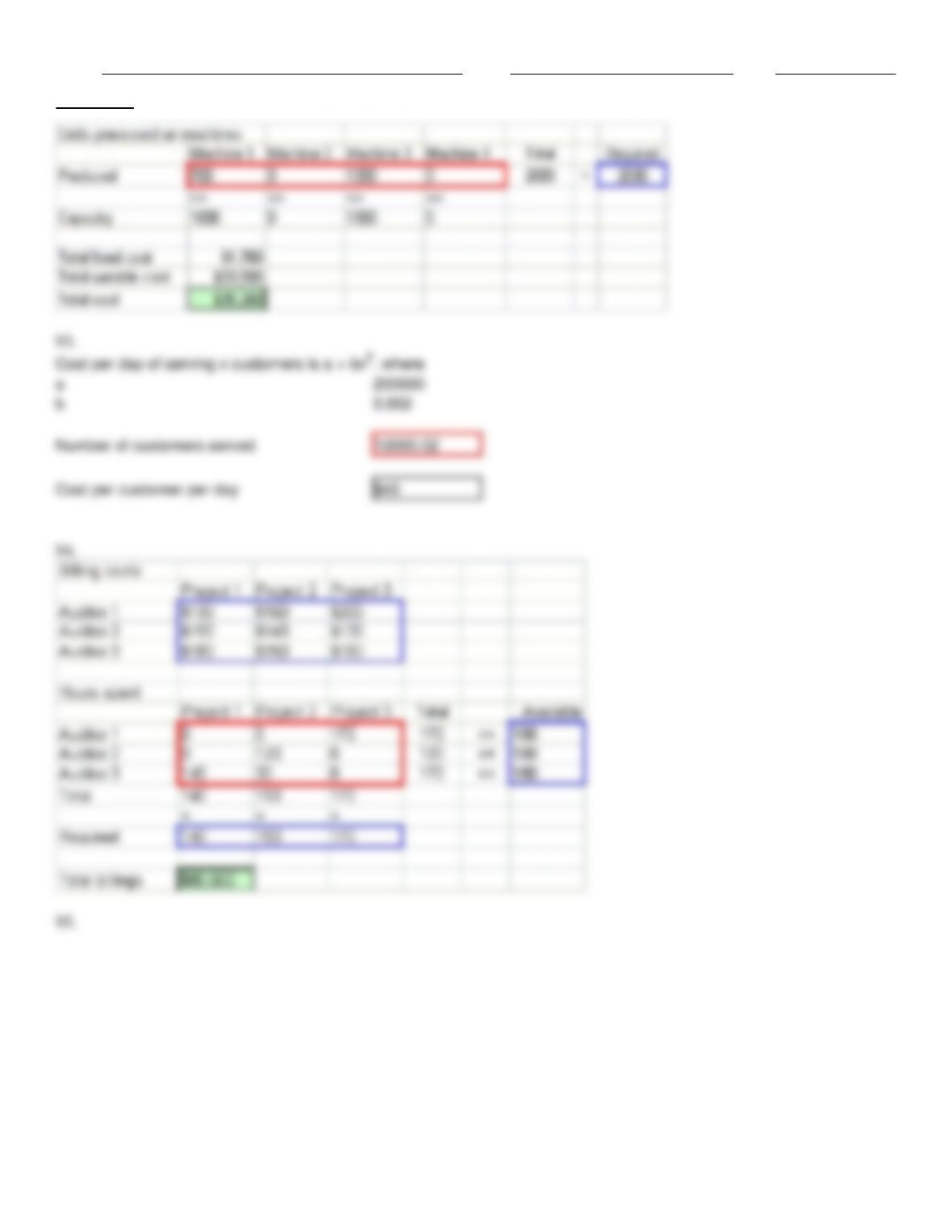
93. The cost per day running a hotel is 200,000 + 0.002 dollars, where x is the number of customers served per day.
What number of customers served per day minimizes the cost per customer of running the hotel?
94. A large accounting firm has three auditors. Each can work up to 180 hours during the next month, during
which time three projects must be completed. Project 1 takes 140 hours, project 2 takes 150 hours, and project 3
takes 170 hours. The amount per hour that can be billed for assigning each auditor to each project is given in the
table below:
Determine how to maximize total billings during the next month by formulating the company’s problem as a
transportation model.
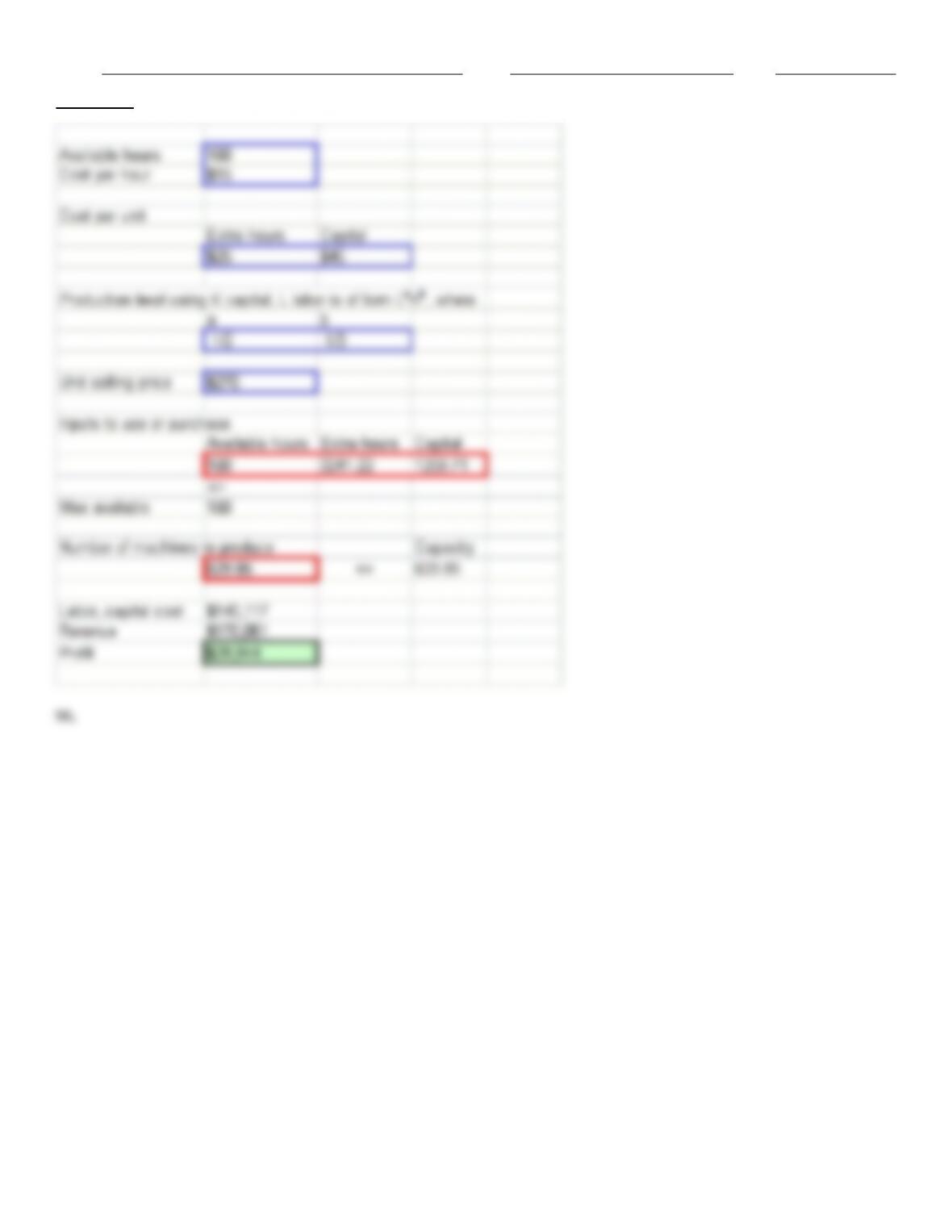
95. A total of 160 hours of labor are available each week at $15 per hour. Additional labor can be purchased at $25
per hour. Capital can be purchased in unlimited quantities at a cost of $45 per unit. If K units of capital and L
units of labor are available during a week, then machines can be produced. Each machine sells for $270.
How can the firm maximize its weekly profit?
A construction company is preparing for a nine-month project, and will need to develop a staffing plan. The
company can assign up to 30 of its own full-time employees to the project, and will hire short-term contract
employees to make up any shortage in meeting the personnel requirements. Company employees earn $6,000
per month, while short-term contract employees make $8,600/month. Contract employees can be assigned to the
project beginning in any month, and their contract period is two months. The number of workers required for the
project by month is shown below:
Name:
Class:
Date:
chapter 14
96. Determine the optimal staffing plan for the project.
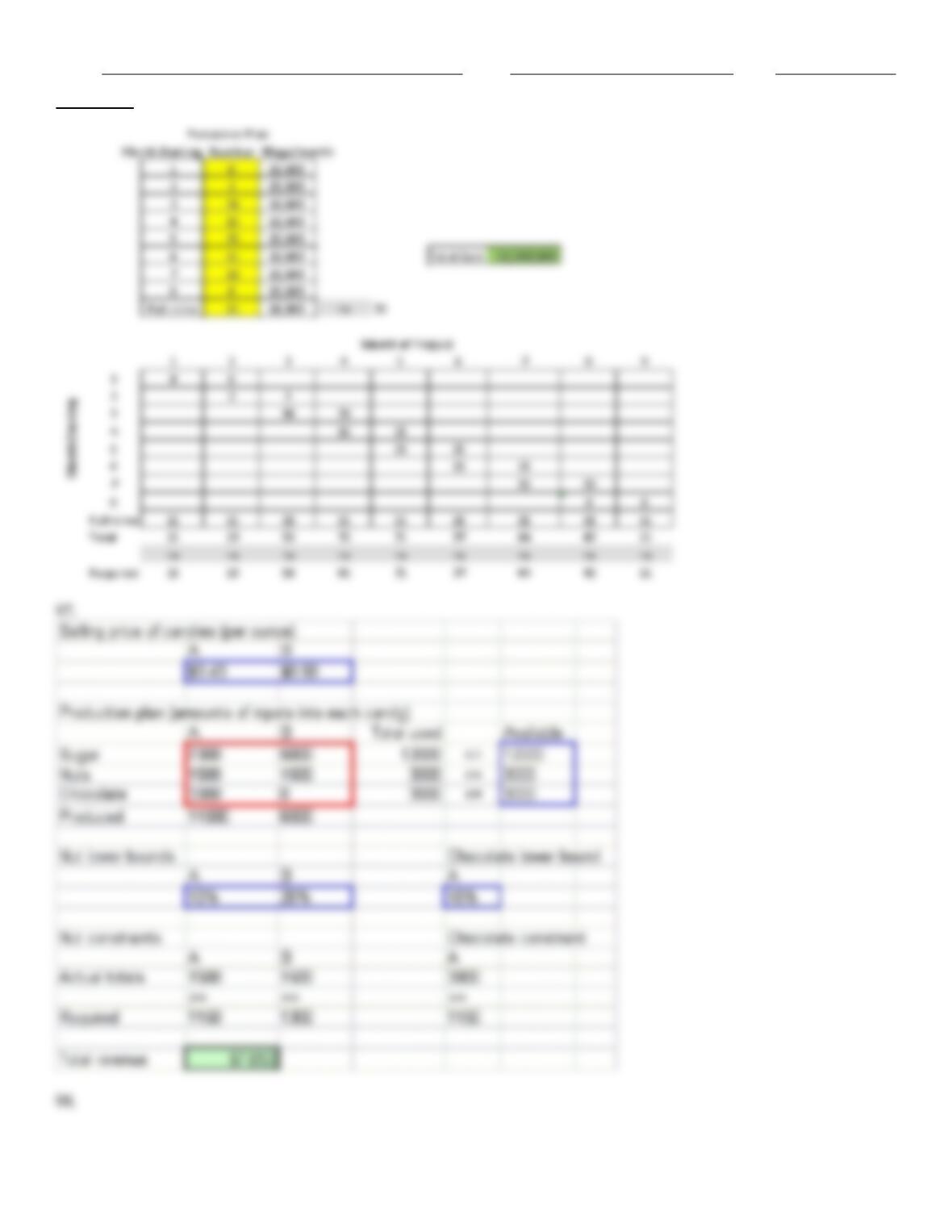
97. You have decided to enter the candy business. You are considering producing two types of candies: A and B,
both of which consist solely of sugar, nuts, and chocolate. At present you have in stock 12,000 ounces of sugar,
3000 ounces of nuts, and 3000 ounces of chocolate. The mixture used to make candy A must contain at least 10%
nuts and 10% chocolate. The mixture used to make candy B must contain at least 20% nuts. Each ounce of candy
A can be sold for $0.40 and each ounce of candy for $0.50. Determine how you can maximize your revenues from
candy sales.
98. Laila, an Egyptian Broker, is currently trying to maximize her profit in the bond market. Four bonds are available for
purchase and sale at the bid and ask prices shown in the table be below:
Laila can buy up to 1000 units of each bond at the ask price or sell up to 1000 units of each bond at the bid price. During
each of the next 3 years, the person who sells a bond will pay the owner of the bond the cash payments shown in the
table below:
Laila’s goal is to maximize her revenue from selling bonds less her payment for buying bonds, subject to the constraint
that after each year’s payments are received, her current cash position (due only to cash payments from bonds and not
purchases or sales of bonds) is nonnegative. Note that her current cash position can depend on past coupons and that
cash accumulated at the end of each year earns 13% annual interest. Determine how to maximize net profit from buying
and selling bonds, subject to the constraints previously described. Why do you think we limit the number of units of each
bond that can be bought or sold?
99. Linear programming models are used by many financial firms to select a desirable bond portfolio. The following is a
simplified version of such a model. Abby is considering investing in four bonds; $1.5 million is available for investment.
The expected annual return, the worst-case annual return on each bond, and the “duration” of each bond are given below
(The duration of a bond is a measure of the bond’s sensitivity to interest rates.)
Abby wants to maximize the expected return from its bond investments, subject to the following three constraints:
∙ The worst-case return of the bond portfolio must be at least 8%.
∙ The average duration of the portfolio must be at most 6. For example, a portfolio that invests $600,000 in bond 1 and
$400,000 in bond 4 has an average duration of [600,000(3) + 400,000 (9)]/1,000,000 = 5.4
∙ Because of diversification requirements, at most 40% of the total amount invested can be invested in a single bond.
Determine how Abby can maximize the expected return on her investment.
A company supplies goods to three customers, each of whom requires 50 units. The company has two warehouses. In
warehouse 1, 75 units are available, and in warehouse 2, 55 units are available. The costs of shipping one unit from each
warehouse to each customer are shown in the table below.
Name:
Class:
Date:
chapter 14
To
From
Customer 1
Customer 2
Customer 3
Warehouse 1
$20
$40
$30
Warehouse 2
$15
$35
$45
Not shipped (shortage)
$100
$90
$115
There is a penalty for each unsatisfied customer unit of demand – with customer 1, a penalty cost of $100 is incurred; with
customer 2, $90; and with customer 3, $115.
100. Suppose that the company can purchase and ship extra units to either warehouse for a total cost of $125 per unit
and that all customer demand must be met. Determine how to minimize the sum of purchasing and shipping costs.
101. A company produces three types of glue on two different production lines. Each line can be utilized by up to
six workers at a time. Workers are paid $550 per week on production line 1 and $950 per week on production line
2. For a week of production it costs $1,050 to set up production line 1 and $2,050 to set up production line 2.
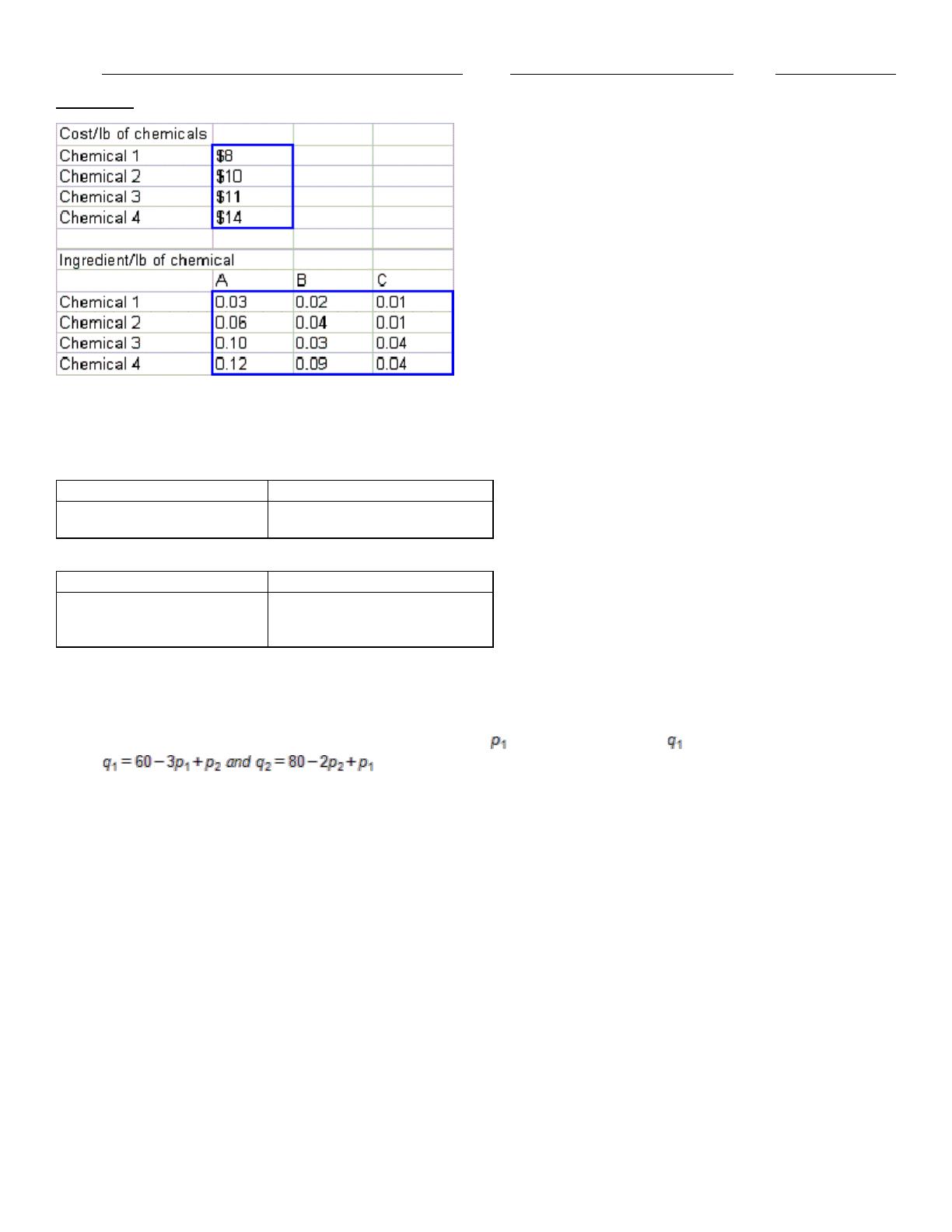
During a week on a production line each worker produces the number of units of glue shown in the table below:
Each week at least 120 units of glue 1, at least 150 units of glue 2, and at least 200 units of glue 3 must be
produced. Determine how to minimize the total cost of meeting weekly demands.
102. A company has daily staffing requirements for two types of jobs, cleaning and customer service persons. The
minimum numbers of workers required each day for each type of job are shown in the table below. To meet these
requirements, the company can employ three types of workers: those who clean only, those who can perform customer
service only, and those who are able to do both. In each of these three categories, the company wants to meet its daily
requirements using only full-time workers. A full-time worker must work five consecutive days with two days off. Workers
who are able to perform only one type of work (cleaning or customer service) earn $50 per day. Those who are able to
perform both types of work earn $60 per day. As a matter of policy, the company wants to ensure that at least 20% of its
total hours are staffed by “swing workers”; those who can do both types of jobs. The company wants to find a staffing
policy that covers the daily worker requirements at minimum total costs per week. Use solver to formulate and solve the
company’s problem.
Type of job
Mon
Tue
Wed
Thu
Fri
Sat
Sun
Cleaning
8
7
7
10
9
15
11
Customer service
13
13
9
14
18
20
19
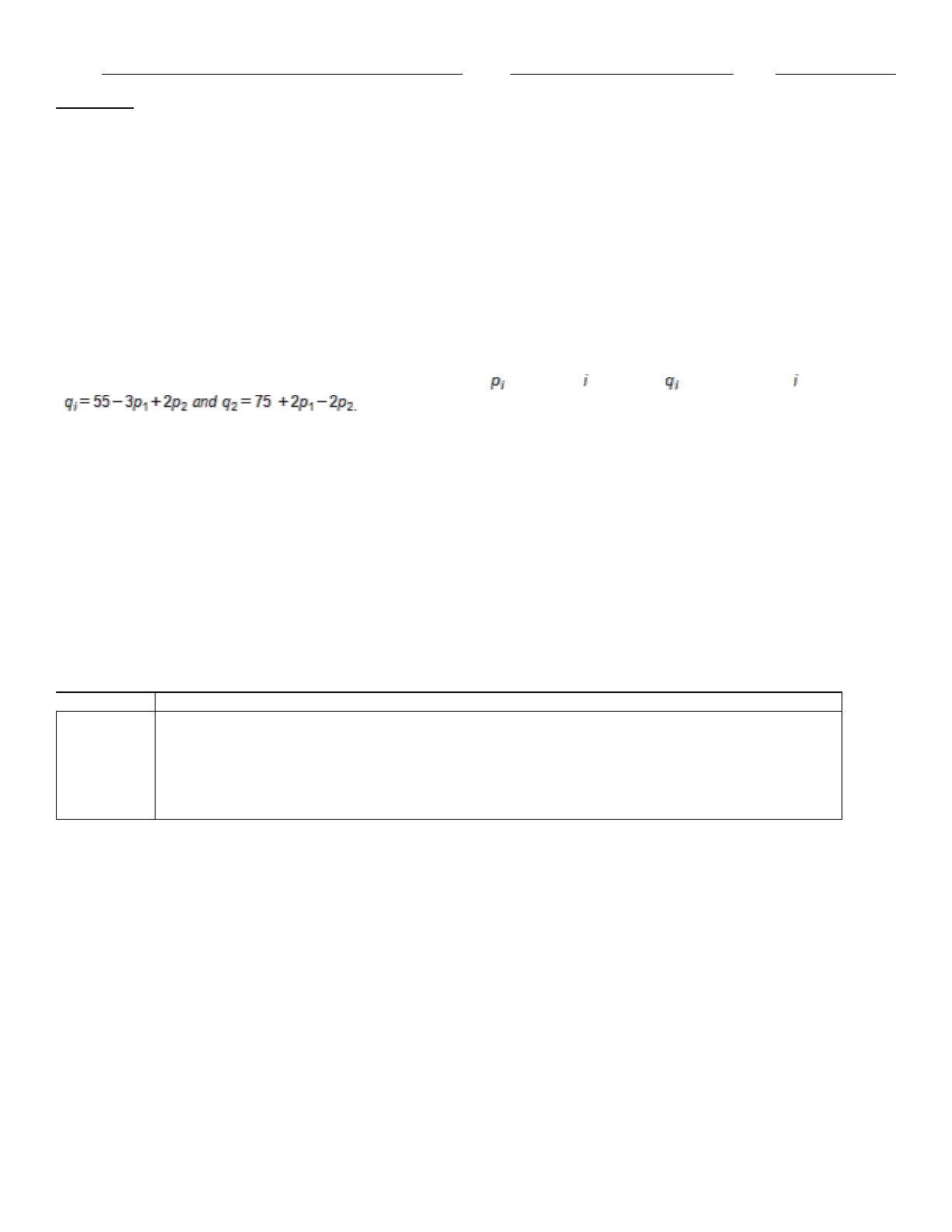
103. A pharmaceutical company produces a drug from four chemicals. Today the company must produce 1000
pounds of the drug. The three active ingredients in the drug are labeled A, B, and C. By weight, at least 8% of the
drug must consist of A, at least 4% must consist of B, and at least 2% must consist of C. The cost per pound of
each chemical and the amount of each active ingredient in 1 pound of each chemical are given below. It is
necessary that at least 100 pounds of chemical 2 be used.
Name:
Class:
Date:
chapter 14
Determine the cheapest way of producing today’s batch of this drug.
104. Assume that you are given the following means, standard deviations, and correlations for the annual return on three
stocks.
Stock 1
Stock 2
Stock 3
Mean return
0.15
0.18
0.23
Stdev. of return
0.18
0.28
0.38
Correlation matrix
Stock 1
Stock 2
Stock 3
Stock 1
1.00
0.62
0.72
Stock 2
0.62
1.00
0.39
Stock 3
0.72
0.39
1.00
The correlation between stocks 1 and 2 is 0.62, between stocks 1 and 3 is 0.72, and between stocks 2 and 3 is 0.39. You
have $12,000 to invest and can invest no more than 55% of your money in any single stock. Determine the minimum
variance portfolio that yields an expected annual return of at least 0.15.
105. A company manufactures two products. If it charges price for product I, it can sell units of product I,
where . It costs $25 to produce a unit of product 1 and $72 to produce a unit of
product 2. How many units of each product should the company produce, and what prices should it charge, to maximize
its profit?
A motorcycle company is determining its production schedule for the next four quarters. Demands for
motorcycles are forecasted to be 40 in quarter 1; 70 in quarter 2; 50 in quarter 3; 20 in quarter 4. The company
incurs four types of costs:
∙ It costs the company $400 to manufacture each motorcycle
∙ A holding cost of $100 per motorcycle left in inventory is incurred at the end of each quarter.
∙ Increasing production from one quarter to the next incurs costs for training employees. It is estimated that a
cost of $700 per motorcycle is incurred if production is increased from one quarter to the next.
∙ Decreasing production from one quarter to the next incurs costs for severance pay, decreasing morale, and so
forth. It is estimated that a cost of $600 per motorcycle is incurred if production is decreased from one quarter to
the next.
All demands must be met on time, and a quarter’s production can be used to meet demand for the current
quarter (as well as future quarters). During the quarter immediately preceding quarter1, 50 motorcycles were
produced. Assume that at the beginning of quarter 1, no motorcycles are in inventory.
106. Determine how to minimize the company’s total cost during the next four quarters.
Name:
Class:
Date:
chapter 14
A meat market manager for a large grocery store is preparing a processing plan to stock the shelves with
sausage, ground meat, and jerky, which he can prepare from beef, pork and venison. Sausage and ground meat
can be made of any mix of the beef, pork and venison, as long at the fat contents are below 15% for sausage and
10% for ground meat. Sausage sells for $5/pound and ground meat sells for $3/pound. Jerky, which sells or
$10/pound, is made in a drying process from beef or venison. In the drying process, there is a 50% loss in weight
for jerky made from beef (e.g., one pound of beef yields 0.5 pounds of beef jerky) and a 30% loss in weight for
jerky made from venison. The market can sell at most 500 pounds of sausage, 1000 pounds of ground meat, and
100 pounds of jerky before their expiration dates. There are currently 1,000 pounds of beef (10% fat content), 500
pounds of pork (8% fat content), and 200 pounds of venison (2% fat content) available for processing.
107. The market manager is concerned about variability in the fat content of beef, noting that it actually can be as
high as 20% and as low as 5%. Perform a sensitivity analysis to determine the effect, first on the amount of beef
used, and then on the revenue. What do the results indicate? Should the manager be concerned?
108. A company manufactures two products. If it charges price for product , it can sell units of product , where
It costs the company $20 to produce a unit of product 1 and $65 to produce a
unit of product 2. How many units of each product should the company produce, and what prices should it charge, to
maximize its profit?
109. A manufacturer can sell product 1 at a profit of $2 per unit and product 2 at a profit of $6 per unit. Three units of raw
material are needed to manufacture one unit of product 1, and 6 units of raw material are needed to manufacture unit of
product 2. A total of 120 units of raw material are available. If any of product 1 is produced, a setup cost of $10 is incurred,
and if any of product 2 is produced, a setup cost of $20 is incurred. Determine how to maximize the manufacturer’s profit.
An oil company produces oil at two wells. Well 1 can produce up to 150,000 barrels per day, and well 2 can produce up to
200,000 barrels per day. It is possible to ship oil directly from the wells to customers in Los Angeles and New York.
Alternatively, the company could transport oil to the ports of Mobile and Galveston and then ship it by tanker to New York
or Los Angeles. Los Angeles requires 160,000 barrels per day, and New York requires 140,000 barrels per day. The costs
(in dollars) of shipping 1000 barrels between various locations are shown below:
To
From
Well 1
Well 2
Mobile
Galveston
New York
Los Angeles
Well 1
$10,000
$10,000
$10
$13
$25
$28
Well 2
$10,000
$10,000
$15
$12
$26
$25
Mobile
$10,000
$10,000
$10,000
$6
$16
$17
Galveston
$10,000
$10,000
$6
$10,000
$14
$16
New York
$10,000
$10,000
$10,000
$10,000
$10,000
$15
Los Angeles
$10,000
$10,000
$10,000
$10,000
$15
$10,000
110. Determine how to minimize the transportation cost in meeting the oil demands of Los Angeles and New York.
111. An auto company must meet (on time) the following demands for cars: 5000 in quarter 1; 3000 in quarter 2; 6000 in
quarter 3; 2000 in quarter 4. At the beginning of quarter 1, there are 500 autos in stock. The company has the capacity to
produce at most 3600 cars per quarter. At the beginning of each quarter, the company can change production capacity. It
costs $125 to increase quarterly production capacity by one unit. It also costs $60 per quarter to maintain each unit of
production capacity (even if it is unused during the current quarter). The variable cost of producing a car is $2400. A
holding cost of $200 per car is assessed against each quarter’s ending inventory. It is required that at the end of quarter 4,
plant capacity must be at least 5000 cars. Determine how to minimize the total cost incurred during the next four quarters.
A meat market manager for a large grocery store is preparing a processing plan to stock the shelves with
sausage, ground meat, and jerky, which he can prepare from beef, pork and venison. Sausage and ground meat
can be made of any mix of the beef, pork and venison, as long at the fat contents are below 15% for sausage and
10% for ground meat. Sausage sells for $5/pound and ground meat sells for $3/pound. Jerky, which sells or
$10/pound, is made in a drying process from beef or venison. In the drying process, there is a 50% loss in weight
for jerky made from beef (e.g., one pound of beef yields 0.5 pounds of beef jerky) and a 30% loss in weight for
jerky made from venison. The market can sell at most 500 pounds of sausage, 1000 pounds of ground meat, and
Name:
Class:
Date:
chapter 14
100 pounds of jerky before their expiration dates. There are currently 1,000 pounds of beef (10% fat content), 500
pounds of pork (8% fat content), and 200 pounds of venison (2% fat content) available for processing.
112. Determine the optimal processing plan for the meat market.
A construction company is preparing for a nine-month project, and will need to develop a staffing plan. The
company can assign up to 30 of its own full-time employees to the project, and will hire short-term contract
employees to make up any shortage in meeting the personnel requirements. Company employees earn $6,000
per month, while short-term contract employees make $8,600/month. Contract employees can be assigned to the
project beginning in any month, and their contract period is two months. The number of workers required for the
project by month is shown below:
113. The project manager is evaluating options to complete the project early so that the company can earn a
bonus. He has determined that the project schedule can be compressed into a six–month schedule, with the
same total number of worker-months. In that case, the staffing requirements are as shown below.
Develop an optimal staffing plan for the project under the accelerated schedule.
Each year, a computer company produces up to 600 computers in New York and up to 500 computers in Memphis. Los
Angeles customers must receive 600 computers, and 500 computers must be supplies to Oklahoma City customers.
Producing a computer costs $850 in New York and $950 in Memphis. Computers are transported by plane and can be
sent through Chicago. The costs of shipping a computer between cities are shown below.
To
From
Chicago
Oklahoma City
L.A.
New York
$95
$245
$295
Memphis
$115
$155
$195
Chicago
NA
$60
$65
114. (A) Determine how to minimize the total (production plus distribution) costs of meeting the company’s annual
demand.
(B) How would you modify the model in (A) if at most 300 units can be shipped through Chicago?
115. A Michigan company consists of three subsidiaries. Each has the respective average payroll, unemployment reserve
fund, and estimated payroll shown in the table below (all figures are in millions of dollars). Any employer in the state of
Michigan whose reserve to average payroll ratio is less than 1 must pay 25% of its estimated payroll in unemployment
insurance premiums. Otherwise, if the ratio is at least one, the employer pays 13%. The company can aggregate its
subsidiaries and label them as separate employers. For example, if subsidiaries 1 and 2 are aggregated, they must pay
25% of their combined payroll in unemployment insurance premiums. Determine which subsidiaries should be
aggregated.
Subsidiary
Ave. Payroll
Reserve
Est. Payroll
1
350
450
400
2
650
560
450
3
850
650
550
Name:
Class:
Date:
chapter 14
Answer Key
Name:
Class:
Date:
chapter 14
Name:
Class:
Date:
chapter 14
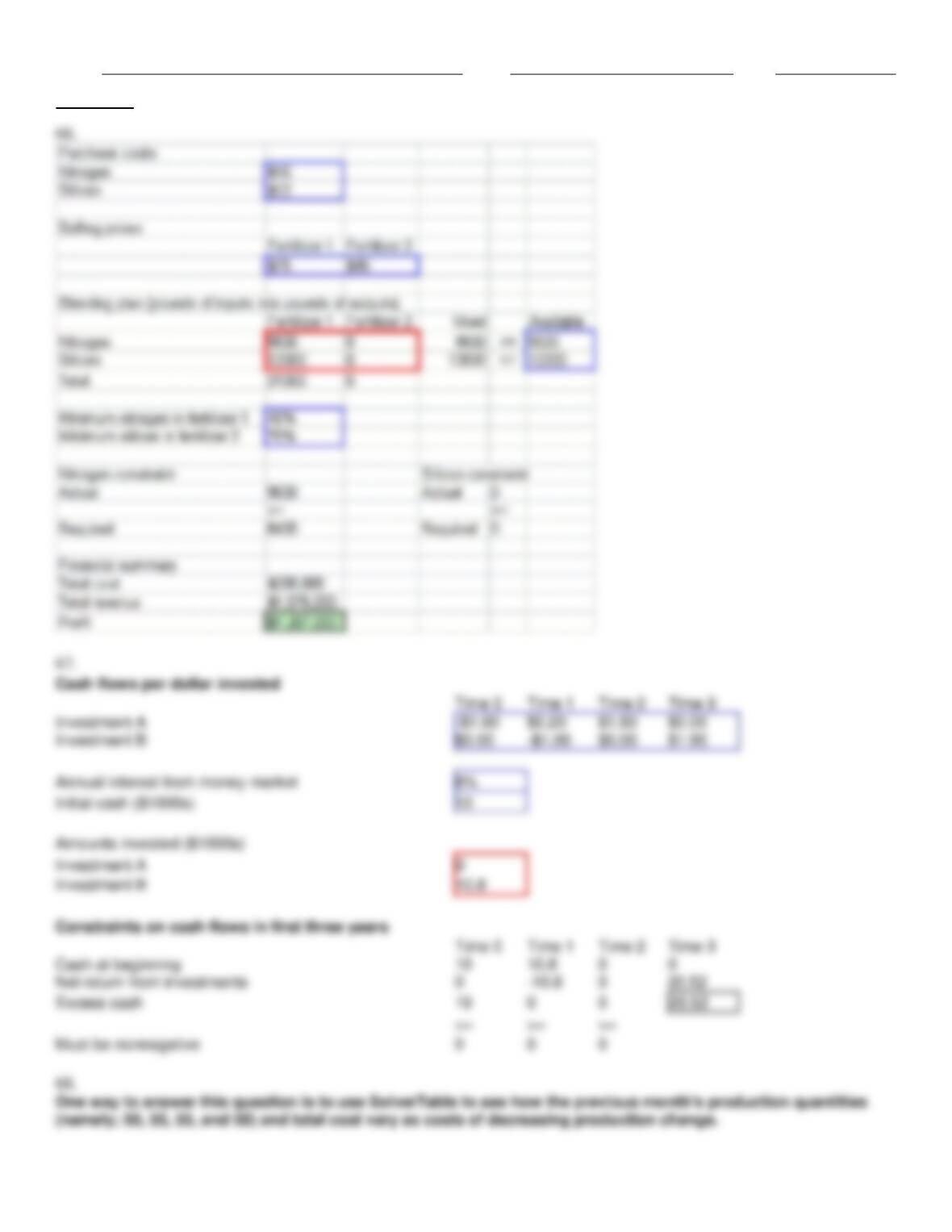
Name:
Class:
Date:
chapter 14
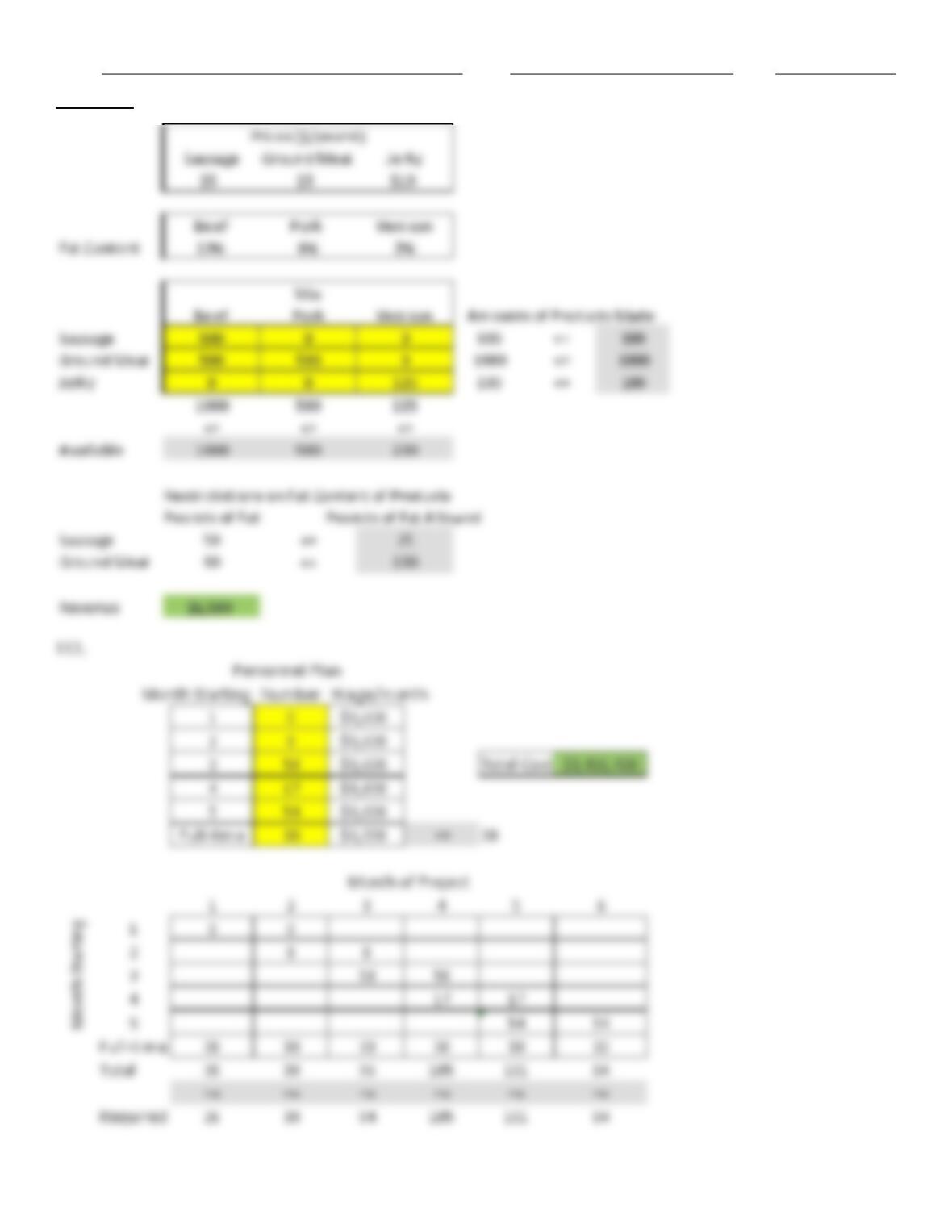
Time 0
Time 1
Time 2
Time 3
Investment A
$0.20
$1.50
$0.00
Investment B
$0.00
$0.00
$1.90
Annual interest from money market
Initial cash ($1000s)
Amounts invested ($1000s)
Investment A
0
Investment B
Time 0
Time 1
Time 2
Time 3
Cash at beginning
0
0
Net return from investments
0
0
20.52
Excess cash
0
0
20.52
Must be nonnegative
0
0
0
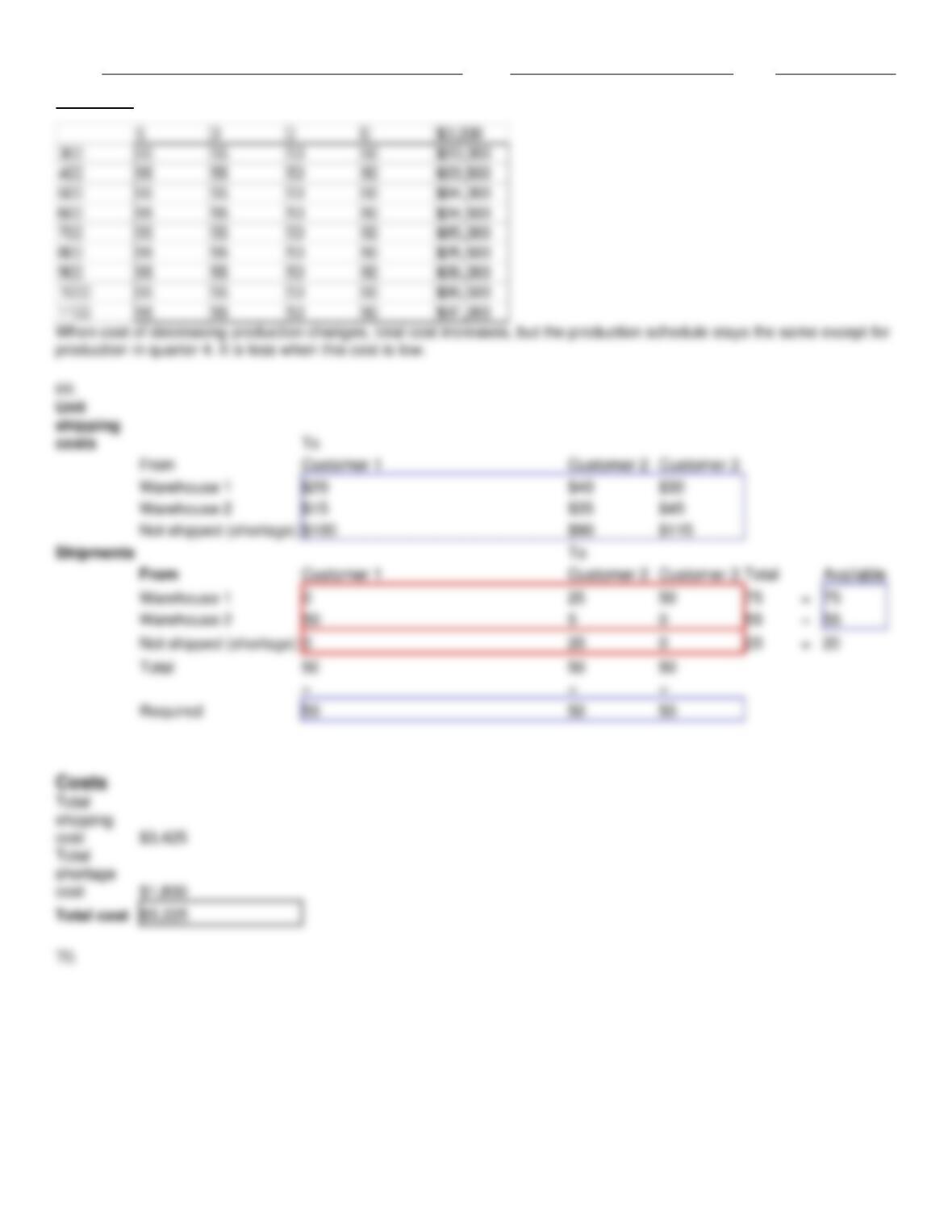
Name:
Class:
Date:
chapter 14
production in quarter 4. It is less when this cost is low.
From
Customer 1
Customer 2
Customer 3
Warehouse 1
Warehouse 2
Not shipped (shortage)
Customer 1
Customer 2
Customer 3
Total
Available
Warehouse 1
0
Warehouse 2
5
0
Not shipped (shortage)
0
0
Total
Required
cost
$3,425
cost
$1,800
$5,225
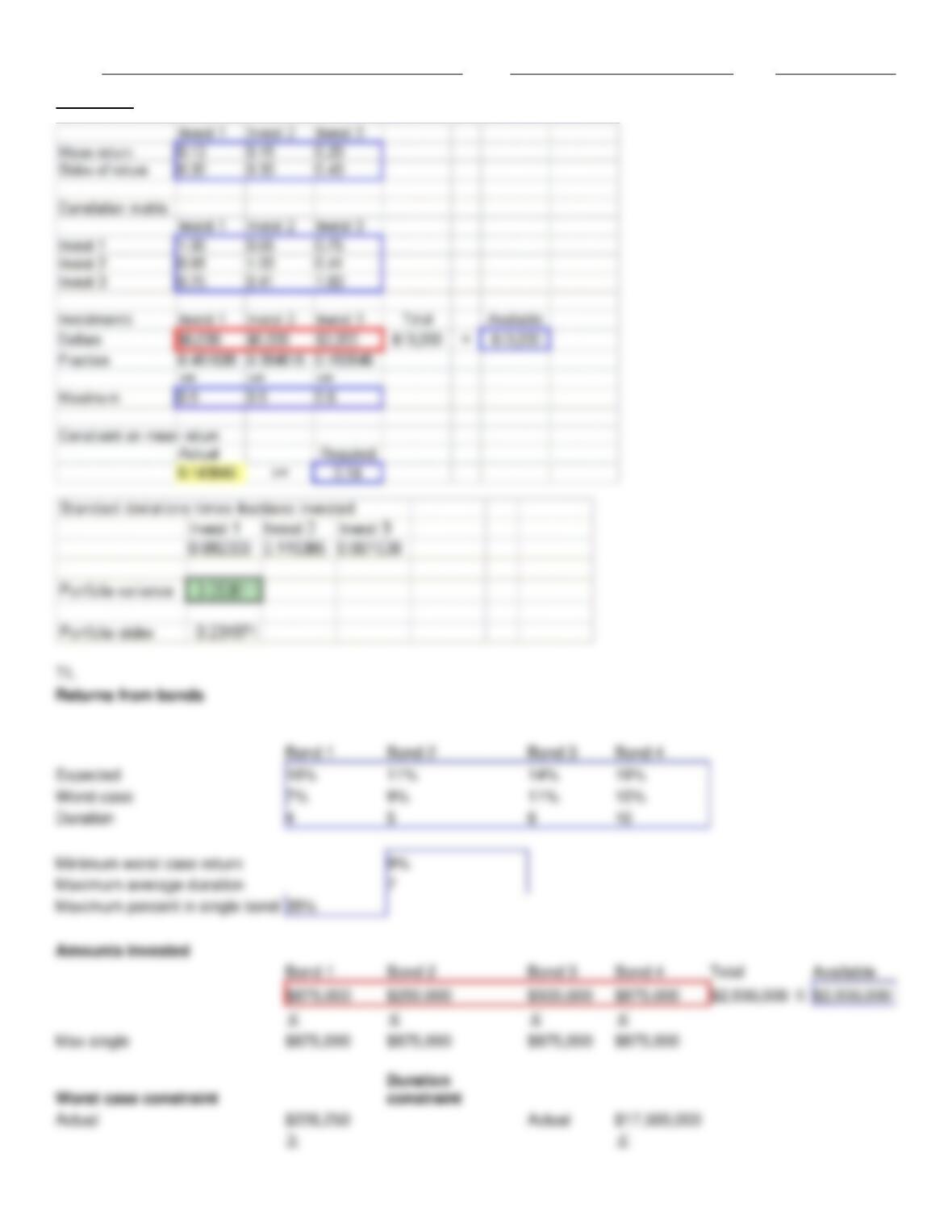
Name:
Class:
Date:
chapter 14
Bond 1
Bond 2
Bond 3
Bond 4
Expected
Worst case
Duration
4
5
8
Minimum worst case return
Maximum average duration
7
Bond 1
Bond 2
Bond 3
Bond 4
Total
Available
$875,000
$250,000
$500,000
$875,000
$2,500,000
$2,500,000
$875,000
$875,000
$875,000
$875,000
Actual
$226,250
Actual
$17,500,000
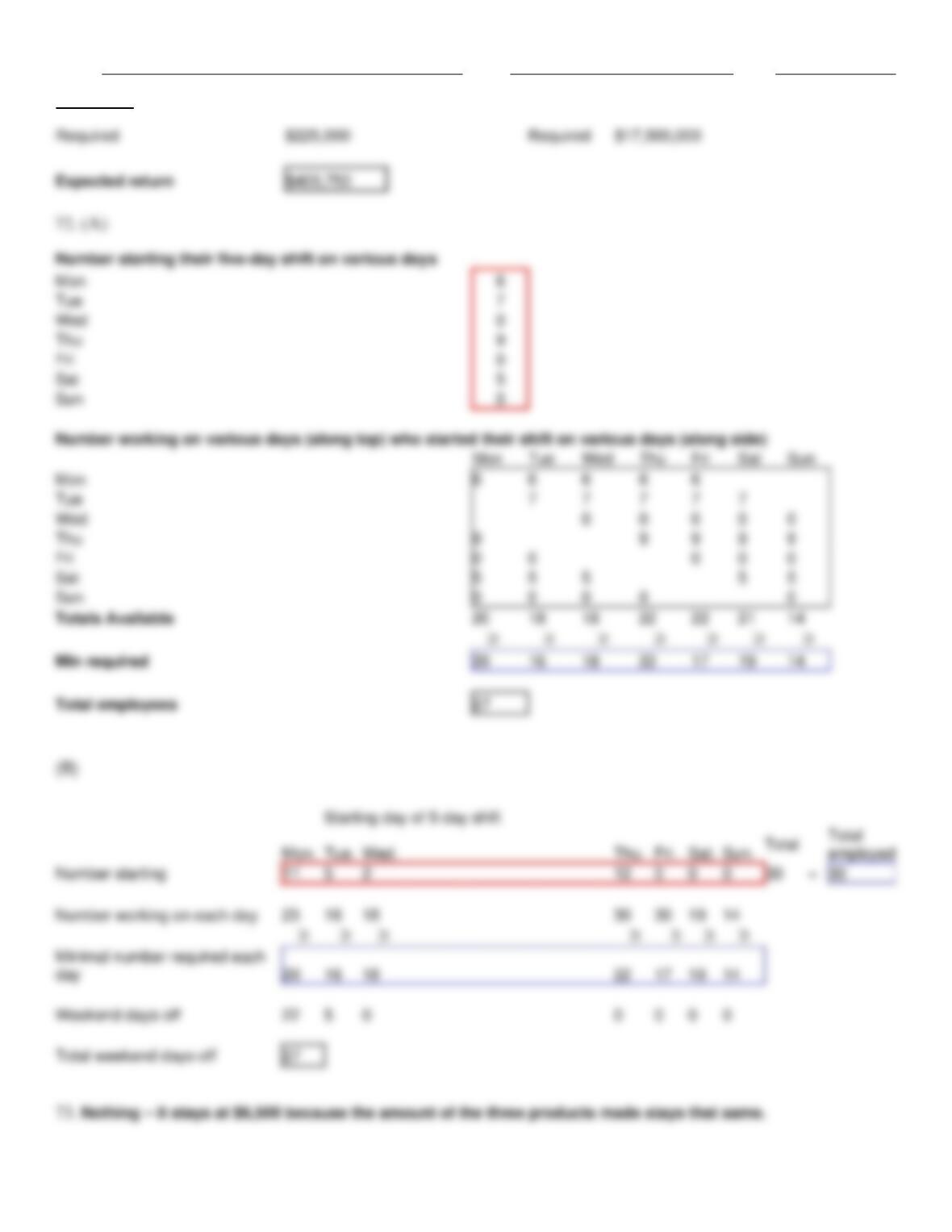
Name:
Class:
Date:
chapter 14
Required
$225,000
Required
$17,500,000
$403,750
Tue
Wed
Thu
Sat
Sun
Tue
Wed
Thu
Sat
Sun
6
6
6
6
6
Tue
7
7
7
7
7
Wed
0
0
0
0
0
Thu
9
9
9
9
9
0
0
0
0
0
Sat
5
5
5
5
5
Sun
0
0
0
0
0
Starting day of 5-day shift
Tue.
Wed.
Thu.
Fri.
Sat.
Sun.
employed
Number starting
5
2
0
0
0
Number working on each day
Weekend days–off
5
0
0
0
0
0
Name:
Class:
Date:
chapter 14
Name:
Class:
Date:
chapter 14
Name:
Class:
Date:
chapter 14
Name:
Class:
Date:
chapter 14
Initial cash (in $1000s)
Fixed cost of withdrawal
Opportunity cost/$1/day
$0.25
Name:
Class:
Date:
chapter 14
Tue
Wed
Thur
Sat
Sun
1
0
0
0
0
0
Logical upper bound
Cash requirement (in $1000s)
Cash on hand at end of day
0
0
0
0
0
0
Summary of costs (in dollars)
Withdrawal cost
Opportunity cost
$24.7
Total cost
$32.7
(per 1000 barrels)
From
Well 1
Well 2
Mobile
Galveston
Well 1
$10,000
$10,000
$10,000
$10,000
Well 2
$10,000
$10,000
$10,000
$10,000
Mobile
$10,000
$10,000
$10,000
Galveston
$10,000
$10,000
$10,000
$10,000
$10,000
$10,000
$10,000
$10,000
$10,000
$10,000
$10,000
$10,000
$10,000
Mobile
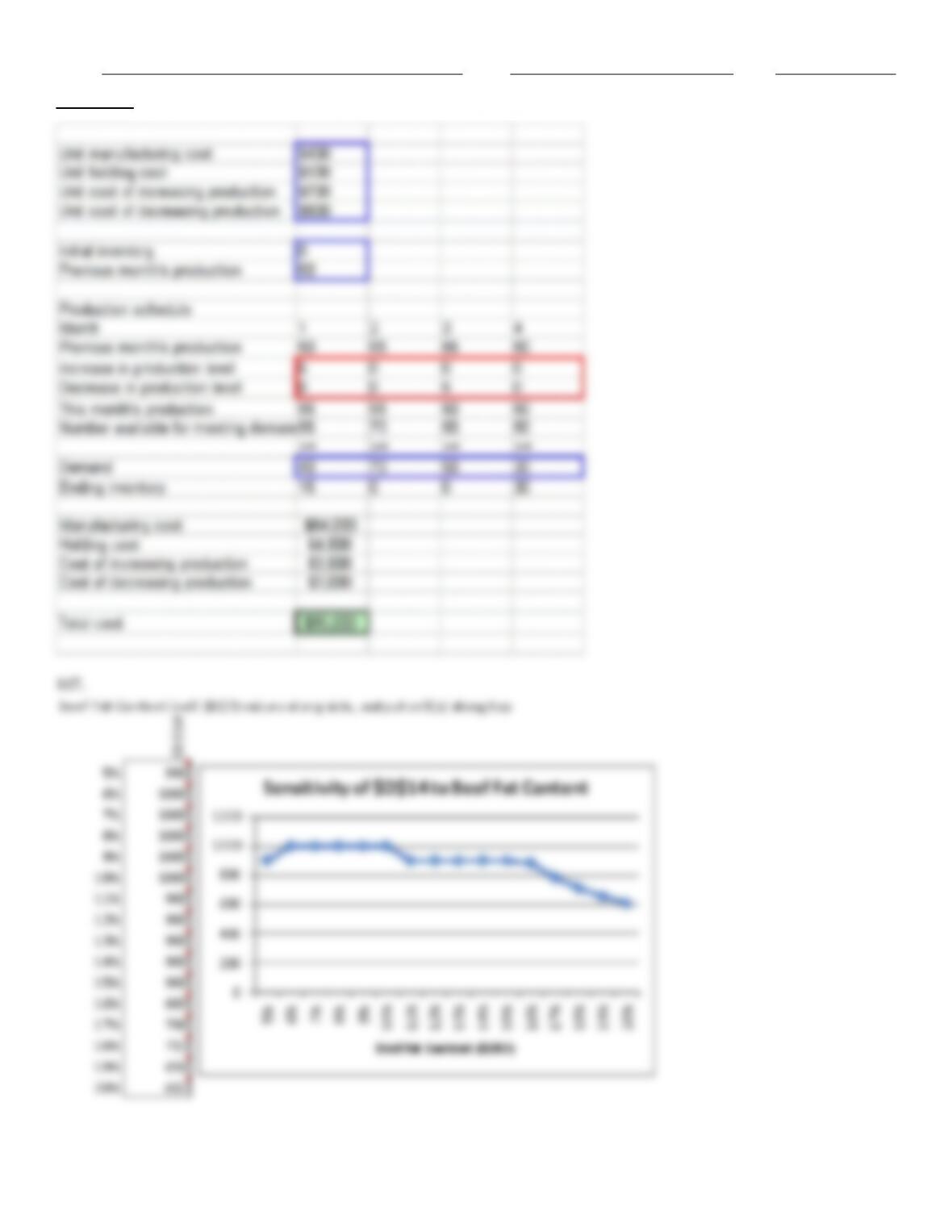
first, where it can be refined.
Galveston
From
Well 1
Well 2
Mobile
Galveston
outflow
Well 1
0
0
0
0
0
Well 2
0
0
0
0
0
Mobile
0
0
0
0
0
Galveston
0
0
0
0
0
0
0
0
0
0
0
0
0
0
0
0
0
0
Name:
Class:
Date:
chapter 14
Total inflow
0
0
Total outflow
0
0
Net flow in or out
0
0
Required
0
0
$11,220,000
Name:
Class:
Date:
chapter 14
Bonds
Home loans
Auto loans
Personal loans
Bonds
Home loans
Auto loans
Personal loans
$240,000
$160,000
$160,000
$240,000
$240,000
$160,000
$240,000
$139,200
short
100s)
Super
4
Regular
4
Unleaded
4
Compt 1
Compt 2
Compt 3
Compt 4
Compt 5
Super
0
1
0
0
0
Regular
1
0
1
0
0
Unleaded
0
0
0
1
1
Sum
1
1
1
1
1
1
1
1
1
1
(in 100s of gallons)
Compt 1
Compt 2
Compt 3
Compt 4
Compt 5
Total
Demand
Name:
Class:
Date:
chapter 14
Super
0
0
0
0
Regular
0
0
0
Unleaded
0
0
0
Total
Capacity
gallons)
Shortage
Super
1
4
Regular
0
4
Unleaded
0
4
Sent
0
0
0
0
0
0
0
0
0
0
Logical bounds
0
0
0
0
0
0
0
0
0
0
Detroit
Atlanta
Dallas
Orlando
$12,000
Detroit
$12,000
Atlanta
$12,000
Dallas
$12,000
$12,000
Orlando
$12,000
$12,000
Detroit
Atlanta
Dallas
Orlando
outflow
0
0
0
0
Detroit
0
0
0
Atlanta
0
0
0
0
0
0
Dallas
0
0
0
0
0
0
Orlando
0
0
0
0
0
0
Total inflow
0
0
0
Total outflow
0
0
0
Net flow out or
0
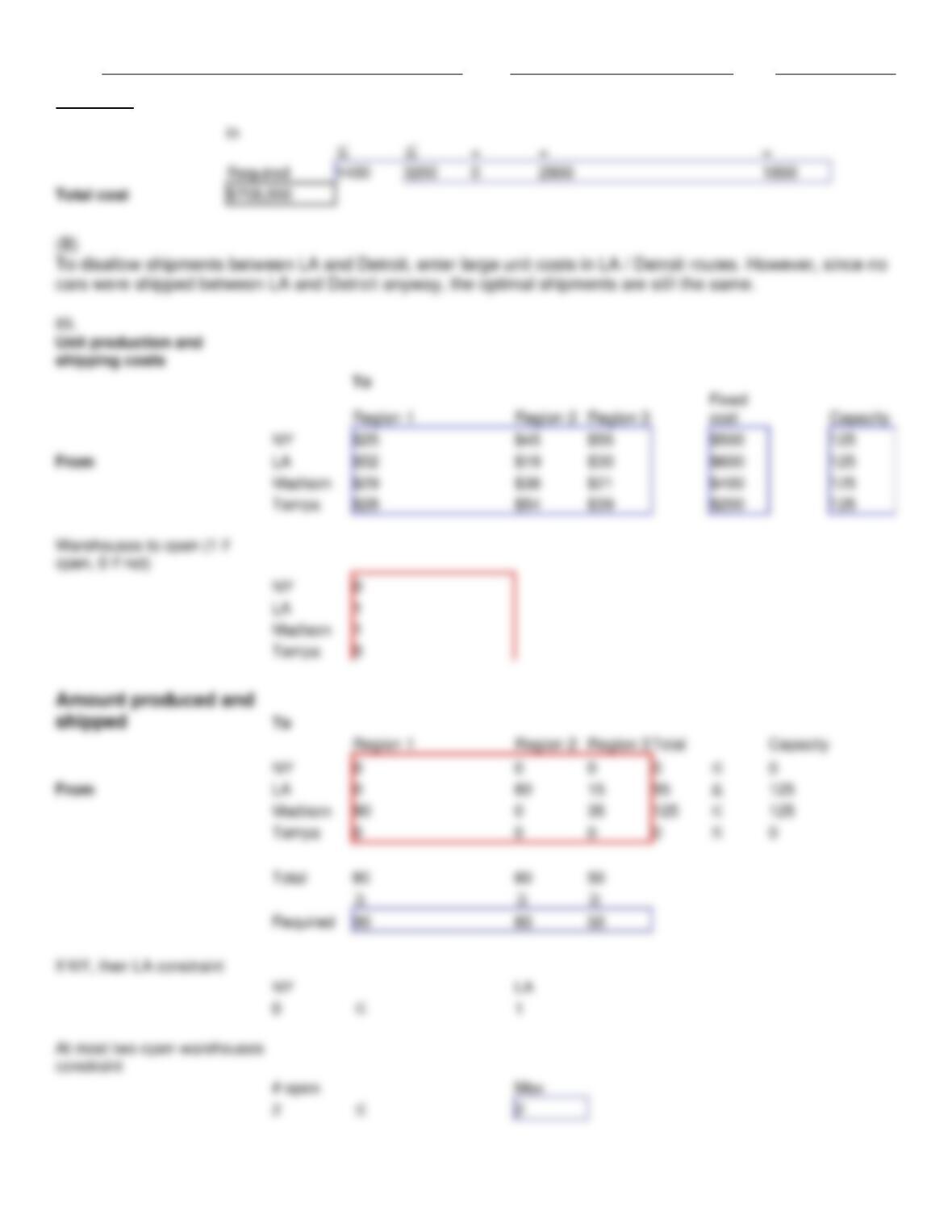
Name:
Class:
Date:
chapter 14
Required
0
$708,000
Region 1
Region 2
Region 3
cost
Capacity
Madison
Tampa
open, 0 if not)
0
1
Madison
1
Tampa
0
Region 1
Region 2
Region 3
Total
Capacity
0
0
0
0
0
0
Madison
0
Tampa
0
0
0
0
0
Total
Required
0
1
constraint
# open
2
2
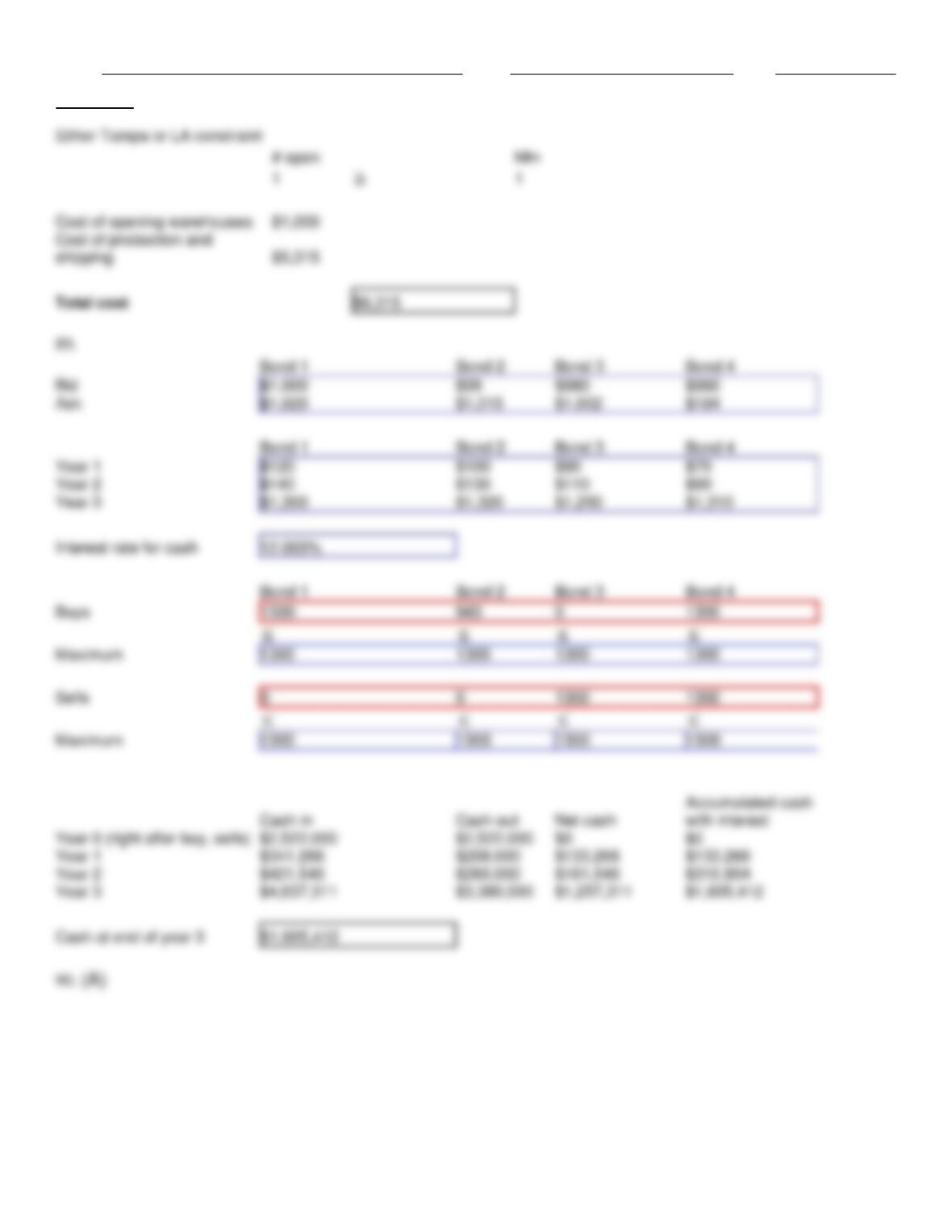
Name:
Class:
Date:
chapter 14
Either Tampa or LA constraint
# open
Min
1
1
Cost of opening warehouses
$1,000
shipping
$5,315
$6,315
Bond 1
Bond 2
Bond 3
Bond 4
Ask
$1,020
$1,015
$1,002
Bond 1
Bond 2
Bond 3
Bond 4
Year 1
Year 2
Year 3
$1,300
$1,320
$1,290
$1,310
Interest rate for cash
12.000%
Bond 1
Bond 2
Bond 3
Bond 4
Buys
0
Maximum
Sells
0
0
Maximum
Cash in
Cash out
Net cash
with interest
Year 0 (right after buy, sells)
$2,522,000
$2,522,000
Year 1
$341,266
$208,000
$133,266
$133,266
Year 2
$421,546
$260,000
$161,546
$310,804
Year 3
$4,637,311
$3,380,000
$1,257,311
$1,605,412
Cash at end of year 3
$1,605,412
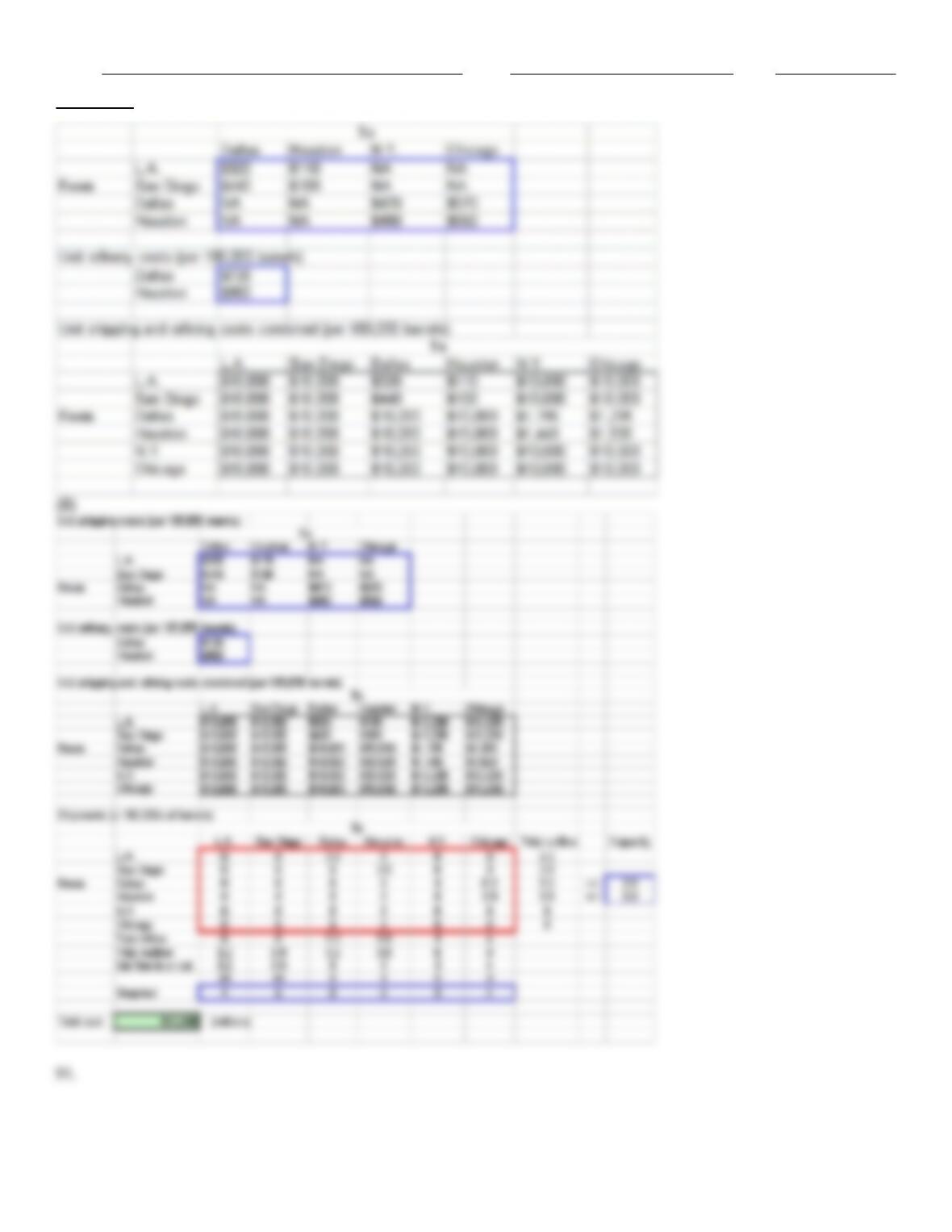
Name:
Class:
Date:
chapter 14
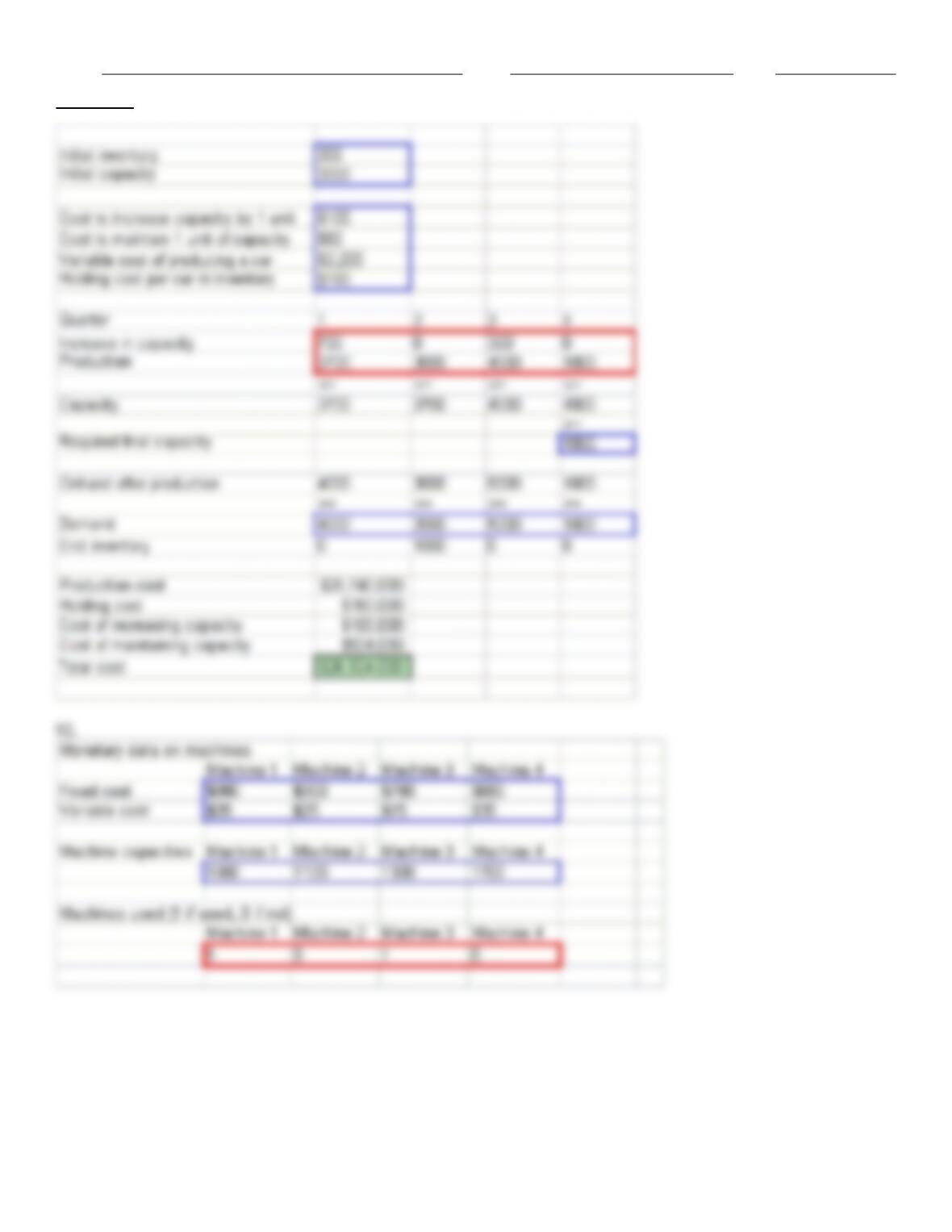
Name:
Class:
Date:
chapter 14
Name:
Class:
Date:
chapter 14
b
0.002
Number of customers served
10000.02
Cost per customer per day
Name:
Class:
Date:
chapter 14
Name:
Class:
Date:
chapter 14
Name:
Class:
Date:
chapter 14
Name:
Class:
Date:
chapter 14
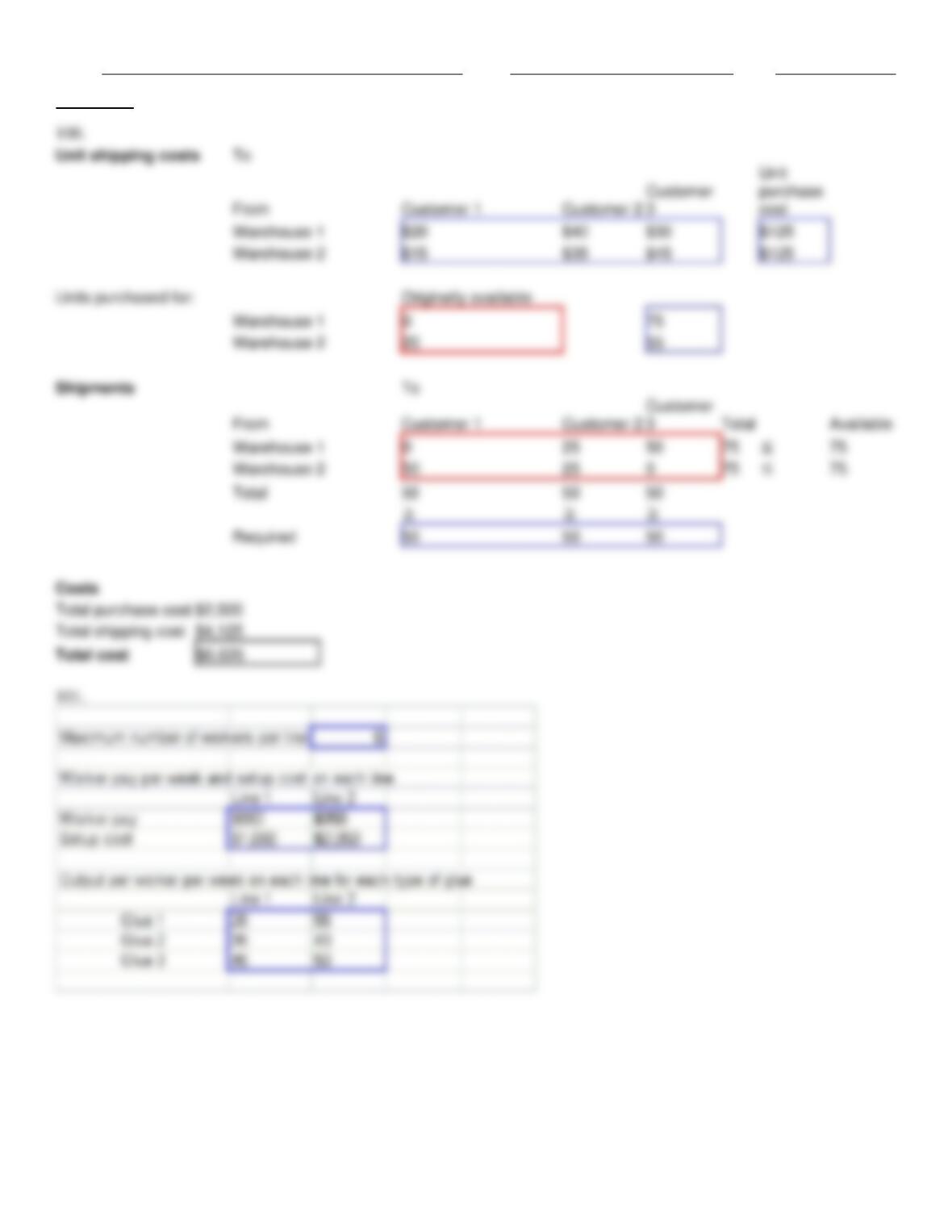
From
Customer 1
Customer 2
3
cost
Warehouse 1
Warehouse 2
Units purchased for:
Originally available
Warehouse 1
0
Warehouse 2
From
Customer 1
Customer 2
3
Total
Available
Warehouse 1
0
Warehouse 2
0
Total
Required
Total purchase cost
$2,500
Total shipping cost
$4,125
$6,625
Name:
Class:
Date:
chapter 14
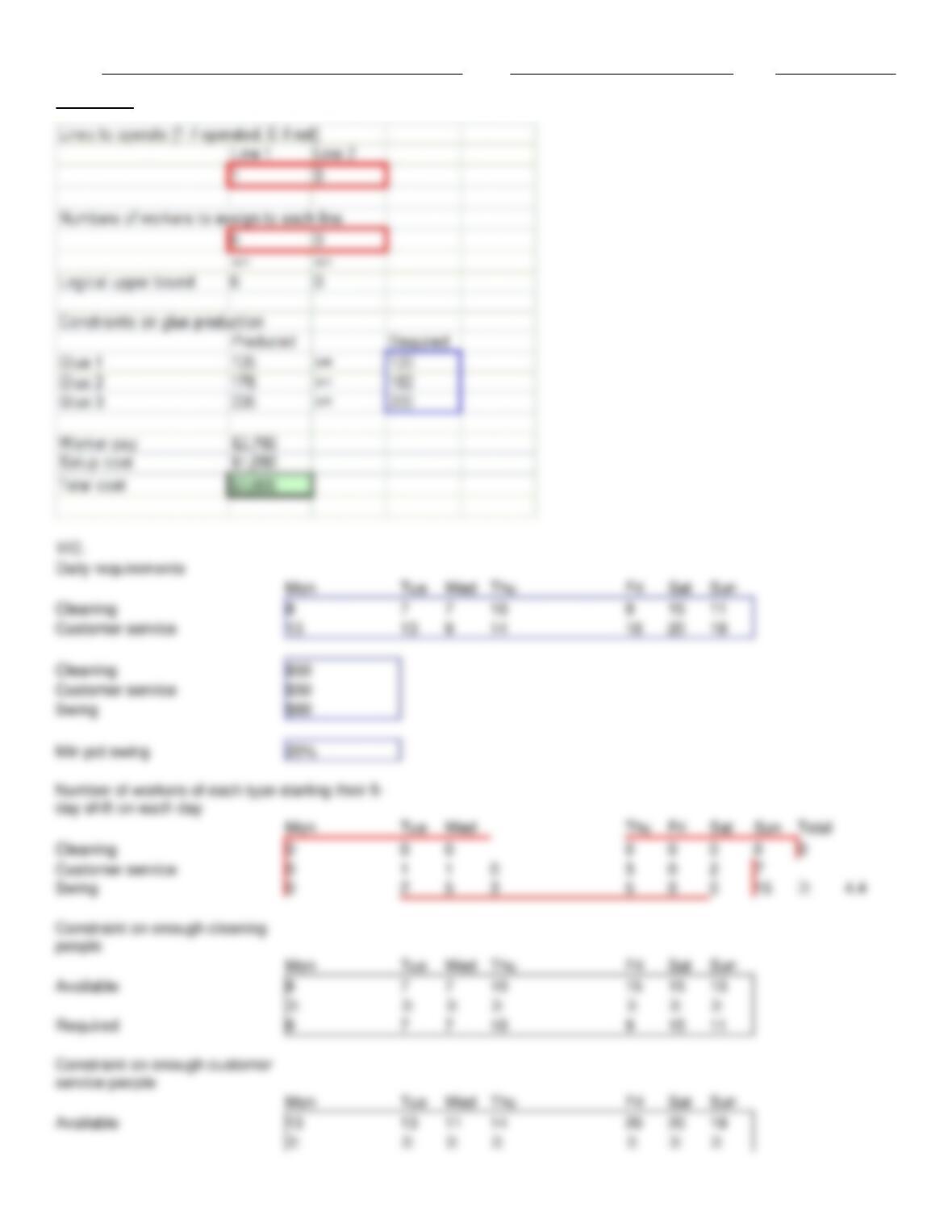
Daily requirements
Tue
Wed
Thu
Sat
Sun
Cleaning
8
7
7
9
Customer service
9
Cleaning
Customer service
Swing
Min pct swing
Tue
Wed
Thu
Sat
Sun
Total
Cleaning
0
0
0
0
0
0
0
0
Customer service
0
1
1
0
3
0
2
7
Swing
0
2
5
3
5
0
0
people
Tue
Wed
Thu
Sat
Sun
Available
8
7
7
Required
8
7
7
9
service people
Tue
Wed
Thu
Sat
Sun
Available
Name:
Class:
Date:
chapter 14
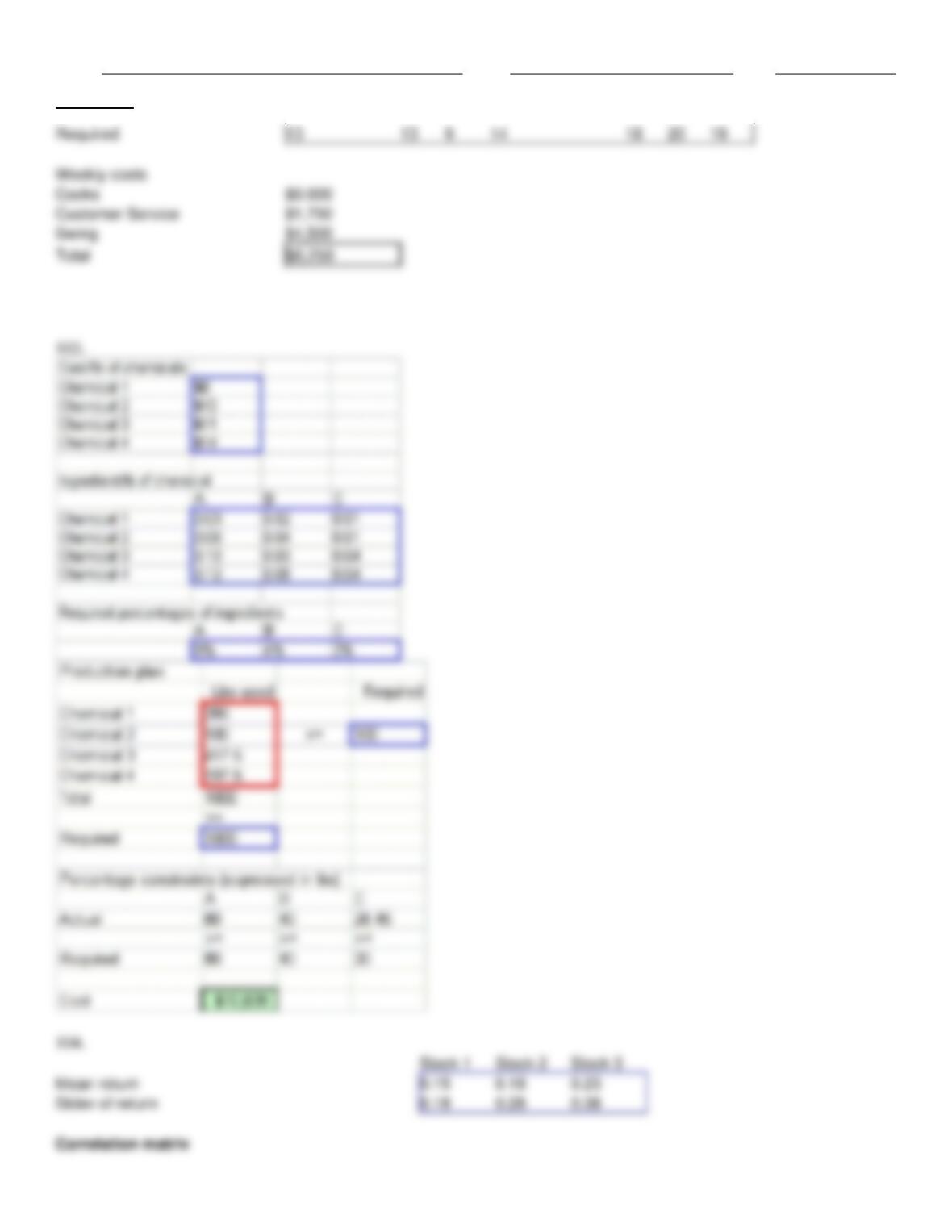
Required
9
Weekly costs
Cooks
$0.000
Customer Service
$1,750
Swing
$4,500
Total
$6,250
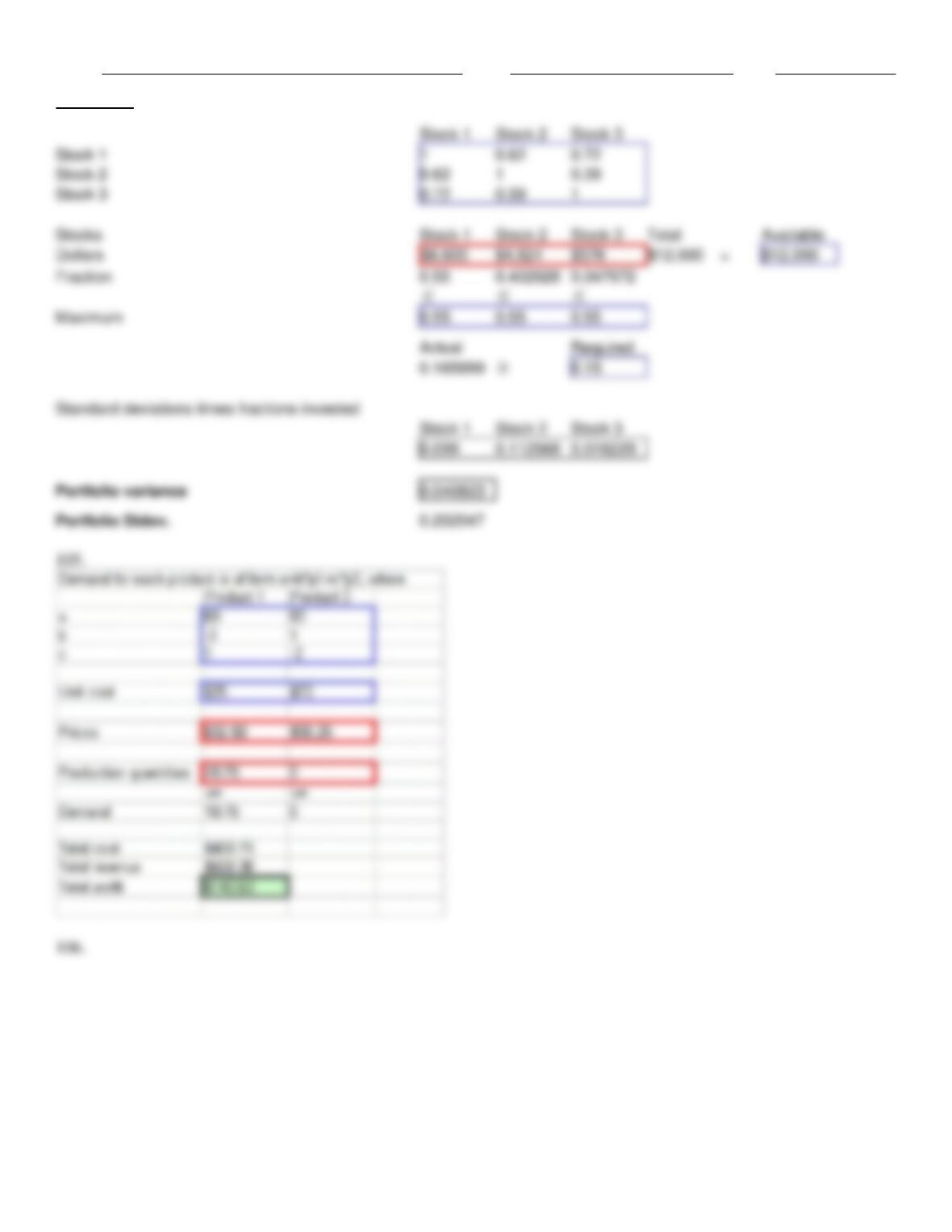
Stock 1
Stock 2
Stock 3
Stdev of return
Name:
Class:
Date:
chapter 14
Stock 1
Stock 2
Stock 3
Stock 1
1
Stock 2
1
Stock 3
1
Stocks
Stock 1
Stock 2
Stock 3
Total
Available
Dollars
$6,600
$4,824
$12,000
$12,000
Fraction
0.402028
0.047972
Maximum
Actual
Required
0.165899
Standard deviations times fractions invested
Stock 1
Stock 2
Stock 3
0.099
0.112568
0.018229
0.040823
0.202047
Name:
Class:
Date:
chapter 14
Name:
Class:
Date:
chapter 14
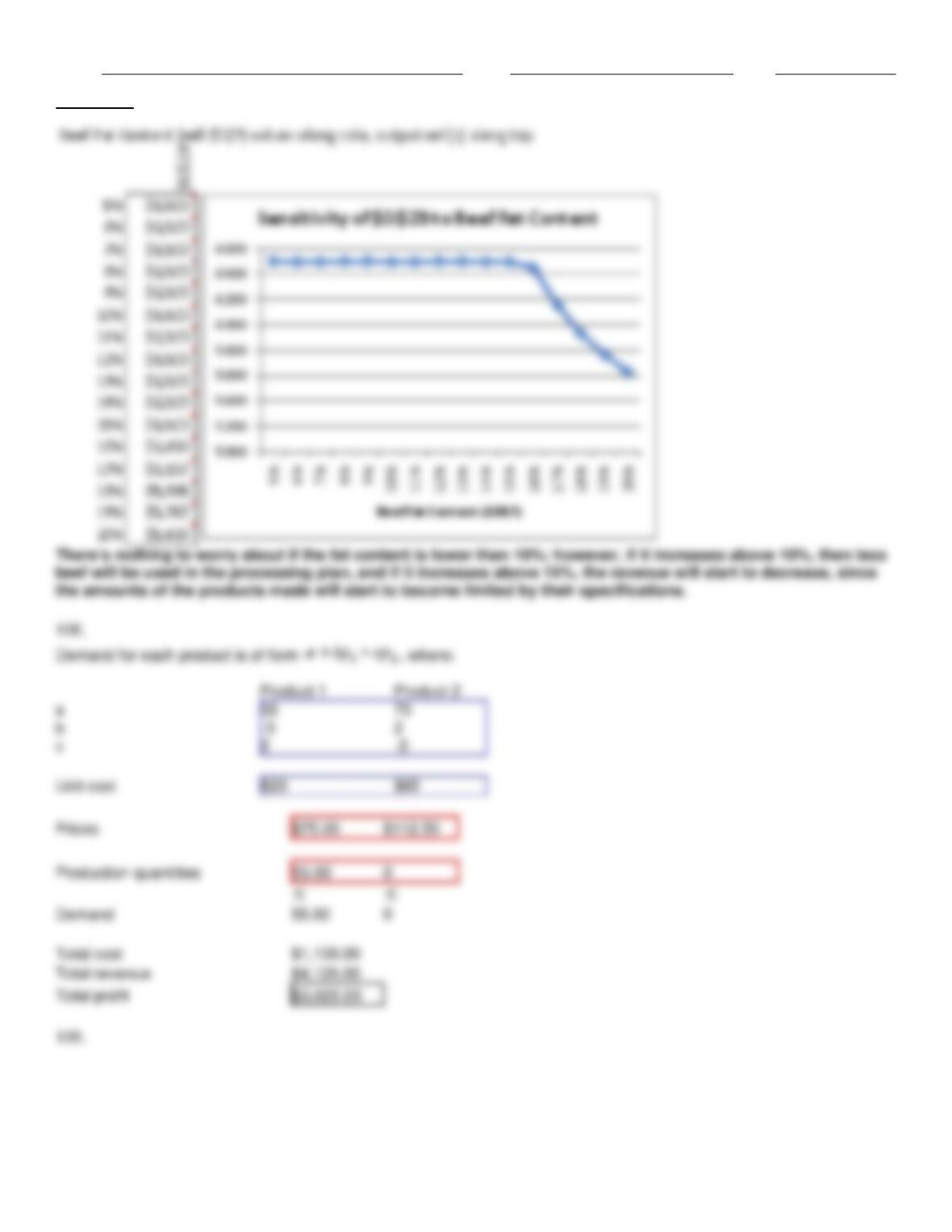
Product 1
Product 2
a
b
-3
2
2
-2
Unit cost
Prices
$75.00
$112.50
Production quantities
55.00
0
Demand
55.00
0
Total cost
$1,100.00
Total revenue
$4,125.00
Total profit
$3,025.00
Name:
Class:
Date:
chapter 14
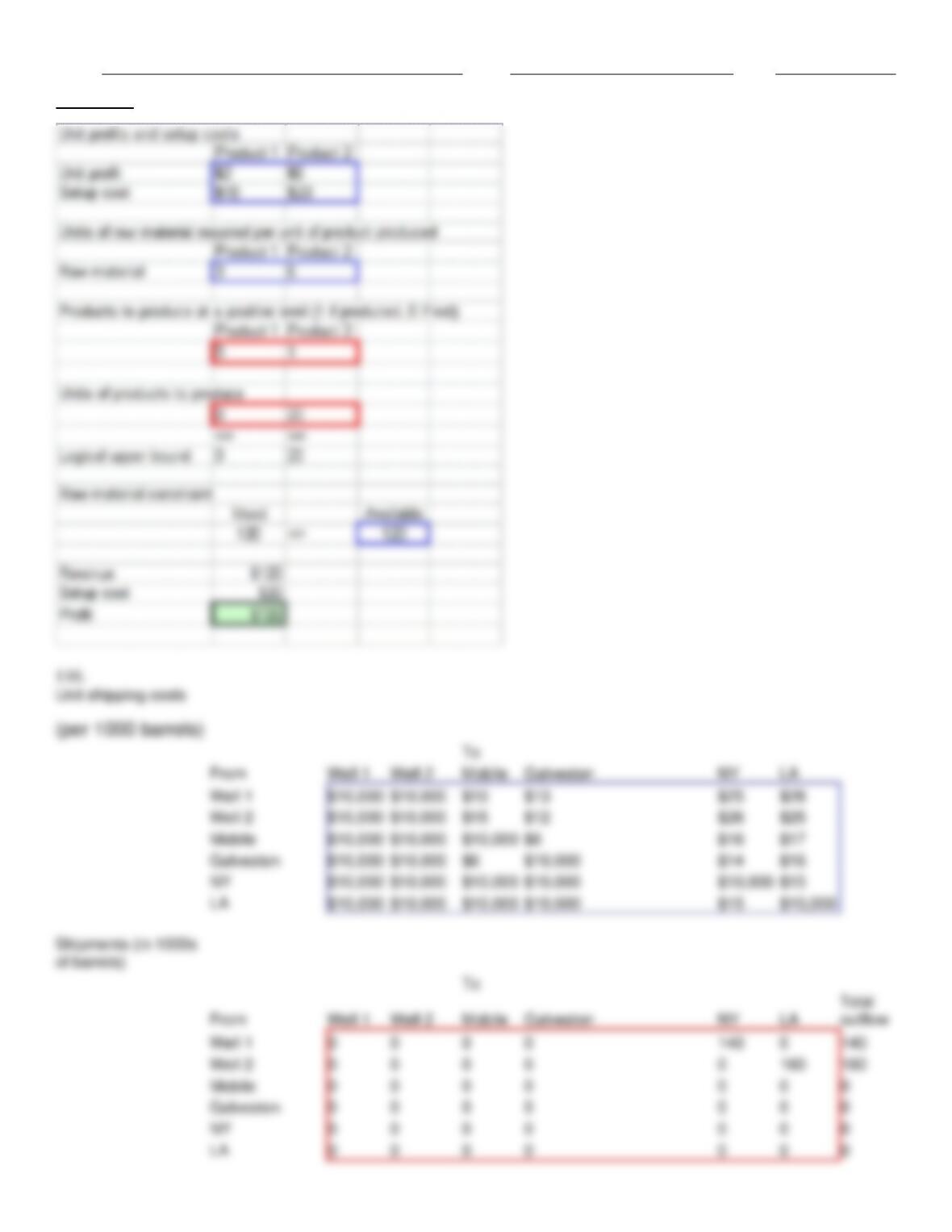
From
Well 1
Well 2
Mobile
Galveston
Well 1
$10,000
$10,000
Well 2
$10,000
$10,000
Mobile
$10,000
$10,000
$10,000
Galveston
$10,000
$10,000
$10,000
$10,000
$10,000
$10,000
$10,000
$10,000
$10,000
$10,000
$10,000
$10,000
$10,000
From
Well 1
Well 2
Mobile
Galveston
outflow
Well 1
0
0
0
0
0
Well 2
0
0
0
0
0
Mobile
0
0
0
0
0
0
0
Galveston
0
0
0
0
0
0
0
0
0
0
0
0
0
0
0
0
0
0
0
0
0
Name:
Class:
Date:
chapter 14
Total inflow
0
0
0
0
Total outflow
0
0
0
0
Net flow in or out
0
0
Required
0
0
$7,500,000
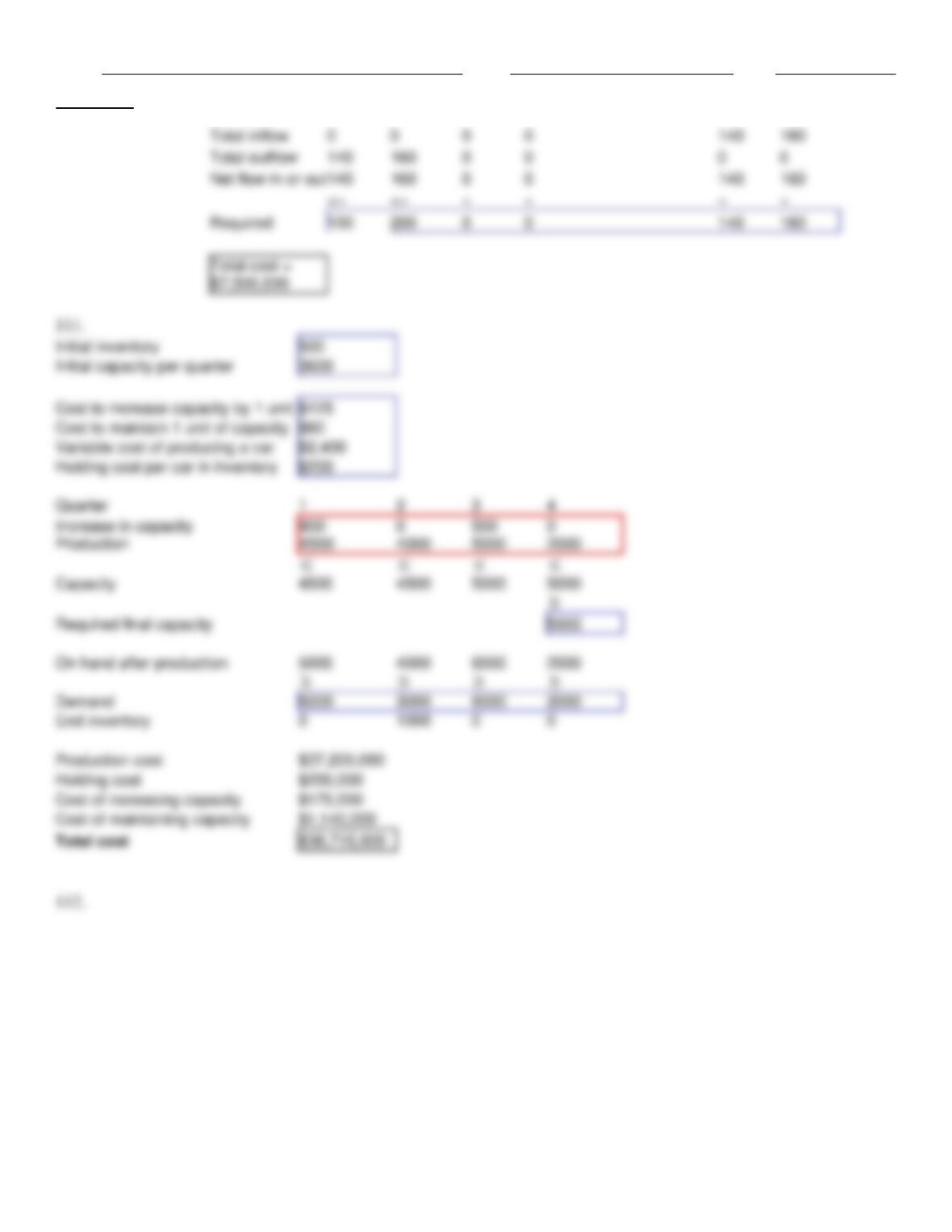
Initial inventory
Initial capacity per quarter
Cost to increase capacity by 1 unit
Cost to maintain 1 unit of capacity
Variable cost of producing a car
$2,400
Holding cost per car in inventory
Quarter
2
3
4
Increase in capacity
0
0
Production
Capacity
Required final capacity
Demand
End inventory
0
0
Production cost
$37,200,000
Holding cost
$200,000
Cost of increasing capacity
$175,000
Cost of maintaining capacity
$1,140,000
$38,715,000
Name:
Class:
Date:
chapter 14
Name:
Class:
Date:
chapter 14
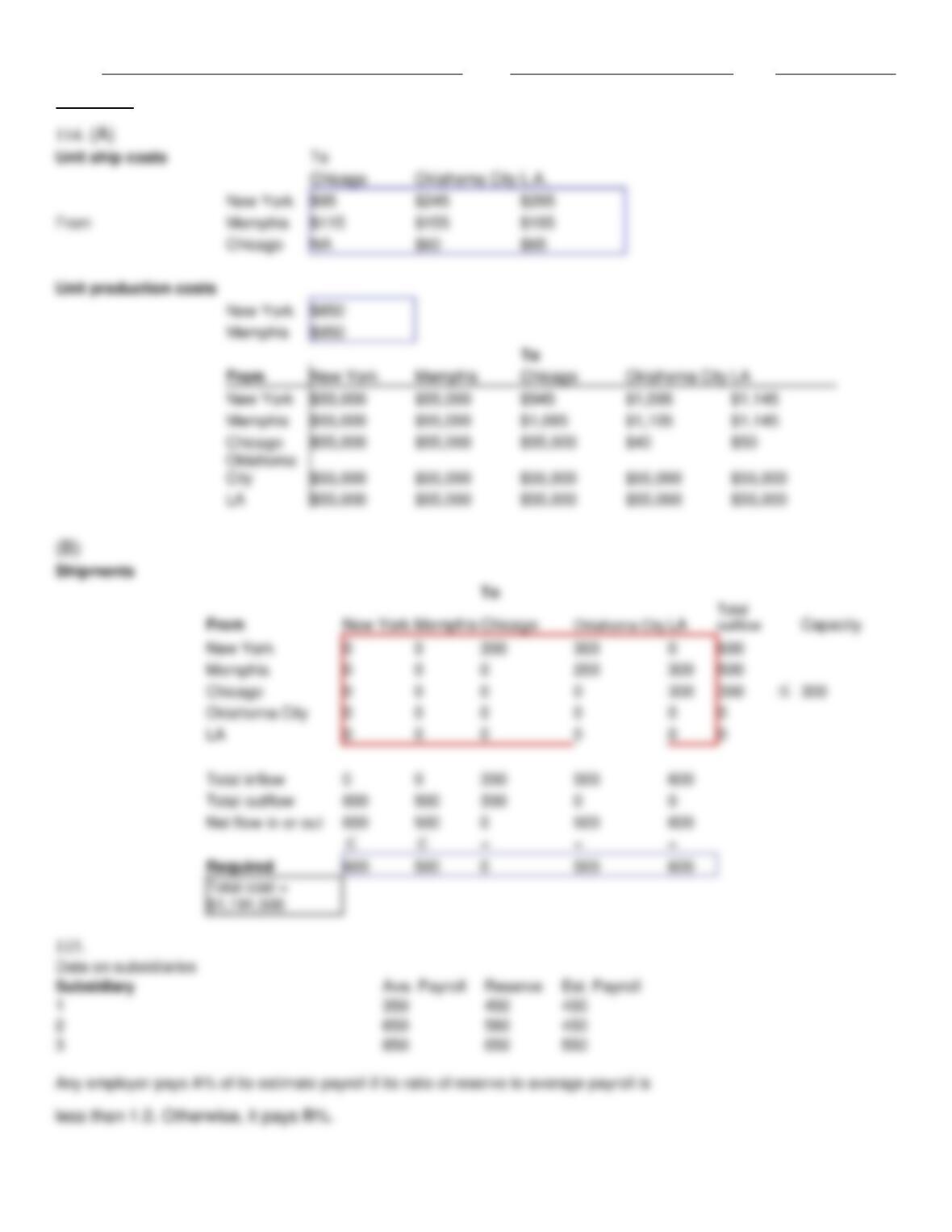
Chicago
Oklahoma City
L.A.
New York
From
Memphis
Chicago
New York
Memphis
New York
Memphis
Chicago
Oklahoma City
New York
$55,000
$55,000
$1,095
$1,145
Memphis
$55,000
$55,000
$1,065
$1,105
$1,145
Chicago
$55,000
$55,000
$55,000
City
$55,000
$55,000
$55,000
$55,000
$55,000
$55,000
$55,000
$55,000
$55,000
$55,000
New York
Memphis
Chicago
Capacity
New York
0
0
0
Memphis
0
0
0
Chicago
0
0
0
0
Oklahoma City
0
0
0
0
0
0
0
0
0
0
0
0
Total inflow
0
0
Total outflow
0
0
Net flow in or out
0
0
$1,191,500
Data on subsidiaries
Ave. Payroll
Reserve
Est. Payroll
1
2
3
Name:
Class:
Date:
chapter 14
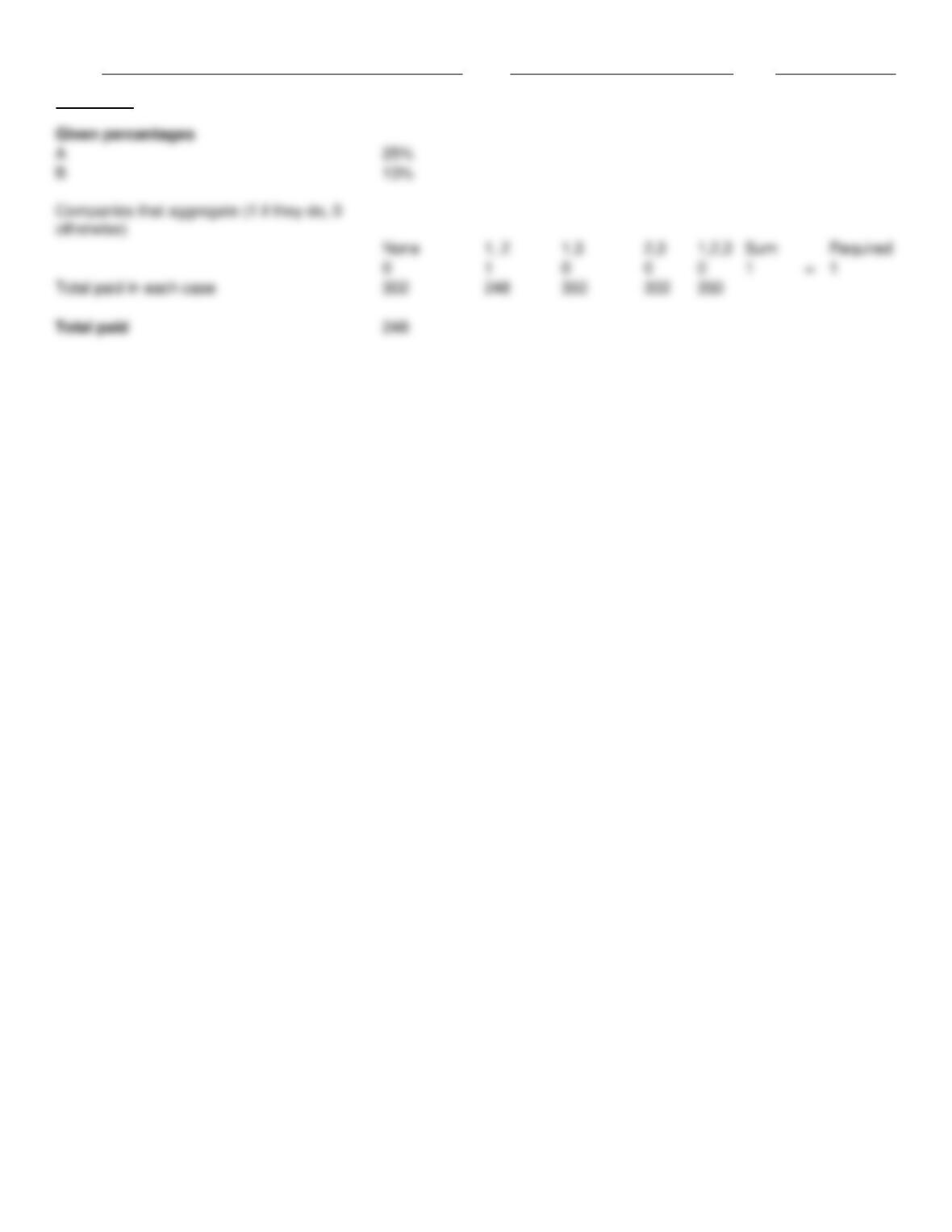
otherwise)
None
Sum
Required
0
1
0
0
0
1
1
Total paid in each case