3932 Monopoly
31.
Refer to Table 15-22. The marginal revenue becomes negative with the production of which
unit of output?
32.
State one benefit of government–granted monopolies like patents and copyrights.
33.
When a single firm can supply a good or service to an entire market at a lower cost than could
two or more firms,
the industry is known as a
34.
The distribution of water to residents of a town and an infrequently used bridge are examples of
Monopoly 3933
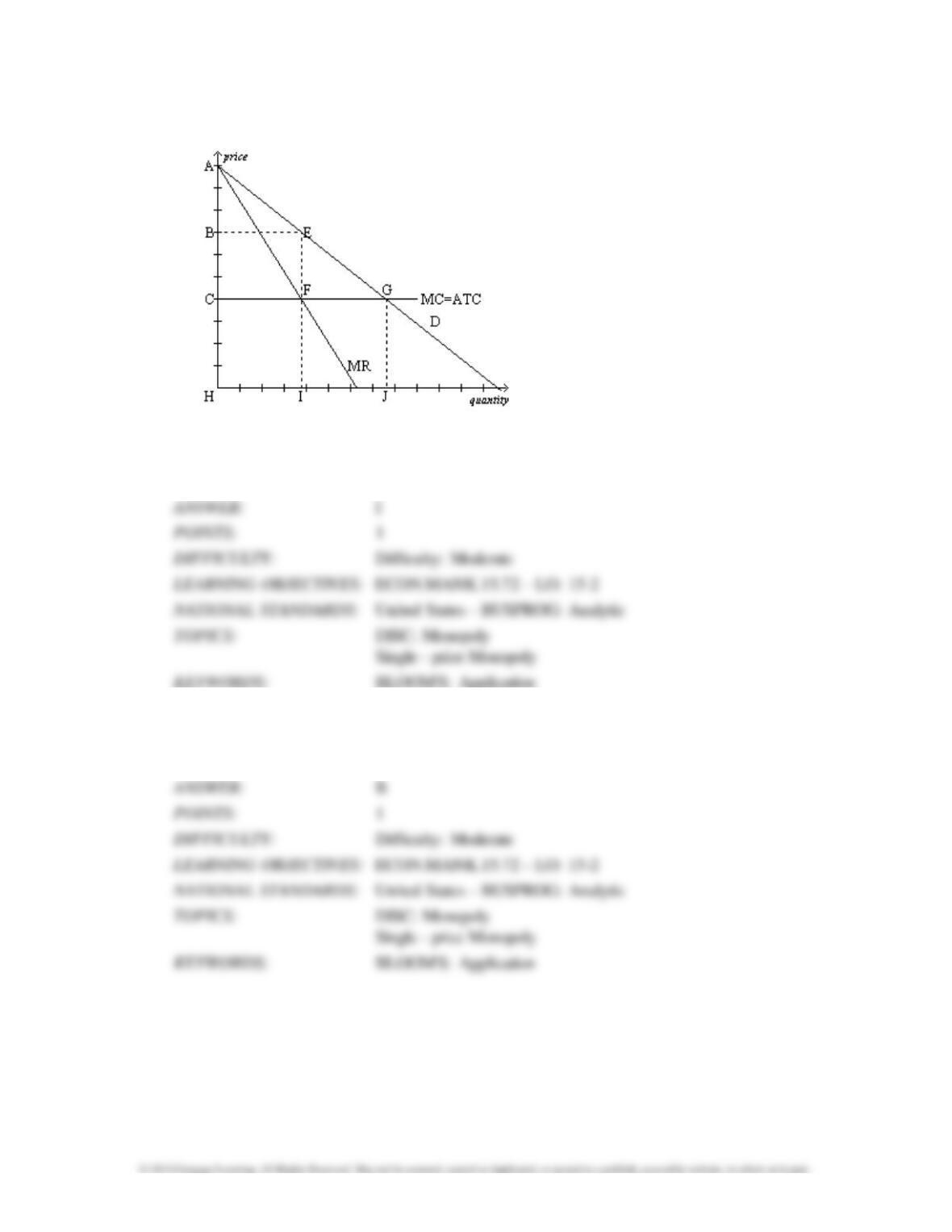
Figure 15–24
35.
Refer to Figure 15–24. Which letter represents the profit-maximizing quantity chosen by the
single price monopolist?
36.
Refer to Figure 15–24. Which letter represents the profit-maximizing price chosen by the single
price monopolist?
37.
Refer to Figure 15-24. Use the letters in the figure to identify the profit area for the single price
monopolist.
38.
Refer to Figure 15–24. Use the letters in the figure to identify the area of deadweight loss for
the single price
monopolist.
39.
Refer to Figure 15–24. If this firm were able to perfectly price discriminate, which letter
represents the amount of
output it would produce?
40.
Refer to Figure 15–24. Use the letters in the figure to identify the profit area if this firm were
able to perfectly price
discriminate.
Scenario 15-11
Vincent operates a scenic tour business in Boston. He has one bus which can fit 50 people per
tour and each tour
lasts 2 hours. His total cost of operating one tour is fixed at $450. Vincent’s
cost is not reduced if he runs a tour with
a partially full bus. While his cost is the same for all
tours, Vincent charges each passenger his/her willingness to
pay: adults $18 per trip, children $10
per trip, and senior citizens $12 per trip. At those rates, on a typical day
Vincent’s demand is:
Passenger Type
Willingness to Pay
Demand per day
Adults
$18
70
Children
$10
25
Senior Citizens
$12
55
Assume that Vincent’s customers are always available for the tour; therefore, he can fill his bus
for each tour as long as there is sufficient total demand for the day.
41.
Refer to Scenario 15-11. Vincent uses a pricing practice called
42.
Refer to Scenario 15-11. What is Vincent’s cost of serving all passengers demanding a tour on
a typical day?
43.
Refer to Scenario 15–11. What is Vincent’s profit on a typical day?
44.
Refer to Scenario 15-11. One of Vincent’s friends tells him he would be more profitable if he
charged a single price of $18. Assuming no changes in consumer demand, what would Vincent’s
profit be if he charged every customer $18?
45.
Refer to Scenario 15-11. One of Vincent’s friends tells him he would be more profitable if he
charged a single price of $12. Assuming no changes in consumer demand, what would Vincent’s
profit be if he charged every customer $12?
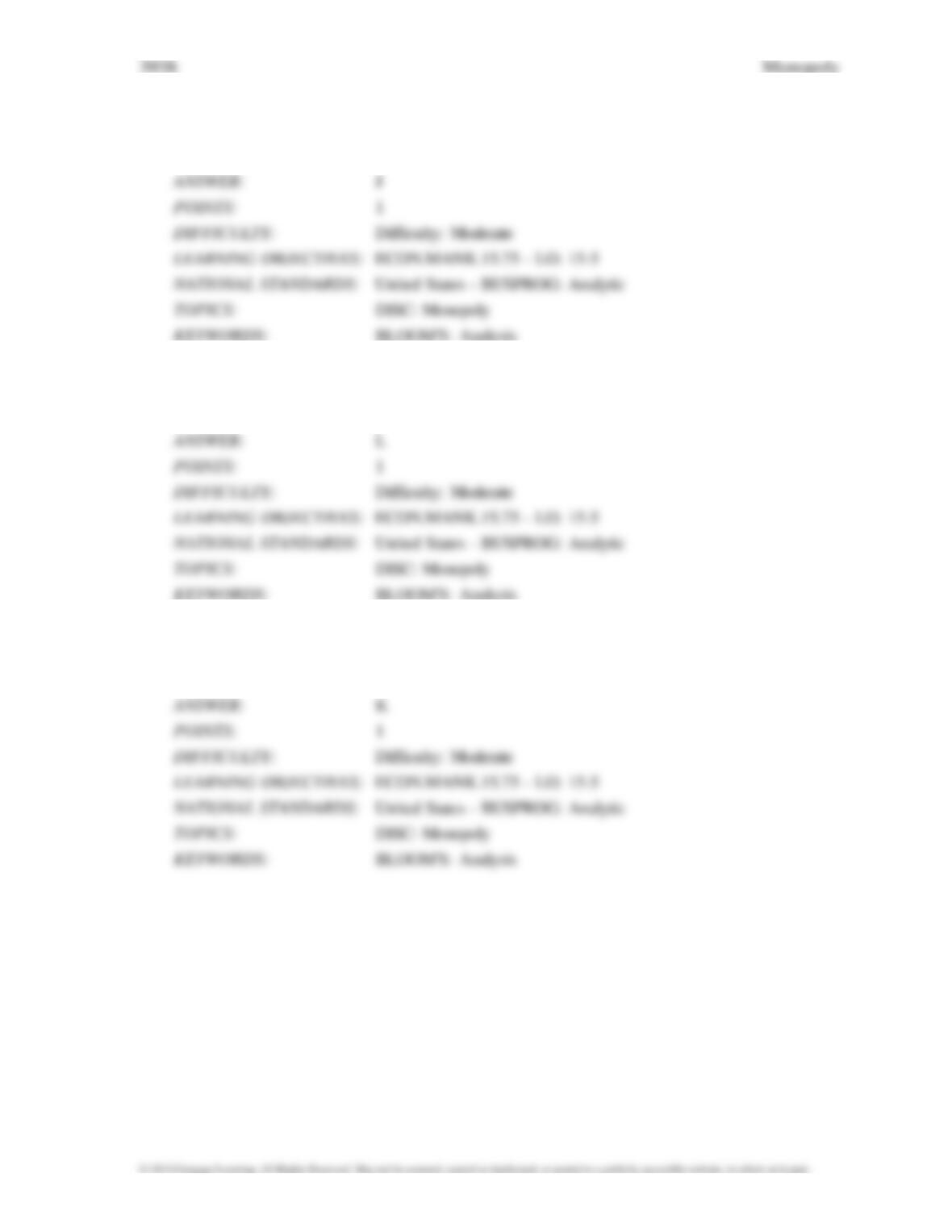
Figure 15–25
46.
Refer to Figure 15–25. If this firm profit maximizes, which letter represents the price it will
charge?
47.
Refer to Figure 15–25. If this firm profit maximizes, which letter represents the quantity it will
produce?
48.
Refer to Figure 15–25. If a regulator requires this firm to charge a socially optimal price, which
letter represents the
amount of output it will produce?
49.
Refer to Figure 15–25. If a regulator requires this firm to charge a fair return price, which
letter represents the
amount of output it will produce?
50.
Refer to Figure 15–25. If a regulator requires this firm to charge a socially optimal price, how
much deadweight loss
results?