Exam
Name___________________________________
MULTIPLE CHOICE. Choose the one alternative that best completes the statement or answers the question.
1)
The upper portion of a glacier flows ________ the lower portion of the glacier.
1)
A)
faster than
B)
slower than
C)
at the same speed as
2)
Several valley glaciers coalescing at the base of a mountain range form a(n)
2)
A)
piedmont glacier.
B)
cirque glacier.
C)
ice cap.
D)
tidewater glacier.
3)
An asymmetrical hill of exposed bedrock produced by plucking and abrasion is known as a(n)
3)
A)
drumlin.
B)
bergschrund.
C)
esker.
D)
roche moutonnée.
4)
The process of calving produces
4)
A)
icebergs.
B)
tidewater glacier.
C)
nunataks.
D)
moraines.
5)
A glacier’s mass balance is determined by
5)
A)
ablation.
B)
accumulation.
C)
both accumulation and ablation.
D)
neither accumulation nor ablation.
6)
The term periglacial refers to
6)
A)
process and effects that existed during the last ice age.
B)
regions that are too warm for ground ice.
C)
cold climate processes that shape landscapes, such as those near glaciers.
D)
areas that are on top of a glacier.
7)
Frozen subsurface water in regions of permafrost is called
7)
A)
ground ice.
B)
the active layer.
C)
periglacial water.
D)
talik.
A
8)
________ are sharp ridges that form when glaciers erode parallel valleys.
8)
A)
Eskers
B)
Drumlins
C)
Bergschrunds
D)
Arêtes
D
9)
Which of the following has NOT been cited as a possible cause of ice sheet darkening?
9)
A)
Ice melt has exposed darker land surface, water, and vegetation.
B)
Black carbon accumulation from wildfires
C)
Snow metamorphism
D)
Sunspot activity
D
10)
Vertical and horizontal movement caused by the expansion of freezing water are called
10)
A)
frost heaving and frost thrusting, respectively.
B)
frost thrusting and frost heaving, respectively.
C)
frost heaving.
D)
frost thrusting.
A
C
11)
A glaciated valley is ________shaped; a stream cut valley is ________shaped.
11)
A)
V–; U–
B)
U–; U–
C)
U–; V–
D)
V–; V–
12)
If two glaciers with lengthy ridges of till along each side of the glacier merge, a ________ moraine
may form.
12)
A)
ground
B)
terminal
C)
medial
D)
lateral
13)
The general term for all glacial deposits is
13)
A)
glacial drift.
B)
erg.
C)
alluvium.
D)
talus.
14)
During the Pleistocene pluvial lakes formed in the ________ United States as a result of ________.
14)
A)
northeastern; melting glaciers
B)
southwestern; melting glaciers
C)
eastern; ice deposits in till plains
D)
western; extended periods of wet conditions
15)
The Great Lakes of North America were created by
15)
A)
ice sheets that enlarged and deepened stream valleys to form the basins of the future lakes.
B)
the deposition of ice in till plains.
C)
isostatic subsidence of the crust.
D)
cirque glaciers.

16)
A long, narrow, sinuous ridge of stratified sand and gravel located in a till plain is known as a(n)
16)
A)
drumlin.
B)
kame.
C)
esker.
D)
kettle.
17)
Which of the following is CORRECT regarding the snowline?
17)
A)
It occurs at approximately the same elevation at all latitudes because the environmental lapse
rate is approximately the same at all latitudes.
B)
It decreases in elevation with increasing latitude.
C)
It increases in elevation with increasing latitude.
18)
A long, narrow glacially–eroded inlets in which the sea extends inland are known as
18)
A)
tarns.
B)
cirques.
C)
fjords.
D)
paternoster.
19)
Sediments deposited by glacial ice are ________; material deposited by glacial meltwater are
________.
19)
A)
sorted; sorted
B)
unsorted; unsorted
C)
sorted; unsorted
D)
unsorted; sorted
20)
Periglacial environments are likely to occur in which of the following climate types?
20)
A)
Humid continental
B)
Tundra
C)
Mesothermal
D)
Desert

21)
The zone where accumulation balances ablation is known as the
21)
A)
snowline.
B)
equilibrium line.
C)
medial moraine.
D)
crevasses.
22)
The type of glacier that dominates Greenland and Antarctica is an
22)
A)
ice cap.
B)
ice shelves.
C)
ice field.
D)
ice sheet.
23)
The various processes that result in the loss of a glacier’s mass are known collectively as
23)
A)
deflation.
B)
sublimation.
C)
ablation.
D)
surface melting.
24)
In terms of areal extent, which of the following sequences is ordered from largest to smallest size?
24)
A)
Ice sheet, ice field, ice cap, alpine glacier
B)
Alpine glacier, ice field, ice cap, ice sheet
C)
Ice sheet, ice cap, ice field, alpine glacier
D)
Ice sheet, alpine glacier, ice field, ice cap
25)
Glaciation can take about ________ years, whereas deglaciation requires about ________ years.
25)
A)
10,000; 90,000
B)
100,000; 10,000
C)
1000; 100
D)
100; 1000
26)
Eroded debris dropped at the glacier’s farthest extent is called ________ moraine.
26)
A)
ground
B)
terminal
C)
medial
D)
lateral

27)
In which year did surface melt on the Greenland ice sheet reach its greatest extent?
27)
A)
2002
B)
2006
C)
2012
D)
2013
28)
Alpine glaciers include all of the following EXCEPT
28)
A)
a cirque glacier.
B)
an ice cap.
C)
a valley glacier.
D)
a piedmont glacier.
B
29)
Which of the following is NOT correct regarding the Pleistocene?
29)
A)
The Ohio and Missouri River systems marked the southern terminus of continuous ice at its
greatest extent.
B)
It began 1.65 mya and had at least 18 glacial/interglacial cycles.
C)
Sea levels were 100 m (330 ft.) higher than today.
D)
At its height almost a third of Earth was covered with ice.
C
30)
A snowline refers to
30)
A)
the latitude or elevation at which winter snow accumulates each year.
B)
the lowest latitude or elevation where winter snow accumulation persists throughout the
summer.
C)
an isoline demarcating the extent of snow or ice on a weather map.
D)
the latitude demarcating the extent of glacial ice during the last glacial maximum.
B
31)
Which of the following is NOT an adaptation to living in periglacial regions?
31)
A)
Buildings placed directly on frozen, hard surfaces
B)
Raised oil pipelines above the frozen ground
C)
Careful maintenance of rail tracks and roadbeds in the summer
D)
Enclosed water and sewage lines
A
C
32)
When several cirque glaciers gouge an individual mountain summit from all sides, a pyramidal
peak known as a ________ results.
32)
A)
horn
B)
col
C)
hanging valley
D)
arêtes
33)
Approximately, what percentage of Earth’s freshwater is frozen?
33)
A)
10%
B)
25%
C)
50%
D)
75%
34)
The transformation of snow into glacial ice in Antarctica takes ________ than in midlatitude alpine
glaciers because ________.
34)
A)
less time; there is more melting and refreezing in the midlatitudes and, therefore, it takes
much longer there
B)
longer; the long summer days in Antarctica (up to 24–hours) results in more sunlight
impeding the glacier development process
C)
longer; the dryness of the Antarctic climate and minimal snowfall as compared to wetter
climates with constant snowfall
D)
less time; more snow fall in the polar regions each year slows the glacier formation process
35)
The zone of seasonally frozen ground that exists between the subsurface permafrost layer and the
ground surface is called the
35)
A)
discontinuous region.
B)
talik.
C)
active layer.
D)
gelifluction.

36)
Which of the following is evidence of recent changes in polar regions?
36)
A)
Ice sheet darkening
B)
The breakup of ice shelves
C)
Decrease in Arctic sea–ice volume
D)
Increase in meltponds
E)
Decrease in sea ice volume, ice sheet darkening, increased meltponds, and ice shelves calving
are all evidence of recent changes in polar regions.
37)
Till that forms behind a terminal moraine as the glacier retreats and is generally spread widely
across the ground surface is called a(n)
37)
A)
lateral moraine.
B)
outwash plain.
C)
drumlin swarm.
D)
till plain.
38)
Which of the following is INCORRECT about glacial movement?
38)
A)
Glacial movement produces distinct landforms.
B)
Glaciers are mostly stationary, only moving several centimeters over tens of years.
C)
Glaciers move in streamlike patterns, merging as tributaries into large rivers of ice.
D)
Glaciers move under the pressure of their own weight and the pull of gravity.
39)
Partly compacted snow that is intermediate between snow and ice is called a(n)
39)
A)
glacier.
B)
firn.
C)
moraine.
D)
snowline.
40)
A lake that fills a steep–sided depression that is left in ground moraine by a large block of stranded
ice that melts is called a(n)
40)
A)
drumlin.
B)
kame.
C)
esker.
D)
kettle.

41)
Why is glacial ice analogous to a metamorphic rock?
41)
A)
It has a crystalline structure.
B)
It forms as a result of recrystallization caused by pressure.
C)
It is solid.
D)
It has a definite chemical composition.
42)
Crevasses usually form as a result of
42)
A)
friction, tension, and compression.
B)
ablation.
C)
deposition.
D)
regelation.
A
43)
All of the following are related to glacial erosion EXCEPT
43)
A)
erratics.
B)
abrasion.
C)
plucking.
D)
ablation.
D
44)
The lengthy ridges of till along each side of an alpine glacier are ________ moraines.
44)
A)
ground
B)
terminal
C)
medial
D)
lateral
D
45)
During a glacier surge, a glacier may move at a speed of
45)
A)
tens of meters per day.
B)
a few kilometers per hour.
C)
1 cm per day.
D)
1 meter per hour.
A
B
46)
Which of the following is NOT an erosional feature formed by an alpine glacier?
46)
A)
Col
B)
Horn
C)
Drumlin
D)
Cirque
47)
Which of the following is NOT true?
47)
A)
Decreases in snow cover may create a positive feedback loop as decreased albedo can lead to
more warming.
B)
The cryosphere comprises only a small, but very important component of Earth’s freshwater
resources.
C)
Seasonal snowpacks increases Earth’s albedo.
D)
Many western states heavily rely on snowmelt for municipal water supplies.
B
48)
The presence of till indicates
48)
A)
deposition by a glacier.
B)
deposition by wind.
C)
deposition by water.
D)
deposition of unknown origin (wind, water, or glacial).
A
49)
The average thickness of the Greenland and Antarctic ice sheets is more than
49)
A)
1,000 m (3,280 ft).
B)
2,000 m (6,500 ft).
C)
3,000 m (9,800 ft).
D)
4,000 m (13,100 ft).
B
50)
The Great Salt Lake is a remnant of which pluvial lake?
50)
A)
Lake Lahontan
B)
Lake Russell
C)
Lake Bonneville
D)
Lake Manix
C
C
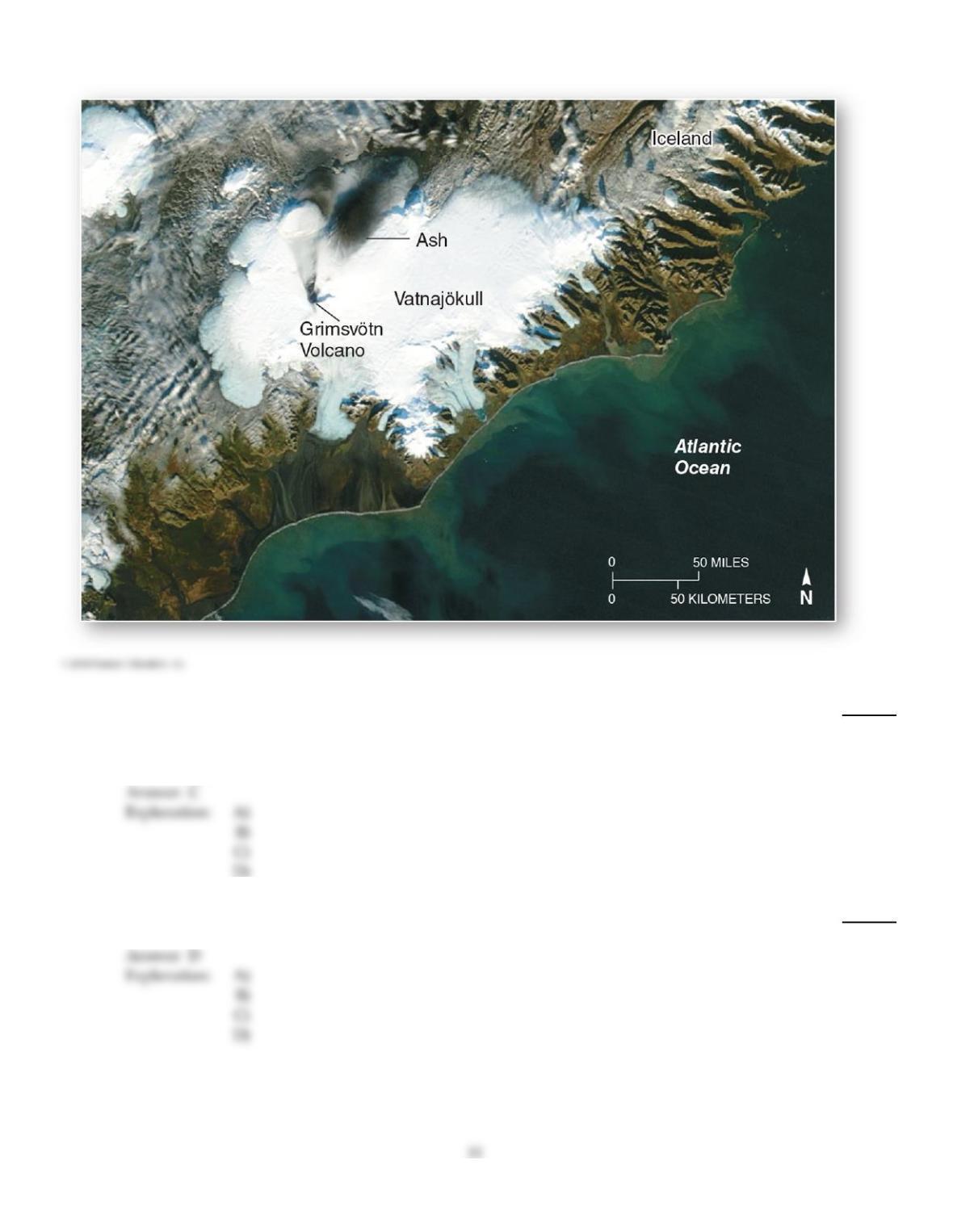
51)
Vatnajökull is the largest and most voluminous Icelandic glacier. It is roughly circular in shape,
overlays several volcanoes, and covers an area of approximately 8,100 km2 (3,100 mi2) with an
average thickness of 400 m (1,300 ft). This glacier is an example of a(n)
51)
A)
alpine glacier.
B)
ice field.
C)
ice cap.
D)
ice sheet.
52)
Glacial polish results from
52)
A)
ice plucking.
B)
regelation.
C)
ablation.
D)
abrasion.
53)
The 10°C (50°F) isotherm for July is used as the environmental criteria to define
53)
A)
the extent of Pleistocene glaciation.
B)
the Antarctic convergence
C)
the Arctic region.
D)
the Antarctic region
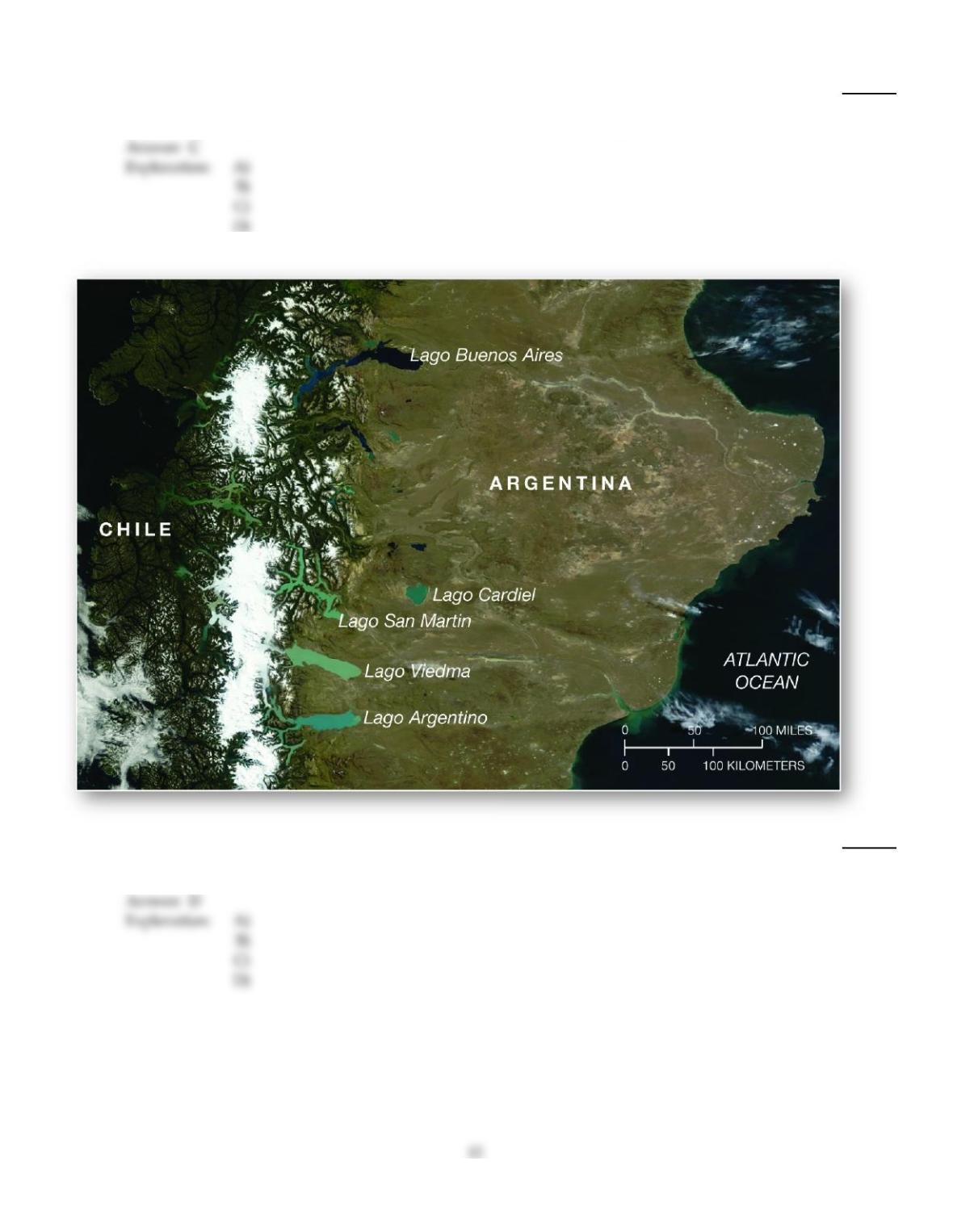
54)
The Patagonia region of Chile and Argentina features a large, elongated glacier approximately 90
km (56 mi) wide and 360 km (224 mi) long. This is an example of a(n)
54)
A)
ice sheet.
B)
alpine glacier.
C)
ice cap.
D)
ice field.
55)
Sea levels 18,000 years ago were approximately
55)
A)
100 m (330 ft) lower than they are today.
B)
50 m (165 ft) higher than they are today.
C)
25 m (82 ft) lower than they are today.
D)
10 m (33 ft) higher than they are today.
56)
The expansion and contraction of frost action results in the movement of soil particles, stones, and
small boulders into distinct shapes know as
56)
A)
patterned ground.
B)
gelifluction.
C)
taliks.
D)
solifluction.
57)
Glacial surges may be associated with
57)
A)
lubrication from meltwater.
B)
soft bed below the glacier.
C)
water pressure under the glacier.
D)
water pressure, soft bed, or lubrication.
58)
A small hill, knob, or mound of sorted sand and gravel that forms on the surface of a glacier and is
deposited after the glacier retreats is a(n)
58)
A)
drumlin.
B)
kame.
C)
esker.
D)
kettle.
59)
Which of the following is NOT true?
59)
A)
Antarctica can be thought of as a continent covered by a single enormous glacier.
B)
The Antarctic is generally colder than the Arctic.
C)
The Arctic is a large landmass surrounded by a cold ocean.
D)
About half of the Arctic sea–ice volume has disappeared since 1970.
60)
Glacial ice is
60)
A)
made of sedimentary rock.
B)
essentially the same as snow.
C)
generally less dense than snow and firn.
D)
formed from continual accumulation of snow that recrystallizes under its own weight into an
ice mass over a period of many years.
61)
Which of the following has been cited as a positive feedback loop involving the thawing of
permafrost?
61)
A)
Thawing of permafrost will inhibit frost wedging action on large boulders, altering
absorption ability.
B)
Thawing of permafrost will increase albedo, leading to more warming.
C)
Thawing of permafrost will release vast amounts of carbon to the atmosphere, accelerating
warming.
D)
Thawing of permafrost will contribute to sea level rise, which will further reduce overall
global albedo values.
C
62)
Which of the following is NOT an example of a pluvial lake?
62)
A)
Lake Russell
B)
Lake Bonneville
C)
Lake Superior
D)
Lake Lahontan
C
63)
Which of the following is NOT generally correct regarding the basal layer of a glacier?
63)
A)
Crevasses form in this region of the glacier.
B)
It can extend tens of meters above the ground surface.
C)
It contains more debris than other parts of the glacier.
D)
It tends to flow more slowly than the overlying parts of the glacier.
A
D

64)
A glacier confined in a bowl–shaped recess is known as a(n)
64)
A)
tidewater glacier.
B)
valley glacier.
C)
cirque glacier.
D)
piedmont glacier.
65)
Which of the following is CORRECT regarding valley glaciers?
65)
A)
The snowfield sources for these glaciers are usually found right at the snowline.
B)
They may range in length from 100 m (325 ft.) to 100 km (62 mi.).
C)
They occur in an unconfined environmentlike an open plain.
D)
They remain stationary and do not move.
66)
Which of the following statements is INCORRECT?
66)
A)
Permafrost develops in areas where soil, sediment, or rock temperatures remain below 0°C
(32°F) for at least two years.
B)
Periglacial regions occupy over 20% of Earth’s land surface.
C)
Periglacial environments occur at high latitudes and high elevations.
D)
There are no permafrost regions in Alaska due to its maritime subarctic climate.
67)
Elongated hills, often in the shape of a bowl of an inverted spoon, streamlined in the direction of
glacial movement, are called
67)
A)
drumlins.
B)
eskers.
C)
horns.
D)
kettles.
68)
Which of the following is INCORRECT relative to the Pleistocene Epoch?
68)
A)
It represents a single, continuous cold spell.
B)
It began 1.65 million years ago.
C)
In some areas the ice sheets were more than 2 km (1.2 mi) thick.
D)
The ice sheets disappeared approximately 7,000 years ago.

69)
An extensive, continuous mass of ice occurring on a continental scale is known as a(n)
69)
A)
tidewater glacier.
B)
ice sheet.
C)
piedmont glacier.
D)
tidal glacier.
70)
Solifluction is most similar to which mass movement process?
70)
A)
Fall
B)
Creep
C)
Slump
D)
Mudflow
71)
A general term for a mass of perennial ice, resting on land or floating in the sea attached to a
landmass is
71)
A)
an iceberg.
B)
a moraine.
C)
the snowline.
D)
a glacier.
72)
Unfrozen ground in a region of discontinuous permafrost is known as
72)
A)
cryotic zone.
B)
patterned ground.
C)
talik.
D)
nunatak.
73)
The accumulation zone of a glacier ends at the ________, which marks the elevation above which
the winter snow and ice remained intact throughout the summer.
73)
A)
snow line
B)
ice field
C)
terminal moraine
D)
firn line

74)
The bulk of ice on Earth is in
74)
A)
North America, specifically Alaska.
B)
floating ice shelves and packs.
C)
Greenland and Antarctica.
D)
European and Asian mountain ranges.
75)
A class of landforms formed by the accumulation of glacial till are known as
75)
A)
alluvium.
B)
moraines.
C)
sorted drift.
D)
outwash.
B
76)
Sorted sediment deposited by glaciofluvial action are called
76)
A)
moraines.
B)
till.
C)
stratified drift.
D)
glacial erratics.
C
77)
The area of sediment deposit by by glaciofluvial action beyond the glacial terminus is known as the
77)
A)
end moraine.
B)
terminal moraine.
C)
till plain.
D)
outwash plain.
D
78)
Which of the following is CORRECT regarding permafrost?
78)
A)
The surface layer of permafrost never thaws, even in the warm season.
B)
It tends to occur at lower elevations in the midlatitudes than in the high latitudes.
C)
It primarily occurs in areas covered with glaciers.
D)
It develops where soil or rock temperatures are below freezing for at least two years.
D
TRUE/FALSE. Write ‘T’ if the statement is true and ‘F’ if the statement is false.
79)
A valley glacier is a form of alpine glacier.
79)
C
80)
Surprisingly, there are no ice caps in Iceland.
80)
81)
Melting on the surface, internally, and wind deflation, calving, and sublimation at the base, are
examples of ablation.
81)
82)
Cirques, horns, cols, and arête are example of depositional landforms from ice sheets.
82)
83)
Alpine glaciers eroding parallel valleys may produce thin, sharp ridge forms known as arête.
83)
84)
Approximately 80% of Alaska has permafrost beneath its surface.
84)
85)
Materials transported directly by glaciers tend to be unsorted when deposited, but those carried by
meltwater are sorted.
85)
86)
During the Pleistocene ice age, many areas of the southwestern United States were covered by large
pluvial lakes.
86)
87)
The snowline is at a higher elevation on equatorial mountains than on midlatitude mountains.
87)
88)
A talik connects the surface to groundwater in discontinuous permafrost.
88)
89)
During the height of the Pleistocene ice age, the glaciers extended as far south as the Ohio and
Missouri river systems.
89)
90)
The albedo of the Greenland Ice Sheet has decreased over the past decade due to ice sheet
darkening.
90)
91)
A paternoster lake is a singular lake filling a small cirque basin behind risers of rock material.
91)
92)
Glacial ice can form during the duration of a single winter season in most glacial areas.
92)
93)
The Pleistocene ice age began 18,000 years ago.
93)
94)
Most glaciers are stationary, moving at no more than several millimeters per year.
94)
95)
Stream–eroded valleys are V–shaped, whereas glacially–scoured valleys are U–shaped.
95)
96)
Overall, the Arctic is much cooler than Antarctic.
96)
97)
During a surge, a glacier moves up to 2 km/hr.
97)
98)
A glacier is an open system with inputs of snow and outputs of ice, meltwater, and water vapor.
98)
99)
Most periglacial environments at high latitudes are seasonally snow–free.
99)
100)
If two glaciers with rock debris on their sides join, then the debris on their sides will join and form
medial moraine deposits when the glacier retreats.
100)
101)
Thawing of permafrost could create a positive feedback loop as vast amounts of carbon are
released into the atmosphere, further amplifying warming.
101)
102)
Drumlins and kettles are examples of alpine glacial landforms.
102)
103)
Many western states rely heavily on snowmelt for their municipal water supplies.
103)
104)
The origins of glacial landforms are difficult to ascertain because glaciers produce landforms that
are similar to landforms made by fluvial processes.
104)
105)
Approximately, 81% of Greenland and 90% of Antarctica are covered with ice sheets.
105)
106)
The ice sheets of Greenland and Antarctica have an average thickness of about 2 km (1.24 mi).
106)
107)
Permafrost requires soil, sediment, or rock temperatures to remain below freezing for at least 2
years.
107)
108)
If a glacier does not have debris embedded in its base, then it is not a very effective agent of
abrasion.
108)
109)
The general term for glacially deposited sediments is alluvium.
109)
110)
During the Pleistocene, there was as many as 18 glacial advances and retreats.
110)
111)
A glacier behaves more like a plastic than a rigid body.
111)
112)
Over 25% of the measured sea level rise has been attributed to alpine glacier wastage.
112)
113)
Crevasses in alpine glaciers result from friction, tension, or compression.
113)
114)
Firn has a higher density than glacial ice.
114)
115)
There is no evidence of recent Antarctic ice sheet breakup.
115)
116)
Solifluction is the downslope movement of soil particles resulting from freeze/thaw cycles.
116)
117)
A fjord is the lower part of a glaciated valley that has been inundated by the ocean.
117)
118)
Calving leads to the formation of icebergs.
118)
119)
The Arctic region is defined based on the July 10°C (50°F) isotherm whereas the Antarctic region is
defined based on the February 10°C (50°F) isotherm.
119)
120)
Disappearance of Mount Kilimanjaro‘s glaciers have been attributed solely to climate change.
120)
121)
The Great Lakes of the United States resulted from repeated glacial advances and retreats which
enlarged and deepened stream valleys to form the basins of the future lakes.
121)
122)
Permafrost describes those portions of the ocean that are constantly covered by floating ice.
122)
123)
Ice regelation incorporates rock debris into a glacier.
123)
124)
The presence of meltwater at the bottom of a glacier can increase its rate of movement.
124)
125)
The Matterhorn in the Swiss Alps is an example of a nunatak.
125)
126)
During the Pleistocene up to 11% of Earth was covered with ice.
126)
127)
An ice cap is the most extensive form of continental glacier.
127)
128)
Combined, alpine glaciers and ice sheets cover about 10% of land surface.
128)
129)
All snowflakes have six sides and show a remarkable degree of similarity to one another.
129)
130)
The thickness of the active layer increases toward the poles.
130)
131)
About half of Arctic sea–ice volume has disappeared since 1970 due to warming throughout the
region.
131)
132)
Worldwide, alpine glaciers are presently increasing in size and number.
132)
133)
Patterned ground results from repeated freeze/thaw cycles and self–organization whereby stones
move towards stone domains and soil towards soil domains.
133)
134)
Glacial ice forms more quickly in polar environments than in midlatitude, alpine environments.
134)
ESSAY. Write your answer in the space provided or on a separate sheet of paper.
135)
Discuss the process of glacial erosion.
136)
Summarize the recent changes in the Arctic and Antarctic regions as a result of climate change.
137)
Describe the importance of periglacial processes.
138)
List several distinct landforms created by alpine glaciers and ice sheets, describing the manner in which they
formed.
139)
Describe the process by which snow becomes glacial ice.
140)
Differentiate between alpine and continental glaciers, ice caps and ice fields.
141)
What is the importance of the Pleistocene ice age epoch to the modern day?
142)
Discuss several issues glacial and periglacial environments may face during the 21st century.
143)
Describe the process of glacial movement.
Answer Key
Testname: C14
Answer Key
Testname: C14
Answer Key
Testname: C14
28
Answer Key
Testname: C14
29
Answer Key
Testname: C14
30