Exam
Name___________________________________
MULTIPLE CHOICE. Choose the one alternative that best completes the statement or answers the
question.
Use the partial sum formula to find the partial sum of the given arithmetic sequence.
1)
1)
Find the sum of the first eight terms of the arithmetic sequence: 10, 15, 20, . . . .
A)
220
B)
440
C)
120
D)
45
Provide an appropriate response.
2)
Find the sum of the infinite geometric series: 5+5
2+5
22+5
23+ . . . .
2)
A)
10
B)
5
2
C)
does not exist
D)
15
2
Express the sum using summation notation. Use 1 as the lower limit of summation and i for the index of summation.
3)
3)
2+8+18 + . . . +50
A)
5
i = 1
i2
B)
5
i = 1
2i2
C)
5
i = 1
22i
D)
5
i = 0
2i2
Use the formula for the sum of the first n terms of a geometric sequence to solve.
4)
4)
Find the sum of the first 12 terms of the geometric sequence: 2, –4, 8, –16, 32, . . . .
A)
–2730
B)
–2736
C)
–2732
D)
–2723
Solve the problem.
5)
5)
The following table shows a country‘s population from 2009 to 2012:
Year 2009 2010 2011 2012
Population in millions 9.40 9.78 10.17 10.58
Divide the population for each year by the population in the preceding year. Use this ratio to
write the general term of the geometric sequence describing the country’s population growth n
years after 2008. Then estimate the country’s population, in millions, in 2018.
A)
an=9.40(1.03)n – 1; 14.98 million
B)
an=9.40(1.03)n – 1; 15.88 million
C)
an=9.40(1.04)n – 1; 13.91 million
D)
an=9.40(1.04)n – 1; 13.38 million
Find the sum of the infinite geometric series, if it exists.
6)
144 + 24 + 4 +2
3+ . . .
6)
A)
172
B)
does not exist
C)
864
5
D)
–144
5
Write the first four terms of the sequence whose general term is given.
7)
an=n2– n
7)
A)
0, 2, 6, 12
B)
1, 4, 9, 16
C)
2, 6, 12, 20
D)
0, 3, 8, 15
Use the partial sum formula to find the partial sum of the given arithmetic sequence.
8)
8)
Find the sum of the first 70 terms of the arithmetic sequence: 1, 8, 15, 22, . . . .
A)
17,220
B)
16,733
C)
16,975
D)
15,990
Use the formula for the sum of the first n terms of an arithmetic sequence to find the indicated sum.
9)
25
i = 1
(–5i – 3)
9)
A)
–1612.5
B)
–1525
C)
–1637.5
D)
–1700
Find the indicated sum.
10)
6
i =3
(4i – 4)
10)
A)
56
B)
60
C)
32
D)
48
Write a formula for the general term (the nth term) of the geometric sequence.
11)
11)
0.006, 0.06, 0.6, 6, . . .
A)
an=6(0.1)n
B)
an=0.06(10)n – 1
C)
an=6(10)n
D)
an=0.006(10)n – 1
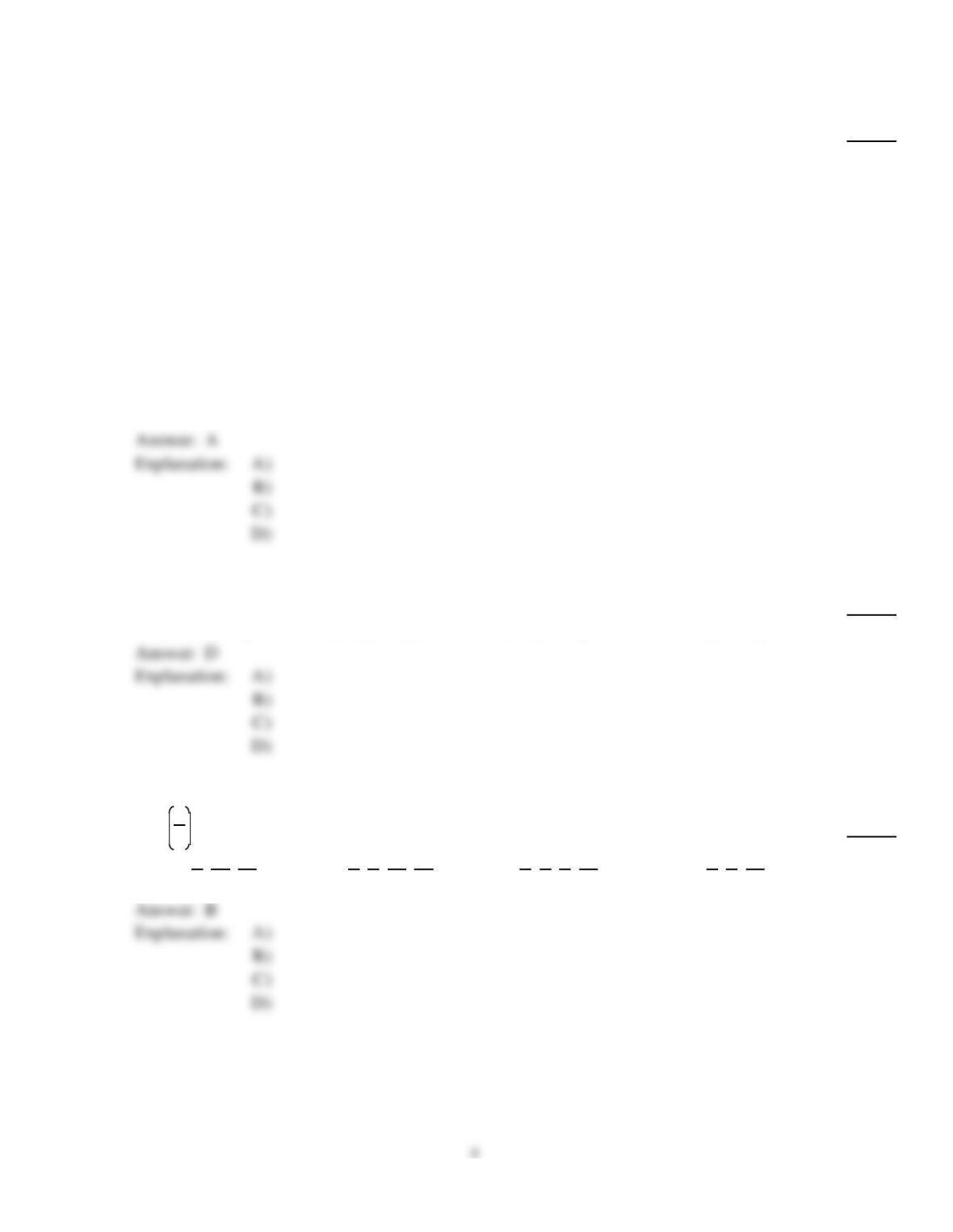
If the probability an event will occur is p and the probability it will not occur is q, then each term in the expansion of
(p +
q)n represents a probability.
12)
12)
The probability that a person in the general population suffers from anxiety is 0.23. If five people
from the general population are randomly selected, the probability that three of them will suffer
from anxiety is the third term of the binomial expansion of
5 people from the general
population are selected.
(0.23 +0.77)5.
Probability a person in
the general population
suffers from anxiety
Probability a person in the
general population does
not suffer from anxiety
What is this probability? Round the answer to four decimal places.
A)
0.0721
B)
0.0555
C)
0.3136
D)
0.2415
Find the term indicated in the expansion.
13)
(x + 2y)12; 10th term
13)
A)
112,640x9y3
B)
56,320x3y10
C)
56,320x9y3
D)
112,640x3y9
Write the first four terms of the sequence whose general term is given.
14)
an=2
3
n
14)
A)
1, 4
9, 8
27 , 16
81
B)
2
3, 4
9, 8
27 , 16
81
C)
2
3, 2
6, 2
9, 2
12
D)
1, 2
3, 4
9, 8
27
Use the formula for the general term (the nth term) of an arithmetic sequence to find the indicated term of the sequence
with the given first term, a1, and common difference, d.
15)
15)
Find a 17 when a1= – 4, d = – 1.
A)
13
B)
12
C)
– 21
D)
– 20
Express the sum using summation notation. Use a lower limit of summation, not necessarily 1, and k for the index of
summation.
16)
a + ar + ar2+ . . . + ar13
16)
A)
13
k = 0
(ar)k
B)
13
k = 1
ark
C)
13
k = 0
ark
D)
14
k = 1
ark
Find the common ratio for the geometric sequence.
17)
17)
4, 8, 16, 32, 64, . . .
A)
4
B)
1
2
C)
not geometric
D)
2
Find the indicated sum.
18)
4
k = 2
k(k + 3)
18)
A)
60
B)
38
C)
56
D)
27
5
Use the Binomial Theorem to expand the binomial and express the result in simplified form.
19)
(3x + 4)5
19)
A)
243x5+ 3840x4+ 5760x3+ 5760x2+ 3840x + 1024
B)
243x5+ 1620x4+ 4320x3+ 5760x2+ 3840x + 1024
C)
(9x2+ 24x + 16)5
D)
243x5+ 324x4+ 432x3+ 576x2+ 768x + 1024
Find the sum of the infinite geometric series, if it exists.
20)
i = 1
8( 4 )i – 1
20)
A)
–8
B)
8
C)
72
D)
does not exist
Find the indicated sum.
21)
5
i = 1
(i – 7)
21)
A)
–8
B)
–18
C)
–20
D)
–2
Find the common difference for the arithmetic sequence.
22)
22)
583, 588, 593, 598, . . .
A)
–583
B)
583
C)
5
D)
–5
Write the first five terms of the arithmetic sequence with the given first term, a1, and common difference, d.
23)
a1=3
4, d =5
4
23)
A)
3
4, 2, 13
4, 9
2, 23
4
B)
3
4, 1, 13
12 , 9
8, 23
20
C)
3
4, –1
4, –7
12 , –3
4, –17
20
D)
3
4, –1
2, –7
4, – 3, –17
4
Express the sum using summation notation. Use a lower limit of summation, not necessarily 1, and k for the index of
summation.
24)
6
7+7
8+8
9+9
10 + . . . +19
20
24)
A)
19
k =6
k + 1
k
B)
19
k =7
k
k + 1
C)
19
k =6
k
k + 1
D)
19
k =7
k + 1
k
Write a formula for the general term (the nth term) of the geometric sequence.
25)
3, –3
5, 3
25 , –3
125 , 3
625, . . .
25)
A)
an=3–1
25
n – 1
B)
an=3–1
5
n
C)
an=3–1
5
n – 1
D)
an=3–1
5
n + 1
26)
26)
8, 24, 72, 216, 648, . . .
A)
an=8(3n)
B)
an=a1+3n
C)
an=8(3)n
D)
an=8(3)n – 1
Write the first four terms of the sequence whose general term is given.
27)
an=2n
27)
A)
1, 2, 4, 8
B)
1, 4, 9, 16
C)
4, 8, 16, 32
D)
2, 4, 8, 16
Write the first five terms of the arithmetic sequence with the given first term, a1, and common difference, d.
28)
28)
a1=5; d = – 1
A)
4, 3, 2, 1, 0
B)
5, 4, 3, 2, 1
C)
6, 5, 4, 3, 2
D)
5, 4, 2, 2, 1
Write the first four terms of the sequence whose general term is given.
29)
29)
an= – 2(n +2)!
A)
–4, –24, –144, –960
B)
–12, –48, –240, –1440
C)
–12, 96, –720, 5760
D)
–4, 12, –48, 240
8
Solve the problem.
30)
30)
When students at State University held a food drive for the needy, 2916 cans of food were
collected on the first day of the drive, 972 the second day, 324 the third day, and so on. Find the
total number of cans collected the first five days.
A)
4356 cans
B)
4320 cans
C)
7380 cans
D)
4368 cans
Express the repeating decimal as a fraction in lowest terms.
31)
0.8=8
10 +8
100 +8
1000 +8
10,000 + . . .
31)
A)
80
9
B)
8
9
C)
4
5
D)
2
25
Solve the problem.
32)
32)
Laura invests $250 each quarter in a fixed–interest mutual fund paying annual interest of 6%
compounded quarterly. How much will her account have in it at the end of 11 years? (Round to
the nearest dollar.)
A)
$3743
B)
$15,551
C)
$15,422
D)
$46,427
Express the sum using summation notation. Use a lower limit of summation, not necessarily 1, and k for the index of
summation.
33)
33)
11 +14 +17 +20 + . . . +35
A)
24
k = 2
3k +5
B)
10
k = 2
3k +5
C)
10
k = 1
3k +5
D)
24
k = 0
3k +5
Use the formula for the general term (the nth term) of an arithmetic sequence to find the indicated term of the sequence
with the given first term, a1, and common difference, d.
34)
34)
Find a8 when a1= – 8, d = – 5 .
A)
27
B)
–48
C)
32
D)
–43
Solve the problem.
35)
35)
Ms. Patterson proposes to give her daughter Claire an allowance of $0.15 on the first day of her
15–day vacation, $0.30 on the second day, $0.60 on the third day, and so on. Find the allowance
Claire would receive on the last day of her vacation.
A)
$2457.60
B)
$2.25
C)
$16,384.15
D)
$4915.20
Write the first four terms of the geometric sequence with the given first term, a1, and common ratio, r.
36)
36)
a1= – 2; r =4
A)
–2, 2, 6, 10, . . .
B)
–2, 8, –32, 128, . . .
C)
–2, –8, –32, –128, . . .
D)
–8, –32, –128, –512, . . .
Provide an appropriate response.
37)
Use the Binomial Theorem to expand and simplify: (x2+ 9)5.
37)
A)
x10 + 45x8+ 1620x6+ 14,580x4+ 32,805x2+ 59,049
B)
x7+ 45x6+ 810x5+ 7290x4+ 32,805x3+ 59,049
C)
x10 + 45x8+ 810x6+ 7290x4+ 32,805x2+ 59,049
D)
x5+ 45x4+ 810x3+ 7290x2+ 32,805x +
59,049
10
Write a formula for the general term (the nth term) of the arithmetic sequence. Then use the formula for an to find a20,
the 20th term of the sequence.
38)
38)
–21, –26 , –31, –36, . . .
A)
an=5n + 21; a20 =121
B)
an= – 5n – 21; a20 = – 121
C)
an=5n + 16; a20 =116
D)
an= – 5n – 16; a20 = – 116
Find the indicated sum. Use the formula for the sum of the first n terms of a geometric sequence.
39)
4
i = 1
3
5
i + 1
39)
A)
12969
3125
B)
816
625
C)
2448
3125
D)
2452
3125
Express the sum using summation notation. Use 1 as the lower limit of summation and i for the index of summation.
40)
a + ar + ar2+ . . . + ar14
40)
A)
14
i = 1
(ar)i – 1
B)
15
i = 1
ari – 1
C)
14
i = 1
ari
D)
14
i = 1
(ar)i
Write a formula for the general term (the nth term) of the arithmetic sequence. Then use the formula for an to find a20,
the 20th term of the sequence.
41)
41)
a1= – 7, d =0.5
A)
an=0.5n – 7; a20 =3
B)
an= – 7n + 7.5; a20 = – 132.5
C)
an= – 7n + 0.5; a20 = – 139.5
D)
an=0.5n – 7.5; a20 =2.5
Solve the problem.
42)
42)
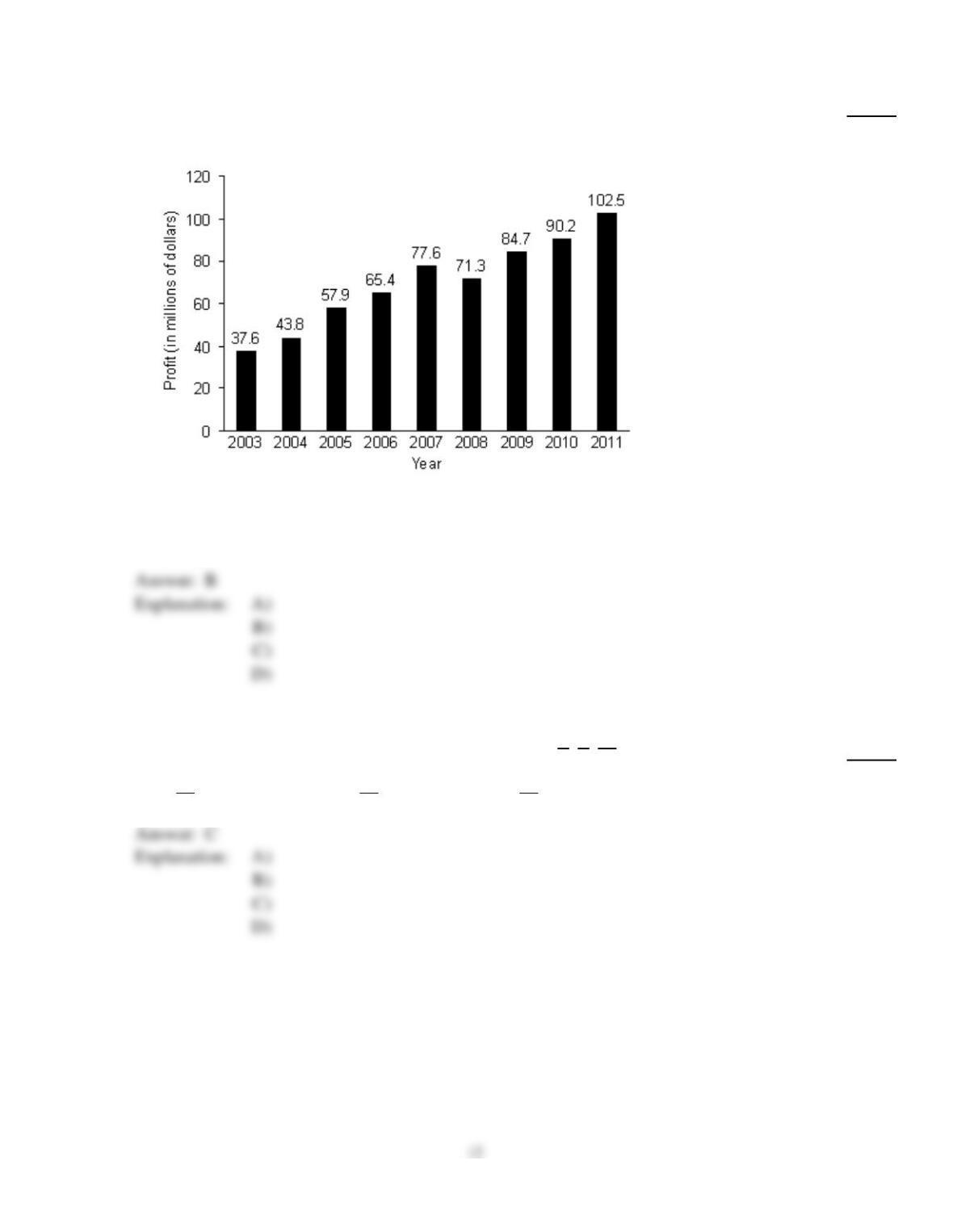
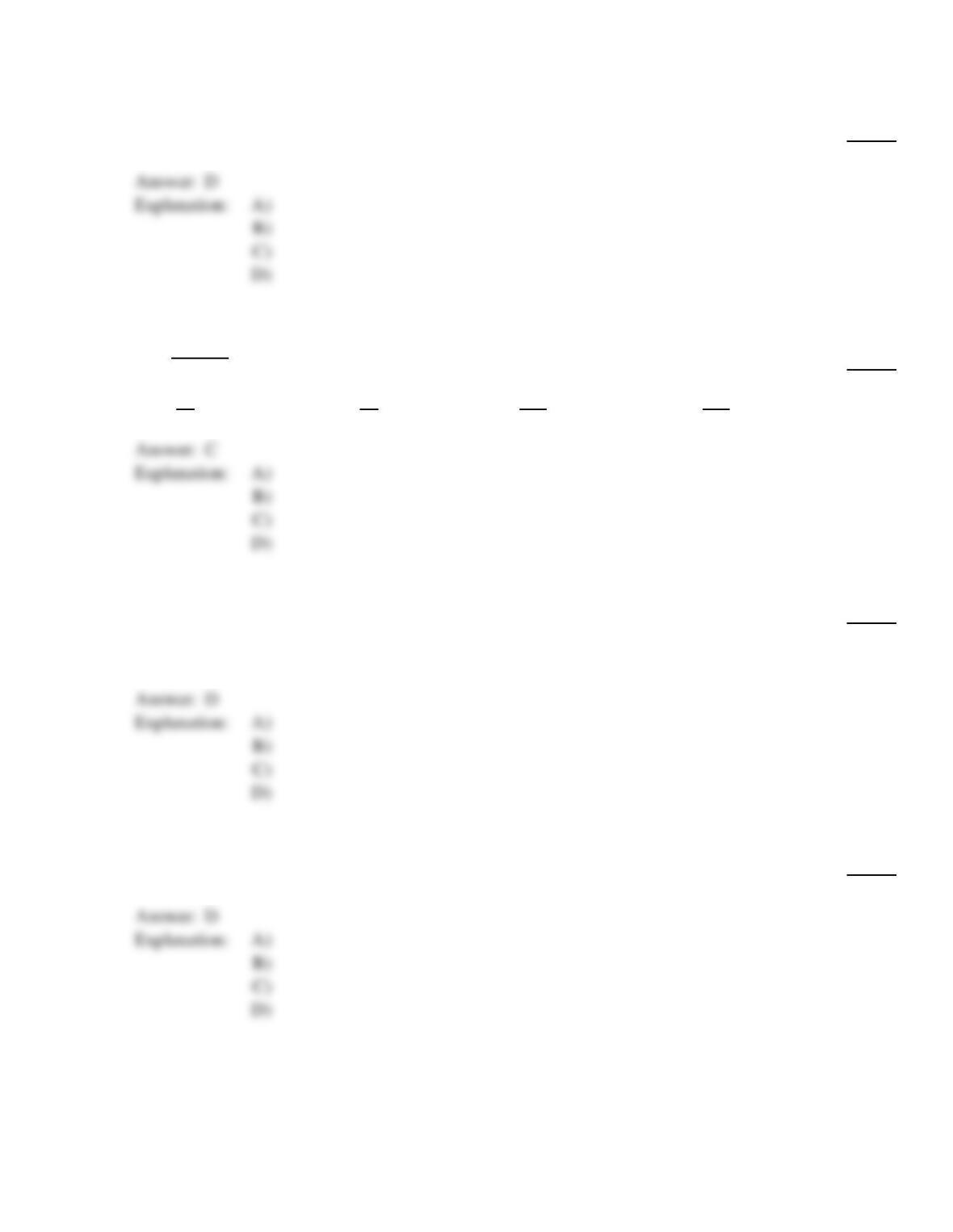
The bar graph below shows a company‘s yearly profits from 2003 to 2011. Let an represent the
company’s profit, in millions, in year n, where n = 1 corresponds to 2003, n = 2 corresponds to
2004, and so on.
Find
9
i =4
ai
A)
$167.9 million
B)
$491.7 million
C)
$549.6 million
D)
$505.8 million
Use the formula for the sum of the first n terms of a geometric sequence to solve.
43)
Find the sum of the first five terms of the geometric sequence: 3
3, 3
6, 3
12 , . . . .
43)
A)
1
12
B)
–1
12
C)
31
16
D)
93
Use the formula for the general term (the nth term) of an arithmetic sequence to find the indicated term of the sequence
with the given first term, a1, and common difference, d.
44)
44)
Find a 32 when a1= – 3, d =3 .
A)
–99
B)
–96
C)
93
D)
90
Find the indicated sum.
45)
5
i = 1
(–1)i – 1
(i + 1)!
45)
A)
23
60
B)
–23
60
C)
53
144
D)
–53
144
Provide an appropriate response.
46)
46)
A job pays a salary of $34,000 for the first year. with an annual increase of 6% per year beginning
in the second year. What is the total salary paid over an 7–year period? (Round to the nearest
cent.)
A)
$237,160.83
B)
$336,513.91
C)
$48,229.65
D)
$285,390.48
Write the first four terms of the sequence whose general term is given.
47)
an=(–1)n + 1(n +7)
47)
A)
–9, 10, –11, 12
B)
–8, 9, –10, 11
C)
8, –18, 30, –44
D)
8, –9, 10, –11
13
Find the indicated sum. Use the formula for the sum of the first n terms of a geometric sequence.
48)
8
i = 1
2
3
i
48)
A)
2059
2187
B)
6305
2187
C)
4118
6561
D)
12,610
6561
Find the term indicated in the expansion.
49)
(x3+y2)7; 3rd term
49)
A)
21x8y4
B)
504x15y4
C)
504x8y4
D)
21x15y4
Write the first four terms of the sequence whose general term is given.
50)
an= – 2
5
n
50)
A)
–2
5, 4
25 , –8
125 , 16
625
B)
–2
5, –4
25 , –8
125 , –16
625
C)
2
5, –2
10 , 2
15 , –2
20
D)
–2
5, 2
10 , –2
15 , –2
20
Use the formula for the general term (the nth term) of a geometric sequence to find the indicated term of the sequence
with the given first term, a1, and common ratio, r.
51)
51)
Find a6 when a1=6, r =4.
A)
6144
B)
1024
C)
24,576
D)
120
Provide an appropriate response.
52)
Use the Binomial Theorem to write the first three terms in the expansion and simplify: (x + 3y2)9.
52)
A)
x9+ 30 x8y2+ 324 x7y4
B)
x9+ 27 x8y2+ 648 x7y4
C)
x9+ 27 x8y2+ 324 x7y4
D)
x9+ 30 x8y2+ 648 x7y4
Use the Binomial Theorem to expand the binomial and express the result in simplified form.
53)
(x – 2y)6
53)
A)
x6– 12x5y +24x4y2– 36x3y3+24x2y4– 12x y5+2y6
B)
x6– 12x5y +60x4y2– 160x3y3+240x2y4– 192xy5+64y6
C)
x6– 12x5y – 64x4y2– 40x3y3– 64x2y4– 12xy5– 2y6
D)
x6– 12x5y – 48x4y2– 144x3y3– 192x2y4– 192xy5– 64y6
Solve the problem.
54)
The finite sequence whose general term is an=0.14n2–1.06n +7.45, where n = 1, 2, 3, . . ., 9
models the total operating costs, in millions of dollars, for a company for nine consecutive years.
Find
4
i = 1
ai
54)
A)
$23.4 million
B)
$26.12 million
C)
$32.65 million
D)
$29.05 million
15
Find the sum of the infinite geometric series, if it exists.
55)
i = 1
7(–0.1)i – 1
55)
A)
–70
9
B)
–70
11
C)
70
9
D)
70
11
Solve the problem.
56)
56)
A theater has 30 rows with 26 seats in the first row, 30 in the second row, 34 in the third row, and
so forth. How many seats are in the theater?
A)
5040 seats
B)
2520 seats
C)
2580 seats
D)
5160 seats
Express the sum using summation notation. Use a lower limit of summation, not necessarily 1, and k for the index of
summation.
57)
(a + 1) + (a +b) + (a +b2) + . . . + (a +bn)
57)
A)
n
k = 0
(a +bk)
B)
n
k = 1
(a +bk)
C)
n
k = 0
abk
D)
n – 1
k = 0
(a +bk)
Use the formula for the sum of the first n terms of a geometric sequence to solve.
58)
Find the sum of the first five terms of the geometric sequence: 4
3, 16
3, 64
3, . . . .
58)
A)
1364
15
B)
1364
3
C)
1363
3
D)
1363
15
Use the Binomial Theorem to expand the binomial and express the result in simplified form.
59)
(x5+3y)4
59)
A)
x9+12x8y +18x7y2+12x5y3+3y4
B)
x20 +12x15y +54x10y2+108x5y3+81y4
C)
x9+9x8y +54x7y2+81x5y3+81y4
D)
x20 +9x15y +54x10y2+81x5y3+81y4
Use the formula for the sum of the first n terms of a geometric sequence to solve.
60)
60)
Find the sum of the first four terms of the geometric sequence: 2, 6, 18, . . . .
A)
80
B)
40
C)
23
D)
26
Write the first three terms in the binomial expansion, expressing the result in simplified form.
61)
(x – 3)17
61)
A)
x17 – 51x16 – 1224x15
B)
x17 – 51x16 + 1224x15
C)
x17 + 51x16 – 1224x15
D)
x17 + 51x16 + 1224x15
Use the formula for the sum of the first n terms of a geometric sequence.
62)
62)
Find the sum of the first 9 terms of the geometric sequence: –5, –10, –20, –40, –80, . . .
A)
–2555
B)
–2518
C)
–2575
D)
–2553
Write out the first three terms and the last term of the arithmetic sequence.
63)
60
i=1
–5i
63)
A)
–1 –5–10 – . . . –300
B)
–5–25 –125 – . . . –1500
C)
–5–10 –15 – . . . –300
D)
–5+25 –75 + . . . –1500
Find the sum of the infinite geometric series, if it exists.
64)
3+3
2+3
4+3
8+ . . .
64)
A)
3
2
B)
6
C)
does not exist
D)
9
2
Write a formula for the general term (the nth term) of the geometric sequence.
65)
–1
8, 1
24 , –1
72 , 1
216 , . . .
65)
A)
an= – 1
8
n – 1
+1
6
B)
an= – 1
3–1
8
n – 1
C)
an= – 1
8–1
3
n – 1
D)
an= – 1
8–1
3(n – 1)
18
Solve the problem.
66)
66)
A new exhibit is scheduled to open at the local museum. Museum officials expect that 8000
people will visit the exhibit in its first week, and that the number of visitors will drop by 30 people
per week after the first week during the first 6 months. Find the total number of visitors expected
in the exhibit’s first 7 weeks.
A)
55,370 visitors
B)
39,550 visitors
C)
47,550 visitors
D)
55,190 visitors
Write the first four terms of the sequence whose general term is given.
67)
an=n + 2
2n – 1
67)
A)
3, 4
3, 1, 6
7
B)
–3, 4
3, 1, 6
7
C)
–3, –4
3, 1, 6
7
D)
3, –4
3, 1, 6
7
Use the Binomial Theorem to expand the binomial and express the result in simplified form.
68)
(x + 8y)5
68)
A)
x5+ 40x4y + 640x3y2+ 5120x2y3+ 20,480xy4+ 32,768
B)
x5+ 40x4y + 640x3y2+ 5120x2y3+ 20,480xy4+ 32,768y5
C)
x5+ 40x4y + 1280x3y2+ 10,240x2y3+ 20,480xy4+ 32,768y5
D)
x5+ 40x4y + 1280x3y2+ 10,240x2y3+ 20,480xy4+ 8y5
Write the first four terms of the sequence whose general term is given.
69)
69)
an= n – 6
A)
–6, –5, –4, –3
B)
1, 2, 3, 4
C)
–24, –18, –12, –6
D)
–5, –4, –3, –2
Find the indicated sum.
70)
6
i =3
i!
(i – 1)!
70)
A)
10
B)
6
C)
3
D)
18
Evaluate the given binomial coefficient.
71)
8
4
71)
A)
70
B)
1680
C)
35
D)
140
72)
126
2
72)
A)
124
B)
7875
C)
126!
124!
D)
15,750
Use the formula for the sum of the first n terms of an arithmetic sequence.
73)
Find
36
i = 1
(5i – 1) .
73)
A)
3384
B)
3510
C)
3204
D)
3294