
Fundamentals of Corporate Finance 3e Test Bank
Chapter 14: Working Capital Management
Ans:
B
2.
Net working capital is important because it is a measure of a firm’s liquidity and represents the
net short-term investment the firm keeps in the business.
A)
True
B)
False
Ans:
A
3.
Working capital management involves making decisions regarding the use and sources of
current assets.
A)
True
B)
False
Ans:
A
1.
The appropriate mix of current assets is not a working capital management decision.
A)
True
B)
False

Fundamentals of Corporate Finance 3e Test Bank
4.
Working capital efficiency refers to the length of time it takes for a firm to convert the raw
material to a finished product.
A)
True
B)
False
Ans:
B
5.
Liquidity is the ability of a company to convert assets—real or financial—into cash quickly
without suffering a financial loss.
A)
True
B)
False
Ans:
A
6.
The operating cycle begins when the firm uses its cash to purchase raw materials and ends
when the firm collects cash payments on its credit sales.
A)
True
B)
False
Ans:
B
AICPA: Industry/Sector Perspective

Fundamentals of Corporate Finance 3e Test Bank
7.
The cash conversion cycle is the length of time between the cash outflow for materials and the
cash inflow from sales.
A)
True
B)
False
Ans:
A
8.
Days’ payables outstanding (DPO), which tells how long, on average, a firm takes to pay off its
suppliers for the cost of inventory, is used to measure the operating cycle.
A)
True
B)
False
Ans:
B
9.
Day’s payables outstanding (DPO) is computed as number of days in a year divided by
accounts payable turnover.
A)
True
B)
False
Ans:
A
AICPA: Industry/Sector Perspective

Fundamentals of Corporate Finance 3e Test Bank
10.
An efficient firm with good working capital management should have a high average collection
period compared to that of its industry.
A)
True
B)
False
Ans:
B
11.
The flexible current asset management strategy calls for management to invest large amounts in
cash, short-term investments, and inventory.
A)
True
B)
False
Ans:
A
12.
The flexible current asset management strategy is perceived to be a high-risk and low-return
course of action for management to follow.
A)
True
B)
False
Ans:
B
AICPA: Industry/Sector Perspective

Fundamentals of Corporate Finance 3e Test Bank
13.
The restrictive current asset management strategy is a high-risk, high-return alternative to a
flexible strategy.
A)
True
B)
False
Ans:
A
14.
If shortage costs dominate carrying costs, the firm will need to move toward a more flexible
policy.
A)
True
B)
False
Ans:
A
15.
If carrying costs are less than shortage costs, then the firm will maximize value by adopting a
more restrictive strategy.
A)
True
B)
False
Ans:
B
AICPA: Industry/Sector Perspective

Fundamentals of Corporate Finance 3e Test Bank
16.
Trade credit, which is short-term financing, comes with an explicit interest charge.
A)
True
B)
False
Ans:
B
17.
An offer of 3/10, net 40 means that the selling firm offers a 10 percent discount if the buyer
pays the full amount of the purchase in cash within 3 days of the invoice date. Otherwise, the
buyer has 40 days to pay the balance in full from the date of delivery.
A)
True
B)
False
Ans:
B
18.
Trade credit is a cheap loan from the supplier.
A)
True
B)
False
Ans:
B
AICPA: Industry/Sector Perspective

Fundamentals of Corporate Finance 3e Test Bank
19.
The aging schedule shows the breakdown of the firm’s accounts receivable by their date of
sale.
A)
True
B)
False
Ans:
A
20.
The conflict between carrying costs and shortage costs is called the working capital trade-off.
A)
True
B)
False
Ans:
A
21.
A firm that employs just-in–time management has to increase its investment in working capital.
A)
True
B)
False
Ans:
B
AICPA: Industry/Sector Perspective

Fundamentals of Corporate Finance 3e Test Bank
22.
Float is the time taken by a credit customer to pay the firm.
A)
True
B)
False
Ans:
B
23.
A lockbox system allows geographically dispersed customers to send their payments to a post
office box close to them.
A)
True
B)
False
Ans:
A
24.
Under the maturity matching strategy, a firm funds all seasonal working capital needs with
short-term borrowing.
A)
True
B)
False
Ans:
A
AICPA: Industry/Sector Perspective

Fundamentals of Corporate Finance 3e Test Bank
AICPA: Industry/Sector Perspective
25.
Short term funding strategy calls for all seasonal working capital and a portion of the
permanent working capital and fixed assets to be funded with short-term debt.
A)
True
B)
False
Ans:
A
26.
An informal line of credit is short term debt promissory notes issued by large financial firms.
A)
True
B)
False
Ans:
B
27.
A factor is an individual or financial institution that buys accounts receivable without recourse.
A)
True
B)
False
Ans:
A

Fundamentals of Corporate Finance 3e Test Bank
28.
Which of the following statements is NOT true?
A)
Gross working capital is the funds invested in a company’s current liabilities.
B)
Net working capital (NWC) refers to the difference between current assets and current
liabilities.
C)
Working capital efficiency refers to the length of time between when a working capital
asset is acquired and when it is converted into cash.
D)
Working capital management involves making decisions regarding the use and sources
of current assets.
Ans:
A
29.
Which of the following statements is NOT true?
A)
If cash balances become too small, it may lead the firm to bankruptcy.
B)
The lower the cash balance, the better the ability of a firm to meet its short-term
financial obligations.
C)
The level of the cash balance has no bearing on a firm’s ability to meet its short-term
financial obligations.
D)
The downside of holding too much cash is that the returns on cash are low.
30.
Which of the following is the equation for net working capital?
A)
Total assets – total liabilities
B)
Current assets – current liabilities
C)
Current assets / current liabilities
D)
Total assets / total liabilities
Ans:
B
AICPA: Industry/Sector Perspective

Fundamentals of Corporate Finance 3e Test Bank
31.
The cash conversion cycle
A)
shows how long a firm keeps its inventory before selling it.
B)
begins when a firm invests cash to purchase the raw materials that would be used to
produce the goods that the firm manufactures.
C)
begins when a firm uses its cash to purchase raw materials and ends when the firm
collects cash payments on its credit sales.
D)
estimates how long it takes on average for a firm to collect its outstanding accounts
receivable balance.
Ans:
B
32.
Which of the following statements is NOT true?
A)
The cash conversion cycle begins when a firm invests cash to purchase the raw
materials that would be used to produce the goods that the firm manufactures.
B)
The cash conversion cycle begins when the firm uses its cash to purchase raw
materials and ends when the firm collects cash payments on its credit sales.
C)
To measure the cash conversion cycle, we need another measure called the days’
payables outstanding.
D)
The cash conversion cycle ends not with the finished goods being sold to customers
and the cash collected on the sales; but when you take into account the time taken by a
firm to pay for its purchases.

Fundamentals of Corporate Finance 3e Test Bank
33.
The operating cycle
A)
begins when a firm receives the raw materials that would be used to produce the goods
that the firm manufactures.
B)
begins when a firm uses its cash to purchase raw materials and ends when the firm
collects cash payments on its credit sales.
C)
cannot be measured without knowing the days’ payables outstanding.
D)
does not end with the finished goods being sold to customers and the cash collected on
the sales; but when you take into account the time taken by the firm to pay for its
purchases.
Ans:
A
34.
Which of the following statements is true when managing working capital accounts?
A)
Maintain minimal raw material inventories without causing manufacturing delays.
B)
Use as little labor as possible to manufacture the product while producing a quality
product.
C)
Delay paying accounts payable as long as possible without suffering any penalties.
D)
All of the above are true.
Ans:
D
35.
Which of the following statements is true?
A)
Cash conversion cycle DSO DSI DPO= + +
B)
Cash conversion cycle DSO DSI DPO= + −
C)
Cash conversion cycle DSO DPO=−
D)
None of the above.
Ans:
B
AICPA: Industry/Sector Perspective

Fundamentals of Corporate Finance 3e Test Bank
AICPA: Industry/Sector Perspective
36.
Which of the following statements is NOT true?
A)
Cash conversion cycle DSO DSI DPO= + −
B)
Operating cycle DSO DSI=+
C)
Both A and B
D)
None of the above
Ans:
D
37.
Trend Foods distributes its products to more than 100 restaurants and delis. The company’s
collection period is 32 days, and it keeps its inventory for 10 days. What is Trend’s operating
cycle?
A)
22 days
B)
32 days
C)
42 days
D)
None of the above
Ans:
C
Fundamentals of Corporate Finance 3e Test Bank
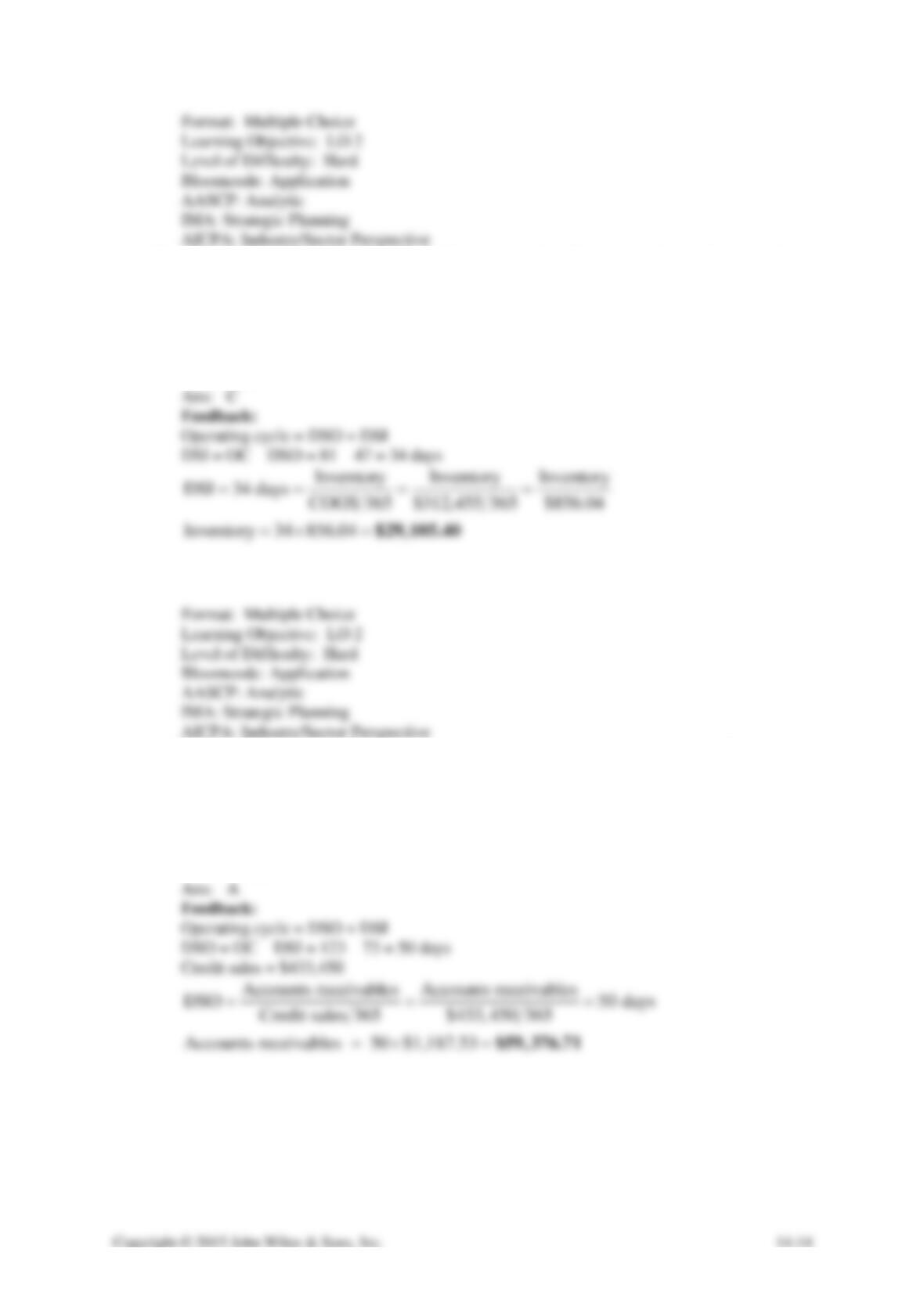
38.
Stamp, Inc. has an operating cycle of 81 days and takes 47 days to collect on its receivables.
What is its level of inventory if the firm’s cost of goods sold is $312,455? Round your final
answer to the nearest dollar.
A)
$9,190
B)
$14,685
C)
$29,105
D)
$69,339
Ans:
C
AICPA: Industry/Sector Perspective
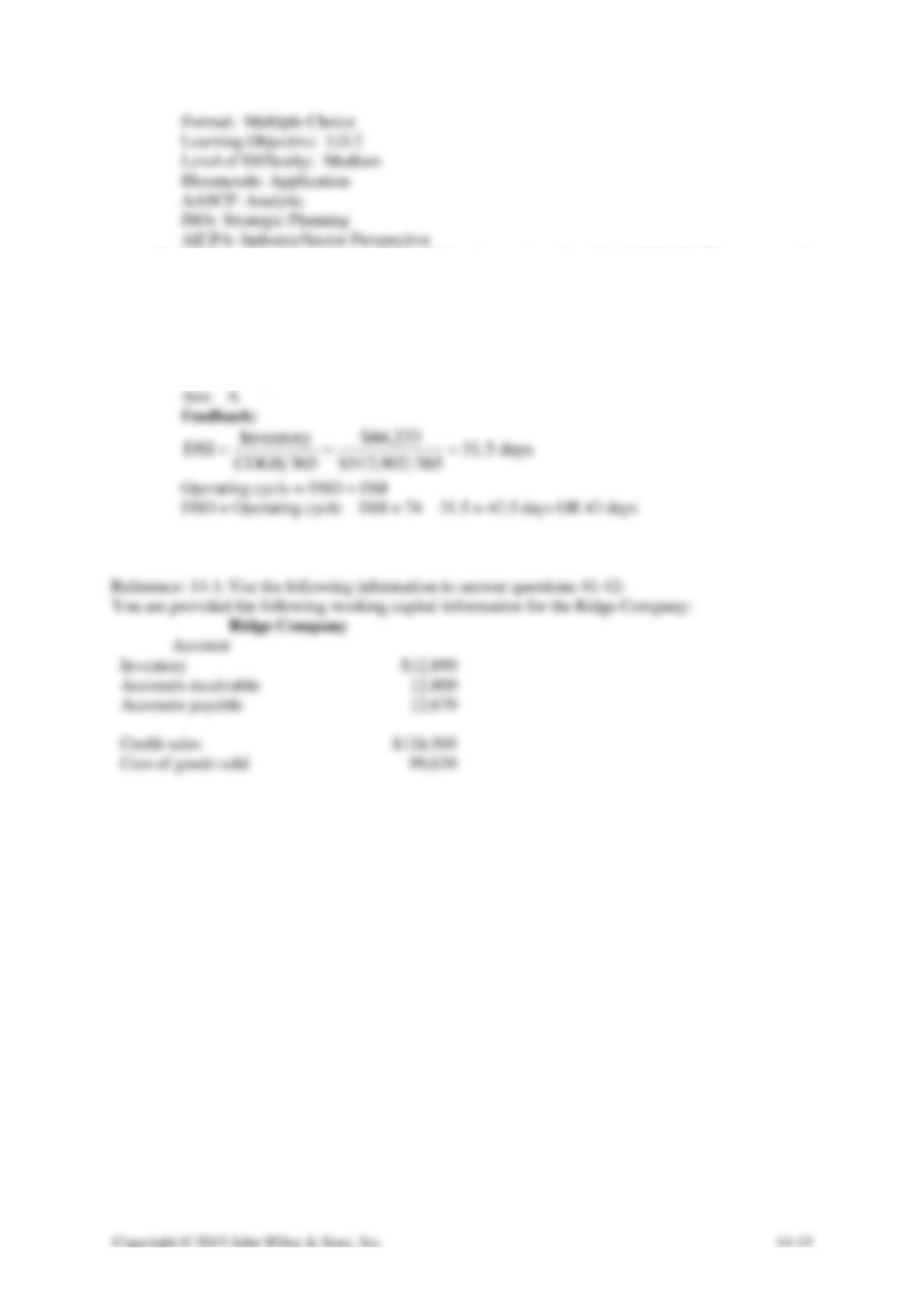
39.
Le Baron Company, a men’s designer firm, has an operating cycle of 123 days. The firm’s days’
sales in inventory is 73 days. How much does the firm have in receivables if it has credit sales
of $433,450? Round your final answer to the nearest dollar.
A)
$59,377
B)
$71,252
C)
$47,501
D)
$64,233
Ans:
A
AICPA: Industry/Sector Perspective
Fundamentals of Corporate Finance 3e Test Bank
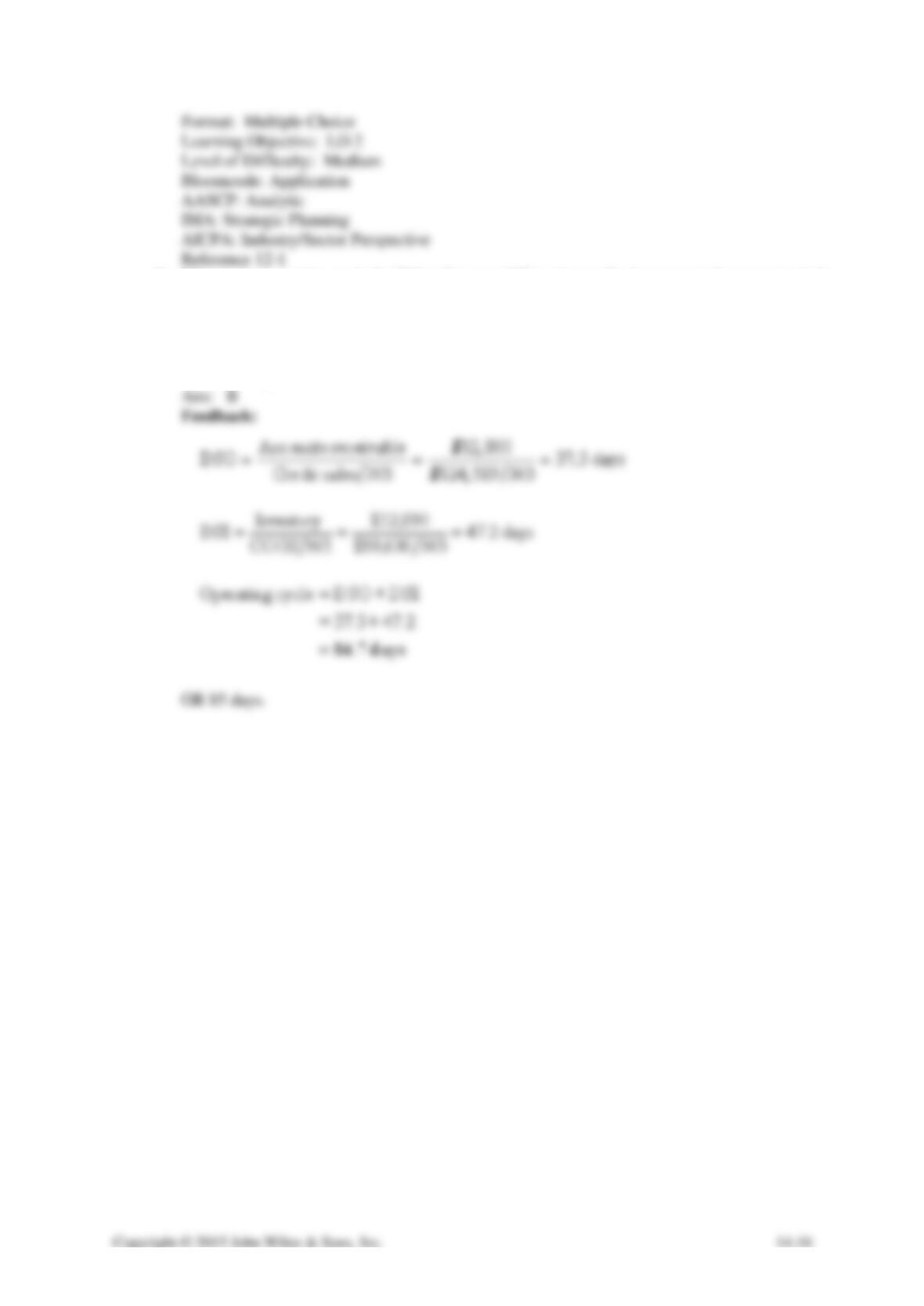
40.
All Stars, Inc. has inventory of $44,233 and cost of goods sold of $512,902. The company has
an operating cycle of 74 days. What is the firm’s days’ sales outstanding (DSO)? Round your
answers to the nearest whole number.
A)
43 days
B)
32 days
C)
49 days
D)
26 days
Ans:
A
Inventory
Accounts payable
Credit sales
Cost of goods sold
AICPA: Industry/Sector Perspective
Fundamentals of Corporate Finance 3e Test Bank
AICPA: Industry/Sector Perspective
41.
What is the operating cycle for Ridge Company? Round your final answer to the nearest whole
number.
A)
47 days
B)
85 days
C)
36 days
D)
51 days
Ans:
B
Fundamentals of Corporate Finance 3e Test Bank
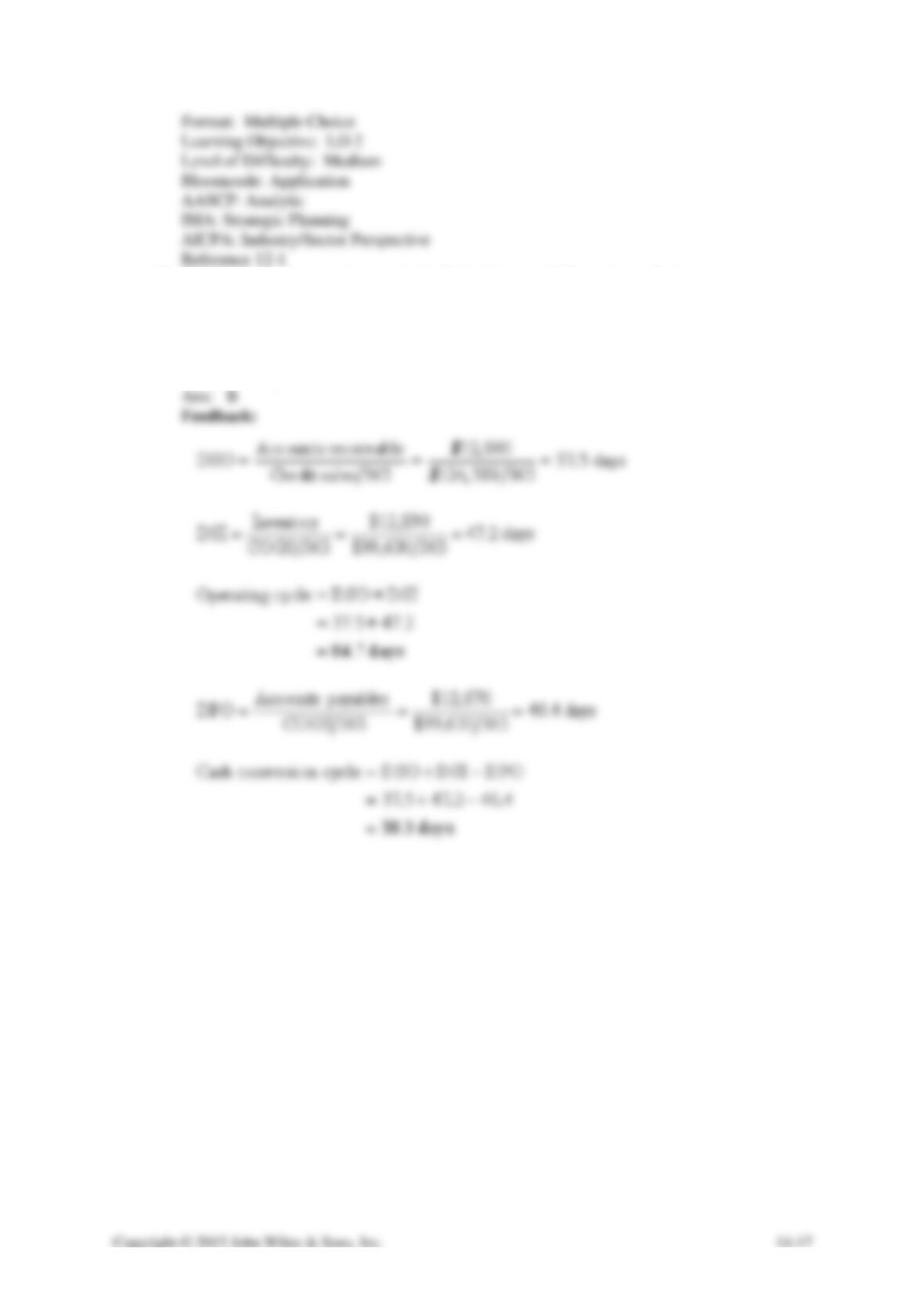
42.
What is the cash conversion cycle for Ridge Company? Round your final answers to one
decimal place.
A)
83.5 days
B)
38.3 days
C)
129.9 days
D)
46.4 days
Ans:
B
AICPA: Industry/Sector Perspective

Fundamentals of Corporate Finance 3e Test Bank
43.
Wolfgang Electricals estimates that the company takes 31 days on average to pay off its
suppliers. It also knows that it has days’ sales in inventory of 54 days and days sales’
outstanding of 34 days. What is its cash conversion cycle?
A)
119 days
B)
34 days
C)
57 days
D)
46 days
Ans:
C
Cash conversion cycle = DSO + DSI – DPO = 34 + 54 – 31 = 57 days
44.
Renald Corp. estimates that the company takes 27 days on average to pay off its suppliers. It
also knows that it has days’ sales in inventory of 43 days and days sales’ outstanding of 45 days.
What is its cash conversion cycle?
A)
61 days
B)
115 days
C)
57 days
D)
46 days
Ans:
A
Cash conversion cycle = DSO + DSI – DPO = 45 + 43 – 27 = 61 days
AICPA: Industry/Sector Perspective