d.
introspective
e.
normative
30. Holly wants to have an extravagant wedding on an exotic, tropical island. She dreams that the weather
will be perfect and that all her friends and family will have the most memorable time of their lives.
This describes Holly’s _____ expectations with regard to this event.
a.
predictive
b.
normative
c.
ideal
d.
equitable
e.
relative
31. Expectations that a consumer forms regarding what he or she thinks should or ought to happen given
the level of work that he or she has put into the experience are called _____ expectations.
a.
ideal
b.
relative
c.
equitable
d.
predictive
e.
normative
32. Denise thinks she should get a bigger bonus than her co-workers as she has been selling more of the
company’s products than the others. This is an example of a(n) _____ expectation.
a.
relative
b.
predictive
c.
ideal
d.
normative
e.
equitable
33. _____ is the phenomenon that occurs when expectations affect performance perceptions.
a.
Confirmatory bias
b.
Backfire effect
c.
Cognitive inertia
d.
Cognitive dissonance
e.
Bandwagon effect
34. When Harry bought a phone, he chose the one recommended by the retailer even though he had his
apprehensions regarding the performance of that particular phone. After he used it for a week, he got
to know from various sources that the Bluetooth connectivity on the particular brand of phone he
bought was flawed. Harry decided to return his phone even though his friends told him that its battery
life was far superior to other brands. Which of the following is most likely responsible for Harry’s
decision to return his phone?
a.
Confirmatory bias
b.
Backfire effect
c.
Cognitive inertia
d.
Cognitive dissonance
e.
Bandwagon effect
35. Which of the following theories states that consumers are motivated to act in accordance with their
attitudes and behaviors?
a.
Expectancy theory
b.
Attribution theory
c.
Self-perception theory
d.
Equity theory
e.
Balance theory
36. When Sam’s friends decided to celebrate his birthday at Grace’s Steaks, a popular steakhouse, Sam
was uncertain as he had his reservations against the quality of meat served there. On the day of the
party, though everyone enjoyed dinner, Sam still harbored his misgivings about the place. Which of
the following theories best explains Sam’s postconsumption evaluation of Grace’s Steaks?
a.
Attribution theory
b.
Equity theory
c.
Self-perception theory
d.
Theory X and Theory Y
e.
Hierarchy of needs theory
37. The overall goodness or badness of a service provided is referred to as service _____.
a.
factor
b.
recovery
c.
variability
d.
quality
e.
level
38. The level of a particular benefit that will lead to a valued end state is referred to as a(n) _____.
a.
expectation
b.
attribution
c.
desire
d.
need
e.
confirmation
39. Which of the following theories proposes that consumers cognitively compare their own level of
inputs and outcomes to those of another party in an exchange?
a.
Attribution theory
b.
Expectancy/disconfirmation theory
c.
Equity theory
d.
Balance theory
e.
Self-perception theory
40. Which of the following is a postconsumption reactions theory?
a.
Need hierarchy theory
b.
Theory X and Theory Y
c.
Self-determination theory
d.
Equity theory
e.
Situational theory
41. The way a consumer judges the outcomes of an exchange is known as _____ fairness.
a.
retributive
b.
procedural
c.
restorative
d.
distributive
e.
interactional
42. Which of the following terms captures how fairly a consumer believes he/she is treated when dealing
with service personnel in resolving some issue?
a.
Retributive fairness
b.
Procedural fairness
c.
Restorative fairness
d.
Distributive fairness
e.
Interactional fairness
43. The attribution theory _____.
a.
judges actual performance perceptions against an expectations benchmark
b.
compares if performance perceptions exactly match with what was expected
c.
explains why a certain event has occurred
d.
maintains consistency among consumers’ beliefs
e.
compares consumers’ own level of inputs and outcomes to those of another party
44. Which of the following theories consists of the three elements—locus, control, and stability?
a.
Attribution theory
b.
Expectancy/disconfirmation theory
c.
Equity theory
d.
Balance theory
e.
Self-perception theory
45. Gwen was less than happy with her last visit to her favorite coffee shop. She held the manager
responsible for the delayed services offered to customers. She attributed the cause to the fact that the
management was not well prepared to cater to the sudden rush as they had very few employees present
on that particular day. Which element of the attribution theory did Gwen associate with the cause for
her perceived dissatisfaction?
a.
Locus
b.
Reliability
c.
Conflict
d.
Stability
e.
Consistency
46. Which of the following elements in the attribution theory refers to judgments of who is responsible for
an event?
a.
Locus
b.
Control
c.
Stability
d.
Consistency
e.
Reliability
47. When Lori moved into a new house, the phone company was supposed to provide her a phone
connection in a month’s time. However, a hurricane struck on the day the serviceman was supposed to
hook it up. Lori did not get the connection until after several months because of the devastation
wrecked by the hurricane. Lori was not mad as she realized that neither did the phone company
regulate the weather nor the extent of the destruction caused by the hurricane. Which of the following
elements in the attribution theory corresponds best with Lori’s realization?
a.
Authority
b.
Stability
c.
Consistency
d.
Control
e.
Locus
48. Which of the following elements in the attribution theory refers to the likelihood that an event will
occur again in the future?
a.
Locus
b.
Stability
c.
Control
d.
Disposition
e.
Authority
49. When Laura went to a particular store, she noticed that the price that rang up when she was billing was
much higher than the price that was advertised on the shelf. This was the third time that she
experienced the price differences in the same store but that did not stop her from buying at that store.
She was extremely satisfied with the quality of the goods and this made her visit the store
occasionally. But after the third incident, she started expecting the price difference every time she went
to that store. Which of the following elements in the attribution theory corresponds best with Laura’s
expectation?
a.
Locus
b.
Disposition
c.
Control
d.
Authority
e.
Stability
50. Which of the following terms refers to lingering doubts about a decision that has already been made?
a.
Buyer’s remorse
b.
Cognitive dissonance
c.
Search regret
d.
Buyer’s guilt
e.
Cognitive inertia
51. A consumer is more likely to experience true dissonance following a purchase when _____.
a.
the consumer is unaware of any attractive alternatives that may offer comparable value
b.
the decision is easy to reverse
c.
the decision is perceived as unimportant by the consumer
d.
the consumer has low self-confidence
e.
the decision is perceived as having minimal risk by the consumer
52. Which of the following is true of cognitive dissonance?
a.
It occurs for all decisions.
b.
It occurs merely for unimportant decisions.
c.
It occurs when the consumer is unaware of any alternatives.
d.
It occurs when the decision involves risk.
e.
It occurs when the decision is easy to reverse.
53. An amusement park was recently inaugurated in Tampa, Florida. All the customers who visited the
park the first few days were sent a feedback form via email to rate their overall satisfaction on a scale.
The form included a set of ten questions with four answer options; completely
dissatisfied/dissatisfied/satisfied/completely satisfied. This scale is an example of a(n) _____ measure.
a.
attribute-specific
b.
disconfirmation
c.
unstructured
d.
direct, global
e.
open-ended
54. _____ measures assess a consumer’s satisfaction with various components of a product, service, or
experience.
a.
Attribute-specific
b.
Disconfirmation
c.
Confirmation
d.
Subordinate
e.
Direct, global
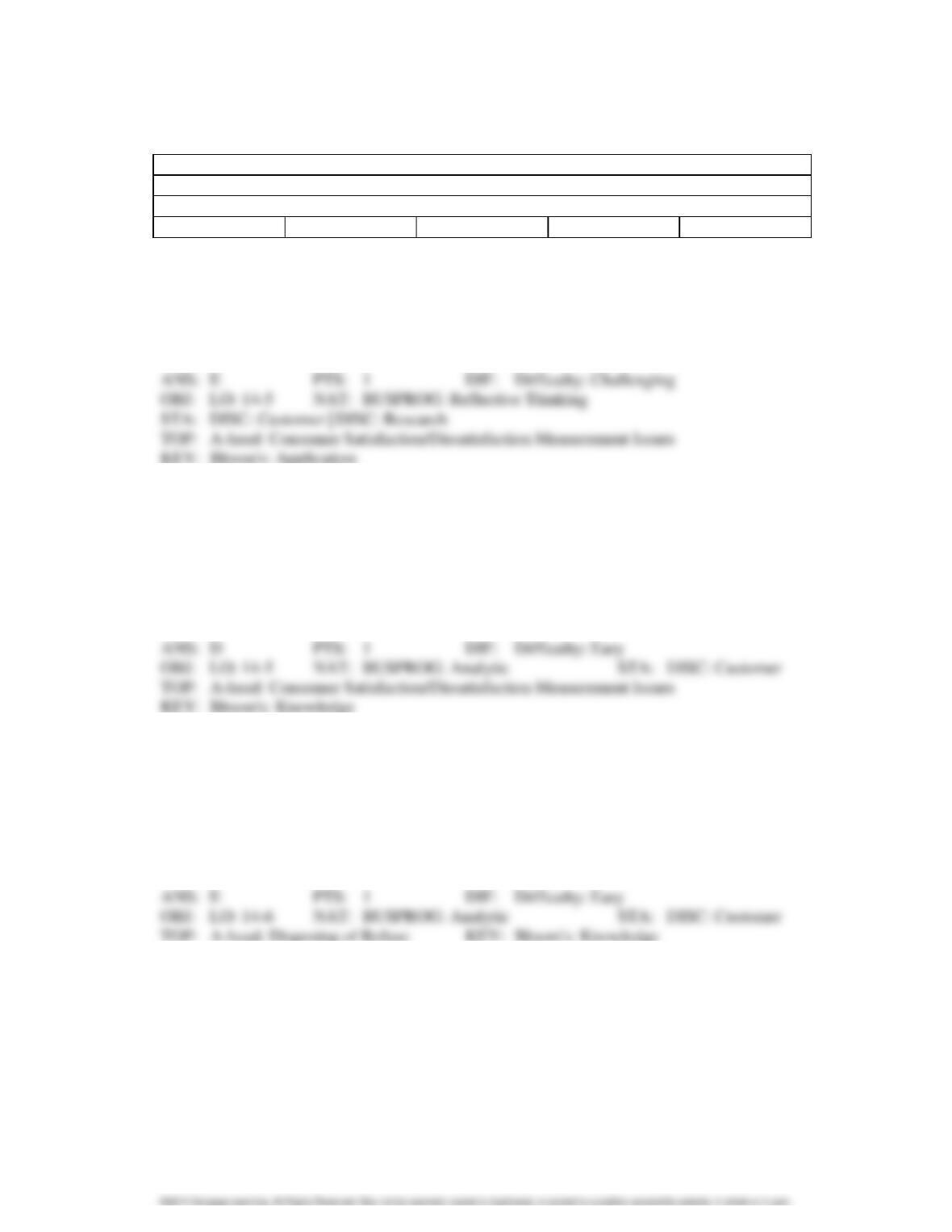
55. A market researcher was contacted by a travel firm to assess consumer satisfaction on the travel
services provided by the firm. The researcher collected feedback from customers by distributing
questionnaires. The questionnaire consisted of ten questions and each question had five options
ranging from completely dissatisfied to completely satisfied. One such question from the questionnaire
is as follows:
How satisfied were you with the accommodation arrangements?
Accommodation arrangements
Completely dissatisfied Completely satisfied
1
2
3
4
5
This is an example of a(n) _____ measure.
a.
direct, global
b.
disconfirmation
c.
open-ended
d.
unstructured
e.
attribute-specific
56. Which of the following consumer satisfaction measures compares the difference between expectations
and performance perceptions?
a.
Direct, global measure
b.
Attribute-specific measure
c.
Categorical measure
d.
Disconfirmation measure
e.
Universal measure
57. Any packaging that is no longer necessary for consumption to take place is referred to as consumer
_____.
a.
regret
b.
waste
c.
remorse
d.
nonessentials
e.
refuse
58. Which of the following disposal alternatives involves consumers simply throwing away waste
material?
a.
Trashing
b.
Recycling
c.
Converting
d.
Trading
e.
Donating
59. Who among the following possess a lifestyle trait leading to a strong tendency toward retaining
consumption-related possessions?
a.
Compilers
b.
Opinion leaders
c.
Market mavens
d.
Packrats
e.
Surrogate consumers
LOUIS VUITTON SCENARIO
Carla purchased a Louis Vuitton Fantaisie handbag for $1,430 when she was in New York City last
weekend. She had always fancied this brand but had never purchased anything of this brand before. In
fact, many of her friends purchased counterfeit Louis Vuitton handbags, wallets, and scarves. But
Carla was very particular about using only genuine goods. While the counterfeit products looked just
as good as the real brand, they weren’t of the same quality as the legitimate branded products. When
she visited the store to purchase the bag, she was very skeptical about spending so much money for a
handbag, but the sales lady was so kind and explained the benefits of the brand to her and made her
feel very welcome in the store. She explained that consumers could only purchase true Louis Vuitton
products at Louis Vuitton stores or from its website. She also explained that if she ever encountered a
problem with her handbag, she could return it to the store for repair or a replacement. All things
considered, Carla’s experience at the store and her purchase far exceeded anything she had expected.
Her initial feeling of skepticalness on splurging on a handbag gave way to a feeling of satisfaction and
pride. This feeling was further strengthened when her friend who bought a counterfeit Louis Vuitton
handbag for a few hundred dollars expressed dismay over her own purchase decision after she saw
Carla’s authentic Louis Vuitton bag with a superior finish.
60. Refer to Louis Vuitton Scenario. Many of Carla’s friends purchased counterfeit Louis Vuitton
handbags, wallets, and scarves. However, Carla was very particular about using only genuine goods.
This indicates that Carla is most concerned with the _____ of the product.
a.
canonicity
b.
periodicity
c.
authenticity
d.
historicity
e.
stability
61. Refer to Louis Vuitton Scenario. Carla’s experience at the store and her purchase far exceeded
anything she had expected. According to the expectancy/disconfirmation theory of satisfaction, which
of the following is most likely to have occurred?
a.
Negative disconfirmation
b.
Positive disconfirmation
c.
Dissatisfaction
d.
Confirmation
e.
Neutral disconfirmation
62. Refer to Louis Vuitton Scenario. Assume that before entering the Louis Vuitton store in New York
City, Carla expected to be treated well considering she was going to spend over $1,000. Which of the
following most likely corresponds to Carla’s expectation?
a.
Predictive expectation
b.
Normative expectation
c.
Comparative expectation
d.
Equitable expectation
e.
Relative expectation
63. Refer to Louis Vuitton Scenario. Carla’s initial feeling of skepticalness on splurging on a handbag
gave way to a feeling of satisfaction and pride when she learned of the replacement warranty as well as
the various benefits that come with buying a genuine Louis Vuitton handbag. This feeling of
satisfaction and pride corresponds best with a customer’s sense of _____ fairness.
a.
retributive
b.
procedural
c.
restorative
d.
distributive
e.
interactional
64. Refer to Louis Vuitton. Carla’s friend, who bought a counterfeit Louis Vuitton handbag for a few
hundred dollars, expressed dismay over her own purchase decision after she saw Carla’s authentic
Louis Vuitton bag with a superior finish. This feeling of dismay is an example of _____.
a.
buyer’s remorse
b.
buyer’s guilt
c.
search regret
d.
cognitive inertia
e.
cognitive dissonance
FINE DINING SCENARIO
Raffiné, a fine dining restaurant in Manhattan, has reservation bookings running several weeks in
advance. Sara and her friends had made reservations two weeks in advance. She had come across
many good reviews about the restaurant that she decided to go there. When the day finally came, Sara
was excited as she had been eagerly looking forward to the dining experience in Raffiné. However,
when she finally reached there and approached the reception, she was told that her name was not
listed. She was made to wait for half an hour before she could get a table. Though the problem was
sorted out, Sara was less than pleased as she had made reservations two weeks in advance. This initial
hassle spoilt Sara’s remainder of the evening and she held the poor management at Raffiné
responsible. It didn’t help when Sara, an environmentalist, learned that the management at Raffiné
simply throws away their waste material without giving a thought for other more environmental
friendly ways of disposing waste. At the end of the meal Sara was handed a customer feedback card.
The card had a question—how do you rate your overall satisfaction at Raffiné? The answer choices
were in the form of a scale that included completely dissatisfied/dissatisfied/satisfied/completely
satisfied. Sara expressed that she was completely dissatisfied with the restaurant’s overall services.
65. Refer to Fine Dining Scenario. Raffiné is a fine dining restaurant in Manhattan. This is an example of
an establishment dealing in _____ goods.
a.
durable
b.
nondurable
c.
recyclable
d.
non-degradable
e.
nonperishable
66. Refer to Fine Dining Scenario. Sara had come across many good reviews on Raffiné, and she was
eagerly looking forward to the dining experience there. However, she was less than pleased with their
services and therefore did not enjoy dining at the restaurant. Which of the following is most likely to
have occurred?
a.
Confirmation
b.
Positive disconfirmation
c.
Neutral disconfirmation
d.
Negative disconfirmation
e.
Satisfaction
67. Refer to Fine Dining Scenario. Sara was less than pleased when she was made to wait for half an hour
before she got a table. This initial hassle spoilt Sara’s remainder of the evening and she held the poor
management at Raffiné responsible. Which element in the attribution theory corresponds best with
Sara holding the management responsible for her spoilt evening?
a.
Locus
b.
Focus
c.
Control
d.
Stability
e.
Consistency
68. Refer to Fine Dining Scenario. At the end of the meal Sara was handed a customer feedback card. The
card had a question—how do you rate your overall satisfaction at Raffiné? The answer choices were in
the form of a scale that included completely dissatisfied/dissatisfied/satisfied/completely satisfied. Sara
expressed that she was completely dissatisfied with the restaurant’s overall services. This is an
example of a(n) _____ measure.
a.
direct, global
b.
attribute-specific
c.
categorical
d.
disconfirmation
e.
universal
69. Refer to Fine Dining Scenario. When Sara, an environmentalist, learned that the management at
Raffiné simply throws away their waste material without giving a thought for other more environment
friendly ways of disposing waste, she was less than pleased. Which of the following disposal
alternatives is used at Raffiné?
a.
Trashing
b.
Recycling
c.
Converting
d.
Trading
e.
Donating
ESSAY
1. Differentiate durable and nondurable goods with examples.
2. Define consumer satisfaction. How does it differ from other important consumer behavior concepts?
3. List out some possible postconsumption reactions.
4. Explain the expectancy/disconfirmation theory. Describe how it explains your satisfaction or
dissatisfaction from a recent consumption experience.
5. Define expectations. Describe the four types of consumer expectations with an example for each.
6. Define attribution theory. Explain how the three elements in the attribution theory help in explaining
consumer satisfaction. Using this theory, explain why you were satisfied or dissatisfied with a recent
consumption experience.
7. Identify the conditions when a consumer is more likely to experience true dissonance following a
purchase.
8. Define consumer refuse. List the disposal alternatives available to consumers. Which alternative do
you use most often?