Corporate Finance, 3e (Berk/DeMarzo)
Chapter 14 Capital Structure in a Perfect Market
14.1 Equity Versus Debt Financing
Use the following information to answer the question(s) below.
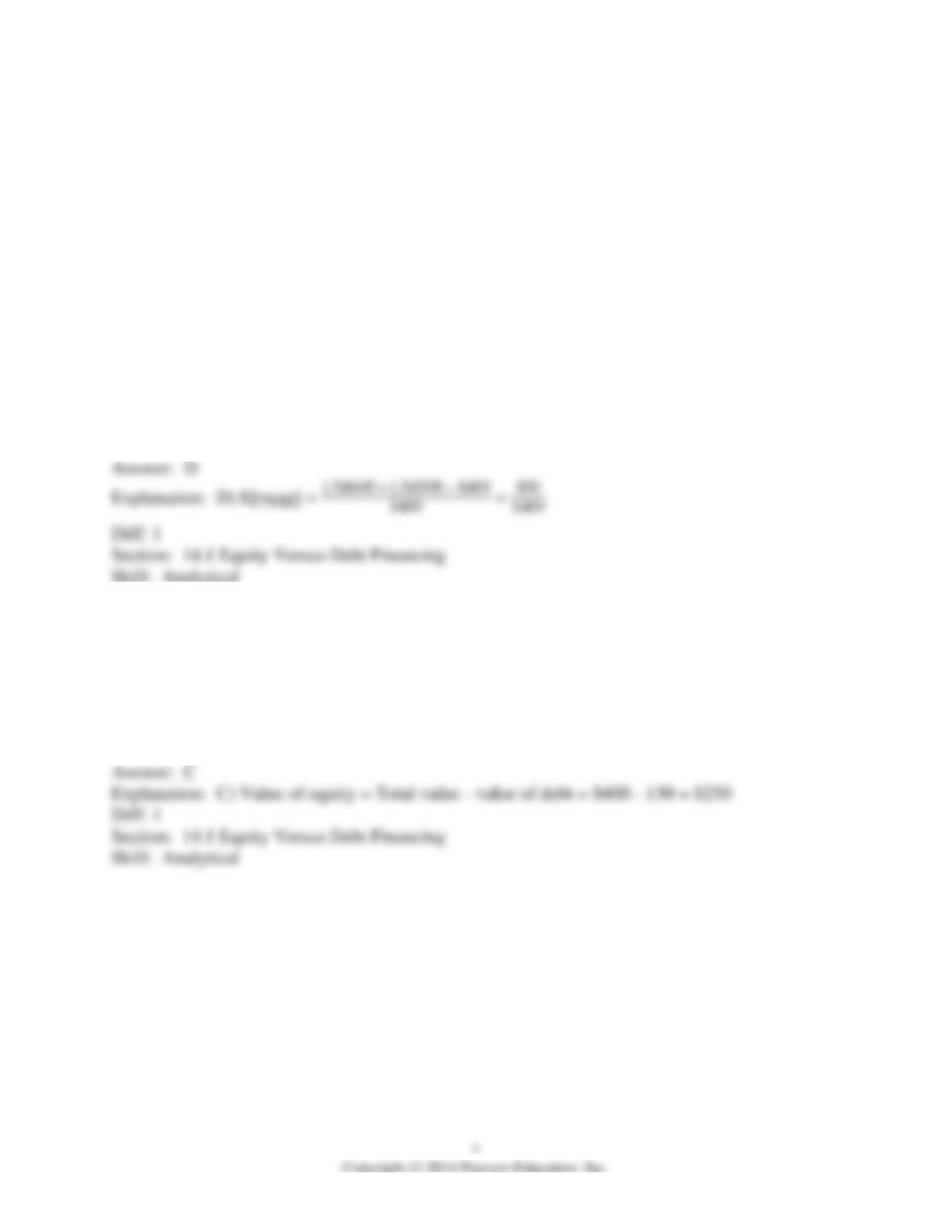
Nielson Motors (NM) has no debt. Its assets will be worth $600 million in one year if the
economy is strong, but only $300 million if the economy is weak. Both events are equally likely.
The market value today of Nielson’s assets is $400 million.
1) The expected return for Nielson Motors stock without leverage is closest to:
A) -25.0%
B) -17.5%
C) -12.5%
D) 12.5%
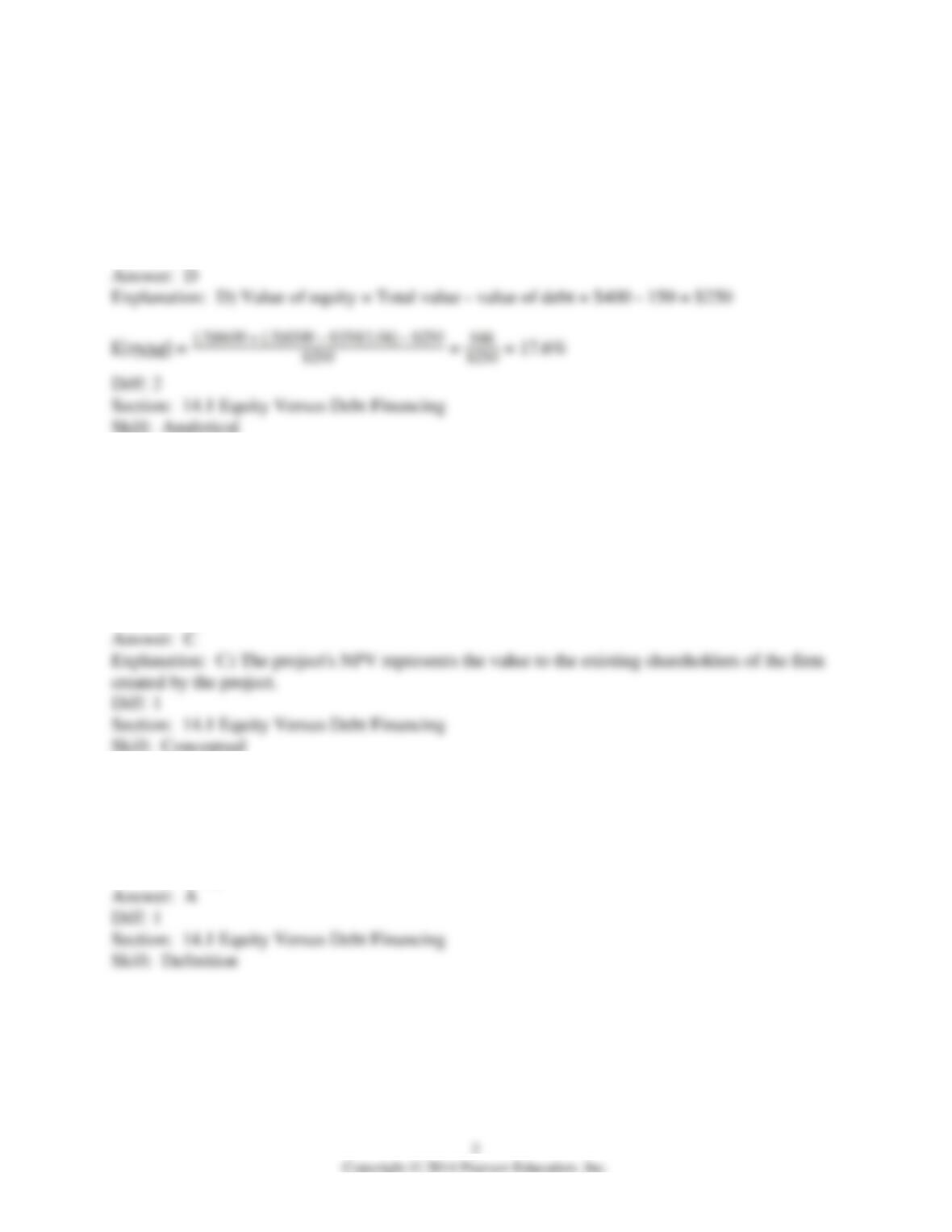
2) Suppose the risk-free interest rate is 4%. If Nielson borrows $150 million today at this rate
and uses the proceeds to pay an immediate cash dividend, then according to MM, the market
value of its equity just after the dividend is paid would be closest to:
A) $0 million
B) $150 million
C) $250 million
D) $400 million
3) Suppose the risk-free interest rate is 4%. If Nielson borrows $150 million today at this rate
and uses the proceeds to pay an immediate cash dividend, then according to MM, the expected
return of Nielson’s stock just after the dividend is paid would be closest to:
A) -17.5%
B) -12.5%
C) 12.5%
D) 17.5%
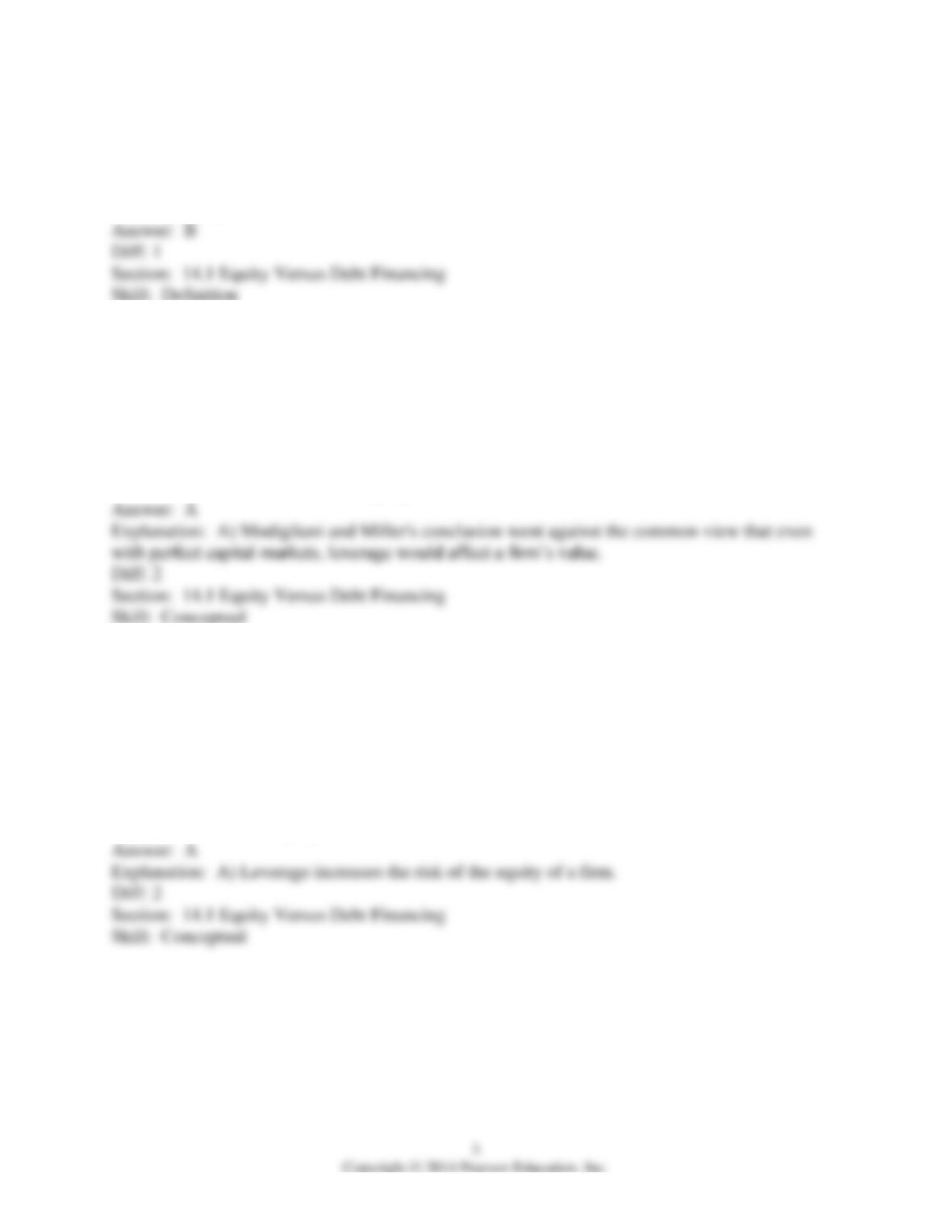
4) Which of the following statements is FALSE?
A) The relative proportions of debt, equity, and other securities that a firm has outstanding
constitute its capital structure.
B) The most common choices are financing through equity alone and financing through a
combination of debt and equity.
C) The project’s NPV represents the value to the new investors of the firm created by the project.
D) When corporations raise funds from outside investors, they must choose which type of
security to issue.
5) Equity in a firm with debt is called:
A) levered equity.
B) riskless equity.
C) unlevered equity.
D) risky equity.
6) Equity in a firm with no debt is called:
A) levered equity.
B) unlevered equity.
C) riskless equity.
D) risky equity.
7) Which of the following statements is FALSE?
A) Modigliani and Miller’s conclusion verified the common view, which stated that even with
perfect capital markets, leverage would affect a firm’s value.
B) We can evaluate the relationship between risk and return more formally by computing the
sensitivity of each security’s return to the systematic risk of the economy.
C) Investors in levered equity require a higher expected return to compensate for its increased
risk.
D) Leverage increases the risk of equity even when there is no risk that the firm will default.
8) Which of the following statements is FALSE?
A) Leverage decreases the risk of the equity of a firm.
B) Because the cash flows of the debt and equity sum to the cash flows of the project, by the
Law of One Price the combined values of debt and equity must be equal to the cash flows of the
project.
C) Franco Modigliani and Merton Miller argued that with perfect capital markets, the total value
of a firm should not depend on its capital structure.
D) It is inappropriate to discount the cash flows of levered equity at the same discount rate that
we use for unlevered equity.
Use the information for the question(s) below.
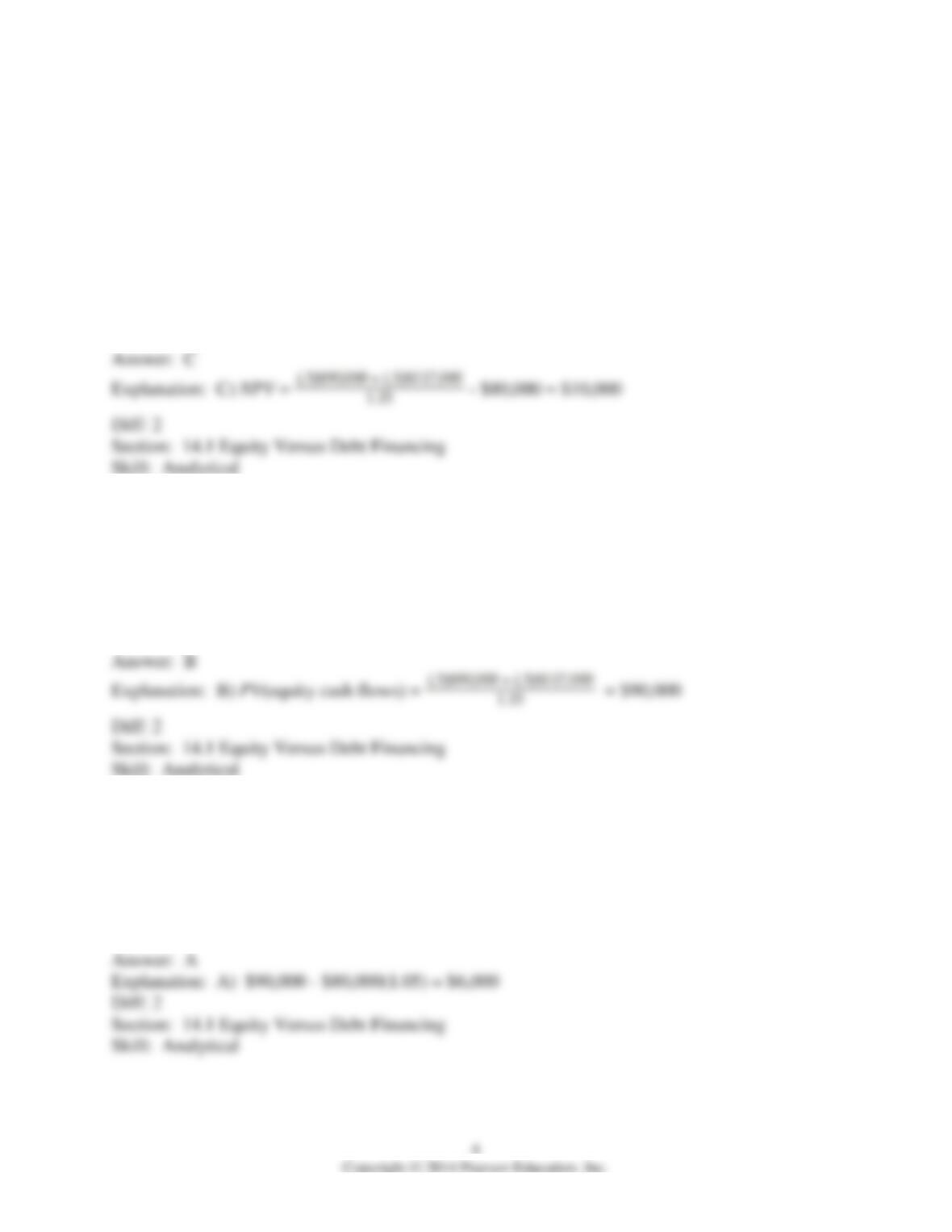
Consider a project with free cash flows in one year of $90,000 in a weak economy or $117,000
in a strong economy, with each outcome being equally likely. The initial investment required for
the project is $80,000, and the project’s cost of capital is 15%. The risk-free interest rate is 5%.
9) The NPV for this project is closest to:
A) $6,250
B) $14,100
C) $10,000
D) $18,600
10) Suppose that to raise the funds for the initial investment, the project is sold to investors as an
all-equity firm. The equity holders will receive the cash flows of the project in one year. The
market value of the unlevered equity for this project is closest to:
A) $94,100
B) $90,000
C) $86,250
D) $98,600
11) Suppose that to raise the funds for the initial investment the firm borrows $80,000 at the risk
free rate, then the cash flow that equity holders will receive in one year in a weak economy is
closest to:
A) $6,000
B) $10,000
C) $0
D) $33,000
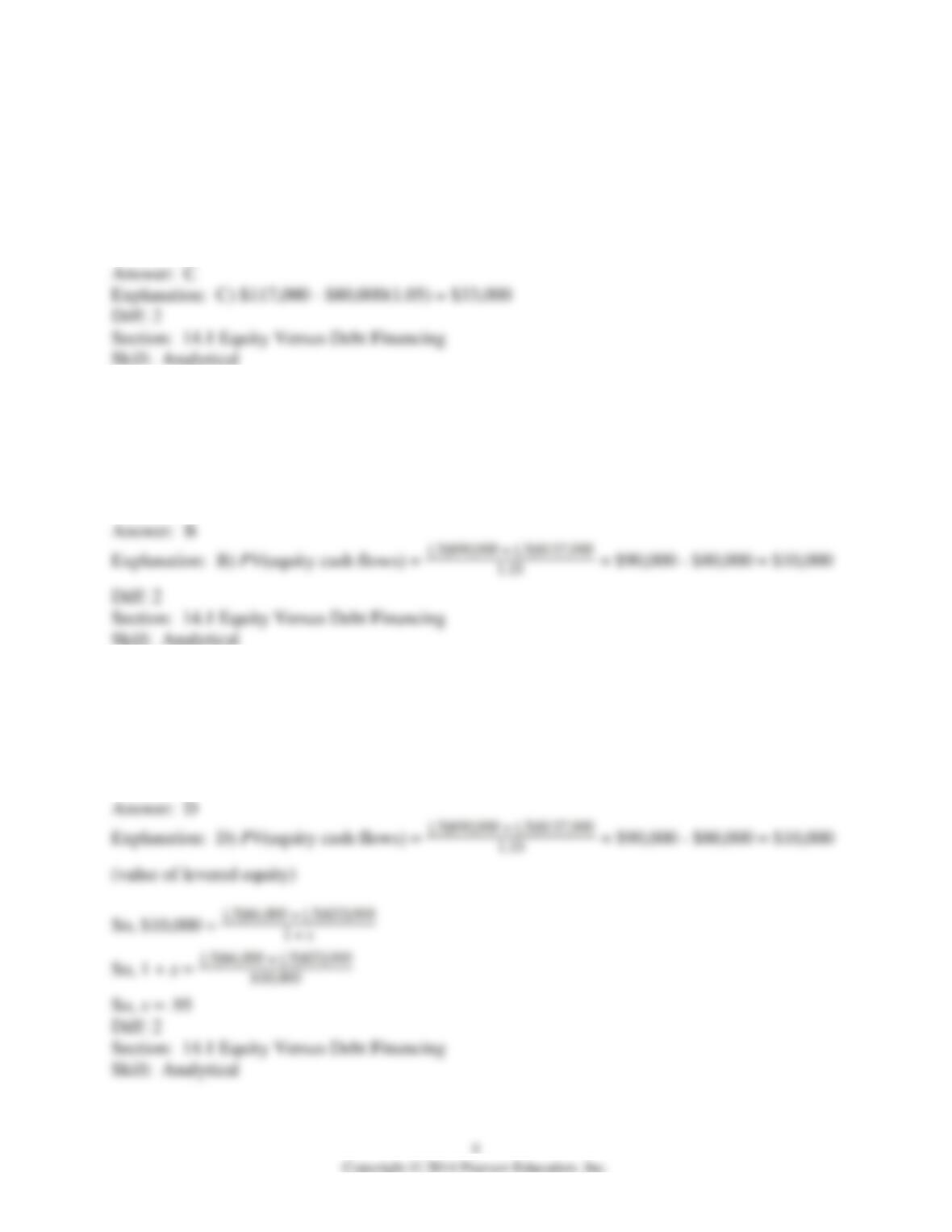
12) Suppose that to raise the funds for the initial investment the firm borrows $80,000 at the risk
free rate, then the cash flow that equity holders will receive in one year in a strong economy is
closest to:
A) $0
B) $6,000
C) $33,000
D) $10,000
13) Suppose that to raise the funds for the initial investment the firm borrows $80,000 at the risk
free rate, then the value of the firm’s levered equity from the project is closest to:
A) $0
B) $10,000
C) $6,000
D) $8,600
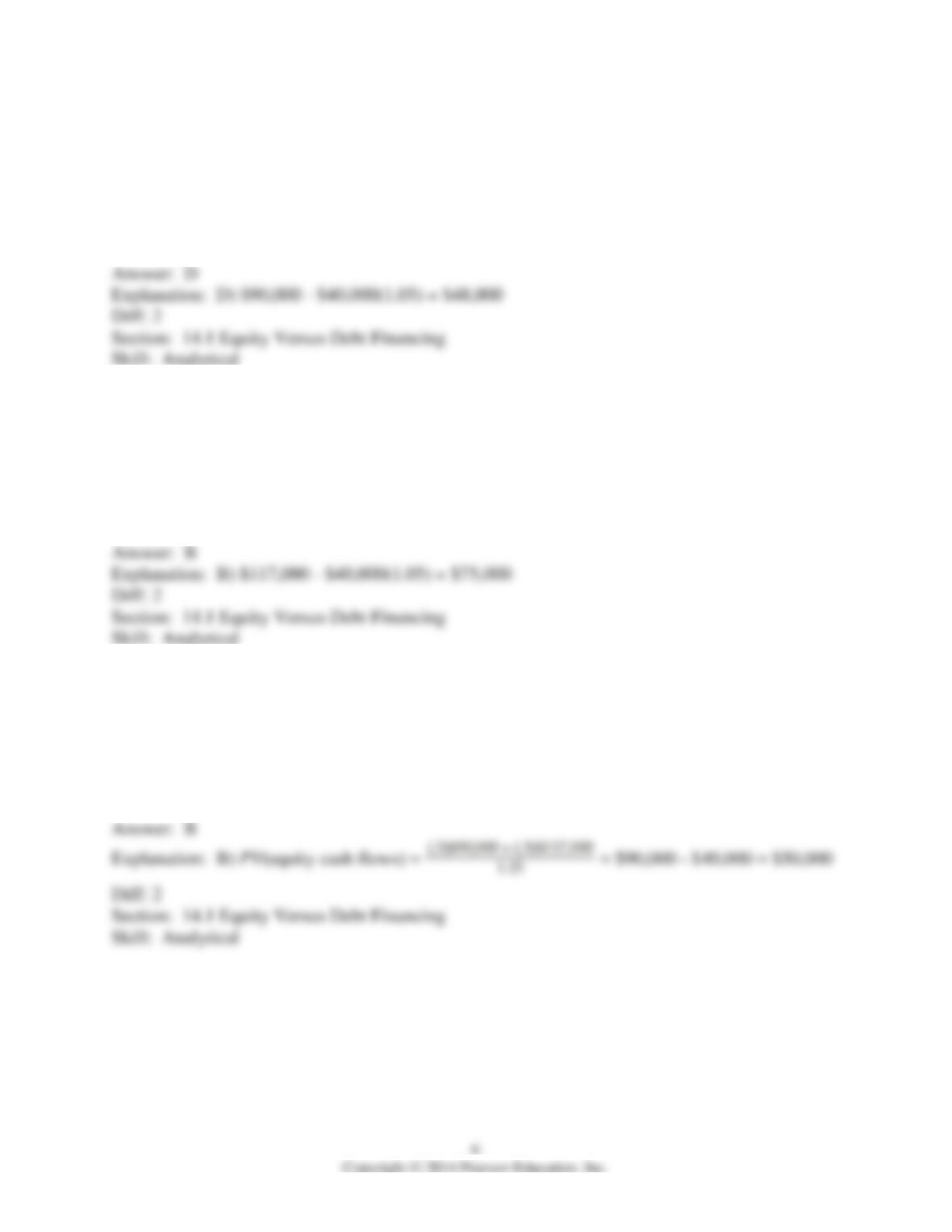
14) Suppose that to raise the funds for the initial investment the firm borrows $80,000 at the risk
free rate, then the cost of capital for the firm’s levered equity is closest to:
A) 45%
B) 25%
C) 15%
D) 95%
15) Suppose that to raise the funds for the initial investment the firm borrows $40,000 at the risk
free rate and issues new equity to cover the remainder. In this situation, the cash flow that equity
holders will receive in one year in a weak economy is closest to:
A) $90,000
B) $0
C) $50,000
D) $48,000
16) Suppose that to raise the funds for the initial investment the firm borrows $40,000 at the risk
free rate and issues new equity to cover the remainder. In this situation, the cash flow that equity
holders will receive in one year in a strong economy is closest to:
A) $117,000
B) $75,000
C) $50,000
D) $0
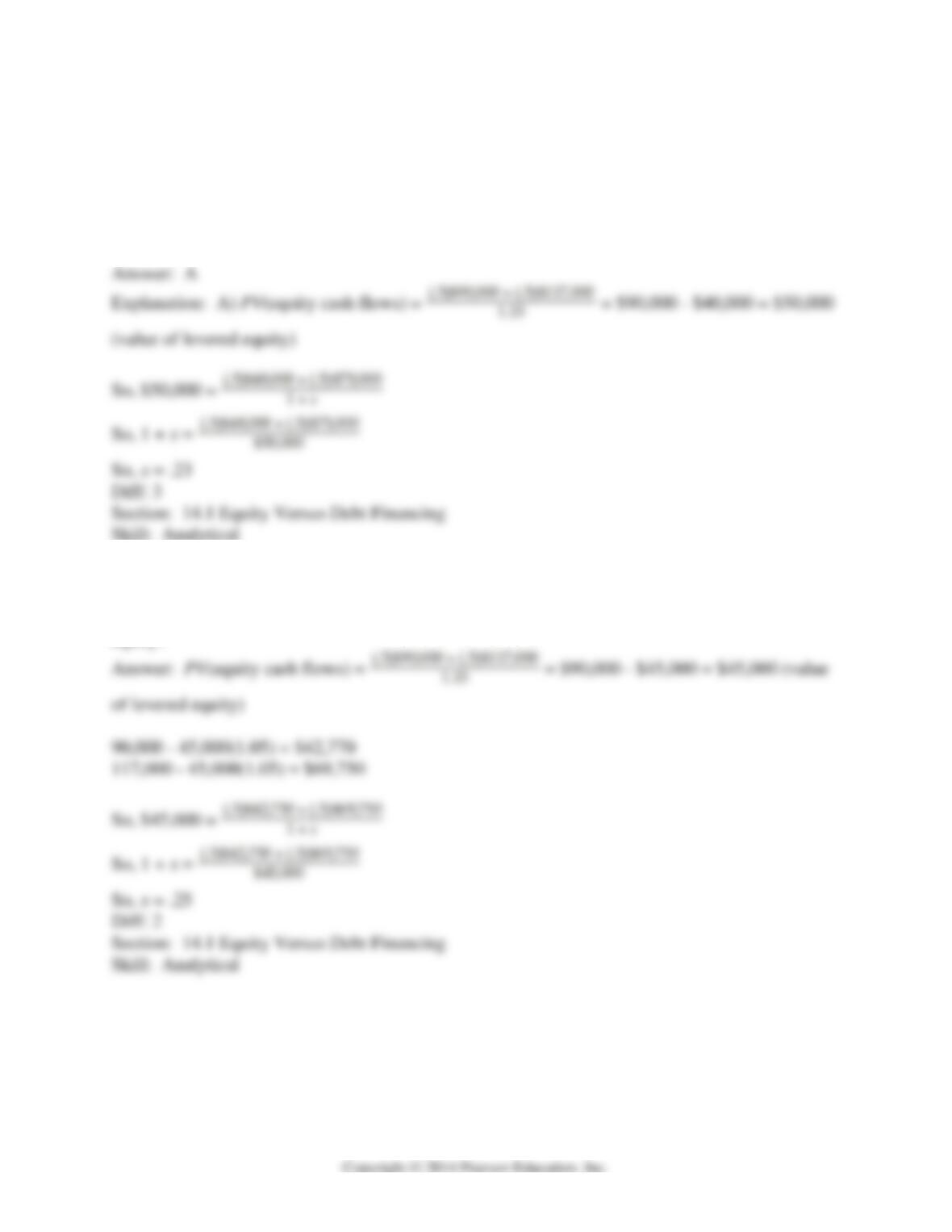
17) Suppose that to raise the funds for the initial investment the firm borrows $40,000 at the risk
free rate and issues new equity to cover the remainder. In this situation, the value of the firm’s
levered equity from the project is closest to:
A) $0
B) $50,000
C) $90,000
D) $40,000
7
18) Suppose that to raise the funds for the initial investment the firm borrows $40,000 at the risk
free rate and issues new equity to cover the remainder. In this situation, the cost of capital for
the firm’s levered equity is closest to:
A) 23%
B) 25%
C) 15%
D) 18%
19) Suppose that to raise the funds for the initial investment the firm borrows $45,000 at the risk
free rate and issues new equity to cover the remainder. In this situation, calculate the value of
the firm’s levered equity from the project. What is the cost of capital for the firm’s levered
equity?
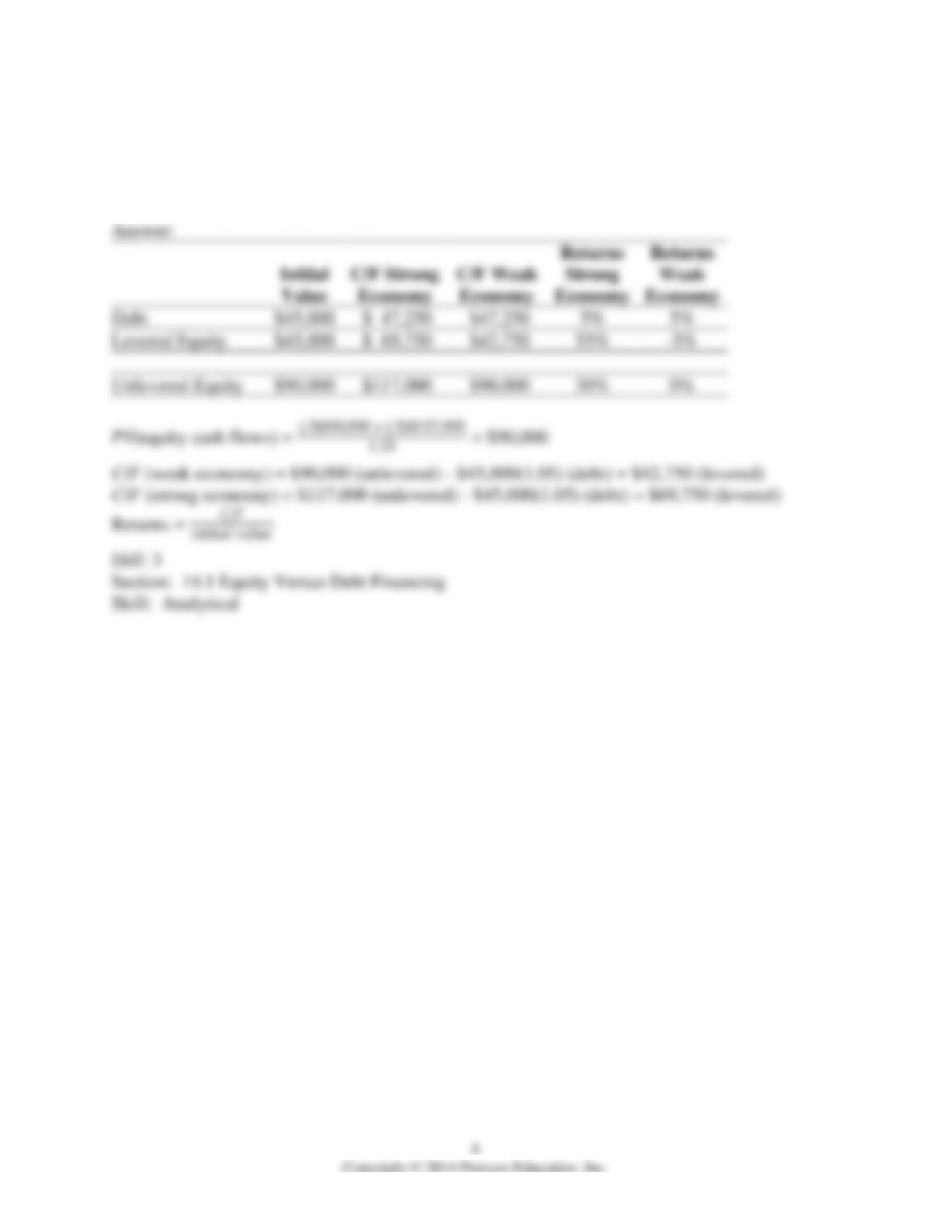
20) Two separate firms are considering investing in this project. Firm unlevered plans to fund
the entire $80,000 investment using equity, while firm levered plans to borrow $45,000 at the
risk-free rate and use equity to finance the remainder of the initial investment. Construct a table
detailing the percentage returns to the equity holders of both the levered and unlevered firms for
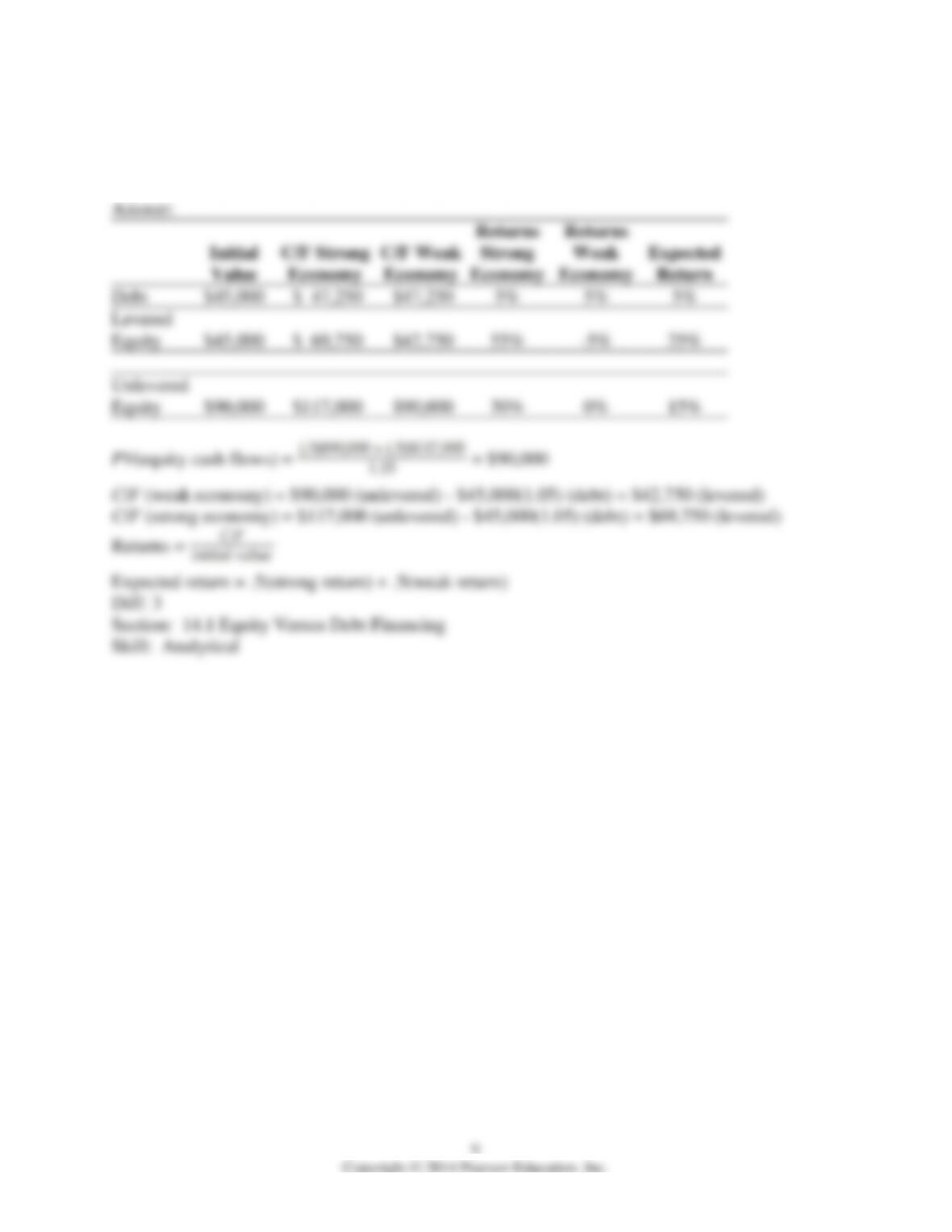
both the weak and strong economy.
21) Two separate firms are considering investing in this project. Firm unlevered plans to fund
the entire $80,000 investment using equity, while firm levered plans to borrow $45,000 at the
risk-free rate and use equity to finance the remainder of the initial investment. Calculate the
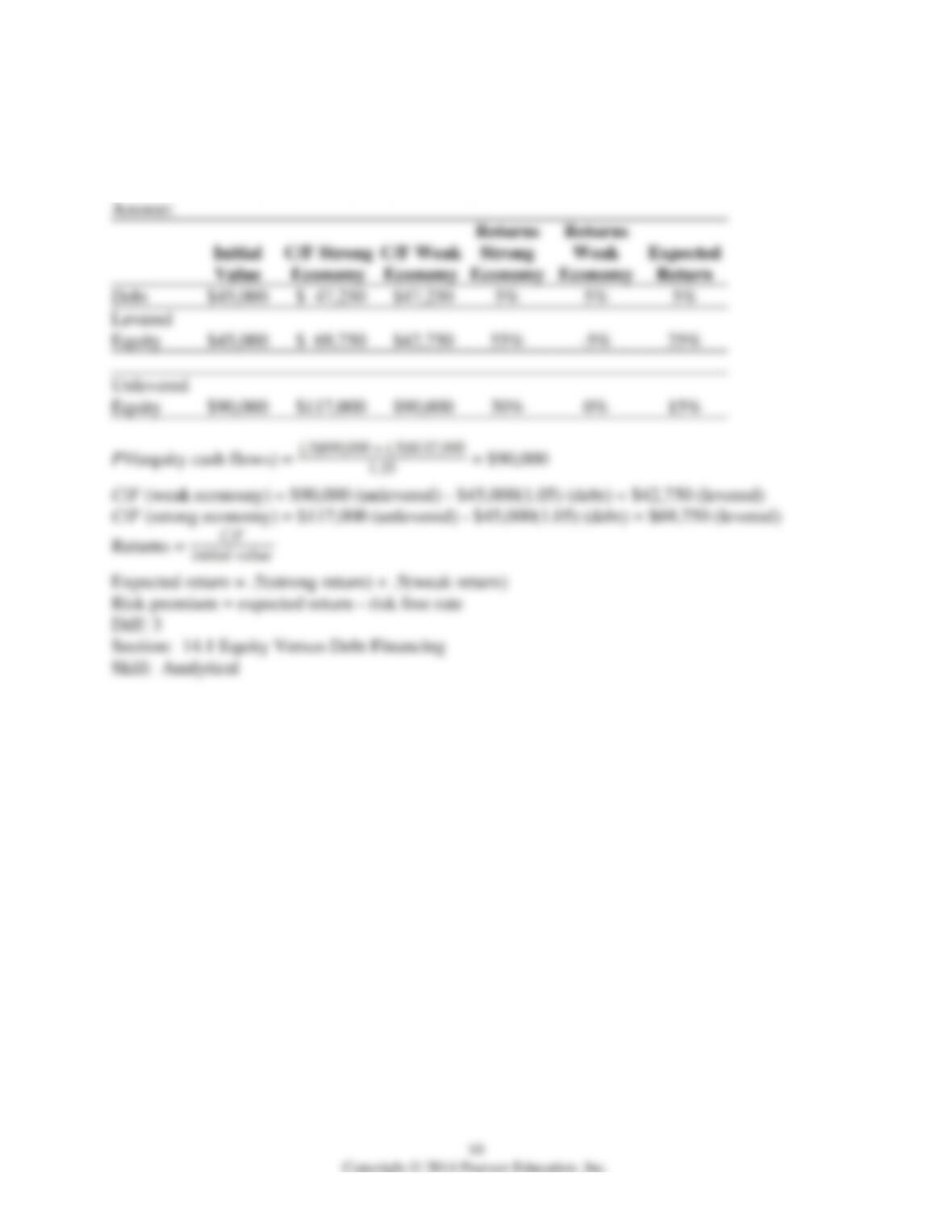
expected returns for both the levered and unlevered firm.
22) Two separate firms are considering investing in this project. Firm unlevered plans to fund
the entire $80,000 investment using equity, while firm levered plans to borrow $45,000 at the
risk-free rate and use equity to finance the remainder of the initial investment. Calculate the risk
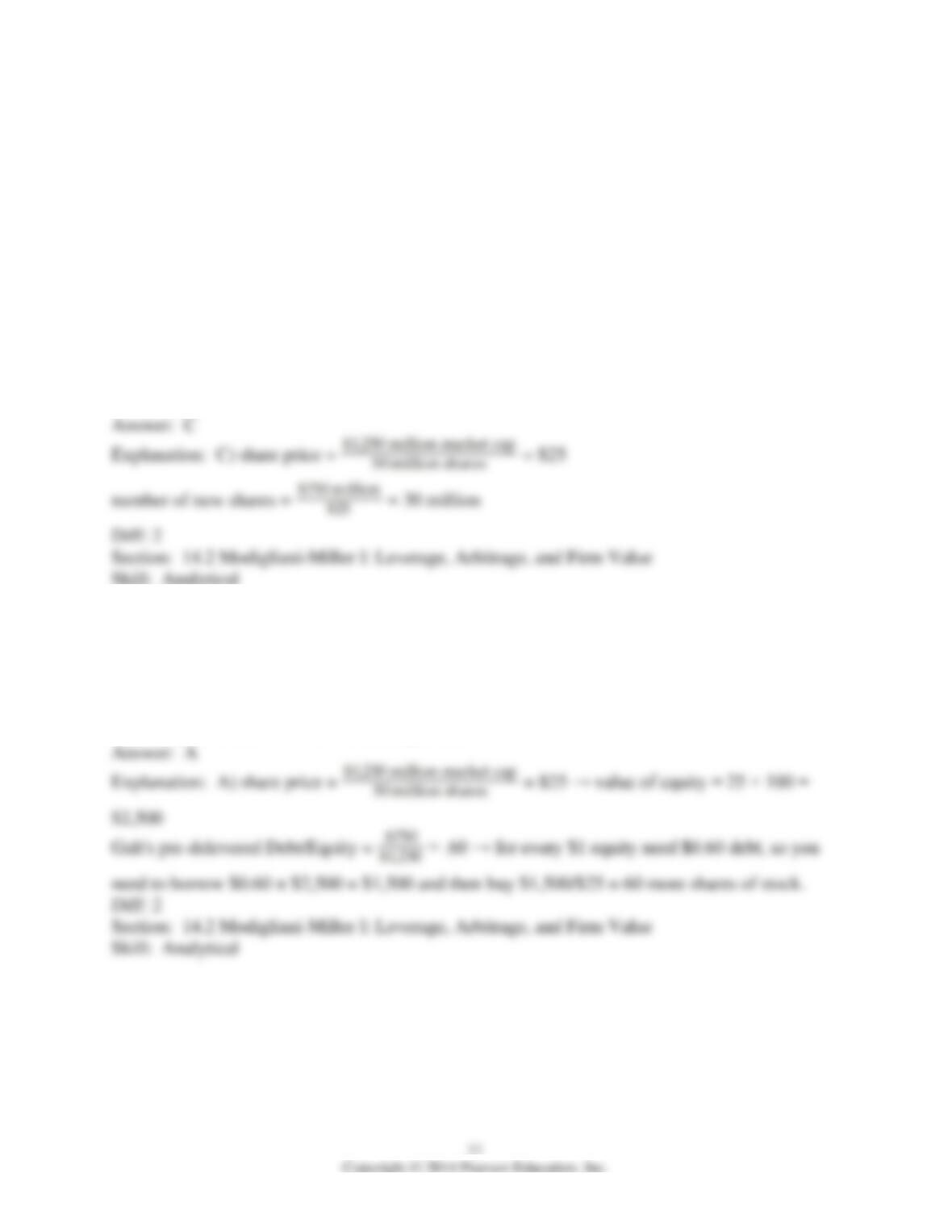
premiums for both the levered and unlevered firm.
14.2 Modigliani-Miller I: Leverage, Arbitrage, and Firm Value
Use the following information to answer the question(s) below.
Galt Industries has 50 million shares outstanding and a market capitalization of $1.25 billion. It
also has $750 million in debt outstanding. Galt Industries has decided to delever the firm by
issuing new equity and completely repaying all the outstanding debt. Assume perfect capital
markets.
1) The number of shares that Galt must issue is closest to:
A) 15 million
B) 25 million
C) 30 million
D) 40 million
2) Suppose you are a shareholder in Galt industries holding 100 shares, and you disagree with
this decision to delever the firm. You can undo the effect of this decision by
A) borrowing $1500 and buying 60 shares of stock.
B) selling 32 shares of stock and lending $800.
C) borrowing $1000 and buying 40 shares of stock.
D) selling 40 shares of stock and lending $1000.
3) Suppose you are a shareholder in Galt industries holding 600 shares, and you disagree with
this decision to delever the firm. You can undo the effect of this decision by:
A) Borrow $6,000 and buy 240 shares of stock
B) Sell 240 shares of stock and lend $6,000
C) Borrow $9,000 and buy 360 shares of stock
D) Sell 360 shares of stock and lend $9,000
4) The market capitalization of d’Anconia Copper before this transaction takes place is closest to:
A) $800 million
B) $900 million
C) $1,100 million
D) $1,200 million
5) The market capitalization of d’Anconia Copper after this transaction takes place is closest to:
A) $800 million
B) $900 million
C) $1,100 million
D) $1,200 million
6) At the conclusion of this transaction, the number of shares that d’Anconia Copper will
repurchase is closest to:
A) 5 million
B) 15 million
C) 20 million
D) 40 million
7) At the conclusion of this transaction, the number of shares that d’Anconia Copper will have
outstanding is closest to:
A) 5 million
B) 15 million
C) 20 million
D) 40 million
8) At the conclusion of this transaction, the value of a share of d’Anconia Copper will be closest
to:
A) $18.33
B) $20.00
C) $25.00
D) $27.50
9) Suppose you are a shareholder in d’Anconia Copper holding 300 shares, and you disagree with
the decision to lever the firm. You can undo the effect of this decision by
A) borrowing $2,000 and buying 100 shares of stock.
B) selling 100 shares of stock and lending $2,000.
C) borrowing $1,200 and buying 60 shares of stock.
D) selling 60 shares of stock and lending $1,200.
10) Suppose you are a shareholder in d’Anconia Copper holding 500 shares, and you disagree
with the decision to lever the firm. You can undo the effect of this decision by:
A) borrowing $2,000 and buying 100 shares of stock.
B) selling 100 shares of stock and lending $2,000.
C) borrowing $1,200 and buying 60 shares of stock.
D) selling 60 shares of stock and lending $1,200.
11) Which of the following is NOT one of Modigliani and Miller’s set of conditions referred to
as perfect capital markets?
A) All investors hold the efficient portfolio of assets.
B) There are no taxes, transaction costs, or issuance costs associated with security trading.
C) A firm’s financing decisions do not change the cash flows generated by its investments, nor
do they reveal new information about them.
D) Investors and firms can trade the same set of securities at competitive market prices equal to
the present value of their future cash flows.
12) Which of the following statements is FALSE?
A) The Law of One Price implies that leverage will affect the total value of the firm under
perfect capital market conditions.
B) In the absence of taxes or other transaction costs, the total cash flow paid out to all of a firm’s
security holders is equal to the total cash flow generated by the firm’s assets.
C) With perfect capital markets, leverage merely changes the allocation of cash flows between
debt and equity, without altering the total cash flows of the firm.
D) In a perfect capital market, the total value of a firm is equal to the market value of the total
cash flows generated by its assets and is not affected by its choice of capital structure.
13) Which of the following statements is FALSE?
A) As long as the firm’s choice of securities does not change the cash flows generated by its
assets, the capital structure decision will not change the total value of the firm or the amount of
capital it can raise.
B) If securities are fairly priced, then buying or selling securities has an NPV of zero and,
therefore, should not change the value of a firm.
C) The future repayments that the firm must make on its debt are equal in value to the amount of
the loan it receives up front.
D) An investor who would like more leverage than the firm has chosen can lend and add
leverage to his or her own portfolio.
14) Which of the following statements is FALSE?
A) As long as investors can borrow or lend at the same interest rate as the firm, homemade
leverage is a perfect substitute for the use of leverage by the firm.
B) When investors use leverage in their own portfolios to adjust the leverage choice made by the
firm, we say that they are using homemade leverage.
C) The value of the firm is determined by the present value of the cash flows from its current and
future investments.
D) The investor can re-create the payoffs of unlevered equity by borrowing and using the
proceeds to purchase the equity of the firm.
15) Which of the following statements is FALSE?
A) When a firm issues new shares that account for a significant percentage of its outstanding
shares, the transaction is called a leveraged recapitalization.
B) MM Proposition I applies to capital structure decisions made at any time during the life of the
firm.
C) By choosing positive-NPV projects that are worth more than their initial investment, the firm
can enhance its value.
D) Holding fixed the cash flows generated by the firm’s assets, however, the choice of capital
structure does not change the value of the firm.
16) Which of the following statements is FALSE?
A) Investors can alter the leverage choice of the firm to suit their personal tastes either by
borrowing and reducing leverage or by holding bonds and adding more leverage.
B) On the market value balance sheet the total value of all securities issued by the firm must
equal the total value of the firm’s assets.
C) The market value balance sheet captures the idea that value is created by a firm’s choice of
assets and investments.
D) One application of MM Proposition I is the useful device known as the market value balance
sheet of the firm.
Use the information for the question(s) below.
Consider two firms, With and Without, that have identical assets that generate identical cash
flows. Without is an all-equity firm, with 1 million shares outstanding that trade for a price of
$24 per share. With has 2 million shares outstanding and $12 million dollars in debt at an
interest rate of 5%.
17) According to MM Proposition 1, the stock price for With is closest to:
A) $8.00
B) $24.00
C) $6.00
D) $12.00
18) Assume that MM’s perfect capital markets conditions are met and that you can borrow and
lend at the same 5% rate as With. You have $5000 of your own money to invest and you plan on
buying Without stock. Using homemade leverage, how much do you need to borrow in your
margin account so that the payoff of your margined purchase of Without stock will be the same
as a $5000 investment in With stock?
A) $10,000
B) $5000
C) $2,500
D) $0
19) Assume that MM’s perfect capital markets conditions are met and that you can borrow and
lend at the same 5% rate as with. You have $5000 of your own money to invest and you plan on
buying Without stock. Using homemade leverage you borrow enough in your margin account so
that the payoff of your margined purchase of Without stock will be the same as a $5000
investment in with stock. The number of shares of Without stock you purchased is closest to:
A) 425
B) 1650
C) 2000
D) 825
20) Assume that MM’s perfect capital markets conditions are met and that you can borrow and
lend at the same 5% rate as with. You have $5000 of your own money to invest and you plan on
buying With stock. Using homemade (un)leverage, how much do you need to invest at the risk-
free rate so that the payoff of your account will be the same as a $5000 investment in Without
stock?
A) $5000
B) $0
C) $2,500
D) $4,000
21) Assume that MM’s perfect capital markets conditions are met and that you can borrow and
lend at the same 5% rate as with. You have $5000 of your own money to invest and you plan on
buying With stock. Using homemade (un)leverage you invest enough at the risk-free rate so that
the payoff of your account will be the same as a $5000 investment in Without stock? The
number of shares of With stock you purchased is closest to:
A) 100
B) 425
C) 1650
D) 825
Use the information for the question(s) below.
Luther is a successful logistical services firm that currently has $5 billion in cash. Luther has
decided to use this cash to repurchase shares from its investors, and has already announced the
stock repurchase plan. Currently Luther is an all equity firm with 1.25 billion shares
outstanding. Luther’s shares are currently trading at $20 per share.
22) The market value of Luther’s non-cash assets is closest to:
A) $20 billion
B) $19 billion
C) $25 billion
D) $24 billion
23) After the repurchase how many shares will Luther have outstanding?
A) 0.75 billion
B) 1.0 billion
C) 1.1 billion
D) 1.2 billion
24) With perfect capital markets, what is the market value of Luther’s equity after the share
repurchase?
A) $15 billion
B) $10 billion
C) $25 billion
D) $20 billion
25) With perfect capital markets, what is the market price per share of Luther’s stock after the
share repurchase?
A) $25
B) $24
C) $15
D) $20