13. Following are the income statement and other information for Polk Corporation.
Polk Corporation
Income Statement
For the Year Ended December 31, 20xx
Sales
$6,000
Cost of goods sold
3,000
Gross margin
$3,000
Operating expenses
$1,200
Depreciation expense
600
1,800
Income before income taxes
$1,200
Income taxes expense
300
Net income
$ 900
Net income
Adjustments to reconcile net income to net cash
flows from operating activities
Depreciation
Changes in current assets and current liabilities
Decrease in accounts receivable
750
Increase in inventory
Decrease in accounts payable
Increase in income taxes payable
Net cash flows from operating activities
Accounts receivable (net) decreased by $1,500 during the year. Inventory increased by $900, and
Accounts Payable decreased by $1,200 during the year. Income Taxes Payable increased by $300
during the year.
Prepare a schedule of cash flows from operating activities using the indirect method.
Polk Corporation
Schedule of Cash Flows from Operating Activities
For the Year Ended December 31, 20xx
14. Malzone Enterprises is preparing a statement of cash flows using the indirect method. Indicate on the
blanks below whether each item is an operating activity (O), an investing activity (I), a financing
activity (F), a noncash transaction (N), or an item that would not appear on or with Malzone’s
statement (NA).
_____ 1. The change in Accounts Payable during the period
_____ 2. Depreciation expense
_____ 3. Exchange of stock for a building
Net income
flows from operating activities
Depreciation
Changes in current assets and current liabilities
Decrease in accounts receivable
Increase in inventory
Decrease in accounts payable
(1,200)
Increase in income taxes payable
Net cash flows from operating activities
_____ 4. Purchase of equipment
_____ 5. Purchases of treasury stock
_____ 6. Borrowing by issuing bonds
_____ 7. A gain on the sale of equipment
_____ 8. Collections from customers
_____ 9. Dividends paid
_____ 10. Income taxes paid
_____ 11. Proceeds from sale of long-term investments at a loss
_____ 12. The change in Inventory for the period
ANS:
15. Geiger Company’s cash balance at December 31, 2009, was $169,000. Calculate the company’s cash
balance at December 31, 2010, given the following information for the year ended December 31, 2010.
Show your work.
Net Income
$370,000
Depreciation and Amortization Expense
98,000
Increase in Accounts Receivable (net)
14,000
Decrease in Inventory
25,000
Increase in Accounts Payable
20,000
Net Cash Flows from Investing Activities
133,000
Net Cash Flows from Financing Activities
(600,000)
1. O
7. O
2. O
8. NA
3. N
9. F
4. I
10. NA
5. F
6. F
12. O
16. Give two explanations for why the amount of cash outflow for equipment for the year might not equal
the increase in the Equipment account balance from one balance sheet date to the next.
ANS:
17. Indicate on the blanks below the letter of the type of activity (O = operating activity, F = financing
activity, I = investing activity, N = noncash transaction) each of the following transactions represents.
_____ 1. Company sold shares of its own stock for cash.
_____ 2. Acquired land and buildings by issuance of long-term mortgage payable.
_____ 3. Declared and paid cash dividends.
_____ 4. Received interest income.
_____ 5. Exchanged shares of stock for 15-year bonds.
_____ 6. Paid the U.S. Treasury for income taxes.
_____ 7. Collected proceeds from the sale of a long-term investment at cost.
_____ 8. Declared stock dividends.
_____ 9. Paid off long-term debt with cash.
_____ 10. Purchased equipment with cash.
18. For 20xx, EHJ Corporation had average total assets of $260,000, sales of $225,000, net income of
$25,000, net cash flows from operating activities of $37,500, dividend payments of $12,500, purchases
of plant assets of $30,000, and sales of plant assets of $27,500. Using this information, compute (a)
cash flow yield, (b) cash flows to sales, (c) cash flows to assets, and (d) free cash flow. Round amounts
to one decimal place.
19. For 20xx, SCJ Corporation had average total assets of $520,000, sales of $450,000, net income of
$50,000, net cash flows from operating activities of $75,000, dividend payments of $25,000, purchases
of plant assets of $60,000, and sales of plant assets of $55,000. Using this information, compute (a)
cash flow yield, (b) cash flows to sales, (c) cash flows to assets, and (d) free cash flow. Round amounts
to one decimal place.
20. The following comparative balance sheet and other information relate to Runnels Corporation.
Runnels Corporation
Comparative Balance Sheets
December 31, 2010 and 2009
Assets
2010
2009
Cash
$ 140
$ 140
Accounts receivable (net)
210
280
Inventory
350
420
Prepaid expenses
105
70
Equipment (net)
3,010
2,800
Investments and other assets
4,900
4,200
Total assets
$8,715
$7,910
Liabilities and Stockholders’ Equity
Accounts payable
$ 350
$ 280
Income taxes payable
70
140
Long-term note payable
2,100
1,400
Common stock
1,400
1,400
Retained earnings
4,795
4,690
Total liabilities and stockholders’ equity
$8,715
$7,910
Additional information:
Depreciation expense $280
Cash dividends declared and paid 70
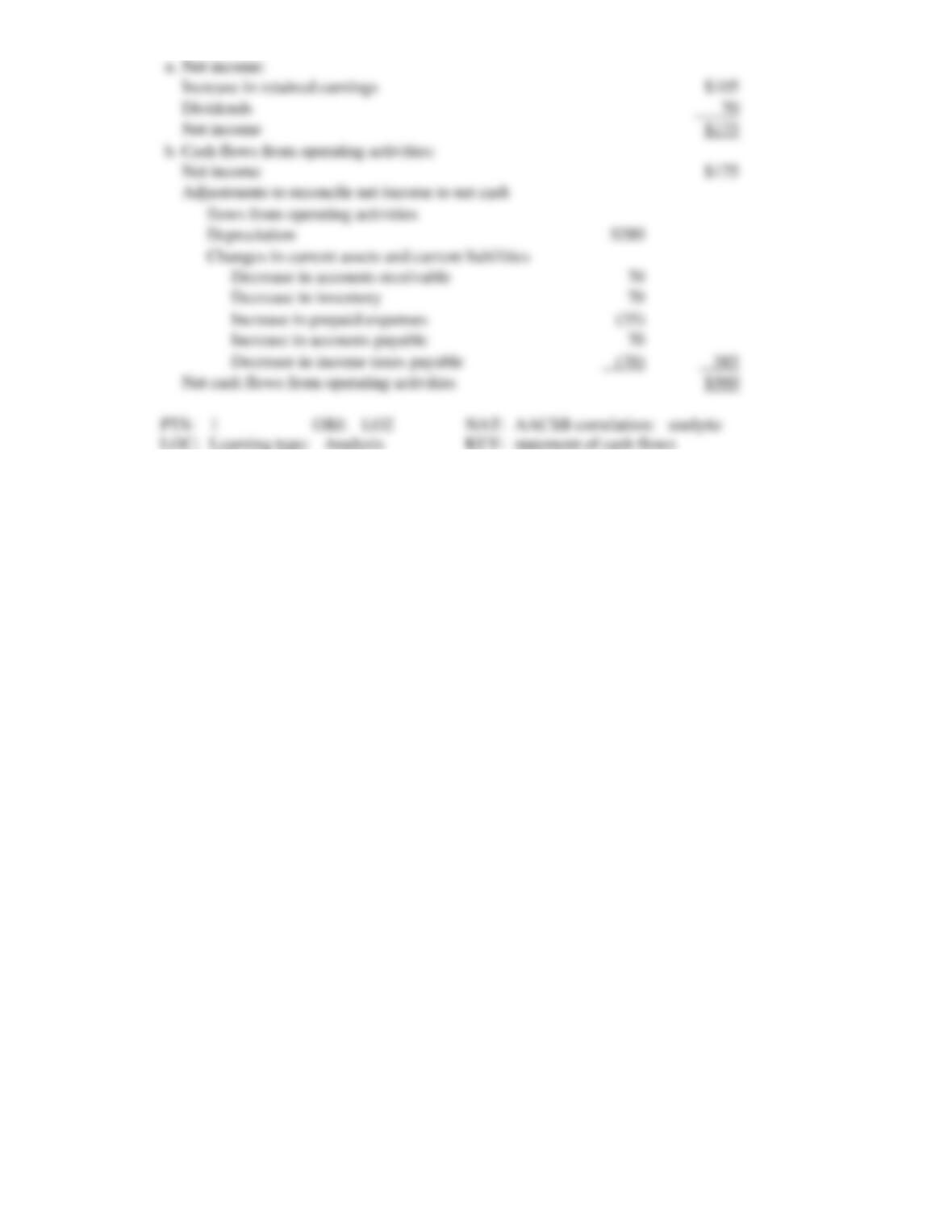
a. Compute net income, assuming net income and the cash dividends were the only items affecting
retained earnings. Show your work.
b. Compute net cash flows from operating activities using the indirect method.
ANS:
21. The following 2009 information relates to Raddatz, Inc.:
Net Income
$365,000
Depreciation Expense
96,000
Amortization of Intangible Assets
11,000
Beginning Accounts Receivable
420,000
Ending Accounts Receivable
439,000
Beginning Inventory
516,000
Ending Inventory
560,000
Beginning Prepaid Expenses
48,000
Ending Prepaid Expenses
42,000
Beginning Accounts Payable
119,000
Ending Accounts Payable
146,000
Purchase of Long-Term Assets for Cash
616,000
Cash from Issuance of Long-Term Debt
200,000
Issuance of Stock for Cash
160,000
Issuance of Stock for Long-Term Assets
110,000
Purchase of Treasury Stock
64,000
Sale of Long-Term Investment at Cost
39,000
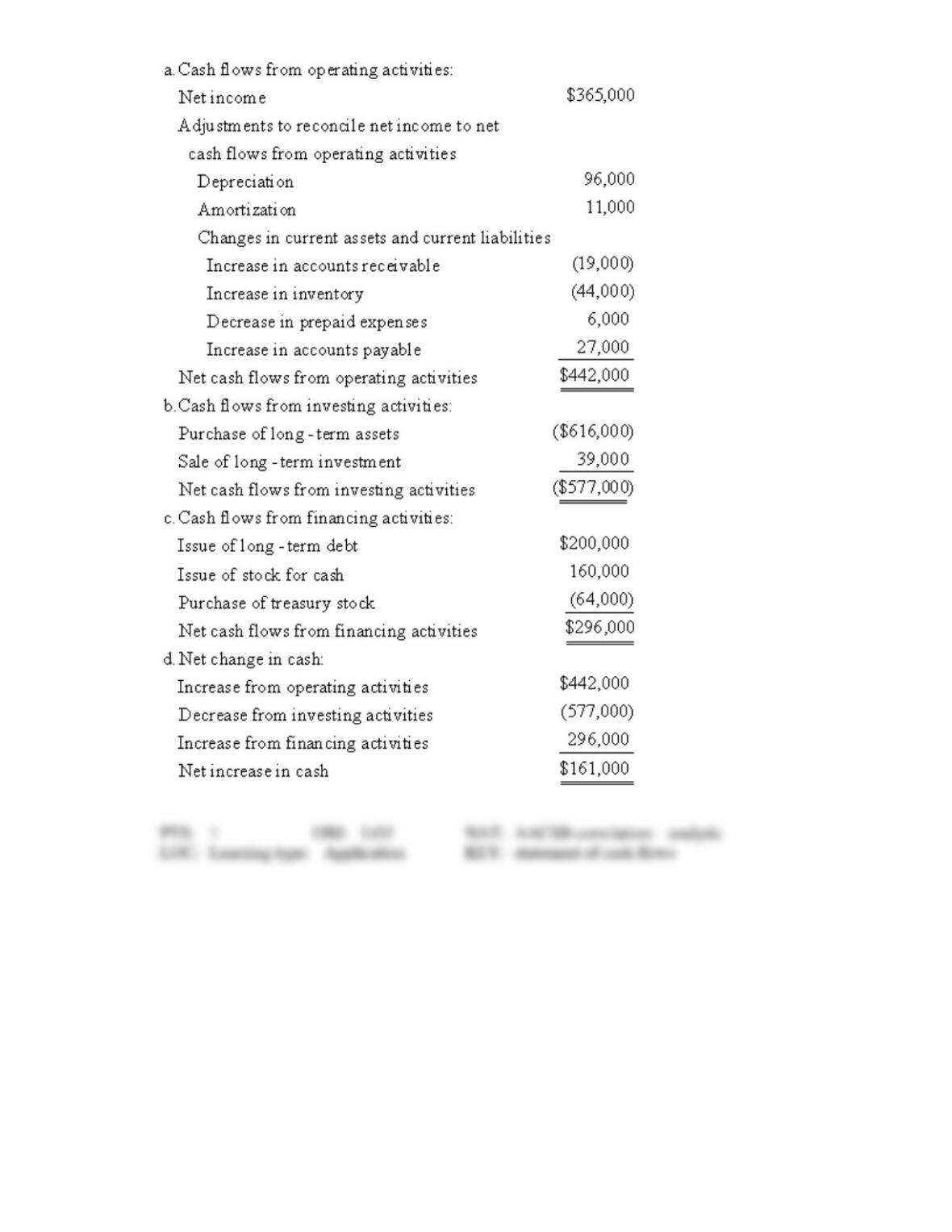
a. Calculate the net cash flows from operating activities. Show your work.
b. Calculate the net cash flows from investing activities. Show your work.
c. Calculate the net cash flows from financing activities. Show your work.
d. Calculate the net change in cash. Show your work.
ANS:
22. The following information relates to Lonborg Corporation for the year ended December 31, 2009:
Net Income
$300,000
Depreciation Expense
72,000
Amortization of Intangible Assets
9,000
Beginning Accounts Receivable
336,000
Ending Accounts Receivable
351,000
Beginning Inventory
413,000
Ending Inventory
450,000
Beginning Prepaid Expenses
34,000
Ending Prepaid Expenses
38,000
Beginning Accounts Payable
95,000
Ending Accounts Payable
116,000
Purchase of Long-Term Assets for Cash
493,000
Cash from Issuance of Long-Term Debt
160,000
Issuance of Stock for Cash
128,000
Issuance of Stock for Long-Term Assets
88,000
Purchase of Treasury Stock
51,000
Sale of Long-Term Investment at Cost
31,000
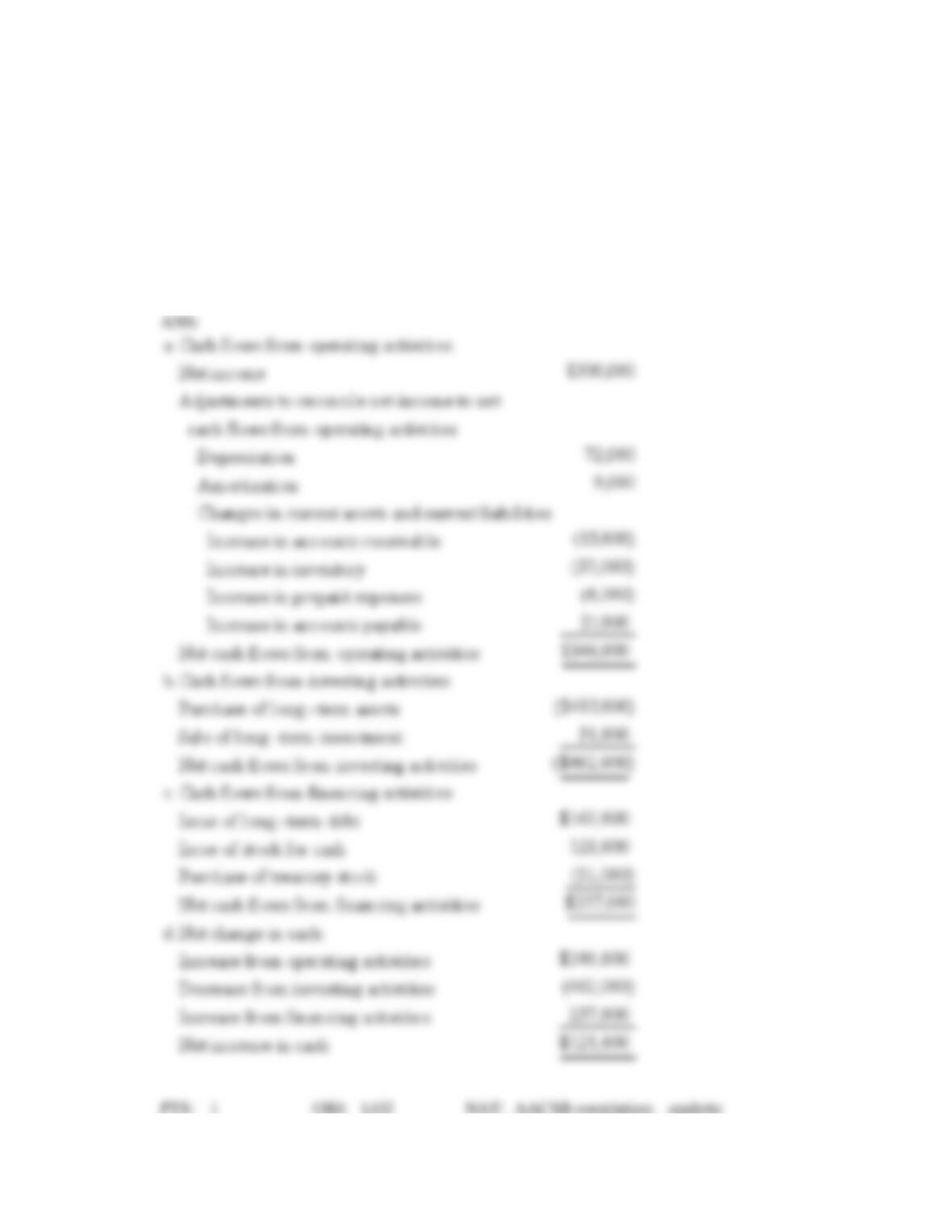
a. Calculate the net cash flows from operating activities. Show your work.
b. Calculate the net cash flows from investing activities. Show your work.
c. Calculate the net cash flows from financing activities. Show your work.
d. Calculate the net change in cash. Show your work.
23. The activity in the Plant Assets and related Accumulated Depreciation accounts for 2009 is shown
below. In addition, the income statement shows a gain on sale of plant assets of $16,000.
Plant Assets
Accumulated Depreciation
Beginning balance, 2009
$234,000
Beginning balance, 2009
$124,000
Purchases
120,000
2009 Depreciation
36,000
Disposals
(82,000)
Disposals
(26,000)
Ending balance, 2009
$272,000
Ending balance, 2009
$134,000
Based on the information given, compute the amounts to be shown and indicate how they would
appear on the statement of cash flows. Assume that the indirect method is being used and that the plant
assets were purchased for cash.
24. The activity from the Long-Term Investments account for Fisk Corporation appears below. In
addition, the income statement shows a loss on the sale of investments of $32,000.
Long-Term Investments
Beginning balance, 2009
$184,000
Purchases
278,000
Sales
(202,000)
Ending balance, 2009
$260,000
Based on the information given, compute the amounts to be shown and indicate how they would
appear on the statement of cash flows. Assume that the indirect method is being used and that the
investments were purchased for cash.
Cash flows from investing activities:
25. The activity from the Long-Term Investments account for Rice Corporation appears below. In
addition, the income statement shows a loss on the sale of investments of $16,000.
Long-Term Investments
Beginning balance, 2009
$ 92,000
Purchases
139,000
Sales
(101,000)
Ending balance, 2009
$130,000
Based on the information given, compute the amounts to be shown and indicate how they would
appear on the statement of cash flows. Assume that the indirect method is being used and that the
investments were purchased for cash.
Cash flows from investing activities:
Purchases of long-term investments
Sales of long-term investments
Net cash flows from investing activities
Purchases of long-term investments
Sales of long-term investments
Net cash flows from investing activities