CHAPTER 14—ENVIRONMENTAL HAZARDS AND HUMAN HEALTH
MULTIPLE CHOICE
1. Bisphenol A (BPA) is an estrogen mimic used in the production of hardened plastic products. This
chemical is a problem when
a.
It is embedded in plastic containers of food products.
b.
Baby bottles that contain it are warmed before use.
c.
Baby bottles that contain it are used for acidic juices, which may leach out the BPA.
d.
Plastic containers with BPA end up as beach litter and cause harm to marine animals.
e.
All of these answers
2. What percentage of Americans over the age of 6 have trace levels of BPA in their bodies?
a.
93%
b.
95%
c.
90%
d.
83%
e.
This applies to citizens of other developed countries, but not America.
3. Risk is expressed as a probability of suffering from
a.
disease
b.
economic loss
c.
death
d.
injury
e.
all of these answers
4. ____ is the scientific process of using statistical methods to estimate how much harm a particular
hazard can cause to human health or the environment.
a.
probability
b.
risk assessment
c.
lifecycle cost-pricing
d.
risk pricing
e.
none of these answers
5. Which of the following is not one of the major types of hazard?
a.
biological hazards
b.
cultural hazards
c.
lifestyle choices
d.
chemical hazards
e.
All of these answers.
6. All of the following are considered to be biological hazards except
a.
viruses
b.
parasites
c.
diet
d.
bacteria
e.
fungi
7. AIDS has reduced the life expectancy of the 750 million people living in sub-Saharan Africa by
a.
5 years
b.
5 to 7 years
c.
10 years
d.
15 to 20 years
e.
none of these answers
8. All of the following statements about AIDS are correct except:
a.
Globally, AIDS is the leading cause of death amongst young people aged 25-44.
b.
The long incubation period for AIDS means that some people spread the virus for years
before they realize they have the disease.
c.
Currently there is no cure for AIDS
d.
90% of the people who suffer from AIDS do not use the drugs that can extend their life
because they are not available in sub-Saharan Africa.
e.
None of these answers.
9. Which of the following infectious diseases is not among the four most deadly?
a.
Flu
b.
Measles
c.
Tuberculosis
d.
Diarrhea
e.
AIDS
10. Genetic resistance to antibiotics has
a.
increased the spread of AIDS
b.
been a factor in the development of MRSA
c.
been favored by overuse of antibiotics
d.
two of these answers are correct
e.
all of these answers
11. Which one of the following infectious diseases has been on the rise since 1990 and kills about 1.3
million people per year?
a.
AIDS
b.
West Nile virus
c.
SARS
d.
measles
e.
tuberculosis
12. The incidence of tuberculosis (TB) is increasing because:
a.
Strains of the TB bacterium have developed resistance to antibiotics.
b.
Population size and air travel have increased.
c.
Immune systems have weakened from the spread of AIDS.
d.
There is a lack of TB screening, especially in developing countries.
e.
All of these answers.
13. Victims of ________________ must be permanently isolated from the rest of society.
a.
AIDS
b.
hepatitis B
c.
multi-drug resistant tuberculosis
d.
measles
e.
SARS
14. Malaria is caused by
a.
viruses
b.
bacteria
c.
Plasmodium parasites
d.
parasitic worms
e.
mosquitoes
15. Effectively combating the spread of malaria has become more challenging since the 1970s because:
a.
The Anopheles mosquito has become genetically resistant to most pesticides.
b.
Plasmodium parasites have become resistant to most antimalarial drugs.
c.
The flea that transmits the disease has become resistant to pesticides.
d.
None of these answers.
e.
Two of these answers.
16. Malaria is spread by
a.
Anopheles mosquitoes
b.
flies
c.
worms
d.
snails
e.
bacteria
17. During the mid-1900s, the spread of malaria decreased sharply from
a.
draining swamplands
b.
draining marshes
c.
spraying breeding areas with pesticides
d.
using drugs to kill the parasites in the bloodstream
e.
all of these answers
18. About ____ of the world’s people are at risk from malaria.
a.
two million
b.
10 percent
c.
1 billion
d.
25%
e.
Half
19. Ecological medicine is a relatively new field of study devoted to
a.
finding a cure for AIDS
b.
the ecology of sick people
c.
diseases that are transmitted from one animal species to another
d.
international diseases such as Asian flu
e.
none of these answers
20. Oral rehydration therapy
a.
is less successful than expected
b.
is too expensive to be practical
c.
was a factor in saving about 3 million lives in 2008
d.
can help prevent death by dehydration of a child with severe diarrhea
e.
None of the above
21. Viral diseases are particularly difficult to combat because they
a.
are not affected by antibiotics
b.
kill large numbers of people
c.
evolve rapidly
d.
all of these answers
e.
none of these answers
22. These diseases are the three largest viral killers.
a.
malaria, AIDS, and SARS
b.
tuberculosis, AIDS, and malaria
c.
Lyme disease, West Nile virus, and SARS
d.
flu, AIDS, and hepatitis B
e.
flu, AIDS, and West Nile virus
23. You were recently hired by WHO (World Health Organization) to investigate the current status of
swine flu outbreaks in a certain part of the United States. Your job title would most likely be
a.
ecological medicine specialist
b.
restoration ecologist
c.
remediation ecologist
d.
recovery botanical specialist
e.
M.D.
24. The principal types of chemical hazards include
a.
Carcinogens
b.
Mutagens
c.
Teratogens
d.
all of these answers.
e.
both carcinogens and mutagens.
25. If you typically consume large amounts of processed foods, and certain wines, which category of
chemical hazard is introduced into your system?
a.
mutagen, because of the nitrites
b.
carcinogen, because of the nitrites
c.
teratogen, because of the nitrites
d.
mutagen, because of the phosphoric acid
e.
carcinogen, because of the high fat content
26. Mutagens
a.
are fatal to humans in low doses
b.
are technically non-toxic
c.
are harmful because they are flammable, explosive, irritating to the skin or lungs, or cause
allergic reactions
d.
cause mutations
e.
all of these answers
27. Mutagens directly change molecules of
a.
water
b.
carbohydrate
c.
DNA
d.
fat
e.
RNA
28. Carcinogens cause
a.
genetic defects
b.
birth defects
c.
Cancer
d.
chronic health effects
e.
allergic reactions
29. Examples of carcinogens include
a.
ultraviolet radiation
b.
certain chemicals in tobacco smoke
c.
Arsenic
d.
A and C are correct
e.
All of the above are correct
30. A delay of ____ years between initial exposure to a carcinogen and appearance of detectable
symptoms is typical.
a.
1–2
b.
2–5
c.
5–10
d.
10–40
e.
40–60
31. The system responsible for defense against disease and harmful substances is the
a.
circulatory system
b.
endocrine system
c.
immune system
d.
excretory system
e.
cardiovascular system
32. Hormonally active agents (HAAs) are a category of chemical hazards that can
a.
Mimic the action of estrogen in the human body.
b.
Disrupt the reproductive system by binding to hormone receptors.
c.
Soften the shells of wild birds and stop their reproduction.
d.
Both disrupt the reproductive system by binding to hormone receptors and soften the
shells of wild birds and stop their reproduction are correct.
e.
Both mimic the action of estrogen in the human body and disrupt the reproductive system
by binding to hormone receptors are correct.
33. A person that develops asthma after living in a city with severe air pollution for decades is
experiencing
a.
a chronic effect
b.
a subchronic effect
c.
an acute effect
d.
a subacute effect
e.
a superacute effect
34. A person experiencing dizziness after using a strong household cleaner is showing
a.
a chronic effect
b.
a subchronic effect
c.
an acute effect
d.
a subacute effect
e.
a superacute effect
35. You are an aquatic biologist studying a small lake. The stream that drains into this lake runs by
croplands. You are detecting a pesticide called atrazine in the insects and worms that live in the lake.
The predatory birds such as herons and egrets have very high concentrations of atrazine in their blood.
The birds prey on the frogs and small fish. What process explains the high atrazine level in the birds?
a.
antagonistic interaction
b.
Persistence
c.
chronic effect
d.
biological magnification
e.
none of these answers
36. What percentage of synthetic chemicals commonly used today has been adequately tested to determine
if they are mutagen, carcinogen, or teratogen?
a.
almost 90%
b.
75%
c.
50%
d.
25%
e.
2%
37. The U.S. Environmental Protection Agency currently recommends that regulators assume children
face a risk ____ times that of adults when exposed to carcinogenic chemicals.
a.
5
b.
10
c.
25
d.
50
e.
100
38. Which statement is true?
a.
All chemicals are unsafe.
b.
Natural chemicals are safe, and synthetic chemicals are deadly.
c.
All chemicals are safe.
d.
Some chemicals, whether synthetic or natural, are safe and others are deadly.
e.
All chemicals are safe except those that cause cancer.
39. Which of the following tools includes the other three?
a.
risk assessment
b.
risk management
c.
risk analysis
d.
risk communication
e.
None of the choices includes any of the others.
40. The major cause of a reduced human life span today is
a.
Poverty
b.
Smoking
c.
Cancer
d.
high cholesterol
e.
Driving
41. Which environmental problem is among the five leading causes of death worldwide?
a.
El Niño
b.
air pollution
c.
water pollution
d.
toxic waste
e.
nuclear waste
42. The strategy that would contribute most to longer lifespan would be
a.
no smoking
b.
regular exercise
c.
safe driving
d.
no alcohol consumption
e.
never traveling by airplane
43. Human reliability is generally ____ technology reliability.
a.
much greater than
b.
slightly greater than
c.
slightly lower than
d.
much lower than
e.
none of these answers
TRUE/FALSE
1. The most preventable kind of hazard is smoking.
2. The three diseases that cause the majority of deaths worldwide are influenza, hepatitis-B, and SARS.
3. Research has indicated that long-term exposure to some chemicals at low doses may disrupt the body’s
immune, nervous, and endocrine systems.
4. After poverty and gender, the greatest risks people face are mainly from lifestyle choices.
5. All chemicals in commercial use were screened for toxicity before they were deemed acceptable for
use.
6. Malaria cannot be transmitted by blood transfusions or by sharing needles.
7. In the United States, the leading cause of death is tobacco use.
8. DDT is a chemical that is persistent, or resistant to breakdown.
9. Common antimalarial drugs have become more effective against the Plasmodium parasites since about
1970.
10. Neurotoxins are always synthetic chemicals.
11. The reason mercury is so persistent in the environment or living organisms is that it is an element and
thus cannot be broken down or degraded.
12. Only water-soluble toxins can accumulate in body tissues and cells.
13. When estimating and calculating the reliability of a given system, experts quantify the reliability of the
technology involved and divide that number by the reliability of the human using the technology.
14. Toxicology is a science devoted to the study of risks to human life.
15. The damage to human health from exposure to a chemical is called the response.
COMPLETION
1. Malaria is transmitted by the ____________________.
2. The overuse of ____________________ can cause bacteria to develop immunity.
3. ____________________ gives an estimate of the likelihood that an event will occur.
4. The scientific process of using statistical methods to estimate potential harm from a particular hazard
is called ____________________.

5. People with HIV are more susceptible to malaria, and people with malaria are more susceptible to
____________________.
6. Carcinogens, mutagens, and ___________ are toxic agents.
7. Nitrites used in food processing and wine production can act as a mutagen and cause
____________________.
8. A(n) ____________________ effect is an immediate or rapid reaction to exposure to a harmful
substance.
9. A viral killer that damages the liver and kills about 600,000 people each year is
____________________.
10. Although it has been largely phased out in most countries, the World Health Organization (WHO)
supports the limited use of ____________________ to control the spread of malaria.
11. PCBs—methyl mercury, arsenic, and lead—are all examples of ____________________.
307
12. A very effective and inexpensive defense against the spread of malaria is a(n)
____________________.
13. Some individuals are sensitive to a multitude of toxins, a condition called ____________________.
14. Because of the difficulty in evaluating the harm caused by exposure to chemicals, scientists
recommend more emphasis on ____________________.
15. An alternative approach to combating _____________ is to provide free or inexpensive insecticide-
treated bed nets to poor people in the regions most affected.
MATCHING
Match the items below with their correct description from the list a through f.
a.
essentially nontoxic
d.
very toxic
b.
slightly toxic
e.
extremely toxic
c.
moderately toxic
f.
supertoxic
1. mercury
2. water
3. ethyl alcohol
4. heroin
5. mushroom toxin
6. nerve gas
7. DDT
8. atropine
9. codeine
10. nicotine
SHORT ANSWER
1. How many more women between 20 and 24 years of age would live if AIDS were eradicated?
2. How many more men between 20 and 24 years of age would live if AIDS could be eradicated?
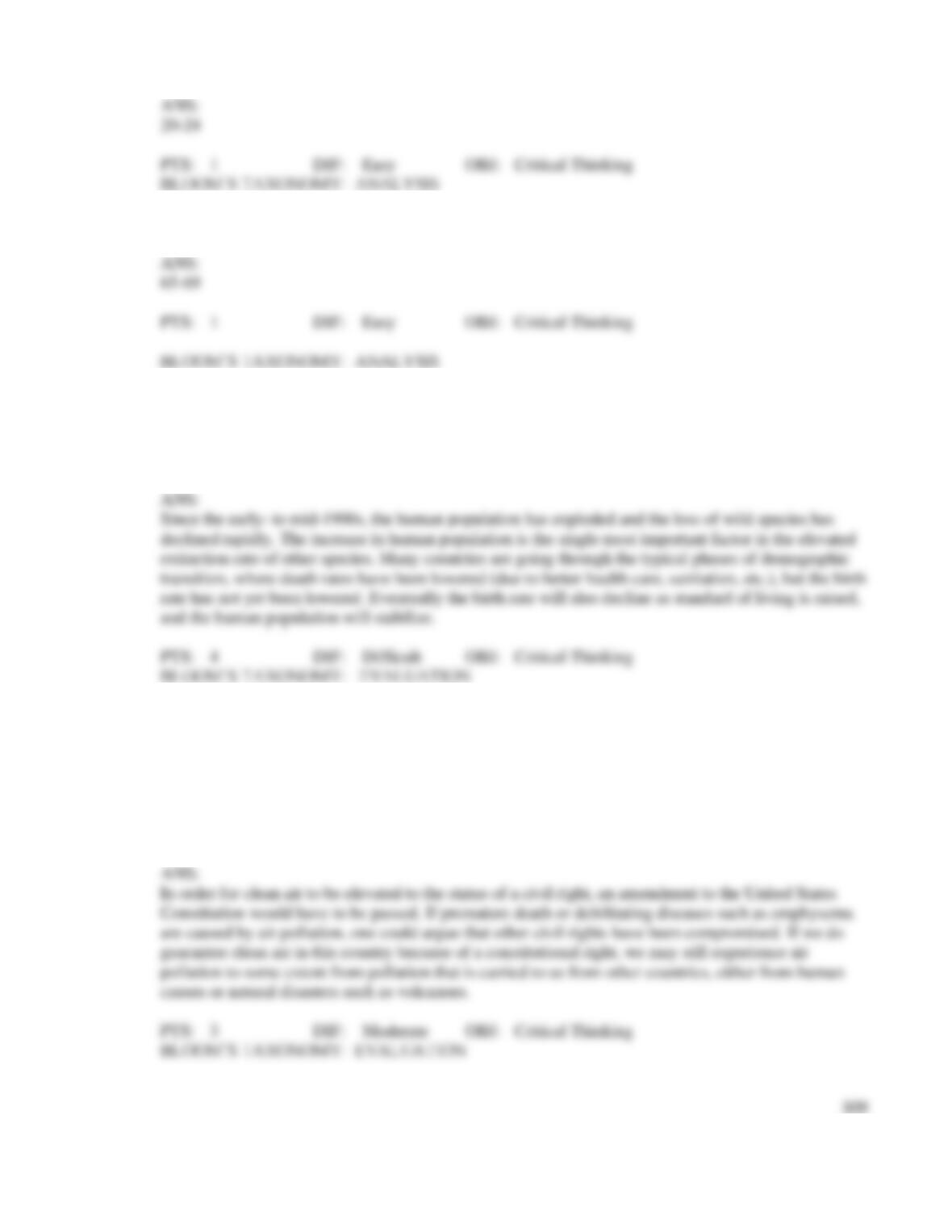
3. At what age are males more likely to die from AIDS than females?
4. At what age are females more likely to die from AIDS than males?
5. Since 1900, and especially since 1950, the incidence of infectious diseases and the death rates from
such disease has been greatly reduced. Recalling discussions from previous chapters, what other
significant events have occurred since about 1950? Do you think these events are correlated? If so,
what process is driving it?
6. Many of the chemical hazards in our world can be avoided by lifestyle choices. However, air pollution,
which is the fourth leading cause of death worldwide, is a form of chemical hazard that we do not have
direct control over. Sandra Steingraber, in her book “Living Downstream,” discusses the idea that
clean air should be elevated to the status of a civil right in the United States. What would have to occur
in order to have clean air become a civil right? Does not having clean air prevent you from realizing
your other civil rights? If it were a civil right in the United States, would this guarantee clean air for
you as a citizen of the U.S.?
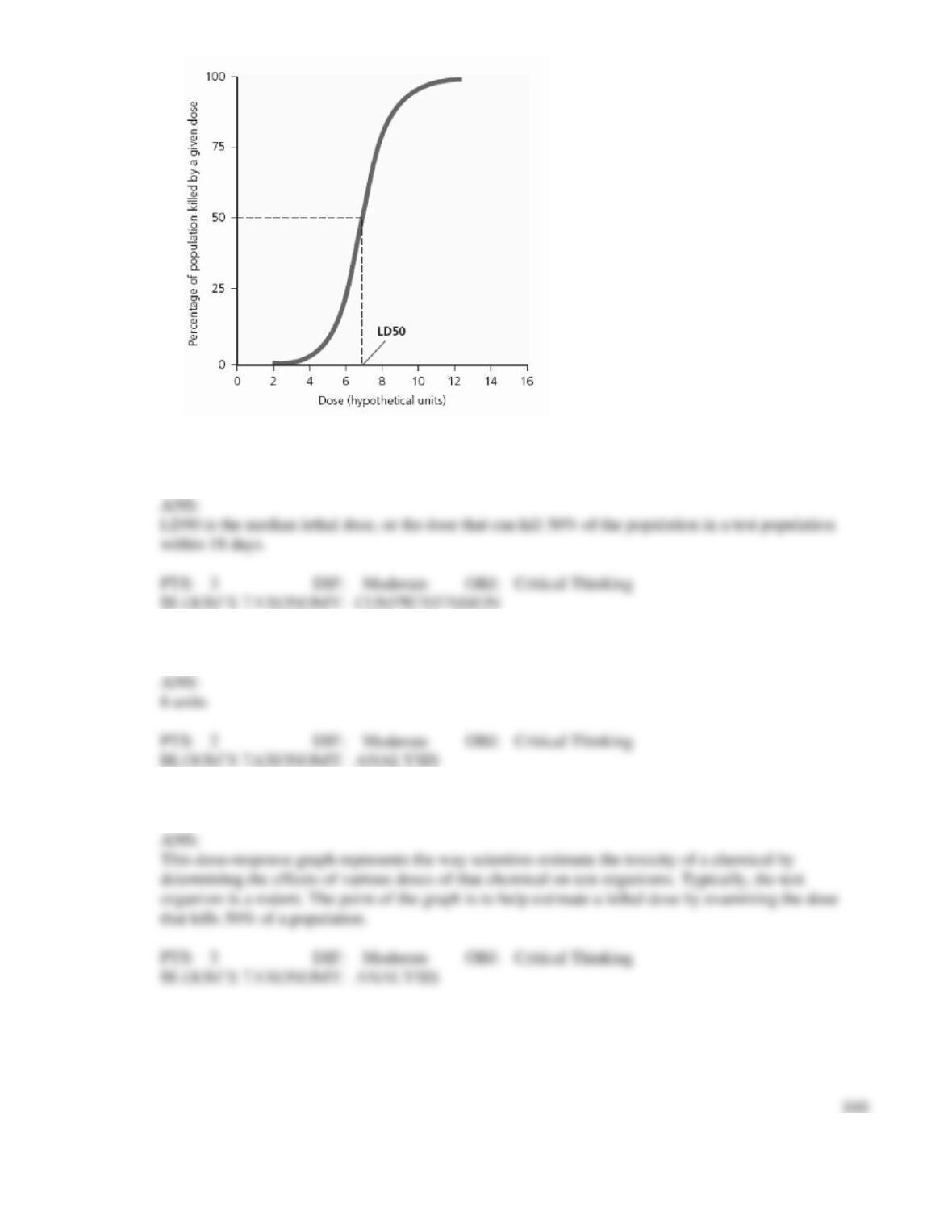
7. On the graph, explain what the designation LD50 means.
8. On this graph, what dose in hypothetical units did it take to kill 25% of the population?
9. What purpose does a graph such as this one serve in our challenge of evaluating hazardous chemicals?
ESSAY
1. Since the AIDS virus has reduced life expectancy in some sub-Saharan African countries by as much
as 20 years, the result is that some countries, such as Botswana and Zimbabwe, will each lose half of
their adult population within a decade. Briefly discuss the implications of this tragedy.
2. List the reasons that we tend to evaluate risks inappropriately.
3. Compare and contrast the greatest threats to human health on our planet, in order of their impact,
noting the degree to which we have control over the cause.
4. Explain why infants and children are more susceptible to the effects of toxic substances than adults
are.
5. Explain this statement made by the German scientist Paracelsus: “The dose makes the poison.”