Introduction to General, Organic & Biological Chemistry, 12e (Timberlake)
Chapter 14 Carboxylic Acids, Esters, Amines, and Amides
14.1 Multiple-Choice Questions
1) Which functional group is found in a carboxylic acid?
A) –OH
B) O
– –OH
C) O
– – O –
D) OH
|
– C – OH
|
E) – –OH
2) A carboxylic acid is named in the IUPAC system by replacing the e in the name of the parent
alkane with ________.
A) oic acid
B) oic
C) carboxylic acid
D) acid
E) oate
3) The functional group in acetic acid is called the ________.
A) hydroxyl group
B) aldehyde group
C) carbonyl group
D) carboxyl group
E) ester group
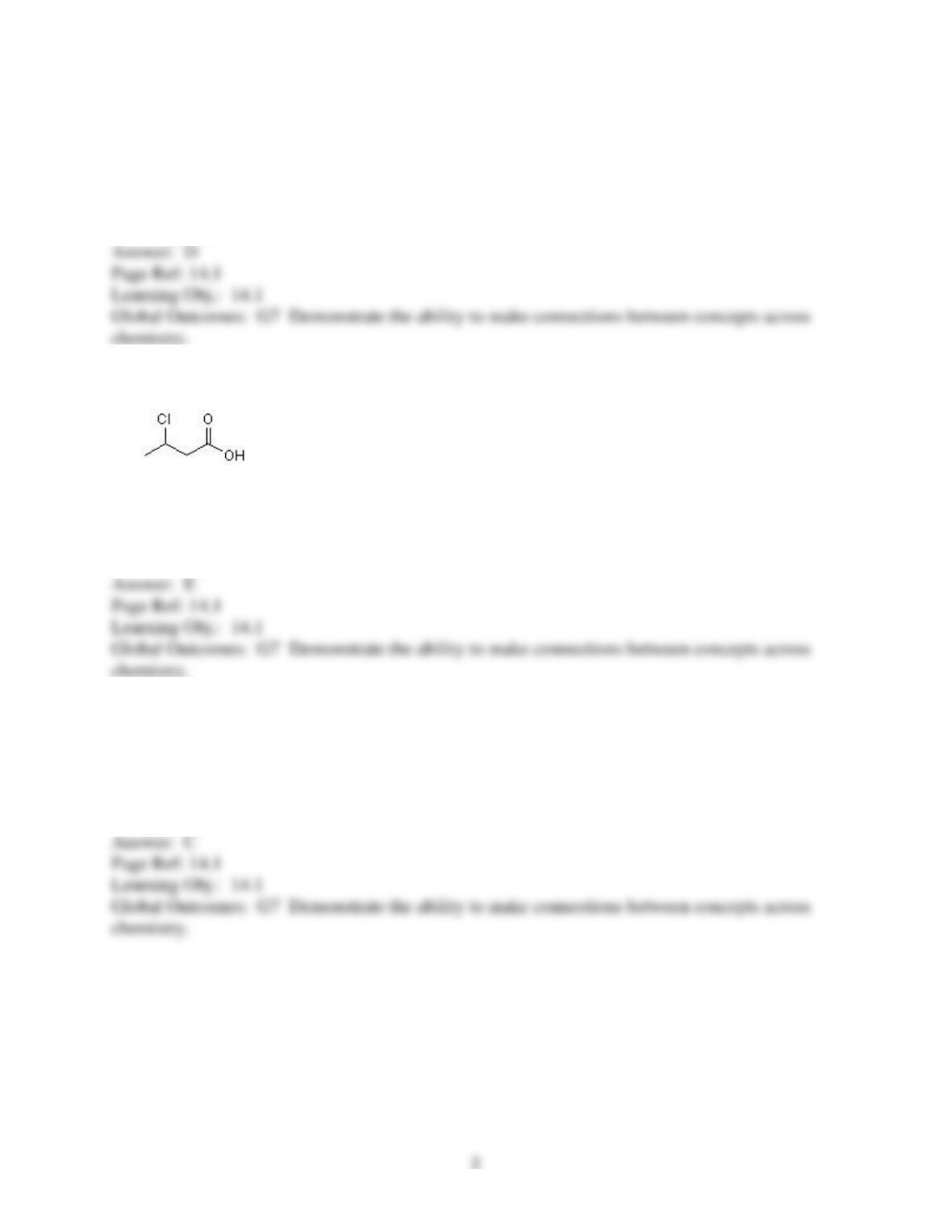
4) The IUPAC name of this compound is ________.
A) 3-chloro-1-butanol
B) chlorobutyric acid
C) 3-chlorobutyric acid
D) 2-chlorobutanoic acid
E) 3-chlorobutanoic acid
5) Which of the following is found in vinegar?
A) nitric acid
B) formic acid
C) acetic acid
D) propionic acid
E) butyric acid
6) What is the common name for ethanoic acid?
A) butyric acid
B) formic acid
C) citric acid
D) stearic acid
E) acetic acid
7) What is the irritating acid found in ant and bee stings?
A) acetic acid
B) formic acid
C) citric acid
D) butyric acid
E) stearic acid
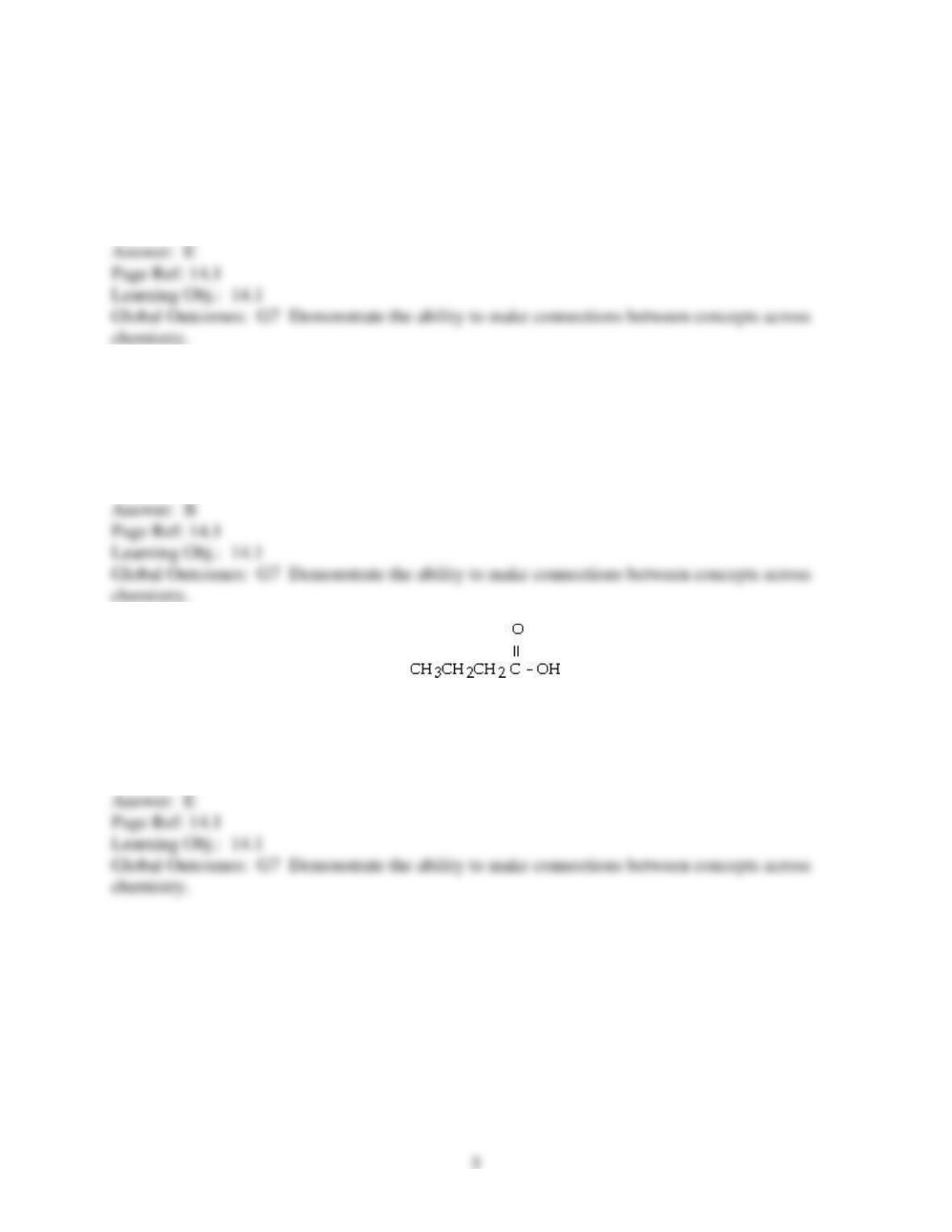
8) The common name of the compound is ________.
A) acetic acid
B) propanoic acid
C) propionic acid
D) butanoic acid
E) butyric acid
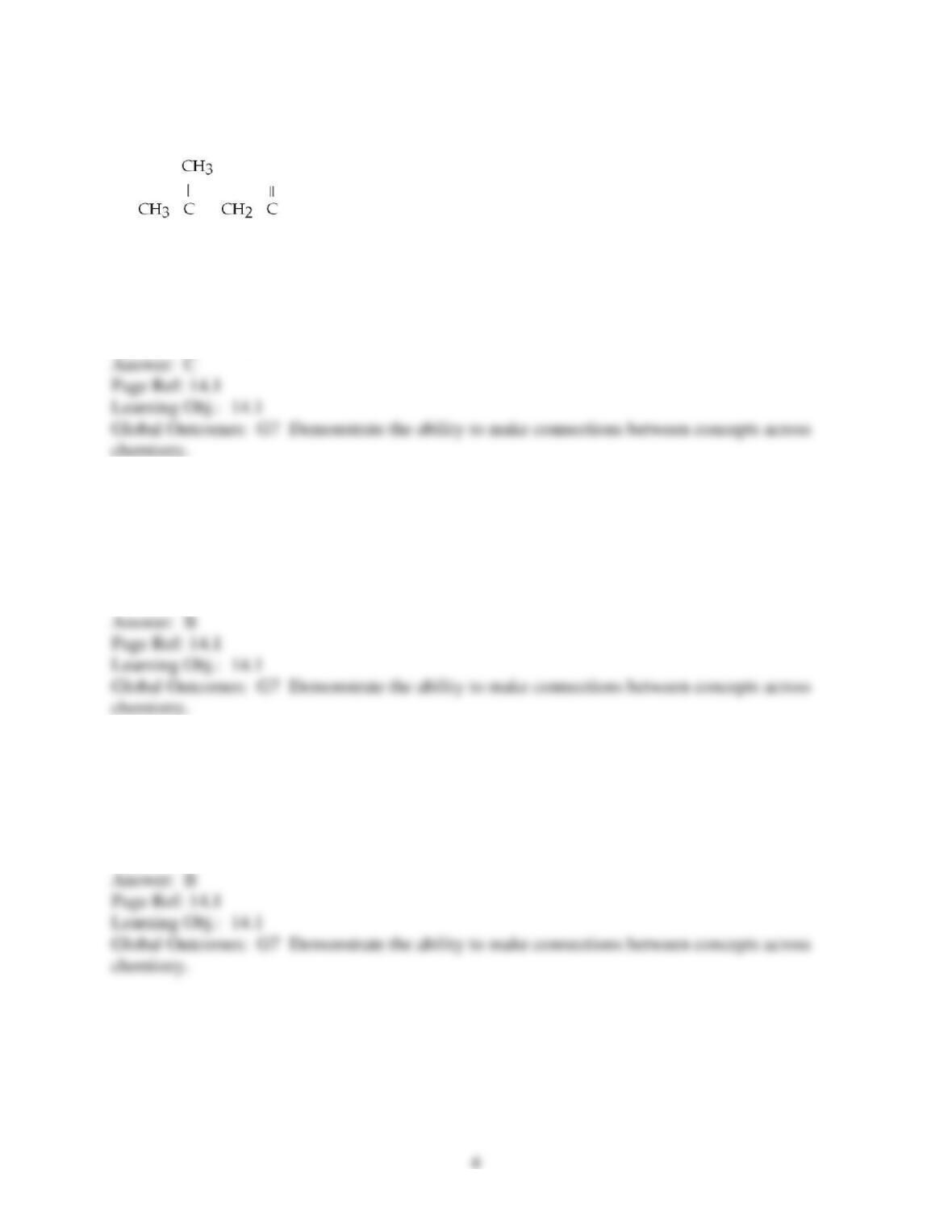
9) What is the IUPAC name for this compound?
O
–H– – –OH
A) pentanoic acid
B) 2-methylbutanoic acid
C) 3-methylbutanoic acid
D) 2-methyl butyric acid
E) 2-methyl-4-butanoic acid
10) What kind of taste do carboxylic acids have?
A) sweet
B) sour
C) fruity
D) slippery
E) oily
11) Which carboxylic acid in the list below is an aromatic carboxylic acid?
A) acetic acid
B) benzoic acid
C) butyric acid
D) benzene
E) citric acid
12) Which of these functional groups is likely to give a sour taste to a food?
A) ester
B) ether
C) ketone
D) carboxylic acid
E) thiol
13) In water solution, how does dilute acetic acid behave?
A) as a strong acid
B) as a weak acid
C) as a strong base
D) as a weak base
E) as a neutral compound
14) The neutralization of formic acid by NaOH produces ________.
A) sodium formate as the only product
B) formate ion and hydronium ion
C) sodium formaldehyde
D) methyl alcohol
E) sodium formate and O
15) Which of the following compounds is most soluble in water?
A) –
B) -O
C) –OH
D) O
– – – –OH
E) O
– –OH
16) When compared to sulfuric acid, how strong are carboxylic acids?
A) stronger
B) just as strong
C) weaker
D) not acidic at all
17) What happens to water solubility as the hydrocarbon chain length increases in carboxylic
acids?
A) It increases.
B) It decreases.
C) It stays the same.
18) Which compound below contains an ester functional group?
A) OH
–H––
B) – –O– –
C) O
H– –O––
D) O
–––
E) O
– –OH
19) This functional group is known as a(n) ________.
O
– C – O -C
A) ester
B) carboxylic acid
C) alcohol
D) aldehyde
E) acetal
20) Many of the fragrances of flowers and the flavors of fruits are due to ________.
A) ethers
B) carboxylic acids
C) esters
D) amines
E) amides
21) What is the common name of this compound?
O
– –O – –
A) ethyl methyl ester
B) diethyl ester
C) ethyl methanoate
D) 2-ether-2-butanone
E) ethyl acetate
22) The reactants that will form an ester in the presence of an acid catalyst are ________.
A) two carboxylic acids
B) two alcohols
C) a carboxylic acid and an alcohol
D) an aldehyde and an alcohol
E) two aldehydes
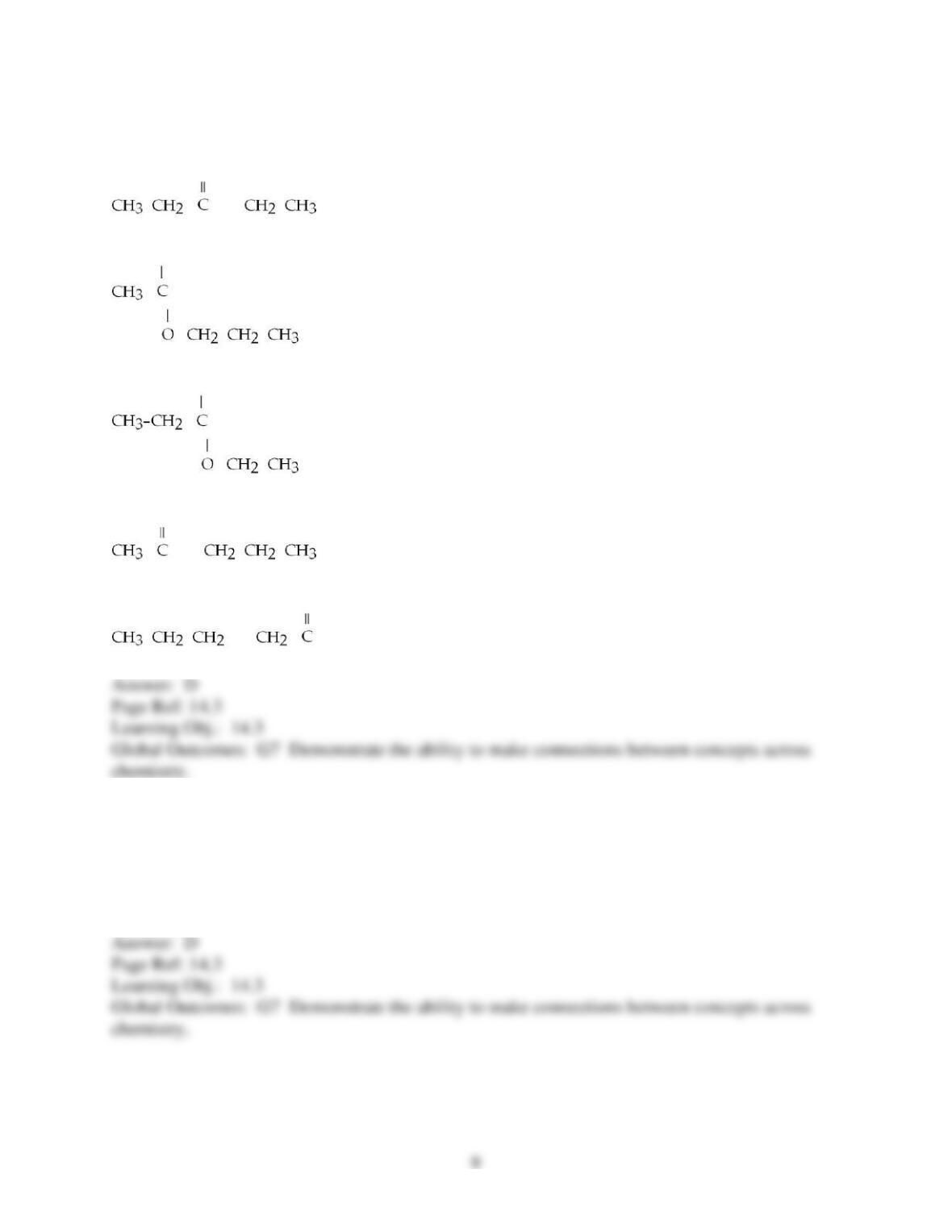
23) Which of these compounds is the ester formed from the reaction of acetic acid and 1-
propanol?
A) O
– – –O– –
B) OH
– –OH
–––
C) OH
– –OH
––
D) O
– –O–––
E) O
– – –O– – –OH
24) The alcohol and carboxylic acid required to form propyl ethanoate are ________.
A) methanol and propionic acid
B) ethanol and propionic acid
C) propanol and propanoic acid
D) 1-propanol and ethanoic acid
E) 2-propanol and ethanoic acid
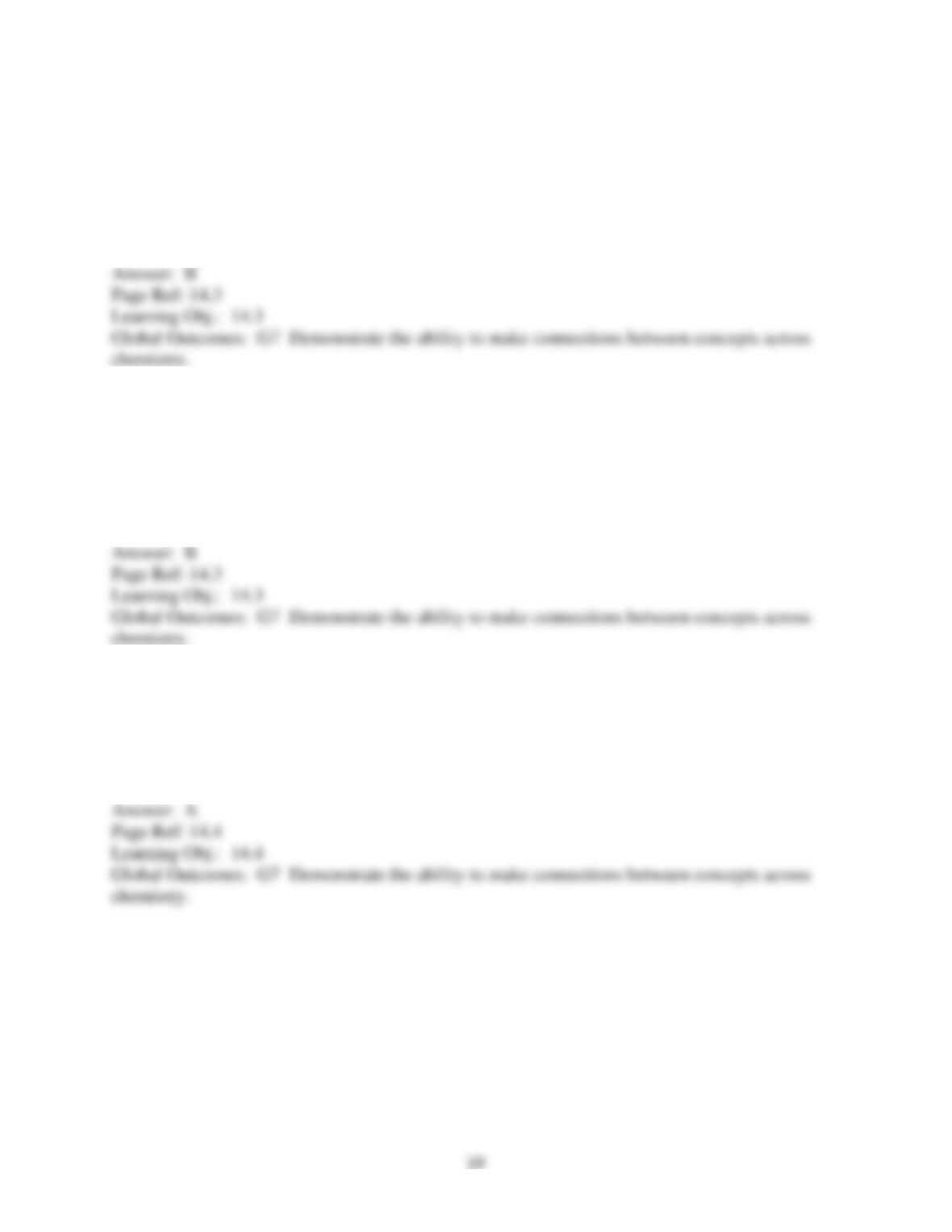
25) What is the product of the reaction of an alcohol and a carboxylic acid when heated together
under acidic conditions?
A) an ether
B) an ester
C) a salt
D) a ketone
E) an aldehyde
26) The first word in the name of an ester is derived from the ________ used in the
esterification.
A) carboxylic acid
B) alcohol
C) ether
D) ester
E) amide
27) The splitting apart of an ester in the presence of a strong acid and water is called ________.
A) hydrolysis
B) saponification
C) neutralization
D) esterification
E) reduction
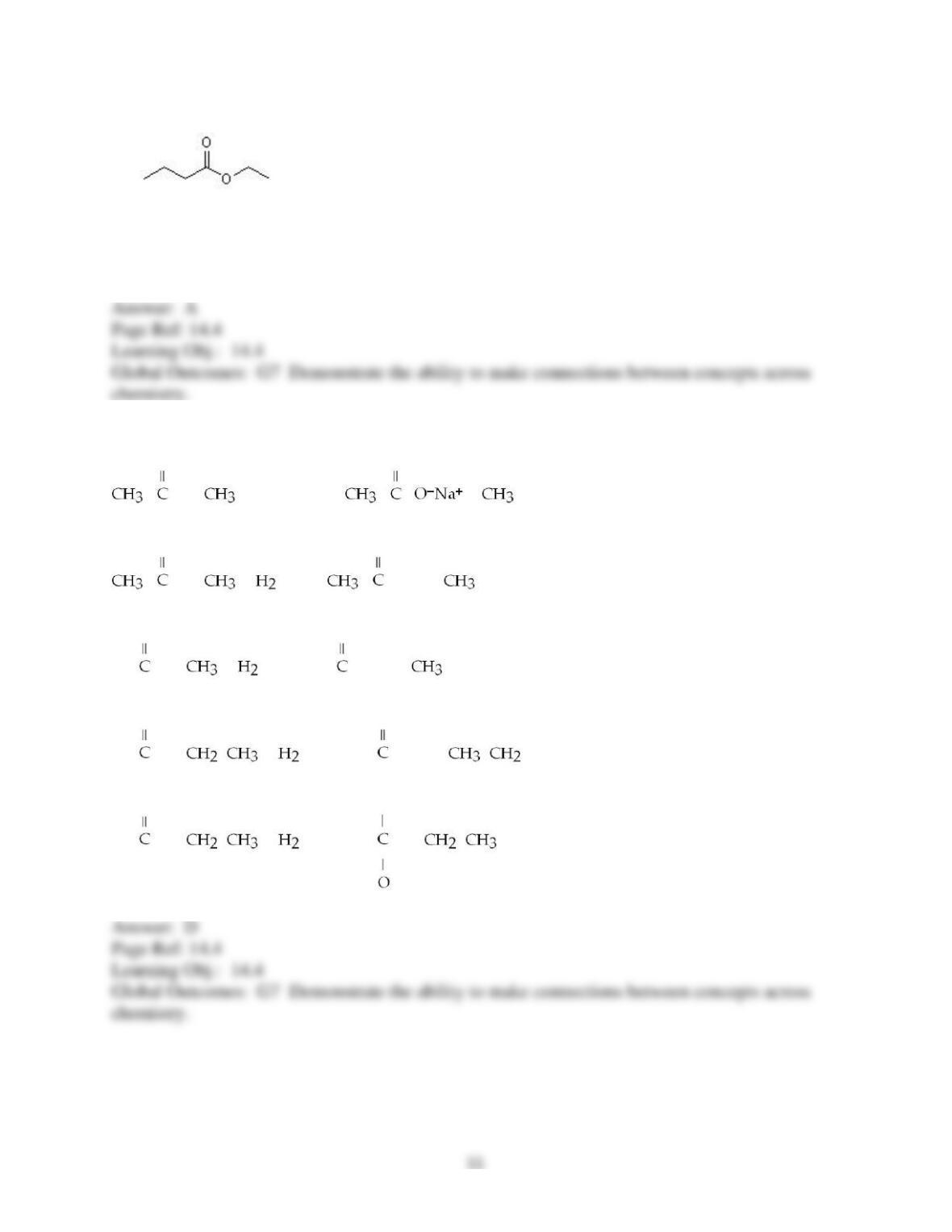
28) When this compound undergoes hydrolysis in acid, what product(s) are obtained?
A) butanoic acid and ethanol
B) butanoic acid
C) ethanol
D) ethanoic acid and butanol
E) butanoic acid and butanol
29) Which of the following is the reaction for the acid hydrolysis of ethyl formate?
A) O O
– –O– + NaOH → – – + –OH
B) O O
– –O– + O → – –OH + –OH
C) O O
H– –O– + O → H– –OH + –OH
D) O O
H– –O–– + O → H– –OH + – –OH
E) O OH
H– –O–– + O → H– –O– –
H
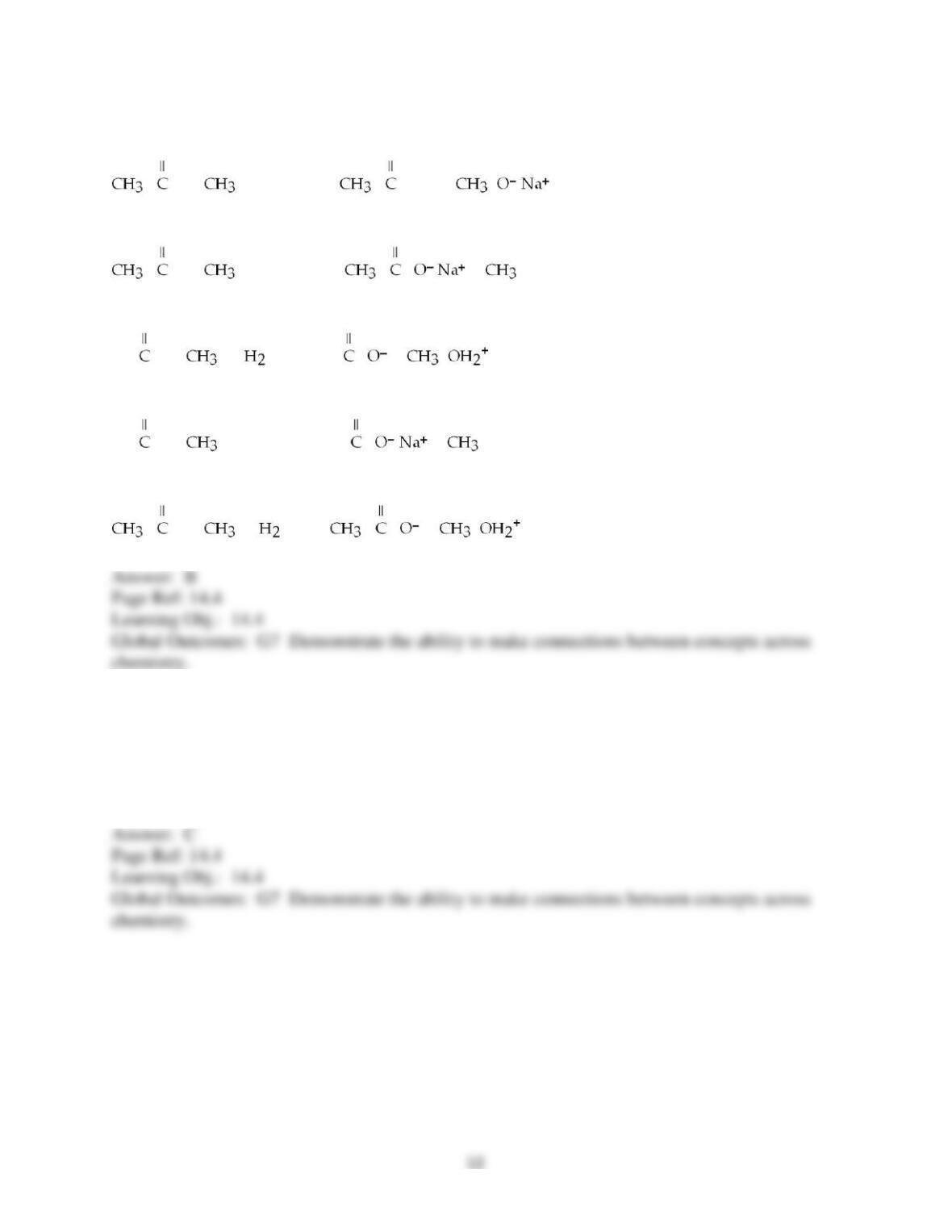
30) Which of the following is the reaction for the saponification of methyl acetate?
A) O O
– –O– + NaOH → – –OH + –
B) O O
– –O– + NaOH → – – + –OH
C) O O
H– –O– + O → H– – + –
D) O O
H– –O– + NaOH → H– – + –OH
E) O O
– –O– + O → – – + –
31) The reaction of an ester with NaOH is known as ________.
A) esterification
B) neutralization
C) saponification
D) reduction
E) oxidation
32) What chemical process is responsible for the smell of vinegar in an old bottle of aspirin?
A) reduction
B) hydration
C) hydrolysis
D) esterification
E) dissolution
33) What kind of conditions can produce hydrolysis of an ester?
A) acidic
B) basic
C) either acidic or basic
D) neither acidic nor basic
34) The common name of this compound is ________.
A) ethylamine
B) ethylethylamine
C) diethylamine
D) dimethylamine
E) ethylmethylamine
35) The compound is classified as a ________.
A) primary amine
B) secondary amine
C) tertiary amine
D) quaternary amine
E) hydrated amine
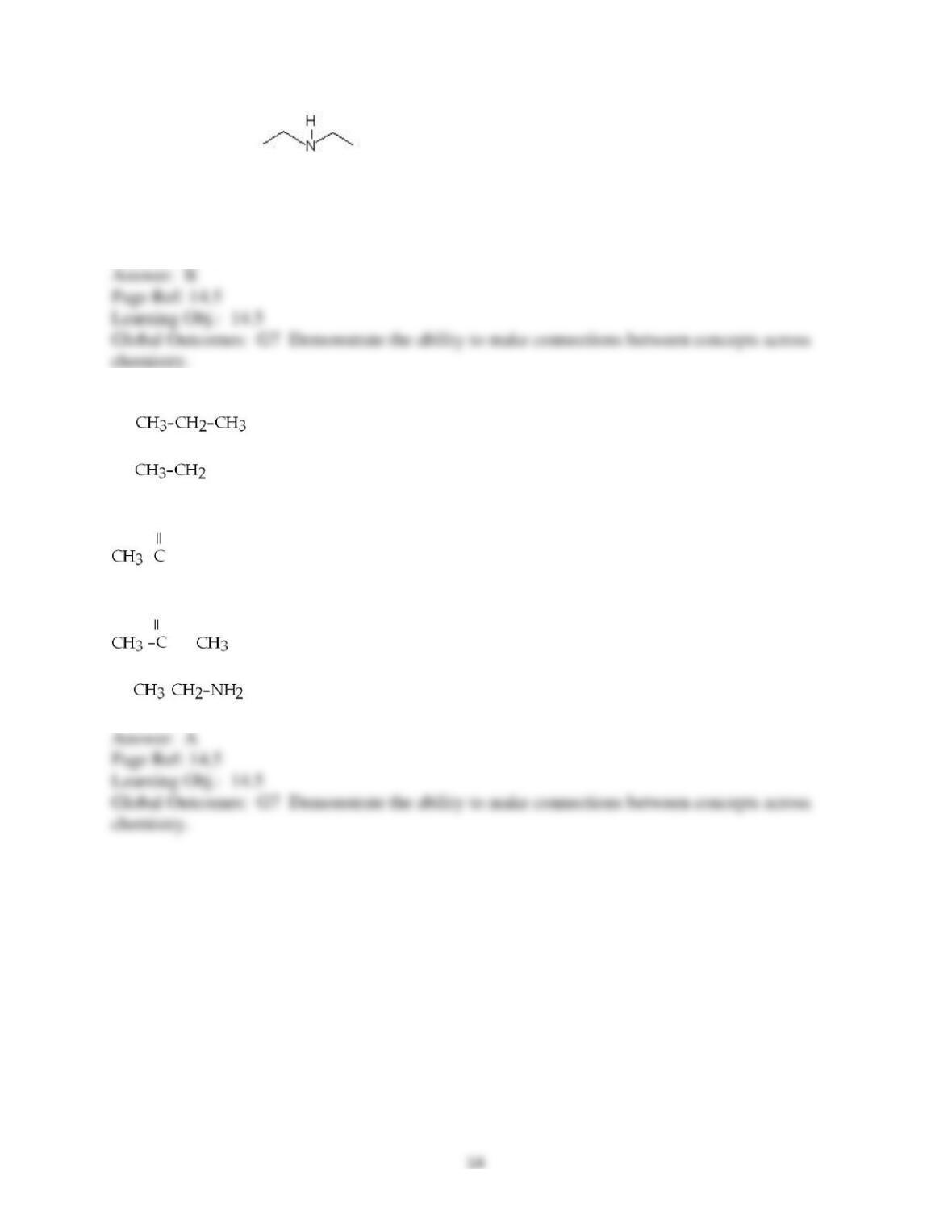
36) The compound is classified as a ________.
A) primary amine
B) secondary amine
C) tertiary amine
D) quaternary amine
E) hydrated amine
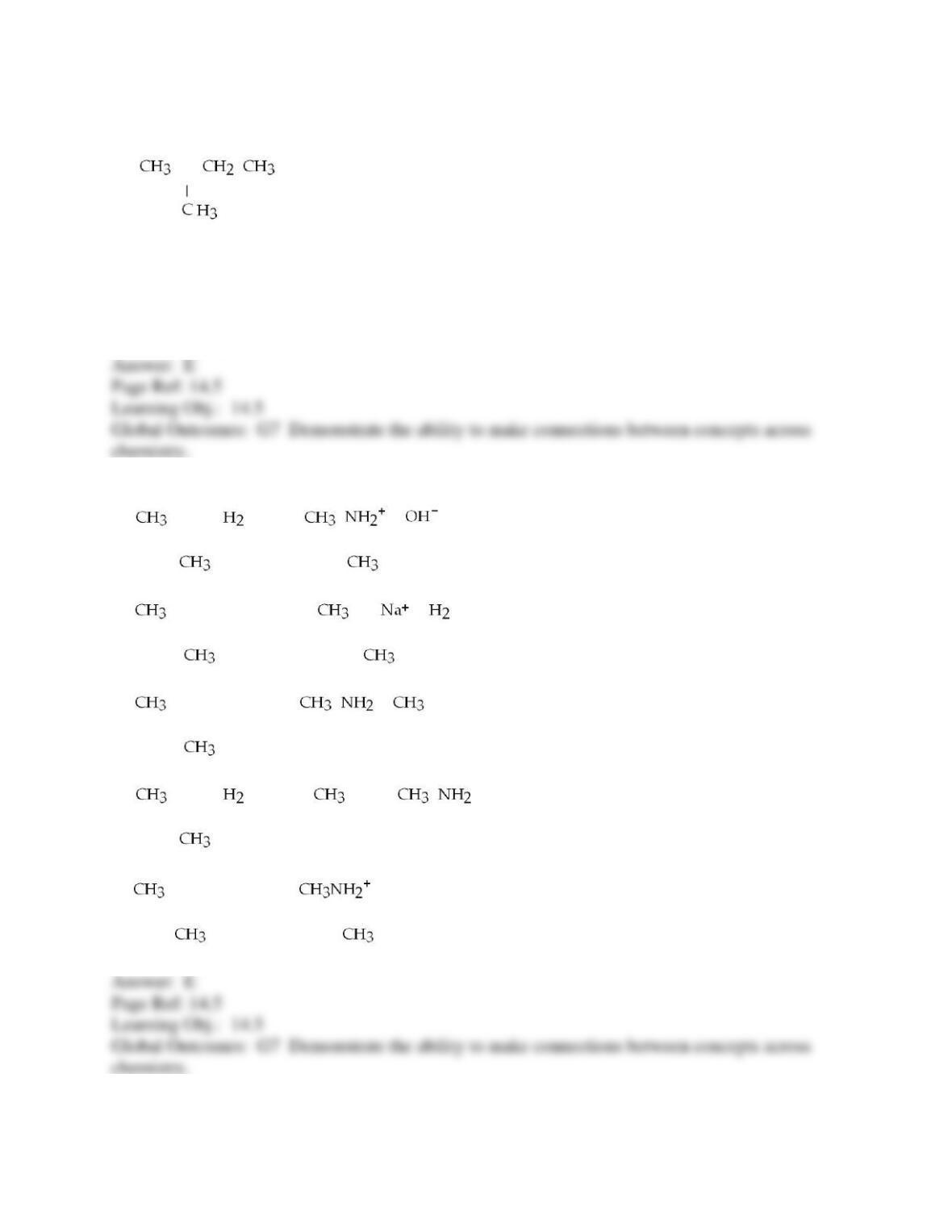
37) Which of the following compounds cannot form hydrogen bonds with water?
A)
B) –OH
C) O
– –OH
D) O
-O-
E) –
15
38) What is the common name of this compound?
–N––
A) trimethylamine
B) diethylamine
C) ethylmethylamine
D) ethylmethylnitride
E) ethyldimethylamine
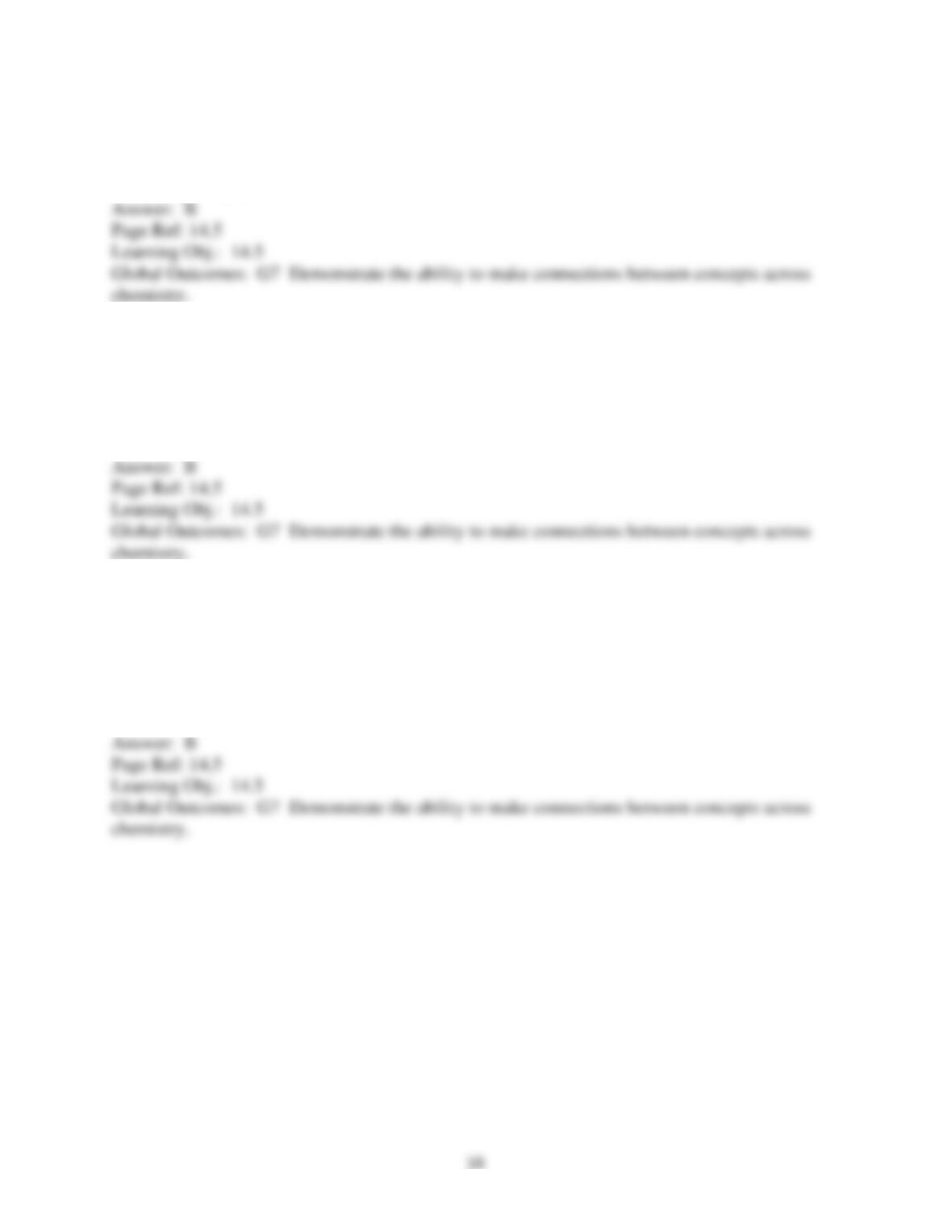
39) Which of the following represents the complete neutralization of dimethylamine?
A) –NH + O → – +
| |
B) –NH + NaOH → –N– + O
| |
C) –NH + HCl → – + Cl
|
D) –NH + O → -OH + –
|
E) NH + HCl → + Cl–
| |
40) When ethylamine dissolves in water, a solution of ________ is produced.
A) ammonia
B) ethylammonium and hydroxide
C) ethylamine
D) ethylhydroxide
E) ethylhydroxylate
41) Diethylamine and HCl react to produce ________.
A) diethyl chloride
B) diethylammonium chloride
C) ethylammonium chloride
D) ammonium chloride
E) butylammonium chloride
42) Physiologically active nitrogen-containing compounds produced by plants are called
________.
A) aromatics
B) alkaloids
C) esters
D) polymers
E) ethers
43) Amines contain the element ________.
A) nitrogen
B) oxygen
C) sulfur
D) astatine
E) arginine
44) In what kind of amine is the nitrogen atom bonded to two carbon atoms?
A) primary
B) secondary
C) tertiary
D) quaternary
E) amide
45) What functional group is always found in alkaloids (such as caffeine, nicotine, and digitalis)?
A) amide
B) acid
C) ether
D) amine
E) ester
46) Aniline is a(n) ________.
A) primary aromatic amine
B) secondary aromatic amine
C) heterocyclic amine
D) aliphatic amine
E) tertiary amine
47) What prefix is used to show that a small alkyl group is attached to the nitrogen of aniline and
not to the aromatic ring?
A) N-
B) C-
C) Roman numerals
D) Greek letters
E) iso-
48) How many alkyl substituents does N-ethyl-N-methylaniline have?
A) one
B) two
C) three
D) eight
E) none
49) What physiologically active amine is responsible for the signs and symptoms encountered in
an allergic reaction?
A) histamine
B) epinephrine
C) diphenhydramine
D) phenylephrine
E) dopamine
50) A deficiency of which amine is responsible for the signs and symptoms of Parkinson’s
disease?
A) histamine
B) dopamine
C) epinephrine
D) diphenhydramine
E) methedrine
51) The prefix nor- in a drug name means that there is ________.
A) one more amine in the new molecule than in the original
B) one more methyl group on the nitrogen atom in the new molecule than in the original
C) one less methyl group on the nitrogen atom in the new molecule than in the original
D) one less amine in the new molecule than in the original
E) one less double bond in the new molecule than in the original
52) Amines can form ________ bonds with water molecules.
A) oxygen
B) hydrogen
C) nonpolar
D) metallic
E) triple
53) Amines are ________.
A) Brønsted-Lowry bases
B) Brønsted-Lowry acids
C) neutral in water solution
D) unreactive.
54) The odor of an amine can be neutralized with ________.
A) water
B) acids
C) bases
D) detergents
E) solvents
55) In what form are amine-containing drugs often administered?
A) free base
B) sodium salt
C) ammonium salt
D) water solution
E) oil solution
56) What are alkaloids?
A) physiologically active nitrogen compounds derived from plants
B) anesthetics found in plants
C) flavoring agents found in fruits and vegetables
D) preservatives found in animal tissue
E) natural steroids
57) Nicotine, coniine, quinine, atropine, and morphine are all examples of ________.
A) ethers
B) esters
C) carboxylic acids
D) alkaloids
E) amides
22
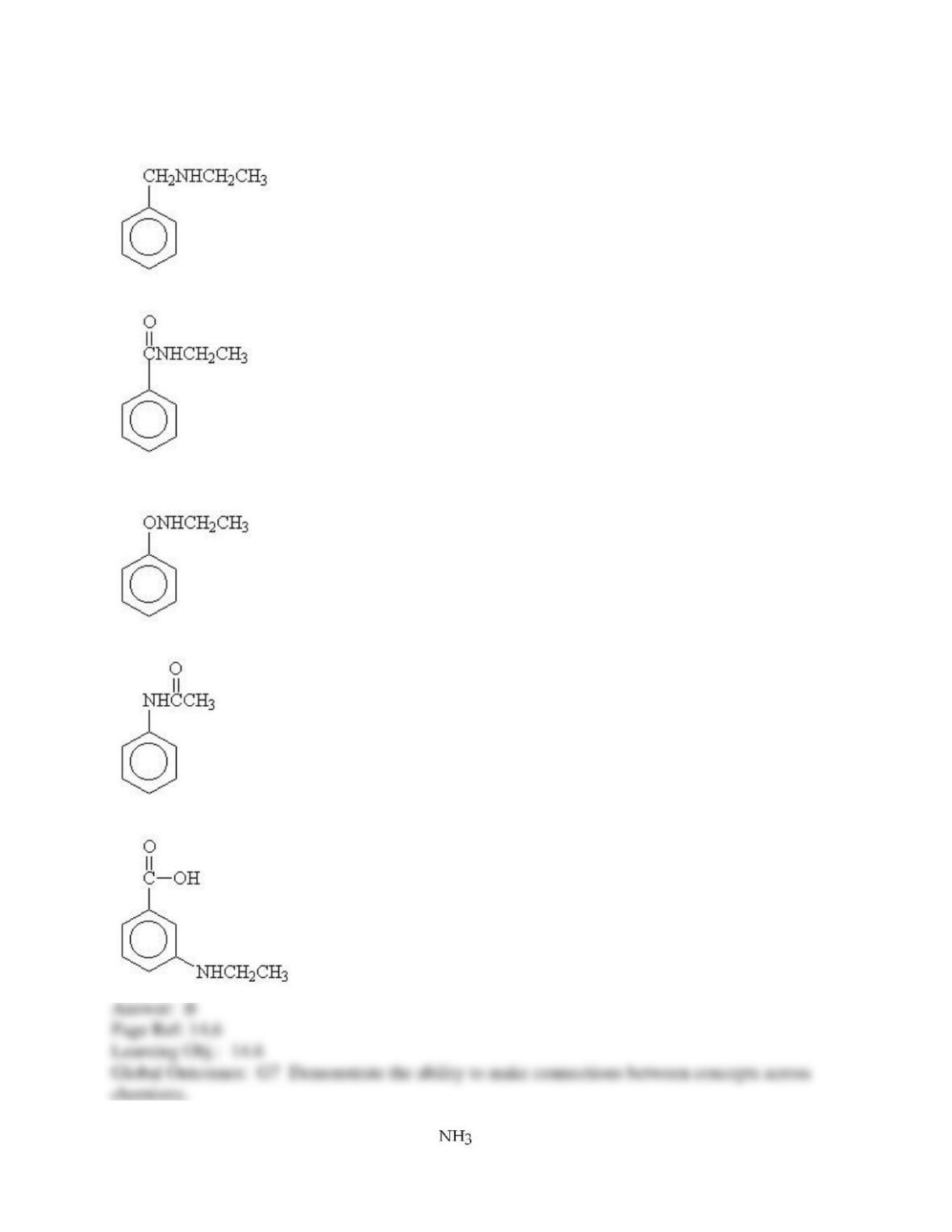
58) The amide formed in the reaction of benzoic acid and ethylamine is ________.
A)
B)
C)
D)
E)
59) When acetic acid reacts with ammonia, , the reaction yields ________.
A) acetamine
B) ammonium acetate
C) ethylammonium hydroxide
D) amino acetate
E) acetamide
60) What is the functional group in the following compound?
O
–NH
A) ketone
B) carboxylic acid
C) ester
D) amine
E) amide
61) With the correct choice of acid, acid hydrolysis of acetamide could produce ________.
A) acetic acid and ammonium chloride
B) acetic acid and methylamine
C) ethanol and ammonia
D) acetaldehyde and ammonium hydroxide
E) formic acid and ethylamine
62) To which chemical class does phenobarbital belong?
A) ester
B) amine
C) amide
D) alkane
E) ether
63) Amides are derivatives of ________ and ________.
A) amines, esters
B) amines, carboxylic acids
C) alkanes, amines
D) carboxylic acids, alcohols
E) alcohols, carboxylic acids
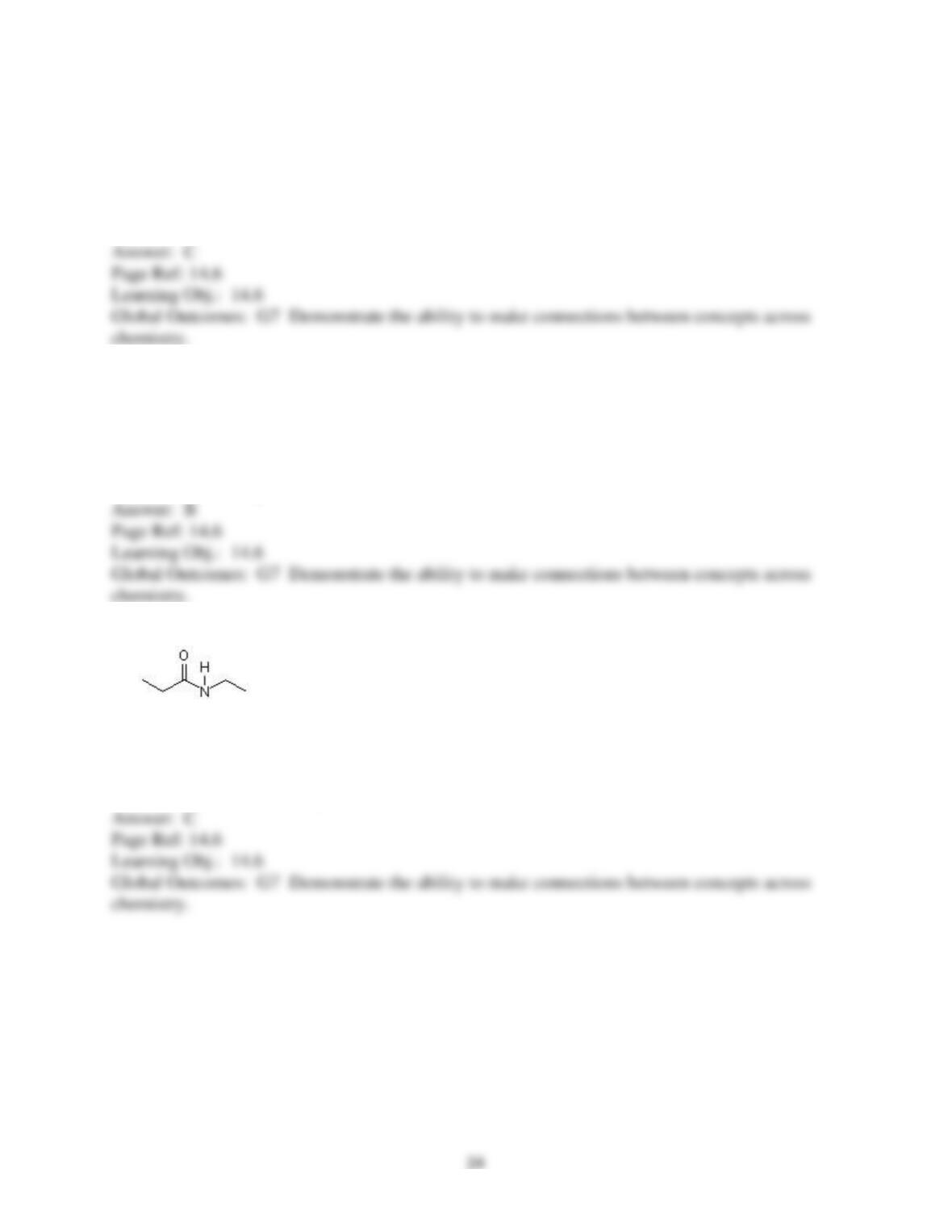
64) What two compounds will react to give this amide?
A) propanol and ammonia
B) propanoic acid and ammonia
C) propanoic acid and ethylamine
D) propanoic acid and diethylamine
E) propanoic acid and methylamine
65) What kind of compound is urea?
A) ester
B) acid
C) amide
D) ketone
E) amine
66) The IUPAC name of this compound is ________.
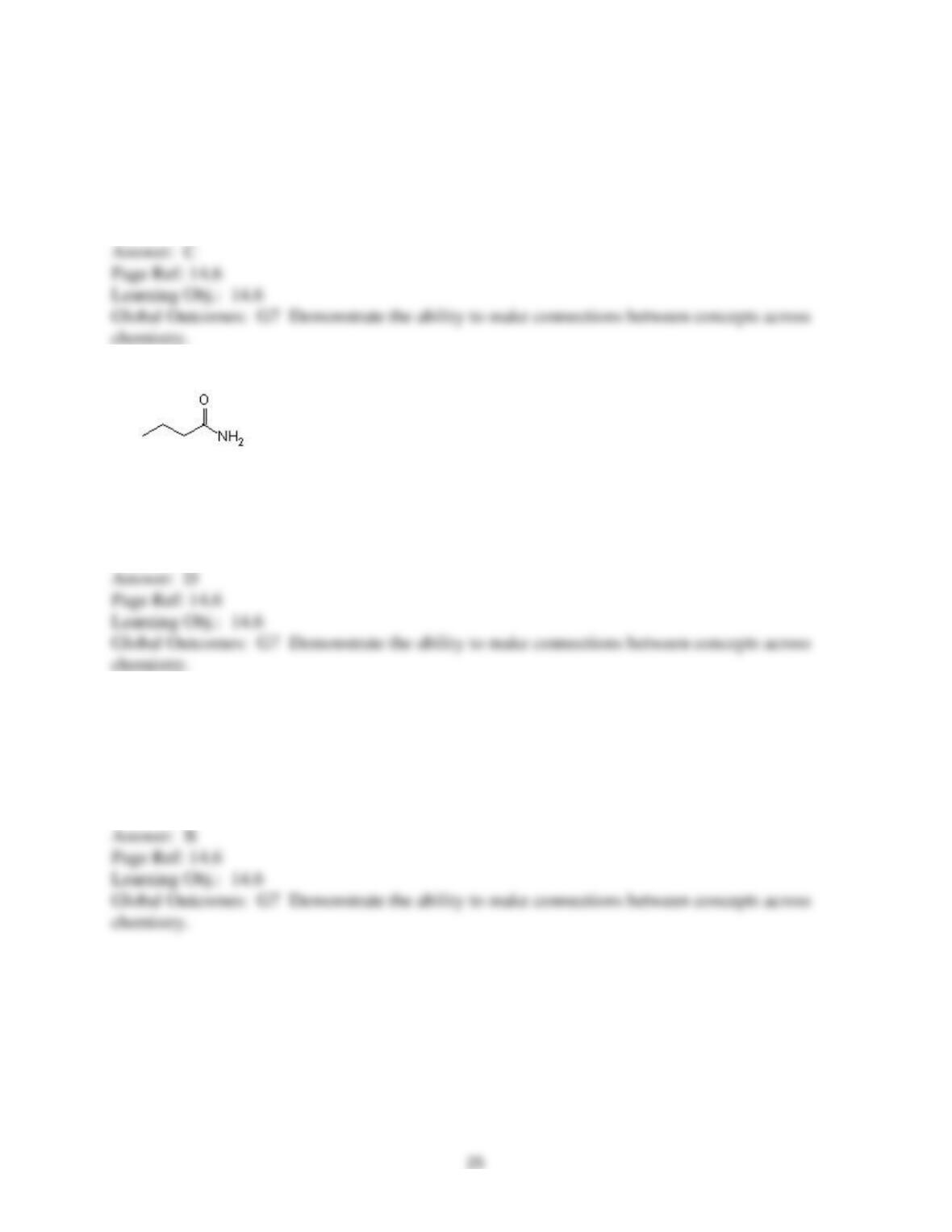
A) pentanamide
B) butyramide
C) butylamine
D) butanamide
E) propanamide
67) Amides having fewer than ________ carbons are generally water soluble.
A) five
B) six
C) ten
D) eleven
E) twelve
14.2 True-False Questions
1) Carboxylic acids are responsible for the sweet taste of fruits and vegetables.
2) The major acidic component of vinegar is formic acid.
3) Benzoic acid is an aliphatic carboxylic acid.
4) Carboxylic acids with more than five carbons are very water soluble.
5) Carboxylic acids with four or fewer carbons are very water soluble.
6) Most of the carboxylic acid in an aqueous solution is ionized.
7) Carboxylic acids are strong acids.
8) Esters are formed from the reaction of an ether with a carboxylic acid.
9) An ester is derived from an alcohol and a carboxylic acid.
10) Methyl salicylate (oil of wintergreen) is used therapeutically as a counterirritant.
11) Butyl alcohol is one of the reactants used to make methyl butyrate.
12) Aspirin that has a smell of vinegar has broken down by hydrolysis.
13) Acid catalyzed hydrolysis of an ester yields a carboxylic acid and an alcohol.
14) Base catalyzed hydrolysis of an ester yields a carboxylic acid and the salt of an alcohol.
15) Soaps are the soluble salt of long chain fatty acids.
16) Caffeine is an alkaloid.
17) Amines are rarely found in physiologically active compounds.
18) This skeletal formula represents a tertiary amine.
19) Primary amines contain two carbon-containing groups bonded to the nitrogen atom.
20) The prefix meth- means that there is one less methyl group on the nitrogen atom of an amine.
21) Amines do not form hydrogen bonds.
22) Tertiary amines form strong hydrogen bonds.
23) Amines act as weak acids by accepting protons from water.
24) Amines are mostly ionized in water.
25) Ammonium salts are usually liquid at room temperature.
26) Ammonium salts are odorless and usually highly water soluble.
27) Aniline is an aromatic amine.
28) Crack cocaine is produced by the neutralization and extraction of cocaine from its
hydrochloride salt.
29) Quinine is an alkaloid used for treatment of malaria.
30) Nicotine is a physiologically active aromatic amine.
31) Heroin is a synthetic compound developed from morphine.
32) Urea is one end product of protein metabolism in humans.
33) Aspirin substitutes may contain amide rather than ester functional groups.
34) The amide group is often found in physiologically active substances.
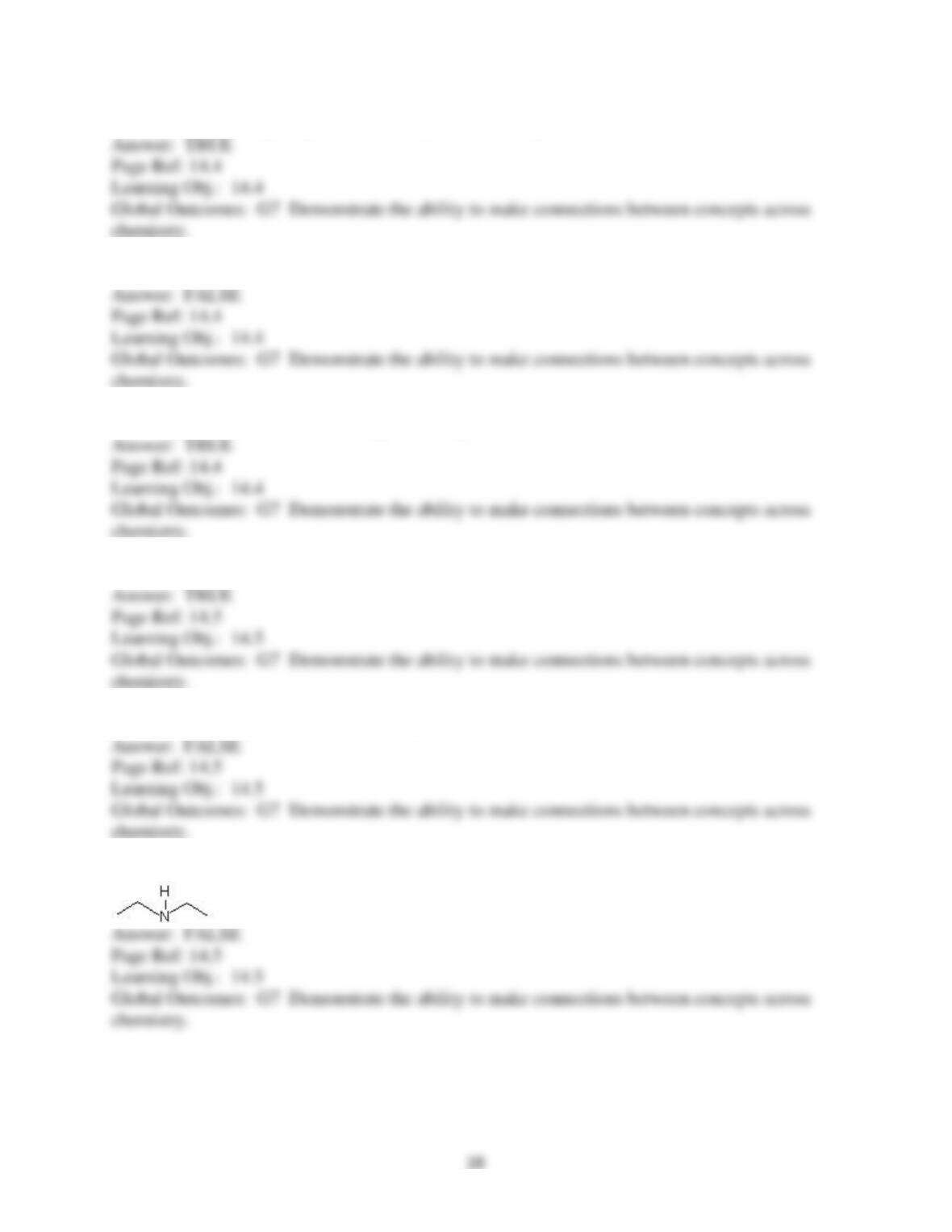
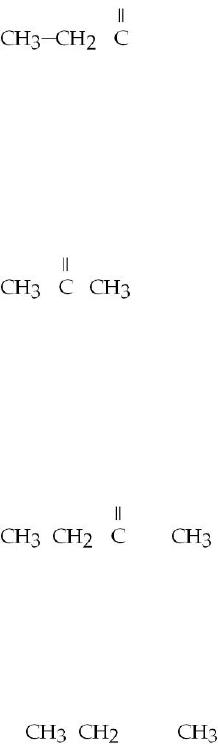
35) This skeletal formula represents an amide.
32
14.3 Matching Questions
Identify the family for each of the following compounds.
A) carboxylic acid
B) ketone
C) ester
D) amide
E) amine
1) O
– –OH
Page Ref: 14.1
Learning Obj.: 14.1
Global Outcomes: G7 Demonstrate the ability to make connections between concepts across
chemistry.
2) O
– –
Page Ref: 14.3
Learning Obj.: 14.3
Global Outcomes: G7 Demonstrate the ability to make connections between concepts across
chemistry.
3) O
– – –O–
Page Ref: 14.3
Learning Obj.: 14.3
Global Outcomes: G7 Demonstrate the ability to make connections between concepts across
chemistry.
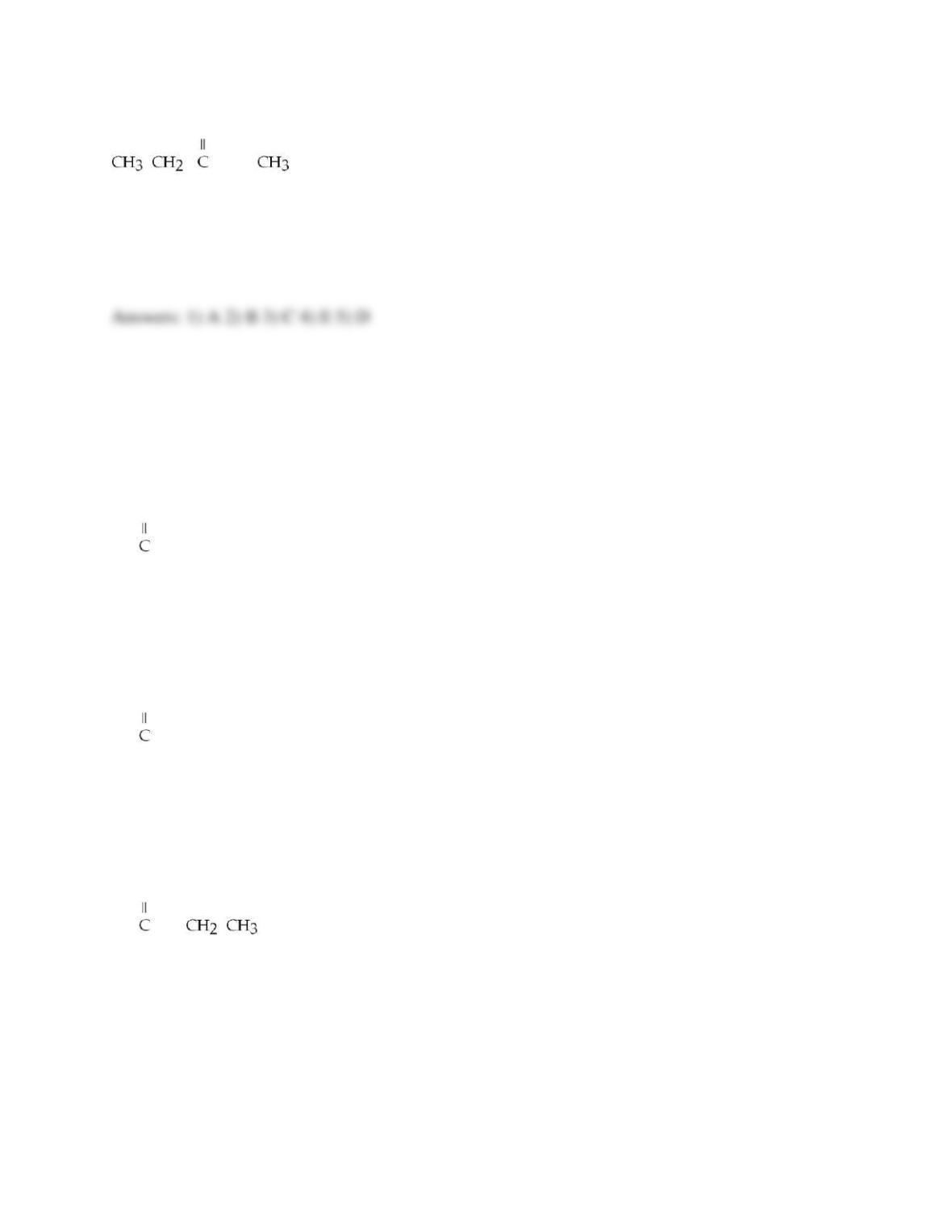
4) – –NH–
Page Ref: 14.5
Learning Obj.: 14.5
Global Outcomes: G7 Demonstrate the ability to make connections between concepts across
chemistry.
33
5) O
– – –NH–
Page Ref: 14.6
Learning Obj.: 14.6
Global Outcomes: G7 Demonstrate the ability to make connections between concepts across
chemistry.
Select the correct name for the following.
A) ethyldimethylamine
B) sodium formate
C) ethyl formate
D) formic acid
6) O
H– –OH
Page Ref: 14.1
Learning Obj.: 14.1
Global Outcomes: G7 Demonstrate the ability to make connections between concepts across
chemistry.
7) O
H– –O–Na+
Page Ref: 14.2
Learning Obj.: 14.2
Global Outcomes: G7 Demonstrate the ability to make connections between concepts across
chemistry.
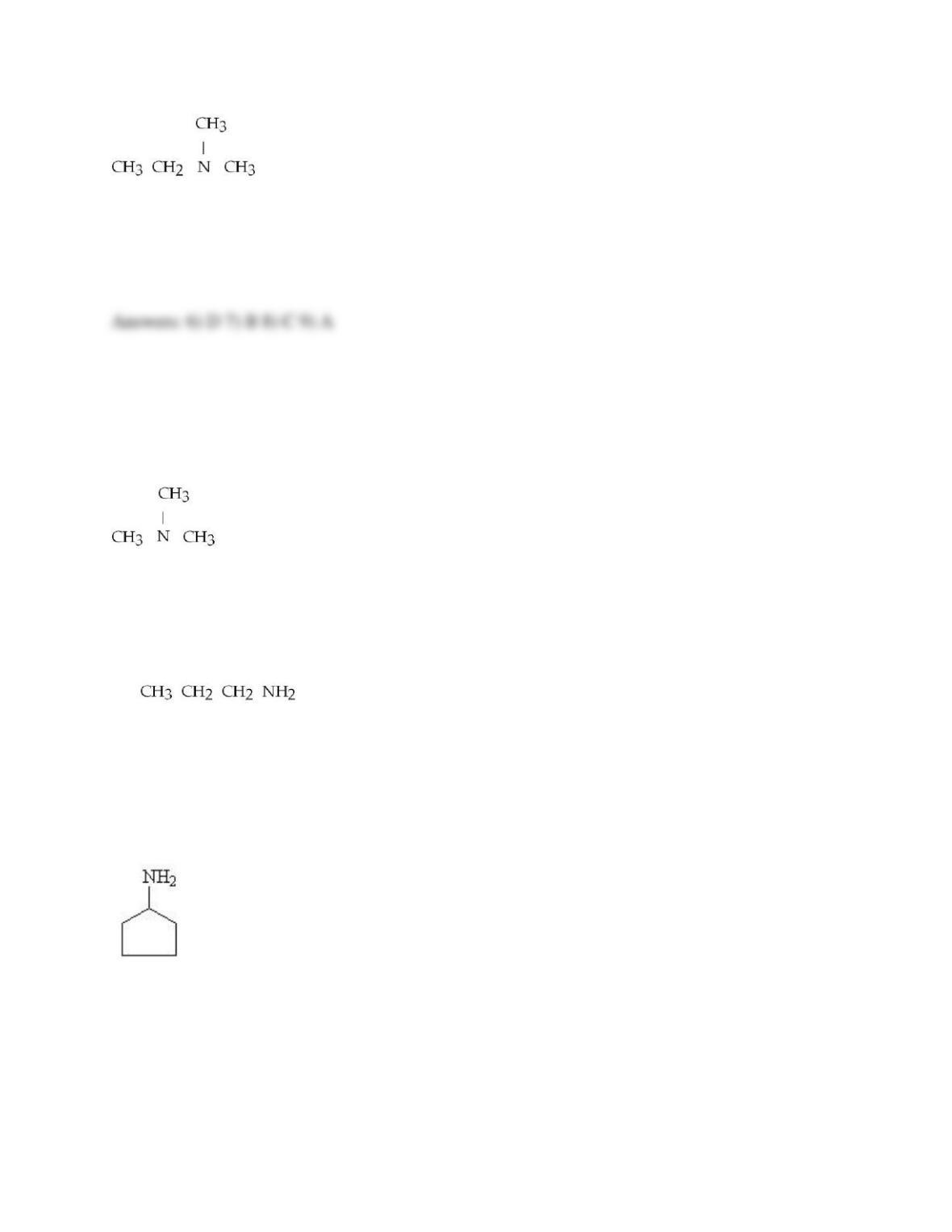
8) O
H– –O––
Page Ref: 14.3
Learning Obj.: 14.3
Global Outcomes: G7 Demonstrate the ability to make connections between concepts across
chemistry.
34
9)
– – –
Page Ref: 14.5
Learning Obj.: 14.5
Global Outcomes: G7 Demonstrate the ability to make connections between concepts across
chemistry.
Classify the amines shown in column 1 as primary, secondary, or tertiary.
A) tertiary
B) secondary
C) primary
10)
– –
Page Ref: 14.5
Learning Obj.: 14.5
Global Outcomes: G7 Demonstrate the ability to make connections between concepts across
chemistry.
11) –––
Page Ref: 14.5
Learning Obj.: 14.5
Global Outcomes: G7 Demonstrate the ability to make connections between concepts across
chemistry.
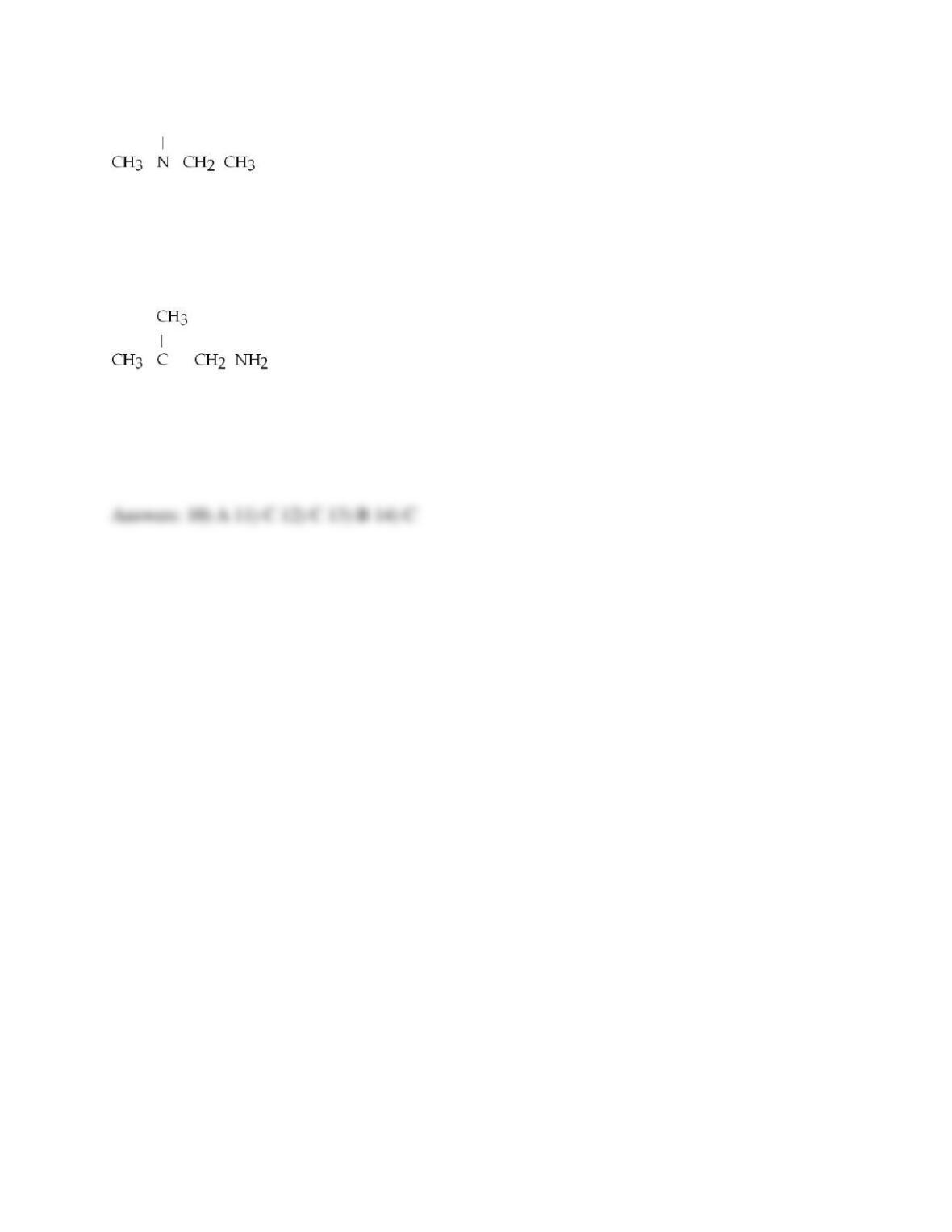
12)
Page Ref: 14.5
Learning Obj.: 14.5
Global Outcomes: G7 Demonstrate the ability to make connections between concepts across
chemistry.
35
13) H
–––
Page Ref: 14.5
Learning Obj.: 14.5
Global Outcomes: G7 Demonstrate the ability to make connections between concepts across
chemistry.
14)
–H– –
Page Ref: 14.5
Learning Obj.: 14.5
Global Outcomes: G7 Demonstrate the ability to make connections between concepts across
chemistry.