CHAPTER 14
FINANCIAL STATEMENT ANALYSIS
SUMMARY OF QUESTIONS BY LEARNING OBJECTIVES AND BLOOM’S TAXONOMY
Item
LO
BT
Item
LO
BT
Item
LO
BT
Item
LO
BT
Item
LO
BT
True-False Statements
1.
1
C
9.
3
K
17.
4
K
25.
5
C
sg33.
4
K
2.
1
K
10.
3
AP
18.
5
K
26.
5
C
sg34.
5
K
3.
1
K
11.
3
C
19.
5
K
27.
6
K
sg35.
5
K
4.
1
K
12.
4
K
20.
5
K
28.
6
K
sg36.
6
K
5.
1
K
13.
4
C
21.
5
K
29.
7
K
6.
2
K
14.
4
C
22.
5
C
30.
7
K
7.
2
K
15.
4
C
23.
5
C
sg31.
2
K
8.
3
K
16.
4
C
24.
5
C
sg32.
3
K
Multiple Choice Questions
37.
1
K
65.
4
C
93.
5
C
121.
5
AP
149.
6
AP
38.
1
K
66.
4
C
94.
5
C
122.
5
AP
150.
6
K
39.
1
C
67.
4
C
95.
5
C
123.
5
AP
151.
6
K
40.
1
C
68.
4
C
96.
5
AP
124.
5
AP
152.
6
AP
41.
1
C
69.
4
C
97.
5
C
125.
5
AP
153.
6
AP
42.
1
C
70.
5
C
98.
5
C
126.
5
AP
154.
6
C
43.
1
C
71.
5
C
99.
5
K
127.
5
AP
155.
6
K
44.
1
K
72.
5
K
100.
5
C
128.
5
AP
156.
6
K
45.
2
K
73.
5
K
101.
5
AP
129.
5
AP
157.
6
K
46.
2
K
74.
5
K
102.
5
AP
130.
5
AP
158.
6
C
47.
2
K
75.
5
AP
103.
5
C
131.
5
AP
159.
6
K
48.
2
K
76.
5
AP
104.
5
K
132.
5
AP
160.
7
C
49.
2
K
77.
5
AP
105.
5
AP
133.
5
AP
sg161.
1
K
50.
2
K
78.
5
AP
106.
5
C
134.
5
AP
sg162.
1
K
51.
3
K
79.
5
K
107.
5
C
135.
5
AP
sg163.
3
AN
52.
3
K
80.
5
C
108.
5
AP
136.
5
AP
st164.
4
K
53.
3
K
81.
5
C
109.
5
K
137.
5
AP
sg165.
4
K
54.
3
AP
82.
5
K
110.
5
C
138.
5
AP
sg166.
5
K
55.
3
K
83.
5
AP
111.
5
K
139.
5
AP
sg167.
5
K
56.
3
C
84.
5
AP
112.
5
K
140.
5
AP
sg168.
5
K
57.
3
C
85.
5
AP
113.
5
K
141.
5
AP
sg169.
5
K
58.
3
C
86.
5
C
114.
5
AP
142.
5
AP
sg170.
6
K
59.
3
AP
87.
5
K
115.
5
AP
143.
5
AP
sg171.
6
AP
60.
3
AP
88.
5
AP
116.
5
AP
144.
5
AP
sg172.
6
K
61.
4
AP
89.
5
K
117.
5
AP
145.
6
AN
62.
4
AP
90.
5
C
118.
5
AP
146.
6
C
63.
4
K
91.
5
C
119.
5
AP
147.
6
AP
64.
4
K
92.
5
C
120.
5
AP
148.
6
AP
sg This question also appears in the Study Guide.
st This question also appears in a self-test at the student companion website.
Test Bank for Managerial Accounting Sixth Edition
FOR INSTRUCTOR USE ONLY
14 – 2
SUMMARY OF QUESTIONS BY LEARNING OBJECTIVES AND BLOOM’S TAXONOMY
Brief Exercises
173.
3
AP
176.
3
AP
179.
5
K
182.
5
AP
174.
3
AP
177.
4
AP
180.
5
AP
183.
6
AP
175.
3
AN
178.
4
AP
181.
5
AP
Exercises
184.
3
AP
191.
3,4
AP
198.
5
AP
205.
5
AP
212.
6
AP
185.
3
AP
192.
4
AP
199.
5
AP
206.
5
AP
213.
6
AP
186.
3
AP
193.
4
AN
200.
5
AP
207.
5
AP
214.
6
AP
187.
3
AN
194.
5
AP
201.
5
AP
208.
5
AN
188.
3,4
AP
195.
5
AP
202.
5
AP
209.
6
AP
189.
3,4
AP
196.
5
AP
203.
5
E
210.
6
AP
190.
3,4
AP
197.
5
AP
204.
5
AN
211.
6
AP
Completion Statements
215.
1
K
218.
5
K
221.
5
AP
224.
5
K
227.
7
K
216.
3
K
219.
5
K
222.
5
K
225.
6
K
217.
4
K
220.
5
AP
223.
5
K
226.
6
K
Matching Statements
228.
5
AN
229.
5
K
Short-Answer Essay
230.
3,4
K
232.
2
K
234.
6
K
236.
1
S
231.
1
K
233.
7
K
235.
7
K
SUMMARY OF LEARNING OBJECTIVES BY QUESTION TYPE
Item
Type
Item
Type
Item
Type
Item
Type
Item
Type
Item
Type
Item
Type
Learning Objective 1
1.
TF
4.
TF
38.
MC
41.
MC
44.
MC
207.
C
2.
TF
5.
TF
39.
MC
42.
MC
161.
MC
231.
SA
3.
TF
37.
MC
40.
MC
43.
MC
162.
MC
236.
SA
Learning Objective 2
6.
TF
31.
TF
46.
MC
48.
MC
50.
MC
7.
TF
45.
MC
47.
MC
49.
MC
Learning Objective 3
8.
TF
51.
MC
56.
MC
163.
MC
184.
Ex
189.
Ex
9.
TF
52.
MC
57.
MC
173.
BE
185.
Ex
190.
MC
10.
TF
53.
MC
58.
MC
174.
BE
186.
Ex
191.
MC
11.
TF
54.
MC
59.
MC
175.
BE
187.
Ex
216.
C
32.
TF
55.
MC
60.
MC
176.
BE
188.
Ex
230.
SA
Learning Objective 4
12.
TF
16.
TF
62.
MC
66.
MC
164.
MC
188.
Ex
192.
Ex
13.
TF
17.
TF
63.
MC
67.
MC
165.
MC
189.
Ex
193.
Ex
14.
TF
33.
TF
64.
MC
68.
MC
177.
BE
190.
MC
217.
C
15.
TF
61.
MC
65.
MC
69.
MC
178.
BE
191.
MC
230.
SA
Note: TF = True-False BE = Brief Exercise C = Completion
MC = Multiple Choice Ex = Exercise
Financial Statement Analysis
FOR INSTRUCTOR USE ONLY
14 – 3
SUMMARY OF LEARNING OBJECTIVES BY QUESTION TYPE
Learning Objective 5
18.
TF
77.
MC
95.
MC
113.
MC
131.
MC
179.
BE
208.
Ex
19.
TF
78.
MC
96.
MC
114.
MC
132.
MC
180.
BE
218.
C
20.
TF
79.
MC
97.
MC
115.
MC
133.
MC
181.
BE
219.
C
21.
TF
80.
MC
98.
MC
116.
MC
134.
MC
182.
BE
220.
C
22.
TF
81.
MC
99.
MC
117.
MC
135.
MC
194.
Ex
221.
C
23.
TF
82.
MC
100.
MC
118.
MC
136.
MC
195.
Ex
222.
C
24.
TF
83.
MC
101.
MC
119.
MC
137.
MC
196.
Ex
223.
C
25.
TF
84.
MC
102.
MC
120.
MC
138.
MC
197.
Ex
224.
C
26.
TF
85.
MC
103.
MC
121.
MC
139.
MC
198.
Ex
228.
MA
34.
TF
86.
MC
104.
MC
122.
MC
140.
MC
199.
Ex
229.
MA
35.
TF
87.
MC
105.
MC
123.
MC
141.
MC
200.
Ex
232.
SA
70.
MC
88.
MC
106.
MC
124.
MC
142.
MC
201.
Ex
236.
SA
71.
MC
89.
MC
107.
MC
125.
MC
143.
MC
202.
Ex
72.
MC
90.
MC
108.
MC
126.
MC
144.
MC
203.
Ex
73.
MC
91.
MC
109.
MC
127.
MC
166.
MC
204.
Ex
74.
MC
92.
MC
110.
MC
128.
MC
167.
MC
205.
Ex
75.
MC
93.
MC
111.
MC
129.
MC
168.
MC
206.
Ex
76.
MC
94.
MC
112.
MC
130.
MC
169.
MC
207.
Ex
Learning Objective 6
27.
TF
147.
MC
152.
MC
157.
MC
172.
MC
212.
Ex
234.
SA
28.
TF
148.
MC
153.
MC
158.
MC
183.
BE
213.
Ex
36.
TF
149.
MC
154.
MC
159.
MC
209.
Ex
214.
Ex
45.
MC
150.
MC
155.
MC
170.
MC
210.
Ex
225.
C
46.
MC
151.
MC
156.
MC
171.
MC
211.
Ex
226.
C
Learning Objective 7
29.
TF
30.
TF
160.
MC
227.
C
233.
SA
235.
SA
Note: TF = True-False BE = Brief Exercise C = Completion
MC = Multiple Choice Ex = Exercise
CHAPTER LEARNING OBJECTIVES
1. Discuss the need for comparative analysis. There are three bases of comparison: (1)
intracompany, which compares an item or financial relationship with other data within a
company. (2) Industry, which compares company data with industry averages. (3)
Intercompany, which compares an item or financial relationship of a company with data of one
or more competing companies.
2. Identify the tools of financial statement analysis. Financial statements can be analyzed
horizontally, vertically, and with ratios.
3. Explain and apply horizontal (trend) analysis. Horizontal analysis is a technique for
evaluating a series of data over a period of time to determine the increase or decrease that
has taken place, expressed as either an amount or a percentage.
4. Describe and apply vertical analysis. Vertical analysis is a technique that expresses each
item within a financial statement in terms of a percentage of a relevant total or a base amount.
5. Identify and compute ratios used in analyzing a firm’s liquidity, profitability, and
solvency. The formula and purpose of each ratio is presented in Illustration 18–27.
Test Bank for Managerial Accounting Sixth Edition
14 – 4
6. Understand the concept of earning power, and indicate how irregular items are
presented. Earning power refers to a company’s ability to sustain its profits from operations.
“Irregular items”—discontinued operations and extraordinary items—are presented net of tax
below income from continuing operations to highlight their unusual nature.
7. Understand the concept of quality of earnings. A high quality of earnings provides full and
transparent information that will not confuse or mislead users of financial statements. Issues
related to quality of earnings are (1) alternative accounting methods, (2) pro forma income,
and (3) improper recognition.
TRUE-FALSE STATEMENTS
1. Intracompany comparisons of the same financial statement items can often detect
changes in financial relationships and significant trends.
2. Calculating financial ratios is a financial reporting requirement under generally accepted
accounting principles.
3. Measures of a company’s liquidity are concerned with the frequency and amounts of
dividend payments.
4. Analysis of financial statements is enhanced with the use of comparative data.
5. Comparisons of company data with industry averages can provide some insight into the
company’s relative position in the industry.
6. Vertical and horizontal analyses are concerned with the format used to prepare financial
statements.
7. Horizontal, vertical, and circular analyses are the most common tools of financial
statement analysis.
8. Horizontal analysis is a technique for evaluating a financial statement item in the current
year with other items in the current year.
9. Another name for trend analysis is horizontal analysis.
Financial Statement Analysis
14 – 5
10. If a company has sales of $110 in 2012 and $154 in 2013, the percentage increase in
sales from 2012 to 2013 is 140%.
11. In horizontal analysis, if an item has a negative amount in the base year, and a positive
amount in the following year, no percentage change for that item can be computed.
12. Common size analysis expresses each item within a financial statement in terms of a
percent of a base amount.
13. Vertical analysis is a more sophisticated analytical tool than horizontal analysis.
14. Vertical analysis is useful in making comparisons of companies of different sizes.
15. Meaningful analysis of financial statements will include either horizontal or vertical
analysis, but not both.
16. Using vertical analysis of the income statement, a company’s net income as a percentage
of net sales is 10%; therefore, the cost of goods sold as a percentage of sales must be
90%.
17. In the vertical analysis of the income statement, each item is generally stated as a
percentage of net income.
18. A ratio can be expressed as a percentage, a rate, or a proportion.
19. A solvency ratio measures the income or operating success of an enterprise for a given
period of time.
20. The current ratio is a measure of all the ratios calculated for the current year.
21. Inventory turnover measures the number of times on the average the inventory was sold
during the period.
Test Bank for Managerial Accounting Sixth Edition
14 – 6
22. Profitability ratios are frequently used as a basis for evaluating management’s operating
effectiveness.
23. The rate of return on total assets will be greater than the rate of return on common
stockholders’ equity if the company has been successful in trading on the equity at a gain.
24. From a creditor’s point of view, the higher the total debt to total assets ratio, the lower the
risk that the company may be unable to pay its obligations.
25. A current ratio of 1.2 to 1 indicates that a company’s current assets exceed its current
liabilities.
26. Using borrowed money to increase the rate of return on common stockholders’ equity is
called “trading on the equity.”
27. When the disposal of a significant segment occurs, the income statement should report
both income from continuing operations and income (loss) from discontinued operations.
28. An event or transaction should be classified as an extraordinary item if it is unusual in
nature or if it occurs infrequently.
29. Variations among companies in the application of generally accepted accounting
principles may reduce quality of earnings.
30. Pro forma income usually excludes items that the company thinks are unusual or
nonrecurring.
31. The three basic tools of analysis are horizontal analysis, vertical analysis, and ratio
analysis.
32. A percentage change can be computed only if the base amount is zero or positive.
33. In vertical analysis, the base amount in an income statement is usually net sales.
34. Profitability ratios measure the ability of the enterprise to survive over a long period of
time.
Financial Statement Analysis
14 – 7
35. The days in inventory is computed by multiplying inventory turnover by 365.
36. Extraordinary items are reported net of applicable taxes in a separate section of the
income statement.
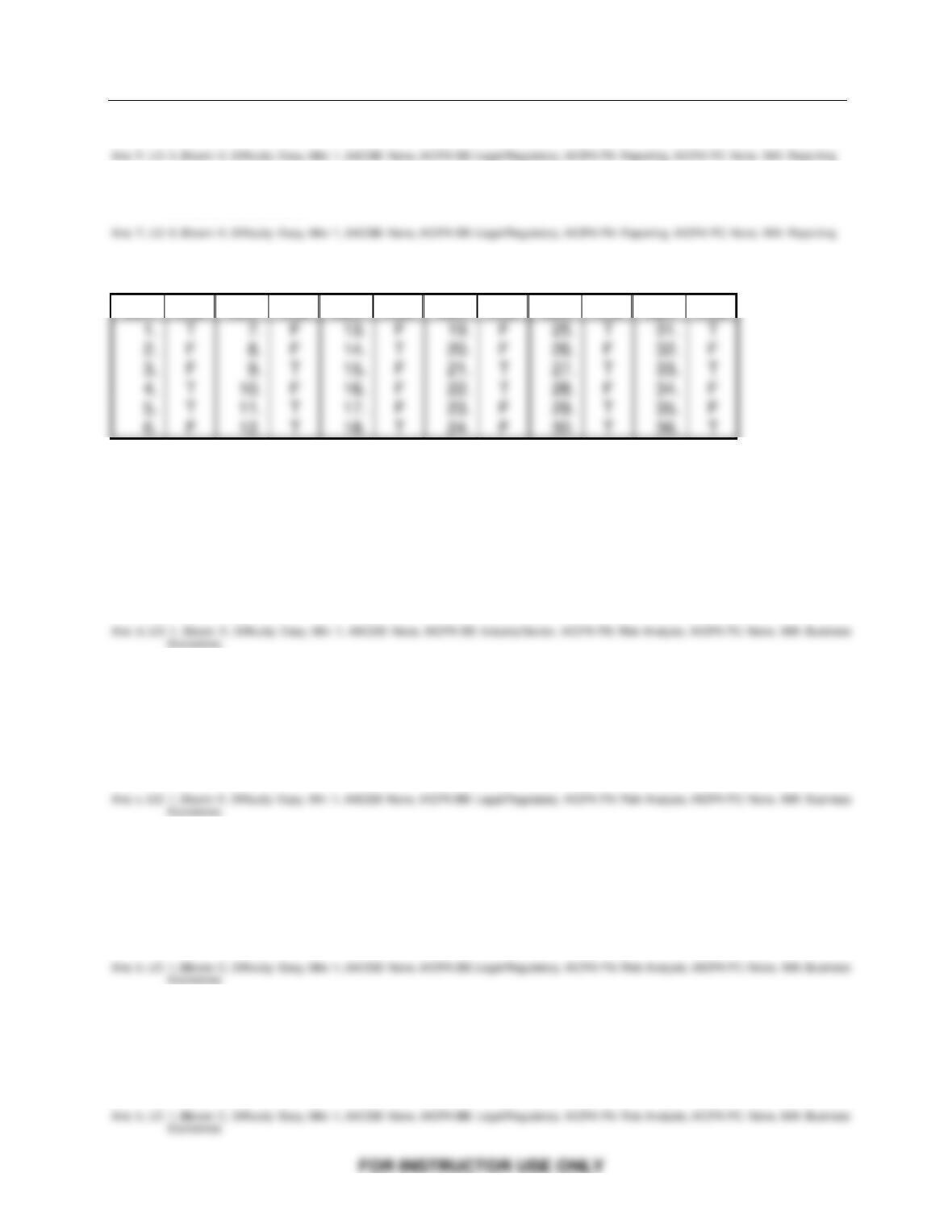
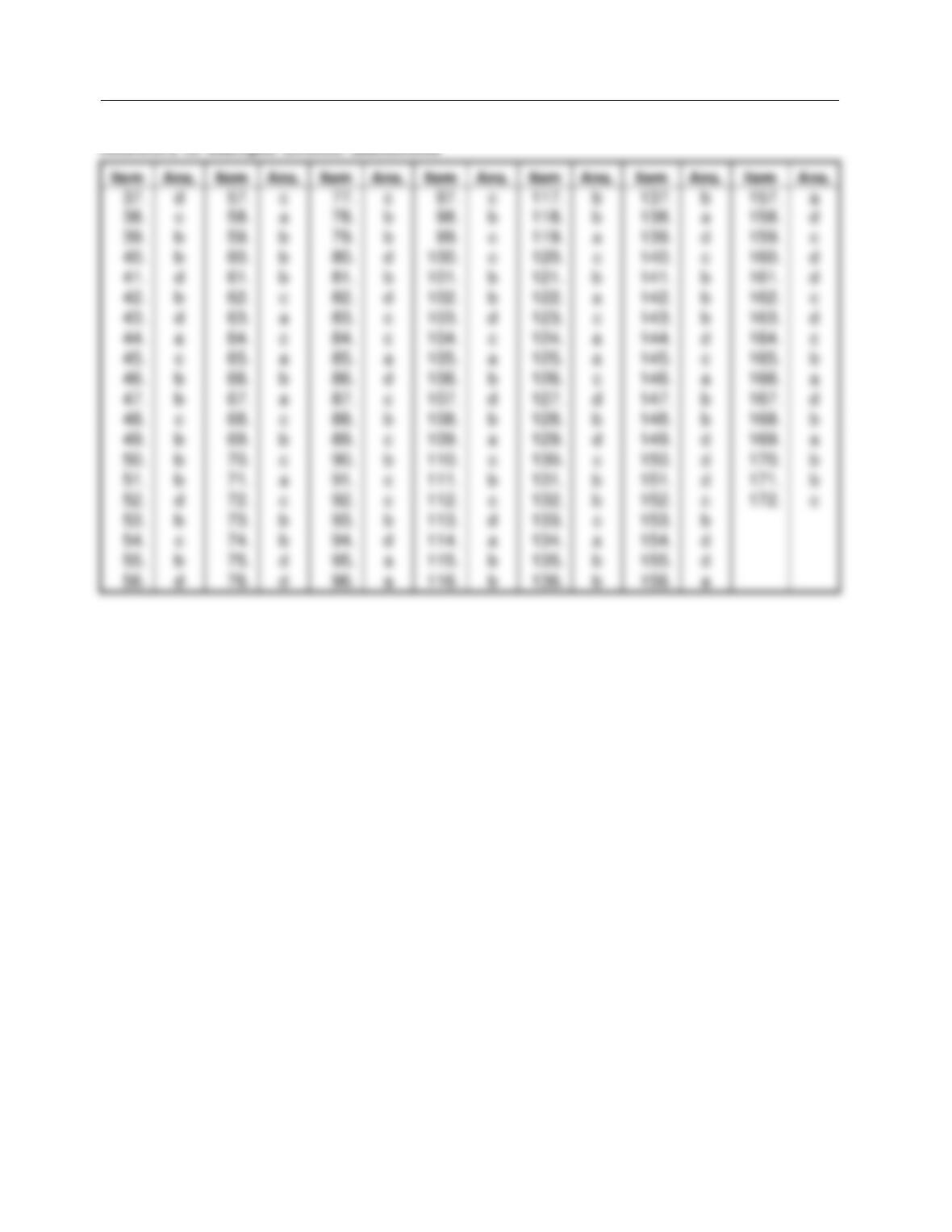
Answers to True-False Statements
Item
Ans.
Item
Ans.
Item
Ans.
Item
Ans.
Item
Ans.
Item
Ans.
MULTIPLE CHOICE QUESTIONS
37. Which one of the following is primarily interested in the liquidity of a company?
a. Federal government
b. Stockholders
c. Long-term creditors
d. Short-term creditors
38. Which one of the following is not a characteristic generally evaluated in analyzing financial
statements?
a. Liquidity
b. Profitability
c. Marketability
d. Solvency
39. In analyzing the financial statements of a company, a single item on the financial
statements
a. should be reported in bold-face type.
b. is more meaningful if compared to other financial information.
c. is significant only if it is large.
d. should be accompanied by a footnote.
40. Short-term creditors are usually most interested in evaluating
a. solvency.
b. liquidity.
c. marketability.
d. profitability.
Test Bank for Managerial Accounting Sixth Edition
14 – 8
41. Long-term creditors are usually most interested in evaluating
a. liquidity and solvency.
b. solvency and marketability.
c. liquidity and profitability.
d. profitability and solvency.
42. Stockholders are most interested in evaluating
a. liquidity and solvency.
b. profitability and solvency.
c. liquidity and profitability.
d. marketability and solvency.
43. A stockholder is interested in the ability of a firm to
a. pay consistent dividends.
b. appreciate in share price.
c. survive over a long period.
d. all of these.
44. Comparisons of financial data made within a company are called
a. intracompany comparisons.
b. interior comparisons.
c. intercompany comparisons.
d. intramural comparisons.
45. A technique for evaluating financial statements that expresses the relationship among
selected items of financial statement data is
a. common size analysis.
b. horizontal analysis.
c. ratio analysis.
d. vertical analysis.
46. Which one of the following is not a tool in financial statement analysis?
a. Horizontal analysis
b. Circular analysis
c. Vertical analysis
d. Ratio analysis
Financial Statement Analysis
14 – 9
47. In analyzing financial statements, horizontal analysis is a
a. requirement.
b. tool.
c. principle.
d. theory.
48. Horizontal analysis is also called
a. linear analysis.
b. vertical analysis.
c. trend analysis.
d. common size analysis.
49. Vertical analysis is also known as
a. perpendicular analysis.
b. common size analysis.
c. trend analysis.
d. straight-line analysis.
50. In ratio analysis, the ratios are never expressed as a
a. rate.
b. negative figure.
c. percentage.
d. simple proportion.
51. The formula for horizontal analysis of changes since the base period is the current year
amount
a. divided by the base year amount.
b. minus the base year amount divided by the base year amount.
c. minus the base year amount divided by the current year amount.
d. plus the base year amount divided by the base year amount.
52. Horizontal analysis evaluates a series of financial statement data over a period of time
a. that has been arranged from the highest number to the lowest number.
b. that has been arranged from the lowest number to the highest number.
c. to determine which items are in error.
d. to determine the amount and/or percentage increase or decrease that has taken
place.
Test Bank for Managerial Accounting Sixth Edition
14 – 10
53. Horizontal analysis evaluates financial statement data
a. within a period of time.
b. over a period of time.
c. on a certain date.
d. as it may appear in the future.
54. Assume the following sales data for a company:
2014 $1,050,000
2013 950,000
2012 800,000
2011 550,000
If 2011 is the base year, what is the percentage increase in sales from 2011 to 2013?
a. 100%
b. 90.9%
c. 72.7%
d. 52.4%
55. Comparative balance sheets are usually prepared for
a. one year.
b. two years.
c. three years.
d. four years.
56. Horizontal analysis is appropriately performed
a. only on the income statement.
b. only on the balance sheet.
c. only on the statement of retained earnings.
d. on all three of these statements.
57. A horizontal analysis performed on a statement of retained earnings would not show a
percentage change in
a. dividends paid.
b. net income.
c. expenses.
d. beginning retained earnings.
Financial Statement Analysis
FOR INSTRUCTOR USE ONLY
14 – 11
58. Under which of the following cases may a percentage change be computed?
a. The trend of the balances is decreasing but all balances are positive.
b. There is no balance in the base year.
c. There is a positive balance in the base year and a negative balance in the subsequent
year.
d. There is a negative balance in the base year and a positive balance in the subsequent
year.
59. Assume the following sales data for a company:
2014 $945,000
2013 877,500
2012 650,000
If 2012 is the base year, what is the percentage increase in sales from 2012 to 2013?
a. 24%
b. 35%
c. 76%
d. 135%
60. Assume the following cost of goods sold data for a company:
2014 $1,680,000
2013 1,400,000
2012 1,200,000
If 2012 is the base year, what is the percentage increase in cost of goods sold from 2012
to 2014?
a. 140%
b. 40%
c. 23%
d. 17%
61. Darius, Inc. has the following income statement (in millions):
DARIUS, INC.
Income Statement
For the Year Ended December 31, 2013
Net Sales $300
Cost of Goods Sold 120
Gross Profit 180
Operating Expenses 44
Net Income $136
Test Bank for Managerial Accounting Sixth Edition
14 – 12
MC 61. (Cont.)
Using vertical analysis, what percentage is assigned to Cost of Goods Sold?
a. 30%
b. 40%
c. 100%
d. None of the above
62. Darius, Inc. has the following income statement (in millions):
DARIUS, INC.
Income Statement
For the Year Ended December 31, 2013
Net Sales $300
Cost of Goods Sold 120
Gross Profit 180
Operating Expenses 44
Net Income $136
Using vertical analysis, what percentage is assigned to Net Income?
a. 100%
b. 75.6%
c. 45.3%
d. None of the above
63. Vertical analysis is also called
a. common size analysis.
b. horizontal analysis.
c. ratio analysis.
d. trend analysis.
64. Vertical analysis is a technique which expresses each item within a financial statement
a. in dollars and cents.
b. in terms of a percentage of the item in the previous year.
c. in terms of a percent of a base amount.
d. starting with the highest value down to the lowest value.
65. In common size analysis,
a. a base amount is required.
b. a base amount is optional.
c. the same base is used across all financial statements analyzed.
d. the results of the horizontal analysis are necessary inputs for performing the analysis.
Financial Statement Analysis
14 – 13
66. In performing a vertical analysis, the base for prepaid expenses is
a. total current assets.
b. total assets.
c. total liabilities and stockholders’ equity.
d. prepaid expenses.
67. In performing a vertical analysis, the base for sales revenues on the income statement is
a. net sales.
b. sales.
c. net income.
d. cost of goods available for sale.
68. In performing a vertical analysis, the base for sales returns and allowances is
a. sales.
b. sales discounts.
c. net sales.
d. total revenues.
69. In performing a vertical analysis, the base for cost of goods sold is
a. total selling expenses.
b. net sales.
c. total revenues.
d. total expenses.
70. Each of the following is a liquidity ratio except the
a. acid-test ratio.
b. current ratio.
c. debt to total assets ratio.
d. inventory turnover.
71. A ratio calculated in the analysis of financial statements
a. expresses a mathematical relationship between two numbers.
b. shows the percentage increase from one year to another.
c. restates all items on a financial statement in terms of dollars of the same purchasing
power.
d. is meaningful only if the numerator is greater than the denominator.
Test Bank for Managerial Accounting Sixth Edition
14 – 14
72. A liquidity ratio measures the
a. income or operating success of an enterprise over a period of time.
b. ability of the enterprise to survive over a long period of time.
c. short-term ability of the enterprise to pay its maturing obligations and to meet
unexpected needs for cash.
d. number of times interest is earned.
73. The current ratio is
a. calculated by dividing current liabilities by current assets.
b. used to evaluate a company’s liquidity and short-term debt paying ability.
c. used to evaluate a company’s solvency and long-term debt paying ability.
d. calculated by subtracting current liabilities from current assets.
74. The acid-test (quick) ratio
a. is used to quickly determine a company’s solvency and long-term debt paying ability.
b. relates cash, short-term investments, and net receivables to current liabilities.
c. is calculated by taking one item from the income statement and one item from the
balance sheet.
d. is the same as the current ratio except it is rounded to the nearest whole percent.
75. Harvey Clothing Store had a balance in the Accounts Receivable account of $390,000 at
the beginning of the year and a balance of $410,000 at the end of the year. Net credit
sales during the year amounted to $3,000,000. The average collection period of the
receivables in terms of days was
a. 30 days.
b. 365 days.
c. 274 days.
d. 48.7 days.
76. Parker Hardware Store had net credit sales of $8,000,000 and cost of goods sold of
$5,000,000 for the year. The Accounts Receivable balances at the beginning and end of
the year were $600,000 and $700,000, respectively. The receivables turnover was
a. 7.7 times.
b. 4.6 times.
c. 11.4 times.
d. 12.3 times.
Financial Statement Analysis
14 – 15
77. Wagon Department Store had net credit sales of $16,000,000 and cost of goods sold of
$15,000,000 for the year. The average inventory for the year amounted to $2,000,000.
Inventory turnover for the year is
a. 8 times.
b. 15 times.
c. 7.5 times.
d. 5 times.
78. Wagon Department Store had net credit sales of $16,000,000 and cost of goods sold of
$15,000,000 for the year. The average inventory for the year amounted to $2,000,000.
The average number of days in inventory during the year was
a. 365 days.
b. 48.7 days.
c. 46 days.
d. 30 days.
79. Each of the following is included in computing the acid-test ratio except
a. cash.
b. inventory.
c. receivables.
d. short-term investments.
80. Which one of the following would not be considered a liquidity ratio?
a. Current ratio
b. Inventory turnover
c. Acid-test ratio
d. Return on assets
81. Asset turnover measures
a. how often a company replaces its assets.
b. how efficiently a company uses its assets to generate sales.
c. the portion of the assets that have been financed by creditors.
d. the overall rate of return on assets.
82. Profit margin is calculated by dividing
a. sales by cost of goods sold.
b. gross profit by net sales.
c. net income by stockholders’ equity.
d. net income by net sales.
Test Bank for Managerial Accounting Sixth Edition
14 – 16
83. Stout Corporation had net income of $200,000 and paid dividends to common
stockholders of $40,000 in 2013. The weighted average number of shares outstanding in
2013 was 50,000 shares. Stout Corporation’s common stock is selling for $75 per share
on the New York Stock Exchange. Stout Corporation’s price-earnings ratio is
a. 3.8 times.
b. 15 times.
c. 18.8 times.
d. 12 times.
84 Stout Corporation had net income of $200,000 and paid dividends to common
stockholders of $40,000 in 2013. The weighted average number of shares outstanding in
2013 was 50,000 shares. Stout Corporation’s common stock is selling for $60 per share
on the New York Stock Exchange. Stout Corporation’s payout ratio for 2013 is
a. $4 per share.
b 25%.
c. 20%.
d. 12.5%.
85 Flake Company reported the following on its income statement:
Income before income taxes $600,000
Income tax expense 150,000
Net income $450,000
An analysis of the income statement revealed that interest expense was $50,000. Flake
Company’s times interest earned was
a. 13 times.
b. 12 times.
c. 6 times.
d. 7 times.
86. The debt to total assets ratio measures
a. the company’s profitability.
b. whether interest can be paid on debt in the current year.
c. the proportion of interest paid relative to dividends paid.
d. the percentage of the total assets provided by creditors.
87. Trading on the equity (leverage) refers to the
a. amount of working capital.
b. amount of capital provided by owners.
c. use of borrowed money to increase the return to owners.
d. number of times interest is earned.
Financial Statement Analysis
14 – 17
88. The current assets of Margo Company are $300,000. The current liabilities are $100,000.
The current ratio expressed as a proportion is
a. 300%.
b. 3.0 : 1
c. .33 : 1
d. $300,000 ÷ $100,000.
89. The current ratio may also be referred to as the
a. short run ratio.
b. acid-test ratio.
c. working capital ratio.
d. contemporary ratio.
90. A weakness of the current ratio is
a. the difficulty of the calculation.
b. that it doesn’t take into account the composition of the current assets.
c. that it is rarely used by sophisticated analysts.
d. that it can be expressed as a percentage, as a rate, or as a proportion.
91. A supplier to a company would be most interested in the company’s
a. asset turnover.
b. profit margin.
c. current ratio.
d. earnings per share.
92. Which one of the following ratios would not likely be used by a short-term creditor in
evaluating whether to sell on credit to a company?
a. Current ratio
b. Acid-test ratio
c. Asset turnover
d. Receivables turnover
93. Ratios are used as tools in financial analysis
a. instead of horizontal and vertical analyses.
b. because they may provide information that is not apparent from inspection of the
individual components of the ratio.
c. because even single ratios by themselves are quite meaningful.
d. because they are prescribed by GAAP.
Test Bank for Managerial Accounting Sixth Edition
14 – 18
94. The ratios that are used to determine a company’s short-term debt paying ability are
a. asset turnover, times interest earned, current ratio, and receivables turnover.
b. times interest earned, inventory turnover, current ratio, and receivables turnover.
c. times interest earned, acid-test ratio, current ratio, and inventory turnover.
d. current ratio, acid-test ratio, receivables turnover, and inventory turnover.
95. A measure of the percentage of each dollar of sales that results in net income is
a. profit margin.
b. return on assets.
c. return on common stockholders’ equity.
d. earnings per share.
96. West Company had $375,000 of current assets and $150,000 of current liabilities before
borrowing $75,000 from the bank with a 3-month note payable. What effect did the
borrowing transaction have on the amount of West Company’s working capital?
a. No effect
b. $75,000 increase
c. $150,000 increase
d. $75,000 decrease
97. West Company had $375,000 of current assets and $150,000 of current liabilities before
borrowing $75,000 from the bank with a 3-month note payable. What effect did the
borrowing transaction have on West Company’s current ratio?
a. The ratio remained unchanged.
b. The change in the current ratio cannot be determined.
c. The ratio decreased.
d. The ratio increased.
98. If equal amounts are added to the numerator and the denominator of the current ratio, the
ratio will always
a. increase.
b. decrease.
c. stay the same.
d. equal zero.
99. The acid-test ratio
a. is a quick calculation of an approximation of the current ratio.
b. does not include all current liabilities in the calculation.
c. does not include inventory as part of the numerator.
d. does include prepaid expenses as part of the numerator.
Financial Statement Analysis
14 – 19
100. If a company has an acid-test ratio of 1.2:1, what respective effects will the borrowing of
cash by short-term debt and collection of accounts receivable have on the ratio?
Short-term Borrowing Collection of Receivable
a. Increase No effect
b. Increase Increase
c. Decrease No effect
d. Decrease Decrease
101. A company has a receivables turnover of 10 times. The average receivables during the
period are $500,000. What is the amount of net credit sales for the period?
a. $50,000
b. $5,000,000
c. $500,000
d. Cannot be determined from the information given
102. If the average collection period is 60 days, what is the receivables turnover?
a. 6.0 times
b. 6.1 times
c. 12.2 times
d. None of these
103. A general rule to use in assessing the average collection period is that
a. it should not exceed 30 days.
b. it can be any length as long as the customer continues to buy merchandise.
c. it should not greatly exceed the discount period.
d. it should not greatly exceed the credit term period.
104. Inventory turnover is calculated by dividing
a. cost of goods sold by the ending inventory.
b. cost of goods sold by the beginning inventory.
c. cost of goods sold by the average inventory.
d. average inventory by cost of goods sold.
105. A company has an average inventory on hand of $40,000 and the days in inventory is 73
days. What is the cost of goods sold?
a. $200,000
b. $2,920,000
c. $400,000
d. $1,460,000
Test Bank for Managerial Accounting Sixth Edition
14 – 20
106. A successful grocery store would probably have
a. a low inventory turnover.
b. a high inventory turnover.
c. zero profit margin.
d. low volume.
107. An aircraft company would most likely have
a. a high inventory turnover.
b. low profit margin.
c. high volume.
d. a low inventory turnover.
108. Net sales are $6,000,000, beginning total assets are $2,800,000, and the asset turnover is
3.0 times. What is the ending total asset balance?
a. $2,000,000
b. $1,200,000
c. $2,800,000
d. $2,200,000
109. Earnings per share is calculated
a. only for common stock.
b. only for preferred stock.
c. for common and preferred stock.
d. only for treasury stock.
110. Which of the following is not a profitability ratio?
a. Payout ratio
b. Profit margin
c. Times interest earned
d. Return on common stockholders’ equity
111. Times interest earned is also called the
a. money multiplier.
b. interest coverage ratio.
c. coupon coverage ratio.
d. premium ratio.
Financial Statement Analysis
14 – 21
112. The ratio that uses weighted average common shares outstanding in the denominator is
the
a. price-earnings ratio.
b. return on common stockholders’ equity.
c. earnings per share.
d. payout ratio.
113. Net income does not appear in the numerator of the
a. profit margin.
b. return on assets.
c. return on common stockholders’ equity.
d. payout ratio.
114. Bria Clothing Store had a balance in the Accounts Receivable account of $920,000 at the
beginning of the year and a balance of $980,000 at the end of the year. Net credit sales
during the year amounted to $7,600,000. The receivables turnover ratio was
a. 8.0 times.
b. 8.4 times.
c. 7.8 times.
d. 8.3 times.
115. Bria Clothing Store had a balance in the Accounts Receivable account of $810,000 at the
beginning of the year and a balance of $850,000 at the end of the year. Net credit sales
during the year amounted to $6,640,000. The average collection period of the receivables
in terms of days was
a. 91.3 days.
b. 45.6 days.
c. 30 days.
d. 46.7 days.
116. Donner Corporation had net income of $200,000 and paid dividends to common
stockholders of $40,000 in 2013. The weighted average number of shares outstanding in
2013 was 50,000 shares. Donner Corporation‘s common stock is selling for $35 per share
on the New York Stock Exchange. Donner Corporation’s price-earnings ratio is
a. 5 times.
b. 8.75 times.
c. 4 times.
d. 10.9 times.
Test Bank for Managerial Accounting Sixth Edition
FOR INSTRUCTOR USE ONLY
14 – 22
117. Donner Corporation had net income of $400,000 and paid dividends to common
stockholders of $40,000 in 2013. The weighted average number of shares outstanding in
2013 was 50,000 shares. Donner Corporation‘s common stock is selling for $50 per share
on the New York Stock Exchange. Donner Corporation’s payout ratio for 2013 is
a. $8 per share.
b. 10%.
c. 12.5%.
d. 20%.
118. Town Company reported the following on its income statement:
Income before income taxes $750,000
Income tax expense 150,000
Net income $600,000
An analysis of the income statement revealed that interest expense was $100,000. Town
Company’s times interest earned was
a. 5 times.
b. 8.5 times.
c. 6 times.
d. 7.5 times.
119. The following information pertains to Sampson Company. Assume that all balance sheet
amounts represent both average and ending balance figures. Assume that all sales were
on credit. Assets
Cash and short-term investments $ 45,000
Accounts receivable (net) 25,000
Inventory 20,000
Property, plant and equipment 210,000
Total Assets $300,000
Liabilities and Stockholders’ Equity
Current liabilities $ 50,000
Long-term liabilities 90,000
Stockholders’ equity—common 160,000
Total Liabilities and Stockholders’ Equity $300,000
Income Statement
Sales $ 120,000
Cost of goods sold 66,000
Gross profit 54,000
Operating expenses 30,000
Net income $ 24,000
Number of shares of common stock 6,000
Market price of common stock $20
Dividends per share .50
Financial Statement Analysis
14 – 23
MC 119. (Cont.)
What is the current ratio for Sampson?
a. 1.80
b. 1.30
c. 1.40
d. .64
120. The following information pertains to Sampson Company. Assume that all balance sheet
amounts represent both average and ending balance figures. Assume that all sales were
on credit. Assets
Cash and short-term investments $ 45,000
Accounts receivable (net) 35,000
Inventory 20,000
Property, plant and equipment 210,000
Total Assets $310,000
Liabilities and Stockholders’ Equity
Current liabilities $ 50,000
Long-term liabilities 90,000
Stockholders’ equity—common 160,000
Total Liabilities and Stockholders’ Equity $310,000
Income Statement
Sales $ 105,000
Cost of goods sold 66,000
Gross profit 39,000
Operating expenses 30,000
Net income $ 9,000
Number of shares of common stock 6,000
Market price of common stock $20
Dividends per share .50
What is the receivables turnover for Sampson?
a. 1.5 times
b. 1.1 times
c. 3.0 times
d. 12.9 times
Test Bank for Managerial Accounting Sixth Edition
FOR INSTRUCTOR USE ONLY
14 – 24
121. The following information pertains to Sampson Company. Assume that all balance sheet
amounts represent both average and ending balance figures. Assume that all sales were
on credit. Assets
Cash and short-term investments $ 45,000
Accounts receivable (net) 25,000
Inventory 11,000
Property, plant and equipment 210,000
Total Assets $291,000
Liabilities and Stockholders’ Equity
Current liabilities $ 50,000
Long-term liabilities 90,000
Stockholders’ equity—common 151,000
Total Liabilities and Stockholders’ Equity $291,000
Income Statement
Sales $ 120,000
Cost of goods sold 55,000
Gross profit 65,000
Operating expenses 30,000
Net income $ 35,000
Number of shares of common stock 6,000
Market price of common stock $20
Dividends per share .50
What is the inventory turnover for Sampson?
a. 3.2 times
b. 5 times
c. 10.9 times
d. 0.20 times
122. The following information pertains to Sampson Company. Assume that all balance sheet
amounts represent both average and ending balance figures. Assume that all sales were
on credit. Assets
Cash and short-term investments $ 45,000
Accounts receivable (net) 25,000
Inventory 20,000
Property, plant and equipment 210,000
Total Assets $300,000
Liabilities and Stockholders’ Equity
Current liabilities $ 50,000
Long-term liabilities 90,000
Stockholders’ equity—common 160,000
Total Liabilities and Stockholders’ Equity $300,000

Financial Statement Analysis
FOR INSTRUCTOR USE ONLY
14 – 25
MC 122. (Cont.) Income Statement
Sales $ 120,000
Cost of goods sold 66,000
Gross profit 54,000
Operating expenses 30,000
Net income $ 24,000
Number of shares of common stock 6,000
Market price of common stock $20
Dividends per share .50
What is the return on assets for Sampson?
a. 8.0%
b. 7.0%
c. 18.0%
d. 16.0%
123. The following information pertains to Sampson Company. Assume that all balance sheet
amounts represent both average and ending balance figures. Assume that all sales were
on credit. Assets
Cash and short-term investments $ 45,000
Accounts receivable (net) 25,000
Inventory 20,000
Property, plant and equipment 310,000
Total Assets $400,000
Liabilities and Stockholders’ Equity
Current liabilities $ 50,000
Long-term liabilities 90,000
Stockholders’ equity—common 260,000
Total Liabilities and Stockholders’ Equity $400,000
Income Statement
Sales $ 300,000
Cost of goods sold 66,000
Gross profit 234,000
Operating expenses 30,000
Net income $ 204,000
Number of shares of common stock 6,000
Market price of common stock $20
Dividends per share .50
Test Bank for Managerial Accounting Sixth Edition
14 – 26
MC 123. (Cont.)
What is the profit margin for Sampson?
a. 115%
b. 28.2%
c. 68%
d. 51%
124. The following information pertains to Sampson Company. Assume that all balance sheet
amounts represent both average and ending balance figures. Assume that all sales were
on credit. Assets
Cash and short-term investments $ 45,000
Accounts receivable (net) 25,000
Inventory 20,000
Property, plant and equipment 230,000
Total Assets $320,000
Liabilities and Stockholders’ Equity
Current liabilities $ 50,000
Long-term liabilities 90,000
Stockholders’ equity—common 180,000
Total Liabilities and Stockholders’ Equity $320,000
Income Statement
Sales $ 150,000
Cost of goods sold 66,000
Gross profit 84,000
Operating expenses 30,000
Net income $ 54,000
Number of shares of common stock 6,000
Market price of common stock $20
Dividends per share .50
What is the return on common stockholders’ equity for Sampson?
a. 30%
b. 46.7%
c. 36%
d. 16.9%
Financial Statement Analysis
FOR INSTRUCTOR USE ONLY
14 – 27
125. The following information pertains to Sampson Company. Assume that all balance sheet
amounts represent both average and ending balance figures. Assume that all sales were
on credit. Assets
Cash and short-term investments $ 45,000
Accounts receivable (net) 25,000
Inventory 20,000
Property, plant and equipment 210,000
Total Assets $300,000
Liabilities and Stockholders’ Equity
Current liabilities $ 50,000
Long-term liabilities 90,000
Stockholders’ equity—common 160,000
Total Liabilities and Stockholders’ Equity $300,000
Income Statement
Sales $ 120,000
Cost of goods sold 66,000
Gross profit 54,000
Operating expenses 18,000
Net income $ 36,000
Number of shares of common stock 6,000
Market price of common stock $33
Dividends per share .50
What is the price-earnings ratio for Sampson?
a. 5.5 times
b. 1.1 times
c. 6 times
d. 6.6 times
126. The following information pertains to Eura Company. Assume that all balance sheet
amounts represent both average and ending balance figures. Assume that all sales were
on credit. Assets
Cash and short-term investments $ 40,000
Accounts receivable (net) 30,000
Inventory 25,000
Property, plant and equipment 215,000
Total Assets $310,000
Liabilities and Stockholders’ Equity
Current liabilities $ 60,000
Long-term liabilities 75,000
Stockholders’ equity—common 175,000
Total Liabilities and Stockholders’ Equity $310,000

Test Bank for Managerial Accounting Sixth Edition
14 – 28
MC 126. (Cont.)
Income Statement
Sales $ 90,000
Cost of goods sold 45,000
Gross profit 45,000
Operating expenses 25,000
Net income $ 20,000
Number of shares of common stock 5,000
Market price of common stock $22
Dividends per share 1.00
What is the return on assets for Eura?
a. 4.8%
b. 9.7%
c. 6.5%
d. 12.9%
127. The following information pertains to Eura Company. Assume that all balance sheet
amounts represent both average and ending balance figures. Assume that all sales were
on credit. Assets
Cash and short-term investments $ 40,000
Accounts receivable (net) 30,000
Inventory 25,000
Property, plant and equipment 215,000
Total Assets $310,000
Liabilities and Stockholders’ Equity
Current liabilities $ 60,000
Long-term liabilities 75,000
Stockholders’ equity—common 175,000
Total Liabilities and Stockholders’ Equity $310,000
Income Statement
Sales $ 135,000
Cost of goods sold 45,000
Gross profit 90,000
Operating expenses 25,000
Net income $ 65,000
Number of shares of common stock 5,000
Market price of common stock $22
Dividends per share 1.00
What is the profit margin for Eura?
a. 27.8%
b. 51.9%
c. 72.2%
d. 48.1%
Financial Statement Analysis
FOR INSTRUCTOR USE ONLY
14 – 29
128. The following information pertains to Eura Company. Assume that all balance sheet
amounts represent both average and ending balance figures. Assume that all sales were
on credit. Assets
Cash and short-term investments $ 40,000
Accounts receivable (net) 30,000
Inventory 45,000
Property, plant and equipment 215,000
Total Assets $330,000
Liabilities and Stockholders’ Equity
Current liabilities $ 60,000
Long-term liabilities 75,000
Stockholders’ equity—common 195,000
Total Liabilities and Stockholders’ Equity $330,000
Income Statement
Sales $ 90,000
Cost of goods sold 45,000
Gross profit 45,000
Operating expenses 30,000
Net income $ 15,000
Number of shares of common stock 5,000
Market price of common stock $22
Dividends per share 1.00
What is the return on common stockholders’ equity for Eura?
a. 4.8%
b. 7.7%
c. 23.1%
d. 46.2%
129. The following information pertains to Eura Company. Assume that all balance sheet
amounts represent both average and ending balance figures. Assume that all sales were
on credit. Assets
Cash and short-term investments $ 40,000
Accounts receivable (net) 30,000
Inventory 25,000
Property, plant and equipment 215,000
Total Assets $310,000
Liabilities and Stockholders’ Equity
Current liabilities $ 60,000
Long-term liabilities 75,000
Stockholders’ equity—common 175,000
Total Liabilities and Stockholders’ Equity $310,000
Test Bank for Managerial Accounting Sixth Edition
14 – 30
MC 129. (Cont.)
Income Statement
Sales $ 90,000
Cost of goods sold 45,000
Gross profit 45,000
Operating expenses 25,000
Net income $ 20,000
Number of shares of common stock 5,000
Market price of common stock $22
Dividends per share 1.00
What is the price-earnings ratio for Eura?
a. 5 times
b. 4.0 times
c. 7.3 times
d. 5.5 times
130. The following information is available for Compton Company:
2013 2012
Accounts receivable $ 460,000 $ 500,000
Inventory 280,000 320,000
Net credit sales 2,470,000 1,400,000
Cost of goods sold 1,860,000 1,060,000
Net income 300,000 170,000
The receivables turnover ratio for 2013 is
a. 1.6 times.
b. 5.4 times.
c. 5.1 times.
d. 3.9 times.
131. The following information is available for Compton Company:
2013 2012
Accounts receivable $ 360,000 $ 400,000
Inventory 340,000 420,000
Net credit sales 2,470,000 1,400,000
Cost of goods sold 1,860,000 1,060,000
Net income 300,000 170,000
The inventory turnover ratio for 2013 is
a. 6.2 times.
b. 4.9 times.
c. 5.5 times.
d. 4.4 times.
Financial Statement Analysis
14 – 31
132. The following amounts were taken from the financial statements of Plant Company:
2013 2012
Total assets $800,000 $1,000,000
Net sales 720,000 650,000
Gross profit 352,000 320,000
Net income 126,000 117,000
Weighted average number of common shares outstanding 90,000 90,000
Market price of common stock $35 $39
The return on assets ratio for 2013 is
a. 16%.
b. 14%.
c. 32%.
d. 28%.
133. The following amounts were taken from the financial statements of Plant Company:
2013 2012
Total assets $800,000 $1,000,000
Net sales 840,000 650,000
Gross profit 352,000 320,000
Net income 155,400 117,000
Weighted average number of common shares outstanding 90,000 90,000
Market price of common stock $35 $39
The profit margin ratio for 2013 is
a. 19.4%.
b. 44.1%.
c. 18.5%.
d. 10.7%.
134. The following amounts were taken from the financial statements of Plant Company:
2013 2012
Total assets $800,000 $1,000,000
Net sales 720,000 650,000
Gross profit 352,000 320,000
Net income 150,000 117,000
Weighted average number of common shares outstanding 60,000 90,000
Market price of common stock $67.50 $39
The price-earnings ratio for 2013 is
a. 27 times.
b. 45 times.
c. 11 times.
d. 2.5 times.
Test Bank for Managerial Accounting Sixth Edition
14 – 32
135. Star Corporation had net income of $300,000 and paid dividends to common stockholders
of $40,000 in 2013. The weighted average number of shares outstanding in 2013 was
50,000 shares. Star Corporation’s common stock is selling for $36 per share on the New
York Stock Exchange.
Star Corporation‘s price-earnings ratio is
a. 5.2 times.
b. 6 times.
c. 18 times.
d. 6.9 times.
136. Star Corporation had net income of $320,000 and paid dividends to common stockholders
of $80,000 in 2013. The weighted average number of shares outstanding in 2013 was
50,000 shares. Star Corporation’s common stock is selling for $30 per share on the New
York Stock Exchange.
Star Corporation‘s payout ratio for 2013 is
a. 16%.
b. 25%.
c. 9%.
d. $4 per share.
137. The following financial statement information is available for Houser Corporation:
2013 2012
Inventory $ 44,000 $ 43,000
Current assets 81,000 106,000
Total assets 432,000 358,000
Current liabilities 30,000 36,000
Total liabilities 102,000 88,000
The current ratio for 2013 is
a. .37:1.
b. 2.7:1.
c. .79:1.
d. 4.24:1.
138. The following financial statement information is available for Jones Corporation:
2013 2012
Net sales $784,000 $697,000
Cost of goods sold 406,000 377,000
Net income 112,000 80,000
Tax expense 48,000 29,000
Interest expense 14,000 14,000
The profit margin ratio for 2013 is
a. 14.3%.
b. 16.1%.
c. 48.2%.
d. 11.7%.
Financial Statement Analysis
14 – 33
139. The following financial statement information is available for Henn Corporation:
2013 2012
Stockholders’ equity – common $330,000 $270,000
Net sales 784,000 697,000
Cost of goods sold 406,000 377,000
Net income 112,000 80,000
Inc tax expense 48,000 29,000
Interest expense 14,000 14,000
Dividends paid to preferred
stockholders 22,000 20,000
Dividends paid to common
stockholders 15,000 10,000
The return on common stockholders’ equity for 2013 is
a. 25.0%.
b. 37.3%.
c. 27.3%.
d. 30.0%.
140. The following financial statement information is available for Bongo Corporation:
2013 2012
Net income $115,000 $ 80,000
Income tax expense 50,000 29,000
Interest expense 15,000 14,000
Dividends paid to preferred
stockholders 22,000 20,000
Dividends paid to preferred
stockholders 15,000 10,000
The times interest earned for 2013 is
a. 8.8 times.
b. 7.7 times.
c. 12 times.
d. 11 times.
141. Dean Corporation reported net income $48,000, net sales $400,000, and average assets
$800,000 for 2013. The 2013 profit margin was:
a. 6%.
b. 12%.
c. 50%.
d. 200%.
Test Bank for Managerial Accounting Sixth Edition
14 – 34
142. Goin Company reports the following amounts for 2013:
Net income $ 150,000
Average stockholders’ equity 2,000,000
Preferred dividends 48,000
Par value preferred stock 200,000
The 2013 rate of return on common stockholders’ equity is:
a. 5.1%.
b. 5.7%.
c. 7.5%.
d. 8.3%.
143. Gamble Corporation had beginning inventory $100,000, cost of goods purchased
$700,000, and ending inventory $140,000. What was Gamble’s inventory turnover?
a. 5 times.
b. 5.5 times.
c. 5.83 times.
d. 6.6 times.
144. In 2013 Shum Corporation reported income from operations $180,000, interest expense
$50,000, and income tax expense $40,000. Shum’s times interest earned ratio was:
a. 5.4 times.
b. 4.6 times.
c. 4.4 times.
d. 3.6 times.
145. Reynolds Company has income before taxes of $360,000 and an extraordinary loss of
$80,000. If the income tax rate is 30% on all items, the income statement should show
income before irregular items and an extraordinary loss, respectively, of:
a. $360,000 and ($80,000)
b. $252,000 and ($24,000)
c. $252,000 and ($56,000)
d. $108,000 and ($24,000)
146. All of the following statements regarding changes in accounting principles are true except:
a. Most changes in accounting principles are only reported in current periods when the
principle change takes place.
b. Changes in accounting principles are allowed when new principles are preferable to
old ones.
c. Most changes in accounting principles are retroactively reported.
d. Consistency is one of the biggest concerns when a change in accounting principle is
undertaken.
Financial Statement Analysis
14 – 35
147. Alpha’s Bunny Barn has experienced a $60,000 loss due to tornado damage to its
inventory. Tornados have never before occurred in this area. Assuming that the
company’s tax rate is 30%, what amount will be reported for this loss on the income
statement?
a. $60,000
b. $42,000
c. $18,000
d. $54,000
148. Wing Company reported income before taxes of $900,000 and an extraordinary loss of
$250,000. Assume that the company’s tax rate is 30%. What amounts will be reported on
the income statement for income before irregular items and extraordinary items,
respectively?
a. $630,000 and $250,000
b. $630,000 and $175,000
c. $650,000 and $250,000
d. $650,000 and $175,000
149. Krug Corporation has income before taxes of $900,000 and an extraordinary gain of
$300,000. If the income tax rate is 25% on all items, the income statement should show
income before irregular items and extraordinary items, respectively, of
a. $600,000 and $300,000.
b. $600,000 and $225,000.
c. $675,000 and $300,000.
d. $675,000 and $225,000.
150. Hook Inc. has an investment in available-for-sale securities of $80,000. This investment
experienced an unrealized loss of $5,000 during the current year. Assuming a 35% tax
rate, the effect of this loss on comprehensive income will be
a. no effect.
b. $80,000 increase.
c. $28,000 decrease.
d. $5,000 decrease.
151. The disposal of a significant component of a business is called
a. a change in accounting principle.
b. an extraordinary item.
c. an other expense.
d. discontinued operations.
Test Bank for Managerial Accounting Sixth Edition
14 – 36
152. ACME Company reports income before income taxes of $2,400,000 and had an extra-
ordinary loss of $800,000. If the tax rate is 30%,
a. the income before the extraordinary item is $1,920,000.
b. the extraordinary loss would be reported on the income statement at $800,000.
c. the income before the extraordinary item is $1,680,000.
d. the extraordinary loss will be reported at $240,000.
153. Eaton, Inc. disposes of an unprofitable segment of its business. The operation of the
segment suffered a $360,000 loss in the year of disposal. The loss on disposal of the
segment was $180,000. If the tax rate is 30%, and income before income taxes was
$2,250,000,
a. the income tax expense on the income before discontinued operations is $513,000.
b. the income from continuing operations is $1,575,000.
c. net income is $1,710,000.
d. the losses from discontinued operations are reported net of income taxes at $270,000.
154. Each of the following is an extraordinary item except the
a. effects of major casualties, if rare in the area.
b. effects of a newly enacted law or regulation.
c. expropriation of property by a foreign government.
d. losses attributable to labor strikes.
155. The discontinued operations section of the income statement refers to
a. discontinuance of a product line.
b. the income or loss on products that have been completed and sold.
c. obsolete equipment and discontinued inventory items.
d. the disposal of a significant segment of a business.
156. Which one of the following would be classified as an extraordinary item?
a. Expropriation of property by a foreign government
b. Losses attributed to a labor strike
c. Write-down of inventories
d. Gains or losses from sales of equipment
157. A loss on the write down of obsolete inventory should be reported as
a. “other expenses and losses.”
b. part of discontinued operations.
c. an operating expense.
d. an extraordinary item.
Financial Statement Analysis
14 – 37
158. If an item meets one (but not both) of the criteria for an extraordinary item, it
a. only needs to be disclosed in the footnotes of the financial statements.
b. may be treated as sales revenue (if it is a gain) and as an operating expense (if it is a
loss).
c. is reported as an “other revenue or gain” or “other expense and loss,” net of tax.
d. is reported at its gross amount as an “other revenue or gain” or “other expense or
loss.”
159. The order of presentation of nontypical items that may appear on the income statement is
a. Extraordinary items, Discontinued operations, Other revenues and expenses.
b. Discontinued operations, Extraordinary items, Other revenues and expenses.
c. Other revenues and expenses, Discontinued operations, Extraordinary items.
d. Other revenues and expenses, Extraordinary items, Discontinued operations.
160. Each of the following is a factor affecting quality of earnings except
a. alternative accounting methods.
b. improper recognition.
c. pro forma income.
d. extraordinary items.
161. Comparisons can be made on each of the following bases except
a. industry averages.
b. intercompany basis.
c. intracompany basis.
d. Each of these is a basis for comparison.
162. Comparisons of data within a company are an example of the following comparative
basis:
a. Industry averages
b. Intercompany
c. Intracompany
d. Interregional
163. Center Corporation reported net sales of $200,000, $350,000, and $550,000 in the years
2012, 2013, and 2014 respectively. If 2012 is the base year, what is the trend percentage
for 2014?
a. 100%
b. 75%
c. 175%
d. 275%
Test Bank for Managerial Accounting Sixth Edition
14 – 38
164. In vertical analysis, the base amount for each income statement item is
a. gross profit.
b. net income.
c. net sales.
d. sales.
165. When performing vertical analysis, the base amount for administrative expense is
generally
a. administrative expense in a previous year.
b. net sales.
c. gross profit.
d. fixed assets.
166. Ratios that measure the short-term ability of the company to pay its maturing obligations
are
a. liquidity ratios.
b. profitability ratios.
c. solvency ratios.
d. trend ratios.
167. What type of ratios best measure the short-term ability of the enterprise to pay its
maturing obligations and to meet unexpected needs for cash?
a. Leverage
b. Solvency
c. Profitability
d. Liquidity
168. The acid-test ratio is also known as the
a. current ratio.
b. quick ratio.
c. fast ratio.
d. times interest earned ratio.
169. The debt to total assets ratio
a. is a solvency ratio.
b. is computed by dividing total assets by total debt.
c. measures the total assets provided by stockholders.
d. is a profitability ratio.
Financial Statement Analysis
14 – 39
170. An extraordinary item is one that
a. occurs infrequently and is uncontrollable in nature.
b. occurs infrequently and is unusual in nature.
c. is material and is unusual in nature.
d. is material and is uncontrollable in nature.
171. Parrish, Inc. decided on January 1 to discontinue its telescope manufacturing division. On
July 1, the division’s assets with a book value of $1,250,000 are sold for $850,000.
Operating income from January 1 to June 30 for the division amounted to $125,000.
Ignoring income taxes, what total amount should be reported on Parrish’s income
statement for the current year under the caption, Discontinued Operations?
a. $125,000
b. $275,000 loss
c. $400,000 loss
d. $525,000
172. When there has been a change in accounting principle,
a. the old principle should be used in reporting the results of operations for the current
year.
b. the cumulative effect of the change should be reported in the current year’s retained
earnings statement.
c. the change should be reported retroactively.
d. the new principle should be used in reporting the results of operations of the current
year, but there is no change to prior years.
Test Bank for Managerial Accounting Sixth Edition
FOR INSTRUCTOR USE ONLY
14 – 40
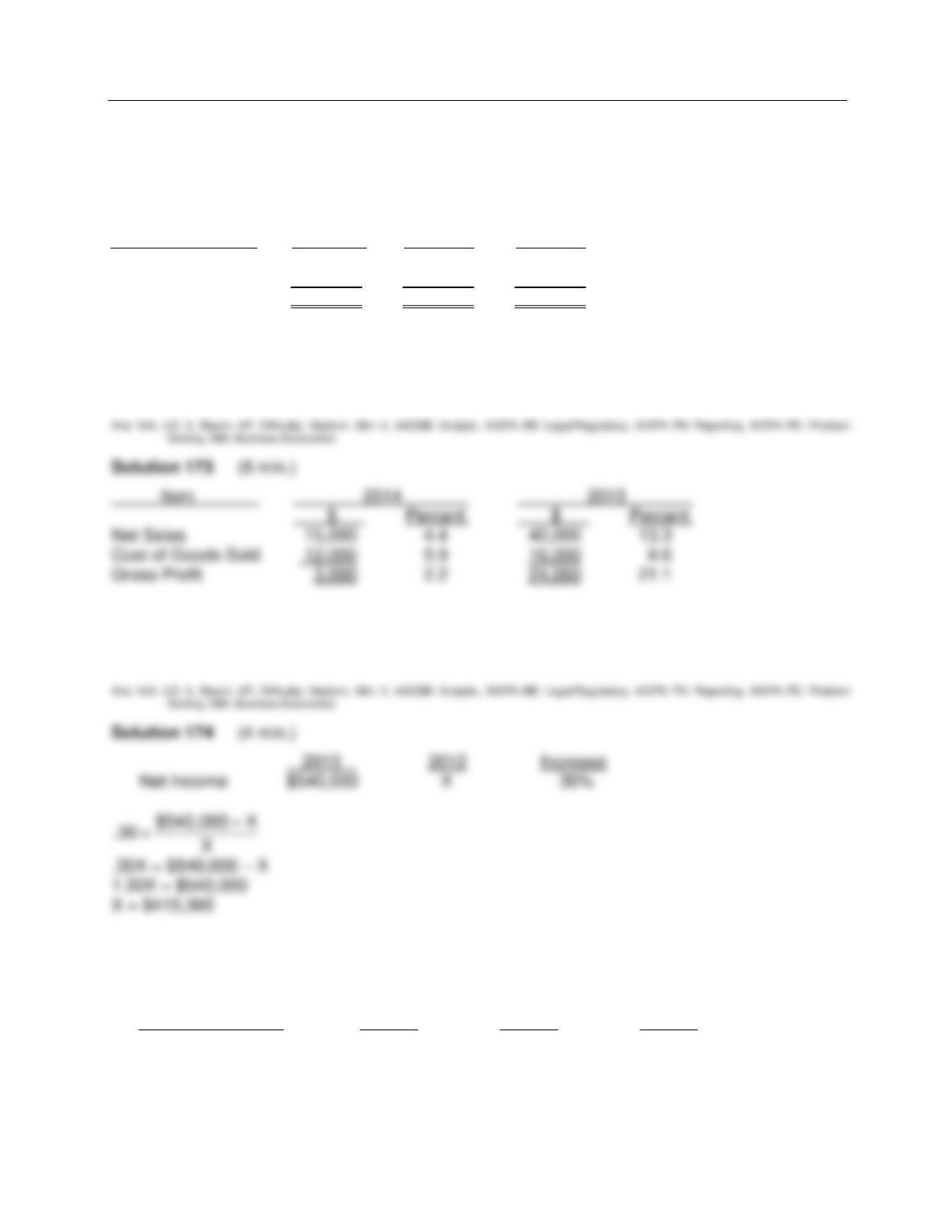
Answers to Multiple Choice Questions
Financial Statement Analysis
FOR INSTRUCTOR USE ONLY
14 – 41
BRIEF EXERCISES
BE 173
The following items were taken from the financial statements of Henager, Inc., over a three-year
period:
Item 2014 2013 2012
Net Sales $355,000 $340,000 $300,000
Cost of Goods Sold 214,000 202,000 186,000
Gross Profit $141,000 $138,000 $114,000
Instructions
Compute the following for each of the above time periods.
a. The amount and percentage change from 2012 to 2013.
b. The amount and percentage change from 2013 to 2014.
BE 174
If Parton Company had net income of $540,000 in 2013 and it experienced a 30% increase in net
income over 2012, what was its 2012 net income?
BE 175
Horizontal analysis (trend analysis) percentages for Staas Company’s sales, cost of goods sold,
and expenses are listed here.
Horizontal Analysis 2014 2013 2012
Sales 98.2% 104.8% 100.0%
Cost of goods sold 102.5 98.0 100.0
Expenses 108.6 96.4 100.0
Test Bank for Managerial Accounting Sixth Edition
14 – 42
BE 175 (Cont.)
Instructions
Explain whether Staas’ net income increased, decreased, or remained unchanged over the 3-
year period.
BE 176
Using the following operating data for Simple Corporation, illustrate horizontal analysis.
2013 2012
Net sales $350,000 $320,000
Cost of goods sold 240,000 180,000
Operating expenses 80,000 100,000
Net income 30,000 40,000
BE 177
Using the following operating data for Simple Corporation, prepare a schedule showing a vertical
analysis for 2013.
2013 2012
Net sales $360,000 $320,000
Cost of goods sold 210,000 180,000
Operating expenses 112,000 100,000
Net income 28,000 40,000
Financial Statement Analysis
FOR INSTRUCTOR USE ONLY
14 – 43
BE 178
Using these data from the comparative balance sheet of Tanner Company, perform vertical
analysis.
December 31, 2013 December 31, 2012
Accounts receivable $ 510,000 $ 400,000
Inventory 780,000 600,000
Total assets 4,000,000 3,000,000
BE 179
For each of the ratios listed below, indicate by the appropriate code letter, whether it is a liquidity
ratio (L), a profitability ratio (P), or a solvency ratio (S).
____ 1. Times interest earned ratio
____ 2. Asset turnover
____ 3. Receivables turnover
____ 4. Debt to total assets ratio
____ 5. Current ratio
____ 6. Payout ratio
Test Bank for Managerial Accounting Sixth Edition
FOR INSTRUCTOR USE ONLY
14 – 44
BE 180
Selected financial statement data for Morgan Company are presented below.
12/31/13
Cash $ 10,000
Short-term investments 15,000
Accounts receivable 60,000
Inventories 75,000
Total current liabilities 100,000
Instructions
Compute the following ratios at December 31, 2013:
(a) Current.
(b) Acid-test.
BE 181
Barnes Company had net income of $175,000 and net sales of $625,000 in 2013. The company’s
total assets for 2012/2013 averaged $4,000,000. Its common stockholders’ equity for the period
averaged $2,340,000. Calculate (a) profit margin, (b) return on assets, and (c) return on common
stockholders’ equity.
BE 182
Berman Company reported the following financial information:
12/31/13 12/31/12
Accounts receivable $ 320,000 $ 360,000
Net credit sales 2,550,000 2,420,000
Compute (a) the receivables turnover and (b) the average collection period for 2013.
Financial Statement Analysis
FOR INSTRUCTOR USE ONLY
14 – 45
BE 183
Prepare a partial income statement, beginning with income before income taxes using the
following information for Stone Corporation for the fiscal year ended December 31, 2013:
Sales $720,000
Extraordinary loss 80,000
Operating expenses 180,000
Cost of goods sold 400,000
Loss on sale of land 25,000
Stone Corporation is subject to a 30% income tax rate.
EXERCISES
Ex. 184
Selected financial information for Brant Corporation is presented below.
December 31, 2013 December 31, 2012
Current assets $ 55,000 $ 45,000
Long-term liabilities 92,000 80,000
Retained earnings 120,000 100,000
Instructions
Prepare a schedule showing a horizontal analysis for 2013 using 2012 as the base year.
Test Bank for Managerial Accounting Sixth Edition
FOR INSTRUCTOR USE ONLY
14 – 46
Ex. 185
Comparative information taken from the Wimbley Company financial statements is shown below:
2013 2012
(a) Notes receivable $ 20,000 $ -0-
(b) Accounts receivable 175,000 140,000
(c) Retained earnings 30,000 (40,000)
(d) Income taxes payable 55,000 20,000
(e) Sales 900,000 750,000
(f) Operating expenses 160,000 200,000
Instructions
Using horizontal analysis, show the percentage change from 2012 to 2013 with 2012 as the base
year.
Ex. 186
Fork Corporation had net income of $2,000,000 in 2011. Using 2011 as the base year, net
income decreased by 75% in 2012 and increased by 190% in 2013.
Instructions
Compute the net income reported by Fork Corporation for 2012 and 2013.
Financial Statement Analysis
FOR INSTRUCTOR USE ONLY
14 – 47
Ex. 187
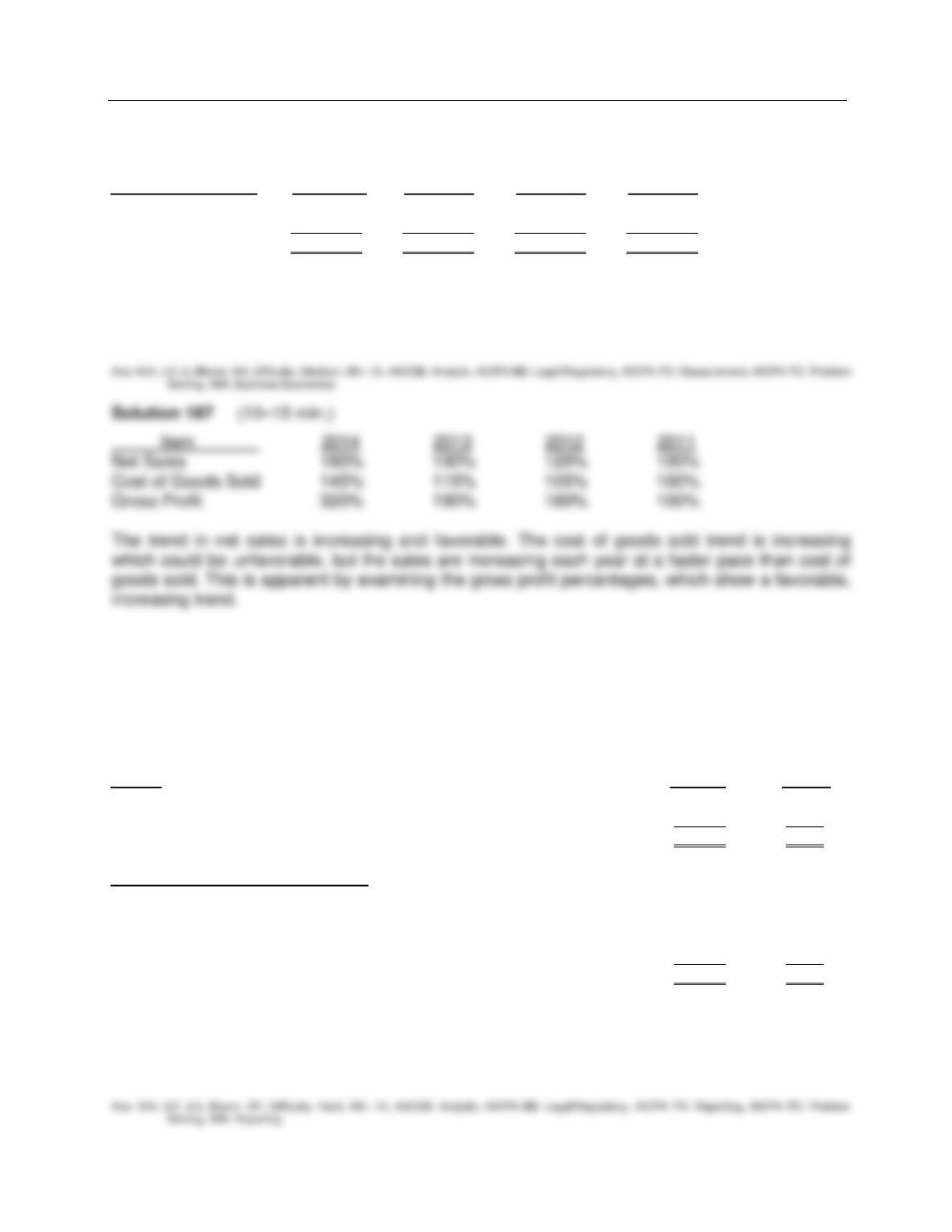
The following items were taken from the financial statements of Rug, Inc., over a four-year period:
Item 2014 2013 2012 2011
Net Sales $900,000 $650,000 $600,000 $500,000
Cost of Goods Sold 580,000 460,000 420,000 400,000
Gross Profit $320,000 $190,000 $180,000 $100,000
Instructions
Using horizontal analysis and 2011 as the base year, compute the trend percentages for net
sales, cost of goods sold, and gross profit. Explain whether the trends are favorable or
unfavorable for each item.
Ex. 188
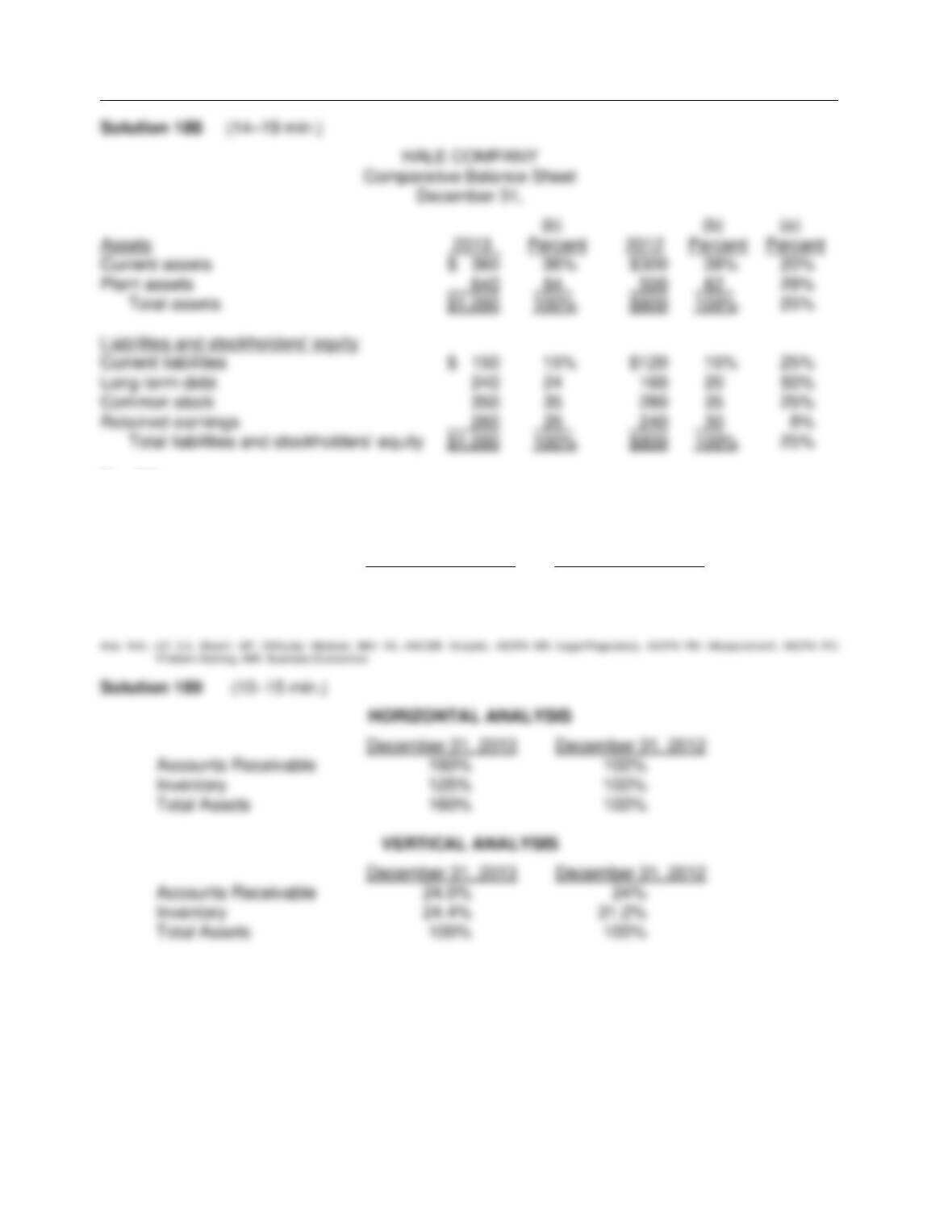
The comparative balance sheet of Hale Company appears below:
HALE COMPANY
Comparative Balance Sheet
December 31,
———————————————————————————————————————————
Assets 2013 2012
Current assets …………………………………………………………………………. $ 360 $300
Plant assets ……………………………………………………………………………. 640 500
Total assets ……………………………………………………………………………. $1,000 $800
Liabilities and stockholders’ equity
Current liabilities ……………………………………………………………………… $ 150 $120
Long-term debt ………………………………………………………………………… 240 160
Common stock ………………………………………………………………………… 350 280
Retained earnings ……………………………………………………………………. 260 240
Total liabilities and stockholders’ equity ………………………………….. $1,000 $800
Instructions
(a) Using horizontal analysis, show the percentage change for each balance sheet item using
2012 as a base year.
(b) Using vertical analysis, prepare a common size comparative balance sheet.
Test Bank for Managerial Accounting Sixth Edition
FOR INSTRUCTOR USE ONLY
14 – 48
Ex. 189
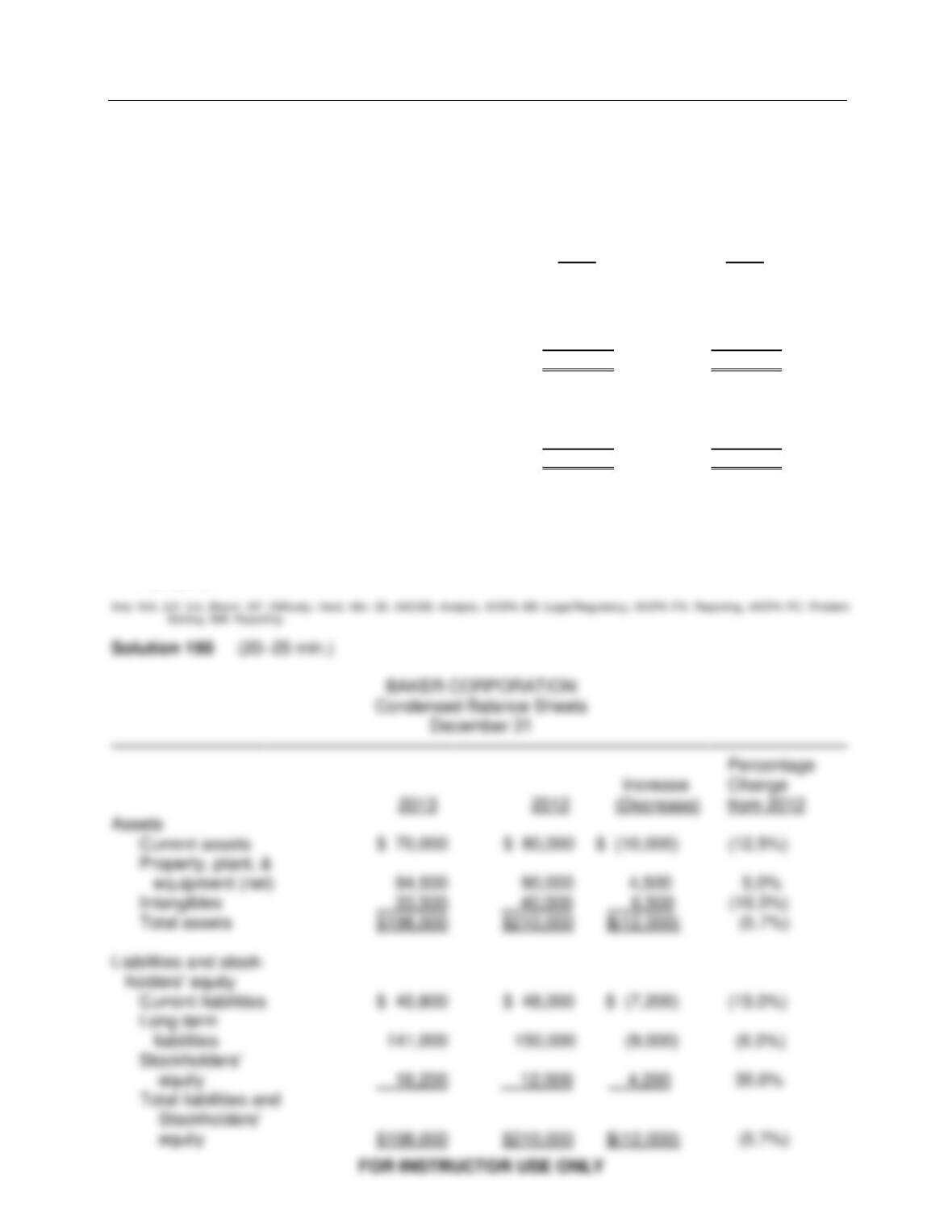
Using the following selected items from the comparative balance sheet of Ames Company,
illustrate horizontal and vertical analysis.
December 31, 2013 December 31, 2012
Accounts Receivable $ 960,000 $ 600,000
Inventory 975,000 780,000
Total Assets 4,000,000 2,500,000
Financial Statement Analysis
14 – 49
Ex. 190
The comparative condensed balance sheets of Baker Corporation are presented below.
BAKER CORPORATION
Comparative Condensed Balance Sheets
December 31
2013 2012
Assets
Current assets $ 70,000 $ 80,000
Property, plant, and equipment (net) 94,500 90,000
Intangibles 33,500 40,000
Total assets $198,000 $210,000
Liabilities and stockholders’ equity
Current liabilities $ 40,800 $ 48,000
Long-term liabilities 141,000 150,000
Stockholders’ equity 16,200 12,000
Total liabilities and stockholders’ equity $198,000 $210,000
Instructions
(a) Prepare a horizontal analysis of the balance sheet data for Baker Corporation using 2012 as
a base.
(b) Prepare a vertical analysis of the balance sheet data for Baker Corporation in columnar form
for 2013.
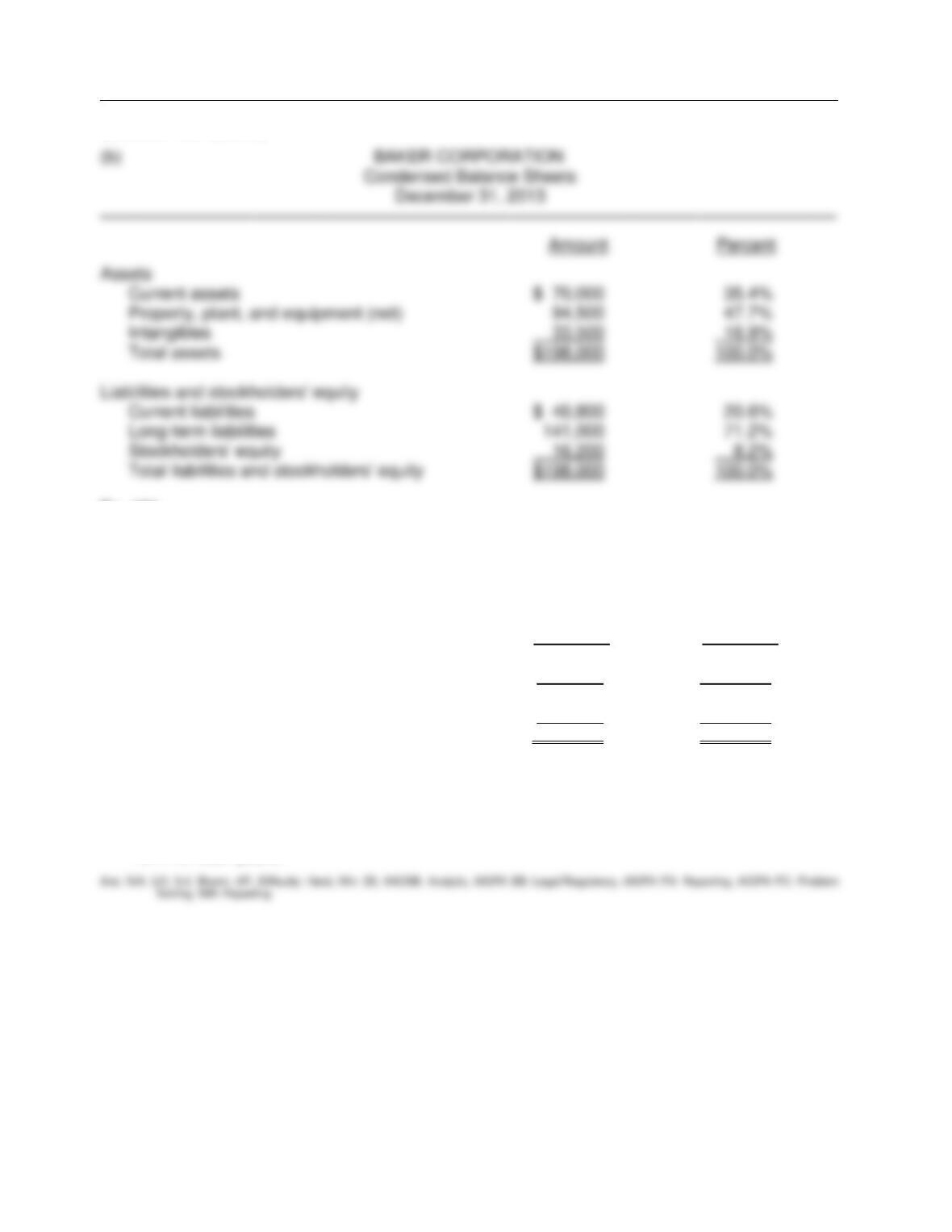
Test Bank for Managerial Accounting Sixth Edition
FOR INSTRUCTOR USE ONLY
14 – 50
Solution 190 (Cont.)
Ex. 191
The comparative condensed income statements of Marks Corporation are shown below.
MARKS CORPORATION
Comparative Condensed Income Statements
For the Years Ended December 31
2013 2012
Net sales $620,000 $500,000
Cost of goods sold 450,000 400,000
Gross profit 170,000 100,000
Operating expenses 54,000 40,000
Net income $116,000 $ 60,000
Instructions
(a) Prepare a horizontal analysis of the income statement data for Marks Corporation using
2012 as a base. (Show the amounts of increase or decrease.)
(b) Prepare a vertical analysis of the income statement data for Marks Corporation in columnar
form for both years.
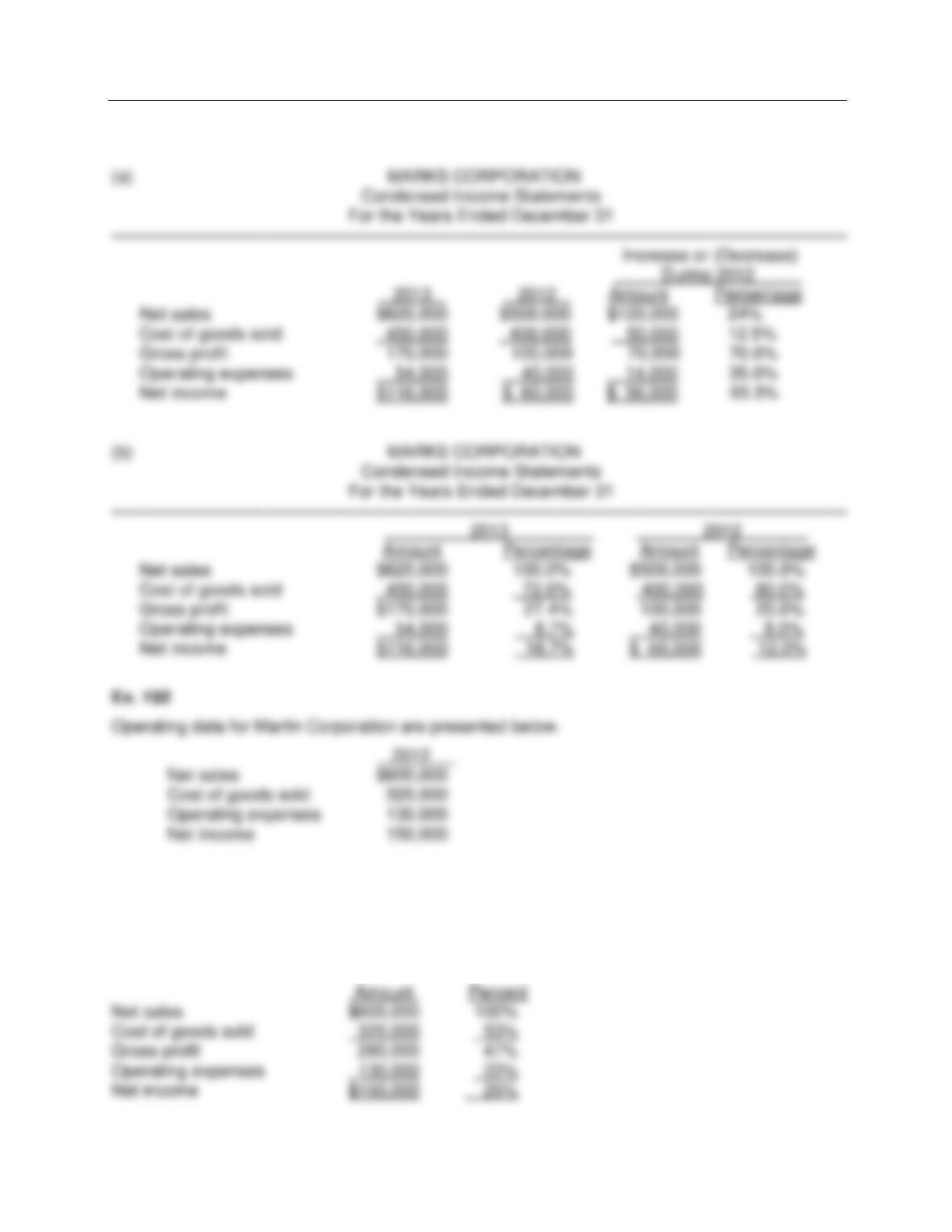
Financial Statement Analysis
FOR INSTRUCTOR USE ONLY
14 – 51
Solution 191 (20–25 min.)
Instructions
Prepare a schedule showing a vertical analysis for 2012.
Ans: N/A, LO: 4, Bloom: AP, Difficulty: Medium, Min: 10, AACSB: Analytic, AICPA BB: Legal/Regulatory, AICPA FN: Measurement, AICPA PC: Problem
Solving, IMA: Business Economics
Solution 192 (10 min.)
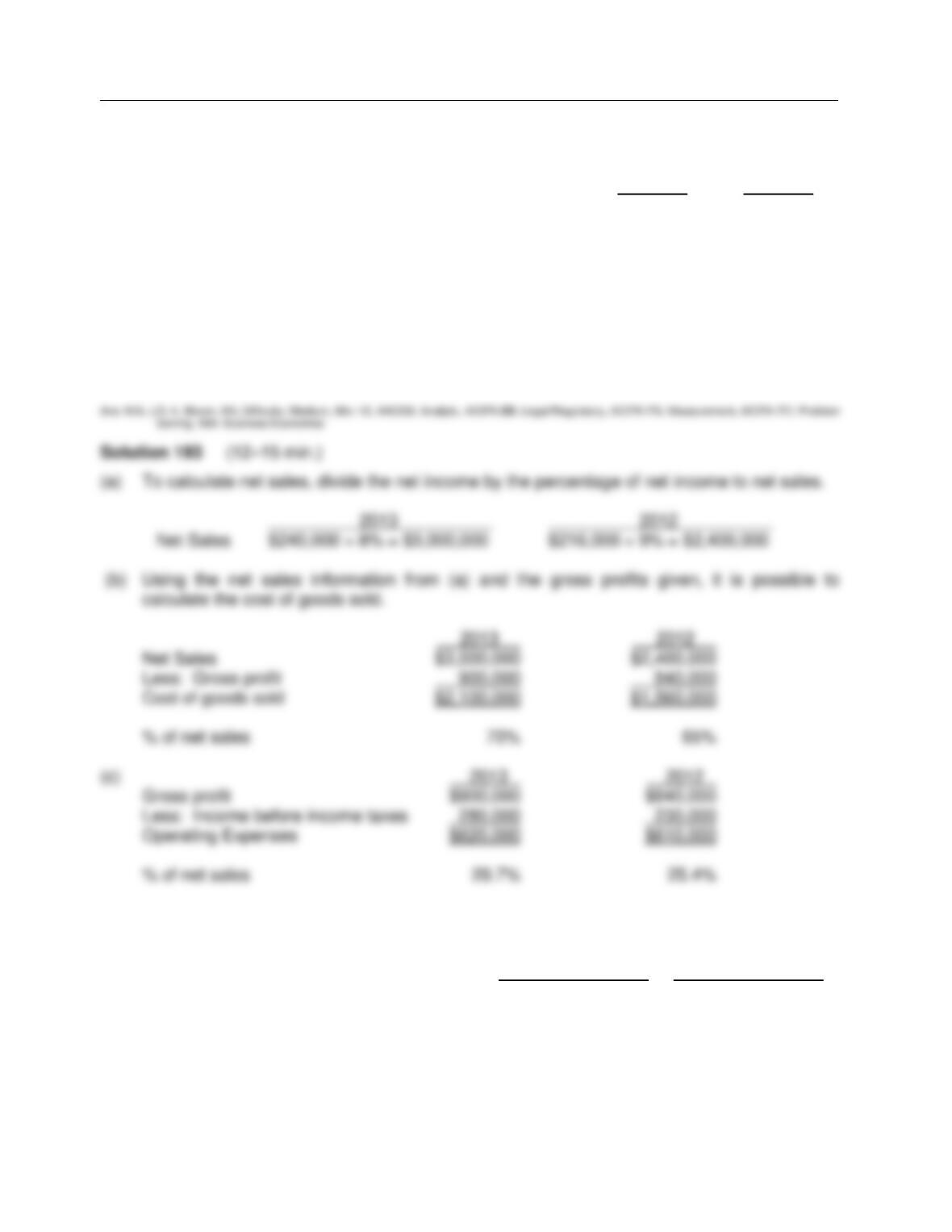
Test Bank for Managerial Accounting Sixth Edition
FOR INSTRUCTOR USE ONLY
14 – 52
Ex. 193
The following information was taken from the financial statements of Lawson Company:
2013 2012
Gross profit on sales ………………………………………………….. $900,000 $840,000
Income before income taxes ……………………………………….. 280,000 230,000
Net income ………………………………………………………………. 240,000 216,000
Net income as a percentage of net sales ………………………. 8% 9%
Instructions
(a) Compute the net sales for each year.
(b) Compute the cost of goods sold in dollars and as a percentage of net sales for each year.
(c) Compute operating expenses in dollars and as a percentage of net sales for each year.
(Income taxes are not operating expenses).
Ex. 194
Selected financial statement data for Moor Company are presented below.
December 31, 2013 December 31, 2012
Cash $ 40,000 $30,000
Short-term investments 25,000 18,000
Receivables (net) 100,000 80,000
Inventories 85,000 65,000
Total current liabilities 100,000 90,000
Financial Statement Analysis
14 – 53
Ex. 194 (Cont.)
During 2013, net sales were $950,000, and cost of goods sold was $775,000.
Instructions
Compute the following ratios at December 31, 2013:
(a) Current.
(b) Acid-test.
(c) Receivables turnover.
(d) Inventory turnover.
Ex. 195
Selected information from the comparative financial statements of Fava Company for the year
ended December 31, appears below:
2013 2012
Accounts receivable (net) $ 180,000 $200,000
Inventory 140,000 160,000
Total assets 1,200,000 800,000
Current liabilities 140,000 110,000
Long-term debt 400,000 300,000
Net credit sales 1,330,000 700,000
Cost of goods sold 900,000 530,000
Interest expense 50,000 25,000
Income tax expense 60,000 29,000
Net income 150,000 85,000
Instructions
Answer the following questions relating to the year ended December 31, 2013. Show
computations.
1. Inventory turnover for 2013 is __________.
2. Times interest earned in 2013 is __________.
3. The debt to total assets ratio for 2013 is __________.
4. Receivables turnover for 2013 is __________.
5. Return on assets for 2013 is __________.
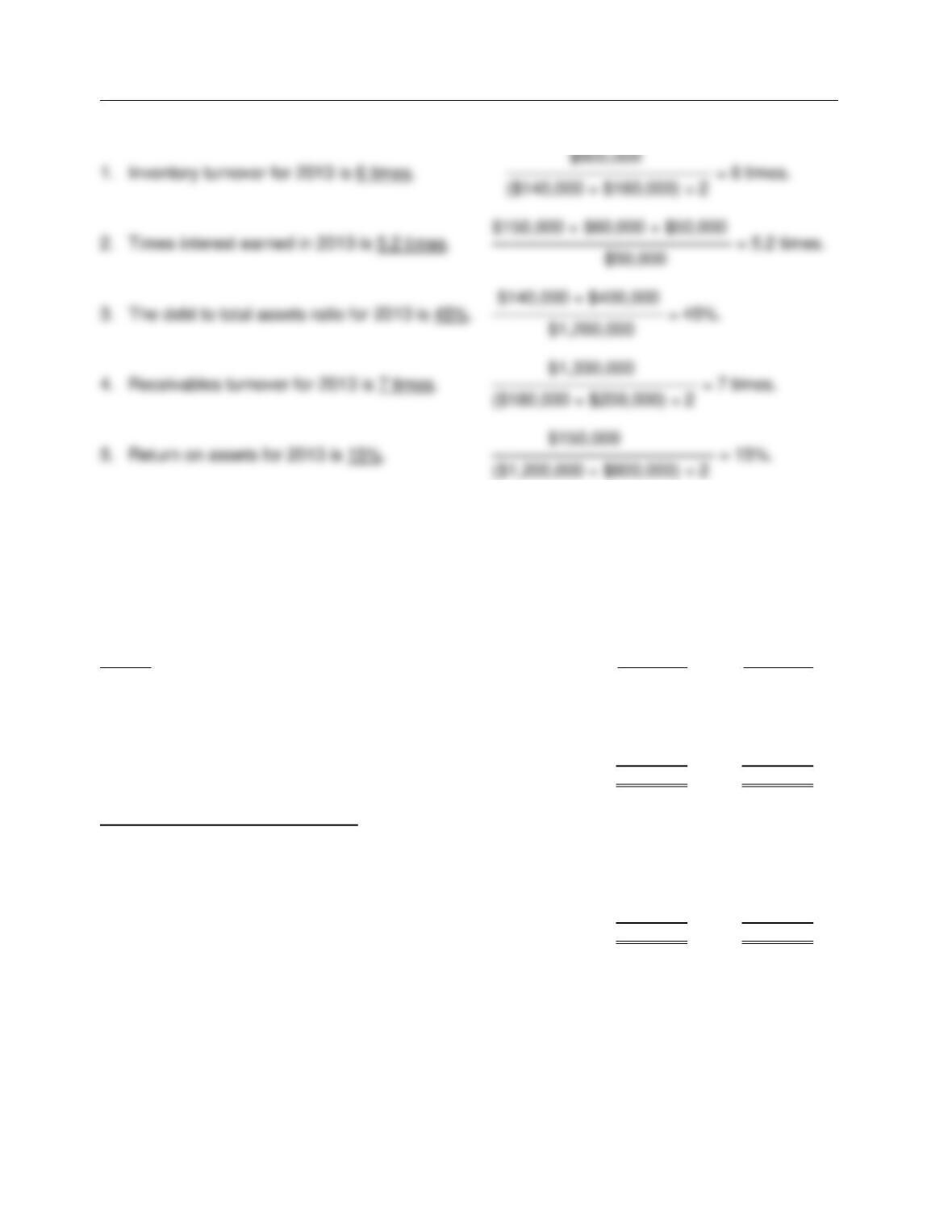
Test Bank for Managerial Accounting Sixth Edition
FOR INSTRUCTOR USE ONLY
14 – 54
Solution 195 (9–14 min.)
Ex. 196
The financial statements of Gaines Company appear below:
GAINES COMPANY
Comparative Balance Sheet
December 31,
———————————————————————————————————————————
Assets 2013 2012
Cash………………………………………………………………………………….. $ 25,000 $ 40,000
Short-term investments ………………………………………………………… 15,000 60,000
Accounts receivable (net) ……………………………………………………… 50,000 30,000
Inventory ……………………………………………………………………………. 50,000 70,000
Property, plant and equipment (net) ……………………………………….. 260,000 300,000
Total assets ………………………………………………………………….. $400,000 $500,000
Liabilities and stockholders’ equity
Accounts payable ………………………………………………………………… $ 20,000 $ 30,000
Short-term notes payable …………………………..…………………………. 30,000 90,000
Bonds payable ……………………………………………………….…………… 90,000 160,000
Common stock ……………………………………………………………………. 150,000 150,000
Retained earnings ……………………………………………………………….. 110,000 70,000
Total liabilities and stockholders’ equity ……………………………… $400,000 $500,000

Financial Statement Analysis
FOR INSTRUCTOR USE ONLY
14 – 55
Ex. 196 (cont.)
GAINES COMPANY
Income Statement
For the Year Ended December 31, 2013
Net sales ……………………………………………………………………………. $400,000
Cost of goods sold ………………………………………………………………. 240,000
Gross profit ………………………………………………………………………… 160,000
Expenses
Operating expenses ……………………………………………………….. $42,000
Interest expense …………………………………………………………….. 18,000
Total expenses …………………………………………………………. 60,000
Income before income taxes …………………………………………………. 100,000
Income tax expense …………………………………………………………….. 30,000
Net income …………………………………………………………………………. $ 70,000
Additional information:
a. Cash dividends of $23,000 were declared and paid in 2013.
b. Weighted-average number of shares of common stock outstanding during 2013 was 30,000
shares.
c. Market value of common stock on December 31, 2013, was $21 per share.
Instructions
Using the financial statements and additional information, compute the following ratios for Gaines
Company for 2013. Show all computations.
Computations
1. Current ratio _________.
2. Return on common stockholders’ equity _________.
3. Price-earnings ratio _________.
4. Acid-test ratio _________.
5. Receivables turnover _________.
6. Times interest earned _________.
7. Profit margin _________.
8. Days in inventory _________.
9. Payout ratio _________.
10. Return on assets _________.
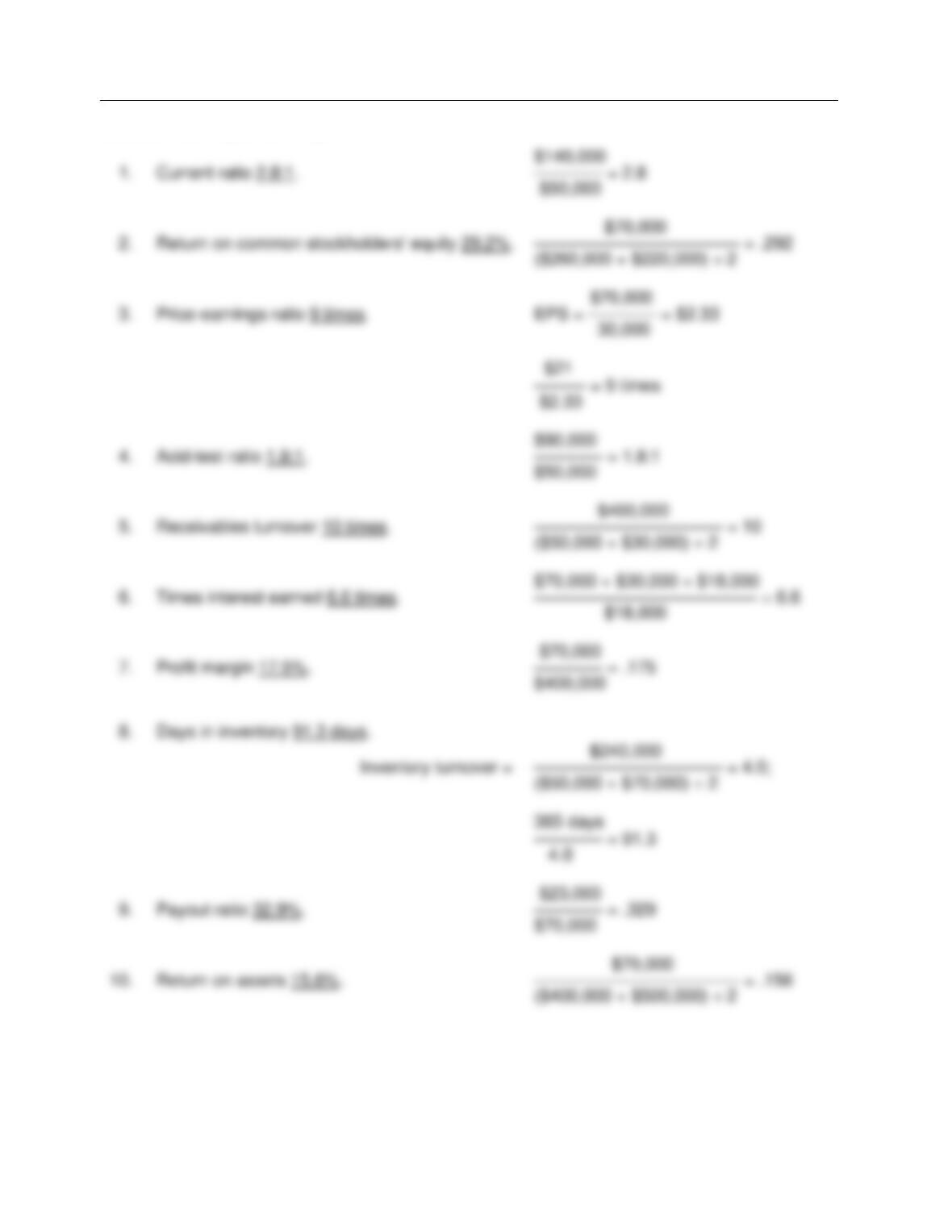
Test Bank for Managerial Accounting Sixth Edition
FOR INSTRUCTOR USE ONLY
14 – 56
Solution 196 (15–20 min.)

Financial Statement Analysis
FOR INSTRUCTOR USE ONLY
14 – 57
Ex. 197
The following ratios have been computed for Mason Company for 2013.
Profit margin 12.5%
Times interest earned 7 times
Receivables turnover 4 times
Acid-test ratio 2 : 1
Current ratio 3 : 1
Debt to total assets ratio 20%
Mason Company’s 2013 financial statements with missing information follow:
MASON COMPANY
Comparative Balance Sheet
December 31,
———————————————————————————————————————————
Assets 2013 2012
Cash …………………………………………………………………………….. $ 30,000 $ 45,000
Short-term Investments ……………………………………………………. 10,000 25,000
Accounts receivable (net) …………………………………………………. ? (6) 40,000
Inventory ……………………………………………………………………….. ? (8) 50,000
Property, plant, and equipment (net) ………………………………….. 200,000 160,000
Total assets …………………………………………………………….. $ ? (9) $320,000
Liabilities and stockholders’ equity
Accounts payable ……………………………………………………………. $ ? (7) $ 30,000
Short-term notes payable …………………………………………………. 40,000 35,000
Bonds payable ……………………………………………………………….. ? (10) 20,000
Common stock ……………………………………………………….………. 220,000 200,000
Retained earnings …………………………………………………………… 60,000 35,000
Total liabilities and stockholders’ equity ……………………….. $ ? (11) $320,000
MASON COMPANY
Income Statement
For the Year Ended December 31, 2013
———————————————————————————————————————————
Net sales ……………………………………………………………………….. $200,000
Cost of goods sold ………………………………………………………….. 75,000
Gross profit ……………………………………………………………………. 125,000
Expenses:
Depreciation expense …………………………………………………. $ ? (5)
Interest expense ………………………………………………………… 5,000
Selling expenses ……………………………………………………….. 8,000
Administrative expenses …………………………………………….. 12,000
Total expenses …………………………………………………….. ? (4)
Income before income taxes …………………………………………….. ? (2)
Income tax expense …………………………………………………… ? (3)
Net income …………………………………………………………………….. $ ? (1)
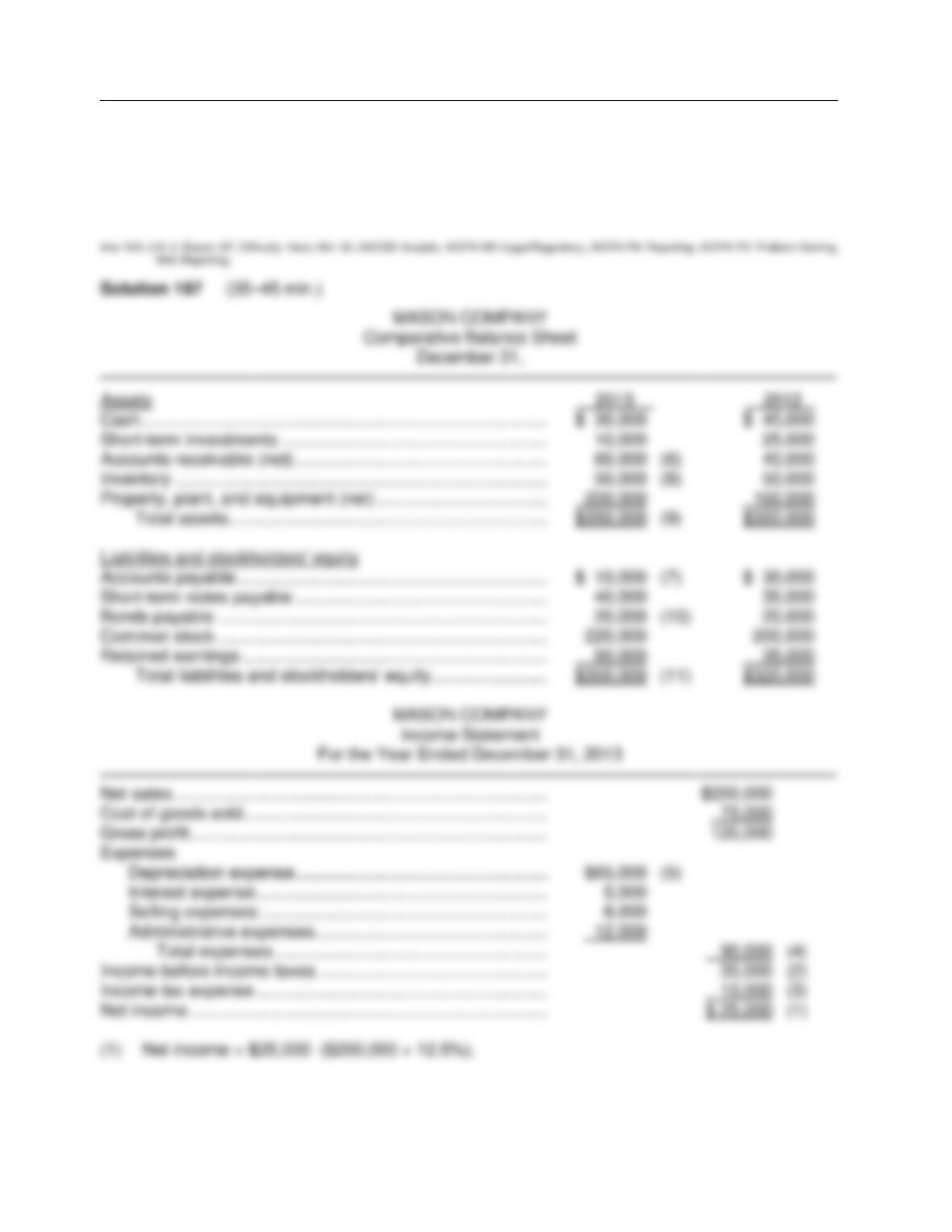
Test Bank for Managerial Accounting Sixth Edition
FOR INSTRUCTOR USE ONLY
14 – 58
Ex. 197 (Cont.)
Instructions
Use the above ratios and information from the Mason Company financial statements to fill in the
missing information on the financial statements. Follow the sequence indicated. Show
computations that support your answers.
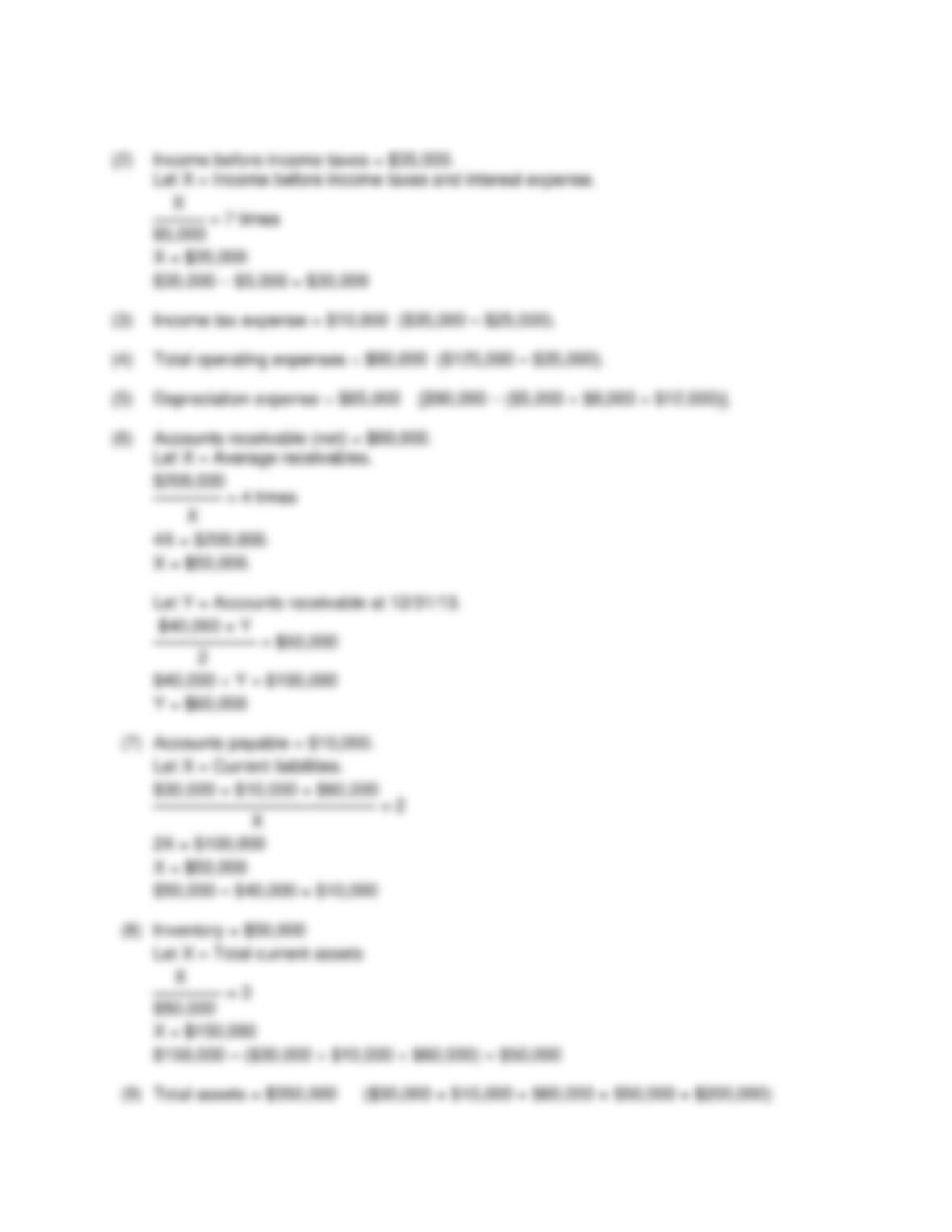
Financial Statement Analysis
FOR INSTRUCTOR USE ONLY
14 – 59
Solution 197 (cont.)
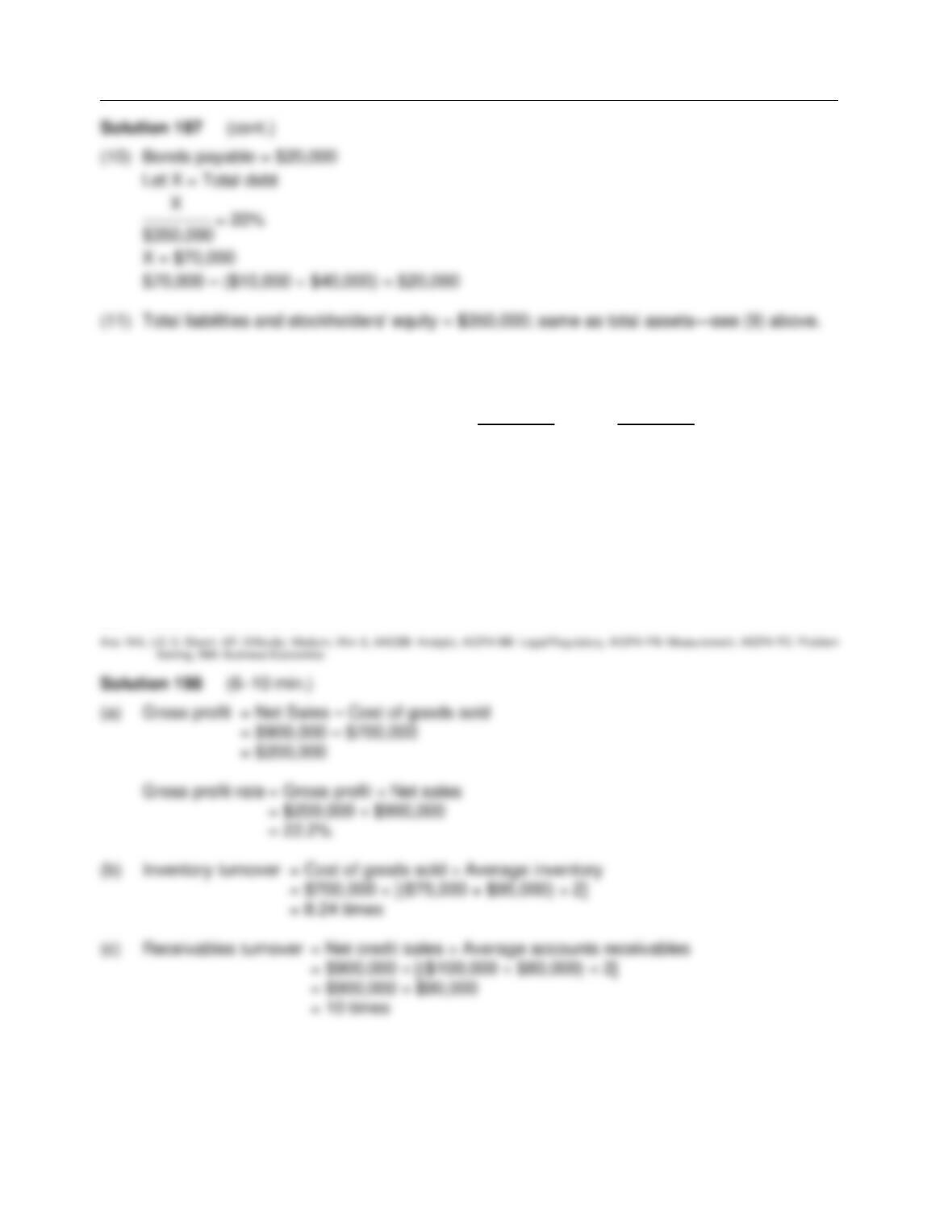
Test Bank for Managerial Accounting Sixth Edition
FOR INSTRUCTOR USE ONLY
14 – 60
Ex. 198
Selected data for Norma‘s Store appear below.
2013 2012
Net sales $900,000 $520,000
Cost of goods sold 700,000 345,000
Inventory at end of year 75,000 95,000
Accounts receivable at end of year 100,000 80,000
Instructions
Compute the following for 2013:
(a) Gross profit rate.
(b) Inventory turnover.
(c) Receivables turnover.
Financial Statement Analysis
FOR INSTRUCTOR USE ONLY
14 – 61
Ex. 199
Selected financial statement data for Homer Company are presented below.
Net sales $1,500,000
Cost of goods sold 700,000
Interest expense 10,000
Net income 205,000
Total assets (ending) $900,000
Total common stockholders’ equity (ending) $600,000
Total assets at the beginning of the year were $800,000; total common stockholders’ equity was
$500,000 at the beginning of the period.
Instructions
Compute each of the following:
(a) Asset turnover
(b) Profit margin
(c) Return on assets
(d) Return on common stockholders’ equity
Ex. 200
Wings Corporation has issued common stock only. The company has been successful and has a
gross profit rate of 20%. The information shown below was taken from the company’s financial
statements.
Beginning inventory $ 482,000
Purchases 4,836,000
Ending inventory ?
Average accounts receivable 800,000
Average common stockholders’ equity 3,500,000
Sales (all on credit) 6,000,000
Net income 420,000
Instructions
Compute the following:
(a) Receivables turnover and the average collection period.
(b) Inventory turnover and the days in inventory.
(c) Return on common stockholders’ equity.
Test Bank for Managerial Accounting Sixth Edition
FOR INSTRUCTOR USE ONLY
14 – 62
Solution 200 (13–18 min.)
Ex. 201
Booker Corporation had the following comparative current assets and current liabilities:
Dec. 31, 2013 Dec. 31, 2012
Current assets
Cash $ 60,000 $ 30,000
Short-term investments 40,000 10,000
Accounts receivable 55,000 95,000
Inventory 110,000 90,000
Prepaid expenses 35,000 20,000
Total current assets $300,000 $245,000
Current liabilities
Accounts payable $140,000 $110,000
Salaries payable 40,000 30,000
Income tax payable 20,000 15,000
Total current liabilities $200,000 $155,000
During 2013, credit sales and cost of goods sold were $750,000 and $400,000, respectively.
Financial Statement Analysis
FOR INSTRUCTOR USE ONLY
14 – 63
Ex. 201 (Cont.)
Instructions
Compute the following liquidity measures for 2013:
1. Current ratio.
2. Working capital.
3. Acid-test ratio.
4. Receivables turnover.
5. Inventory turnover.
Ex. 202
Selected data from Octo Company are presented below:
Total assets $1,600,000
Average assets 2,000,000
Net income 375,000
Net sales 1,400,000
Average common stockholders’ equity 1,000,000
Instructions
Calculate the profitability ratios that can be computed from the above information.
Test Bank for Managerial Accounting Sixth Edition
FOR INSTRUCTOR USE ONLY
14 – 64
Solution 202 (9–13 min.)
Ex. 203
The following data are taken from the financial statements of Dands Company:
2013 2012
Monthly average accounts receivable $ 565,000 $ 700,000
Net sales on account $6,200,000 $7,000,000
Terms for all sales are 2/10, n/30
Instructions
(a) Compute the receivables turnover and the average collection period for both years.
(b) What conclusion can an analyst draw about the management of the accounts receivable?
Financial Statement Analysis
FOR INSTRUCTOR USE ONLY
14 – 65
Solution 203 (Cont.)
Ex. 204
State the effect of the following transactions on the current ratio. Use increase, decrease, or no
effect for your answer.
(a) Collection of an accounts receivable.
(b) Declaration of cash dividends.
(c) Additional stock is sold for cash.
(d) Short-term investments are purchased for cash.
(e) Equipment is purchased for cash.
(f) Inventory purchases are made for cash.
(g) Accounts payable are paid.
Ex. 205
The balance sheet for Flavor Corporation at the end of the current year indicates the following:
Bonds payable, 8% ……………………………………………………. $4,000,000
6% Preferred stock, $100 par ………………………………………. 1,000,000
Common stock, $10 par ……………………………………………… 2,000,000
Income before income taxes was $480,000 and income taxes expense for the current year
amounted to $144,000. Cash dividends paid on common stock were $300,000, and the common
stock was selling for $22 per share at the end of the year. There were no ownership changes
during the year.
Instructions
Determine each of the following:
(a) times that bond interest was earned.
(b) earnings per share for common stock.
(c) price-earnings ratio.
Test Bank for Managerial Accounting Sixth Edition
14 – 66
Solution 205 (9–14 min.)
Ex. 206
The income statement for Dana Company for the year ended December 31, 2013 appears below.
Sales $720,000
Cost of goods sold 380,000
Gross profit 340,000
Expenses 190,000*
Net income $150,000
*Includes $20,000 of interest expense and $22,000 of income tax expense.
Additional information:
1. Common stock outstanding on January 1, 2013 was 50,000 shares. On July 1, 2013, 10,000
more shares were issued.
2. The market price of Dana’s stock was $12 at the end of 2013.
3. Cash dividends of $30,000 were paid, $6,000 of which were paid to preferred stockholders.
Instructions
Compute the following ratios for 2013:
(a) earnings per share.
(b) price-earnings.
(c) times interest earned.
Financial Statement Analysis
FOR INSTRUCTOR USE ONLY
14 – 67
Solution 206 (8–13 min.)
Ex. 207
Selected comparative statement data for Willow Products Company are presented below. All
balance sheet data are as of December 31.
2013 2012
Net sales $800,000 $720,000
Cost of goods sold 480,000 440,000
Interest expense 7,000 5,000
Net income 60,000 42,000
Accounts receivable 120,000 100,000
Inventory 85,000 75,000
Total assets 600,000 500,000
Total common stockholders’ equity 430,000 320,000
Instructions
Compute the following ratios for 2013:
(a) Profit margin.
(b) Asset turnover.
(c) Return on assets.
(d) Return on common stockholders’ equity.
Test Bank for Managerial Accounting Sixth Edition
FOR INSTRUCTOR USE ONLY
14 – 68
Solution 207 (Cont.)
Ex. 208
Sinclair Corporation experienced a fire on December 31, 2013, in which its financial records were
partially destroyed. It has been able to salvage some of the records and has ascertained the
following balances.
December 31, 2013 December 31, 2012
Cash $ 30,000 $ 10,000
Receivables (net) 84,000 126,000
Inventory 200,000 180,000
Accounts payable 50,000 90,000
Notes payable 30,000 60,000
Common stock, $100 par 400,000 400,000
Retained earnings 130,000 101,000
Additional information:
1. The inventory turnover is 4.5 times
2. The return on common stockholders’ equity is 22%. The company had no additional paid-in
capital.
3. The receivables turnover is 8.8 times.
4. The return on assets is 20%.
5. Total assets at December 31, 2012, were $585,000.
Instructions
Compute the following for Santo Corporation.
(a) Cost of goods sold for 2013.
(b) Net sales (credit) for 2013.
(c) Net income for 2013.
(d) Total assets at December 31, 2013.
Financial Statement Analysis
14 – 69
Solution 208 (Cont.)
Ex. 209
For its fiscal year ending October 31, 2013, Conner Corporation reported the following partial
data
Income before income taxes $1,200,000
Income tax expense (30% x 950,000) 285,000
Income before extraordinary items 915,000
Extraordinary loss from flood 250,000
Net income $665,000
The flood loss is considered an extraordinary item. The income tax rate is 30% on all items.
Instructions
Prepare a correct income statement, beginning with income before income taxes.
Test Bank for Managerial Accounting Sixth Edition
FOR INSTRUCTOR USE ONLY
14 – 70
Ex. 210
Grande Corporation had income from continuing operations of $425,000 for the year ended
December 31, 2013. It also had the following items (before income taxes):
1. Extraordinary flood loss of $120,000.
2. Loss of $50,000 on discontinuance of a division.
All items are subject to income taxes at a 30% tax rate.
Instructions
Prepare a partial income statement, beginning with income from continuing operations.
Ex. 211
Nola Corporation gathered the following information for the fiscal year ended December 31, 2013:
Sales $1,300,000
Extraordinary fire loss 110,000
Selling and administrative expenses 160,000
Cost of goods sold 900,000
Loss on sale of equipment 40,000
Nola Corporation is subject to a 30% income tax rate.
Instructions
Prepare a partial income statement, beginning with income before income taxes.
Financial Statement Analysis
FOR INSTRUCTOR USE ONLY
14 – 71
Ex. 212
Whyte Corporation had the information listed below available in preparing an income statement
for the year ended December 31, 2013. All amounts are before income taxes. Assume a 30%
income tax rate for all items.
Sales $ 700,000
Expropriation of property by a foreign government (loss) $ (90,000)
Income from operation of discontinued cement division $ 100,000
Loss from disposal of cement division $ (80,000)
Operating expenses $ 125,000
Gain on sale of equipment $ 65,000
Cost of goods sold $ 420,000
Instructions
Prepare a multiple-step income statement in good form which takes into account intraperiod
income tax allocation. Ignore EPS computations.
Test Bank for Managerial Accounting Sixth Edition
FOR INSTRUCTOR USE ONLY
14 – 72
Ex. 213
Indicate whether the following items would be reported as an ordinary or an extraordinary item in
Mallak Corporation’s income statement.
(a) Loss attributable to labor strike.
(b) Gain on sale of fixed assets.
(c) Loss from fire. Mallak is a chemical company.
(d) Loss from sale of short-term investments.
(e) Expropriation of property by a foreign government.
(f) Loss from hurricane damage. Mallak Corporation is located in the New Orleans area.
(g) Loss from government condemnation of property through newly enacted law.
Ex. 214
Martin Company has income from continuing operations of $520,000 for the year ended
December 31, 2013. It also has the following items (before considering income taxes):
(1) An extraordinary fire loss of $150,000.
(2) A gain of $90,000 on the discontinuance of a major segment.
(3) A correction of an error in last year’s financial statement that resulted in a $70,000
overstatement of 2012 net income.
Assume all items are subject to income taxes at a 30% tax rate.
Instructions
(a) Prepare an income statement, beginning with income from continuing operations.
(b) Indicate the statement presentation of any item not included in (a) above.
Financial Statement Analysis
14 – 73
Solution 214 (Cont.)
COMPLETION STATEMENTS
215. In analyzing and interpreting financial statement information, three major characteristics
are generally evaluated: (1)____________, (2)_____________, and (3)_____________.
216. ______________ analysis, also called trend analysis, is a technique for evaluating a
percentage increase or decrease for a financial statement item over a period of time.
217. Expressing each item within a financial statement as a percentage of a base amount is
called ______________ analysis.
218. The ratios used in evaluating a company’s liquidity and short-term debt paying ability that
complement each other are the ______________ ratio and the ______________ ratio.
219. The receivables turnover is calculated by dividing _________________ by average
___________________.
220. If inventory turnover is 10 times, and the average inventory was $400,000, the cost of
goods sold during the year was $______________ and the days in inventory was
______________ days.
221. Hansen Corporation had net income for the year of $200,000 and a profit margin of 25%.
If total average assets were $400,000, the asset turnover ratio was ____________ times.
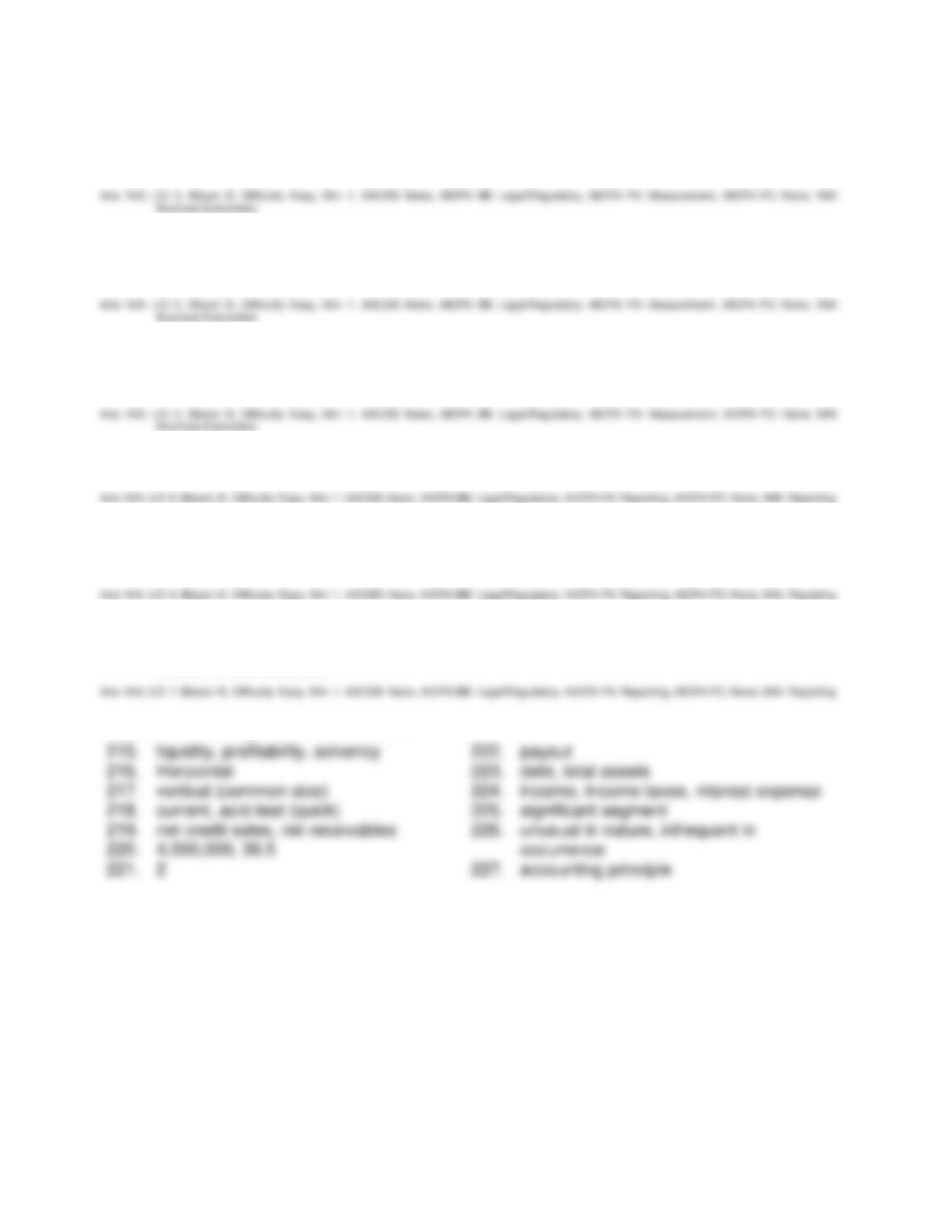
Test Bank for Managerial Accounting Sixth Edition
FOR INSTRUCTOR USE ONLY
14 – 74
222. The ______________ ratio measures the percentage of earnings distributed in the form of
cash dividends.
223. The lower the ______________ to ______________ ratio, the more equity “buffer” there
is available to the creditors.
224. Times interest earned is calculated by dividing _____________ before _______________
and ________________ by interest expense.
225. Discontinued operations refers to the disposal of a ______________ of a business.
226. The two criteria necessary for an item to be classified as an extraordinary item are that the
transaction or event must be (1) __________________ and (2) ___________________.
227. A change in inventory methods during the year would be classified as a change in
__________________.
Answers to Completion Statements
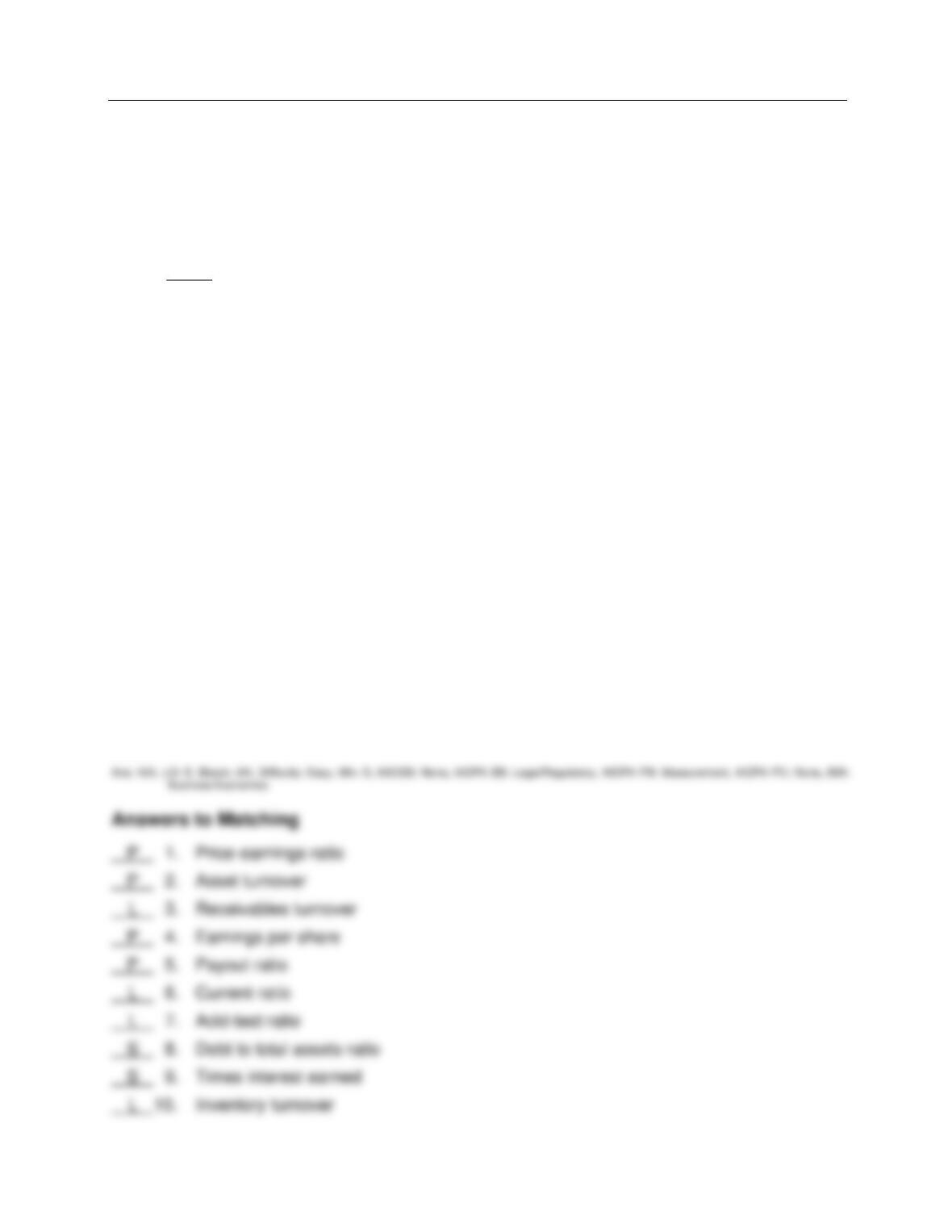
Financial Statement Analysis
FOR INSTRUCTOR USE ONLY
14 – 75
MATCHING
SET A
228. For each of the ratios listed below, indicate by the appropriate code letter, whether it is a
liquidity ratio, a profitability ratio, or a solvency ratio.
Code:
L = Liquidity ratio
P = Profitability ratio
S = Solvency ratio
____ 1. Price-earnings ratio
____ 2. Asset turnover
____ 3. Receivables turnover
____ 4. Earnings per share
____ 5. Payout ratio
____ 6. Current ratio
____ 7. Acid-test ratio
____ 8. Debt to total assets ratio
____ 9. Times interest earned
____ 10. Inventory turnover

Test Bank for Managerial Accounting Sixth Edition
14 – 76
SET B
229. Match the ratios with the appropriate ratio computation by entering the appropriate letter in
the space provided.
A. Current ratio F. Times interest earned
B. Acid-test ratio G. Inventory turnover
C. Profit margin H. Average collection period
D. Asset turnover I. Days in inventory
E. Price-earnings ratio J. Payout ratio
Cost of goods sold
____ 1. —————————
Average inventory
Net income
____ 2. —————
Net sales
Cash dividends
____ 3. ———————
Net income
Net sales
____ 4. ———————
Average assets
Current assets
____ 5. ————————
Current liabilities
365 days
____ 6. ——————————
Receivables turnover
Market price per share of stock
____ 7. ——————————————
Earnings per share
365 days
____ 8. ————————
Inventory turnover
Income before income taxes and interest expense
____ 9. ——————————————————————
Interest expense
Cash + short-term investments + receivables (net)
____ 10. ———————————————————————
Current liabilities
Financial Statement Analysis
FOR INSTRUCTOR USE ONLY
14 – 77
Answers to Matching
SHORT-ANSWER ESSAY QUESTIONS
S-A E 230
Horizontal and vertical analyses are analytical tools frequently used to analyze financial
statements. What type of information or insights can be obtained by using these two techniques?
Explain how the output of horizontal analysis and vertical analysis can be compared to industry
averages and/or competitive companies.
S-A E 231
Eric Harden, the CEO of Mystical Products, is a successful entrepreneur but a poor student of
accounting. He asks you to explain to him, in a memo, the bases of comparison for ratio analysis.
Test Bank for Managerial Accounting Sixth Edition
FOR INSTRUCTOR USE ONLY
14 – 78
Solution 231
S-A E 232
What do the following classes of ratios measure? (a) Liquidity ratios. (b) Profitability ratios.
(c) Solvency ratios.
S-A E 233
(a) What is meant by trading on the equity?
(b) How would you determine the profitability of trading on the equity?
S-A E 234
Why is it important to report discontinued operations separately from income from continuing
operations?
Financial Statement Analysis
FOR INSTRUCTOR USE ONLY
14 – 79
Solution 234
S-A E 235 (Ethics)
A trusted employee of Wilderness Tours was caught in the act of embezzling funds. He
confessed to earlier embezzlements, but retracted the confession on the advice of his attorney.
Over the course of the most recent quarter, it has been determined that $20,000 was embezzled.
Wilderness Tours has suffered adverse publicity in the recent past because of serious injury to
five tourists that occurred during a two week “Winter Wilds Adventure” tour. The company has
therefore decided to avoid publicity and has agreed to drop all charges against the embezzling
employee. In return, the employee has agreed to a notation of “Terminated—Not to be Rehired”
to be appended to his personnel file.
Required:
1. Who are the stakeholders in the decision not to prosecute?
2. Was it ethical for the company to decide not to prosecute? Explain.
Test Bank for Managerial Accounting Sixth Edition
14 – 80
S-A E 236 (Communication)
Kwik Express specializes in the overnight transportation of medical equipment and laboratory
specimens. The company has selected the following information from its most recent annual
report to be the subject of an immediate press release.
• The financial statements are being released.
• Net income this year was $2.1 million. Last year’s net income had been $2.0 million.
• The current ratio has changed to 2:1 from last year’s 1.5:1
• The debt/total assets ratio has changed to 4:5 from last year’s 3:5
• The company expanded its truck fleet substantially by purchasing ten new delivery vans. The
company already had twelve delivery vans.
• The company is now the largest medical courier in the mid-Atlantic region.
Required:
Prepare a brief press release incorporating the information above. Include all information. Think
carefully which information (if any) is good news for the company, and which (if any) is bad news.