ch14.doc Page 1
Chapter 14
Health Care Providers
TRUE/FALSE (CHAPTER 14)
1. The statement of financial position of a not-for-profit health care organization should
distinguish among unrestricted, temporarily restricted, and permanently restricted
net assets.
2. Unlike businesses, not-for-profit health care providers often serve patients who they
know will be unable to pay any portion of the amounts billed.
3. Health care organizations provide uncompensated patient care as a matter of policy
but not law.
4. Restricted funds of a not-for-profit nursing home are not available for current use;
however, the income earned on the funds is available.
5. Charity care provided by a health care organization would be recorded in a contra–
revenue account.
6. In a not-for-profit health care organization, the cost of malpractice must be accrued if
it is either probable that impairment has occurred or if the amount of loss can be
reasonably estimated.
7. Not-for-profit health care entities must provide information on the three categories of
net asset donor restrictiveness.
8. The statement of activities must indicate net assets released from restriction and any
transfers between funds.
9. In the long run, the health of a hospital depends mainly on the demand for its
services and the ability to meet that demand at a reasonable cost.
10. Prepaid health care plans that earn revenue from agreements to provide services
record revenue when services are rendered.
11. Medicaid is a federally sponsored and managed health care program for retirees.
12. The services of Health Maintenance Organizations are prepaid and fixed.
13. The services of Preferred Provider Organizations are prepaid and fixed.
ch14.doc Page 2
14. Capitation fees paid by HMOs to hospitals, physicians, and other medical groups
generally are based on the number of persons covered and expected costs to be
incurred rather than on actual services provided.
15. Not-for-profit hospitals are accounted for similarly to businesses but must adhere to
the FASB’s standards for not-for-profit entities.
ch14.doc Page 3
MULTIPLE CHOICE (CHAPTER 14)
1. For a not-for-profit hospital, which of the following financial statements is NOT
required?
a) Statement of financial position.
b) Statement of activities.
c) Statement of cash flows.
d) Statement of functional expenses.
2. Intermountain Hospital, a not-for-profit health care provider, issued $70 million in
term bonds to finance construction of a new wing at its main hospital. Terms of the
bond issue require that $5 million of the proceeds of the bond issue be invested in
U.S. government securities. The $5 million must be held until maturity of the bonds.
The $5 million will increase which class of net assets?
a) Unrestricted net assets.
b) Temporarily restricted net assets.
c) Permanently restricted net assets.
d) Either (b) or (c).
3. In 2013 St. Martin’s Hospital received a $50,000 cash gift to be used to buy supplies and
other items for the pediatric department of the hospital. In 2014, St. Martin’s purchased
puppets and other items to be used in explaining medical procedures to young children. The
acquisition of the items causes a NET decrease in which class(es) of net assets?
a) Unrestricted net assets only.
b) Temporarily restricted net assets.
c) Both unrestricted and temporarily net assets.
d) Neither unrestricted nor temporarily restricted net assets.
Use the following information to answer Questions 4 and 5.
Pelican Hospital, a not-for-profit entity, received a pledge from a donor in support of a fund-
raising effort by the hospital to finance construction of a new facility for cancer treatment. The
donor promised to pay $2 million in equal annual installments of $200,000 over the next 10
years. The present value of the gift at the risk-free interest rate is $1,472,000.
4. The amount of unrestricted revenue that should be recognized by Pelican in the year of the
gift is
a) $2 million.
b) $1,472,000.
c) $200,000.
d) $0.
ch14.doc Page 4
5. The amount of restricted revenue that should be recognized by Pelican in the year of the gift
is
a) $2 million.
b) $1,472,000.
c) $200,000.
d) $0.
6. An accountant has encountered a perplexing financial reporting issue related to the hospital
for which she is preparing financial statements. The issue is not specifically addressed by
FASB statements. To which of the following sources would the accountant probably look
first for industry-specific guidance?
a) GASB Statements.
b) AICPA accounting and auditing guide, Not-for-Profit Organizations.
c) AICPA accounting and auditing guide, Health Care Organizations.
d) Pronouncements of the HFMA or AHA.
7. In prior years, a not-for-profit hospital received funds from a donor who restricted the use of
those funds to providing nursing scholarships. During the current year $8,000 of
scholarships were awarded. These scholarships should be reported
a) As expenses in the unrestricted fund.
b) As reductions in the revenue section in the unrestricted fund.
c) As expenses in the temporarily restricted fund.
d) As expenses in the permanently restricted fund.
8. During the current year, St. Louise’s Hospital (a not-for-profit entity) earned, based on its
normal billing rate, $1 million in patient service revenues. Many of these patients belong to a
health plan that has an established pay schedule. Based on the specific services rendered to
members of the plan, the hospital estimates that $0.05 million will not be collectible from the
plan or the patient. Some of the patients are hospital employees. These employees are given
a 50 percent discount on the services rendered. Employee discounts for the current year total
$0.01 million. Some of the patients are uninsured and the hospital estimates that, of the
amount billed to the uninsured patients, $0.2 million will not be collectible (bad debts). The
amount of net patient service revenues for St. Louise’s Hospital for the current year is
a) $1 million.
b) $0.94 million.
c) $0.87 million.
d) $0.74 million.
ch14.doc Page 5
9. A consortium of physicians agrees to provide services to the employees of a large county
government. The agreement calls for monthly payments from the county to the consortium
in the amount of $200,000 per month. County employees are not billed for services rendered
by the consortium. All county employees are required to use the consortium under their
health care program (any services rendered to county employees by other physicians are not
covered under the health plan). During the month the consortium performed services for
county employees for which it would have billed $170,000. The consortium referred patients
to other health care providers for services they could not perform. The consortium estimates
that patients will be billed $10,000 for those services. The amount of revenue that should be
recognized for the month by the consortium is
a) $200,000.
b) $190,000.
c) $170,000.
d) $160,000.
10. A hospital estimates that, based on past experience, it will incur $5 million in malpractice
claims as a result of services rendered in the current period. The hospital carries a
malpractice insurance policy with a yearly $2 million deductible clause. The amount that
should appear on its year-end financial statement as Claims Expense (Loss) should be
a) $0.
b) $2 million.
c) $3 million.
d) $5 million.
11. A hospital carried a 2-year malpractice insurance policy that allows for retroactive premium
adjustments based on experience (claims actually incurred). The basic premium is $300,000,
payable in advance. At the end of the first year the hospital estimates that it will have to pay
an additional $80,000 in premiums as a result of claims filed in the current year and it
estimates that it will incur additional premiums in the second year of $100,000 as a result of
claims filed in the second year. The amount of insurance expense that should appear on the
financial statements at the end of the first year should be
a) $150,000.
b) $230,000.
c) $300,000.
d) $480,000.
12. Sponsors of not-for-profit health care organizations generally include:
a) Universities
b) Community Organizations
c) Religious Organizations
d) Any of the above
ch14.doc Page 6
13. A specialized health care facility normally purchases its medicines. However, this month a
wealthy philanthropist donates the medicines. The donated medicines should be recorded at
fair market value and should be credited to:
a) Deferred revenue
b) Unrestricted net assets
c) Non-operating gains
d) Other revenues
14. The Gulf Coast bank is holding a $750,000 donation in an independent permanent trust with
the investment income dedicated for use by Coastal Hospital for operating purposes.
The $750,000 principal should be:
a) Disclosed in notes to the financial statements of the hospital
b) Reported as a permanently restricted net asset of the hospital
c) Reported as non-operating revenue of the hospital
d) Reported as an asset limited as to use by the hospital
15. Which of the following would normally be considered ongoing or central transactions for a
not-for-profit hospital?
a) Recovery room fees for surgical patients
b) Room and board fees from patients
c) Both of the above
d) Neither of the above
16. The community hospital of Briarwood normally includes proceeds from sales of meals in its
cafeteria as
a) Ancillary service revenues
b) Other revenues
c) Deductions from dietary meal service expenses
d) Patient service revenues
17. In accounting for health care organizations, restricted net assets are:
a) Not available for current operating use; however, the income generated is available for
current operating use.
b) Not available unless the directors remove the restrictions.
c) Restricted as to use only for board-designated purposes.
d) Restricted as to use by the donor, grantor, or other source of the resources.
18. In the process of general purpose external financial reporting, a health care organization is
required to present
a) A separate statement of changes in equity, net assets, or fund balances
b) A statement of activities or operations
c) Performance indicators (required only of for-profit entities)
d) Fund group information (required only of not-for-profit organizations)

ch14.doc Page 7
19. Hospital revenue usually includes which of the following?
Revenue from
Educational Programs Unrestricted Gifts
a) Yes Yes
b) No No
c) Yes No
d) No Yes
20. The Medical Arts Clinic, a well-established health care organization, received a $1,500,000
pledge in fiscal year 2015 that was restricted to cover operating expenses. The gift was
received over two years; $600,000 in the first year and $900,000 in the second year. The
following table reflects the funds received as well as the amounts spent on operating the
clinic.
Fiscal Year Ended
June 30, 2015 June 30, 2016
Gifts received $600,000 $ 900,000
Clinic operating expenses $ 40,000 $1,020,000
What should the clinic report as Net Assets Released from Restrictions on the statement of
activities for the fiscal year ended June 30, 2016?
a) $900,000
b) $960,000
c) $1,020,000
d) $1,500,000
21. During the current year, a voluntary health and welfare organization receives $800,000 in
unrestricted pledges. Of this amount, $300,000 has been designated by donors for use next
year to support operations in the pharmacy. If 20 percent of the unrestricted pledges are
expected to be uncollectible, what amount of unrestricted support should the organizations
recognize in its current-year financial statements?
a) $800,000
b) $700,000
c) $500,000
d) $400,000
ch14.doc Page 8
22. Daniel, an auditor, is performing a routine review of a not-for-profit hospital and notes the
following account balances in the statement of activities for the fiscal year ending September
30, 2014:
Gross patient service revenue from all $4,450,000
services at the hospital’s established
billing rate
Bad debts expense $ 90,000
Contractual adjustments $ 420,000
What amount should the hospital report as net patient service revenue in its statement of
activities for the fiscal year ending September 30, 2014?
a) $4,080,000
b) $4,140,000
c) $4,030,000
d) $4,410,000
23. Based upon St. Thomas Hospital’s established billing rate structure, the hospital would have
earned patient service revenue of $5,100,000 for the year. However, the hospital does not
expect to collect this amount because of charity care provided in the amount of $600,000 and
contractual allowances to third-party payers of $450,000. How much should the hospital
record as patient service revenue for the year?
a) $5,100,000
b) $4,650,000
c) $4,500,000
d) $4,050,000
24. The LRF Healthcare Foundation donated 1,800,000 as a permanent endowment to a senior
citizen health and welfare organization during the year. The foundation stipulated that the
income and investment appreciation be used to maintain its preventive care center for the
elderly. The endowment principal had an investment appreciation of $120,000 and
investment income of $160,000. The organization spent $140,000 to maintain its preventive
care center during the year. What is the amount of change in temporarily restricted net assets
that the organization should report?
a) $140,000
b) $160,000
c) $280,000
d) $1,940,000
ch14.doc Page 9
25. A not-for-profit hospital signs a contract with an insurance company in which the company
agrees to pay the hospital $9 million in capitation fees for the year July 1, 2014, through June
30, 2015. Between July 1, 2011 and December 31, 2011, the hospital provides services that,
at its standard rates, would bill at $5.1 million. Between January 1, 2011, and June 30, 2012,
it provides services that it would bill at $4.2 million. For the year ending December 31, 2011,
the hospital should recognize capitation revenue of
a) $0
b) $4.5 million
c) $5.1 million
d) $9 million
26. During a particular year, a not-for-profit hospital provides services that at standard rates
would be billed at $400 million. This amount includes $20 million of charity care. Of the
remaining $380 million, the hospital estimates that $240 million will be billed to third-party
providers which, per contractual agreements, will pay only 75 percent of the standard rate
(i.e., $180 million). Of the $140 million to be billed to individuals, the hospital estimates that
$80 million will have to be written off as bad debts. The hospital should recognized net
patient care revenue of
a) $240 million
b) $320 million
c) $380 million
d) $400 million
27. “Variance power” refers to the ability
a) Of a not-for-profit organization to use property for commercial purposes, even though it
was zoned for residential purposes.
b) Of a not-for-profit organization to alter the terms of any purpose restrictions associated
with a contribution that it has received.
c) Of a donor to change the beneficiary of a gift from the beneficiary initially specified.
d) Of a charitable organization to unilaterally decide to direct the use of donated assets to a
beneficiary other than that specified by the donor.
28. Moore Art Association, a not-for-profit entity, received a cash gift of $10 million. The
association trustees decided to use the gift to establish a permanent endowment for the
association. The income from the endowment would be used to provide grants to promising
sculptors and students of the history of sculpture. The association should report the gift as an
increase in
a) Permanently restricted net assets.
b) Temporarily restricted net assets.
c) Unrestricted net assets.
d) Board restricted net assets.
29. A “term endowment” is a gift with donor specifications whereby
a) The principal is available for expenditure after a specific period of time.
b) The principal must be returned to the donor after a specific period of time.
c) The income generated must be added to the principal after a specific period of time.
ch14.doc Page 10
d) The income generated must be expended within a specified period of time.
30. Unrestricted revenues of a not-for-profit health care organization generally are subdivided
into “patient care revenue” and “other revenue.” Which of the following revenues would
NOT be considered patient care revenue?
a) Fees for providing medical records.
b) Charges for room and board.
c) Charges for operating room services.
d) Laboratory and pharmacy fees.
ch14.doc Page 11
PROBLEMS (CHAPTER 14)
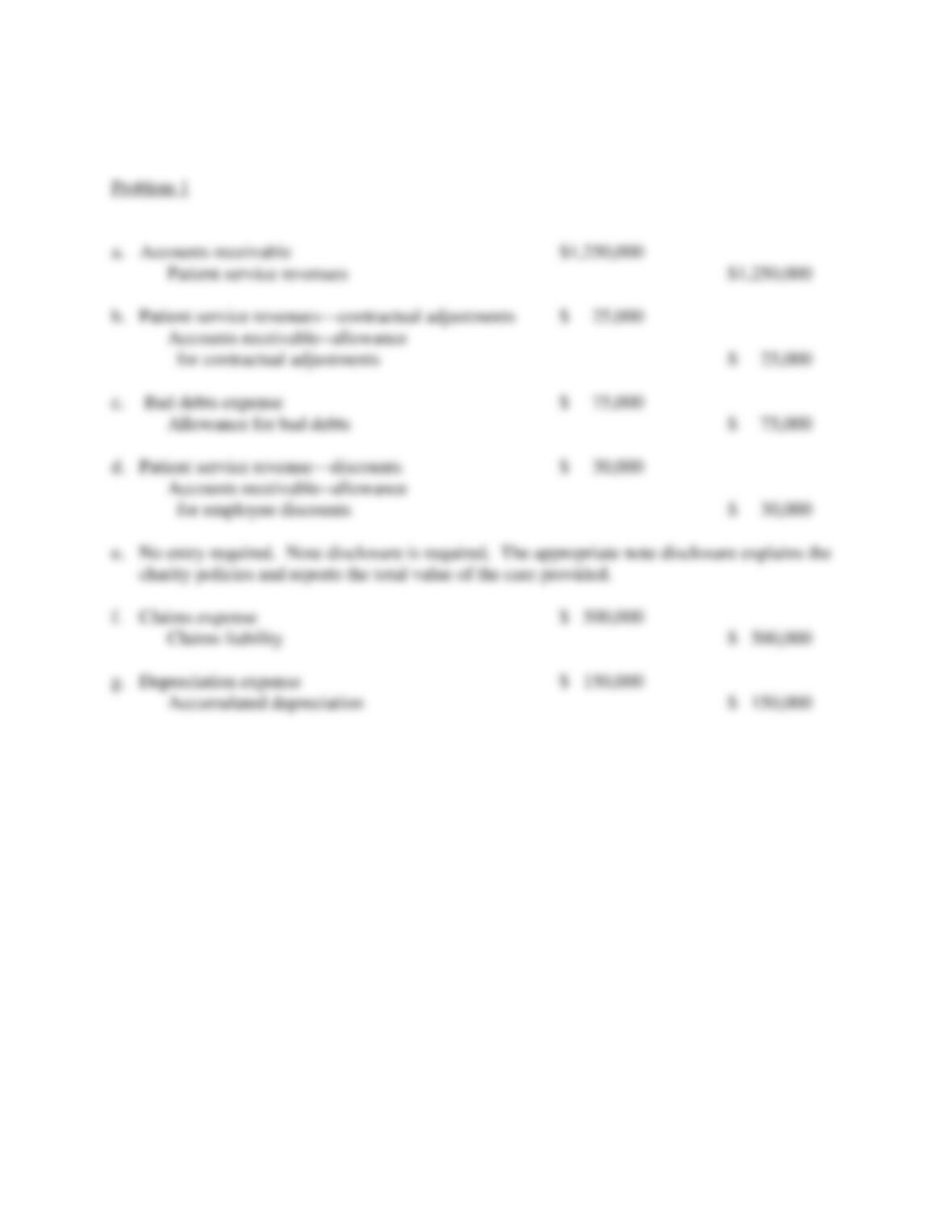
1. St. Anthony’s Hospital is a private not-for-profit entity that provides health care services to
citizens of the small rural community in which the hospital is located. The most recent
construction at the hospital was financed using Hill-Burton funds. During the current month,
St. Anthony’s engaged in the following transactions. Make the appropriate journal entries
for St. Anthony’s for the current month.
a. Based on the hospital’s established billing rate, services rendered to patients amounted to
$1.5 million. Of this amount $1,000,000 will be billed to Delta Medical Group; a third-
party payor that insures many state employees; $190,000 will be billed to uninsured
patients; $250,000 is provided to indigents and will be considered charity care; and
$60,000 was for services rendered to hospital employees.
b. Delta Medical Group pays for services rendered to its insurees on a rate schedule based
on types of procedures rendered. For the services rendered during the current month to
Delta insurees, Delta will reimburse the hospital $975,000. Part of the agreement
between St. Anthony’s and Delta is that Delta insurees will not be billed for the
difference between the amount that the hospital bills and the amount that Delta pays.
c. Based on prior experience with uninsured patients, the Hospital estimates that $75,000 of
the $190,000 will be uncollectible.
d. The hospital provides a 50 percent discount for services rendered to its employees.
e. The hospital recognizes the value of charity services rendered.
f. The hospital is the defendant in a malpractice suit. Attorneys for the hospital are
reasonably sure the hospital will be found liable and that the best estimate of the amount
of the loss is $1,500,000. The hospital carries medical malpractice insurance with a
$500,000 deductible clause.
g. The hospital has numerous capital assets on its books. Straight-line depreciation on the
assets is $150,000 for the current period.
ch14.doc Page 12
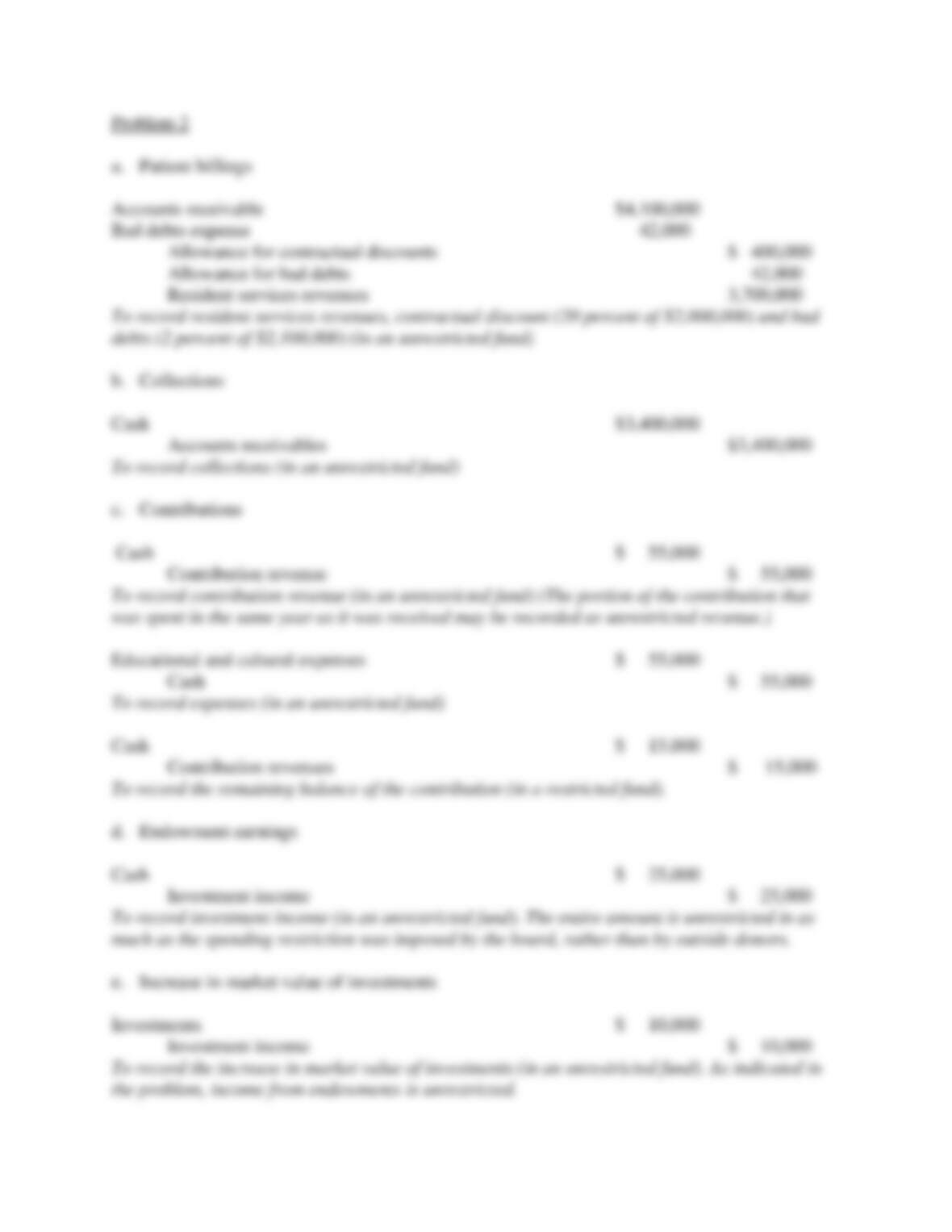
2. A not-for-profit residential assisted-living center engaged in the following transactions
during the year. Prepare appropriate journal entries.
a. The center billed residents for $4,100,000. Of this amount it estimates that $2,000,000
will be paid by third-party providers at a rate of only 80 percent. Of the remaining
balance, it estimates that 2 percent will be uncollectible.
b. The center collected $3,400,000.
c. The center received a cash contribution of $70,000 to be used exclusively for residents’
educational and cultural programs. Of this amount, the center spent $55,000 on qualified
activities during the year.
d. The center earned interest and dividends of $25,000 (cash) on its endowment of
$500,000. Income from the endowment is unrestricted. However, it is the policy of the
center’s board of trustees that only income greater than 2 percent of the principal balance
will be available for expenditures. The balance will be retained in the endowment to
compensate for inflation. Thus, only $15,000 of the income was made available for
expenditure.
e. The market value of the endowment’s investments increased by $10,000.
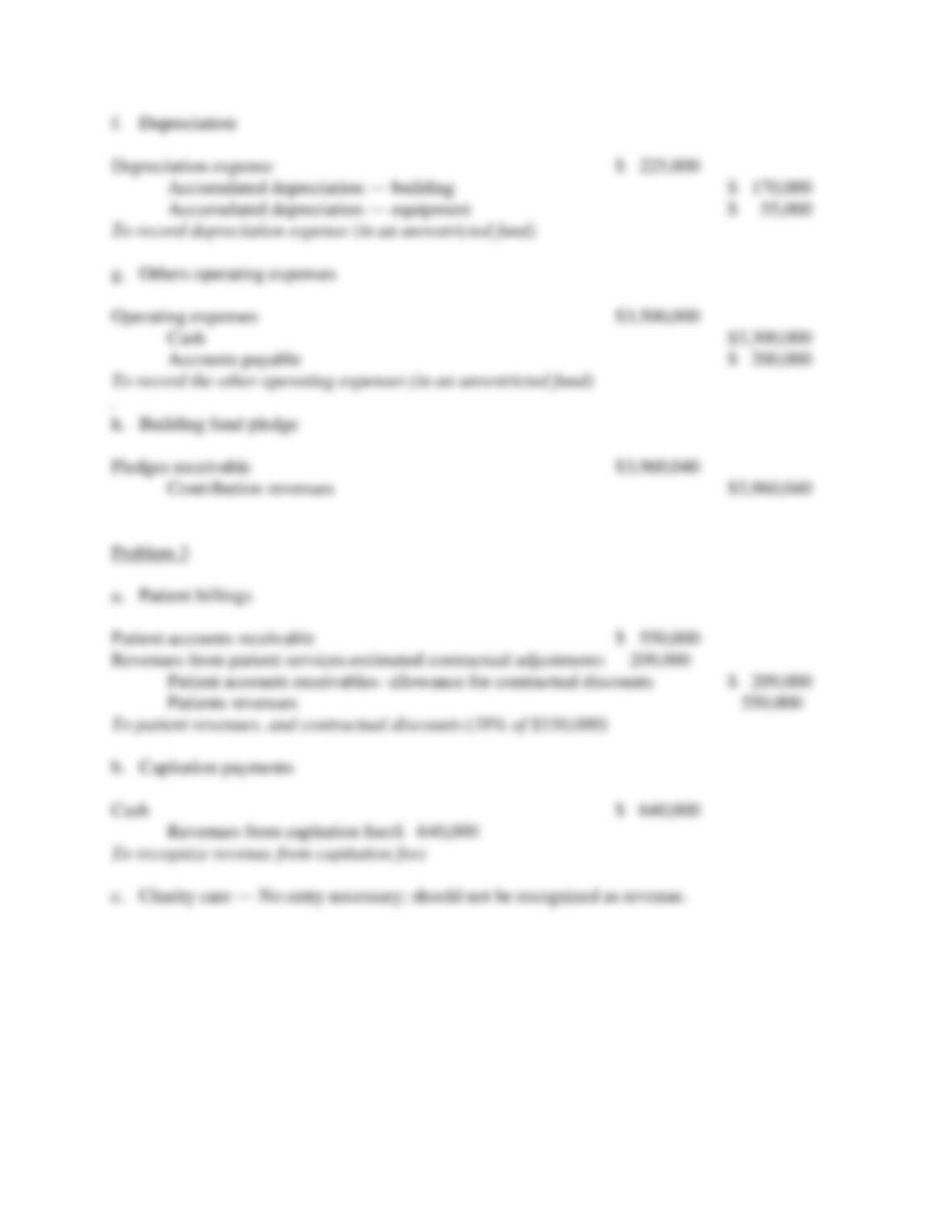
f. The center recognized $170,000 of depreciation on the building and $55,000 on
equipment.
g. The center incurred other operating expenses of $3,500,000, of which $3,300,000 was
paid in cash.
h. At year-end the center received a pledge of $4,200,000 toward the center’s new building
campaign. It will be paid at the rate of $1,400,000 at the end of each of the following
three years. The center uses a discount rate of 3 percent to value noncurrent pledges.
Based on that rate, the present value of the annuity is $3,960,040.
ch14.doc Page 13
3. Prepare journal entries for the following transactions of St. Mary’s Hospital, a not-for-profit
health care entity.
a. St. Mary’s hospital billed the state Medicaid program $550,000 for services provided at its
standard billing rate. The prospective payment system gives Medicaid a 38 percent discount
from these rates.
b. The hospital has an arrangement with an HMO to provide hospital care to the HMO’s
members at a specific rate per member, per month. In April the HMO paid the hospital
$640,000 per agreement for patients treated in March. Based on pre-established billing rates,
the hospital would have billed the HMO $735,000.
c. The hospital provided services to patients under “charity care” which amounted to
$1,915,000 for the year.
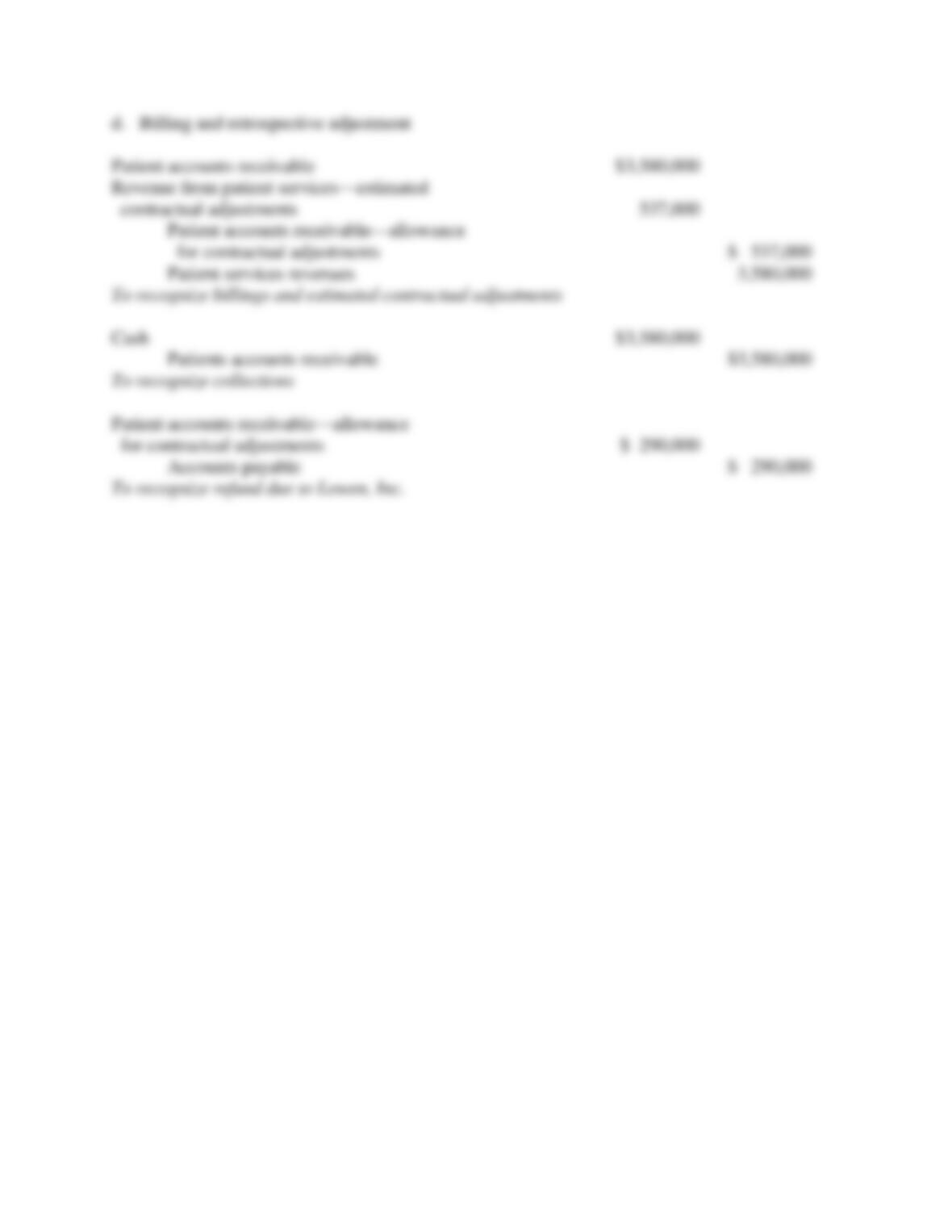
d. At its standard billing rates St. Mary’s hospital provided services to Lowen, Inc., a third-
party payor, for $3,580,000. The retrospective billing arrangement with Lowen, Inc.
stipulates that the hospital would receive payment at an interim rate of 85 percent of its
established rates, subject to retrospective adjustment based upon agreed-upon allowable
costs. By the end of the fiscal year, Lowen, Inc. had paid all the billings. Before issuing its
financial statements, the hospital estimated that it would need to refund $290,000 to Lowen,
Inc., based on allowable costs.
ch14.doc Page 14
ESSAYS (CHAPTER 14)
1. How do the three major financial statements of a private not-for-profit hospital differ from
those of a government hospital?
2. As the comptroller of a hospital, you were just informed that one of the surgeons failed to
remove an instrument from a patient’s innards. The hospital is certain to be sued. How, if at
all, should this information affect the hospital’s financial statements?
3. Gamma Hospital is a recipient of Hill-Burton funds and must provide some hospital care for
which it will not be compensated. During the current year, the hospital provided $1 million
in charity care. Discuss the following questions.
a. What is the current financial reporting requirement for charity care?
b. Do you agree or disagree with the current financial reporting requirement? Why or why
not?
c. If you do not agree with the current financial reporting requirement, how do you think
charity care should be reported?
d. Alternatively, if you do agree with the current standards, what alternative reporting
requirements do you believe would be proposed by those who do not agree with the
current standards?

ch14.doc Page 15
ANSWERS TO TRUE/FALSE (CHAPTER 14)

ch14.doc Page 16
ANSWERS TO MULTIPLE CHOICE (CHAPTER 14)
ch14.doc Page 17
ANSWERS TO PROBLEMS (CHAPTER 14)
ch14.doc Page 18
ch14.doc Page 19
ch14.doc Page 20
ch14.doc Page 21
ESSAY ANSWERS (CHAPTER 14)