Name:
Class:
Date:
Chapter 14: Transaction Costs, Asymmetric Information, and Behavioral Economics
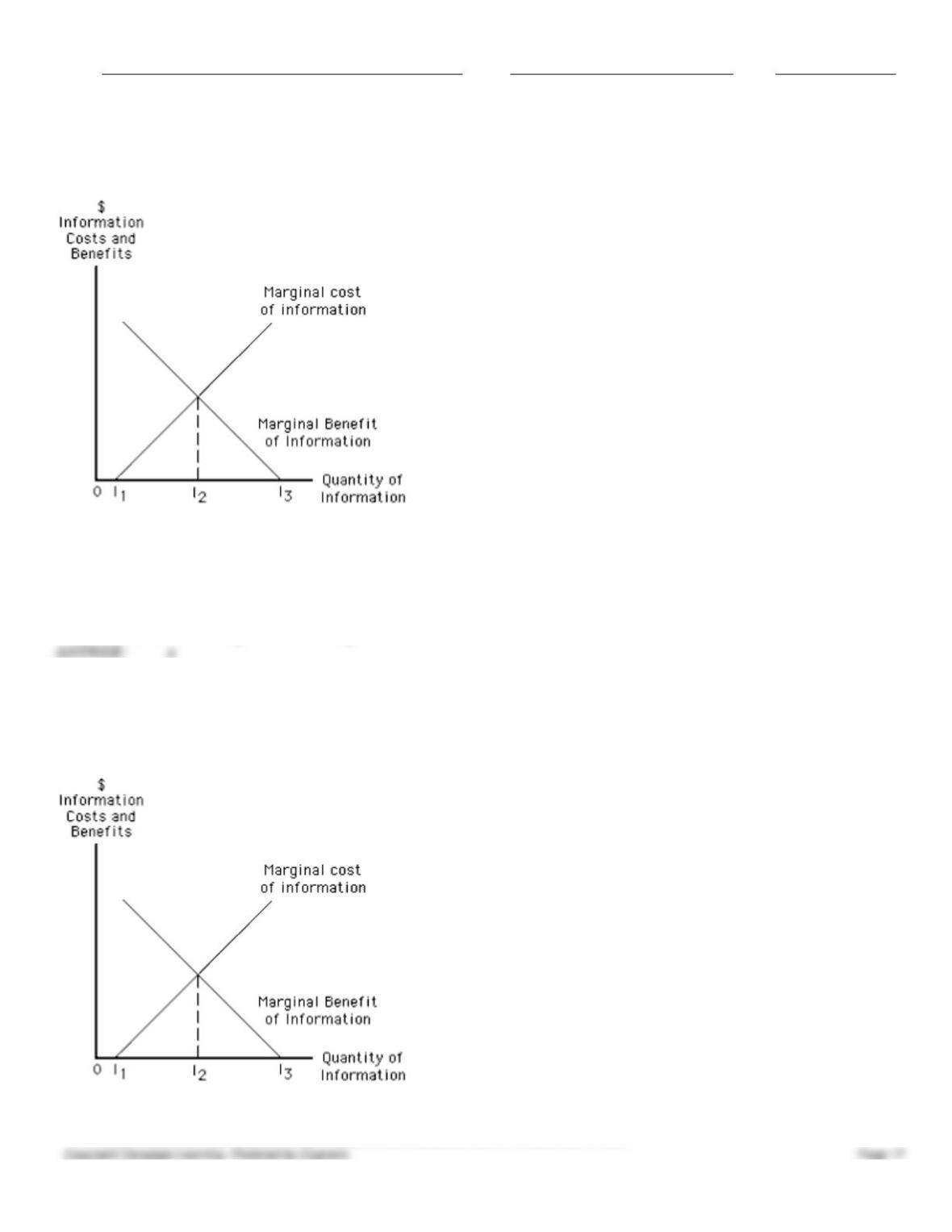
84. The figure given below shows the marginal cost and the marginal benefit of information curves. In the figure given
below, the marginal benefit curve shows that:
Figure 14.2
a. as consumers become more familiar with a market, additional information yields less and less improvement in
product quality or value.
b. the marginal benefit of information increases as a consumer spends more and more time acquiring information.
c. greater and greater distances must be covered to acquire a marginal piece of information.
d. the cost of gathering information diminishes as more of it is gathered.
e. common knowledge alone is enough to decide consumer choice.
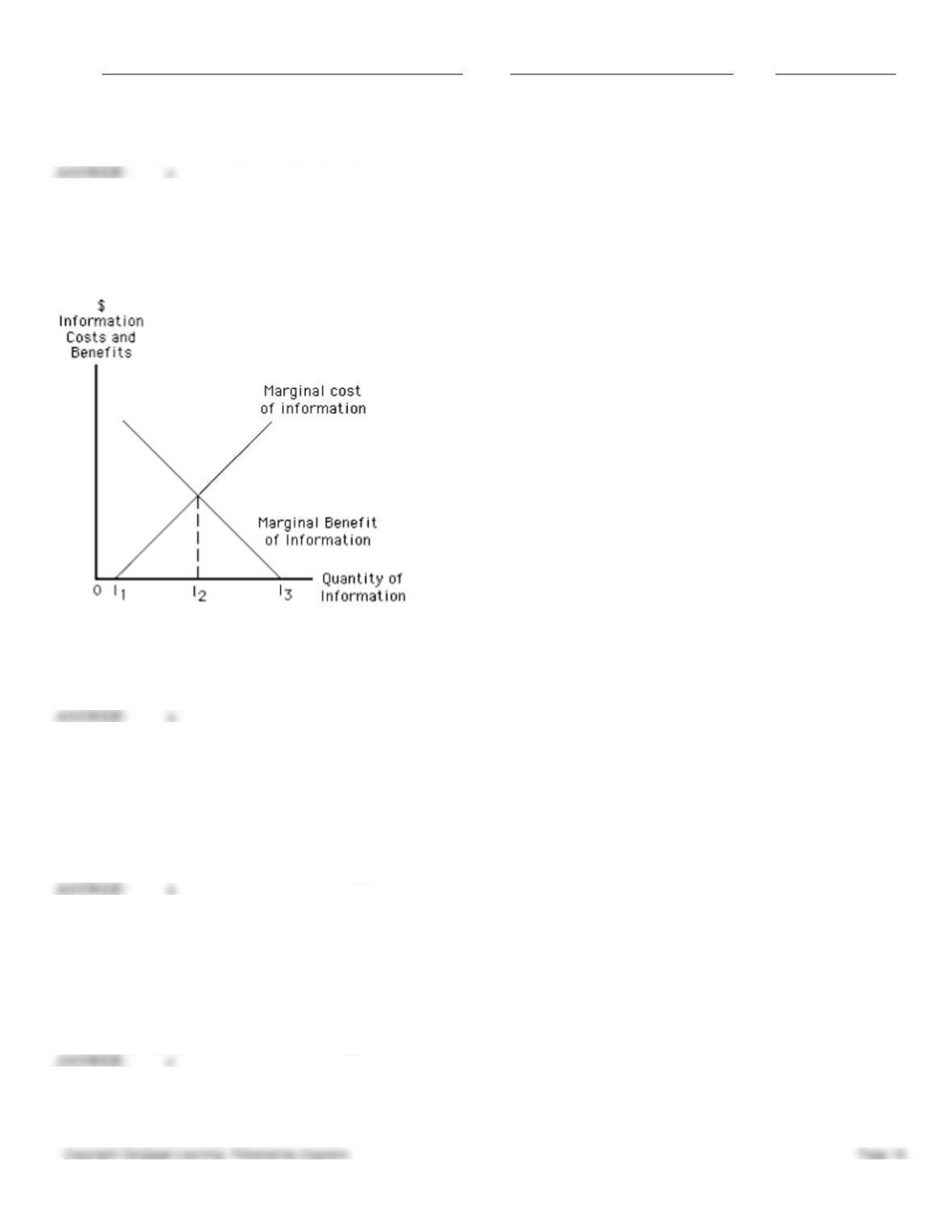
85. The figure given below shows the marginal cost and the marginal benefit of information curves. In the figure given
below, which of the following is true of a consumer who has gathered information equal to I3?
Figure 14.2
a. The consumer has made an optimal search.
b. The consumer is relying solely on common knowledge.
c. The consumer has acquired all available information that is beneficial to her.
Name:
Class:
Date:
Chapter 14: Transaction Costs, Asymmetric Information, and Behavioral Economics
d. Further information will be costless to this consumer.
e. The consumer should increase her search.
86. The figure given below shows the marginal cost and the marginal benefit of information curves. In the figure given
below, if a consumer gathers an amount of information equal to I2, it implies that:
Figure 14.2
a. she has made the optimal search.
b. she has avoided the cost of acquiring information.
c. she has searched too much.
d. further information will be costless to her.
e. she should increase her search.
87. According to Stigler’s search model, the marginal cost of acquiring information about a product:
a. is greater for a doctor than for a nurse.
b. is the same for high-income consumers as for low-income consumers.
c. is greater for expensive items than for cheap items.
d. is greater for cheap items than for expensive items.
e. diminishes as more information is acquired.
88. According to Stigler’s search model, the marginal benefit of acquiring information about a product:
a. is greater for a doctor than for a nurse.
b. is the same for both high-income and low-income consumers.
c. is greater for expensive items than for cheap items.
d. is greater for cheap items than for expensive items.
e. increases as more information is acquired.
89. According to Stigler’s search model, we should expect greater price dispersion for a given good:
a. if the good is a luxury.

Name:
Class:
Date:
Chapter 14: Transaction Costs, Asymmetric Information, and Behavioral Economics
b. if the good is inferior.
c. if there is a lot of common knowledge about the good.
d. during a recession.
e. if a computerized search service is offered.
90. According to Stigler’s search model, a computerized used car search service is likely to:
a. increase the opportunity cost of time.
b. decrease the amount of search.
c. increase price dispersion.
d. decrease price dispersion.
e. lower the marginal benefit of search.
91. According to Stigler’s search model, an e-shopping site is likely to:
a. increase the marginal cost of information.
b. decrease the marginal benefit of search.
c. increase quality dispersion.
d. reduce quality dispersion.
e. increase price dispersion.
92. According to Stigler’s search model, an increase in the earnings of individuals in a growing economy is likely to result
in:
a. a decrease in quality dispersion.
b. a decrease in the opportunity cost of time.
c. an increase in the marginal benefit of search.
d. an increase in the amount of search.
e. an increase in price dispersion.
93. Personal dating advertisements in the newspaper are popular because they:
a. increase the marginal benefit of search.
b. reduce the marginal cost of search.
c. increase the marginal cost of search.
d. reduce the optimal amount of search.
e. increase quality dispersion.
94. For which of the following goods is the marginal benefit of search likely to be greatest?
a. A toaster
b. An apple
c. A radio
d. A tube of toothpaste
e. An LED TV
Name:
Class:
Date:
Chapter 14: Transaction Costs, Asymmetric Information, and Behavioral Economics
95. Identify a good that is most likely to have the maximum marginal benefit of search.
a. A pair of shoes
b. An automobile
c. A jar of honey
d. A loaf of bread
e. A pair of jeans
96. Among the goods and services mentioned below, the marginal benefit of search is likely to be highest for _____.
a. a haircut
b. a babysitter
c. a jar of peanut butter
d. cosmetic surgery
e. a CFL bulb
97. The marginal benefit of acquiring additional information tends to:
a. be zero if the marginal cost of information is zero.
b. increase and then decrease as additional information is obtained.
c. be very high for goods whose price dispersion is very small.
d. be zero in the case of luxury goods.
e. decrease as additional information is obtained.
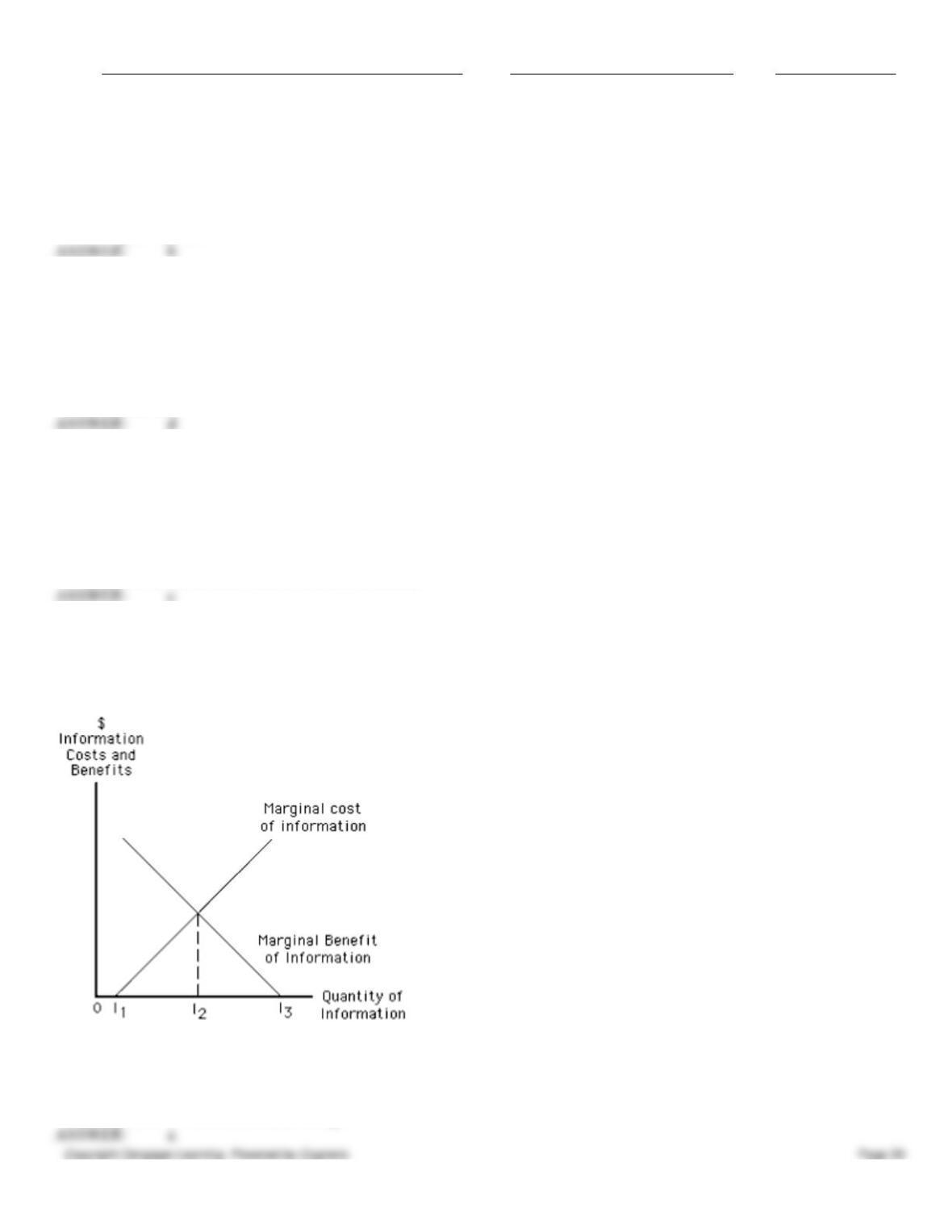
98. The figure given below shows the marginal cost and the marginal benefit of information curves. In the figure given
below, identify a likely impact of a new technology that requires consumers to spend less time searching for information.
Figure 14.2
a. A rightward shift of the marginal cost of information curve
b. A rightward shift of the marginal benefit of information curve
c. A leftward shift of the marginal cost of information curve
d. A leftward shift of the marginal benefit of information curve
e. An increase in common knowledge
Name:
Class:
Date:
Chapter 14: Transaction Costs, Asymmetric Information, and Behavioral Economics
99. The statement “It doesn’t hurt to get more information.” holds true:
a. especially when the opportunity cost of acquiring the information is high.
b. when information is less than perfect.
c. only if the marginal benefit of information is greater than the marginal cost of information.
d. only if the marginal benefit of information is equal to the marginal cost of information.
e. only if the marginal benefit of information is less than the marginal cost of information.
100. Which of the following would lead a utility-maximizing consumer to search for additional information?
a. An increase in income
b. An increase in the marginal cost of information
c. Improved technology (e.g., Internet search programs)
d. A reduction in the dispersion of prices
e. An increase in the consumer’s wage rate
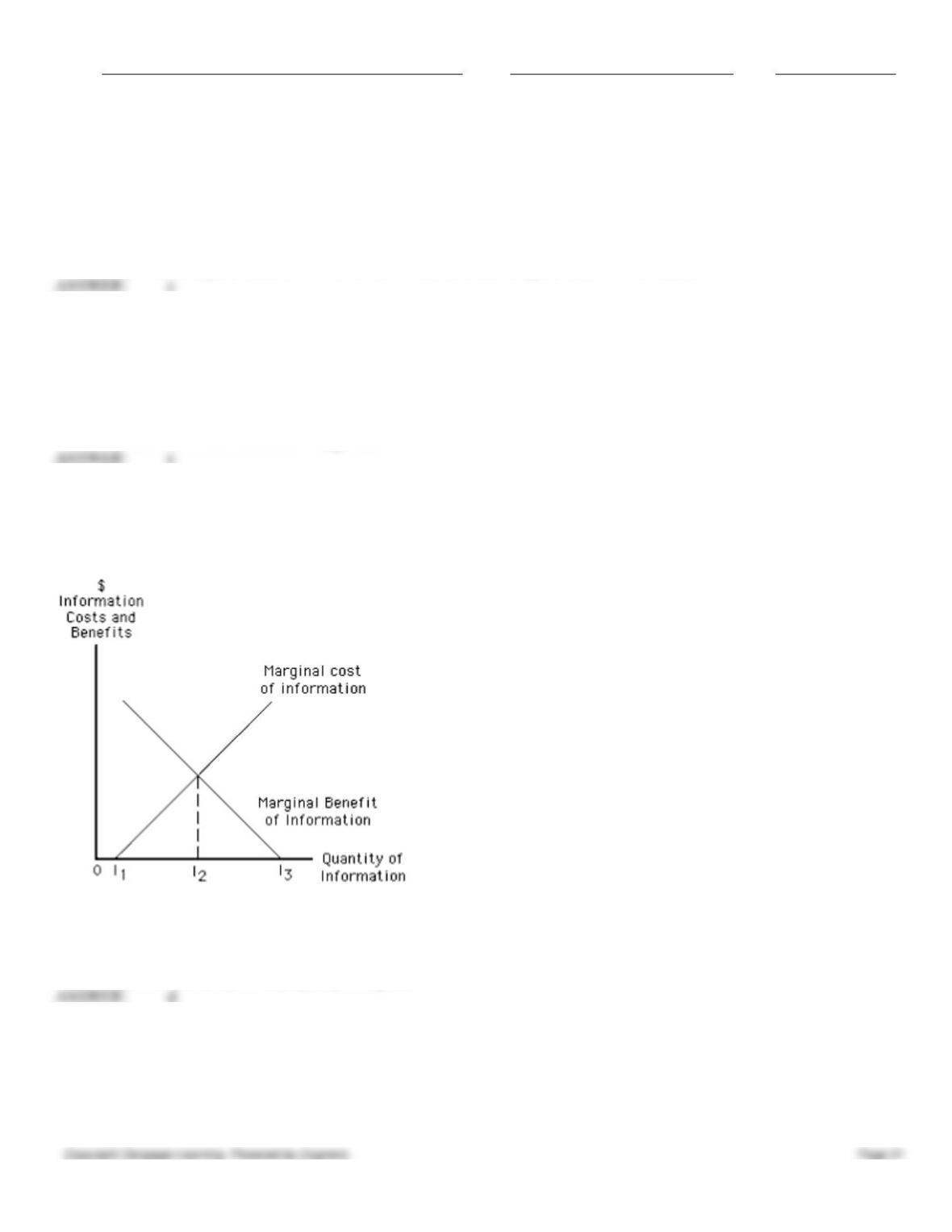
101. The figure given below shows the marginal cost and the marginal benefit of information curves. In the figure given
below, which of the following is likely to shift the marginal cost of information curve upward?
Figure 14.2
a. Introduction of a new technology
b. An increase in unemployment in an economy
c. An increase in the availability of substitute goods
d. An increase in the earnings of an economy
e. Improvement in the overall quality of a good
102. Which of the following is true of the marginal benefit curve for additional information in Stigler’s search model?
a. It is positively sloped.
b. It always lies above the marginal cost curve.
c. It begins on the horizontal axis at a point that represents full information.
d. It slopes downward.

Name:
Class:
Date:
Chapter 14: Transaction Costs, Asymmetric Information, and Behavioral Economics
e. It begins on the horizontal axis at a point that represents common knowledge.
103. Which of these factors is likely to reduce search cost and price dispersion?
a. Growth in the number of educated workers
b. Growth of information technology
c. Growth in unemployment
d. Immigration of skilled workers
e. Decline in the average earnings of workers
104. Imperfect information among the potential bidders of a cable TV franchise results in a final bid that is more than the
market value of a franchise. This situation is an example of:
a. moral hazard.
b. an authority relation.
c. the winner’s curse.
d. the principal-agent problem.
e. adverse selection.
105. The winner’s curse is more likely to occur when:
a. there is only one bidder.
b. the demand for the good being auctioned is increasing.
c. the value of the good being auctioned is common knowledge.
d. the value of the good being auctioned is uncertain.
e. the marginal cost of information is low.
106. The publisher that paid Arthur James, a popular novelist, a $2 million advance on his recent novel, which sold only
42 copies, fell victim to:
a. moral hazard.
b. an authority relation.
c. the winner’s curse.
d. the principal-agent problem.
e. adverse selection.
107. In an auction, the winning bidder often ends up as an overly optimistic loser due to:
a. asymmetric information.
b. political pressure.
c. zero marginal costs.
d. lack of common knowledge.
e. lack of perfect information.
108. If a seller has more information about the qualities and characteristics of a good than a buyer:
a. the problem of the winner’s curse occurs.

Name:
Class:
Date:
Chapter 14: Transaction Costs, Asymmetric Information, and Behavioral Economics
b. the marginal cost curve for information becomes horizontal.
c. the demand for the good will be price inelastic.
d. the problem of asymmetric information occurs.
e. the marginal benefit of search curve becomes vertical.
109. The two types of asymmetric information situations are those with:
a. hidden costs and hidden actions.
b. hidden characteristics and hidden costs.
c. hidden characteristics and hidden actions.
d. hidden actions and hidden selection.
e. moral hazard and natural selection.
110. The timeshare condominium in Florida bought by an individual last year ended up involving many extra costs and
restrictions that were not apparent at the time of sale. This problem is a classic example of _____.
a. a winner’s curse
b. moral hazard
c. negative externalities
d. the principal-agent relationship
e. hidden characteristics
111. One result of asymmetric information in the market for used cars is that:
a. few used cars are offered for sale.
b. few lemons are offered for sale.
c. more lemons may be offered for sale than good cars.
d. buyers benefit at the expense of sellers.
e. good cars sell at a price that is higher than their market value.
112. One result of asymmetric information in the market for bank loans is that:
a. few privileged customers are offered loans.
b. few bad loans are made and the default rate is low.
c. more bad loans than good loans may be made.
d. lenders benefit at the expense of borrowers.
e. the interest charged on good loans is higher than the same charged on bad loans.
113. The used car market may be inefficient because the purchase of a used car often involves:
a. natural selection.
b. moral hazard.
c. low marginal search costs.
d. open-access resources.
e. hidden characteristics.

Name:
Class:
Date:
Chapter 14: Transaction Costs, Asymmetric Information, and Behavioral Economics
114. Which of the following results from the lemons problem observed in the market for used cars?
a. The ratio of lemons to high-quality cars will be high.
b. The ratio of lemons to high-quality cars will be low.
c. Good quality used cars will be sold at a price much higher than their market value.
d. Lemons will not be offered for sale in the market.
e. The price of lemons will be below their market value.
115. When sellers have more information about the hidden characteristics of a good compared to buyers, more low-quality
units are likely to be sold than high-quality units. This phenomenon is termed:
a. the law of diminishing marginal returns.
b. the law of natural selection.
c. the winner’s curse.
d. the lemons problem.
e. the problem of common pools.
116. When individuals belonging to the informed side of a market self-select and harm those belonging to the uninformed
side, the _____ problem occurs.
a. natural selection
b. negative externality
c. adverse selection
d. winner’s curse
e. common pool
117. Individuals who have a tendency to default are usually more willing to pay high interest rates and thus get loans. This
describes an example of:
a. symmetrical information.
b. adverse selection.
c. natural selection.
d. moral hazard.
e. the winner’s curse.
118. A refrigerator repairman charges Sandra for two hours of labor even though he could have fixed it in ten minutes. In
this example, Sandra is facing the problem of:
a. natural selection.
b. moral hazard.
c. hidden actions.
d. external costs.
e. hidden characteristics.
119. The principal-agent problem arises because of:
a. natural selection.
b. diminishing marginal returns.
c. hidden actions.

Name:
Class:
Date:
Chapter 14: Transaction Costs, Asymmetric Information, and Behavioral Economics
d. the winner’s curse.
e. hidden characteristics.
120. In which of the situations described below is the principal-agent problem least likely to occur?
a. A patient using hospital services
b. A doctor visiting a patient at home
c. A bartender serving an individual at a bar
d. A mechanic repairing a television set
e. A stockbroker offering financial advice to a client
121. The principal-agent problem is less likely to occur when getting a haircut than when getting a car repaired because:
a. haircuts are less expensive than car repairs.
b. there are no hidden actions when getting your hair cut.
c. there are no hidden actions when getting your car repaired.
d. auto mechanics are less honest than hair stylists.
e. there is no principal-agent relationship in car repair.
122. Which of the following does not describe a principal-agent relationship?
a. An NGO sponsoring the primary education of orphans
b. Payless Inc. hiring a salesperson
c. Dixie hiring a lawyer
d. Citizens electing a state senator
e. Opal getting her car repaired
123. Which of these principal-agent relationships is least likely to pose a problem?
a. An individual hiring a gardener to mow her lawn
b. An individual appointing lawyer to file a legal suit
c. An individual following up with a doctor for liver disease
d. An individual consulting an income tax lawyer for her company’s tax policy
e. An individual appointing a nurse for her daily routine check-up at the hospital
124. Copious Corp. is owned by 2 million stockholders who elect a board of directors. This board selects a management
team responsible for hiring workers to serve customers by selling and repairing computer monitors. Which of the
following statements is true?
a. In the principal-agent relationship between workers and customers, the customers are the agents.
b. In the principal-agent relationship between workers and managers, the managers are the agents.
c. In the principal-agent relationship between the stockholders and the board of directors, the stockholders are the
agents.
d. In the principal-agent relationship between the stockholders and the customers, the stockholders are the agents.
e. In the principal-agent relationship between management and the board of directors, the managers are the agents.

Name:
Class:
Date:
Chapter 14: Transaction Costs, Asymmetric Information, and Behavioral Economics
125. The academic dean at Esoteric University hires a philosopher to teach one of the 12 sections of a course called “Why
Nerf Balls Ingest Hair.” Which of the following is true?
a. The academic dean is the agent; the philosopher is the principal.
b. The academic dean is the agent; the students are the principals.
c. The academic dean is the principal; the students are the agents.
d. The philosopher is the principal to both the academic dean and the students.
e. The philosopher is an agent to both the academic dean and the students.
126. A situation in which one party makes a contractual agreement with a second party in the expectation that the second
party will act on its behalf is known as:
a. a collusion.
b. a horizontal agreement.
c. an authority relation.
d. a principal-agent problem.
e. a vertical agreement.
127. Which of the following problems is most likely to occur if an individual hires an attorney for her child’s custody suit?
a. The winner’s curse
b. The unbounded rationality problem
c. A principal-agent problem
d. An adverse selection problem
e. A hidden characteristic problem
128. A principal-agent problem is most likely to arise when:
a. a new music school is inaugurated in a town.
b. a homeowner appoints a gardener to maintain his lawn.
c. a homemaker buys fresh fish from a local fishmonger.
d. a company outsources its tax computation to a consultancy.
e. a teenager requests his hair stylist for a new hairstyle.
129. Andrew leaves the washer, dryer, and dishwasher running at home when he leaves for his music class. Being aware
that the recently bought fire insurance for his house will cover any damage caused by fire, he considers himself risk free.
Which of the following problems is described in this example?
a. The common resource problem
b. The unbounded rationality problem
c. The adverse selection problem
d. The winner’s curse problem
e. The moral hazard problem
130. By requiring that applicants for insurance policies fill out lengthy forms and take a physical examination, insurers
attempt to guard against:
a. unbounded rationality.
b. adverse selection.

Name:
Class:
Date:
Chapter 14: Transaction Costs, Asymmetric Information, and Behavioral Economics
c. negative signaling.
d. moral hazard.
e. the winner’s curse.
131. In the market for used cars, car owners have abundant personal experience with the important characteristics of the
vehicle that they are selling. However, a prospective buyer can only guess the characteristics based on each car’s
appearance. Which of the following problems arises due to this information mismatch?
a. The principal-agent problem
b. The problem of winner’s curse
c. The problem of adverse selection
d. The problem of moral hazard
e. The problem of unbounded rationality
132. An individual is least likely to confront the principal-agent problem while availing services from:
a. a plumber.
b. a real estate agent.
c. an air hostess.
d. a car mechanic.
e. a travel agent.
133. Waiters, barbers, and bellhops are paid primarily through tips because:
a. managers can easily assess their productivity.
b. managers are better at judging their productivity than are consumers.
c. consumers can judge their productivity easily.
d. it’s always been done that way.
e. union regulations require this form of payment.
134. There is less of a principal-agent problem between managers and apple pickers than between managers and
secretaries because:
a. apple pickers naturally work harder.
b. secretaries get paid less than their worth.
c. productivity is easier to measure in apple picking than in secretarial services.
d. a secretary’s marginal product is easier to estimate than an apple picker’s.
e. secretaries receive on-the-job training but the apple pickers receive no such training.
135. At Tony’s Car Wash, a team of four workers washes and rinses each car by hand and one worker dries the car by
hand. Which of the following is true?
a. Tony will not face any principal-agent problem in performance evaluation.
b. Tony will face more problems in performance evaluation in washing and rinsing than in drying the cars.
c. Tony will face more problems in performance evaluation in drying than in washing and rinsing the cars.
d. Tony will face similar problems in performance evaluation in washing, rinsing, and drying.
e. Tony will not have an incentive to monitor the car wash as the productivity of the workers is same.

Name:
Class:
Date:
Chapter 14: Transaction Costs, Asymmetric Information, and Behavioral Economics
136. Which of the following occupations is most likely to encounter the adverse selection problem?
a. A salesman at an apparel store
b. A hair stylist
c. A manager of a company
d. A supermarket cashier
e. A tightrope walker
137. In which of these occupations is it easy for the customers to observe and quantify the ability of workers?
a. Air pilots
b. Garment factory workers
c. Lawyers
d. Bartenders
e. Doctors
138. Which of these problems is encountered in labor markets where the abilities of the workers are intangible or
unmeasurable?
a. The principal-agent problem
b. The adverse selection problem
c. The moral hazard problem
d. The winner’s curse problem
e. The problem of diminishing marginal productivity
139. Adverse selection is more likely when:
a. a job requires specific training.
b. a job requires intangible or immeasurable abilities.
c. the wage offered is above the average wage rate in the market.
d. wage is based on true marginal revenue products.
e. performance can be monitored closely.
140. A wage offer that is above the market wage, intended to avoid the adverse selection problem, is called a(n) _____.
a. efficiency wage
b. unionized wage
c. equilibrium wage
d. minimum wage
e. indirect wage
141. Darryl graduated with honors from college. However, he obtained his outstanding grades by cheating on every final
exam with help from his best friend; Darryl actually has the talent of a C student. Nevertheless, he gets a job with a top
accounting firm in Boston. The fact that he is hired illustrates a failure of:
a. efficiency wage theory.
b. signaling and screening.

Name:
Class:
Date:
Chapter 14: Transaction Costs, Asymmetric Information, and Behavioral Economics
c. marginal productivity theory.
d. supply and demand theory.
e. outsourcing and specialization.
142. In the context of a job market, a signal is:
a. a proxy measure for working conditions associated with a particular job.
b. a proxy measure of a job applicant’s skills.
c. used by employers to indicate that a job interview is over.
d. an indication of an excess demand for labor.
e. an indication of an excess supply of qualified labor.
143. Employers rely on a job applicant’s signals:
a. because they are always an accurate indicator of the applicant’s skills.
b. because actual abilities are not observable prior to employment.
c. because actual abilities are not observable after the applicant is hired.
d. only when hiring someone for an entry-level position.
e. only when hiring someone who has a college degree.
144. Which of the following is true of signaling used in a job market?
a. It is used to show employees in a market that demand in a profession has increased.
b. It is used to show employees in a market that supply in a profession has increased.
c. It is used by employees to indicate possession of unobservable qualities required for a particular job.
d. It is used by employers to discriminate against certain groups of people.
e. It teaches employees to stay out of certain professions.
145. Which of the following involves signaling?
a. High wage rates attracting a larger pool of applicants for a job
b. Firms taking advantage of outsourcing when transactions costs are low
c. Reporting one’s college GPA on a résumé
d. Paying higher wages to workers who produce more
e. Requiring the sales staff to work strictly on commission
146. Which of these is an example of screening in a job market?
a. Listing years of education on résumés
b. Providing college transcripts
c. Sending in letters of recommendation
d. Dressing in a suit for interviews
e. Checking résumés for spelling and typographical errors
147. Which of these is true of behavioral economics?
a. It borrows insights from sociology to explain certain economic decisions.

Name:
Class:
Date:
Chapter 14: Transaction Costs, Asymmetric Information, and Behavioral Economics
b. It questions the basic assumptions in traditional economics, particularly utility and ability.
c. It borrows insights from psychology to explain certain economic decisions.
d. It questions the basic assumptions in traditional economics, particularly rationality and will power.
e. It assumes that people act rationally to maximize their well-being.
148. Which of the following is true of traditional economics?
a. It questions the assumptions of utility and demand.
b. It questions the assumptions of unbounded rationality and will power.
c. It borrows insights from philosophy to explain certain economic decisions.
d. It assumes that people make irrational choices and end up with bad outcomes.
e. It assumes that people act rationally to maximize their overall well-being.
149. Which of the following is an example of the fact that people are prone to inertia?
a. An individual deciding to continue with an insurance policy even after its premium rate increases and alternative
policies are available in the market
b. An individual deciding to decrease the consumption of a commodity when the utility derived from it falls
c. An individual deciding to opt for additional savings schemes apart from those set as default by employers
d. An individual replacing high-power electrical lights and appliances with low-power ones to reduce electricity
consumption per month
e. An individual visiting a new grocery store for her monthly grocery shopping
150. “Humans try to avoid making some decisions even when the consequences of no decision are costly.” This statement
supports the concept of:
a. bounded rationality.
b. unbounded willpower.
c. rational choice.
d. information asymmetry.
e. diminishing marginal utility.
151. Which of the following approaches borrow insights from psychology to help explain economic choices?
a. Behavioral economics
b. Traditional economics
c. Development economics
d. Keynesian economics
e. Classical economics
152. The subfield of behavioral economics that examines how economic decision making affects areas of the brain is
called _____.
a. rational economics
b. neuroeconomics
c. environmental economics
d. developmental economics
e. scientific economics

Name:
Class:
Date:
Chapter 14: Transaction Costs, Asymmetric Information, and Behavioral Economics