Biology: A Guide to the Natural World, 5e (Krogh)
Chapter 14 How Proteins Are Made: Genetic Transcription, Translation, and Regulation
1) How many different types of amino acids are found in proteins?
A) 100
B) 200
C) 1,000
D) 20
E) 4
2) Proteins differ from one another because:
A) the bonds linking amino acids differ from protein to protein.
B) the sequence of amino acids in the polypeptide chain differs from protein to protein.
C) the number of nucleotides found in each protein varies from molecule to molecule.
D) the tRNA attached to the protein differs from protein to protein.
E) of the length of the mRNA.
3) When an mRNA moves into the cell’s cytoplasm, it first becomes associated with a:
A) protein.
B) tRNA.
C) ribosome.
D) transcription factor.
4) Transcription:
A) occurs on the ribosome.
B) is the final process in the assembly of a protein.
C) is the synthesis of RNA from a DNA template.
D) is catalyzed by DNA polymerase.
E) occurs in the cytoplasm.
5) The process that converts the information in DNA into RNA is:
A) translation.
B) replication.
C) transcription.
D) duplication.
E) meiosis.
6) What is the sugar found in an RNA nucleotide?
A) uracil
B) deoxyribose
C) ribose
D) glucose
E) thymine
7) Which of the following is a component of an RNA nucleotide?
A) uracil
B) deoxyribose sugar
C) thymine
D) glycine
8) Wherever there is an adenine on a DNA strand, during transcription it will be base-paired with
a ________ on an RNA strand.
A) thymine
B) adenine
C) guanine
D) cytosine
E) uracil
9) If a DNA segment has the sequence GCTAA, what RNA sequence will be made from it?
A) GCTAA
B) CGATT
C) UGATT
D) CGUTT
E) CGAUU
10) The form of RNA that carries the information from DNA to the site of protein assembly is
called:
A) messenger RNA.
B) small nuclear RNA.
C) ribosomal RNA.
D) transfer RNA.
E) primary mRNA script.
11) The enzyme responsible for transcribing DNA is:
A) DNA polymerase.
B) RNA polymerase.
C) helicase.
D) DNA transcription factor.
12) Which molecule is the product of transcription?
A) nucleotides
B) DNA
C) proteins
D) amino acids
E) RNA
13) Which process or processes occur in the nucleus?
A) DNA replication and transcription
B) DNA replication
C) transcription and translation of RNA
D) transcription
E) DNA replication, transcription, and translation
14) What is a codon?
A) three genes in a bacterium that are all regulated together
B) a segment of a chromosome that encodes an RNA
C) three amino acids in a row in a protein
D) a three-base sequence of mRNA that codes for a specific amino acid
E) a sequence in DNA that is the binding site for RNA polymerase
15) How many bases does it take to code for a single amino acid?
A) one
B) two
C) three
D) four
E) six
16) If a base sequence in DNA reads GCA, what will be the corresponding codon in the mRNA?
A) CGT
B) GCT
C) GCU
D) CGU
E) ACG
17) If a DNA sequence reads TTGCGATCG, what mRNA will it encode?
A) TTGCGUTCG
B) AACGCTAGC
C) AACGCUAGC
D) TTGCGATCG
E) UUCGCTUGC
18) Which of the following is not an RNA transcript?
A) AUGCGU
B) ATGCGT
C) UACGCA
D) UAGCGU
E) GCGUUU
19) Insulin is a protein that is made up of 51 amino acids. It would have been translated from an
mRNA transcript that had at least:
A) 153 nucleotides.
B) 1153 nucleotides.
C) 1530 nucleotides.
D) 300 nucleotides.
20) The genetic code:
A) tells us how RNA is assembled on a DNA template.
B) is a list of all the possible proteins that can be made.
C) describes the mechanics of translation.
D) shows the connection between nucleotide triplets and the amino acids they code for.
E) shows the connection between nucleotide triplets in DNA and their corresponding codons in
RNA.
21) If a codon is three nucleotides and there are four different nucleotides, how many different
codons can be made?
A) 3
B) 12
C) 28
D) 64
E) 120
22) What does the RNA polymerase enzyme complex do?
A) It unwinds the DNA.
B) It brings complimentary RNA nucleotides to DNA.
C) It synthesizes RNA molecule.
D) It splices introns out of mRNA.
E) It unwinds the DNA, brings complementary RNA nucleotides to DNA, and synthesizes an
RNA molecule.
23) A three-nucleotide sequence on an mRNA that codes for an amino acid is referred to as a/an:
A) anticodon.
B) primary transcript.
C) tRNA.
D) template.
E) codon.
24) What are the products of translation?
A) polypeptide chains/proteins
B) DNA
C) nucleotides
D) ribosomes
E) RNA
25) If we create the figure: DNA → RNA → Polypeptide [Protein], what do the arrows indicate?
A) replication
B) transcription
C) translation
D) replication and transcription
E) transcription and translation
26) Which of the following brings amino acids to the ribosomes?
A) exons
B) messenger RNA
C) transfer RNA
D) introns
E) ribosomal RNA
27) Translation of mRNA into protein always starts at:
A) a termination codon.
B) the E site.
C) an AUG codon.
D) the A site.
E) the first anticodon on the mRNA.
28) The first amino acid of a new polypeptide chain is:
A) serine.
B) cysteine.
C) variable.
D) phenylalanine.
E) methionine.
29) The process in which polypeptide synthesis requires information in the form of a nucleotide
sequence to be changed into amino acid sequence information is known as:
A) the genetic code.
B) transcription.
C) translation.
D) genetic regulation.
30) tRNAs will move from the A site to the P site to the E site during protein synthesis. These
sites are found in:
A) mRNA.
B) tRNA.
C) the large ribosomal subunit.
D) the small ribosomal subunit.
E) the nucleus.
31) How many codons can act as termination codons?
A) one
B) two
C) three
D) four
32) In the sequence of events during translation, what is the next step after an mRNA binds to
the ribosome’s small subunit?
A) A tRNA enters the A site of the ribosome.
B) An amino acid from a tRNA in the P site attaches to an amino acid on the tRNA in the A site.
C) A tRNA binds to the start codon, and the large ribosomal subunit joins the ribosome.
D) A tRNA is released from the E site.
E) The ribosome shifts down the mRNA by one codon.
33) In the sequence of events during translation, what is the next step after an amino acid on the
tRNA in the P site is linked to an amino acid on the tRNA in the A site?
A) The tRNA is released from the A site.
B) The small ribosomal subunit attaches to the mRNA.
C) A tRNA binds to the start codon, and the large ribosomal subunit joins the ribosome.
D) The tRNA in the A site moves to the E site.
E) The ribosome shifts down the mRNA by one codon.
34) If a codon has the sequence CAG, tRNA with which anticodon will bind to it?
A) CTG
B) UGA
C) GTC
D) CAG
E) GUC
35) Which component of transcription or translation has the anticodon?
A) mRNA
B) RNA polymerase
C) tRNA
D) rRNA
E) ribosome
36) Transfer RNA (tRNA) differs from other types of RNA because it:
A) transfers genetic instructions from the cell nucleus to the cytoplasm.
B) carries the codons for amino acid sequence of a particular protein.
C) carries an amino acid at one end of the molecule and binds with the mRNA with the
anticodon at the other end.
D) is made up of amino acids instead of nucleotides.
37) The set of nucleotides on a tRNA that base-pairs with nucleotides on an mRNA is the:
A) anticodon.
B) codon.
C) template.
D) primary transcript.
E) P site.
38) The process of translation is completed when:
A) a stop codon moves into the A site.
B) the cell runs out of amino acids.
C) the cell runs out of ribonucleotides.
D) the translation machinery reaches the end of the DNA molecule.
E) the stop codon is severed at the P site.
39) Introns in genes are:
A) redundant codons.
B) base sequences not required to make the protein.
C) regions where the RNA polymerase binds.
D) regulatory regions of the genome.
E) coding portions of the genome.
40) Which segment of an mRNA transcript is removed before it is translated?
A) exons.
B) operators.
C) introns.
D) Alu sequences.
E) stop codons.
41) Which of the following is the best description of a gene?
A) a protein whose amino acid sequence is encoded in a segment of DNA
B) a collection of millions or billions of base pairs of DNA, encoding many proteins
C) a segment of DNA that is transcribed into an mRNA, a tRNA, or an rRNA
D) a segment of mRNA that is translated into a protein
E) A section of the nucleus where transcription takes place.
42) In order for a gene to be transcribed, a multipart protein complex must bind to the ________
to help RNA polymerase align with it.
A) enhancer
B) promoter
C) intron
D) exon
43) Hoxc8 genes are responsible for the development of:
A) abdominal structure in vertebrates.
B) thoracic structures in vertebrates.
C) cranial structures.
D) limbs in vertebrates.
E) the whole vertebrate body.
44) Hoxc8 is nearly identical in all animals, but Hoxc8 enhancer differs in:
A) the sequence of amino acids.
B) the RNA base sequence.
C) the DNA base sequence.
D) DNA-binding proteins.
E) the DNA base sequence and its DNA-binding proteins.
45) Which of the following statements is true about micro-RNAs?
A) Alternative splicing converts them into mRNAs.
B) They bring amino acids to the ribosome.
C) They regulate the amount of protein in a cell by interfering with mRNAs.
D) They are too small to be of any use to the cell.
46) The genomes of human beings and chimpanzees are nearly identical, so why are humans and
chimps so different?
A) The genes of chimps make different proteins.
B) Out of 907 genes in the liver of both humans and chimps, only half are active in chimps.
C) The micro RNAs destroy mRNAs in chimps.
D) The micro RNAs destroy DNAs in chimps.
E) The regulatory sequences are different in the two species.
47) The full complement of DNA found in a cell of your body constitutes your:
A) coding sequences.
B) non-coding sequences.
C) genome.
D) genetic code.
48) Alternative splicing is:
A) removing introns and retaining exons.
B) removing exons and retaining introns.
C) when a single primary transcript is edited in different ways to yield multiple mRNAs.
D) converting an exon into an intron.
49) Dietary factors are now being studied for how they regulate gene activity and how this
contributes to disease. For example, how does a diet high in unsaturated fatty acids help maintain
a healthy blood lipid profile? Within hours of feeding animals with diets rich in polyunsaturated
fatty acids (PUFAs), there is an increase in the activity of genes responsible for making enzymes
that break down fats and a reduction of the activity of genes responsible for making enzymes that
make fats. This has the effect of changing fat metabolism, which leads to a lowering of blood
lipid levels. The control of what type of DNA sequence would PUFAs most likely be affecting?
A) intron sequences
B) exon sequences
C) enhancer sequences
D) micro-RNA sequences
50) What accounts for the fact that cells in different tissues and organisms have different
functions and respond differently to their environments?
A) The cells use the same genes to make different proteins.
B) The cells have different genes.
C) The cells are expressing (using) different genes.
D) The cells use different genetic codes.
E) The cells DNA is different.
51) The human genome codes for 20,000 to 25,000 proteins, but any given cell might produce
only 5,000 different proteins. How is this possible?
A) Every cell contains a different fraction of the genome.
B) All possible proteins are made in all cells, but those that are not needed are degraded.
C) Some cells use introns to produce proteins, and some cells use exons.
D) Genes are regulated so that not all genes are transcribed in all cells.
E) Not every cell has the machinery for transcription and translation.
52) Approximately what percent of the human genome codes for protein?
A) less than 2 percent
B) 97 percent
C) 75 percent
D) 12 percent
E) 21 percent
53) There are between 20,000 and 25,000 genes in the human genome, yet our cells are capable
of producing more than 90,000 different proteins. How is this possible?
A) Many genes are actually yet to be discovered.
B) Introns are spliced back together to form mRNAs.
C) Micro-RNAs can also be used to make proteins.
D) Primary transcripts can be edited in different ways by alternative splicing to produce different
mRNAs.
54) Which of the following is considered “non-coding” DNA?
A) rRNA genes
B) exons
C) genes that are not constantly transcribed but may be turned on in some cells
D) introns
55) Which of the following statements is correct?
A) The more complex the organism, the more DNA it has.
B) The simpler the organism, the less DNA it has.
C) The more complex the organism, the higher the percentage of the non-coding DNA.
D) The simpler the organism, the lower the percentage of the non-coding DNA.
56) How large is the human genome?
A) 3.2 billion base pairs
B) 10 billion base pairs
C) 1 million base pairs
D) 1 trillion base pairs
E) 3 million base pairs
58) The first anticodon on a tRNA that binds to an mRNA transcript is complementary to AUG.
59) During translation, one mRNA can be translated by many ribosomes at once.
60) tRNA and rRNA are not translated into proteins.
61) The larger an organism is, the larger its genome must be.
62) Mutations in regulatory DNA sequences may be more important to evolution than mutations
in genes.
16
Match the following.
A) DNA
B) rRNA
C) tRNA
D) micro-RNA
E) mRNA
63) A primary transcript must be edited before becoming this.
Topic: Section 14.3
Skill: Knowledge/Comprehension
64) One end of this links to an amino acid.
Topic: Section 14.3
Skill: Knowledge/Comprehension
65) This forms part of the structure of a ribosome.
Topic: Section 14.4
Skill: Knowledge/Comprehension
66) These regulatory sequences reduce production of specific proteins.
Topic: Section 14.5
Skill: Knowledge/Comprehension
67) This contains large segments that used to be considered “junk.”
Topic: Section 14.5
Skill: Knowledge/Comprehension
68) The process of ________ enables DNA to pass its information to RNA.
69) During translation, the tRNA binds to the mRNA using its ________.
70) What signals the end of the translation of an mRNA?
71) The codon AAC in mRNA will match with the tRNA anticodon sequence ________.
72) In translation, when an incoming tRNA with the next amino acid comes into the ribosome, it
enters the ________ site, while the tRNA with the growing polypeptide chain is located in the
________ site.
73) What are the basic differences between DNA and RNA molecules?
74) How does the protein synthesis occur?
75) What are the different types of RNA that are found in a cell, and what are their functions?
18
76) A portion of a gene has the following DNA sequence: GAAGGAGTAGCA, which when
translated gives the amino acid sequence leucine-proline-histidine-arginine. Assume a mutation
causes a C to be inserted into the sequence in between the second A and the second G. Predict
how this would affect the protein produced when it is translated.
77) What is the relationship between DNA, chromosomes, genes, RNA, proteins, transcription,
and translation?
78) Arabidopsis thaliana is a small plant commonly known as the thale cress or mouse-ear cress
and has approximately 25,000 genes. The human genome also contains approximately 25,000
genes, yet a human is clearly more complex than this plant. Both species have introns in their
genes. Formulate a hypothesis to explain why a human is more complex than Arabidopsis even
though the human and the plant have a similar number of genes.
79) You are an evolutionary biologist analyzing the evolution of embryo development in
different species. You identify an important gene that controls the placement of body regions in
fruit flies, mice, and chickens, and you find the gene is exactly the same in each species. You
then determine it is the enhancer sequence of the genes that is different in each species. Why
would such very different species have the same gene sequence but a different enhancer
sequence?
Refer to the figure below, and then answer the question that follows.
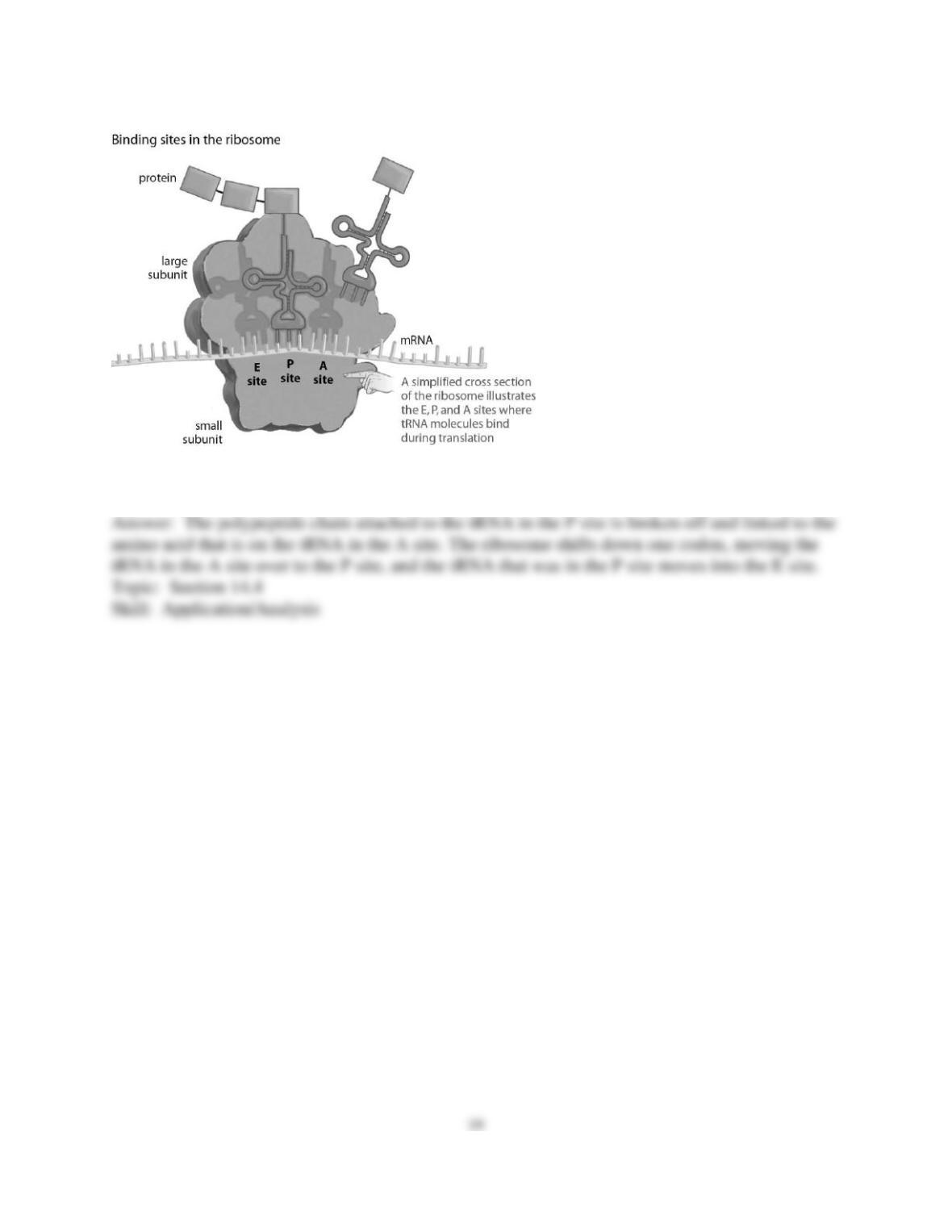
80) During translation, a tRNA with its bound amino acids is in the P site. What processes
happen once a new tRNA is in the A site?
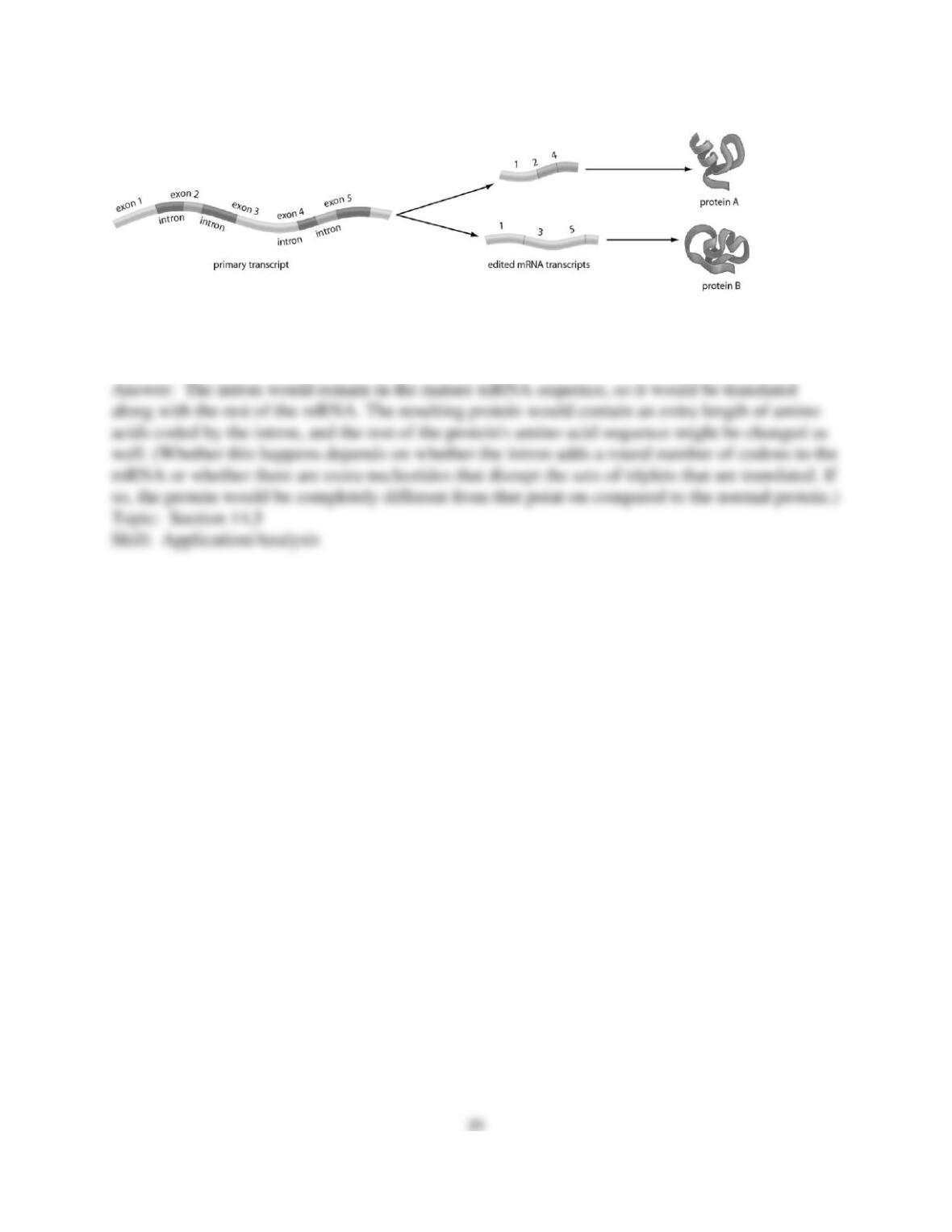
Refer to the figure below, and then answer the question that follows.
81) Primary transcripts are spliced by enzymes that recognize base sequences at the beginnings
and ends of introns. A mutation changes the base sequence in a segment of DNA. If a mutation
changed the base sequence at the beginning of the first intron so that it was no longer recognized
by a splicing enzyme, how would that affect translation?