Chapter 14: Measuring and Assigning Costs for Income Statements
Learning Questions
True /
False
Multiple Choice
Matching
Exercises
Short
Answer
Problems
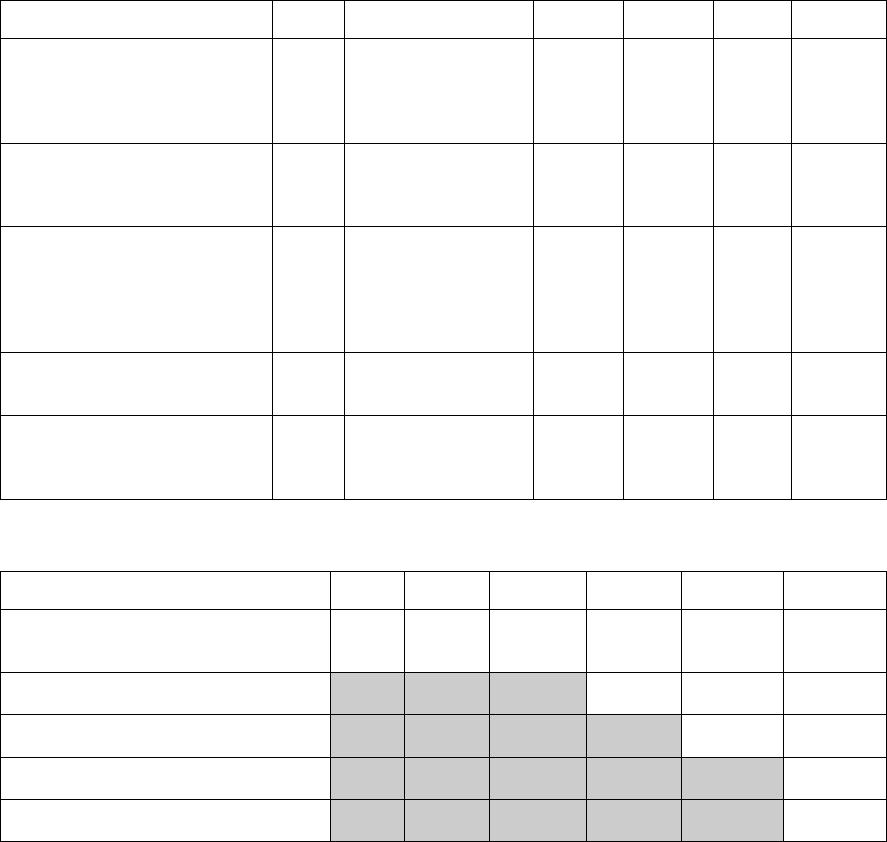
1. How are absorption costing
income statements
constructed?
1-5
1, 3, 12-15, 19, 27, 29,
36, 38, 74-78
S: 82,, 88, 89, 94, 98
W: 105, 106, 116, 121,
123, 124
1, 2
1
5
1, 2, 4, 5,
6
2. What factors affect the
choice of production volume
measures for allocating fixed
overhead?
6-11
32-35, 41-55
S: 90-92, 95, 96, 99,
103, 104
W: 110-114, 120
2
2
2, 6
1, 4, 5
3. How are variable costing
income statements
constructed?
12–17
2, 4-11, 16-18, 20, 26,
28, 30, 31, 37, 39,
40, 73, 79, 80
S: 81, 83, 84, 86, 87,
93, 97
W: 107, 115, 122, 125
1, 2
1, 2, 3
1, 8,
10, 11
1, 2, 3, 5,
6
4. How are throughput costing
income statements
constructed?
18–23
21-23, 56-69
S: 85
W: 109, 117
1, 2
1, 2, 3
1, 12
1, 2
5. What are the uses and
limitations of absorption,
variable and throughput
costing income statements?
24–28
24, 25, 70-72
S: 100-102
W: 108, 118, 119
3, 4, 7,
9
1, 2, 5, 6
S: Questions from the study guide
W: Questions from web quizzes on the student web site
Level of Complexity*
True /
False
Multiple
Choice
Matching
Exercises
Short
Answer
Problems
Foundation: Repeat or paraphrase
information; Reason to single correct
solution; Perform computations; etc.
All
All
All
All
1, 8, 11
All
Step 1: Identify the problem, relevant
information, and uncertainties
2, 3, 5, 6,
7
4, 6
Step 2: Explore interpretations and
connections
4, 9, 10,
12
1, 2, 3, 5,
6
Step 3: Prioritize alternatives and
implement conclusions
Step 4: Envision and direct strategic
innovation
*Based on level in Steps for Better Thinking (Exhibit 1.10, textbook p. 16):
Note: Step 1, 2, 3, and 4 questions in this test bank are intentionally open-ended and subjective, giving students the
opportunity to demonstrate skills such as judgment, reasoning, identification of uncertainties, identification or analysis of
pros and cons, and so on. Therefore, student answers may not exactly match those shown in the solutions.

14-2 Cost Management
True / False
1. Absorption costing statements conform to generally accepted accounting principles.
2. Absorption costing income statements typically include “gross margin” as a line item.
3. In absorption costing systems, costs on the income statement are classified by their behavior.
4. Absorption costing systems subtract inventoried costs from revenues at the time of production.
5. “Cost” and “expense” are two terms for describing the same concept.
6. Theoretical capacity is a supply-based capacity measurement.
7. Theoretical capacity and practical capacity are demand-based capacity measurements.
8. Practical capacity is always less than theoretical capacity.
9. The Internal Revenue Service requires managers to use practical capacity for tax reporting because it
is more stable over time and therefore less easy to manipulate.
10. Normal capacity and budgeted capacity are demand-based capacity measurements.
11. Budgeted capacity is always greater than normal capacity.
12. On a variable costing income statement, costs are grouped according to their behavior.
13. Variable costing income statements include fixed manufacturing overhead as part of the costs of
ending inventory.
14. When units produced are equal to units sold, operating income under absorption costing will equal
operating income under variable costing.
15. Variable costing does not conform to GAAP because it does not match manufacturing costs with
revenues.
16. Synonyms for variable costing include direct costing and marginal costing.
17. Variable costing data can often be used for making nonroutine operating decisions.
18. Throughput costing is a modified form of absorption costing that treats direct labor and variable
overhead as period expenses.
19. Throughput costing was an outgrowth of the Theory of Constraints.
20. In a throughput costing income statement, the throughput contribution is calculated as revenues –
direct materials costs.
21. Throughput costing assumes that product costs other than materials tend to be fixed in the short run.
22. Fixed overhead costs are treated differently under variable costing and throughput costing.
23. Direct materials costs are treated similarly under variable costing and throughput costing.
24. Because absorption costing capitalizes fixed manufacturing overhead costs to inventory, managers
using it may build up inventories unnecessarily.
25. Throughput costing income statements help managers determine the most efficient uses of resources
in the short term.
26. Throughput costing income statements cannot be used to evaluate management performance.
27. Improved information technology has increased the availability of variable costing and throughput
costing income statements.
28. JIT systems are incompatible with absorption costing systems.

Chapter 14: Measuring and Assigning Costs for Income Statements 14-3
Multiple Choice
Use the following information for the next 4 questions.
Shipp, Inc. budgets the following costs for a normal monthly volume of 500 units selling for $4,000 each.
Manufacturing Nonmanufacturing
Variable $800,000 $1,000,000
Fixed 600,000 400,000
1. The product cost per unit using absorption costing is
a. $1,600
b. $2,800
c. $2,000
d. $2,400
2. The product cost per unit using variable costing is
a. $1,600
b. $2,800
c. $2,000
d. $2,400
3. The income (loss) using absorption costing when 500 units are produced and 400 units are sold is
a. $840,000 loss
b. $160,000 income
c. $480,000 income
d. $720,000 loss
4. The income (loss) using variable costing when 500 units are produced and 400 units are sold is
a. $840,000 loss
b. $160,000 income
c. $480,000 income
d. $720,000 loss
Use the following information for the next 3 questions.
Exeter Mfg. Co. introduced a new mass-produced specialty product early in the year. Production and sales of
this product for the first four months are as follows:
Month Units Produced Units Sold
1 800 600
2 1,100 800
3 1,200 1,100
4 1,000 1,400
The firm’s budgeted fixed overhead is $200,000, and budgeted output is 1,000 units per month. The volume
variance, if any, is carried forward month-by-month and closed at the end of the year. When 1,000 units are
produced and sold, expected monthly operating income is $40,000.
5. In which month(s) was variable costing income higher than absorption costing income?
a. 4
b. l, 2, and 3
c. 2 and 3
d. 3 and 4
6. In which month(s) was variable costing income lower than absorption costing income?
a. 4
b. 1, 2, and 3
c. 2 and 3
d. 3 and 4

14-4 Cost Management
7. Compared to using absorption costing, using variable costing will result in operating income for the
4-month period to be
a. Higher
b. Lower
c. Same
d. Cannot be determined
Use the following information for the next 4 questions.
Bella, Inc. has operated for 2 years. During that time it produced 1,000 units in year 1 and 800 in year 2,
while sales were 800 units in year 1 and 900 in year 2. Variable production costs were $8 per unit during both
years. The company uses last-in, first-out (LIFO) for inventory costing. The absorption costing income
statements for these 2 years were:
Year 1 Year 2
Sales $16,000 $18,000
Less cost of goods sold:
Beginning inventory $ 0 $ 2,200
Product costs 11,000 9,400
Ending inventory (2,200) 8,800 (1,175) 10,425
Gross profit 7,200 7,575
Less operating expenses:
Variable 1,200 1,350
Fixed 5,000 6,200 5,000 6,350
Operating income $ 1,000 $ 1,225
8. Cost of goods sold for year 1 using variable costing would be
a. $6,400
b. $8,800
c. $8,000
d. $7,600
9. Operating income for year 1 using variable costing would be
a. $1,600
b. $(2,800)
c. $2,200
d. $400
10. Ending inventory for year 2 using variable costing would be
a. $2,200
b. $1,100
c. $1,175
d. $800
11. Operating income for year 2 using variable costing would be
a. $1,000
b. $1,600
c. $4,000
d. $1,450

Chapter 14: Measuring and Assigning Costs for Income Statements 14-5
Use the following information for the next 4 questions.
Baylor, Inc. just finished its second year of operations. In the first year it produced 1,000 units and sold 400.
The second year resulted in the same production level, but sales were 1,200 units. The variable costing
income statements for both years are shown below:
Year 1 Year 2
Sales $ 40,000 $120,000
Variable cost of goods sold $22,000 $66,000
Variable selling and administration 800 22,800 2,400 68,400
Contribution margin 17,200 51,600
Fixed overhead 30,000 30,000
Fixed selling and administration 15,000 45,000 15,000 45,000
Operating income $(27,800) $ 6,600
12. The product cost per unit during year 1 using absorption would be
a. $67,000
b. $73,000
c. $82,000
d. $85,000
13. The operating income for year 1 using absorption costing would be
a. $6,000
b. $(9,000)
c. $(9,800)
d. $600
14. The ending inventory for year 2 using absorption costing would be
a. $51,000
b. $34,000
c. $22,000
d. $17,000
15. The operating income for year 2 using absorption costing would be
a. $(9,800)
b. $600
c. $(9,000)
d. $6,000
Use the following information for the next 3 questions.
Rubble Enterprises develops an annual overhead budget at the start of each year (which has remained
unchanged for the last 2 years), and closes any over- or underapplied overhead at year-end. For the firm’s
single product the following ending inventory levels have been experienced during the last 7 months:
Month Units
December 31 300
January 31 300
February 28 200
March 31 400
April 30 300
May 31 400
June 30 500
16. For how many months would variable costing income be higher than absorption?
a. 1
b. 2
c. 3
d. 4
14-6 Cost Management
17. In how many months would variable costing income be lower than absorption costing income?
a. 1
b. 2
c. 3
d. 4
18. In how many months would variable costing income be equal to absorption costing income?
a. 0
b. 1
c. 2
d. 3
19. Total production overhead is treated as a product cost when using
a. Absorption costing
b. Throughput costing
c. Variable costing
d. Throughput costing and absorption costing
20. Variable production overhead is allocated to inventory when using
a. Absorption costing and variable costing
b. Absorption costing and throughput costing
c. Variable costing and throughput costing
d. Absorption costing, variable costing, and throughput costing
21. Under which costing method(s) are administrative and selling costs considered period expenses?
I. Absorption costing
II. Throughput costing
III. Variable costing
a. I and II only
b. II and III only
c. I and III only
d. I, II, and III
22. Any costs traced or allocated to inventory are expensed when units are sold in which of the following
costing method(s)
I. Absorption
II. Throughput
III. Variable
a. I and II only
b. II and III only
c. I and III only
d. I, II, and III
23. Direct materials costs are deducted from revenues when units are sold under which of the following
costing method(s)?
I. Absorption
II. Throughput
III. Variable
a. I and II only
b. II and III only
c. I and III only
d. I, II, and III
Chapter 14: Measuring and Assigning Costs for Income Statements 14-7
24. The chief executive officer told Nick, the production manager at BRS Corporation, to reduce costs
and increase profits. In response, Nick decided to produce more units for inventory. BRS is most
likely using
a. Variable costing.
b. Throughput costing.
c. Absorption costing.
d. Capacity-based costing.
25. Which costing method matches costs and revenues most appropriately for generally accepted
accounting principles?
a. Throughput costing
b. Absorption costing
c. Variable costing
d. Activity-based costing
Use the following information for the next 4 questions.
During its first year of operations, Kima Corp. experienced the following:
Units manufactured 70,000
Units sold 60,000
Product costs:
Variable $10.50/unit
Fixed $315,000
Selling and Administrative:
Variable $1.60/unit
Fixed $140,000
26. The amount of variable costs deducted from revenues under the variable costing approach would be
a. $847,000
b. $831,000
c. $726,000
d. $742,000
27. The amount of fixed costs deducted from revenues under the absorption costing approach would be
a. $410,000
b. $455,000
c. $390,000
d. $435,000
28. If Kima calculates operating income under the variable costing method as opposed to the absorption
costing method, operating income will be
a. $45,000 lower
b. $270,000 lower
c. $315,000 higher
d. $270,000 higher
29. The cost of goods sold under absorption costing would be
a. $585,000
b. $735,000
c. $945,000
d. $900,000

14-8 Cost Management
30. Philpott’s operating income using absorption costing is $100. Its inventories using both absorption
and variable costing are as follows:
Beginning of Year End of Year
Absorption costing $98 $86
Variable costing $76 $60
Under variable costing, operating income would be:
a. $102
b. $94
c. $100
d. $96
31. Variable costing income for the period July 1 through September 30 was $400. Inventory data are as
follows:
Absorption Costing Variable Costing
July 1 $1,600 $1,200
September 30 1,900 1,400
What is the income if absorption costing is used?
a. $300
b. $500
c. $400
d. $600
Use the following information for the next 3 questions.
General Mtg. Co. budgeted fixed overhead costs of $25,000 per quarter and 1,000 units per quarter in its
normal absorption costing system. Any volume variance is carried forward and closed at year end. The
company experienced the following activity:
Quarter Units Produced Units Sold
1 900 600
2 1,200 1,000
3 1,400 1,200
4 1,000 1,500
32. The volume variance was favorable in quarter(s)?
a. 2, 3, and 4
b. 2 and 3
c. 3 and 4
d. 3
33. The volume variance in quarter 1 was
a. $2,500 Unfavorable
b. $10,000 Unfavorable
c. $7,500 Favorable
d. $5,000 Favorable
34. The volume variance for the year was
a. -0-
b. Favorable
c. Unfavorable
d. Cannot be determined

Chapter 14: Measuring and Assigning Costs for Income Statements 14-9
35. Exter Manufacturing experienced the following activity over the last four years.
Year Units Produced Units Sold
1 800 600
2 1,100 800
3 1,200 1,100
4 1,000 1,400
The firm’s estimated fixed overhead allocation rate was unchanged over the 4 years at $200 per unit,
based on budgeted fixed overhead of $200,000 and 1,000 units of output. The volume variance is
closed to the cost of goods sold each year. Exter maintains an absorption costing system.
The volume variance for Year 2 is
a. $40,000 Unfavorable
b. $60,000 Favorable
c. $100,000 Unfavorable
d. $20,000 Favorable
36. Under generally accepted accounting principles, absorption costing is used for
Job Costing Process Costing
a. Yes Yes
b. No No
c. No Yes
d. Yes No
37. In variable costing
a. Only variable production costs are considered product costs
b. All non-variable production costs are treated as product costs
c. Direct costs are considered to be period costs
d. All variable costs are considered product costs
38. Absorption costing
a. Is used for external reporting purposes
b. Includes variable and fixed period costs in inventory
c. Is the method in which the fixed overhead cost is not included in inventory
d. Treats production costs as expenses in the period in which they are incurred
39. Under the variable costing method, fixed production overhead is
a. Included in inventory
b. Expensed in the period incurred
c. Expensed as a product cost
d. Expensed when the inventory is sold
40. Absorption costing will produce a larger operating income than variable costing if
a. Fixed production overhead increases
b. Fixed production overhead decreases
c. Units produced exceed units sold
d. Units sold exceed units produced
41. When calculating an estimated fixed production cost overhead allocation rate, accountants choose the
a. Allocation base to use as the denominator
b. Allocation base to use as the numerator
c. Allocation base to use as the rate
d. Allocation base that minimizes total fixed production overhead
14-10 Cost Management
44. Supply-based capacity levels include
I. Normal capacity
II. Practical capacity
III. Theoretical capacity
a. I and II only
b. I and III only
c. II and III only
d. I, II, and III
45. The capacity level which assumes continuous, uninterrupted production 365 days per year is called
a. Budgeted capacity
b. Normal capacity
c. Practical capacity
d. Theoretical capacity
47. What type of capacity is the upper capacity limit that takes into account the organization’s regularly
scheduled times for production?
a. Tax capacity
b. Practical capacity
c. Scheduled capacity
d. Normal capacity
48. Practical capacity is estimated based on
a. Engineering studies and labor use patterns
b. The behavior of fixed costs
c. The behavior of variable costs
d. Demand patterns
49. For income tax accounting, the Internal Revenue Service requires the use of
a. Normal capacity
b. Budgeted capacity
c. Theoretical capacity
d. Practical capacity
50. The difference between practical capacity and theoretical capacity is
a. Budgeted fixed costs
b. Expected downtimes
c. Excess capacity
d. Nothing, because the two terms have the same meaning
51. Which of the following are demand-based capacity levels?
I. Normal capacity
II. Budgeted capacity
III. Practical capacity
a. I and II only
b. II and III only
c. I and III only
d. I, II, and III
52. The volume variance is calculated as
a. Difference between estimated fixed overhead costs and allocated fixed overhead costs
b. Sum of estimated fixed overhead costs and allocated fixed overhead costs
c. Difference between estimated fixed overhead costs and actual fixed overhead costs
d. Difference between actual fixed overhead costs and allocated fixed overhead costs
Chapter 14: Measuring and Assigning Costs for Income Statements 14-11
53. Volume variances are calculated for which of the following reasons?
I. GAAP requires that actual costs be recorded in the income statement and balance sheet.
II. Estimates are used for allocation rates so that costs can be allocated when actual costs are
not yet known.
III. Only the IRS requires volume variances in the calculation of income taxes.
a. I only
b. II only
c. I and II only
d. I, II, and III
54. An estimated fixed overhead allocation rate
a. Is unrealistically large if determined using theoretical capacity
b. Can be considered an estimated cost of capacity per unit
c. Is usually based on theoretical capacity
d. Does not provide information about opportunity costs of unused capacity
55. Which of the following types of capacity can result in an unrealistically small fixed overhead
allocation rate if used as an allocation base?
a. Normal capacity
b. Theoretical capacity
c. Budgeted capacity
d. Practical capacity
56. Throughput costing is a modified form of
a. Variable costing
b. Full costing
c. Absorption costing
d. Job costing
57. In throughput costing, direct labor and variable overhead are treated as
a. Measures of capacity
b. Fixed costs
c. Period costs
d. Product costs
58. Throughput costing was developed in the 1980s as part of
a. The theory of constraints
b. Zero-based budgeting
c. Activity-based costing
d. Variable costing income statements
59. Which of the following are considered product costs in a throughput costing income statement?
I. Direct materials
II. Direct labor
III. Variable overhead
a. I and II only
b. I only
c. II and III only
d. I, II, and III
60. Under throughput costing, inventory is valued using
a. Direct materials costs only
b. Prime costs only
c. Variable costs only
d. Conversion costs only
14-12 Cost Management
61. Throughput contribution is computed as
a. Sales – variable costs
b. Sales – cost of direct materials purchased
c. Number of units sold × (price per unit – material cost per unit)
d. Sales – period costs
62. In a throughput costing system, all overhead costs are treated as
I. Period costs
II. Fixed costs
III. Deductions from throughput contribution
a. I and II only
b. II and III only
c. I and III only
d. I, II, and III
Use the following information for the next 7 questions.
PFA Corporation uses a throughput costing system and reported the following information for its first month
of operations:
Units produced 140
Units sold 120
Material cost per unit produced $3.50
Conversion cost per unit produced $6.50
Fixed period costs per unit produced $6.00
Variable period costs per unit produced $4.00
Selling price per unit $25.00
63. PFA’s total throughput product cost incurred was
a. $490
b. $1,400
c. $420
d. $1,200
64. PFA’s throughput cost of goods sold was
a. $420
b. $490
c. $1,200
d. $1,400
65. PFA’s throughput ending inventory was
a. $70
b. $200
c. $0
d. $490
66. PFA’s throughput contribution was
a. $3,000
b. $3,500
c. $2,580
d. $1,800
67. Total period costs reported on PFA’s throughput costing income statement were
a. $1,400
b. $1,200
c. $2,310
d. $1,980

Chapter 14: Measuring and Assigning Costs for Income Statements 14-13
68. Under which of the following costing methods would PFA report the highest operating income?
a. Absorption costing
b. Variable costing
c. Throughput costing
d. Income will be equal under all three methods
69. PFA’s throughput costing operating income will be
a. $270
b. $600
c. $400
d. None of the above
70. Throughput costing can be used for
I. Internal reporting
II. External reporting
III. Income tax reporting
a. I only
b. II only
c. III only
d. I, II, and III
71. Which costing method(s) conform with GAAP?
Absorption Variable Throughput
a. Yes No No
b. Yes No Yes
c. No Yes Yes
d. No No Yes
72. Which of the following correctly identifies the best use for each costing method?
E. External reporting
P. Performance evaluations
S. Short-term capacity decisions
Absorption Variable Throughput
a. P S E
b. S E P
c. E P S
d. E S P
73. Direct material and direct labor costs are assigned to inventory when using
I. Absorption costing
II. Throughput costing
III. Variable costing
a. I and III only
b. I and II only
c. II and III only
d. I, II, and III

14-14 Cost Management
More Difficult Multiple Choice
These multiple choice questions require more complex computations or present information differently than
in the textbook.
Use the following information for the next 7 questions.
Brady, Inc. uses a normal absorption costing system in which the overhead rate and variable manufacturing
costs have remained unchanged for the last 2 years. During the current year the following activity occurred:
Denominator volume 25,000 units
Unit sales 20,000 units
Cost of goods sold $170,000
Volume variance $5,040 Unfavorable
Operating income after adjusting for
the volume variance $40,000
Budgeted fixed overhead $90,000
The firm had no beginning or ending work in process inventories. However, there were 1,000 units in
beginning finished goods.
74. The fixed overhead in cost of goods sold amounted to
a. $90,000
b. $66,960
c. $72,000
d. $84,960
75. The variable product cost per unit was
a. $4.90
b. $5.15
c. $4.00
d. $4.25
76. The number of units produced was
a. 26,400
b. 25,000
c. 20,000
d. 23,600
77. The number of units in ending finished goods inventory was
a. 7,400
b. 6,000
c. 1,000
d. 4,600
78. The sales revenue for the year was
a. $210,000
b. $215,040
c. $260,000
d. $204,960
79. If variable costing had been used, operating income would be
a. $27,040
b. $56,560
c. $52,960
d. $45,040

Chapter 14: Measuring and Assigning Costs for Income Statements 14-15
80. If variable costing had been used, the cost of goods sold would be:
a. $133,280
b. $93,100
c. $98,000
d. $111,720
Multiple Choice from Study Guide
s81. Variable costing will produce a larger operating income than absorption costing if
a. Fixed overhead decreases
b. Production exceeds sales
c. Fixed overhead increases
d. Sales exceed production
s82. Under absorption costing, fixed overhead is
a. Not a product cost
b. Expensed in the period incurred
c. Expensed when the inventory is sold
d. A period cost
s83. When reconciling from variable costing income to absorption costing income, if production exceeded
sales and LIFO is used, then the
a. Fixed overhead in the beginning inventory is added
b. Fixed overhead in the beginning inventory is deducted
c. Fixed overhead in the ending inventory is added
d. Fixed overhead in the ending inventory is ignored
s84. Musa Company’s inventory balances for the beginning and ending of 2004, using both variable
costing and absorption costing, are shown below:
12/31/04 1/1/04
Variable costing $1,200 $1,200
Absorption costing 1,420 1,260
Variable costing income for 2004 was $3,460. Musa uses LIFO. If absorption costing had been used,
income for 2004 would be
a. $3,420
b. $3,620
c. $3,500
d. $3,660
s85. Which inventory costing method treats direct materials as a product cost?
a. Absorption costing
b. Variable costing
c. Throughput costing
d. All of the above
s86. Which inventory costing method treats direct labor as a product cost?
a. Absorption costing
b. Variable costing
c. Throughput costing
d. Both (a) and (b)

14-16 Cost Management
s87. Which inventory costing method treats variable overhead as a product cost?
a. Absorption costing
b. Variable costing
c. Throughput costing
d. Both (a) and (b)
s88. Which inventory costing method treats fixed overhead as a product cost?
a. Absorption costing
b. Variable costing
c. Throughput costing
d. None of the above
s89. Which inventory costing method treats variable selling costs as product costs?
a. Absorption costing
b. Variable costing
c. Throughput costing
d. None of the above
Use the following information for the next 3 questions.
Whidby Corporation has budgeted overhead as $100,000 plus $5 per unit for the current year. The
denominator capacity is 40,000 units per year. Any volume variance is carried forward quarter by quarter and
closed at year-end. The company experienced the following activity during the year:
Quarter Units Produced Units Sold
First 10,000 8,000
Second 9,000 9,000
Third 9,000 10,000
Fourth 8,000 6,000
s90. The volume variance for the first quarter was
a. $0
b. $5,000 unfavorable
c. $15,000 unfavorable
d. $10,000 favorable
s91. The volume variance was unfavorable in quarters
a. 1 and 4
b. 3
c. 1 and 3
d. 2, 3, and 4
s92. The volume variance for the year was
a. $17,500 unfavorable
b. $7,500 favorable
c. $10,000 unfavorable
d. $12,500 favorable
Use the following information for the next 4 questions.
Orca, Inc experienced the following activity and costs during its first three years of operations:
Variable Total Fixed Selling
Units Production Production Price
Year Produced Units Sold Cost per Unit Costs Per Unit
2003 22,000 18,000 $2.00 $49,500 $10
2004 20,000 19,000 2.25 49,500 10
2005 18,000 18,000 2.50 49,500 10
Chapter 14: Measuring and Assigning Costs for Income Statements 14-17
s93. Operating income for 2003 using variable costing was
a. $94,500
b. $103,500
c. $86,500
d. $126,500
s94. Assuming Orca uses actual costing, operating income for 2003 using absorption costing was
a. $94,500
b. $103,500
c. $86,500
d. $126,500
s95. Assuming a denominator level of 20,000 units and that Orca closes any volume variance to cost of
goods sold, operating income for 2003 using absorption costing was
a. $103,500
b. $104,400
c. $99,450
d. $94,500
s96. Assume a denominator level of 20,000 units and that Orca uses LIFO and closes any volume variance
to cost of goods sold. Operating income for 2005 using absorption costing was
a. $103,500
b. $104,400
c. $95,400
d. $85,500
s97. Which of the following statements about the contribution margin format of the income statements is
false?
a. Gross margin is not calculated
b. The amount of fixed production costs is clearly displayed
c. Variable non-manufacturing costs are deducted as product costs
d. Manufacturing and non-manufacturing costs are segregated
s98. Which of the following statements about the traditional format of the income statements is true?
a. Contribution margin is clearly displayed
b. Only manufacturing costs are deducted from sales to arrive at gross margin
c. Fixed costs and variable costs are segregated
d. The traditional format is used with variable, but not throughput, costing
s99. A favorable volume variance occurs when the
a. Denominator level exceeds the number of units produced
b. Number of units produced exceeds the number of units sold
c. Number of units sold exceeds the denominator level
d. Number of units produced exceeds the denominator level
s100. When managers are compensated based on income levels, they may have an incentive to overproduce
inventory units if income is computed using
a. Throughput costing
b. Variable costing
c. Absorption costing
d. Managers have an incentive to overproduce under all 3 methods
s101. Some companies use throughput costing for internal purposes because
a. They believe only direct materials costs are truly variable in the short run
b. They believe direct labor costs are fixed in the short run
c. They believe all overhead costs are fixed in the short run
d. All of the above

14-18 Cost Management
s102. When production exceeds sales and costs from year to year have been stable, which method will
compute the highest operating income?
a. Throughput costing
b. Variable costing
c. Absorption costing
d. Activity-based costing
s103. The fixed manufacturing overhead rate will be the lowest when the denominator level used is
a. Theoretical capacity
b. Practical capacity
c. Normal capacity
d. Budgeted capacity
s104. A company using absorption costing had an unfavorable volume variance. Which of the following
statements is true?
a. Budgeted fixed overhead costs were less than actual
b. Allocated fixed overhead costs were greater than were budgeted
c. Income will be higher when the volume variance is charged to cost of goods sold than if it is
allocated to cost of goods sold, finished goods, and work in process
d. The unfavorable volume variance reduces reported income
Multiple Choice from Web Quizzes (Available on Student Web Site)
w105. The following income statements are produced according to generally accepted accounting principles
a. Variable costing
b. Absorption costing
c. Throughput costing
d. Standard costing
w106. Absorption costing income statements
a. Assign only direct material and direct labor costs to inventory
b. Allocate fixed production costs to inventory
c. Treat selling and administrative costs as product costs
d. Treat costs in a similar manner to variable costing income statements
w107. Variable costing income statements
a. Assign direct material and direct labor costs to inventory
b. Allocate fixed production costs to inventory
c. Treat variable selling costs as period costs
d. Assign only direct material costs to inventory
w108. Under absorption costing, production overhead is allocated to inventory so that
a. Expenses are matched to revenues
b. Inventory costs can be used in decision making
c. All product-related and period-related costs will be absorbed into inventory cost on the income
statement and balance sheet
d. Product costs consist solely of variable costs
w109. Throughput costing income statements
a. Are useful for long-term decision making
b. Help managers plan for the short term
c. Meet the requirements of generally accepted accounting principles
d. Treat fixed costs as product costs
Chapter 14: Measuring and Assigning Costs for Income Statements 14-19
w110. Fixed overhead volume variances arise because
a. Budgeted overhead and actual overhead are usually identical
b. An estimate of production volume is used for the denominator in calculating the fixed overhead
allocation rate
c. The actual amount of direct materials is not identical to the budgeted level
d. The actual amount of fixed overhead costs in not identical to the budgeted level
w111. A fixed overhead volume variance
a. Is prorated to Work in process, Finished Goods, and Cost of Goods Sold if it is a material amount
b. Is always closed only to Cost of Goods Sold, even if it is a material amount
c. Occurs when actual selling and administrative costs are different than allocated selling and
administrative costs
d. Occurs when actual fixed overhead costs are not identical to budgeted overhead costs
w112. Normal capacity reflects
a. Actual capacity levels
b. The capacity level with no reduction for holidays or other down time
c. The estimate of average capacity over time
d. The capacity level taking into account holidays and other down time
w113. Practical capacity reflects
a. Actual capacity levels
b. The capacity level with no reduction for holidays or other down time
c. The estimate of average capacity over time
d. The capacity level taking into account holidays and other down time
w114. Theoretical capacity reflects
a. Actual capacity levels
b. The capacity level with no reduction for holidays or other down time
c. The estimate of average capacity over time
d. The capacity level taking into account holidays and other down time
w115. Inventory cost under variable costing includes
a. Only direct materials costs
b. Only variable production costs
c. Variable and fixed production costs
d. All of the costs of the organization
w116. Inventory cost under absorption costing includes
a. Only direct materials costs
b. Only variable production costs
c. Variable and fixed production costs
d. All of the costs of the organization
w117. Inventory cost under throughput costing includes
a. Only direct materials costs
b. All variable production costs
c. Variable and fixed production costs
d. All of the costs of the organization
w118. Absorption costing income statements are produced for
a. External decision makers
b. Internal decision makers
c. Cost-volume-profit analysis
d. Only for top management
14-20 Cost Management
w119. Variable costing income statements are produced for
a. External decision makers
b. Internal decision makers
c. The Internal Revenue Service
d. Only for top management
w120. (CMA) Practical capacity as a plant capacity concept
a. Assumes all personnel and equipment will operate at peak efficiency and total plant capacity will
be utilized
b. Does not consider idle time caused by inadequate sales demand
c. Includes consideration of idle time caused by both limited sales orders and human and equipment
inefficiencies
d. Is the production volume that is necessary to meet sales demand for the next year
w121. (CMA) Which method of inventory costing treats direct manufacturing costs and manufacturing
overhead costs, both variable and fixed, as inventoriable costs?
a. Direct costing
b. Variable costing
c. Absorption costing
d. Conversion costing.
Use the following information to answer the next 4 questions.
For the month ended October 31st, there are no finished goods or work in process inventories at the beginning
of the month for the Fleetfoot Company.
Net sales $8,400
Product costs:
Variable 3,780
Fixed 1,890
Selling and Administrative costs:
Variable 588
Fixed 840
Units manufactured 210
Units sold 180
w122. What is the value of ending inventory under variable costing?
a. $540
b. $624
c. $810
d. $1,014
w123. What would Fleetfoot’s finished goods inventory cost be at December 31st under the absorption
costing method?
a. $540
b. $624
c. $810
d. $1,014
w124. Under absorption costing, Fleetfoot’s operating income for the year is
a. $2,112
b. $1,842
c. $1,014
d. $2,002

Chapter 14: Measuring and Assigning Costs for Income Statements 14-21
w125. Under variable costing, Fleetfoot’s operating income for the year is
a. $2,112
b. $1,842
c. $1,014
d. $2,002
Matching
1. In MTC Corporation’s first month of operations, the company produced 500 units and sold 400 units.
Its accounting information system reported the following information related to those units:
Direct materials cost per unit produced $7.00
Direct labor cost per unit produced $6.00
Variable overhead cost per unit produced $8.00
Total fixed overhead cost incurred $2,000
Variable selling and administrative costs per unit sold $3.00
Fixed selling and administrative costs per unit sold $2.00
Selling price per unit $50.00
Match the lettered items on the right with the appropriate item on the left. Each numbered item may
have more than one correct answer. Each lettered item may be used once, more than once, or not at
all.
____ 1. Cost of ending inventory under absorption
costing
____ 2. Cost subtracted from revenue under throughput
costing
____ 3. Total contribution margin under variable costing
____ 4. Throughput contribution
____ 5. Ending inventory under throughput costing
____ 6. Method that conforms with generally accepted
accounting principles
____ 7. Method in which inventory costs are not
expensed until units are sold
____ 8. Operating income reported under variable
costing
____ 9. Method that reports the lowest operating income
this period
____ 10. Method that reports the highest operating
income this period
A. Absorption costing
B. Variable costing
C. Throughput costing
D. $2,500
E. $2,800
F. $3,500
G. $17,200
H. $10,400
I. $700
J. $7,600

14-22 Cost Management
2. Match each term or concept on the left with the definition or explanation on the right. Each
numbered item has only one correct answer, and each lettered item may be used only once.
____ 1. Absorption costing
____ 2. Denominator
motivation for normal
costing
____ 3. Variable costing
____ 4. Expected capacity
____ 5. Information timeliness
motivation for normal
costing
____ 6. Numerator motivation
for normal costing
____ 7. Practical capacity
____ 8. Theoretical capacity
____ 9. Throughput costing
____ 10. Volume variance
A. Upper limit takes into account Regular
production schedules
B. Modified form of variable costing that treats
direct labor as a period expense
C. Maximum volume of goods an organization
can hypothetically produce
D. Includes contribution margin on the income
statement
E. Fixed production overhead costs vary over
time
F. Conforms to generally accepted accounting
principles
G. Closed to cost of goods sold if immaterial
H. Also known as budgeted capacity
I. Actual production volumes fluctuate
J. Actual fixed overhead costs are not known
during the period
Exercises
1. During a recent period, Pickeral Company produced 15,000 units and sold 10,000 at $15 each. The
company had no beginning inventory. During this period Pickeral incurred the following costs:
Direct materials $60,000
Direct labor 30,000
Fixed overhead 22,500
Variable overhead 15,000
Fixed selling & administrative 30,000
Variable selling & administrative 11,250
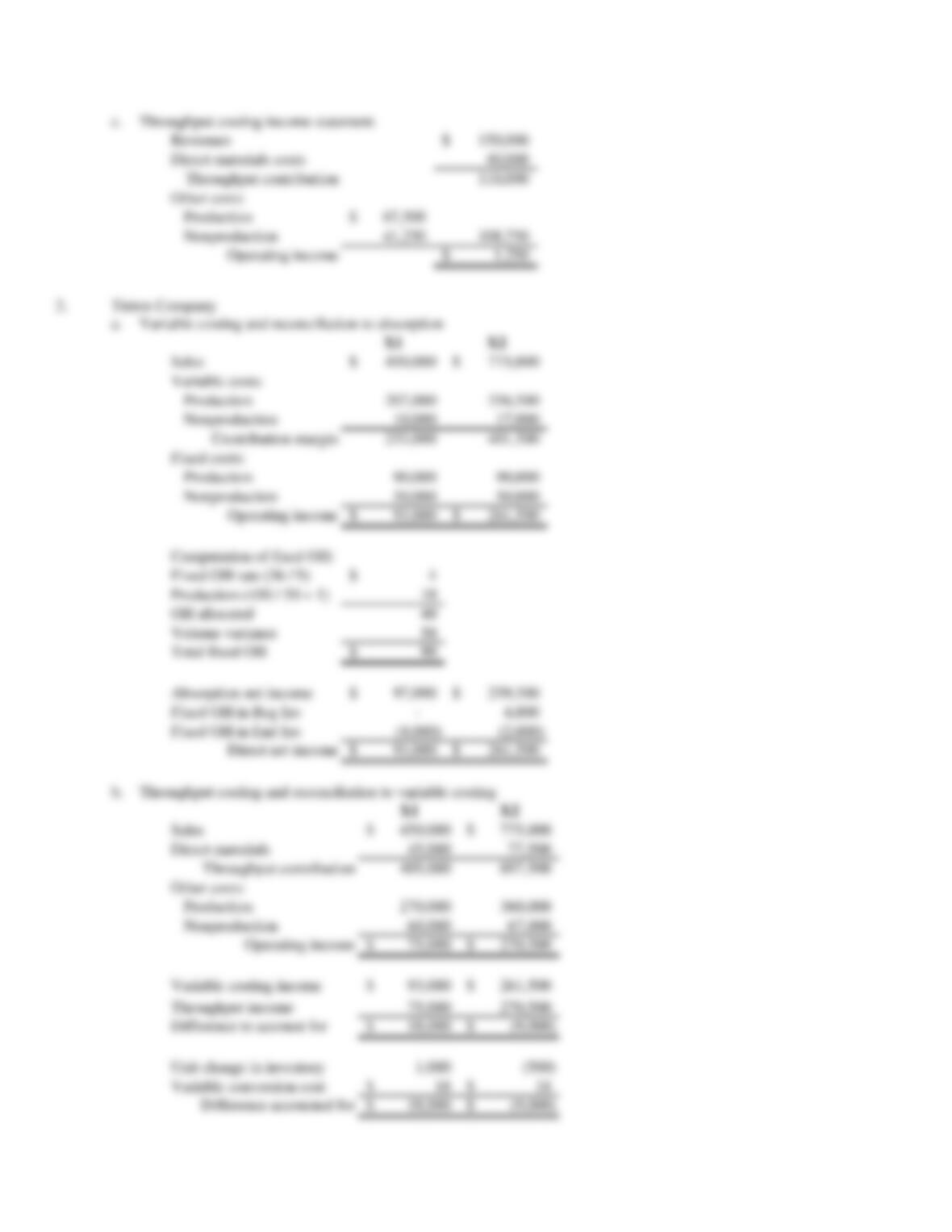
a. Prepare an income statement using absorption costing.
b. Prepare an income statement using variable costing.
c. Prepare an income statement using throughput costing.

Chapter 14: Measuring and Assigning Costs for Income Statements 14-23
2. The Tieton Company uses absorption costing for external reporting purposes. During the last 2 years
the per-unit production costs have remained constant. The volume variance is closed to cost of goods
sold at the end of each year. During Year 1, production exceeded sales by 1,000 units. The income
statements follow:
Year 1 Year 2
Sales ($50 per unit) $450,000 $775,000
Cost of goods sold:
Direct materials 45,000 77,500
Direct labor 90,000 155,000
Variable overhead 72,000 124,000
Fixed overhead 36,000 62,000
Volume variance adjustment 50,000 30,000
Total cost of goods sold 293,000 448,500
Gross margin 157,000 326,500
Selling and Administration:
Variable 10,000 17,000
Fixed 50,000 50,000
Total selling and administration 60,000 67,000
Operating income $ 97,000 $259,500
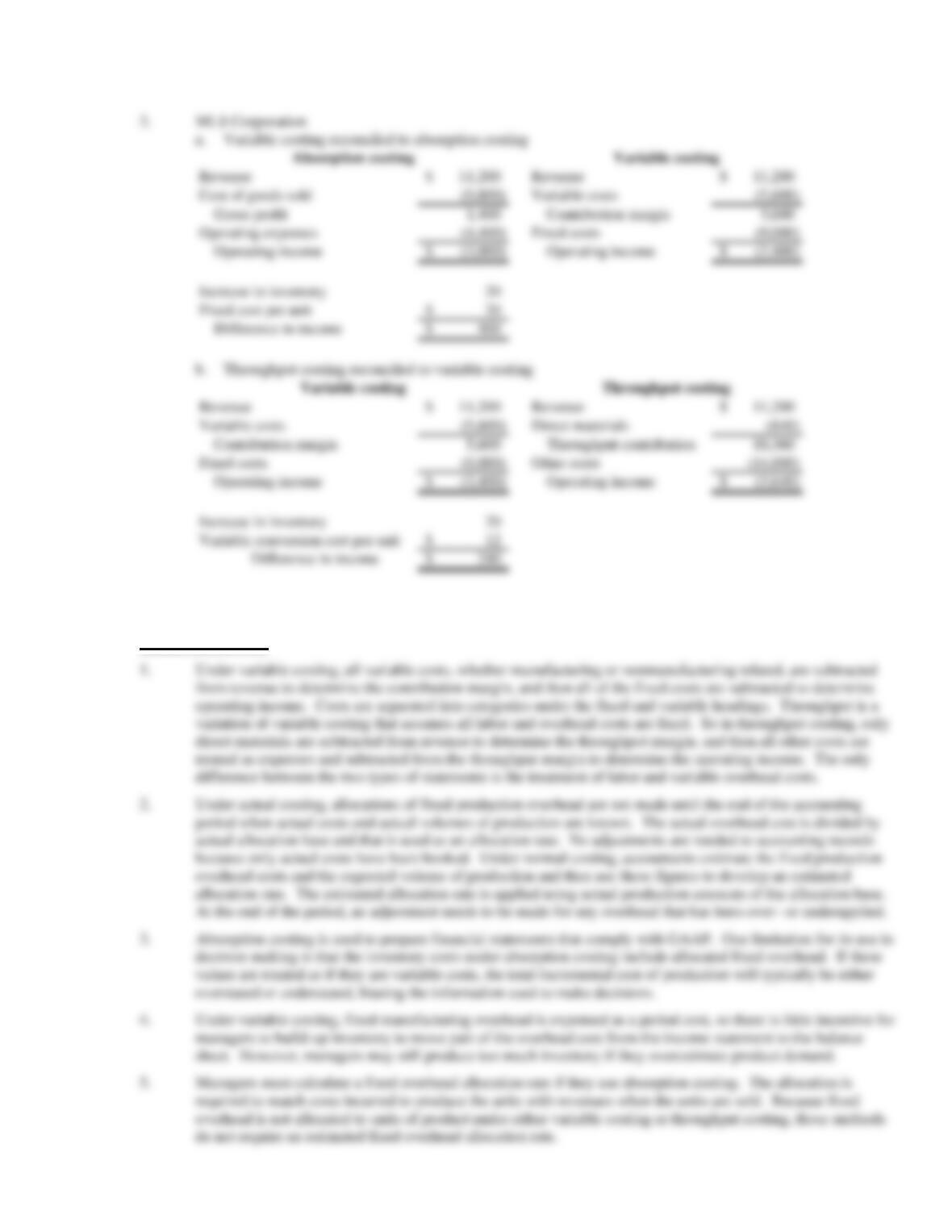
a. Prepare the income statements using variable costing, and reconcile them with the absorption
statements.
b. Prepare the income statements using throughput costing, and reconcile them to the variable
statements prepared in part (a).
3. During its second month of operations, MLS Corporation produced 300 units and sold 280 units at
$40 each. The beginning inventory comprised 50 units, and costs were unchanged from the previous
month. MLS uses a LIFO cost flow assumption to account for inventory. Costs incurred during the
second month were:
Direct materials per unit produced $3
Direct labor per unit produced $5
Variable overhead per unit produced $7
Variable selling and administrative cost per unit sold $5
Total fixed production overhead $6,000
Total fixed selling and administrative costs $3,000
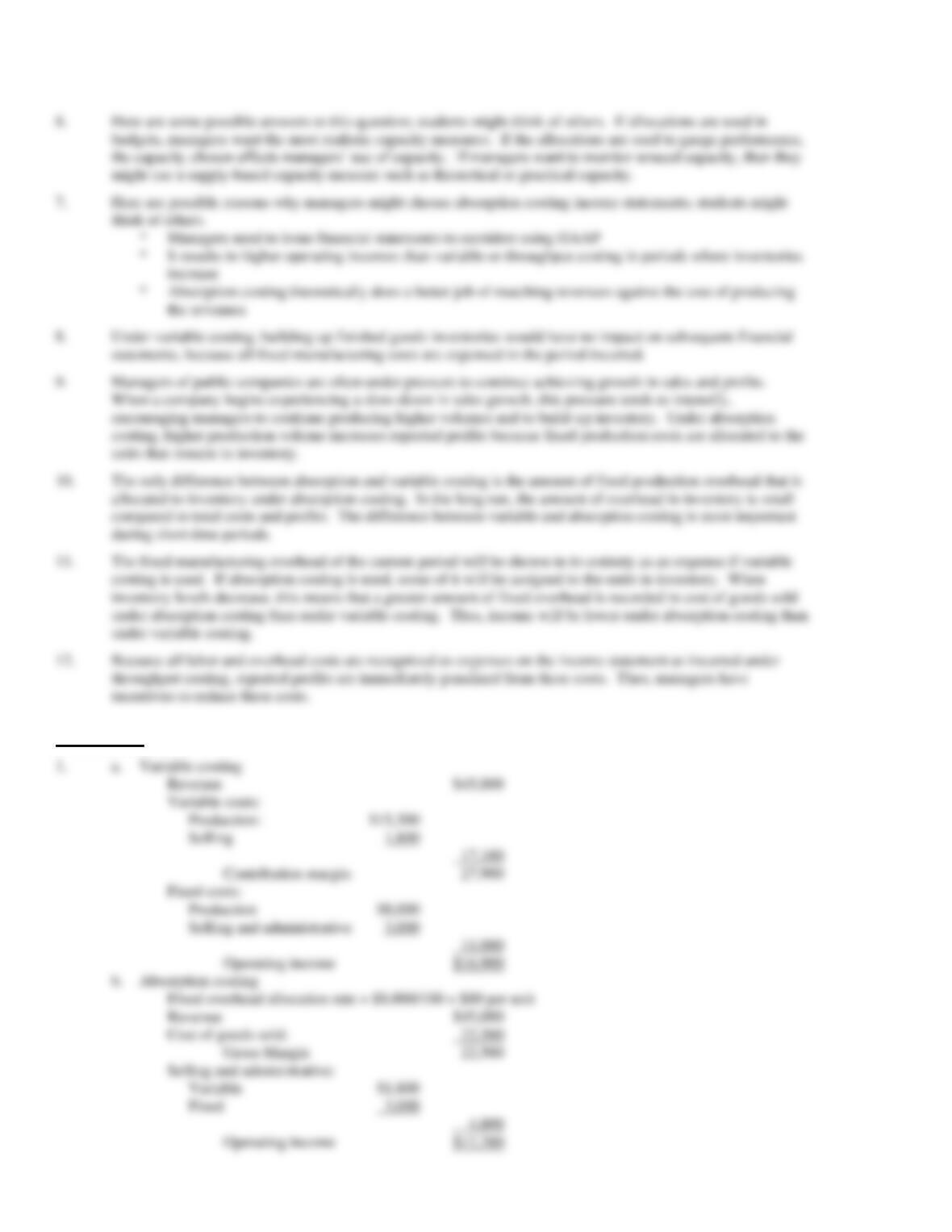
a. Reconcile MLS’ income based on absorption costing and variable costing.
b. Reconcile MLS’ income based on variable costing and throughput costing.
Short Answer
1. Distinguish between variable costing and throughput costing.
2. Compare and contrast actual costing and normal costing.
3. Describe one reason to use absorption costing and explain one limitation for its use in decision
making.
4. Can the use of variable costing eliminate the buildup of ending finished goods inventories that often
occurs under absorption costing? Why, or why not?
5. For which of the following costing method(s) would managers calculate a fixed overhead allocation
rate? Absorption costing, variable costing, and throughput costing. Explain why this is required.
14-24 Cost Management
6. List and discuss one factor that could influence managers’ choice of capacity measures for allocations
of fixed production overhead under absorption costing.
7. Identify two possible reasons why managers might choose absorption costing to prepare income
statements.
8. If variable costing is used, what would be the effects of building up the current year’s ending finished
goods inventories on the following year’s balance sheet and income statement?
9. Zeta Manufacturing is a public company that issues financial statements using generally accepted
accounting principles. The company has begun experiencing a slowdown in sales growth. Explain
why the managers of Zeta have an incentive to build up unnecessarily high levels of finished goods
inventories.
10. In the long run, there is little difference between absorption and variable costing. Explain what this
means.
11. If inventory physically decreases during the period, income under absorption costing will usually be
lower than income using variable costing. Explain.
12. Throughput costing encourages managers to reduce labor and overhead costs. Explain.
Problems
1. Finish-It-Yourself Furniture Company manufactures replicas of antique oak filing cabinets.
Additional information is as follows:
Price $500 per filing cabinet
Variable production cost $170 per filing cabinet
Fixed production costs $8,000 per month
Variable selling and administration $20 per filing cabinet
Fixed selling and administration $3,000 per month
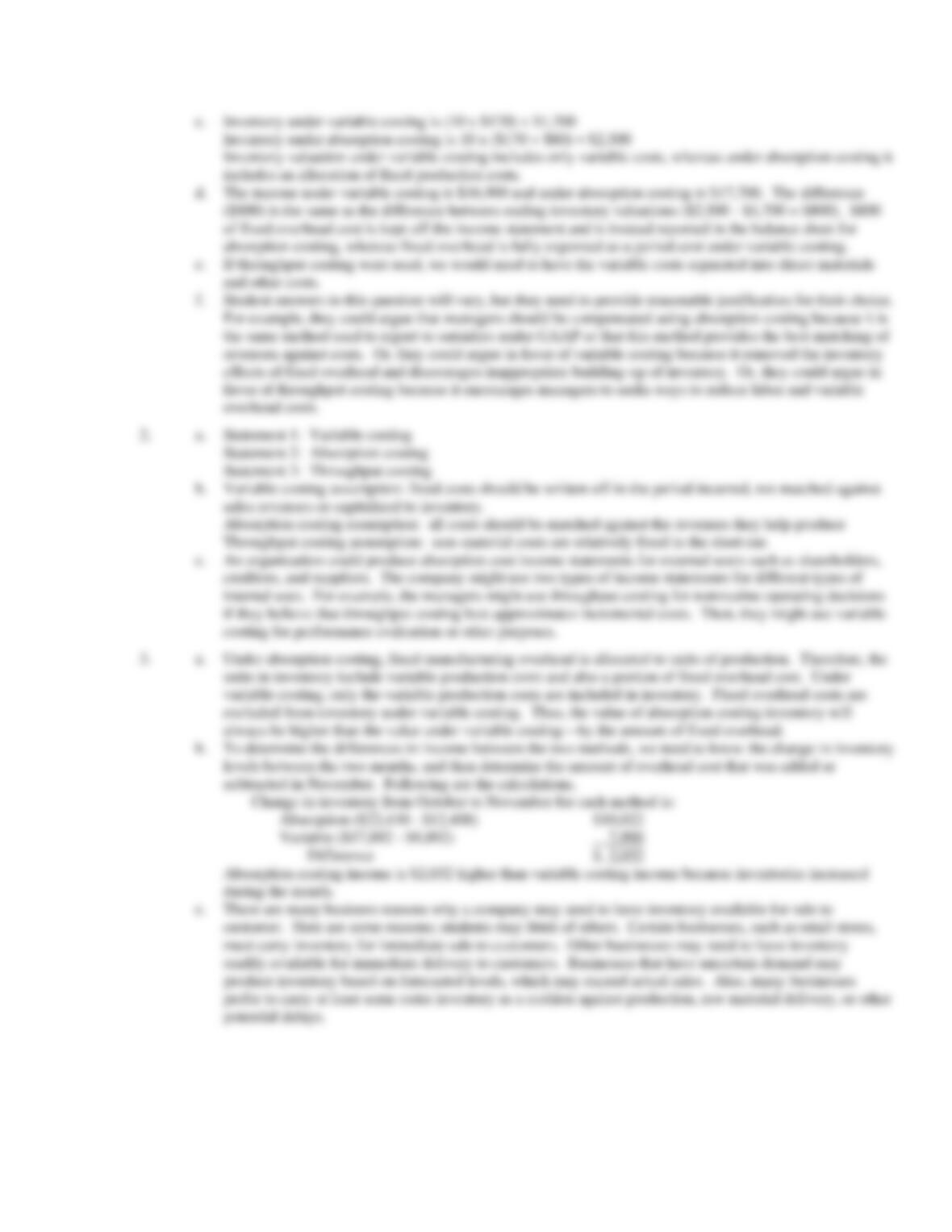
a. Estimate operating income for a month in which 100 filing cabinets are manufactured and 90 are
sold, if the firm uses variable costing. Assume no beginning inventory. Use the proper variable
costing income statement format.
b. Estimate operating income for a month in which 100 filing cabinets are manufactured and 90 are
sold, if the firm uses absorption costing and actual costing. Assume no beginning inventory. Use
the proper absorption costing income statement format.
c. What is the cost assigned to ending inventory under each of the above costing methods? Explain
the differences between the two ending inventory valuations (do not perform a computation for
this answer).
d. Reconcile the operating incomes between variable costing and absorption costing.
e. What additional information would be needed to calculate throughput costing operating income?
f. If the manager of Finish-It-Yourself Furniture Company is given a bonus based on income, which
type of costing income statement would you recommend for evaluating manager performance?
Justify your choice.
2. Consider the following income statements for Nero Company:
Revenue 1,800$ Revenue 1,400$ Revenue 2,000$
Direct costs (300) Cost of goods sold (200) Direct materials costs (800)
Contribution margin 1,500 Gross margin 1,200 Throughput contribution 1,200
Fixed costs (500) Nonproduction costs (300) Other costs (400)
Operating income 1,000$ Operating income 900$ Operating income 800$
Income Statement #3
Income Statement #1
Income Statement #2

Chapter 14: Measuring and Assigning Costs for Income Statements 14-25
a. Identify which income statement is prepared using each of the following costing methods:
absorption costing, variable costing, and throughput costing.
b. For each costing method, identify one assumption associated with its use.
c. Explain why Nero Company might produce all three types of income statements for the same
time period.
3. Sparkle Toy Manufacturer uses absorption costing for its external reports and variable costing for its
internal reports. The LIFO cost flow is used for both costing methods. Data concerning the firm’s
inventories appear below:
September October November
Absorption cost $10,436 $12,408 $22,430
Variable cost 8,320 9,892 17,882
a. Why is the value of inventory lower under variable costing than under absorption costing? Will
this always be the case?
b. What is the relationship between absorption cost and variable cost operating income in
November? Determine whether variable costing or absorption costing will show the higher
operating income in November, and calculate the amount by which the operating incomes would
differ.
c. If the company were to carry no finished goods inventories, then operating income would be the
same under absorption and variable costing. Provide a business reason why companies typically
do not carry zero finished goods inventories.
4. Glorious Gift Baskets began last year with no inventories. During the year 21,000 baskets were
produced, of which 18,800 were sold. Data concerning last year’s operations appear below:
Revenue $94,000
Variable direct production costs 42,000
Variable production overhead 15,750
Variable selling and administrative costs 1,880
Fixed production overhead 17,850
Fixed selling and administrative costs 16,320
Variable manufacturing costs are variable with respect to the number of units manufactured. Variable
selling and administration costs are variable with respect to the number of units sold.
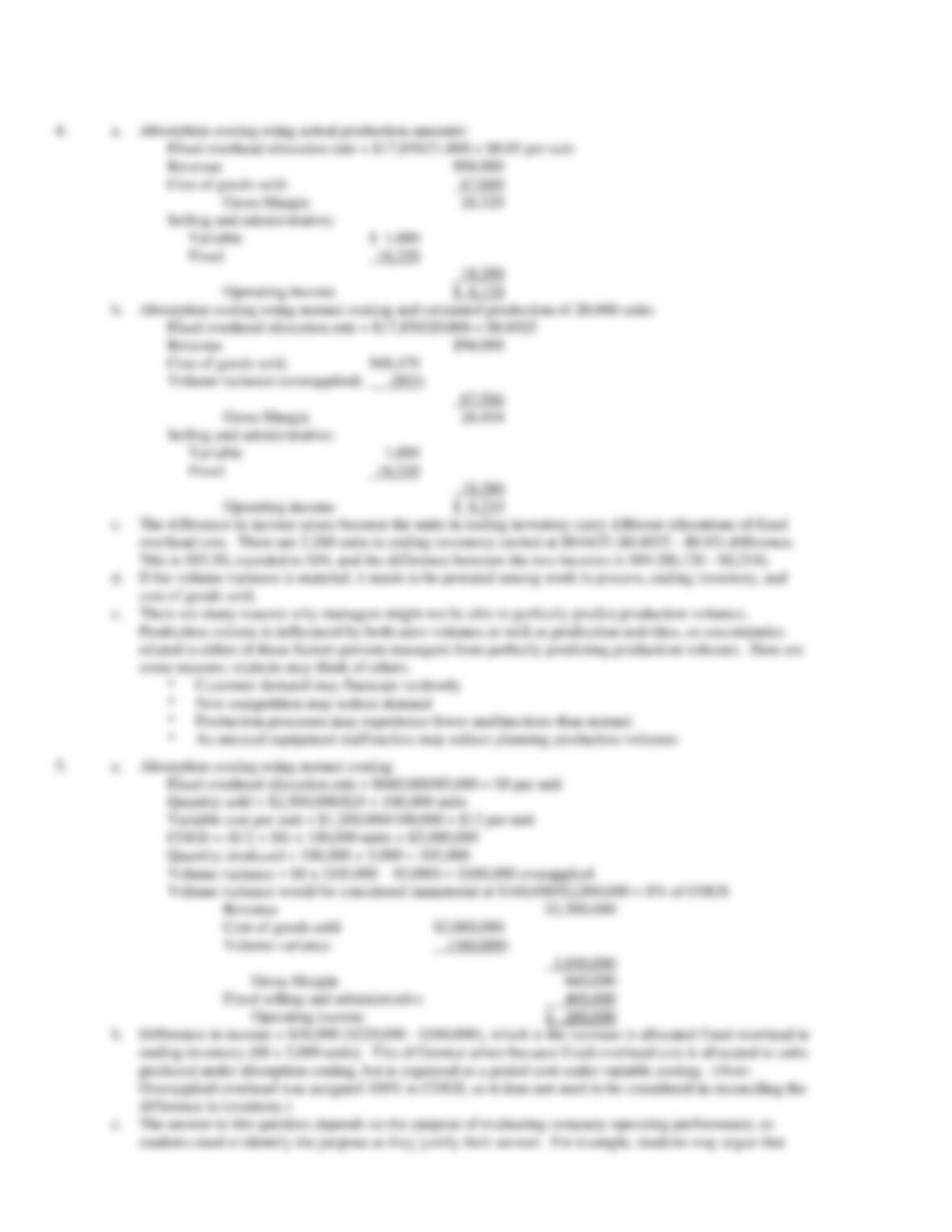
a. Assume that Glorious uses an actual costing system for fixed production overhead. Prepare an
absorption costing income statement.
b. Assume that Glorious uses a normal costing system for fixed production overhead based on
normal production of 20,000 baskets. Prepare an absorption costing income statement, assuming
that the volume variance is considered immaterial.
c. Reconcile the difference between the incomes you calculated in parts (a) and (b) above.
d. Explain how to close the volume variance if it is considered material.
e. List two reasons why it might not be possible for managers to perfectly predict production
volumes.
5. The vice president for sales of Johnstown Company has received the following income statement for
February, which was prepared using variable costing:
Sales $2,500,000
Variable production costs 1,200,000
Contribution margin 1,300,000
Fixed production costs 680,000
Fixed selling and administrative costs 400,000
Operating income $ 220,000
14-26 Cost Management
The controller attached the following notes to the statement:
1. The unit sales price for February was $25.
2. Fixed manufacturing costs are allocated to each unit at a predetermined rate based on
normal monthly production of 85,000 units.
3. Production for November was 5,000 units in excess of sales.
4. The inventory on the last day of February consisted of 40,000 units.
5. Cost of goods sold is calculated using the LIFO cost flow assumption.
6. Materiality of the volume variance is calculated as a percentage of COGS.
The vice president for sales is not pleased with the results under variable costing and wonders what
the operating income would have been with under absorption costing.
a. Present the February income statement under absorption costing. Create schedules showing the
calculation of cost of goods sold and the volume variance.
b. Provide calculations for the difference between the variable costing and absorption costing
operating income, and explain why the difference arises.
c. Which income statement provides a better measure of the company’s operating performance
during February? Justify your conclusion.
6. Fournier Company had the following operating data for its first two years of operations:
Variable cost per unit:
Direct materials $4
Direct labor $5
Variable overhead $3
Fixed costs per year:
Overhead $120,000
Selling and administrative $20,000
Fournier produced 20,000 units in the first year and sold 15,000. In the second year, it produced
15,000 units and sold 20,000 units. The selling price per unit each year was $21. Fournier uses
actual costing.
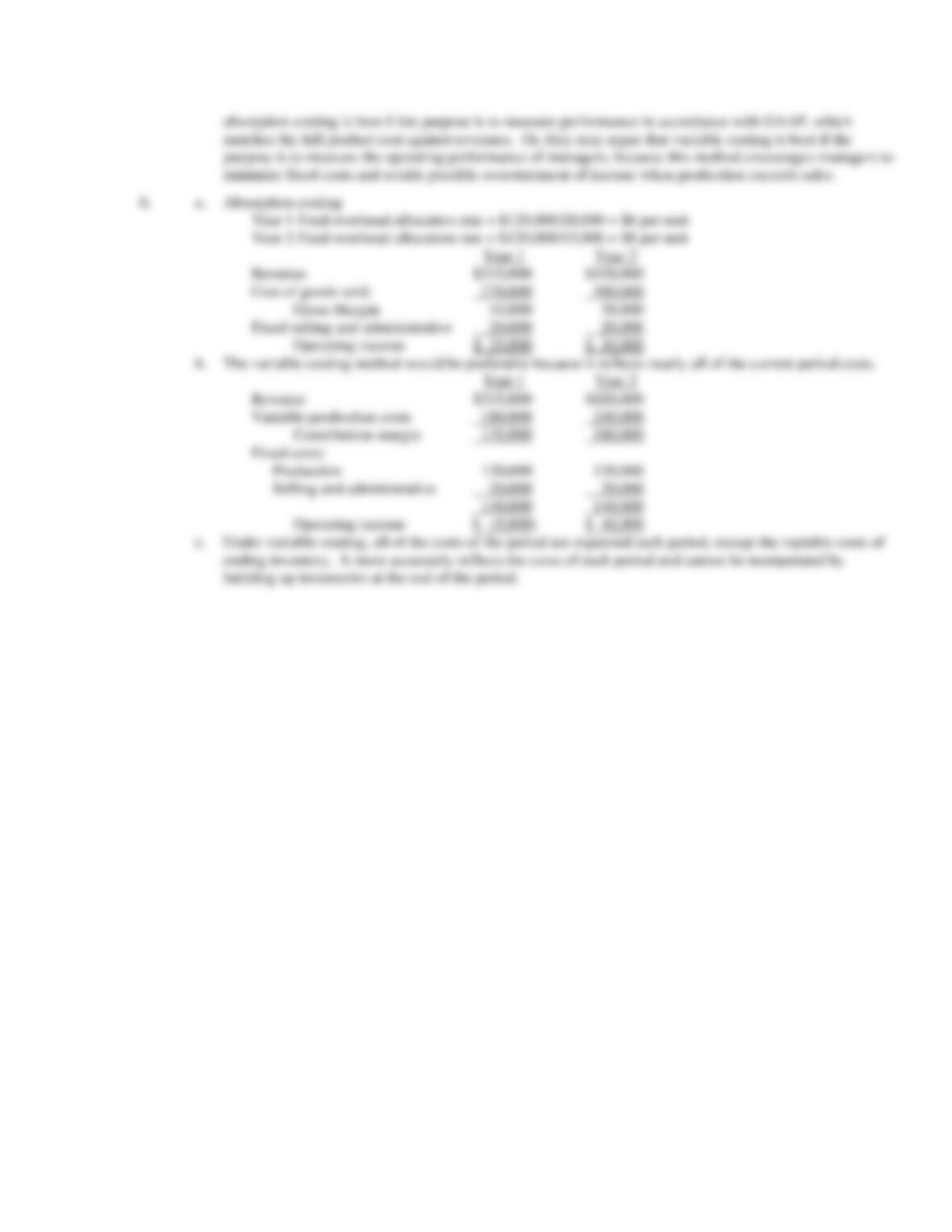
a. Prepare income statements for both years using absorption costing. Has firm performance, as
measured by income, improved or declined from Year 1 to Year 2?
b. Prepare income statements for both years using variable costing. Based on variable costing
income, has firm performance improved or declined from Year 1 to Year 2?
c. Briefly explain why variable costing measures managers’ performance more accurately than
absorption costing.
Chapter 14: Measuring and Assigning Costs for Income Statements 14-27
Answers
True / False
Multiple Choice
14-28 Cost Management
Matching
Chapter 14: Measuring and Assigning Costs for Income Statements 14-29
Exercises
14-30 Cost Management
Chapter 14: Measuring and Assigning Costs for Income Statements 14-31
Short Answer
14-32 Cost Management
Problems
Chapter 14: Measuring and Assigning Costs for Income Statements 14-33
14-34 Cost Management
Chapter 14: Measuring and Assigning Costs for Income Statements 14-35