Chapter 14 – The Urinary System
49. Intrinsic control of GFR, which is mediated by parasympathetic nervous system input to the efferent arterioles, is
aimed at long-term regulation of arterial blood pressure.
a.
True
b.
False
False
50. The rate of glomerular filtration depends on the filtration coefficient as well as on the net filtration pressure.
a.
True
b.
False
True
51. Sodium reabsorption in the proximal tubule plays a pivotal role in reabsorbing glucose, amino acids, H2O, chloride
ions and urea.
a.
True
b.
False
True
52. The most important and best-known hormonal system involved in regulating sodium ions is the renin–angiotensin–
aldosterone system (RAAS).
a.
True
b.
False
True
53. Plasma protein concentration can become extremely high in diabetes mellitus, a digestive disorder involving
inadequate insulin action.
a.
True
Chapter 14 – The Urinary System
b.
False
False
54. Clinical measurement of blood urea nitrogen (BUN) is a crude assessment of kidney function.
a.
True
b.
False
True
55. Urea molecules, being the smallest of the waste products, are the only wastes passively reabsorbed.
a.
True
b.
False
True
56. Hydrogen ions are only secreted by the proximal tubules.
a.
True
b.
False
False
57. Several factors can alter the rate of potassium secretion, the most important being renin.
a.
True
b.
False
False
secretions
58. Because the organic ion secretory carriers are not very selective, different drugs can compete for binding sites on the
same carrier.
a.
True
Chapter 14 – The Urinary System
b.
False
True
59. The plasma clearance rate for a secreted substance is always less than the glomerular filtration rate.
a.
True
b.
False
False
60. If a H2O deficit exists relative to the solute load, the body fluids are too concentrated or are hypertonic, having an
osmolarity greater than 300 mOsm/L.
a.
True
b.
False
True
61. Although vasopressin promotes H2O conservation by the body, it cannot halt urine production.
a.
True
b.
False
True
62. Water diuresis involves increased excretion of both H2O and solute caused by excess unreabsorbed solute in the
tubular fluid, such as occurs in untreated diabetes mellitus.
a.
True
b.
False
False
63. Regardless of cause, renal failure can manifest itself either as painful renal failure or non-painful renal failure.
Chapter 14 – The Urinary System
a.
True
b.
False
False
64. Bladder smooth muscle is richly supplied by parasympathetic fibers, stimulation of which causes bladder contraction.
a.
True
b.
False
True
65. The micturition reflex is initiated when stretch receptors within the urethra are stimulated.
a.
True
b.
False
False
66. The kidneys maintain proper __________ volume, which is important in the long-term regulation of arterial
__________.
67. The renal vein is a branch of the __________.
68. The renal medulla is made up of striated structures called the renal __________.
pyramids
69. The __________ apparatus produces substances involved in the control of kidney function.
Chapter 14 – The Urinary System
14.1 Kidneys: Functions, Anatomy, and Basic Processes
70. The selective movement of substances from inside the tubule (the tubular lumen) into the blood is called tubular
__________.
14.1 Kidneys: Functions, Anatomy, and Basic Processes
71. The basement membrane is a(n) __________ gelatinous layer composed of collagen and glycoproteins that is
sandwiched between the __________ and Bowman’s capsule.
acellular; glomerulus
14.2 Glomerular Filtration
HUPH.SHER.16.14.2.1 – Describe the three layers that make up the glomerular membrane
72. Plasma-colloid __________ pressure is caused by the unequal distribution of plasma proteins across the __________
membrane.
osmotic; glomerular
14.2 Glomerular Filtration
73. Two mechanisms contribute to autoregulation of the GFR: a(n) __________mechanism and a tubuloglomerular
__________ mechanism.
myogenic; feedback
14.2 Glomerular Filtration
74. In response to the resultant rise in salt delivery to the distal tubule, the macula densa cells release __________ and
adenosine.
14.2 Glomerular Filtration
75. Contraction of __________ cells closes off a portion of the filtering capillaries, reducing the surface area available for
filtration within the glomerular tuft.
Chapter 14 – The Urinary System
76. To be reabsorbed, a substance must cross the __________ membrane of the tubular cell to enter the interstitial fluid.
77. Of the total energy spent by the kidneys, 80% is used for __________ transport.
78. The granular cells of the juxtaglomerular apparatus secrete an enzymatic hormone called __________.
79. Atrial natriuretic peptide (ANP) and brain natriuretic peptide (BNP) produce __________.
80. During reabsorption, H2O passes primarily through __________ that are formed by specific plasma membrane
proteins in the tubular cells.
81. Like tubular reabsorption, tubular secretion involves __________ transport, but the steps are __________.
82. Potassiumsecretion in the principal cells of the distal and collecting tubules is coupled to __________ reabsorption by
the energy-dependent basolateral __________ pump.
83. A rise in plasma potassium concentration __________ stimulates aldosterone secretion by the __________ cortex.
84. The plasma clearance rate of a substance filtered, but not reabsorbed or secreted, always equals the __________.
85. If too much H2O is present relative to the solute load, the body fluids are __________, which means they are too
dilute at an osmolarity less than 300 mOsm/L.
86. The __________ fluid that enters Henle’s loop becomes progressively more concentrated as it flows down the
__________ limb.
87. Vasopressin is produced by several specific neuronal cell bodies in the __________ and then stored in the posterior
__________ gland.
88. In the tubular segments permeable to H2O, solute reabsorption is always accompanied by comparable __________
reabsorption because of __________ considerations.
89. Chronic renal failure is insidious because up to __________% of the kidney tissue can be destroyed before the loss of
kidney function is even noticeable.
90. Bladder smooth muscle is richly supplied by __________ fibers, stimulation of which causes bladder contraction.
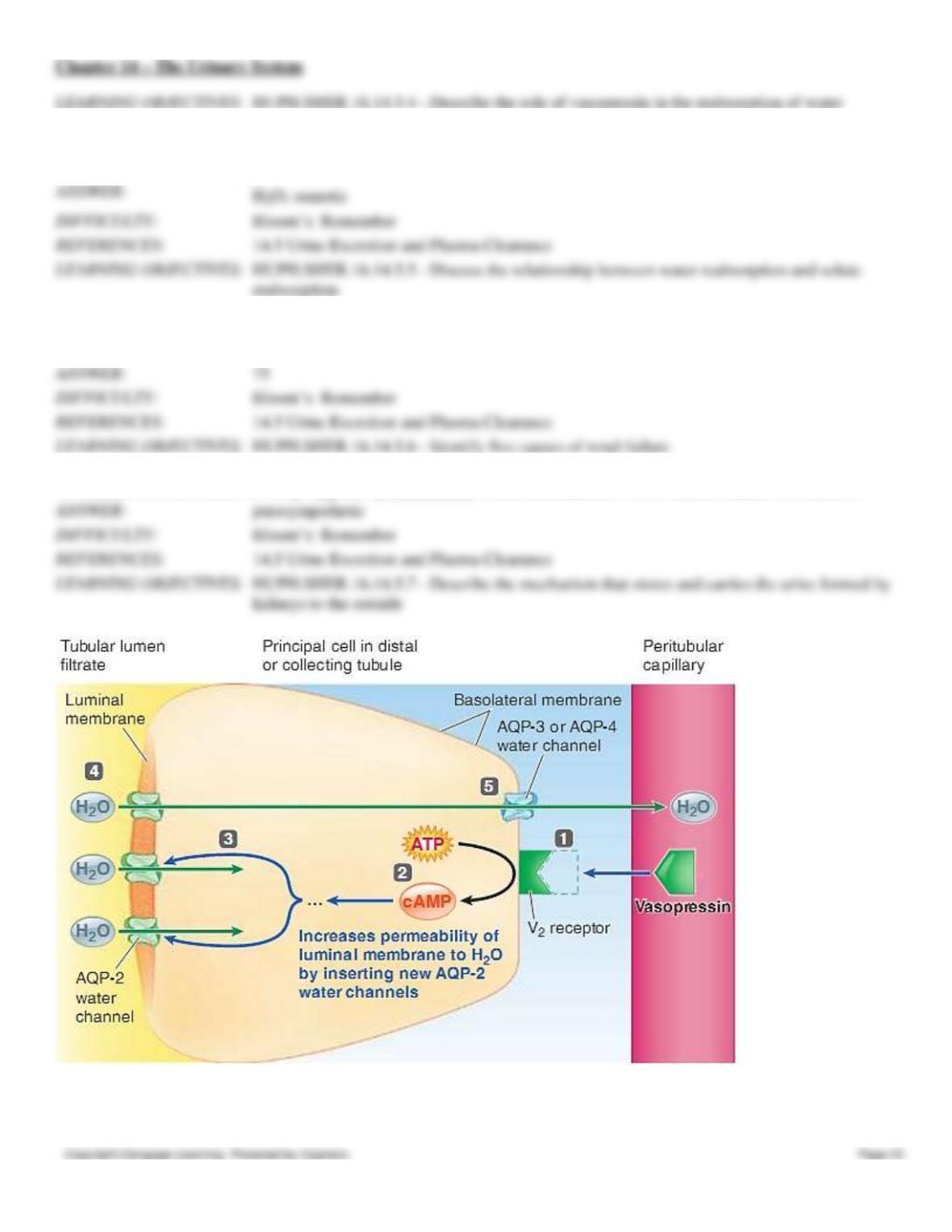
Use the figure above (Figure 14–26) to answer the corresponding questions.
91. Which number in the figure represents where water enters the tubular cell from the tubular lumen through the inserted
water channels?
Chapter 14 – The Urinary System
a.
1
b.
2
c.
3
d.
4
e.
5
d
92. Which number in the figure represents blood-borne vasopressin binding with its receptor sites on the basolateral
membrane of a principal cell?
a.
1
b.
2
c.
3
d.
4
e.
5
93. Which number in the figure represents cyclic AMP increasing the opposite luminal membrane’s permeability to H2O?
a.
1
b.
2
c.
3
d.
4
e.
5
94. Which number in the figure represents water exiting the cell through different (always open) water channels
permanently positioned at the basolateral border?
a.
1
b.
2
c.
3
d.
4
e.
5
95. Which number in the figure represents activation of the cyclic AMP (cAMP) second-messenger pathway within the
cell?
a.
1
b.
2
c.
3
d.
4
e.
5
b
96. Outline the role of the kidneys in the urinary system.
97. Discuss the glomerular filtration rate.
98. Discuss the drugs that affect sodium absorption.
99. Describe how hydrogen ion secretion impacts acid-base balance.
100. Discuss the role of vasopressin in the urinary system.