Chapter 14: Financing Liabilities: Bonds and Notes Payable
154. Which of the following is true for accounting for a troubled debt restructuring by a modification of terms by the
debtor?
a.
If undiscounted cash flows after restructuring are greater than carrying value of the debt before restructuring,
recognize a gain.
b.
If undiscouraged cash flows after restructuring are greater than carrying value of the debt before restructuring,
recognize no gain and impute new interest rate.
c.
If present value of cash flows after restructuring is greater than carrying value of the debt before restructuring,
recognize a gain.
d.
If undiscouraged cash flows after restructuring are less than carrying value of the debt before restructuring,
recognize NO gain and impute new interest rate.
b
1
Easy
ACCT.WHAL. – 16.20.1 – LO 20.1
United States – BUSPROG – Reflective Thinking; BUSPROG: Analytic
United States – OH – Default City – AICPA – FN-Decision Modeling
Bloom’s: Understanding
155. Which of the following is true for accounting for a troubled debt restructuring by a modification of terms by the
creditor?
a.
Loss on restructuring is based on undiscounted repayment cash flows using the current market interest rate.
b.
Loss on restructuring is based on undiscounted repayment cash flows using the contractual interest rate.
c.
Loss on restructuring is based on present value of repayment cash flows using the current market interest rate.
d.
Loss on restructuring is based on present value of repayment cash flows using the contractual interest rate.
d
1
Moderate
ACCT.WHAL. – 16.20.1 – LO 20.1
United States – BUSPROG – Reflective Thinking; BUSPROG: Analytic
United States – OH – Default City – AICPA – FN-Decision Modeling
Bloom’s: Understanding
156. Match each of the following bond classifications (a–h) with the appropriate characteristic (1-8) by entering the
appropriate letter in the space provided.
a.
Debenture bonds
f.
Zero-coupon bonds
b.
Mortgage bonds
g.
Callable bonds
c.
Bond Indenture
h.
Convertible bonds
d.
Par Value
i.
Serial bonds
e.
Nominal rate
j.
Effective Interest rate
____
1.
Portions of the bond mature in periodic installments.
____
2.
The principle of the bond.
____
3.
Bonds that are secured by a lien against specific assets.
____
4.
Bonds that can be exchanged for a predetermined number of shares of stock.
____
5.
Bonds whose marketability is based on the general credit rating of the issuing company.
____
6.
A document that defines the rights of the bond holder.
____
7.
Bonds that the company has the right to retire before their maturity date.
____
8.
Bonds on which no interest is paid until the maturity
date.
____
9.
The rate of interest the bond issuer has agreed to pay until maturity.
____
10.
The market rate of interest at the time a bond is sold.
1.
6.
c
2.
d
7.
g
3.
b
8.
f
4.
h
9.
e
5.
a
10.
j
1
Challenging
United States – BUSPROG: Reflective Thinking – BUSPROG: Analytic
United States – OH – Default City – AICPA: FN-Decision Modeling
Bloom’s: Remembering
157. Briggs Industries, Inc. issued $900,000 of 8% debentures on July 1, 2013. The bonds pay interest semiannually on
January 1 and July 1. The maturity date on these bonds is July 1, 2021. The bonds were sold to yield an effective-
interest rate of 10%. Briggs incurred issuance costs of $15,000.
PV of $1
4%
5%
8%
10%
8 periods
0.731
0.677
0.54
0.467
16 periods
0.534
0.458
0.292
0.218
PV of Annuity $1
8 periods
6.733
6.463
5.747
5.335
16 periods
11.652
10.838
8.851
7.824
Requirements
1) Calculate the selling price of the bonds.
2) Prepare the journal entry for the issuance of the bonds and the issuance costs.
158. A $700,000, 20-year, 8% bond issue was sold to yield 10%. Interest was payable annually. Actuarial information for
20 periods follows:
8%
10%
Future value of 1
4.661
6.728
Present value of 1
0.21455
.14864
Future value of annuity of 1
45.762
57.275
Present value of annuity of 1
9.818
8.514
Required:
Compute the amount of cash that was received when the bonds were issued.
$580,807
1
Challenging
ACCT.WHAL.16.14.3 – LO: 14.3
United States – BUSPORG: Analytic
United States – OH – Default City – AICPA: FN-Measurement
Bloom’s: Evaluating
159. On May 1, 2014, a $300,000, ten-year, 14% bond was sold to yield 12% plus accrued interest. The bond was dated
January 1, 2014, and interest is paid each January 1 and July 1. Present value data follow:
PV of $1
PV of an Annuity
10 periods
20 periods
10 periods
20 periods
6%
0.558395
0.311805
7.360087
11.469921
7%
0.508349
0.258419
7.023582
10.594014
12%
0.321973
0.103667
5.650223
7.469444
14%
0.269744
0.072762
5.216116
6.623131
Required:
a.
Compute the amount of cash received from the sale of the bond.
b.
Prepare the journal entry to record the sale.
c.
When preparing the journal entry, you recorded a premium or discount. Discuss why.
$ 93,541.50
240,868.34
Price
14,000.00
Total cash received
348,409.84
Premium on Bonds Payable
Bonds Payable
300,000.00
resulting in a premium.
160. On April 1, 2016, Quicke Mart issued $1,000,000, 9% bonds at par plus accrued interest dated January 1, 2014.
Interest is payable semi-annually on January 1 and July 1. The bonds mature on January 1, 2023.
Requirements
Prepare journal entries to record the following transactions related to long-term bonds of Quicke Mart:
1) The issuance of the bonds.
2) The first interest payments.
161. On January 1, 2016, the Q-Ball Company issued $200,000 bonds with an 8% stated interest rate. Each $1,000 bonds
pay interest on June 30 and December 31. The bonds mature on December 31, 2025.
Required:
a.
Assume the bonds were sold for $175,075.58 to yield 10%. Prepare a bond
amortization schedule for the first year of the bond life using the effective interest
method. Round all calculations to the nearest dollar.
b.
Prepare the journal entry for paying the interest on December 31, 2016.
c.
Why did these bonds originally sell at a discount?
175,829.36
162. On January 1, 2016, Smalls, Inc. issued $60,000 of its 12-year 10% bonds for $52,584. Interest is payable annually
and the effective yield was 12%. Issuance costs were $3,200.
Required:
a.
Prepare the entry to record the issuance of the bonds.
b.
Prepare the journal entry to record interest expense in 2017 using the effective interest
method.
c.
Prepare the journal entry to record interest expense in 2017 using the straight-line method.
1
Challenging
ACCT.WHAL.16.14.5 – LO: 14.5
United States – BUSPORG: Analytic
United States – OH – Default City – AICPA: FN-Measurement
Bloom’s: Analyzing
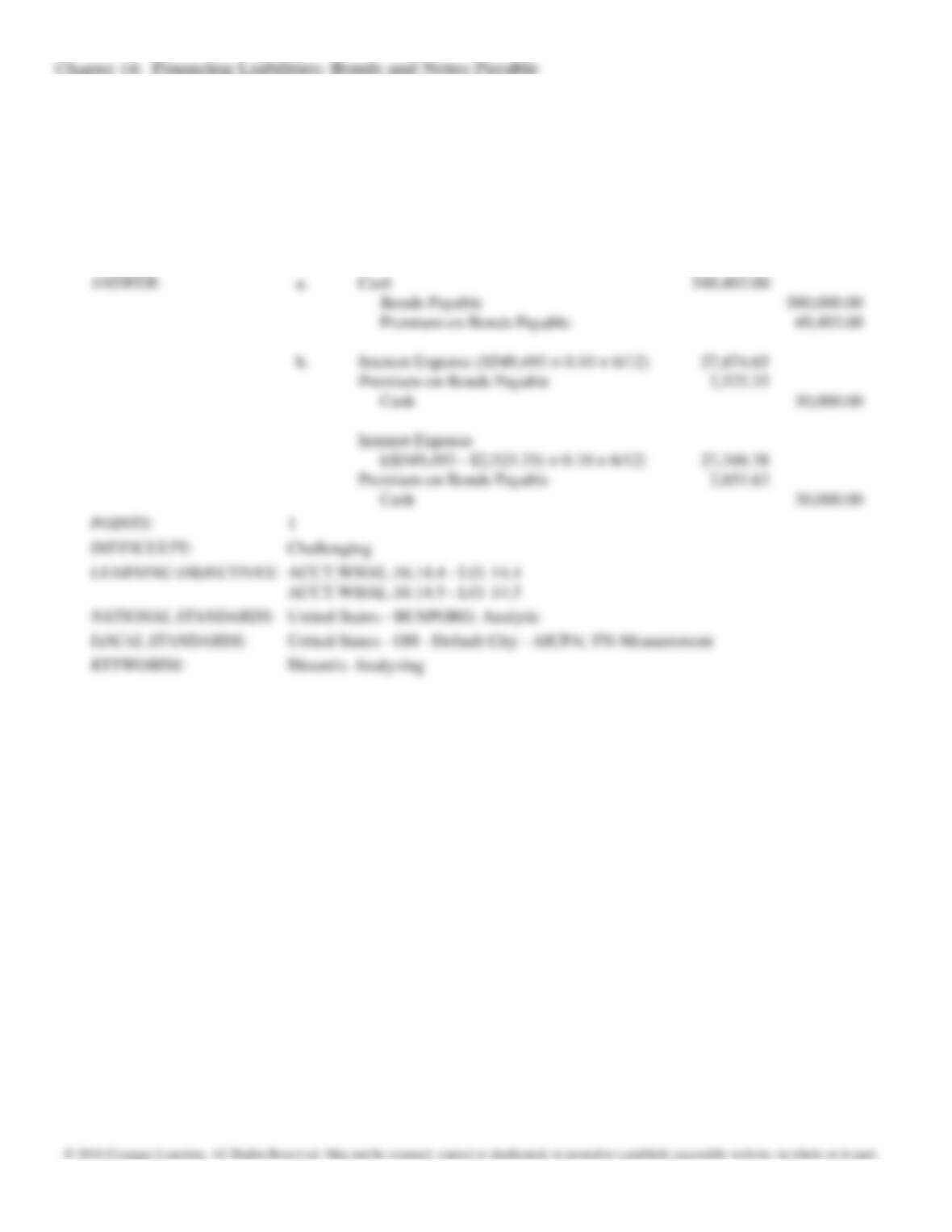
163. The Windy City Company issued $500,000 of 12% bonds on January 1, 2016. The bonds were sold for $549,493,
and they were expected to yield 10% interest compounded semiannually. The interest dates are June 30 and
December 31. The maturity date of the bonds is December 31, 2022.
Required:
a.
Prepare the journal entry to record the issuance of the bonds.
b.
Using the effective interest method, prepare the journal entries to record the first two
interest payments.
1
ACCT.WHAL.16.14.4 – LO: 14.4
United States – OH – Default City – AICPA: FN-Measurement
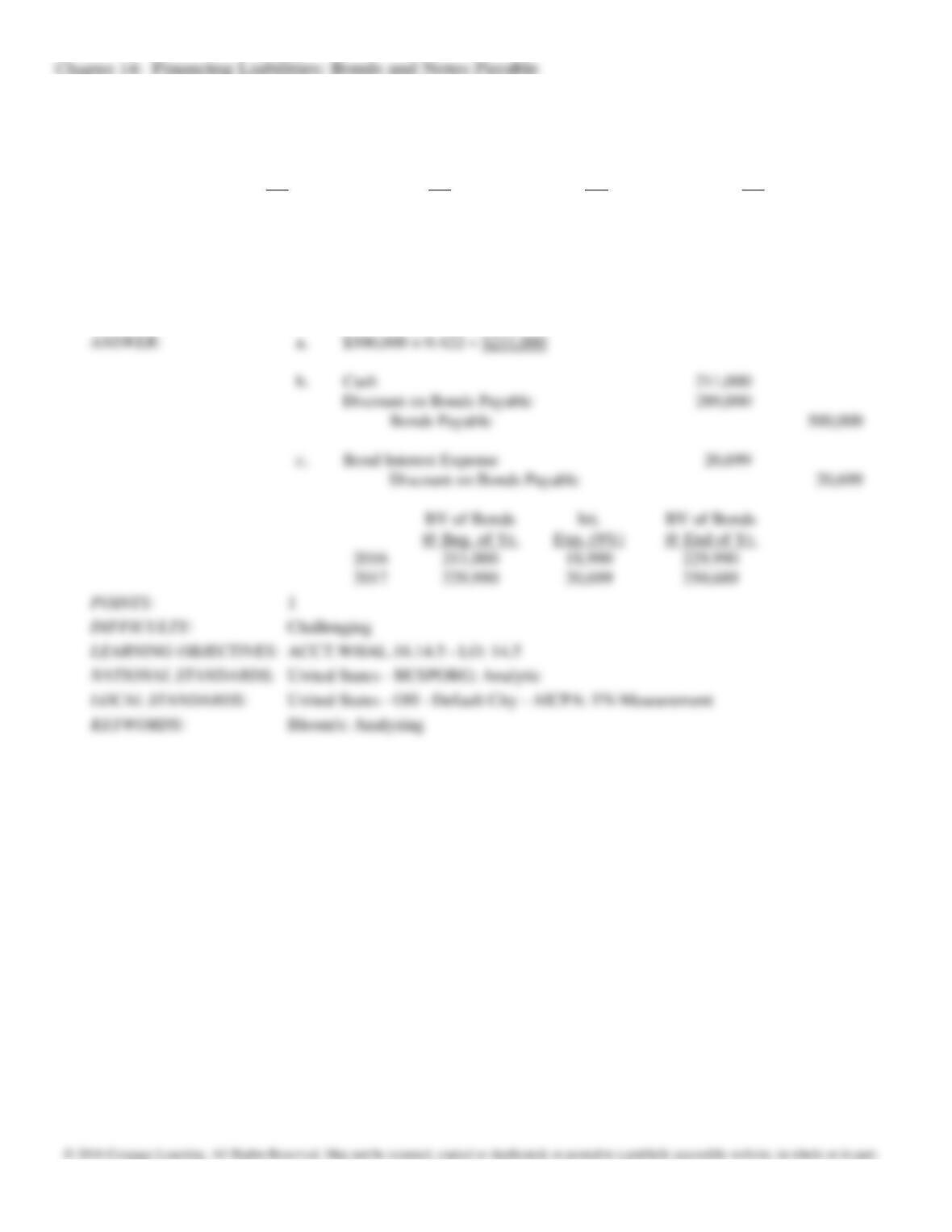
164. Durham, Inc. issued $500,000 of its ten-year zero-coupon bonds on January 1, 2016, to yield 9%. The effective
interest method is used.
PV of $1
PV of an Annuity
FV of $1
FV of an Annuity
9%
9%
9%
9%
10 periods
0.422
6.418
2.367
15.19
Required:
a.
Compute the cash proceeds from the sale of the bond.
b.
Prepare the journal entry to record the sale.
c.
Prepare the journal entry to record interest for 2017.
Bonds Payable
Discount on Bonds Payable
211,000
229,990
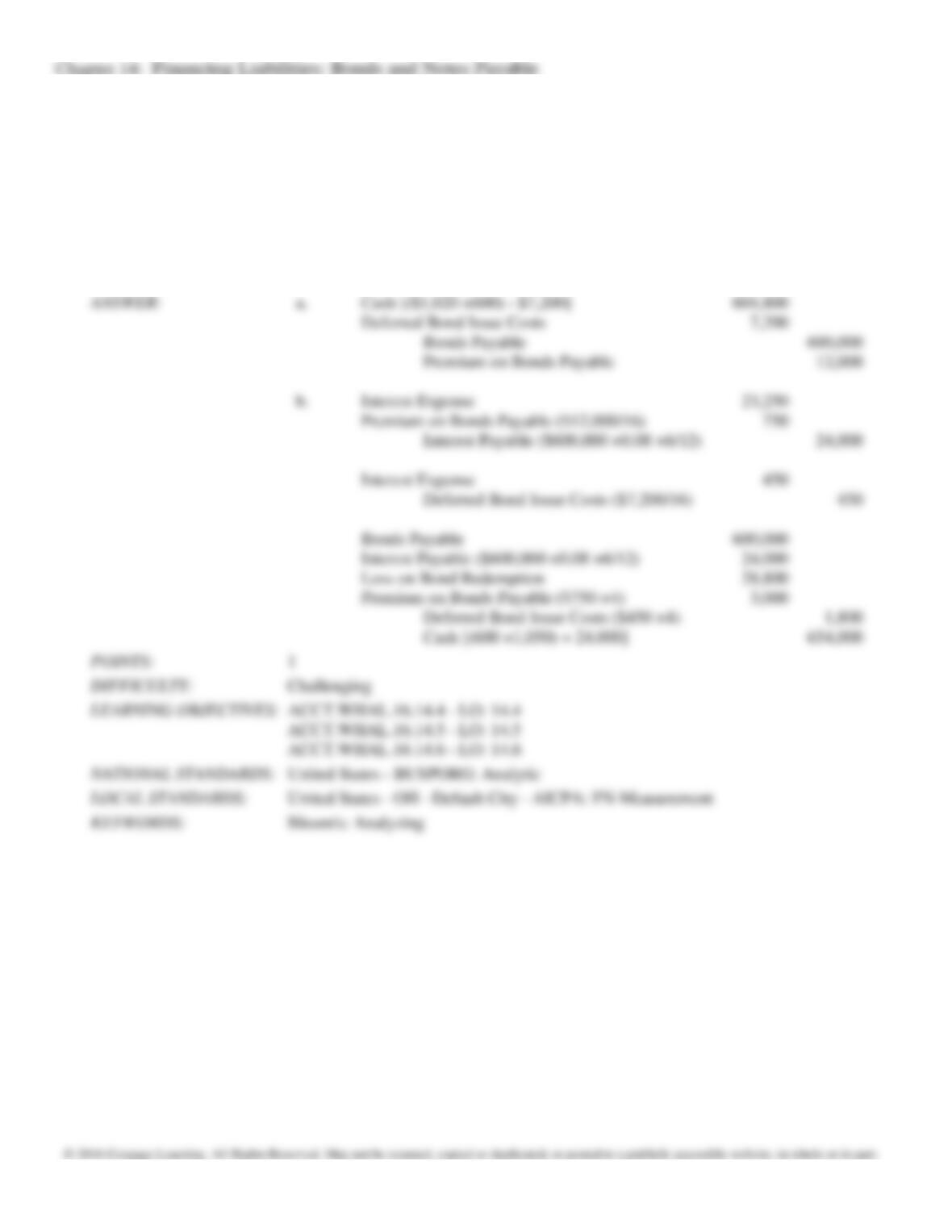
165. On January 1, 2016, the Rangler Company issued $600,000 of eight-year bonds at 102. The stated annual interest
rate is 8%, and interest is paid on June 30 and December 31. The bonds are callable at 105 plus accrued interest. The
bond issue costs were $7,200. The Rangler Company uses the straight-line method to amortize bond discounts and
premiums.
Required:
a.
Prepare the journal entry(ies) to record the issuance of the bonds and the bond issue costs.
b.
At the end of the sixth year, the company exercised the call option and retired the bonds.
Prepare the journal entries to record the related interest and retirement.
Challenging
ACCT.WHAL.16.14.4 – LO: 14.4
ACCT.WHAL.16.14.5 – LO: 14.5
United States – OH – Default City – AICPA: FN-Measurement
Bloom’s: Analyzing
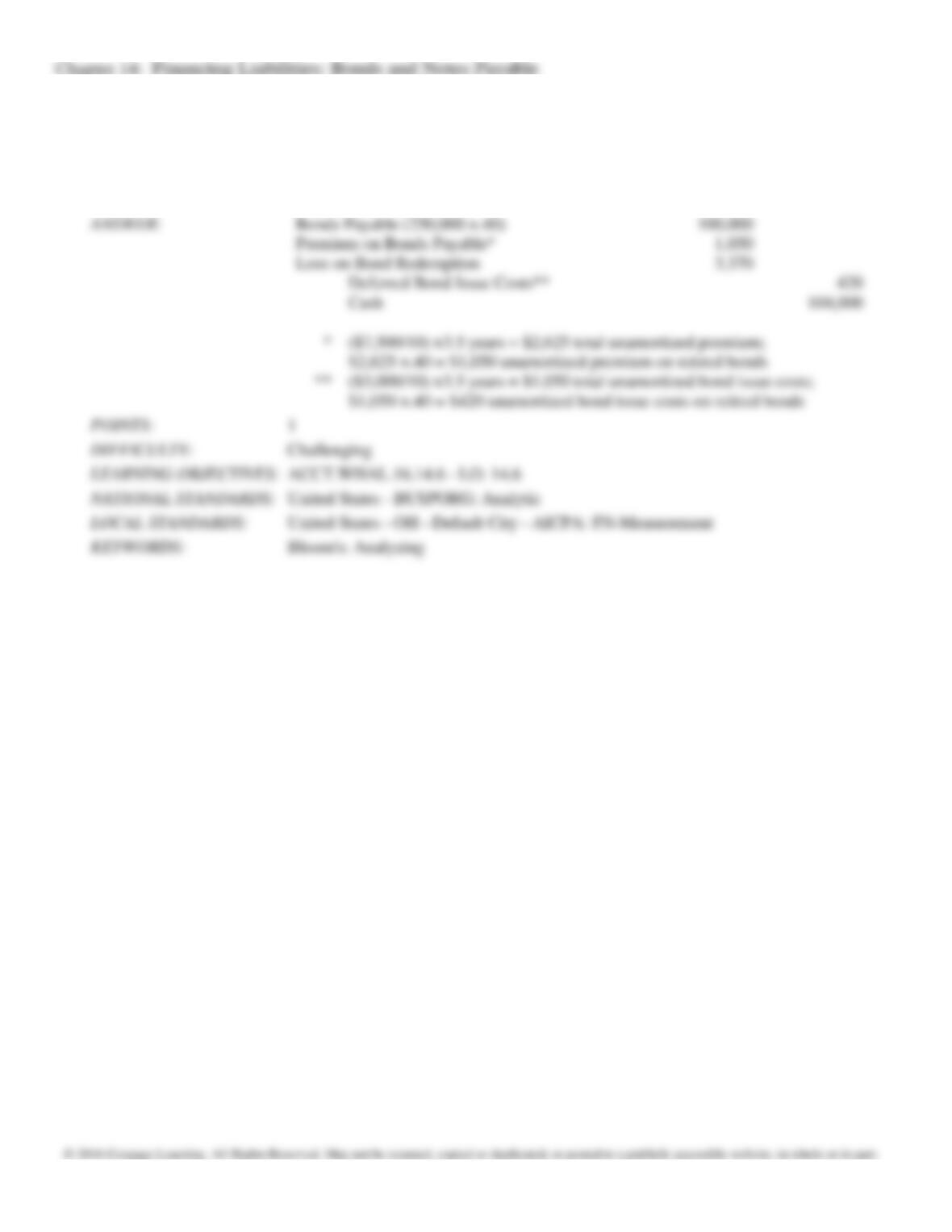
166. On January 1, 2016, High Shots issued $250,000 of 11% ten-year bonds at 104. Issuance costs amounted to $3,000.
Bond premium is amortized on straight-line basis. On July 1, 2022, 40% of the bonds were called at 104.
Required:
Record the retirement of the bonds. Ignore interest and use straight-line amortization.
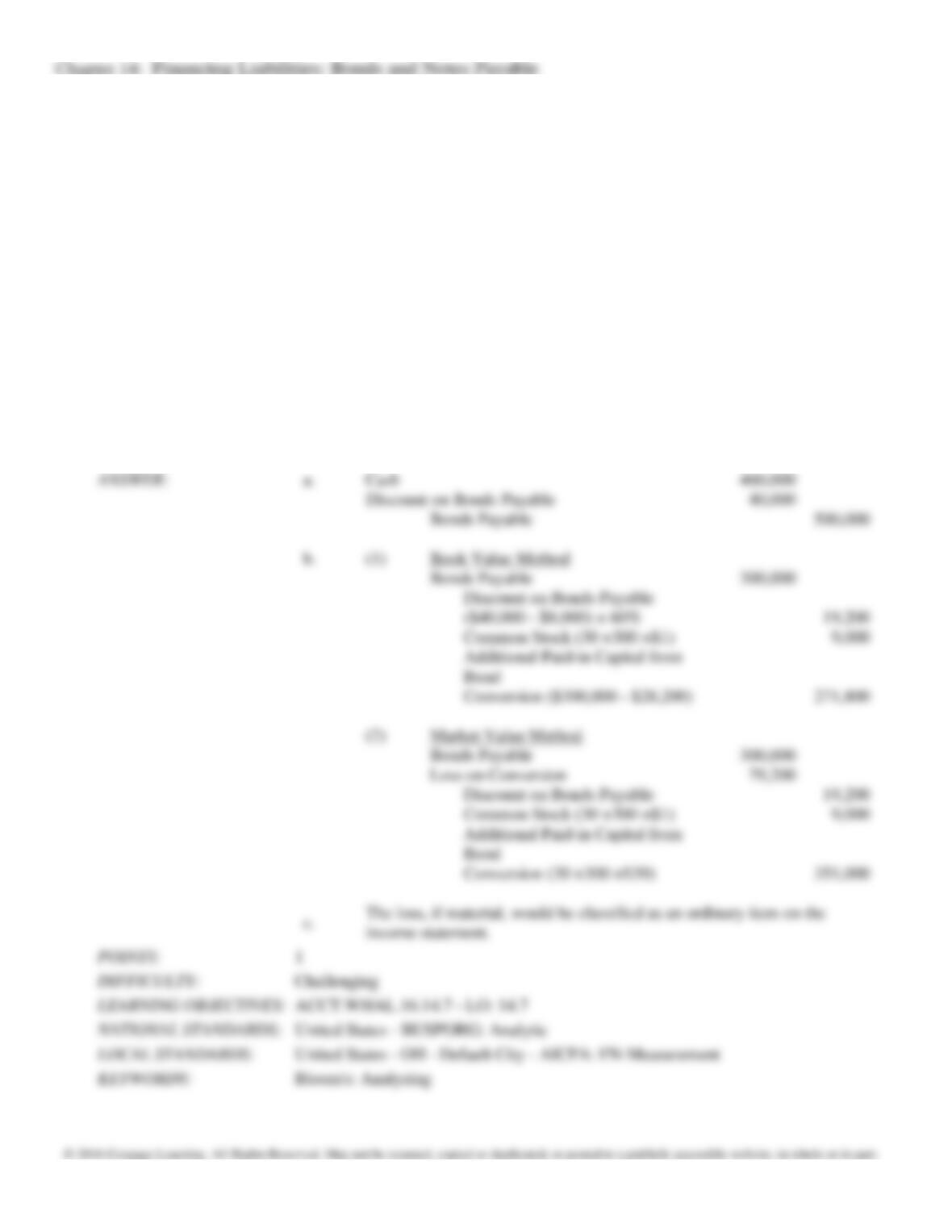
167. The following events relate to Mathers Corporation’s issue of convertible debentures:
·
On January 1, 2015, the Mathers Corporation issued $500,000 of 12% convertible bonds
for $460,000. The bonds are due on January 1, 2025, and interest is paid on July 1 and
January 1. Each $1,000 bond is convertible into 30 shares of common stock with a par
value of $1 per share. On the date of bond issuance, a share of common stock was selling
at $24.
·
On January 2, 2017, 12% convertible bonds with a face value of $300,000 were converted
into common stock. The market value of the common stock on the date of conversion was
$40 per share. Mathers uses the straight-line method to amortize premiums and discounts.
Required:
a.
Prepare the journal entry to record the issuance of the convertible bonds.
b.
Record the conversion on January 2, 2017, using:
(1)
the book value method
(2)
the market value method
c.
Assuming that any gain or loss on conversion is material, how would it be disclosed in
the financial statements?
Discount on Bonds Payable
Bonds Payable
Discount on Bonds Payable
Common Stock (30 ×300 ×$1)
Additional Paid-in Capital from
Conversion ($300,000 – $28,200)
(2)
Market Value Method
Loss on Conversion
Discount on Bonds Payable
Additional Paid-in Capital from
Conversion (30 ×300 ×$39)
The loss, if material, would be classified as an ordinary item on the
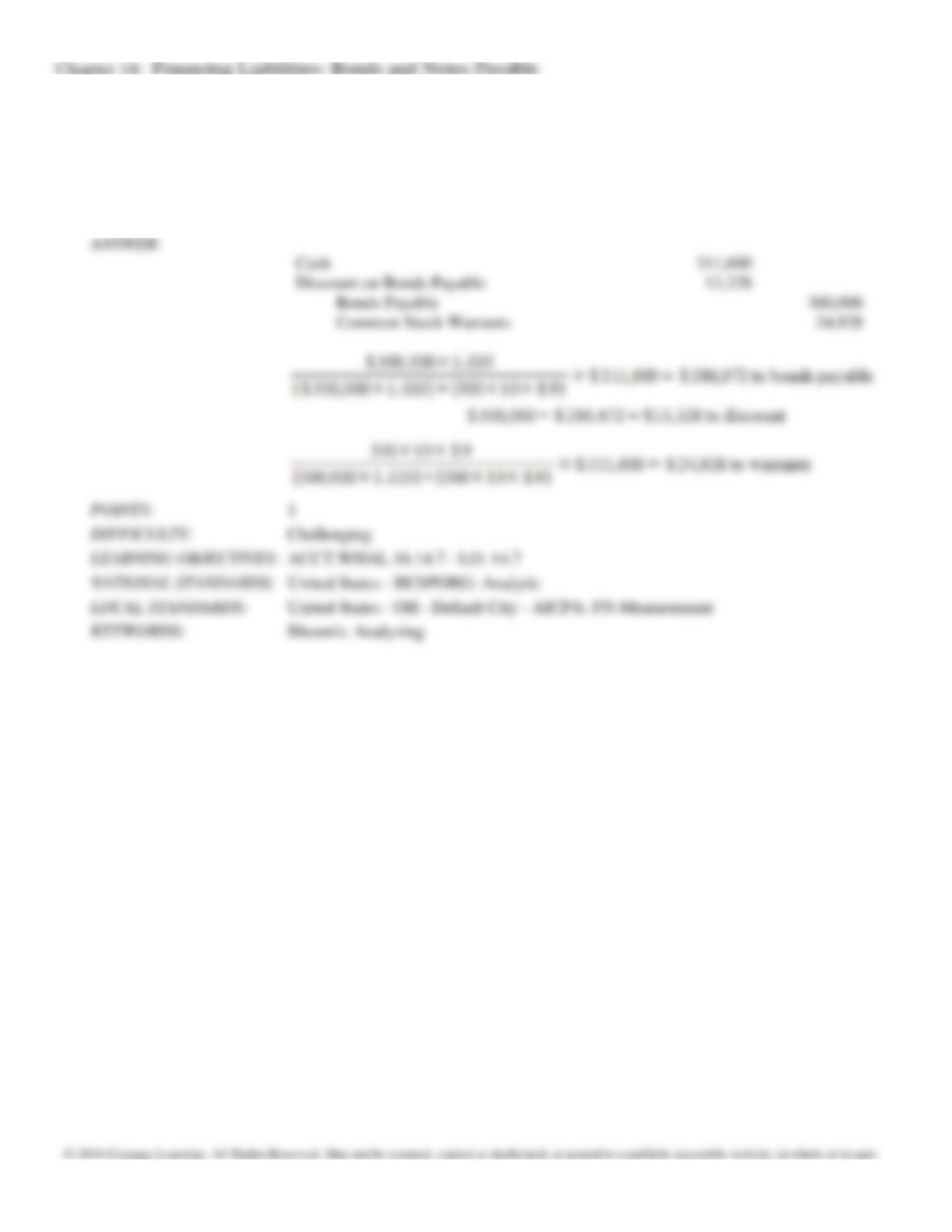
168. Hoosier Co. sold $300,000 of 10% bonds for $311,600. Each $1,000 bond carried ten warrants and each warrant
allowed the holder to acquire one share of $10 par value common stock for $25 a share. After the issuance of the
securities, the bonds were quoted at 103.5 and each warrant was quoted at $9.
Required:
Prepare the entry to record the sale of the bonds.
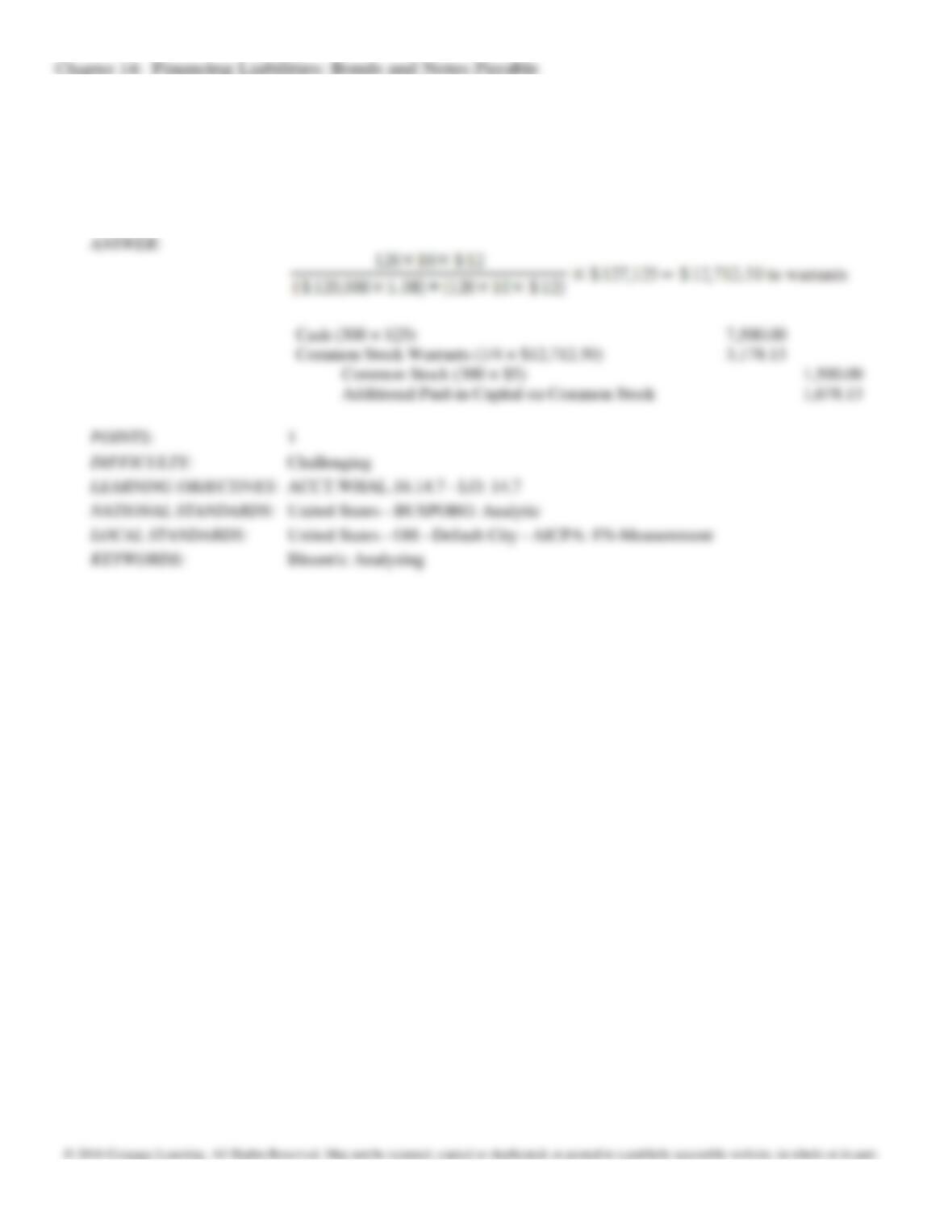
169. Siena sold $120,000 of 6% bonds for $127,125. Each $1,000 bond carried ten warrants and each warrant allowed the
holder to acquire one share of $5 par common stock for $25 a share. After the issuance of the securities, the bonds
were quoted at 108 and the warrants were quoted at $12. Later, one-fourth of the rights were exercised.
Required:
Journalize the exercise of the warrants.
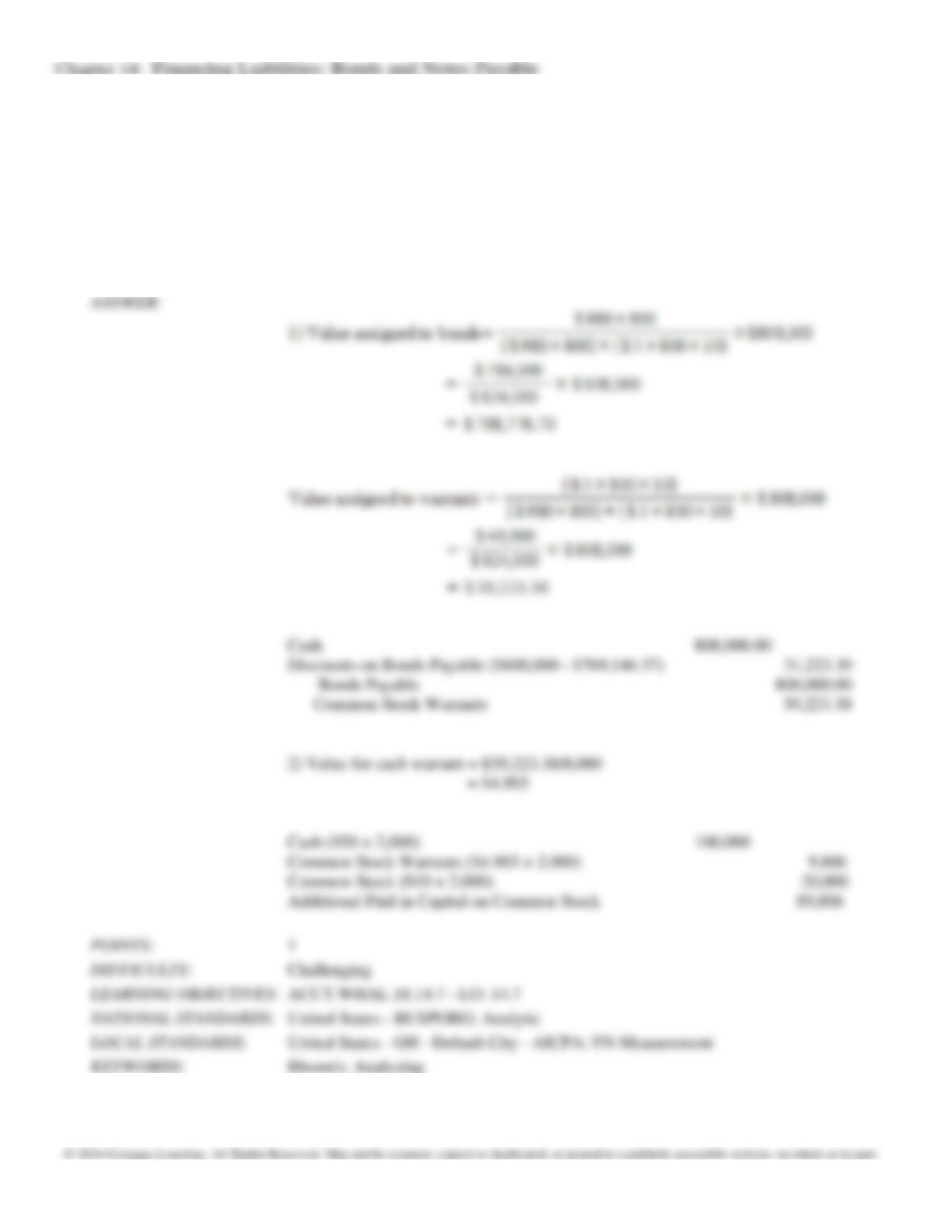
170. On January 1, 2016, Cooper Corporation issued $800,000 of 12.5% bonds due January 1, 2023, at 101. The bonds
pay interest semiannually on June 30 and December 31. Each $1,000 bond carried 10 warrants which allowed the
acquired to exchange 1 share of $10 par common stock for $50. Some time after the bonds were issued the bonds
were quoted at 98 ex rights and each individual warrant was quoted at $5. Subsequently, on April 30, 2017, 2,000
rights were exercised.
Required:
1. Prepare the journal entry to record the bond issue.
2. Prepare the journal entries on April 30, 2017, to record the exchange of the warrants for common shares.