Chapter 14—The Link Between Capital Structure and Capital Budgeting
MULTIPLE CHOICE
1. Chapter 14 describes three cash flow discounting methods with the acronyms
a.
WACC, APV, and SLG
b.
WACC, FTE, and SLG
c.
APV, SLG, and TDI
d.
WACC, SLG, and TDI
e.
None of the above
2. A firm has current equity value $cev billion and debt worth $d billion. It is considering a project that
generates perpetual pre-tax cash flows of $cf million. Discounting after-tax cash flows at the firm’s
current WACC results in a value of future cash flows (excluding the initial investment) equal to $fcf
million. The tax rate is r%. Validity of discounting the project cash flows with the firm’s existing
WACC requires that the firm finance the project with an initial debt level
a.
$w1 million
b.
$w2 million
c.
$ans million
d.
$w3 million
e.
none of the above
3. To calculate the cash flows that will be discounted using the WACC approach, one can start with the
cash flows that would accrue to an unlevered firm and
a.
add back all of the corporate taxes
b.
add back the taxes shielded by interest
c.
subtract interest payments
d.
subtract principal and interest payments
e.
none of the above
4. High Street Consultants are engaged in an LBO and would like to incorporate the effect of different
possible debt levels on union negotiations, taxes paid, and investment banking fees. An appropriate
analysis would likely employ which method?
a.
WACC
b.
APV
c.
FTE

d.
Different elements of this problem are best addressed by different methods, so that no
single method is best.
e.
The FTE in early years of the project, then the WACC.
5. Assume the assumptions underlying the APV are relevant. Brakes and Rakes Co. (BRR) has required
return on levered equity equal to rl%, required return on debt of rd%, and corporate tax rate of tc%.
The required return on the market is rr%. BRR has debt with market value $d million and equity with
market value $e million. What is BRR’s unlevered cost of capital?
a.
w1%
b.
w2%
c.
r%
d.
w3%
e.
w4%
6. As part of the financing for a project, a firm will have risk-free debt outstanding with t years to
maturity. The debt has face value $fv million and offers annual coupons with coupon rate equal to the
r1% annual risk-free rate. The debt will not be reissued at maturity. The marginal corporate tax rate for
this firm is r2%. The tax benefits of debt calculated in an APV analysis would be __________.
a.
$w1 million
b.
$pv million
c.
$w2 million
d.
$w3 million
e.
$w4 million
7. Greta’s Gaskets is considering investment in a new production facility. Initial investment would be $v
million, financed by $e million of equity and $d million of debt. The firm will maintain a constant
leverage ratio over time. The expected return on levered equity for this project is r1%, while the
expected return on debt is r2%. The project will generate pre-tax cash flows each year of $pt million,
and the tax rate is r3%. The cash flow to equity each year is __________, and the project NPV is
__________.
a.
$a2 million, $c1 million
b.
$a1 million, –$c2 million
c.
$a1 million, $c million
d.
$a3 million, $c3 million
e.
$a3 million, $c4 million

8. When Wiser Lake Corp. uses the WACC method to discount cash flows, it (correctly) applies a rate of
wacc%. Wiser Lake’s debtholders require a return of rd%. Wiser Lake has equity valued at $e million
and debt worth $d million. It faces a tax rate of tc%. If Wiser Lake discounts cash flows (with
comparable risk and leverage) using the flow-to-equity method, what discount rate should it apply,
rounding to two decimal places?
a.
w1%
b.
w2%
c.
w3%
d.
re%
e.
none of the above
9. Which discounting methods discount unlevered cash flows?
a.
WACC and APV
b.
APV
c.
FTE and WACC
d.
APV and FTE
e.
WACC, APV, and FTE
10. Given research evidence on typical corporate debt issuance policies, which method(s) is/are likely best
suited to most capital budgeting problems?
a.
WACC
b.
APV
c.
FTE
d.
a and b
e.
a and c
11. Malachi’s Mailboxes (MAMA) is considering a new product line that will require investment of $ri
today. Currently, MAMA has $e million (market value) of equity and $d million of debt. If it makes
the investment, it will maintain its current leverage ratio over time. In the absence of debt, the new
product line would generate perpetual annual after-tax cash flows of $cf. For MAMA, the required
return on debt is rd%, the required return on equity is re%, and the marginal corporate tax rate is tc%.
To the nearest $1000, the NPV of this investment is then:
a.
–$w1

b.
–$ans
c.
$w2
d.
$w3
e.
None of the above
12. Piano Tuners Unlimited is considering a promotional campaign at cost $cc. The resultant after-tax cash
flows would be $cf per year in the absence of debt, and the appropriate discount rate for an unlevered
PTU would be r1%. However, PTU will issue $ptu of perpetually outstanding risk-free debt paying the
risk-free rate of rfr%. There are also net agency benefits of debt with present value $pv. PTU faces a
corporate tax rate of r2%. What is the NPV of this campaign?
a.
–$w1
b.
$ans
c.
$w2
d.
$w3
e.
None of the above are within $1,000 of the correct NPV
13. The Pharmaceutical firm Research in Lotion Ltd (RILL), has an investment that requires initial
investment of $ii, including $d of debt with required return r1%.Assume that this investment will
maintain RILL’s existing leverage ratio and that capital structure will be rebalanced as necessary over
time to maintain that ratio. If RILL’s required return on levered equity is r2% and the tax rate is r3%,
what annual pre-tax cash flow, maintained in perpetuity, implies a zero NPV for this project?
a.
$w1
b.
$w2
c.
$w3
d.
$w4
e.
$x
14. Goldman Tacks Corp (GT) can legitimately discount unlevered cash flows with its WACC of r1%. GT
has equity market value $mv billion and debt value $d billion. GT faces a tax rate of r2% and has
required return on debt of r3%. If GT were to use the flow-to-equity approach, what would be an
appropriate discount rate to equity?
a.
w1%
b.
w2%
c.
re%
d.
w3%
e.
w4%
15. Locheed Tartan Corp. (LTC) is investigating a project that, in the absence of debt, will generate annual
pretax cash flows of $cf. LTC faces a tax rate of r1%. Its required return on unlevered equity for
projects such as this is r3%, and its required return on debt is r3%. Suppose LTC will select a debt
level and keep the dollar amount of debt constant in perpetuity. If the required investment for this
project is $ri, how much debt would the project need to support, in order that the project be worth
doing?
a.
The project has positive NPV even with no debt
b.
$w1
c.
$w2
d.
$ans
e.
$w3
16. What percentage of U.S. firms routinely uses the APV method?
a.
About 5 %
b.
About 11%
c.
About 27%
d.
About 50%
17. The cash flow associated with the WACC, APV, and FTE methods is respectively ______, _____, and
_______.
a.
Unlevered, unlevered, and levered
b.
Unlevered, levered, and levered
c.
Levered, levered, and unlevered
d.
Levered, unlevered, and levered

18. How would you value an investment project if you expect the firm to changes its target debt-to-equity
ratio through time?
a.
It does not matter which approach is used
b.
The WACC method is easiest to apply
c.
The APV method is easiest to apply
d.
The FTE method is easiest to apply
19. Which valuation method is the most flexible?
a.
All methods are equally inflexible
b.
The WACC method
c.
The APV method
d.
The FTE method
20. The approach that only includes the tax shield is
a.
None of the methods include the tax shield
b.
The WACC method
c.
The APV method
d.
The FTE method
SHORT ANSWER
1. Explain how to discount cash flows using the WACC approach in the presence of corporate taxation.
In particular, what sort of cash flow is discounted, and how is the discount rate calculated?
2. Cactus Cushions, a non-traditional pillow manufacturer, is considering a new capital investment
project that requires a $ri million investment today. Next year, the project will generate expected
pre-tax cash flows of $ptcf million, all of which are taxable. The following year, expected cash flows
will grow by r1%, and constant annual growth will continue forever. Assume that the project will
always be backed by debt equal to r2% of the contemporaneous project value. The tax rate is r3%, debt
will have required return r4%, and equity will have required return r5%. What is the project NPV
according to the WACC method?
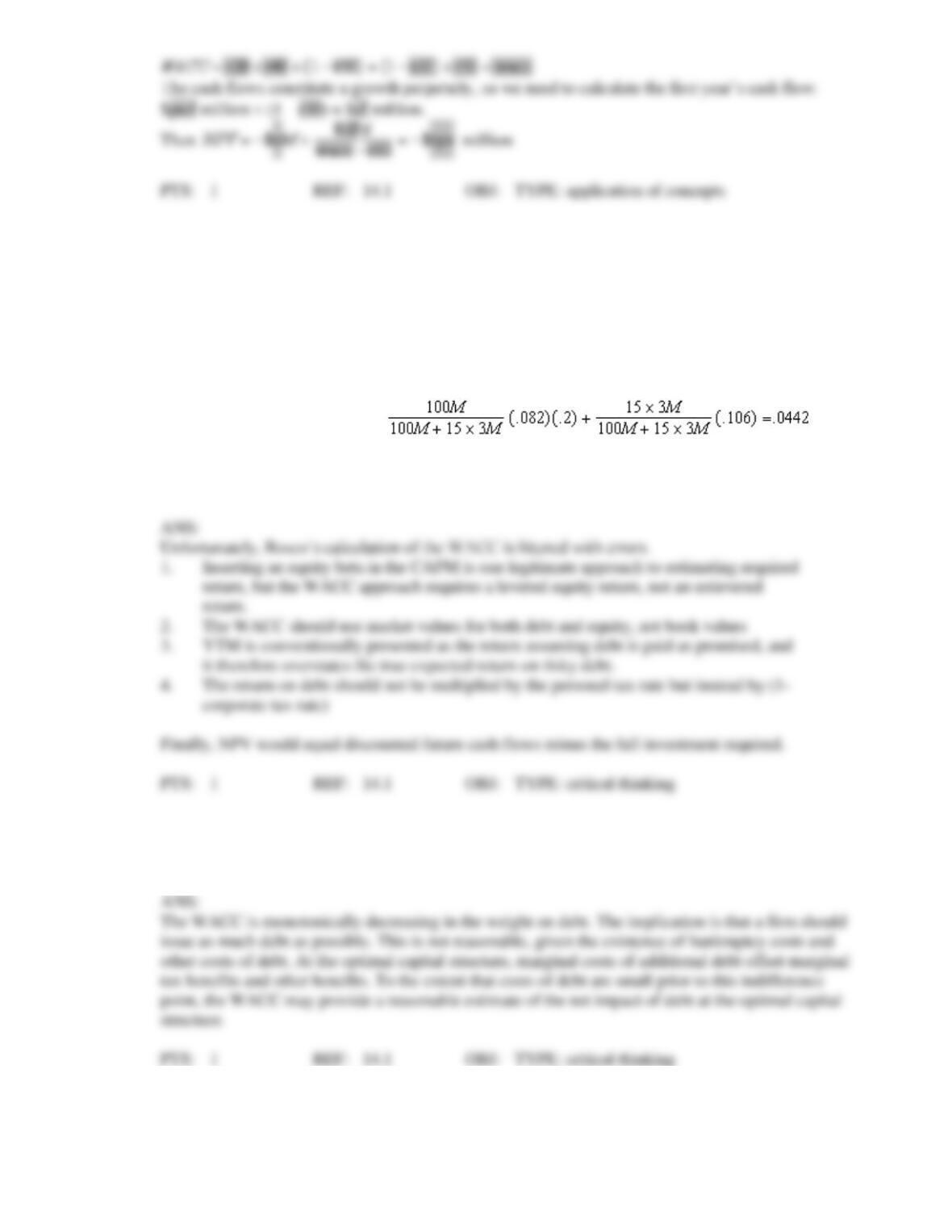
3. Rosco often makes mistakes when applying the WACC method to discount cash flows for his home
security company. Please help Rosco by noting anything that is clearly incorrect in his effort that he
describes below.
Our firm will maintain its current leverage ratio. Therefore, I estimate our unlevered equity beta and
find that it is 1.6, while the market risk premium is 3.5%. Given a risk-free rate of 5%, our expected
return on equity is 1.6*3.5%+5%=10.6%. Our debt, which is rated B, has yield to maturity of 8.2%.
Our firm has 3 million shares, book value per share of $15, and long-term debt of $100 million. Also,
our investors face a personal tax rate 20% on interest. Therefore, I will discount cash flows by a
weighted average cost of capital
I will use this rate to discount cash flows from my project that are calculated as if my firm had no
leverage, and I will accept the project if the discounted cash flows exceed the value of debt we will
use.
4. Assume that a firm will select a constant leverage ratio so that the WACC method is relevant. What
would be the best degree of leverage according to the WACC formula, and what does your answer
imply regarding the validity of the WACC as a discount rate?
5. Your firm has initially has debt with market value $d billion and equity with market value $e billion.
The firm can invest $ci million today and receive an expected cash flow, after taxes, of $c1 million
next year and $c1 million the following year. The project would be financed with $f1 million of equity
and $f2 million of debt, and the debt would be repaid after 1 year. Your firm’s required return on
equity is r1% and the required return on debt is r2%. The tax rate is r3%.
Use the firm’s existing WACC to find the NPV, and then comment on whether use of the WACC
approach in this context likely leads to an over-or understated value.
6. Consider a firm that currently has current debt and equity market values of $200 million and $1
billion, respectively. The expected growth rate of the firm as a whole is 0, and the expected change in
its debt is zero. Suppose there are two possibilities for debt policy: either debt is fixed at $200 million
forever, or debt will be set at a constant fraction of equity, such that if the firm does unexpectedly well
debt rises, while debt will be retired should the firm value unexpectedly drop. Why might the value of
tax shields be dependent on the choice of debt policy? Which policy would you expect to yield a
higher firm value?
7. Scones and More Inc. (SAM), is considering investing in a large baking facility. Capital expenditure
today would be $ce, which could be depreciated straight line over 5 years. New revenues and costs
(both pretax) generated by the plant over the next 5 years would be (in millions):
Year
1
2
3
4
5
Revenues
$rev1
$rev2
$rev3
$rev4
$rev5
Costs
$cost1
$cost2
$cost3
$cost4
$cost5
The firm faces a tax rate of tr% and always has positive taxable income (even incorporating this
project). Beyond year 5, assume that net cash flows will stay constant in perpetuity. Suppose the beta
of this project is beta, the market risk premium is rp%, and the risk-free rate is rfr%. SAM has current
debt and equity values of $10 million and $70 million, respectively. This new project would allow
financing of $5 million of risk-free debt (paying the risk-free rate) and $15 million of equity initially.
At year 5, an additional $2 million of debt would be issued to pay some of that year’s costs, and debt
would then be maintained at $12 million in perpetuity.
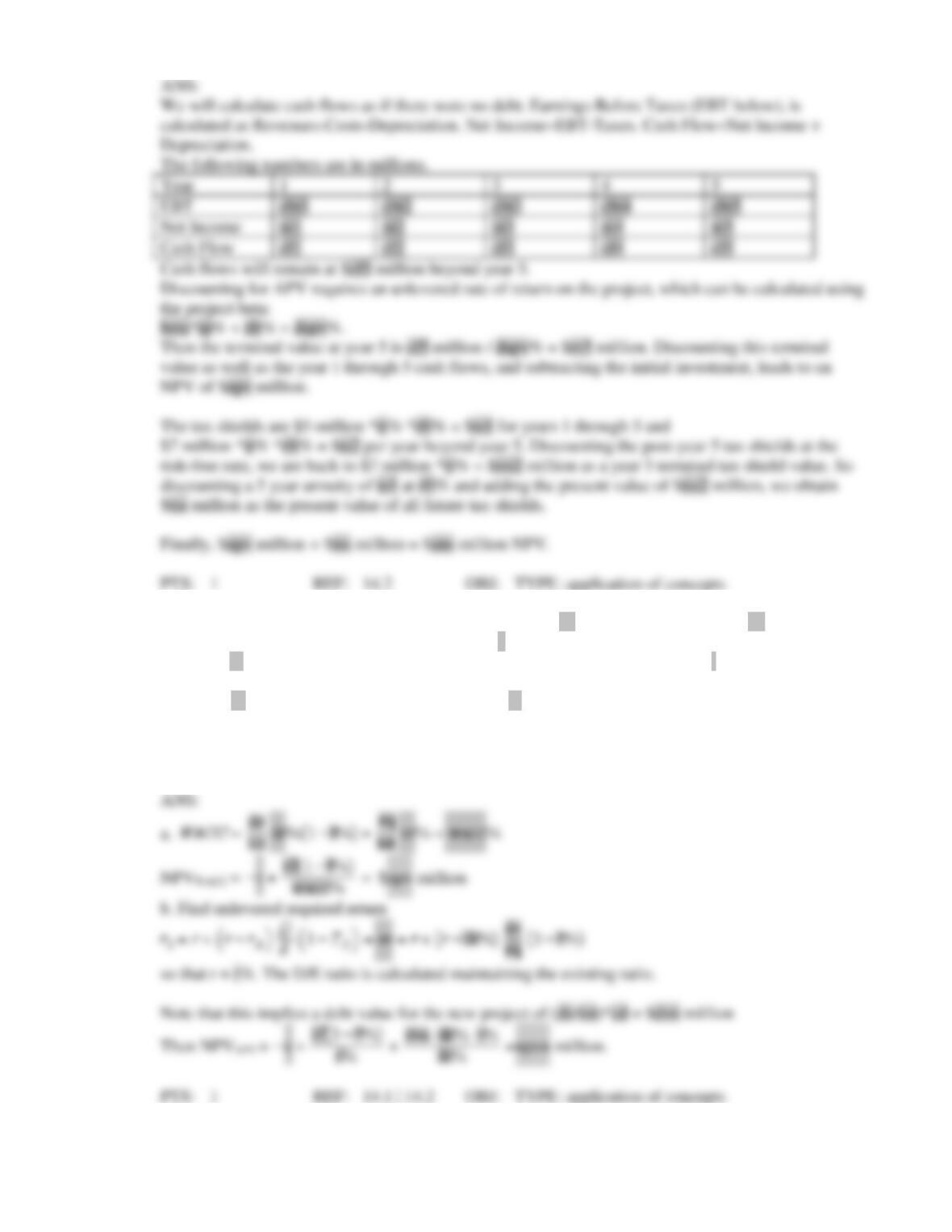
Perform an APV analysis of the project to determine its NPV.
8. LardMart Stores, Inc. has current market value of equity $eq Billion, and debt value $dv Billion. It is
investigating an expansion that would require a $c million outlay today and return annual pretax cash
flows of $cf million in perpetuity, starting one year from now. LardMart faces a t% tax rate. It intends
to maintain its current debt to equity ratio over time with the new project. The pre-tax required return
on debt is dr% and the required return on equity is er%.
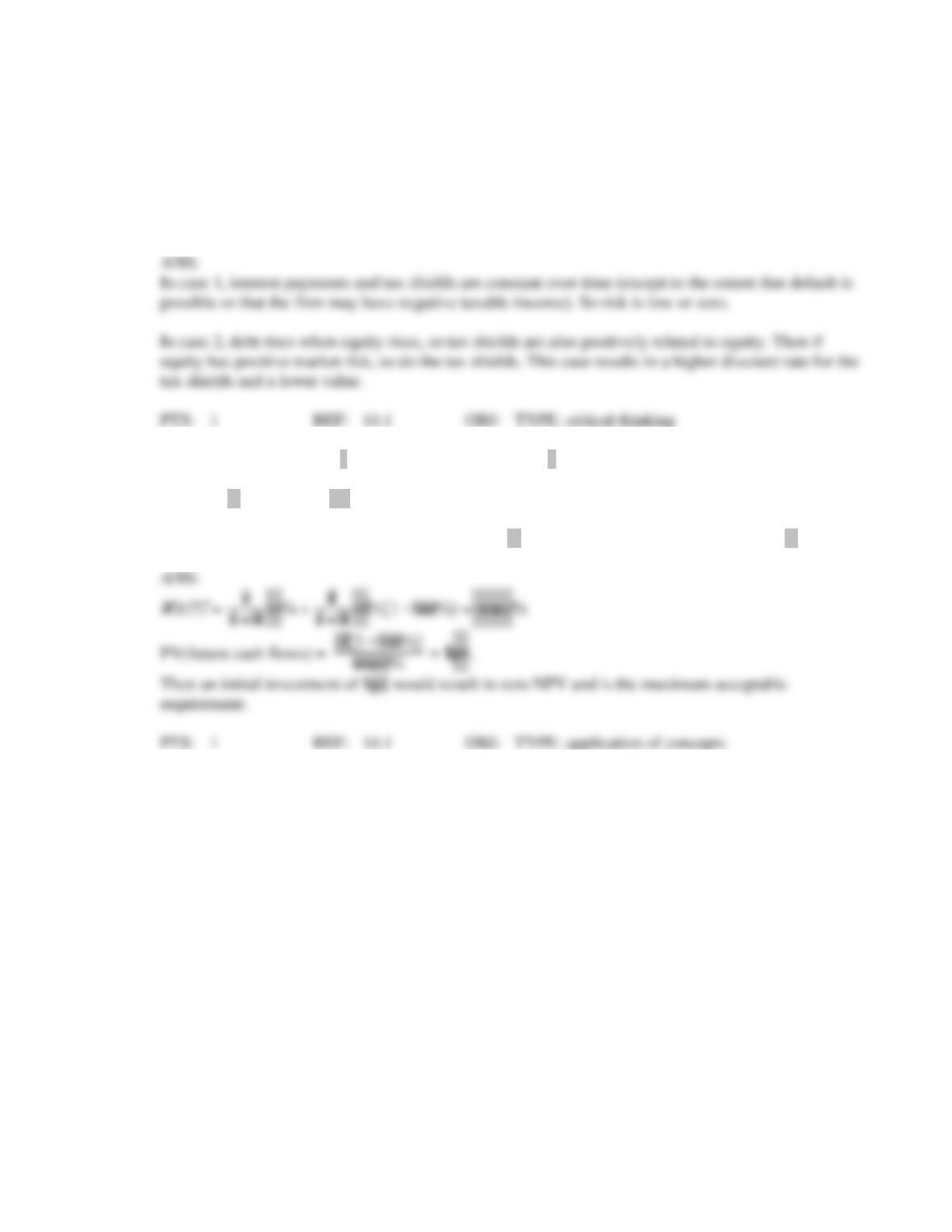
a. Calculate the NPV using WACC
b. Show that the same NPV obtains under APV, provided the debt-to-value ratio applies to the value of
future cash flows, not the amount of the initial investment.
9. Why would it matter what a firm’s debt policy is when selecting amongst discount rates? To be more
specific, consider a firm that has level perpetual cash flows and for which the expected amount of debt
and equity is also constant. Consider two possible debt policies:
1) No matter whether cash flows and equity rise or fall relative to their expected level, the debt will be
held at a constant dollar amount
2) Debt will be maintained at a constant fraction of equity.
Compare the risk of the interest tax shields and the discounted value of those tax shields under these
two scenarios.
10. Julie’s Juicers Corp. has $e market value of equity and $d market value of debt. JJC is considering a
new product line that will generate pre-tax expected annual cash flows (fully taxable, were there no
debt) of $cf. JJC faces a tax% tax rate. JJC is planning to maintain its current leverage ratio, no matter
what happens in the future. What is the maximum initial investment for which this project is
acceptable if the pre-tax required return on debt is rd% and the required return on equity is re%?