Chapter 14: Long-Term Liabilities: Bonds and Notes
119.
Any unamortized premium should be reported on the balance sheet of the issuing corporation as
a.
a direct deduction from the face amount of the bonds in the liabilities section
b.
as paid-in capital
c.
a direct deduction from retained earnings
d.
an addition to the face amount of the bonds in the liabilities section
120.
The balance in Discount on Bonds Payable that is applicable to bonds due in three years would be reported on
the
balance sheet in the section entitled
a.
investments
b.
long-term liabilities
c.
current assets
d.
intangible assets
Chapter 14: Long-Term Liabilities: Bonds and Notes
121.
Balance sheet and income statement data indicate the following:
Bonds payable, 6% (due in 15 years)
Preferred 8% stock, $100 par
(no change during the year)
$1,200,000
200,000
Common stock, $50 par
(no change during the year)
1,000,000
Income before income tax for year
320,000
Income tax for year
80,000
Common dividends paid
60,000
Preferred dividends paid
16,000
Based on the data presented above, what is the number of times bond interest charges were earned (round to two
decimal places)?
a. 5.00
b. 5.44
c. 4.00
d. 4.33
122.
Debtors are interested in the number of times interest charges are earned because they want to
a.
know what rate of interest the corporation is paying
b.
have adequate protection against a potential drop in earnings jeopardizing their interest payments
c.
be sure their debt is backed by collateral
d.
know the tax effect of lending to a corporation
Chapter 14: Long-Term Liabilities: Bonds and Notes
123.
Numbers of times interest charges are earned is computed as
a.
Income Before Income Taxes plus Interest Expense divided by Interest Expense
b.
Income Before Income Taxes less Interest Expense divided by Interest Expense
c.
Income Before Income Taxes divided by Interest Expense
d.
Income Before Income Taxes plus Interest Expense divided by Interest Revenue
124.
Balance sheet and income statement data indicate the following:
Bonds payable, 6% (this is year 4 of 20 years)
Preferred 8% stock, $100 par
(no change during the year)
$1,200,000
200,000
Common stock, $50 par
(no change during the year)
1,000,000
Income before income tax for year
340,000
Income tax for year
80,000
Common dividends paid
60,000
Preferred dividends paid
16,000
Based on the data presented above, what is the number of times bond interest charges were earned (round to two
decimal places)?
a. 5.72
b. 6.83
c. 4.72
d. 4.83
Chapter 14: Long-Term Liabilities: Bonds and Notes
125.
The present value of $40,000 to be received in two years, at 12% compounded annually, is (rounded to
nearest
dollar)
a. $31,888
b. $48,112
c. $8,112
d. $40,000
126.
A corporation issues for cash $9,000,000 of 8%, 30-year bonds, interest payable semiannually. The
amount
received for the bonds will be
a.
present value of 60 semiannual interest payments of $300,000, plus present value of $9,000,000 to be
repaid
in 30 years
b.
present value of 30 annual interest payments of $600,000
c.
present value of 30 annual interest payments of $600,000, plus present value of $9,000,000 to be repaid
in
30years
d.
present value of $9,000,000 to be repaid in 30 years, less present value of 60 semiannual interest payments of
$300,000
127.
The present value of $60,000 to be received in one year, at 6% compounded annually, is (rounded to nearest
dollar)
a. $56,604
b. $63,396
c. $60,000
d. $3,396
Chapter 14: Long-Term Liabilities: Bonds and Notes
128.
When the market rate of interest was 12%, Halprin Corporation issued $1,000,000, 11%, 10-year bonds that
pay
interest annually. The selling price of this bond issue was
a. $321,970
b. $1,000,000
c. $943,494
d. $621,524
129.
The Designer Company issued 10-year bonds on January 1. The 6% bonds have a face value of $800,000 and
pay
interest every January 1 and July 1. The bonds were sold for $690,960 based on the market interest rate of
8%. Designer uses the effective interest method to amortize bond discounts and premiums. On July 1, of the
first
year, Designer should record interest expense (round to the nearest dollar) of
a. $27,638
b. $24,000
c. $48,000
d. $55,277
130.
The Merchant Company issued 10-year bonds on January 1. The 15% bonds have a face value of $100,000 and
pay interest every January 1 and July 1. The bonds were sold for $117,205 based on the market interest rate of
12%. Merchant uses the effective interest method to amortize bond discounts and premiums. On July 1 of the
first
year, Merchant should record interest expense (round to the nearest dollar) of
a. $7,032
b. $7,500
c. $8,790
d. $14,065
Chapter 14: Long-Term Liabilities: Bonds and Notes
131.
When the effective interest method is used, the amortization of the bond premium
a.
increases interest expense each period
b.
decreases interest expense each period
c.
increases interest expense in some periods and decreases interest expense in other periods
d.
has no effect on the interest expense in any period
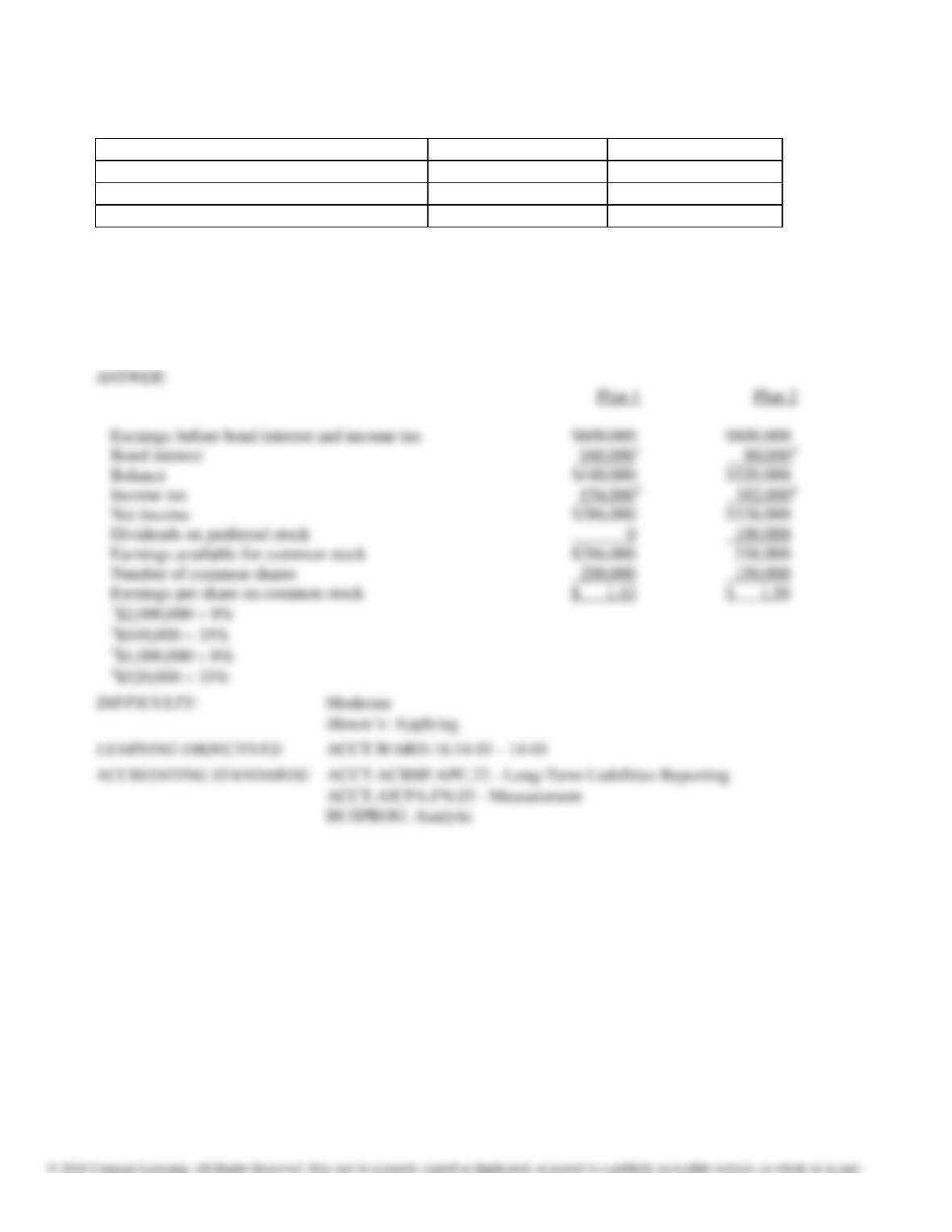
132. Two companies are financed as follows:
Bonds payable, 9% issued at face
X Co.
$5,000,000
Y Co.
$3,000,000
Common stock, $25 par
3,000,000
3,000,000
Income tax is estimated at 40% of income for both companies.
Determine for each company the earnings per share of common stock, assuming that the income before bond
interest and income taxes is $2,280,000 each.
Chapter 14: Long-Term Liabilities: Bonds and Notes
133.
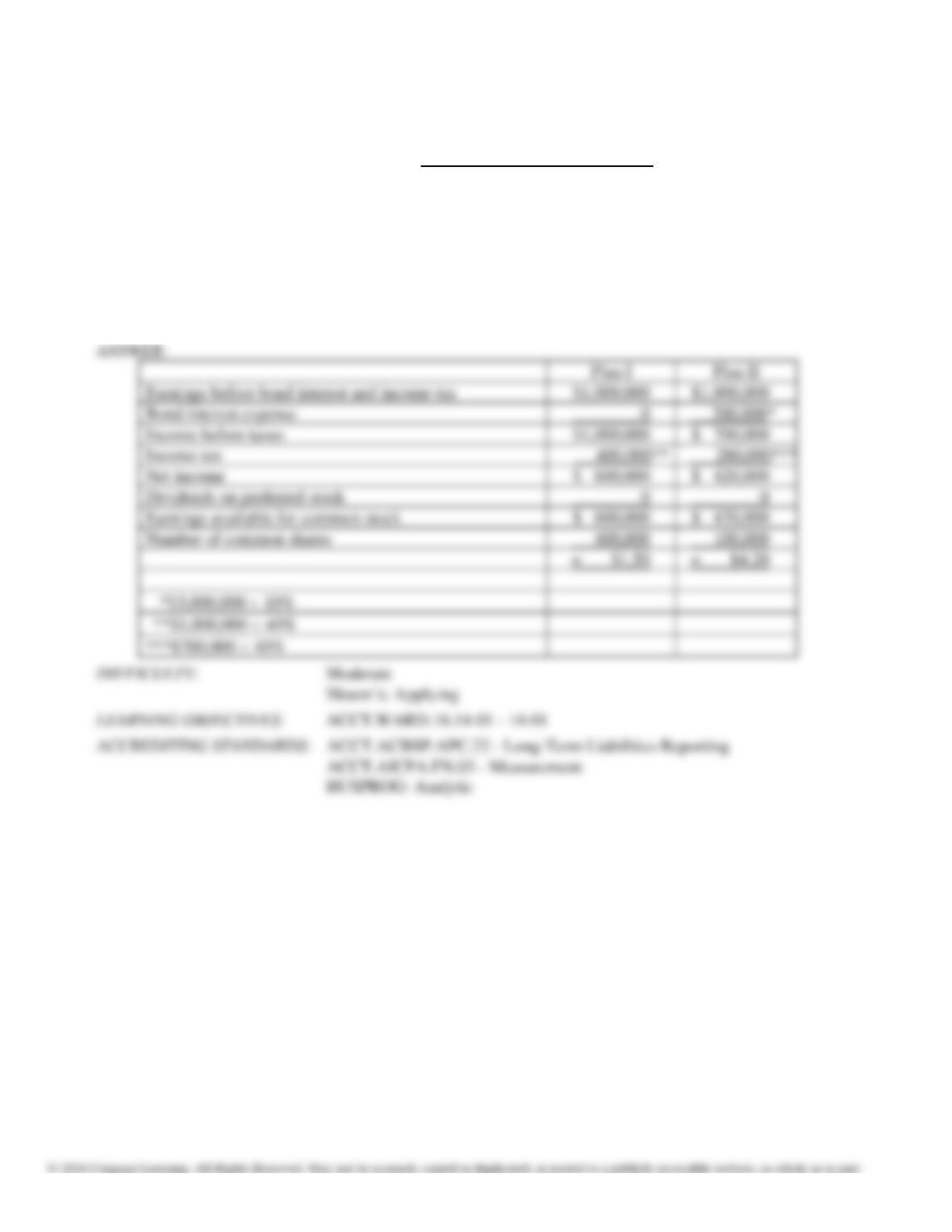
Ulmer Company is considering the following alternative financing plans:
Plan 1
Plan 2
Issue 8% bonds at face value
$2,000,000
$1,000,000
Issue preferred stock, $15 par
—
1,500,000
Issue common stock, $10 par
2,000,000
1,500,000
Income tax is estimated at 35% of income. Dividends of $1 per share were declared and paid on the preferred
stock.
Required: Determine the earnings per share of common stock, assuming income before bond interest and income
tax is $600,000.
Chapter 14: Long-Term Liabilities: Bonds and Notes
134.
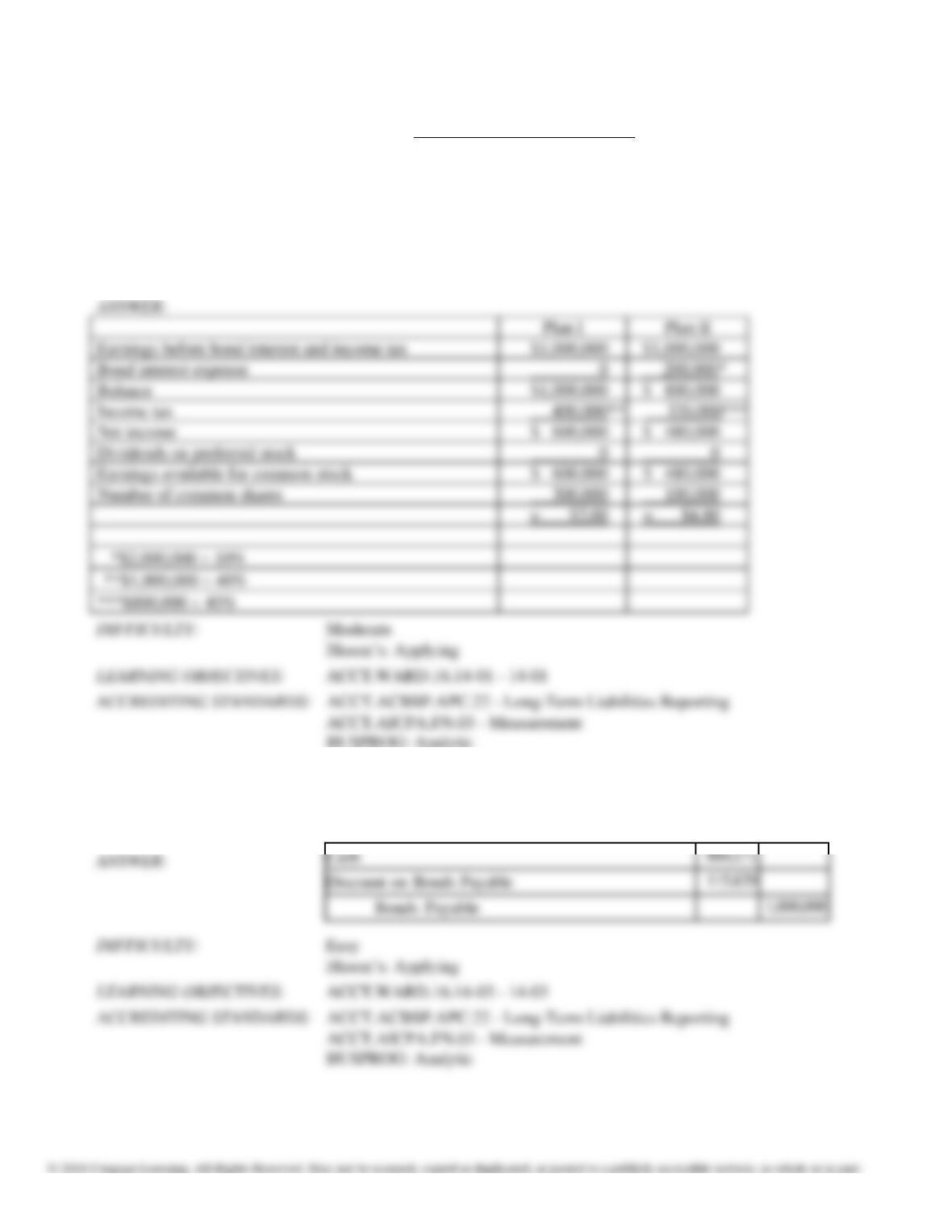
Sorenson Co., is considering the following alternative plans for financing the company:
Plan I
Plan II
Issue 10% bonds (at face)
—
$3,000,000
Issue $10 par common stock
$4,000,000
1,000,000
Income tax is estimated at 40% of income.
Determine the earnings per share of common stock under the two alternative financing plans, assuming
income
before bond interest and income tax is $1,000,000.
Chapter 14: Long-Term Liabilities: Bonds and Notes
135. Jenson Co. is considering the following alternative plans for financing the company:
Plan I
Plan II
Issue 10% bonds (at face)
—
$2,000,000
Issue $10 common stock
$3,000,000
1,000,000
Income tax is estimated at 40% of income.
Determine the earnings per share of common stock under the two alternative financing plans, assuming
income
before bond interest and income tax is $1,000,000.
Plan II
Earnings before bond interest and income tax
$1,000,000
Bond interest expense
Balance
$ 800,000
Income tax
400,000**
Net income
$ 480,000
Dividends on preferred stock
0
Earnings available for common stock
Number of common shares
136.
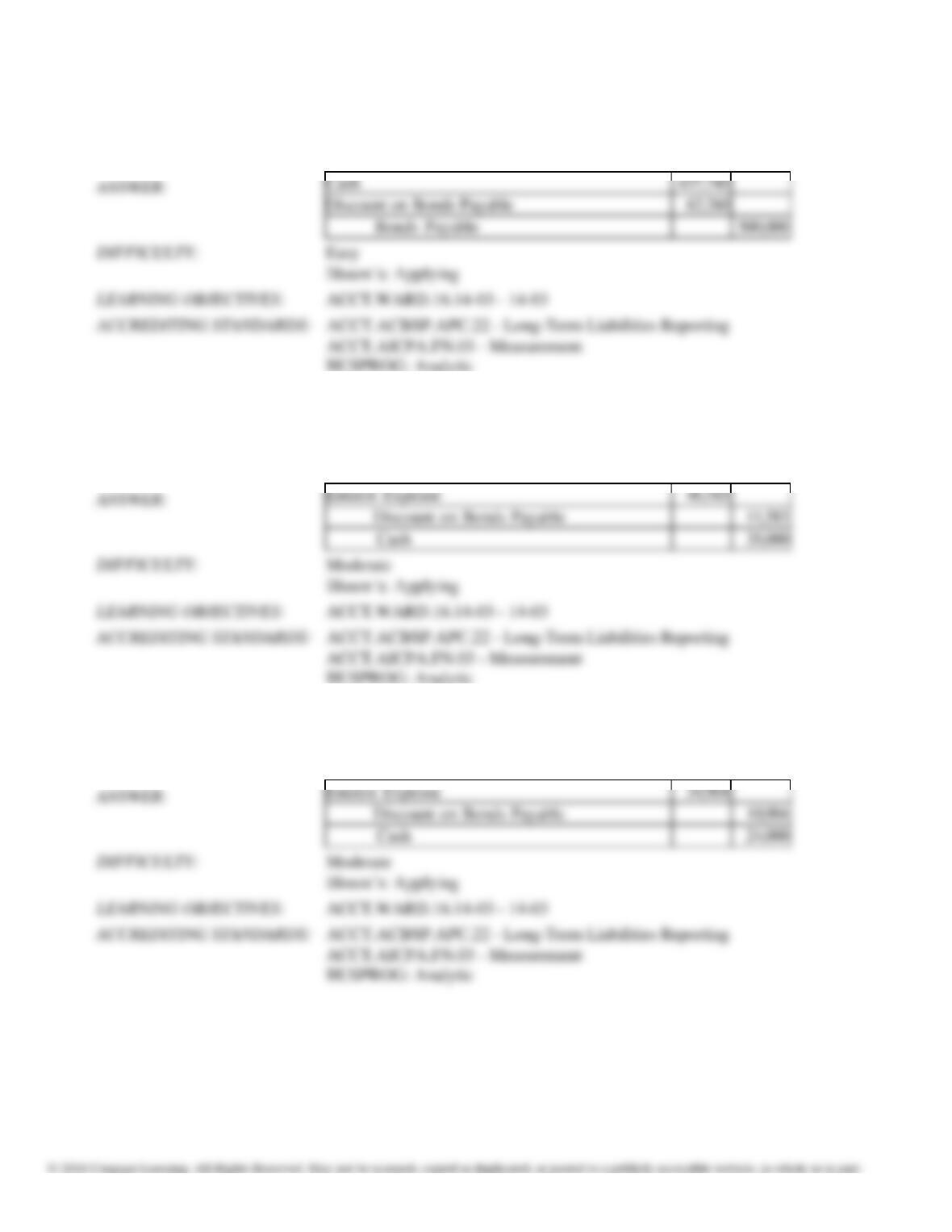
On the first day of the fiscal year, a company issues a $1,000,000, 7%, 5-year bond that pays semiannual
interest of $35,000 ($1,000,000 × 7% × 1/2), receiving cash of $884,171. Journalize the entry to record the
issuance of the
bonds.
Chapter 14: Long-Term Liabilities: Bonds and Notes
137.
On the first day of the fiscal year, a company issues a $500,000, 8%, 10-year bond that pays semiannual
interest of $20,000 ($500,000 × 8% × 1/2), receiving cash of $437,740. Journalize the entry to record the
issuance of the
bonds.
138.
On the first day of the fiscal year, a company issues a $1,000,000, 7%, 5-year bond that pays semiannual
interest of $35,000 ($1,000,000 × 7% × 1/2), receiving cash of $884,171. Journalize the first interest payment
and the
amortization of the related bond discount using the straight-line method. Round answers to the nearest
dollar.
139.
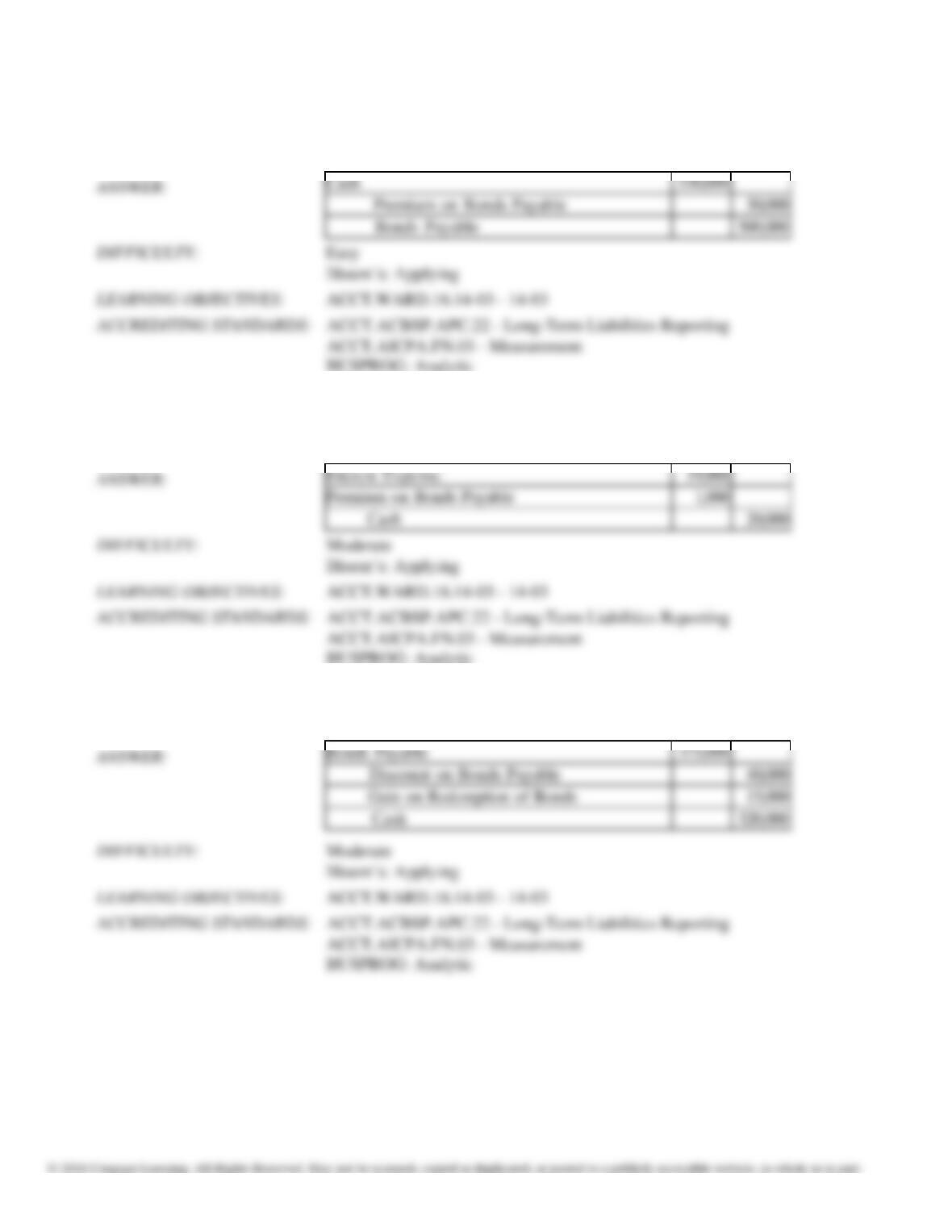
On the first day of the fiscal year, a company issues a $800,000, 6%, 5-year bond that pays semiannual
interest of $24,000 ($800,000 × 6% × 1/2), receiving cash of $690,960. Journalize the entry to record the first
interest
payment and the amortization of the related bond discount using the straight-line method.
Chapter 14: Long-Term Liabilities: Bonds and Notes
140.
On the first day of the fiscal year, a company issues a $500,000, 8%, 10-year bond that pays semiannual
interest of $20,000 ($500,000 × 8% × 1/2), receiving cash of $530,000. Journalize the entry to record the
issuance of the
bonds.
141.
On the first day of the fiscal year, a company issues a $500,000, 8%, 10-year bond that pays semiannual
interest of $20,000 ($500,000 × 8% × 1/2), receiving cash of $520,000. Journalize the entry to record the first
interest
payment and amortization of premium using the straight-line method.
142.
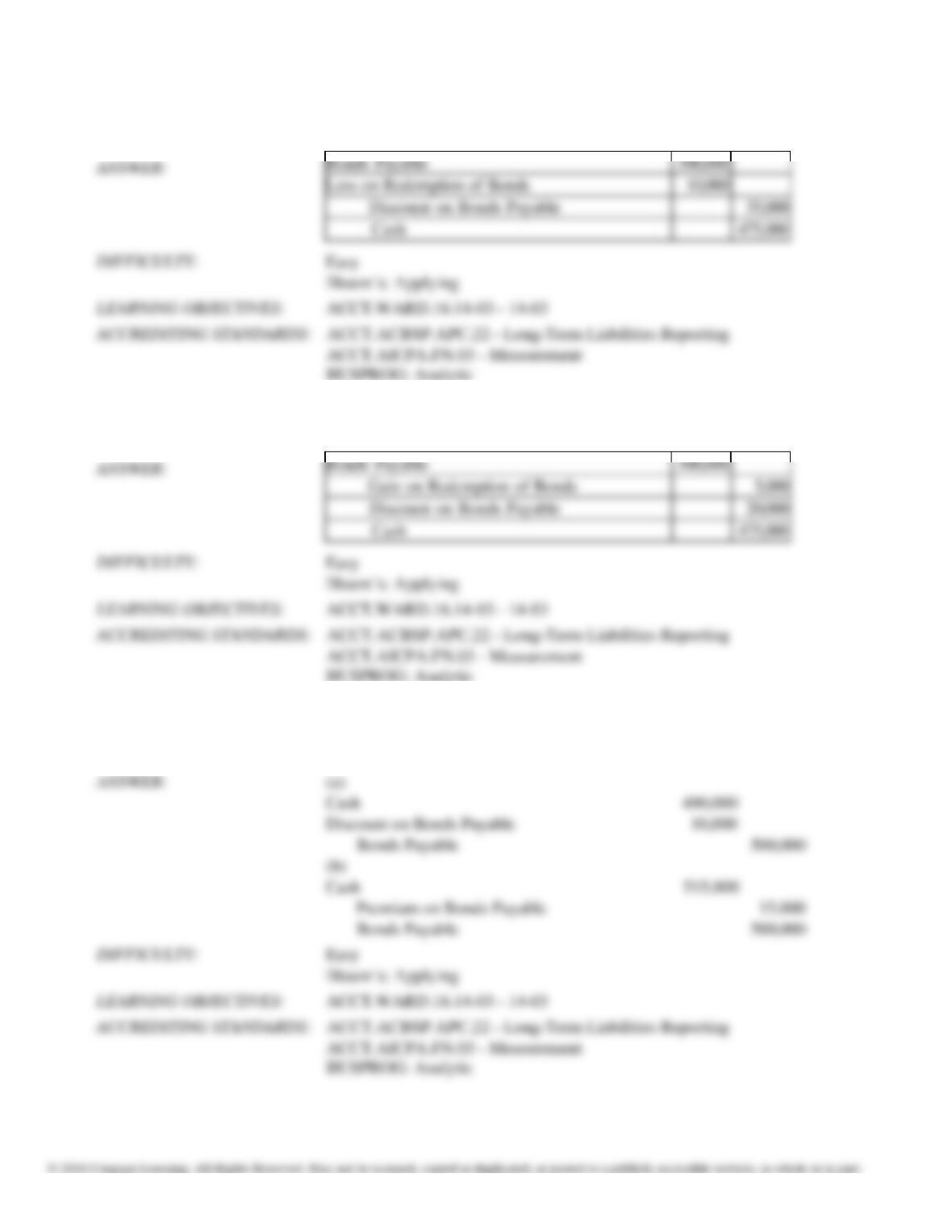
A $375,000 bond issue on which there is an unamortized discount of $40,000 is redeemed for $320,000.
Journalize
the redemption of the bonds.
Chapter 14: Long-Term Liabilities: Bonds and Notes
143.
A $500,000 bond issue on which there is an unamortized discount of $35,000 is redeemed for $475,000.
Journalize
the redemption of the bonds.
144.
A $500,000 bond issue on which there is an unamortized discount of $20,000 is redeemed for $475,000.
Journalize
the redemption of the bonds.
145. (a.) Prepare the journal entry to issue $500,000 bonds that sold for $490,000.
(b.) Prepare the journal entry to issue $500,000 bonds that sold for $515,000.
Chapter 14: Long-Term Liabilities: Bonds and Notes
146.
Brubeck Co. issued $10,000,000 of 30-year, 8% bonds on May 1 of the current year, with interest payable on
May
1 and November 1. The fiscal year of the company is the calendar year. Journalize the entries to record the
following selected transactions for the current year:
May 1 Issued the bonds for cash at their face amount.
Nov. 1 Paid the interest on the bonds.
Dec. 31 Recorded accrued interest for two months.
147.
On the first day of the current fiscal year, $1,500,000 of 10-year, 8% bonds, with interest payable
semiannually,
were sold for $1,225,000. Present entries to record the following transactions for the current
fiscal year:
(a)
Issuance of the bonds.
(b)
First semiannual interest payment (record as separate entry from discount amortization).
(c)
Amortization of bond discount for the year, using the straight-line method of amortization.
Chapter 14: Long-Term Liabilities: Bonds and Notes
148.
On the first day of the current fiscal year, $2,000,000 of 10-year, 7% bonds, with interest payable annually,
were
sold for $2,125,000. Present entries to record the following transactions for the current fiscal year.
(a)
Issuance of the bonds.
(b)
First annual interest payment (record as separate entry from premium amortization).
(c)
Amortization of bond premium for the year, using the straight-line method of amortization.
149.
On August 1, Clayton Co. issued $1,300,000 of 20-year, 9% bonds, dated August 1, for $1,225,000. Interest is
payable semiannually on February 1 and August 1. Present the entries to record the following transactions for
the
current year.
(a)
Issuance of the bonds.
(b)
Accrual of interest and amortization of bond discount for the first year, on December
31,
using the straight-line method. Round to the nearest dollar when necessary.
Chapter 14: Long-Term Liabilities: Bonds and Notes
150.
On the first day of the fiscal year, Lisbon Co. issued $1,000,000 of 10-year, 7% bonds for $1,050,000, with
interest
payable semiannually. Orange Inc. purchased the bonds on the issue date for the issue price. Prepare
entries to
record the following transactions for the current fiscal year.
(a)
Issuance of the bonds.
(b)
Second semiannual interest payment.
(c)
Amortization of bond premium for the first year, using the straight-line method
of
amortization.
151.
Present entries to record the selected transactions described below:
(a)
Issued $2,750,000 of 10-year, 8% bonds at 97.
(b)
Amortized bond discount for a full year, using the straight-line method.
(c)
Called bonds at 98. The bonds were carried at $2,692,250 at the time of the redemption.