Cost Accounting: A Managerial Emphasis, 6e
Chapter 14 – Period Cost Allocation
40) AAA Fence Company manufactures wireless and aluminum fences in a common manufacturing
facility. The company has become aware of unusual discrepancies in the costs of its products which
management cannot explain. It seems that the sales and related production of wireless fences are in a very
consistent growth market and are easily predicted. However, the sales and related production of
aluminum fences are very erratic. Management does not understand why the costs per unit of wireless
fences change when the production level seldom changes.
Required:
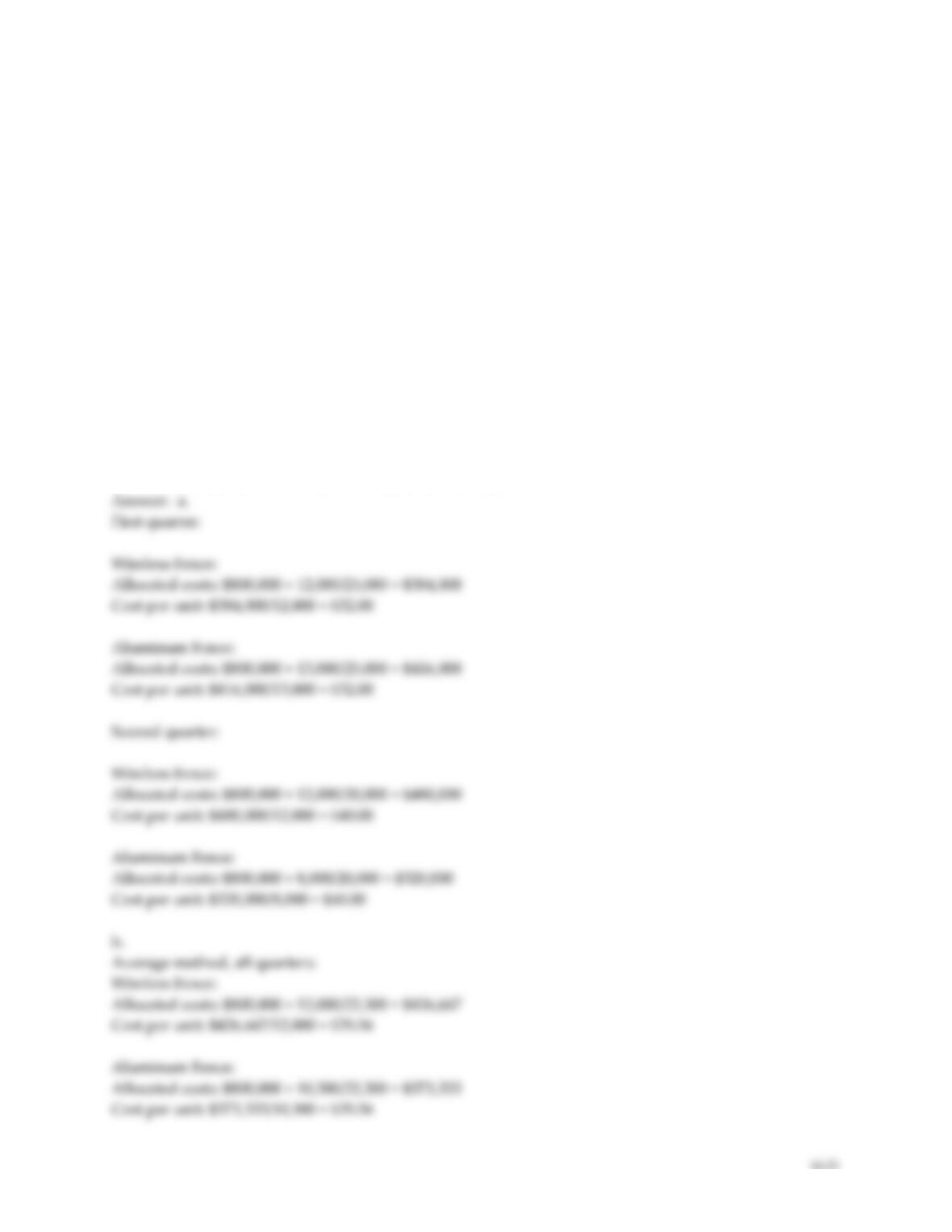
a. After some investigation you determine that for the last two quarters, the common fixed cost of the
manufacturing operation has been $800,000. For the first quarter 12,000 wireless and 13,000 aluminum
units were produced, respectively. For the second quarter, 12,000 wireless and 8,000 aluminum units
were produced, respectively. What were the total cost per product and the cost per unit of each product
in each quarter when production units is the allocation basis?
b. After studying the results of the above computations you decide to use the company’s average
quarterly production of 12,000 wireless and 10,500 aluminium units as the allocation base, respectively.
What are the total cost per product and the cost per unit per quarter for each product when average
production is used?
c. Which allocation base do you recommend, and why?
Cost Accounting: A Managerial Emphasis, 6e
Chapter 14 – Period Cost Allocation
41) The fixed costs of operating the maintenance facility of General Hospital are $4,500,000 annually.
Variable costs are incurred at the rate of $30 per maintenance-hour. The facility averages 40,000
maintenance-hours a year. Budgeted and actual hours per user for the year are as follows:
Budgeted hours Actual hours
Building and grounds 10,000 12,000
Operating and emergency 8,000 8,000
Patient care 21,000 22,000
Administration 1,000 1,200
Total 40,000 43,200
Assume that budgeted maintenance-hours are used to calculate the allocation rates.
Required:
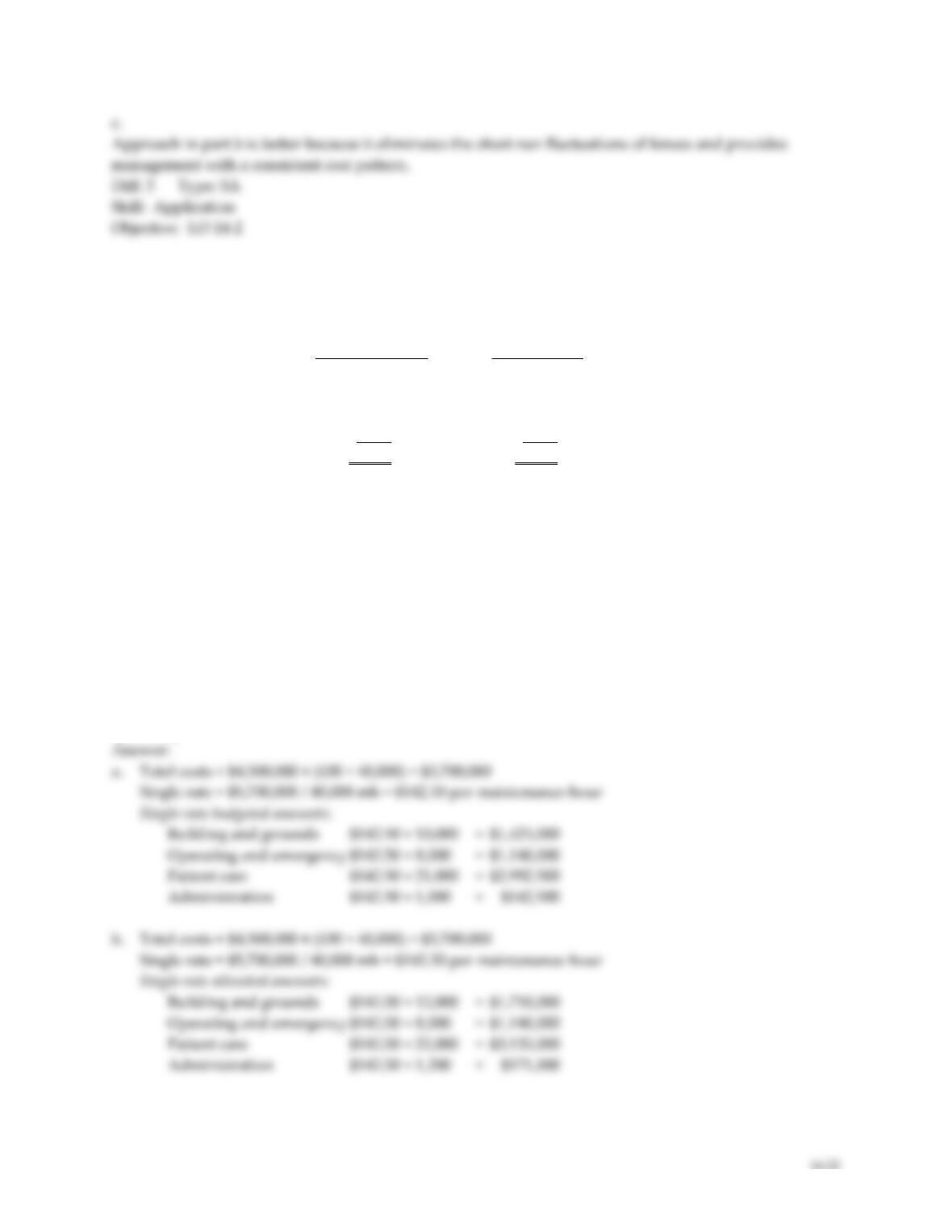
a. If a single-rate cost-allocation method is used, what amount of maintenance cost will be budgeted for
each department?
b. If a single-rate cost-allocation method is used, what amount of maintenance cost will be allocated to
each department based on actual usage?
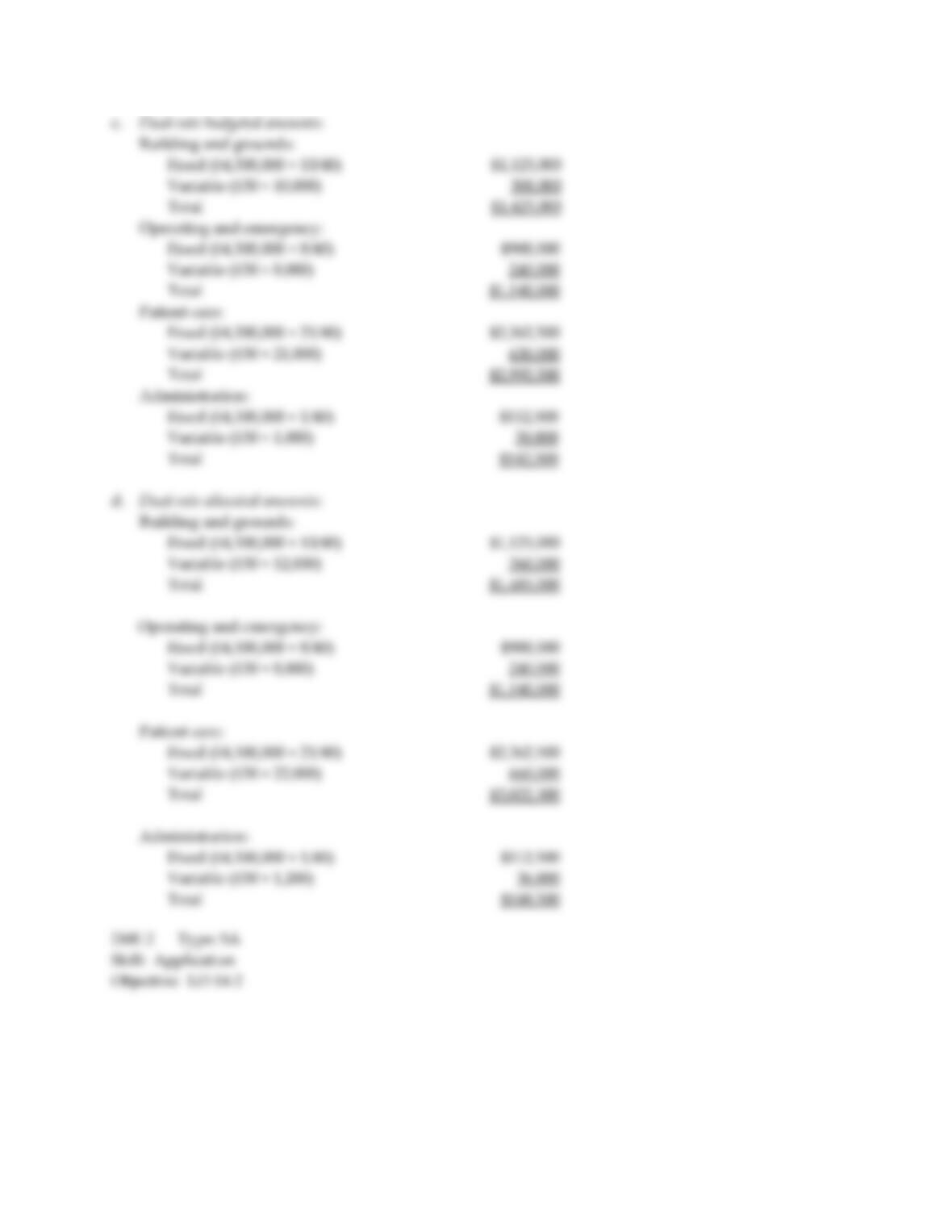
c. If a dual-rate cost-allocation method is used, what amount of maintenance cost will be budgeted for
each department?
d. If a dual-rate cost-allocation method is used, what amount of maintenance cost will be allocated to
each department based on budgeted usage for fixed operating costs and actual usage for variable
operating costs?
Cost Accounting: A Managerial Emphasis, 6e
Chapter 14 – Period Cost Allocation
14–23
Cost Accounting: A Managerial Emphasis, 6e
Chapter 14 – Period Cost Allocation
42) The Alex Miller Corporation operates one central plant that has two divisions, the Flashlight Division
and the Lamp Division. The following data apply to the coming budget year:
Budgeted costs of the operating the plant
for 10,000 to 20,000 hours:
Fixed operating costs per year $240,000
Variable operating costs $10 per hour
Practical capacity 20,000 hours per year
Budgeted long-run usage per year:
Lamp Division 800 hours × 12 months = 9,600 hours per year
Flashlight Division 450 hours × 12 months = 5,400 hours per year
Assume that practical capacity is used to calculate the allocation rates. Further assume that actual usage
of the Lamp Division was 700 hours and the Flashlight Division was 400 hours for the month of June.
Required:
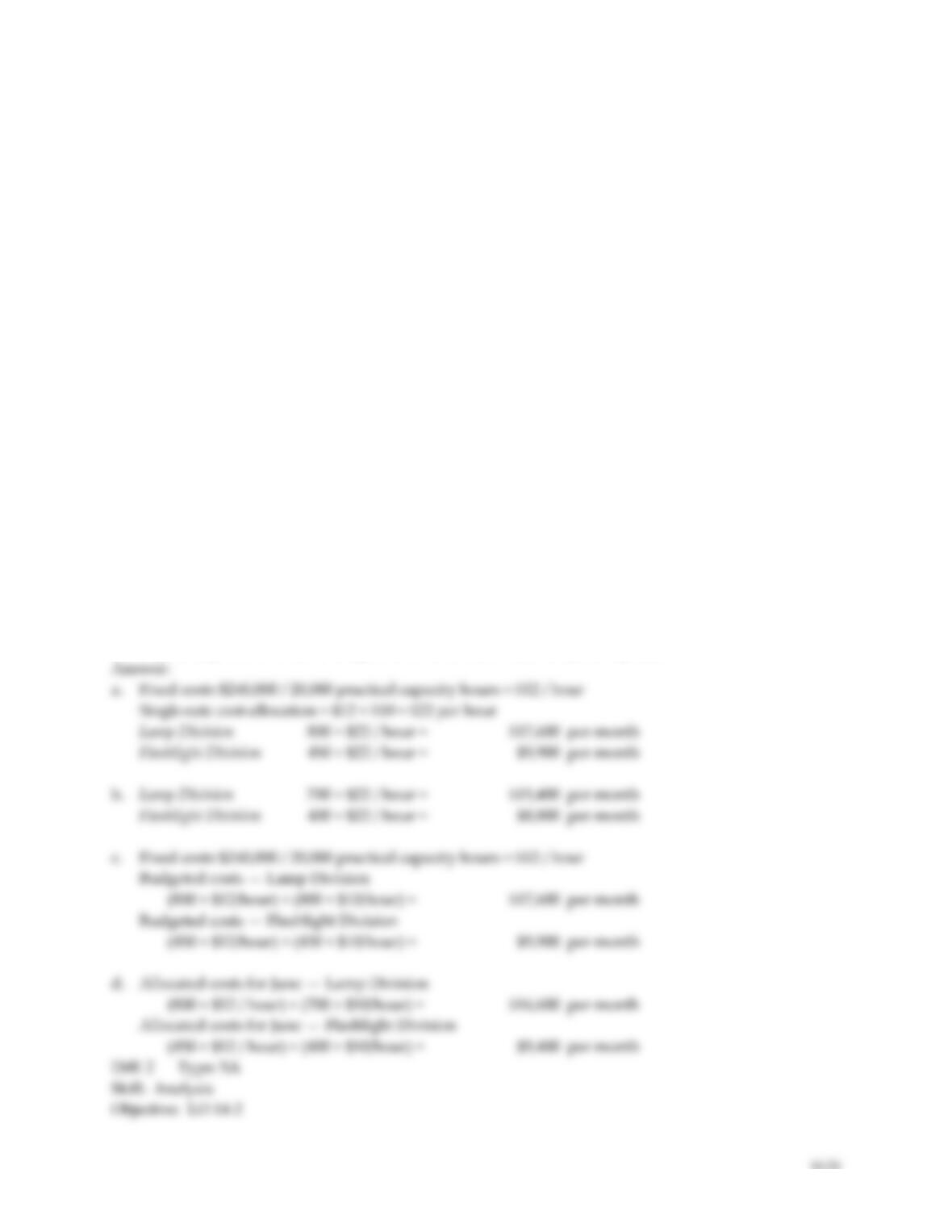
a. If a single-rate cost-allocation method is used, what amount of operating costs will be budgeted for
the Lamp Division each month? For the Flashlight Division each month?
b. For the month of June, if a single-rate cost-allocation method is used, what amount of cost will be
allocated to the Lamp Division? To the Flashlight Division? Assume actual usage is used to allocate
operating costs.
c. If a dual-rate cost-allocation method is used, what amount of operating costs will be budgeted for the
Lamp Division each month? For the Flashlight Division each month?
d. For the month of June, if a dual-rate cost-allocation method is used, what amount of cost will be
allocated to the Lamp Division? To the Flashlight Division? Assume budgeted usage is used to allocate
fixed operating costs and actual usage is used to allocate variable operating costs.
Cost Accounting: A Managerial Emphasis, 6e
Chapter 14 – Period Cost Allocation
43) Blaster Drive-In is a fast-food restaurant that sells burgers and hot dogs in a 1950s environment. The
fixed operating costs of the company are $5,000 per month. The controlling shareholder, interested in
product profitability and pricing, wants all costs allocated to either the burgers or the hot dogs. The
following information is provided for the operations of the company:
Burgers Hot Dogs
Sales for January 4,000 2,400
Sales for February 6,400 2,400
Required:
a. What amount of fixed operating costs is assigned to the burgers and hot dogs when actual sales are
used as the allocation base for January? For February?
b. Hot dog sales for January and February remained constant. Did the amount of fixed operating costs
allocated to hot dogs also remain constant for January and February? Explain why or why not. Comment
on any other observations.
14.3 Analyze how the selection of the single or dual cost allocation rate affects the
calculation of the efficiency variance.
1) The user department is responsible for any unfavourable cost variances during the budgeting period if
budgeted prices and quantities are used for cost allocation.
Cost Accounting: A Managerial Emphasis, 6e
Chapter 14 – Period Cost Allocation
2) User departments will be able to determine their allocated costs for each category in advance if
budgeted usage is the allocation base.
3) A budgeted rate helps to motivate the manager of a support department.
4) A support department adds value directly to a product or service, which is observable by the customer.
5) When budgeted cost-allocation rates are used, managers of the supplier division are motivated to
improve efficiency.
6) When budgeted cost-allocation rates are used, variations in actual usage by one division affect the costs
allocated to other divisions.
Cost Accounting: A Managerial Emphasis, 6e
Chapter 14 – Period Cost Allocation
7) When choosing between budgeted usage and actual usage as allocation bases, which of the following is
true?
A) Actual rates let users know in advance what their costs are.
B) When budgeted rates are used, users must wait till the end of the budget period to know what their
costs are.
C) With actual rates, a support department, rather than a user department, bears the risk of unfavourable
cost variances.
D) Budgeted rates may lead to user departments outsourcing needed work, rather than relying on an
internal support department.
E) Budgeted rates may help the manager of a support department to improve efficiency.
8) Fixed costs
A) should be allocated according to past production capacity.
B) should be allocated according to current usage.
C) should be allocated according to short-term expected usage.
D) should be allocated according to long-term expected usage.
E) should be allocated using actual usage as the allocation base.
Cost Accounting: A Managerial Emphasis, 6e
Chapter 14 – Period Cost Allocation
Use the information below to answer the following question(s).
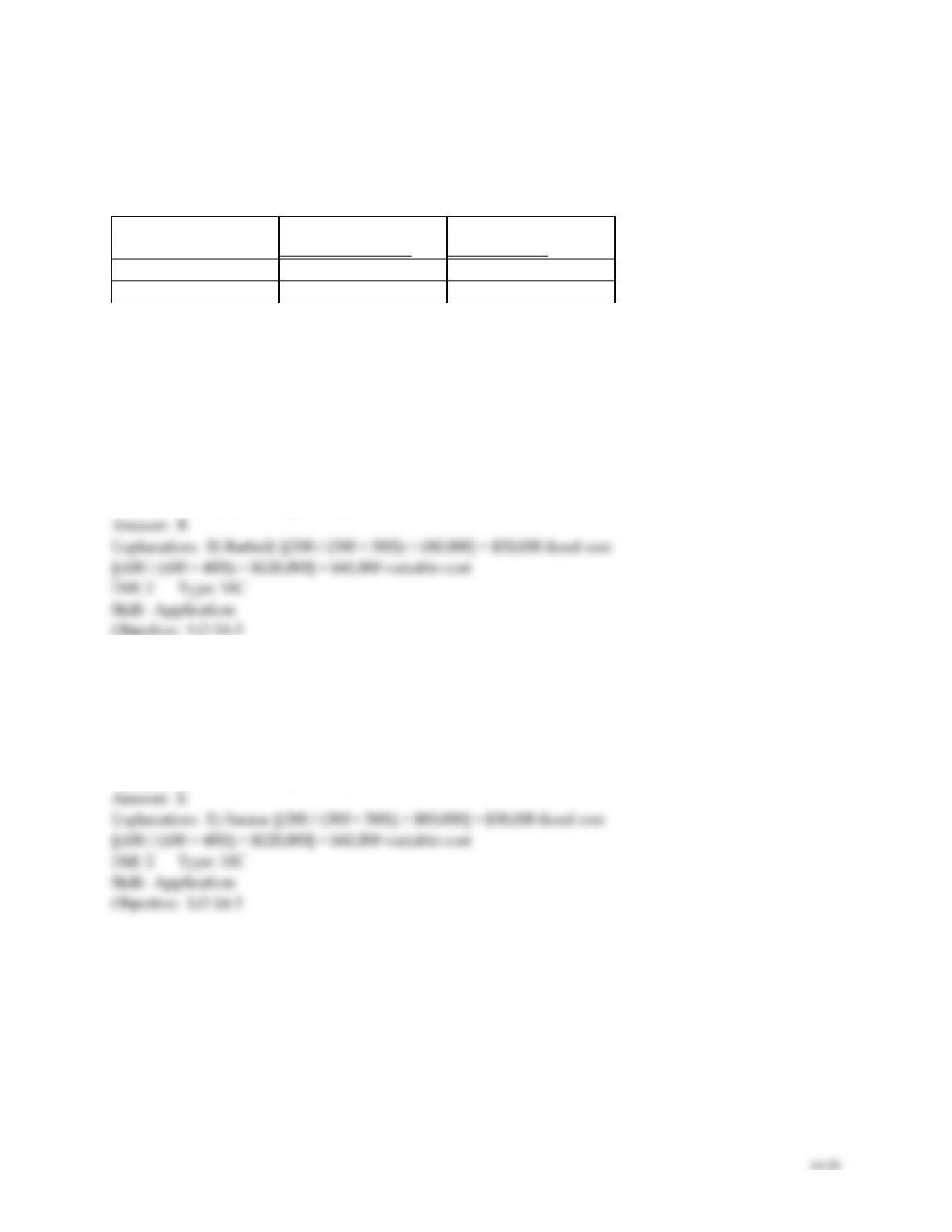
We Be Warehouse Fitness Equipment incurred $80,000 of common fixed costs and $120,000 of common
variable costs. Data are provided below for the capacity allowed and the capacity used.
Department
Capacity
Provided in Hours
Capacity
Used in Hours
Barbell Department
500
400
Sauna Department
300
400
For both departments, common fixed costs are to be allocated on the basis of capacity provided and
common variable costs are to be allocated on the basis of capacity used.
9) The fixed and variable costs allocated to the Barbell Department are
A) $50,000 and $75,000, respectively.
B) $50,000 and $60,000, respectively.
C) $30,000 and $75,000, respectively.
D) $30,000 and $60,000, respectively.
E) $30,000 and $50,000 respectively.
10) The fixed and variable costs allocated to the Sauna Department are
A) $50,000 and $75,000, respectively.
B) $50,000 and $60,000, respectively.
C) $30,000 and $75,000, respectively.
D) $30,000 and $50,000, respectively.
E) $30,000 and $60,000 respectively
Cost Accounting: A Managerial Emphasis, 6e
Chapter 14 – Period Cost Allocation
11) Both fixed and variable costs are allocated according to capacity used. The fixed and variable costs
allocated to the Barbell Department are
A) $30,000 and $50,000, respectively.
B) $30,000 and $60,000, respectively.
C) $30,000 and $75,000 respectively.
D) $40,000 and $60,000, respectively.
E) $60,000 and $40,000, respectively.
12) Both fixed and variable costs are allocated according to capacity used. The fixed and variable costs
allocated to the Sauna Department are
A) $30,000 and $50,000, respectively.
B) $30,000 and $60,000, respectively.
C) $30,000 and $75,000 respectively.
D) $40,000 and $60,000, respectively.
E) $60,000 and $40,000, respectively.
13) An advantage to using budgeted usage, rather than actual usage, for the allocation base is that
A) GAAP/IFRS requires it for comparability to previous years.
B) variable costs are lower.
C) management does not have to be accountable for actual costs since the system only deals with
budgeted costs.
D) it is consistent with a short-run time horizon.
E) user divisions will know their allocated costs in advance.
Cost Accounting: A Managerial Emphasis, 6e
Chapter 14 – Period Cost Allocation
14) A disadvantage of allocating fixed costs according to actual usage is that
A) managers may be tempted underestimate usage.
B) the allocation would capture the cause-and-effect relationship.
C) variation in usage will result in variances that need to be managed.
D) changes in one department’s usage should not affect another department’s allocation.
E) some organizations offer rewards to managers who make accurate forecasts.
15) Which of the following could be described as a department that adds value to a product or service, which is
observable by a customer?
A) a personnel department
B) an assigned department
C) a support department
D) a service department
E) an operating department
16) Which of the following does NOT apply to support departments?
A) A support department is not an operating department.
B) Support departments create special accounting problems when they provide reciprocal support to each
other.
C) An example of a support department would be a personnel department.
D) To obtain accurate product costs requires the inclusion of support department costs.
E) Direct support costs are always traced, indirect support department costs are allocated.
17) To discourage unnecessary use of a support department, management might
A) not allocate any support department costs to user departments.
B) allocate support department costs based upon user department usage.
C) allocate a fixed amount of support department costs to each department regardless of use.
D) issue memos on useful services provided by the support department.
E) allocate only variable costs based on budgeted usage.
Cost Accounting: A Managerial Emphasis, 6e
Chapter 14 – Period Cost Allocation
18) Correl Company’s power plant provides electricity for its two operating departments, A and B. The
year 2010 budget for the power plant shows:
Budgeted fixed costs $80,000
Budgeted variable costs
per kilowatt hour (kwh) $0.20
Additional data for 2008:
Budget Actual
(kwh) (kwh)
Department A 240,000 215,000
Department B 160,000 195,000
Actual power-plant costs: Fixed $92,000, variable $88,000
Required:
a. Compute the budgeted power-plant costs allocated to A and B using the single-rate method with
budgeted usage as the allocation base.
b. Compute the budgeted power-plant costs allocated to A and B using the dual-rate method with
actual usage as the allocation base for variable costs and budgeted usage as the allocation base for fixed
costs.
c. From the standpoint of Departments A and B, what are the two main benefits of the dual-rate
method?
Cost Accounting: A Managerial Emphasis, 6e
Chapter 14 – Period Cost Allocation
19) The cost of operating the quality control department of Ames Manufacturing includes $608,000 of
fixed costs and $400,000 of variable costs. The department normally budgets 21,000 inspection hours a
year. Two departments receive quality control checks, fabrication and assembly. Fabrication is budgeted
at 1,000 hours a month, while assembly is budgeted the remainder.
Required:
a. In July, fabrication used 1,000 inspection hours and assembly used 800 hours. How much did each
department receive in quality control costs assuming a single rate is used based on budgeted hours?
b. In August, fabrication used 1,200 inspection hours and assembly used 900 hours. How much did
each department receive in quality control costs assuming a dual rate is used with budgeted usage for
fixed costs and actual usage for variable costs?
Cost Accounting: A Managerial Emphasis, 6e
Chapter 14 – Period Cost Allocation
20) Marvelous Motors is a small motor supply outlet that sells motors to companies that make various
small motorized appliances. The fixed operating costs of the company are $300,000 per year. The
controlling shareholder, interested in product profitability and pricing, wants all costs allocated to the
motors and wants to review the company status on a quarterly basis. The shareholder is trying to
determine whether the costs should be allocated each quarter based on the 25% of the annual fixed
operating costs ($75,000) or by using an annual forecast budget to allocate the costs. The following
information is provided for the operations of the company:
Forecast Actual
Sales for First Quarter 5,000 4,850
Sales for Second Quarter 8,000 7,900
Sales for Third Quarter 8,000 8,125
Sales for Fourth Quarter 3,000 3,125
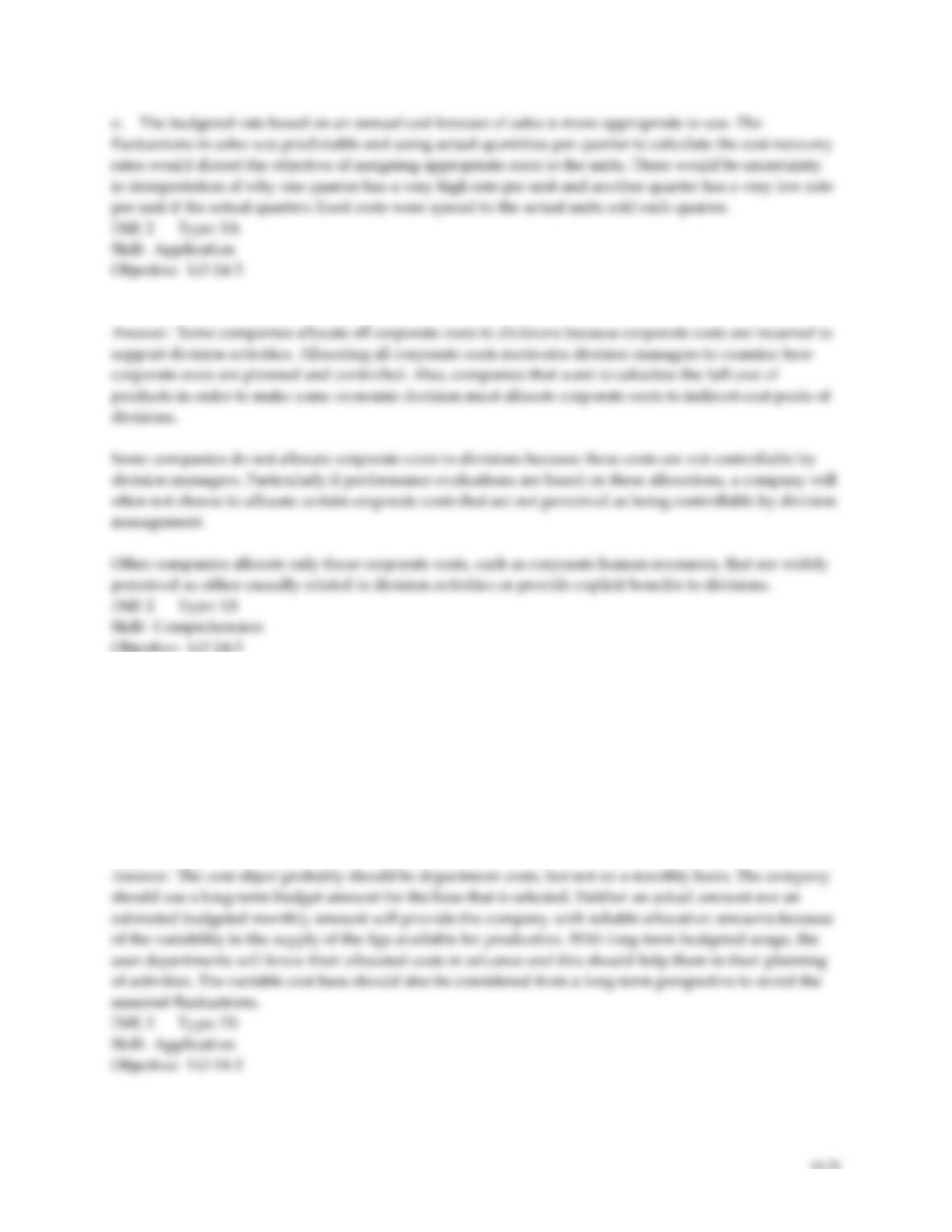
Required:
a. What amount of fixed operating costs are assigned to each motor by quarter when actual sales are
used as the allocation base and $75,000 is allocated?
b. How much fixed cost is recovered each quarter under requirement a.?
c. What amount of fixed operating costs are assigned to each motor by quarter when forecast sales are
used as the allocation base and the rate is calculated annually as part of the budgetary process?
d. How much fixed cost is recovered each quarter under requirement c.?
e. Which method seems more appropriate in this case? Explain.
Cost Accounting: A Managerial Emphasis, 6e
Chapter 14 – Period Cost Allocation
21) Should a company allocate its corporate costs to divisions?
22) Van Meter Company has substantial fluctuations in its production costs because of the seasonality of
figs. Most fig growers have two crops a year, one in June and one in August. However, the company has
been importing figs from southern hemisphere countries, which extends the supply to the months of
December and February.
Required:
What would you recommend as the monthly allocation base for the service departments of Van Meter
Company? State your assumed cost object. A conceptual answer is required, not an example, such as
cartons of figs.
Cost Accounting: A Managerial Emphasis, 6e
Chapter 14 – Period Cost Allocation
23) Brandy has been manager of the downtown branch of General Bank for several years. During this
time she has received very good annual evaluations for her management of the branch. However, during
the current year (it is now July) she has been upset with the monthly performance report generated by the
budgeting department at the home office. Her branch has been making steady progress with controlled
growth during the year and she knows of no reason why the report has such widely fluctuating
variances. One item that she suspects is causing some of the problem is that most of the costs of the bank
are fixed, with each branch getting an allocation of home office expenses each month. The bank also has
some branches which are fast growing and some of which are having operating difficulties.
Required:
From the information presented, what do you suggest as a possible cause of the reporting problems?
24) Why do organizations use budgeted rates instead of actual rates to allocate the costs of support
departments to each other and to user departments and divisions? Explain.
Cost Accounting: A Managerial Emphasis, 6e
Chapter 14 – Period Cost Allocation
14.4 Evaluate and select among three cost allocation methods for a product-sustaining
inventoriable period cost and a facilities-sustaining period cost.
1) The direct allocation method ignores any services rendered between support departments.
2) The step-down allocation method allows partial recognition of services rendered by support
departments to other support departments.
3) The reciprocal allocation method does not incorporate interdepartmental relationships fully into the
support department cost allocations.
4) The direct allocation method provides key information for outsourcing decisions regarding support
services.
5) The step-down method allocates support department costs to other support departments and to
operating departments in a sequential manner.
6) The reciprocal method of support department cost allocation is the most precise method and therefore
is used most often.
Cost Accounting: A Managerial Emphasis, 6e
Chapter 14 – Period Cost Allocation
7) To discourage excessive use of a support department, management might
A) not allocate any costs of the support departments.
B) allocate costs based on user department usage.
C) allocate a fixed amount to each department regardless of use.
D) expense fixed costs of support departments directly to the income statement.
E) create special accounting records for the support department.
8) Which of the following is the most widely used method of allocating support department costs?
A) linear equation method
B) step-down method
C) hybrid method
D) reciprocal method
E) direct allocation method
Use the information below to answer the following question(s).
Joe’s Tire Company has two support departments, Personnel and Maintenance. The Maintenance
Department costs of $80,000 are allocated on the basis of standard service hours used. The Personnel
Department costs of $20,000 are allocated based on the number of employees. Costs of Departments A
and B are $40,000 and $60,000, respectively.
Data on standard service hours and number of employees are as follows:
Maintenance
Dept.
Personnel
Dept.
Production
Dept. A
Production
Dept. B
Standard service hours used
200
200
240
160
Number of employees
10
20
40
120
9) How much of the cost of the Maintenance Department is allocated to Department B using the direct
method?
A) $60,000
B) $12,800
C) $32,000
D) $21,333
E) $5,333
Cost Accounting: A Managerial Emphasis, 6e
Chapter 14 – Period Cost Allocation
10) How much of the cost of the Personnel Department is allocated to Department B using the direct
method?
A) $8,000
B) $15,000
C) $13,333
D) $12,632
E) $48,000
11) How much of the cost of the Personnel Department is allocated to Department A using the direct
method?
A) $5,000
B) $15,000
C) $13,333
D) $12,632
E) $48,000
12) What is the cost of the Maintenance Department allocated to Department B using the step-down
method if the support department with the highest percentage of interdepartmental service to the other
support department is allocated first?
A) $16,000
B) $21,333
C) $12,800
D) $32,471
E) $48,000
Cost Accounting: A Managerial Emphasis, 6e
Chapter 14 – Period Cost Allocation
13) What is the cost of the Maintenance Department allocated to Department A using the step-down
method if the Personnel Department is allocated first?
A) $8,000
B) $4,706
C) $5,000
D) $12,000
E) $14,118
14) Which method allocates costs by explicitly including the mutual services rendered among all support
departments?
A) the direct allocation method
B) the interdepartmental method
C) the reciprocal allocation method
D) the step-down method
E) the incremental method
15) Which of the following describes the complete reciprocated cost?
A) It only includes the actual incurred cost of the operations department.
B) It only includes the actual incurred cost of the support department.
C) It is always larger than actual cost.
D) It is always less than actual cost.
E) It is equal to the actual cost of a single service department.
Cost Accounting: A Managerial Emphasis, 6e
Chapter 14 – Period Cost Allocation
Use the information below to answer the following question(s).
John, owner of Hi-Tech Fiberglass Fabricators Inc. is interested in using the reciprocal allocation method.
The following data from operations were collected for analysis.
Budgeted manufacturing overhead costs:
Plant Maintenance
PM (Support Dept.)
$350,000
Data Processing
DP (Support Dept.)
$75,000
Machining
M (Operating Dept.)
$225,000
Capping
C (Operating Dept.)
$125,000
Service furnished:
By Plant Maintenance (budgeted labour hours)
Data Processing
3,500
Machining
5,000
Capping
8,200
By Data Processing (budgeted computer time)
Plant Maintenance
600
Machining
3,500
Capping
600
16) Which of the following linear equations would represent the complete reciprocated cost of the Data
Processing department?
A) DP = $75,000 + (600/4,700)PM
B) DP = $75,000 + (3,500/16,700)PM
C) DP = $75,000 × (600/4,800) + $350,000 × (3,340/16,700)
D) PM = $350,000 + (600/16,700)DP
E) PM =$75,000 × (600/4,700) + $350,000 × (3,340/16,700)